The Best Dentist-Recommended Electric Toothbrushes
Brushing is the one health habit you repeat twice a day for your whole life, and most people do it badly. Survey data from the ADA Health Policy Institute suggests only about 30% of Americans brush for the full two minutes their dentist asks for. An electric brush fixes that with a timer you can't argue with. It also handles the motion for you, so you stop scrubbing sideways like you're cleaning grout. The research backs the switch: a Cochrane review of 56 randomized trials found oscillating-rotating brushes cut plaque by 21% and gingivitis by 11% more than manual brushing.
Here's the part nobody advertises. No electric toothbrush cleans between your teeth the way floss does, and none of them will undo gum recession you already have. The apps are hit or miss too — they're genuinely useful for the first month while you learn where you're missing, and then most people stop opening them. Replacement heads are the real cost, and over two years they often add up to more than the handle did. Brands know this. That's why the handles get discounted and the heads never do.
So focus on the boring features that actually protect your mouth: a pressure sensor, a two-minute timer, and heads you can reliably buy. We think that the Oral-B iO Series 9 is the best dentist-recommended electric toothbrush for most people, and that the Philips Sonicare 9900 Prestige is the one to buy if you prefer a sonic brush's gentler feel and want the intensity adjusted for you automatically.
Everything we recommend

The most complete brush, if you'll use what it offers

Gentler feel and automatic intensity, with a shakier track record

Nearly all the cleaning, almost none of the screen

The sonic to buy if the flagship feels like too much
At a glance
| Product | Brushing Modes | Battery Life | Price | |
|---|---|---|---|---|
| Oral-B iO Series 9 Electric Toothbrush withTop pick | 7 Settings | — | $169.99On sale |
| Philips Sonicare 9900 Prestige Electric ToothbrushRunner-up | 5 Modes, 3 Levels | — | $335.02On sale |
| Oral-B iO Series 4 Electric Toothbrush withBudget pick | 4 Modes | — | $99.99 |
| Philips Sonicare ProtectiveClean 6500 Rechargeable Electric ToothbrushAlso great | 3 Modes, 3 Levels | 14 Days | $199.96 |
 | Colgate 360 Vibrate Charcoal Battery Powered ElectricAlso in lineup | — | — | $10.96 |
 | Oclean X Pro Digital Set Smart SonicAlso in lineup | — | 30 Days | $89.99 |
 | Philips Sonicare ProtectiveClean 4100 Electric Rechargeable ToothbrushAlso consider | — | — | $74.95 |
 | Quip Ultra Lite Sonic Electric ToothbrushAlso consider | 3 Modes | 30 Days | $84 |
How we picked
Clinical credentials. We prioritized brushes whose technology is backed by published research, including the Cochrane review of 56 randomized trials and the Journal of Clinical Dentistry meta-analysis comparing oscillating-rotating and sonic designs. The ADA Seal of Acceptance was our baseline signal of independent efficacy and safety review.
Pressure protection. Every pick has a pressure sensor, because research in the Journal of Periodontology shows that feedback cuts applied brushing force by more than 60% within four weeks. We treated this as non-negotiable, ahead of mode count or app features.
Timer and pacing. ADA Health Policy Institute data suggests only about 30% of Americans brush the full two minutes. We required a built-in two-minute timer, and we favored brushes that also pace you through 30-second quadrants.
Head cost and supply. We compared how easy each brand's replacement heads are to find and how much a household spends keeping several handles stocked over a couple of years. Brushes with proprietary or hard-to-source heads lost ground.
Owner-reported durability. We read owner feedback across each model for repeated patterns — battery fade, charging-base problems, loose brush mounts — rather than isolated complaints. Recurring failures after a year weighed heavily against otherwise strong brushes.
Top pickOn sale
The most complete brush, if you'll use what it offers
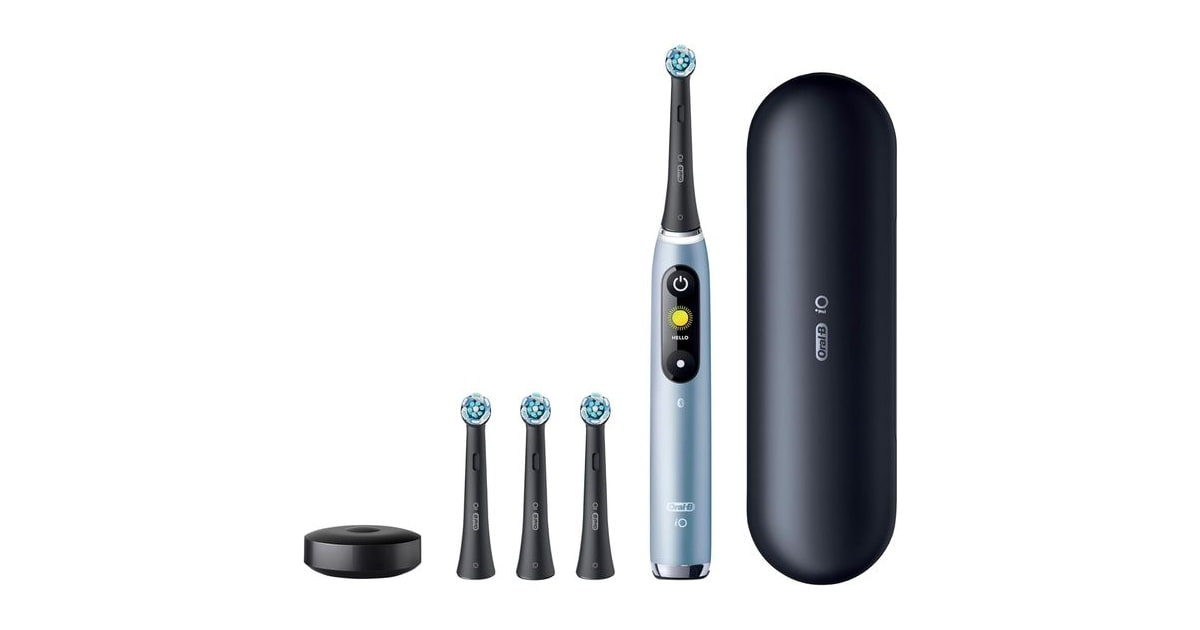
Oral-B iO Series 9 Electric Toothbrush with
The iO Series 9 pairs Oral-B's round oscillating-rotating head with magnetic-drive micro-vibrations and a color screen on the handle. You get seven modes, a pressure sensor that shows green, red, or white, and app-based tracking of which spots you keep skipping.
$169.99fromAmazonList priceThe round head is the reason to start here. Oral-B's small circular brush wraps a single tooth at a time and slips under the gumline in a way a rectangular head struggles to match. That matters most in the back molars and along the sulcus, which is exactly where gingivitis starts. A meta-analysis in the Journal of Clinical Dentistry found oscillating-rotating brushes beat sonic brushes on plaque removal in 11 of 16 comparisons across more than 5,000 patients. It's not a blowout, but it's a consistent edge.
The pressure sensor is the feature we'd protect if you had to strip everything else away. Toothbrush abrasion affects an estimated 10–20% of adults, and it's one of the most preventable causes of gum recession. Research in the Journal of Periodontology found pressure-sensor feedback cut applied force by over 60% within four weeks. On the iO 9, the light ring glows red the moment you lean in — no menu diving, no app required.
The screen on the handle does more than look expensive. It tells you which mode you're in, counts down your two minutes, warns you when the head is worn out, and shows the battery level. If you've ever guessed at whether a brush was in whitening or sensitive mode, you'll appreciate knowing. Owners who never once opened the app still report liking the brush, which is a good sign that the hardware carries the experience on its own.
The seven modes are more than you need, and that's fine. Most people will live on Daily Clean and switch to Sensitive when their gums are sore after a cleaning. The rest are there if you want them. What matters more is that Oral-B heads are stocked nearly everywhere, in multipacks, from several sellers. Ten years from now you'll still be able to buy them at a drugstore at 9 p.m., which is not something you can say about every brush here.
Flaws but not dealbreakers
It's the most expensive brush in this guide, and the gap between it and the iO Series 4 is much wider than the gap in how clean your teeth get. If your budget is tight, buy the 4 and put the difference toward floss and a dental visit.
The charging base draws real complaints. It's a tall handle on a small puck, and owners describe it as easy to knock over or fussy to seat correctly. Battery life is another sore spot — some owners get a couple of weeks, others report the charge dropping faster than expected after a year or two of daily use.
The app is optional but pushy. You'll get prompts to connect, and the brush is at its most impressive when paired. If notifications from a toothbrush sound like a nightmare to you, that's a fair reason to look at a simpler model.
Runner-upOn sale
Gentler feel and automatic intensity, with a shakier track record
Philips Sonicare 9900 Prestige Electric Toothbrush
Philips's flagship sonic brush drives up to 62,000 bristle movements per minute and uses SenseIQ to read pressure, motion, and coverage up to 100 times a second. When you push too hard, it dials itself back instead of just blinking at you.
$335.02fromAmazonList priceSonic brushes feel completely different from Oral-B's, and for some people that's the whole argument. Instead of a head that twists tooth by tooth, you get a high-frequency buzz that drives toothpaste and saliva between your teeth and along the gumline. Philips calls it Fluid Action. If you've tried an oscillating brush and found the sensation too aggressive on your gums, this is the one to try next.
SenseIQ is the smartest pressure system in this lineup. Most brushes flash a light and leave the correcting to you. The 9900 Prestige actually reduces its own intensity when you bear down, then lights a ring at the base of the handle so you know why. For anyone with receding gums or a heavy hand — the group most at risk of abrasion — automatic correction beats a warning you can ignore.
You get five modes and three intensity levels, which works out to 15 combinations, and a travel case that charges the brush inside it. If you're on a plane most weeks, that case is a genuine reason to pick this over the iO 9. Philips claims up to 20 times more plaque removal than a manual brush and 15 times healthier gums in six weeks, and Consumer Reports' 2025 evaluation ranked it second overall behind the iO Series 9.
The A3 Premium All-in-One head is a sensible default. Rather than making you choose between a plaque head, a gum head, and a whitening head, Philips built one that handles all three jobs and pairs it with the mode you select. Fewer decisions at the drugstore, one head to keep in stock.
Flaws but not dealbreakers
Durability is the real worry here, and we won't soften it. Owner feedback on this model skews harsher than on any other Philips brush in this guide, with recurring reports of handles failing, brush-head mounts loosening after a year or two, and units dying not long after the warranty window closes.
Some of the interface leans too hard on the app. Owners describe accidentally changing intensity mid-brush because of where the button sits, and a few report the app being the source of most of their frustration rather than a helpful add-on. It also ships with a single brush head, so budget for more right away.
Budget pick
Nearly all the cleaning, almost none of the screen
Oral-B iO Series 4 Electric Toothbrush with
The iO Series 4 uses the same magnetic-drive oscillating-rotating head as the Series 9 but drops the color display down to a light ring and cuts the modes from seven to four. For most mouths, the clean is indistinguishable.
$99.99fromAmazonThis is the brush we'd buy for the money. The head, the motion, and the pressure sensor are the parts that do the clinical work, and the iO 4 has all three. What you give up is the color screen, three modes you'd rarely touch, and the fancier travel case. Wirecutter's long-running pick was the Oral-B Pro 1000 for exactly this reason — the plainest handle that still carried the clinically validated basics. The iO 4 is the modern version of that argument.
The four modes cover the real cases: Daily Clean, Sensitive, Super-Sensitive, and Whitening. If you've just had a deep cleaning or your gums bleed easily, Super-Sensitive is the mode you'll want, and it's absent from plenty of pricier brushes. The light-ring timer turns green when you've hit two minutes, so you get pacing without needing to look at a screen.
Because it takes the same iO heads as the Series 9, a household can share one supply. Buy a multipack, hand a handle to each person, and everyone's on the same replacement schedule. That's genuinely useful given the ADA's advice to swap heads every three months, and bristle-wear research showing frayed bristles lose up to 30% of their plaque-removal effectiveness before you even hit that mark.
Flaws but not dealbreakers
Charging problems come up more than we'd like. Multiple owners describe units that stopped holding a charge within months, and others report running out of battery in days rather than the week or two they expected. Some found a firmware update through the app improved things, which is an annoying fix for a toothbrush but worth trying before you return it.
It ships with one brush head, and the box is plainer than the Series 9's. There's no charging travel case, so if you're packing this you're packing a cable too.
Also great
The sonic to buy if the flagship feels like too much
Philips Sonicare ProtectiveClean 6500 Rechargeable Electric Toothbrush
The ProtectiveClean 6500 hits 62,000 brush movements per minute with three modes, three intensity levels, and a pressure sensor that reduces vibration when you press too hard. BrushSync recognizes the head you attach and nags you when it's worn.
$199.96fromAmazonYou get the same sonic motor speed as the 9900 Prestige without the screen, the app dependence, or the price. Clean, White, and Gum Care are the three modes almost anyone uses, and each has three intensity levels. That's plenty of adjustment for sensitive gums without turning your bathroom counter into a settings menu.
BrushSync solves the problem people are worst at. The handle reads a chip in the brush head, sets the right intensity for that head automatically, and tracks how long you've been using it. When the head is done, the handle tells you. Since almost nobody remembers what month they last swapped heads, an automatic reminder does more for your gums than a fourth cleaning mode ever would.
Battery life is a strong point: Philips rates it at 14 days of regular use, and it comes with a charging travel case. Owner feedback on this model is the warmest of any Philips brush here, with a recurring theme of hygienists commenting on less plaque at cleanings. That's not a clinical trial, but it's the kind of consistent signal worth weighing.
It's also the easiest brush here to hand to someone who doesn't want a gadget. Press the button, brush, done. For an older relative, or anyone with limited hand dexterity who just wants the timer and the pressure warning, the simplicity is the feature.
Flaws but not dealbreakers
A handful of owners report the brush-head mount going loose and getting noisy after months of use, which is the same failure pattern that shows up on the 9900 Prestige. If it happens, it tends to happen outside the first year.
There's no app coaching or coverage map, so if you want to know which quadrant you keep shortchanging, this won't tell you. It also can't match the iO's round head for getting under the gumline tooth by tooth.
Who this is for
Buy an electric toothbrush if you're managing gingivitis or early gum recession, if you have braces or Invisalign, or if you simply can't make yourself brush for two minutes. A 2023 BMC Oral Health meta-analysis pooling 18 studies found electric users had a 42% greater reduction in gum-bleeding scores over 12 weeks than manual users, and a 2022 trial in The Angle Orthodontist found orthodontic patients using oscillating-rotating brushes had 37% less plaque around bracket bases. If you have restorations, implants, or very sensitive teeth, a pressure sensor is the single feature that protects you.
You don't need one of these if you already brush thoroughly, floss daily, and get clean bills at your checkups — a manual brush used well still works. This guide covers rechargeable and battery-powered toothbrushes for adults. We're not covering kids' brushes, water flossers, or replacement heads sold on their own, and nothing here treats active periodontal disease. If your gums bleed regularly, see a dentist first and buy the brush second.
How we picked
We weighted the features that hold up in the research over the ones that photograph well. Clinical credentials: we started from published trial evidence and the ADA Seal, which independently vets efficacy and safety. Pressure protection: every pick warns you or automatically eases off when you push too hard, since excess force is a leading preventable cause of gum recession. Timer and pacing: a built-in two-minute timer was required, with quadrant pacing preferred. Head cost and supply: we favored brushes whose replacement heads are cheap to restock and easy to find, because that bill outlasts the handle. Owner-reported durability: we looked for repeated failure patterns in owner feedback, not one-off complaints.
Other dentist-recommended electric toothbrushes worth considering
If you want a brush that travels well and stays out of the way: The Quip Ultra Lite Sonic Electric Toothbrush ($84) — The Quip Ultra Lite is a slim sonic brush with a one-piece silicone-and-plastic handle, three modes, a pressure sensor, and a two-minute timer. Quip rates the battery at up to 30 days per charge, and it comes with a travel case, a magnetic charger, and a countertop stand. The seamless handle is genuinely easier to keep clean than a brush with a seam where the head meets the body. What you give up is power and polish — owners describe it as buzzy and loud, and a few find the pressure sensor triggers too easily. It's also the newest product here, with the thinnest track record.
If you want the essentials and nothing else: The Philips Sonicare ProtectiveClean 4100 Electric Rechargeable Toothbrush ($74.95) — The Sonicare ProtectiveClean 4100 is the stripped-down version of our Also great pick: one cleaning mode, a pressure sensor, a two-minute timer with 30-second QuadPacer, and around two weeks of battery. Owners with sensitive gums and past gum surgery report getting along with it well, and it's the plainest way into a credentialed Philips brush. But one mode really means one mode — there's no gum-care or sensitive setting to fall back on, and a few owners expecting more power were disappointed. It charges from a wall plug, not a USB brick, which is worth knowing before you pack it.
The competition
This is what our research surfaced, not a census of every electric toothbrush sold. A few models here are perfectly good at something specific and just lost out to a pick on the criteria that matter most for gum health.
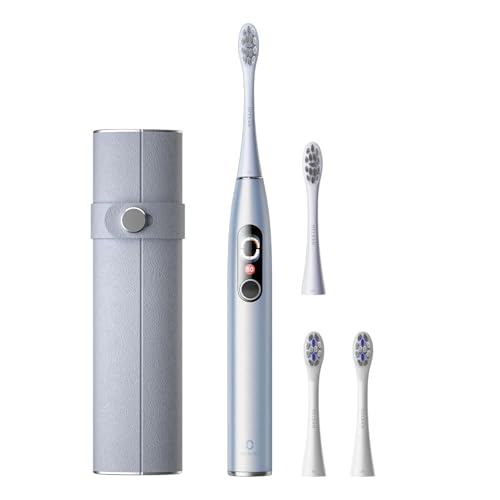
The Oclean X Pro Digital Set Smart Sonic ($89.99) — The Oclean X Pro Digital Set is the most interesting brush here on paper. A maglev motor drives 84,000 movements per minute, a color screen on the handle maps your coverage and scores each session without needing your phone, and Oclean rates the battery at 30 days. The set includes extra heads and a travel case. We couldn't place it above a pick because there's almost no owner feedback to check the claims against, and Oclean's replacement heads are harder to find on short notice than Oral-B's or Philips's. If you're a tech-curious shopper who wants a coverage map without unlocking an app, it's worth a look.
The Colgate 360 Vibrate Charcoal Battery Powered Electric ($10.96) — The Colgate 360 Vibrate is a manual brush with a vibrating motor and a AAA battery inside, sold in a two-pack. It's the simplest way to get some assisted motion, and owners like it as a travel backup or a spare for the guest bathroom. But there's no rechargeable base, no pressure sensor, no timer, and no quadrant pacing — which means it misses the two features we consider essential. Buy it as a second brush for a suitcase, not as the one you use every day.
Care and replacement heads
Replace your brush head every three months, sooner if the bristles splay. Bristle-wear research shows frayed bristles lose up to 30% of their plaque-removal effectiveness before you hit that three-month mark, so a worn head is quietly doing less than you think. Rinse the head under the tap after brushing, shake it out, and store it upright so it dries — a capped head in a damp travel case stays wet all day. Wipe the handle down every week or so, since toothpaste builds up right where the head meets the body. Charge on a schedule rather than waiting for the brush to die, and if a rechargeable handle starts fading fast, check the app for a firmware update before you assume the battery is done. Buy heads in multipacks; they're the recurring cost, and they don't get cheaper one at a time.
Questions we get
Are electric toothbrushes actually better than manual ones?
Yes, and the evidence is unusually strong. A Cochrane review of 56 randomized controlled trials found oscillating-rotating brushes reduced plaque by 21% and gingivitis by 11% more than manual brushing over one to three months. A 2023 BMC Oral Health meta-analysis of 18 studies found 42% greater reduction in gum-bleeding scores over 12 weeks. The catch is that a manual brush used carefully for a full two minutes still works well — the electric brush mostly protects you from your own technique.
What's the difference between sonic and oscillating-rotating?
Oscillating-rotating brushes, like Oral-B's, use a small round head that spins back and forth to scrub one tooth at a time. Sonic brushes, like Philips Sonicare, use a longer head that vibrates at very high frequency and moves fluid between your teeth. A Journal of Clinical Dentistry meta-analysis found oscillating-rotating won on plaque removal in 11 of 16 comparisons across more than 5,000 patients. Sonic brushes feel gentler, though, and the brush you'll actually use twice a day beats the one that wins on paper.
What should I look for if I have sensitive teeth or receding gums?
A pressure sensor, first and always. Toothbrush abrasion affects an estimated 10–20% of adults and is a leading preventable cause of gum recession, and Journal of Periodontology research shows sensor feedback cuts applied force by over 60% within four weeks. Look for a sensitive or gum-care mode too. The Sonicare 9900 Prestige goes furthest by lowering its own intensity when you push, rather than just warning you.
Do I need the app, or is a basic brush just as good?
Coaching apps genuinely help new users brush longer and cover more of their mouth, so if you're switching from manual, use it for the first month. After that, most people stop opening it and their brushing doesn't get worse. If you already brush consistently, the app adds little. The timer and pressure sensor are what keep working whether you open your phone or not.
How often do I really need to replace the head?
Every three months, per the ADA, and sooner if the bristles look splayed. Bristle-wear studies show frayed bristles lose up to 30% of their plaque-removal effectiveness even before that point. Some brushes track this for you — Philips's BrushSync chip and Oral-B's refill-change alert both flag a worn head. Budget for heads as an ongoing cost, since over a couple of years they usually total more than the handle.
Can an electric toothbrush help with gum disease?
It can help with early gingivitis. The clinical data on reduced plaque and bleeding scores is real, and less plaque at the gumline means less inflammation. But an electric brush can't reverse existing recession or treat established periodontitis, and it doesn't replace flossing or professional cleanings. If your gums bleed regularly or you've been told you have pockets, see a dentist — the brush is a supporting player.
Why you should trust us
For this guide:
- We read the clinical literature these brands cite, including the Cochrane review of 56 randomized trials, a Journal of Clinical Dentistry meta-analysis comparing oscillating-rotating and sonic designs, and a 2023 BMC Oral Health meta-analysis on gum bleeding.
- We compared each manufacturer's specifications side by side — motor speed, modes, pressure-sensor behavior, battery claims, and what ships in the box — and checked them against Consumer Reports' published rankings.
- We read owner feedback across all eight listings for repeated themes such as battery fade, charging-base design, and loose brush-head mounts.
- We read owner reviews on every listing, weighted toward the critical ones, because that is where the recurring failures show up.
- We have a systematic way of automatically fetching the latest prices, so the numbers on this page stay current.
- This is a research-focused guide, so the team may not own every product listed — though we often do own the top winners, which gives us extra context for the recommendations.
- We don't accept free products, and the retailer commission never changes which product we recommend.
Sources
Powered vs. Manual Toothbrushes – ADA Oral Health Topics, American Dental Association
Best Electric Toothbrushes 2026 – Wirecutter, Wirecutter / The New York Times
Electric Toothbrush Ratings & Reviews – Consumer Reports, Consumer Reports
Powered toothbrushes for oral health (Cochrane Review), Cochrane Database of Systematic Reviews
Best Electric Toothbrushes, Tested by Dental Experts – Healthline, Healthline
Best Electric Toothbrushes 2026 – Good Housekeeping Institute, Good Housekeeping
Electric Toothbrush vs. Manual: What Dentists Say – WebMD, WebMD
Best Electric Toothbrushes 2026 – Tom's Guide, Tom's Guide
Oral-B iO Series 9 Review – CNET, CNET
Philips Sonicare 9900 Prestige Review – PCMag, PCMag
ADA Seal of Acceptance Program – Product Search, American Dental Association
Brushing Habits & Oral Care Survey Data – ADA Health Policy Institute, ADA Health Policy Institute
Amazon product listings and owner reviews for all 8 products
Manufacturer specification pages for each product
Some passages in this guide may be paraphrased with AI help. Prices are refreshed automatically.
More like this.
Continue exploring health reviews and recommendations.

The Best Electric Toothbrushes for Whitening
Coffee in the morning, tea in the afternoon, a glass of red with dinner. The color those leave behind builds up slowly on the outside of your enamel, and…

The Best Electric Toothbrushes for Sensitive Teeth
If your gums bleed when you brush, or a sip of cold water makes you wince, the problem often isn't the toothbrush - it's how hard you're pushing it.…

The Best Dog Toothbrushes and Dental Chews
Dental disease sneaks up on dogs. It starts as a film you can't see, hardens into tartar along the gumline, and by the time your dog's breath makes you…

The Best Mini Trampolines and Rebounders
A rebounder is one of the few pieces of home cardio gear that people actually keep using. It takes up about as much floor space as an armchair, it doesn't…

The Best Pill Organizers
Nobody skips their medication on purpose. You get distracted, the phone rings, and by dinner you can't remember whether you took the morning pill or just…

The Best Magnetic Resistance Rowing Machines
A rowing machine is one of the few pieces of home cardio gear that works your legs, back, core and arms in the same motion. Rowing engages up to 86% of…