The Best Essential Oil Diffusers
A diffuser does one small job, and it does it in the room where you sleep, work or unwind. That means the details you'd normally shrug off start to matter. How loud is it at 2 a.m.? Does the light stay on when you don't want it to? How often do you have to get up and refill the tank? A good diffuser fades into the background and just makes the room smell like lavender or eucalyptus instead of last night's salmon. A bad one becomes a chore you stop using by week three.
Here's the honest part: no diffuser in this category is built to last forever. These are inexpensive electronics with a motor, a water tank and a plastic or ceramic shell, and owner feedback across nearly every brand includes units that quit after a few months or a switch that stops cycling. Cleaning is the other thing nobody mentions. Skip it for a few weeks and mineral scale plus oil residue will choke the mist output. Budget for replacement eventually, and don't buy on the assumption that spending more buys you immortality.
We also want to be clear about scope. We looked at ultrasonic water diffusers, one nebulizer that atomizes pure oil, and two waterless capsule systems that lock you into brand-specific refills. Those are three genuinely different products that happen to share a shelf. We think that the InnoGear 150ml Ceramic Diffuser is the best essential oil diffuser for most people, and that the ASAKUKI 500ml is the one to buy if you want a big tank, a remote and all-evening runtime without refilling.
Everything we recommend

Ceramic looks and strong mist, without the boutique markup

A big tank and a remote, for people who hate refilling

The cheap one that's actually worth owning

Buy it for the ceramic, not the specs
The overnight one, with light and mist fully separate
At a glance
| Product | Capacity | Run Time | Price | |
|---|---|---|---|---|
| Vitruvi Stone DiffuserUpgrade pick | 90ml | 4hr/8hr | $103.99 |
 | LEVOIT Classic300S Ultrasonic Smart 6L Top FillAlso in lineup | 6L | 60 Hours | $93.79 |
 | URPOWER 2nd Gen 300ml Aroma Essential OilAlso in lineup | 300ml | 6-7 Hours | $28.99 |
 | Raindrop 3.0 Nebulizing Essential Oil Diffuser forAlso consider | — | — | $105 |
 | Pura 4 Smart Fragrance Diffuser - AdjustableAlso consider | — | 120 Hrs/Vial | $49.99 |
| ASAKUKI Essential Oil Diffuser for HomeRunner-up | 500ml | — | $21.99 |
| InnoGear Aromatherapy DiffuserTop pick | 150ml | 4-6 Hours | $32.99 |
| InnoGear Essential Oil DiffuserBudget pick | — | 6-8 Hours | $13.99On sale |
 | AERA Mini Waterless Plug-in Essential Oil DiffuserAlso consider | — | 800 Hours | $95 |
 | Serene House Ultrasonic Botanical Aromatherapy Essential OilAlso in lineup | 130ml | 4hr/8hr | $29.97 |
| InnoGear Oil DiffuserAlso great | 150ml | 4-6H/8-10H | $24.99 |
 | NOW Foods Essential OilsAlso in lineup | — | — | $45On sale |
How we picked
Tank size and runtime. We compared stated capacity against manufacturer runtime claims for both continuous and intermittent modes. A diffuser had to deliver at least a full evening on one fill to earn a pick.
Noise in a quiet room. Most of these end up in a bedroom, so we prioritized units rated under about 25 dB and cross-checked against owner reports of gurgling, clicking or fan whine at night.
Light you can turn off. We treated independent mist and LED control as close to mandatory. Published specs and owner feedback both make clear that forced-on lighting is a common reason people stop using a diffuser overnight.
Cleaning and durability. We read owner feedback for patterns in premature failure and for how easy each unit is to open, wipe and descale. Smooth ceramic and wide tank openings scored better than textured plastic and tight-fitting domes.
Open versus locked systems. We favored diffusers that work with any essential oil. Capsule-based systems were judged separately, since their ongoing cost and scent selection are controlled by the brand.
Top pick
Ceramic looks and strong mist, without the boutique markup
InnoGear Aromatherapy Diffuser
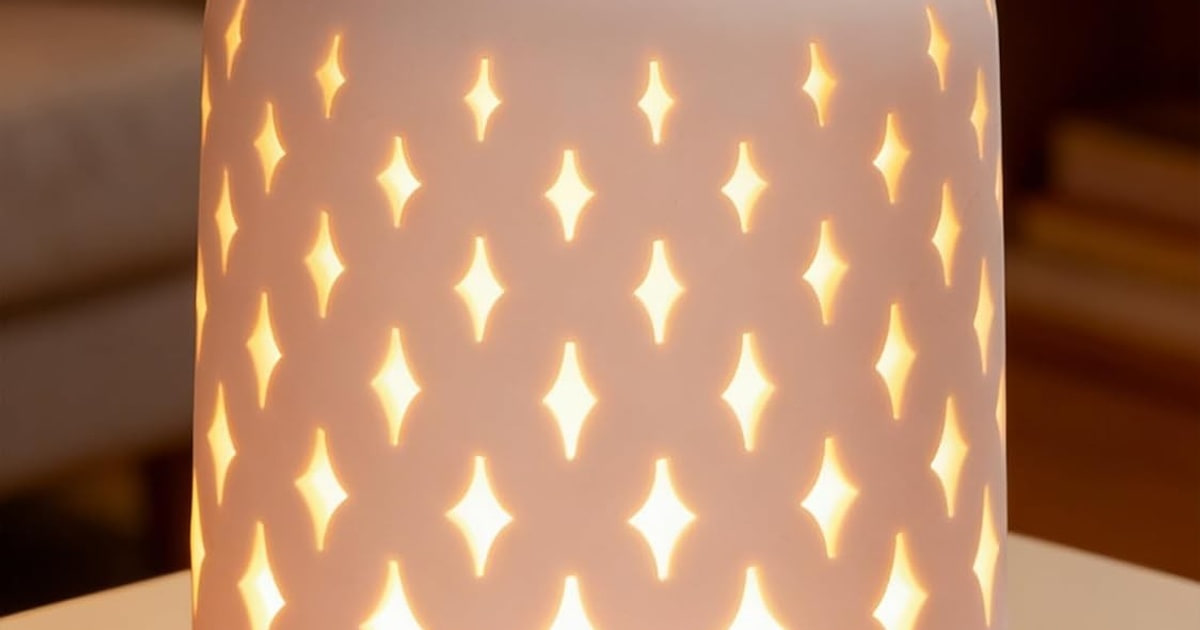
A 150ml ceramic diffuser with a handmade cover, star cutouts that throw a soft pattern on the wall, and unusually strong mist for its size. It's quiet enough for a nightstand and cheap enough that you won't wince when you eventually replace it.
$32.99fromAmazonThis is the diffuser that gets the basics right and then adds one nice thing. The ceramic cover is the nice thing. It sits on a dresser or a bookshelf and reads as a small object, not an appliance, and the star engravings throw a soft pattern on the wall when the light is on. Owners who came from plain plastic units consistently mention that upgrade in feel as the reason they'd buy it again.
The mist output is the part that surprises. InnoGear rates it at 35ml an hour, which is strong for a 150ml tank, and owner feedback backs up that it actually scents a bedroom rather than producing a decorative wisp. You get about 4 to 6 hours on continuous and 8 to 10 on the intermittent setting, which pulses roughly 30 seconds on and 30 off. That intermittent mode is what most people should use anyway.
Noise is where cheap diffusers usually fail, and this one doesn't. Owners describe a faint hum from the fan underneath and not much else — no gurgling, no clicking. If you're a light sleeper, that matters more than any spec on the box. The ceramic shell also seems to help; it's heavier than plastic and doesn't rattle on a wooden nightstand.
Cleaning is easier here than on plastic units, which is the unglamorous reason ceramic is worth having. The surface doesn't hold oil film the way textured plastic does, and a wipe with a cotton swab handles the weekly job. You'll still need to run diluted vinegar through it every month or so if your tap water is hard.
The seven-color LED can hold a single color or cycle. You can also turn it off. That last part sounds trivial until you've owned a diffuser that insists on glowing blue at you all night.
Flaws but not dealbreakers
The 150ml tank is the real limit. If you want scent from breakfast to bedtime, you're refilling at least once, and probably twice on continuous mode. Anyone who wants genuinely hands-off, all-day operation should size up.
The star projection is subtle. Reviews and product photos make it look like a dedicated star projector, and it isn't — it's a soft pattern on a nearby wall in a dark room. Nice, but don't buy it for that alone.
There's no remote, no app and no timer buttons beyond the two mist modes. You walk over and press the button. For a bedside unit that's fine; for a living room across a big open space it's mildly annoying.
Runner-up
A big tank and a remote, for people who hate refilling
ASAKUKI Essential Oil Diffuser for Home
The 500ml tank runs for hours without attention, and the included remote lets you kill the light or change the mist from bed. It's plastic and the yellow finish is a choice, but functionally it's the most convenient ultrasonic diffuser here.
$21.99fromAmazonIf refilling is the thing that makes you stop using a diffuser, this solves it. The 500ml reservoir is more than three times the top pick's, and on the lowest mist setting ASAKUKI claims up to 16 hours. In practice, you fill it before dinner and it's still going when you go to bed. Owners with master bedrooms and open living rooms are the ones who rate it highest.
The remote is the underrated feature. It works from about 16 feet, and it handles mist intensity, LED color and the 60/120/180-minute timers. Being able to shut the light off from bed without getting up is a small thing that you'll use every single night. Most diffusers at any price don't include one.
ASAKUKI rates the fan below 23 dB, and owner feedback lines up — people run it on a nightstand nightly and describe it as quiet. The light and mist run independently, so overnight use with everything dark is straightforward. There's a full ON mode too, if you'd rather it just run.
This is by far the most bought and most reviewed unit in the lineup, and that volume is worth something. The failure reports that do show up cluster around the usual suspects for water appliances: units that stop misting after months of daily use, and moisture getting trapped under the dome at cleaning time. Neither is unique to this diffuser.
Flaws but not dealbreakers
It's plastic, and it feels like it. Pick it up and it's light in the hand — fine for a shelf in a home office, less charming on a bedside table where you'll see it every day. The yellow colorway in particular won't blend into a neutral room.
The dome fits tightly with no lip to grab, so pulling it off for cleaning is fiddlier than it should be, and water tends to collect in the seam. You'll want a towel handy.
A 500ml tank means 15 to 25 drops of oil per fill if you follow the usual guidance. Ongoing oil cost is higher than it is with the small ceramic units, and that adds up faster than the sticker suggests.
Budget pickOn sale
The cheap one that's actually worth owning
InnoGear Essential Oil Diffuser
A 100ml plastic diffuser that covers a small bedroom or a desk, runs 6 to 8 hours on the pulse setting, and shuts off on its own when dry. It's the right first diffuser and the right one to scatter through spare rooms.
$13.99fromAmazonList priceBuy this if you're not sure you'll use a diffuser at all. It's the smallest commitment here, and it does the core job: fine mist, seven LED colors, two mist modes, auto shutoff when the water's gone. InnoGear rates coverage at 100 to 250 square feet, which is a real bedroom or a classroom corner, not marketing math.
The intermittent setting is what makes the small tank work. Continuous gives you 3 to 4 hours; pulsing 30 seconds on and off stretches it to 6 to 8. Owners who run it overnight almost all use the pulse mode, and they report it's still misting in the morning.
Light and mist are independently controlled, which is the feature we'd insist on for anything going in a bedroom. Run the mist in the dark, or run the light alone as a nightlight. Plenty of pricier diffusers tie the two together and force you into a compromise.
InnoGear has been making these for over a decade, and there's a one-year warranty plus ongoing technical support. Owner feedback includes people whose unit failed just past the return window and who got a free replacement after contacting the seller. That's not nothing at this end of the market.
Flaws but not dealbreakers
The 100ml tank is genuinely small. Daily users refill it every day, sometimes twice. If you already know you want scent running most of the time, skip straight to a bigger tank and save yourself the ritual.
It looks like exactly what it is — a white plastic cylinder. There's no design ambition here, and it won't earn a spot on a mantel.
Reliability is the coin flip at this price. Owner feedback splits into people who've run one daily for years and people whose unit died in a month. The warranty covers you, but it's a hassle either way.
InnoGear covers the Basic White with a one-year warranty and lifetime technical support.
Upgrade pick
Buy it for the ceramic, not the specs
Vitruvi Stone Diffuser
Vitruvi's Stone is a heavy matte-ceramic diffuser that genuinely passes for pottery on a shelf. The 90ml tank is the smallest here and the price is the highest, so this is a decor purchase that happens to diffuse oil.
$103.99fromAmazonNothing else in this lineup looks like it. The Stone is a weighty matte ceramic dome with no visible plastic and no cheap-looking LED ring, and owners describe it as the first diffuser they didn't want to hide. In a Scandinavian or minimalist room it reads as an object. If your diffuser lives somewhere guests can see it, that's the entire argument for this one.
The modes are simple on purpose: 4 hours continuous, or 8 hours intermittent at 30 seconds on and 30 off. Auto shutoff cuts power when the water's gone. There's an optional soft LED that glows warm rather than color-cycling, and it's dim enough to leave on overnight without it registering once you're actually asleep.
Vitruvi rates the Stone for rooms up to 500 square feet, which is optimistic for a 90ml tank but reflects how fine the mist is. It's quiet — owners routinely single that out — and the ceramic mass helps, since there's no thin plastic to buzz.
We'd be doing you a disservice not to flag the reliability picture. Owner feedback on this one is more divided than the design praise suggests, with a meaningful share of buyers reporting units that stop turning on or lose mist output over time. Vitruvi's one-year warranty and customer service get good marks, but you shouldn't assume premium pricing buys premium longevity here.
Flaws but not dealbreakers
The 90ml tank is the smallest in this guide, and it's on the most expensive product. In continuous mode you're refilling well before an evening is over. The 8-hour intermittent mode is really the only sensible way to run it.
There's no app, no Wi-Fi, no remote and no timer beyond the two modes. That's a defensible design choice, but it's worth naming: you're paying the most and getting the fewest features.
It's smaller in person than product photos suggest. Several owners mention being surprised by the scale relative to the price. Check the dimensions before you commit.
Vitruvi includes a one-year device warranty on the Stone.
Also great
The overnight one, with light and mist fully separate
InnoGear Oil Diffuser
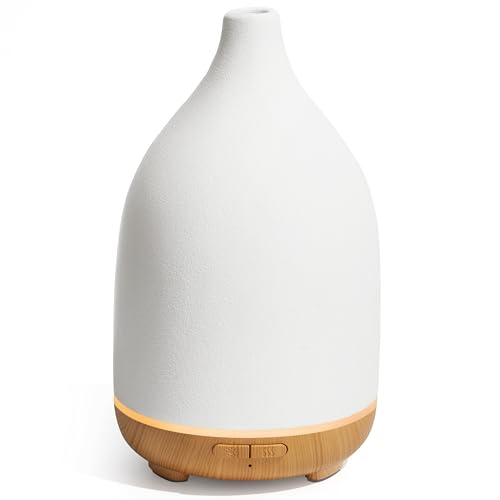
A handcrafted ceramic diffuser built around one idea: run the mist all night with the light completely off. The chimney-shaped outlet aims mist upward so it doesn't settle on your nightstand, and the intermittent mode goes 8 to 10 hours.
$24.99fromAmazonIf the diffuser is going next to your bed, independent light control is the feature to buy for. This InnoGear separates mist and LED entirely, so you can run cedarwood or lavender through the night in a fully dark room. Plenty of diffusers claim this; fewer actually let you turn the light off without also stopping the mist.
The runtime lines up with a night's sleep rather than a work session. Intermittent mode gives you 8 to 10 hours, which covers going to bed and waking up without a refill. Continuous is 4 to 6 hours, useful for an evening in the living room.
The chimney-shaped outlet pushes mist up and away instead of letting it drift down onto whatever's beneath it. If you've ever found a damp ring around a diffuser on a wooden nightstand, you'll appreciate that. There's a noise-reducing inner lid too, which is a small engineering detail you only notice by its absence.
Spec-wise this is close to our top pick — same brand, same 150ml ceramic body, same two mist modes. The difference is the star engravings and mood lighting on one versus the plain white shell and overnight focus on this one. Pick based on which you actually want in the room.
Flaws but not dealbreakers
There's no seven-color LED and no light show. The design is deliberately plain white ceramic. If part of the appeal of a diffuser for you is the ambient color, this is the wrong one.
The tank is 150ml, same as the top pick, so anything longer than a 10-hour stretch means refilling. All-day operation isn't what this is for.
It overlaps heavily with the top pick, and the price difference buys you one specific feature. If you don't care about running the mist in total darkness, there's no reason to choose this over the other ceramic model.
Who this is for
Buy one of these if you want a room to smell like something you chose — lavender before bed, eucalyptus during a stuffy week, citrus in a home office at 3 p.m. Ultrasonic diffusers are the right default for almost everyone: they're quiet, they work with any oil, they add a little moisture to dry winter air, and they're inexpensive enough to put one in two or three rooms. If you're new to essential oils, start small and cheap and learn your habits before spending more.
This guide is not the place to look if you need real humidification for dry skin or sinuses — a diffuser's mist output is far too small for that, and you want an actual humidifier. It's also not a fragrance-plugin comparison; the capsule systems here are included for context, but they can't use your own oils. And a genuine warning before you buy anything: many common oils, including tea tree, eucalyptus, peppermint, citrus, cinnamon and clove, are toxic to cats, and birds should never share a room with a running diffuser. If you have pets, check the specific oil first and give the animal a way out of the room.
How we picked
We built the picks around five things. Runtime: capacity and manufacturer-stated hours in both continuous and intermittent mode, since a tank you refill twice a day stops getting used. Noise: published dB ratings under about 25, checked against owner reports of humming, gurgling or fan whine in a silent bedroom. Light control: whether you can run the mist with the LED completely off, which specs sometimes imply and owner feedback often contradicts. Cleaning: how easy the tank is to reach, wipe and descale, because mineral scale and oil film are the leading causes of dying mist output. Ongoing cost: open systems that take any oil beat proprietary capsule ecosystems for most buyers.
Other essential oil diffusers worth considering
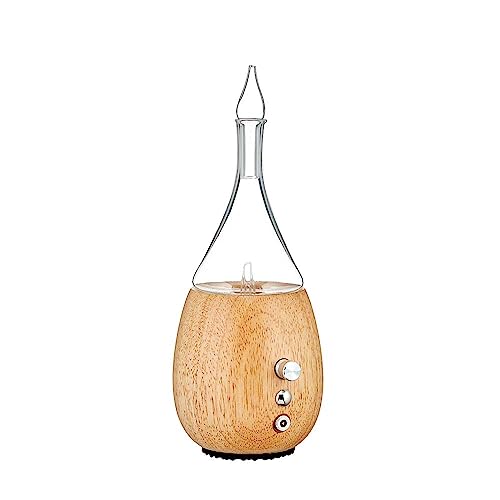
If you want the strongest possible scent with no water: The Raindrop 3.0 Nebulizing Essential Oil Diffuser for ($105) — The Organic Aromas Raindrop 3.0 is a nebulizer, not an ultrasonic diffuser. It uses an air pump to atomize pure essential oil into micro-particles, with no water and no heat, so the oil's chemistry stays intact and the scent hits a room in minutes rather than a quarter hour. The glass-and-wood body looks like a lab instrument, the magnetic breakaway cord means a curious cat won't take it down with the cable, and there's a one-year parts-and-service warranty. What you give up is real: it burns through oil far faster than anything ultrasonic, glass breaks, and owners report thick oils like vetiver and sandalwood gumming up the atomizer unless you flush it with alcohol every few uses. Owner feedback is also notably split, with complaints about the magnetic cord detaching too easily and about mist output tapering off after the first half hour. Buy it only if aromatherapy is already a regular habit.
If you want scheduled scenting you never think about: The Pura 4 Smart Fragrance Diffuser - Adjustable ($49.99) — The Pura 4 is a Wi-Fi plug-in that runs proprietary vials rather than your own oils, and for the people it suits, it's the most set-and-forget option here. It holds two vials so you can alternate or blend scents, detects which refill you've installed and updates the app automatically, and monitors room temperature to keep output steady between a cold January bedroom and a warm July one. Pura claims up to 120 hours per vial. Owner feedback is broadly positive on the app and the scheduling, with the recurring complaints being refill cost and units that eventually drop off Wi-Fi. You're buying into an ecosystem, so go in knowing the device price is the smaller half of what you'll spend.
If you want whole-room coverage with zero humidity: The AERA Mini Waterless Plug-in Essential Oil Diffuser ($95) — The AERA Mini uses capsules and a patented microdroplet system that disperses fragrance with no water and no heat, meaning no damp surfaces, no white mineral dust on furniture and no moisture near electronics. Aera rates it for 100 to 400 square feet with five intensity levels, and up to about 800 hours per capsule at medium. App and Alexa control handle scheduling. The Forest Green finish, done with Apartment Therapy, actually looks intentional rather than like a plastic wall wart. The catch is the same as with Pura, only more so: you can't use your own oils, capsules are sold separately, and the device costs the most of any plug-in here before you've bought a single scent.
The competition
These are the other diffusers our research turned up in this lineup, not a census of everything for sale. Each one lost to a pick for a specific reason, but a couple of them are the right answer for a particular room or a particular buyer.
The URPOWER 2nd Gen 300ml Aroma Essential Oil ($28.99) — The URPOWER 2nd Gen 300ml is the long-standing budget default, and the 300ml tank hits a genuinely useful middle ground: 6 to 7 hours of continuous mist, four timer settings, seven LED colors and a wood-grain base that looks warmer than plain white plastic. It nearly took the budget slot. What kept it out was owner feedback pointing at two specific weak spots — a timer switch that stops cycling through its settings after a week or two, and an audible bloop-bloop from the water that light sleepers notice. If you want more capacity than our budget pick without stepping up to 500ml, it's still a reasonable buy.
The Serene House Ultrasonic Botanical Aromatherapy Essential Oil ($29.97) — The Serene House Botanical is the best-looking mid-range unit here after the Vitruvi. Indigo metal instead of white plastic, a warm seven-color LED, timers at 60, 90 and 120 minutes plus continuous, and auto shutoff when dry. Serene House rates it for rooms up to about 450 square feet, which is ambitious for a 130ml tank. That tank is the problem: 4 hours continuous or 8 intermittent means refilling before a full day is out, on a diffuser that costs more than our top pick. The metal surface also shows water spots and fingerprints in a way matte ceramic doesn't. Choose it if the indigo finish is what you want in the room.
The NOW Foods Essential Oils ($45) — The NOW Foods Ultrasonic Ceramic Stone diffuser is the wellness-aisle option — BPA-free construction, tap water only, rotating LED lights, and a natural off-white ceramic body that suits almost any room. NOW has decades of credibility in essential oils, and if you already buy their oils, matching the diffuser is a coherent choice. It's out of the running mainly because the published specs are thin: capacity and runtime aren't clearly stated, which makes it hard to compare against units that tell you exactly what you're getting. At a similar price, the InnoGear ceramic models and the Serene House are more specific about what they do.
The LEVOIT Classic300S Ultrasonic Smart 6L Top Fill ($93.79) — The LEVOIT Classic300S bundle isn't really a diffuser, and that's the honest reason it's here rather than in the picks. It's a 6L smart humidifier with 16 aroma pads that clip near the mist outlet, so fragrance is an add-on rather than the point. As a humidifier it's excellent — up to 60 hours of continuous output, top-fill design, humidity targeting and auto mode, plus Alexa, Google Home and VeSync app control. But it takes up far more floor space than any dedicated diffuser, the pads need replacing to keep producing scent, and you shouldn't put oil in the tank. Buy it if dry air is your actual problem and scent is a bonus.
Care and cleaning
This is the step almost everyone skips, and it's why most diffusers die early. Empty the tank completely after every use — standing water is what grows mold in a diffuser, not the oil. Every week or two, wipe the inside of the reservoir and the ultrasonic disc with a cotton swab or soft cloth to lift oil film. Once a month, fill the tank with water and about a tablespoon of white vinegar, run it for five minutes, then rinse well; that clears the mineral scale from tap water that slowly strangles mist output. If you switch between strong scents, rinse in between or you'll get a muddled blend you didn't ask for. Nebulizers need different care: run a few drops of isopropyl alcohol through the glass reservoir every two or three uses to dissolve resinous buildup before it clogs the atomizer.
Questions we get
What's the difference between an ultrasonic and a nebulizing diffuser?
An ultrasonic diffuser mixes a few drops of oil into water and vibrates the liquid to make a cool mist. It's quiet, cheap and works with any oil, but the oil is diluted before it ever reaches the air. A nebulizer skips water entirely and uses air pressure to atomize pure oil, which gives you a much stronger, more concentrated scent — at the cost of burning through oil faster and a higher price up front. For most people, ultrasonic is the right call.
How long should I run a diffuser at a time?
Thirty to sixty minutes on, then a similar break, is the common guidance. Running one continuously all day leads to olfactory fatigue, where your brain stops registering the scent entirely, and strong oils like peppermint and eucalyptus can bring on a headache at high concentration. The intermittent mode on most of these picks — roughly 30 seconds on, 30 off — is a good default for unattended use.
Are diffusers safe around pets?
With real caution, yes. Cats are the biggest concern: tea tree, eucalyptus, peppermint, citrus, cinnamon and clove are all documented hazards and can cause liver or respiratory problems from airborne exposure alone. Dogs are somewhat less sensitive but still at risk in a closed room. Birds should never be in a room with a running diffuser at all, and it's worth asking your vet before you make diffusing a daily habit.
How many drops of oil should I use?
The standard is 3 to 5 drops per 100ml of water, so a 300ml tank takes roughly 9 to 15 drops and a 500ml tank takes 15 to 25. Start on the low end — you can always add more mid-session, but an overpowering start just wastes oil. Citrus oils evaporate fast and need a bit more; heavy base notes like patchouli and sandalwood are potent, so use fewer.
Can I run a diffuser overnight?
Yes, on intermittent mode rather than continuous, which keeps the air from getting saturated while you sleep. Every diffuser in this guide shuts itself off when the water runs out, so leaving one running is mechanically safe. The feature that actually matters overnight is independent light control — our Also great pick and the budget pick both let you run mist with the LED completely off.
Do essential oils actually do anything?
The evidence is mixed but not worthless. Lavender has shown mild calming and sleep-supporting effects in clinical studies, peppermint has some support for alertness, and eucalyptus has documented decongestant properties. Broader claims about immune support or hormonal balance aren't backed by solid research and deserve skepticism. What's not in doubt is that a familiar scent can reliably cue your brain toward sleep or focus, and that benefit is real regardless of mechanism.
Why you should trust us
For this guide:
- We compared manufacturer specifications across all twelve listings — tank capacity, stated runtime in both mist modes, noise ratings, coverage claims and warranty terms — and flagged where a claim wasn't clearly documented.
- We read published reviews and buying guidance on ultrasonic, nebulizing and waterless capsule diffusers to understand where each technology genuinely differs.
- We read through owner feedback for each product looking for repeated failure modes — dying mist output, switches that stop cycling, audible gurgling at night — rather than one-off complaints.
- We read owner reviews on every listing, weighted toward the critical ones, because that is where the recurring failures show up.
- We have a systematic way of automatically fetching the latest prices, so the numbers on this page stay current.
- This is a research-focused guide, so the team may not own every product listed — though we often do own the top winners, which gives us extra context for the recommendations.
- We don't accept free products, and the retailer commission never changes which product we recommend.
Sources
Best Essential Oil Diffusers — Wirecutter, Wirecutter / NYT
Best Essential Oil Diffusers of 2026 — Good Housekeeping, Good Housekeeping
Essential Oil Diffuser Reviews — Health.com, Health.com
Best Diffusers Tested by Editors — People, People
How to Choose an Essential Oil Diffuser — Healthline, Healthline
Amazon product listings and owner reviews for all 12 products
Manufacturer specification pages for each product
Some passages in this guide may be paraphrased with AI help. Prices are refreshed automatically.
More like this.
Continue exploring home reviews and recommendations.

The Best Camping and Hiking Gear Essentials
Gear failures rarely announce themselves at home. They show up at 2 a.m. when a zipper jams, or three miles from the trailhead when your headlamp dies and…

The Best Cat Calming Diffusers
A stressed cat rarely announces it. You just notice the shredded corner of the couch, the puddle by the front door, or the hissing match that starts every…

The Best Hair Diffusers for Curly Hair
A diffuser does one job: it breaks up the blast coming out of your dryer so your curls can dry in the shape they already want. Point a bare nozzle at a…

The Best Oil-Filled Radiator Heaters
An oil-filled radiator is the space heater you forget is running. There's no fan, no glowing coil, and no rush of hot air across the room. Instead,…

The Best Synthetic Motor Oils
Motor oil is the simplest insurance your engine will ever get. It cushions bearings, carries away heat, and picks up the soot and varnish that would…

The Best Cedar Beard Oils
A beard oil does two jobs at once. It softens wiry hair so it lies flat instead of poking out, and it puts moisture back into the skin underneath, which…