The Best Synthetic Motor Oils
Oil is the simplest insurance your engine will ever get. It carries heat away from the pistons, keeps the timing chain from grinding itself thin, and holds soot and sludge in suspension so they end up in the filter instead of baked onto a cam lobe. Full synthetics do that better than conventional oil because the base molecules are uniform, which means better cold flow on a January morning and less evaporation on a long climb in July. For most modern engines, they're simply the default.
Here's the honest part: no oil on this page will make your car faster, quieter, or smoother in any way you can feel. Oil isn't a performance upgrade. And brand matters far less than the two numbers on the bottle — the viscosity grade your owner's manual specifies, and the certification it carries. A budget synthetic that meets API SP and ILSAC GF-6 clears the same industrial hurdles as a premium one. What extra money buys you is additive margin, OEM approvals, and longer drain claims, not a different league of protection.
So check your manual first, then pick from the oils that match it. We think that the Mobil 1 Extended Performance is the best synthetic motor oil for most people, and that the Pennzoil Platinum is the one to buy if you want gas-to-liquids base oil and strong piston cleanliness without paying for a long-drain claim you won't use.
Everything we recommend

Easy to find anywhere, with the longest mainstream drain claim

Gas-to-liquids base oil and strong piston cleanliness

Meets the same core standards for far less per quart

A strong choice for turbocharged and direct-injection engines
The one to buy when your car demands a European approval
At a glance
| Product | Viscosity grade | Container size | Price | |
|---|---|---|---|---|
| Mobil 1 Extended Performance Full Synthetic MotorTop pick | 0W-20 | 5 quart | $35.97 |
| Pennzoil Platinum Full Synthetic 10W-30 Motor OilRunner-up | 10W-30 | 1 quart | $10.48 |
| Castrol EDGE 5W-30 Advanced Full Synthetic MotorAlso great | 5W-30 | 5 quarts | $31.97 |
 | Amsoil ASL1G-EA Signature Series 5W-30 Synthetic MotorAlso consider | 5W-30 | — | $104.08On sale |
 | Red Line 15305 SAE 5W30 Fully SyntheticAlso consider | 5W-30 | 1 gallon | $69.90 |
| Motul 8100 X-clean Gen2 5W-40 Full SyntheticUpgrade pick | 5W-40 | 5 liter | $59.03On sale |
| Kirkland Signature 0W-20 Full Synthetic Motor OilBudget pick | 0W-20 | 5 quart | $46.50 |
 | Quaker State Full Synthetic 5W-30 Motor OilAlso consider | 5W-30 | 1 quart, 6 pack | $49.99 |
How we picked
Certifications first. We treated API SP and ILSAC GF-6 as the entry requirement for any oil aimed at a modern engine, since those standards added the low-speed pre-ignition and timing-chain wear protection that older oils lack. Anything without a current certification or an equivalent OEM approval didn't make the list.
OEM approvals. For European applications, we looked for named manufacturer approvals on the spec sheet — BMW Longlife, Mercedes-Benz 229-series, VW 504/507 — because OEM documentation makes clear the oil must carry the approval itself, not just resemble one that does.
Grade coverage. We favored oils sold in the viscosity grades most owner's manuals actually specify, with 0W-20 and 5W-30 covering the bulk of modern engines. Published specifications and listing details confirmed which grades each product is offered in.
Drain-interval claims. We read each maker's stated interval and its conditions rather than the headline number, since manufacturer claims assume a specific filter, grade, and driving profile. Consumer Reports' guidance to follow the owner's manual set the ceiling we'd actually recommend.
Cost and availability. We weighed how easy each oil is to restock and how much it costs per quart relative to the others, because an oil you can't find when you need it leads to a worse substitution. Multi-quart packaging and broad retail distribution counted in a product's favor.
Top pick
Easy to find anywhere, with the longest mainstream drain claim
Mobil 1 Extended Performance Full Synthetic Motor
A 0W-20 full synthetic sold in five-quart jugs at nearly every auto parts counter and big-box store in the country. Mobil 1 backs Extended Performance with a 25,000-mile protection claim on this listing, and the brand's own guidance ties long drains to pairing it with a Mobil 1 filter.
$35.97fromAmazonFor most drivers, availability is a feature. If you change your own oil, you want the stuff you can grab on a Saturday morning without ordering ahead, and you want to buy the same thing again next time so your maintenance log stays consistent. Mobil 1 is stocked almost everywhere, in almost every grade. That matters more than a marginal difference in additive chemistry that you'll never notice from the driver's seat.
The 0W-20 grade on this listing is what a huge share of modern Toyotas, Hondas, Fords, and Subarus call for from the factory. The 0W front half means it flows fast on a cold start, which is when most engine wear actually happens — not at highway speed. Check your cap or your manual, because 0W-20 and 5W-30 are not interchangeable just because the second number differs.
The drain-interval claim is real, but it comes with conditions. Mobil 1 states that Extended Performance paired with a Mobil 1 Extended Performance filter protects up to 20,000 miles between changes, and this listing advertises 25,000 miles. Either way, your vehicle's maintenance schedule and warranty terms still govern. Consumer Reports has long advised following the interval in your owner's manual rather than any aftermarket number — including the old 3,000-mile habit.
It meets API SP and ILSAC GF-6, which is the part that actually matters for a newer car. Those standards launched with added protection against low-speed pre-ignition and timing-chain wear, both of which are real failure modes in small turbocharged direct-injection engines. If your car has a turbo and a four-cylinder badge, an API SP oil isn't optional — it's the baseline.
Flaws but not dealbreakers
The long-drain claim invites people to stretch intervals further than their driving warrants. Short trips, lots of idling, towing, or dusty roads all shorten the useful life of any oil, and the fine print on extended-interval claims assumes none of that. If your commute is six miles of stop-and-go, the oil never fully warms up and fuel dilution builds faster than mileage suggests.
Mobil 1's base-oil composition has drawn skepticism from longtime users who remember earlier formulations, and that argument shows up regularly in owner discussion. It's noise more than signal — the oil carries current certifications — but if base-stock purity is something you care about on principle, you'll be happier with one of the ester or gas-to-liquids options below.
Runner-up
Gas-to-liquids base oil and strong piston cleanliness
Pennzoil Platinum Full Synthetic 10W-30 Motor Oil
Pennzoil makes Platinum from natural gas rather than crude, using Shell's PurePlus process, which starts with a cleaner base stock. The listing claims it keeps pistons cleaner than the toughest industry standard requires, based on Sequence IIIH results, and backs it with a 15,000-mile protection guarantee.
$10.48fromAmazonThe base oil here starts cleaner than crude-derived synthetics. Pennzoil converts natural gas to liquid base oil, which means fewer of the impurities that come along with refining crude. In practice that translates to good oxidation resistance and deposit control — the stuff that keeps ring grooves free and piston crowns from varnishing over 100,000 miles. It's a genuine chemistry difference, not a marketing coat of paint.
This particular listing is 10W-30, which is worth pausing on. That's the grade for older engines, many light trucks, and a lot of small air-cooled equipment — not for the modern 0W-20 crowd. If your manual calls for 10W-30, this is an easy recommendation. If it calls for 0W-20, buy the grade your manual lists instead; Pennzoil sells Platinum in that too.
Owners buying this grade often run it in mowers and tractors alongside their cars, and the feedback there is consistently positive on cleanliness over long seasons. That's a reasonable proxy for what the oil does in a passenger car: hold deposits in suspension and resist thickening under heat. The 15,000-mile guarantee on the listing is shorter than Mobil 1's claim, which honestly makes it easier to take at face value.
It's sold here as a single quart, which is the right format if you're topping off between changes rather than doing a full service. Buying by the jug costs less per quart for a full oil change, so check both formats before you order five singles.
Flaws but not dealbreakers
Single-quart packaging costs more per quart than a multi-quart jug, and for a full oil change you'll need four to six of them. Owner feedback on this listing skews toward packaging and shipping gripes rather than the oil itself, which tells you the product is fine but the format is situational.
10W-30 is the wrong grade for a lot of newer cars, and the number on the bottle is the single easiest thing to get wrong when ordering online. Read your filler cap before you click buy.
Budget pick
Meets the same core standards for far less per quart
Kirkland Signature 0W-20 Full Synthetic Motor Oil
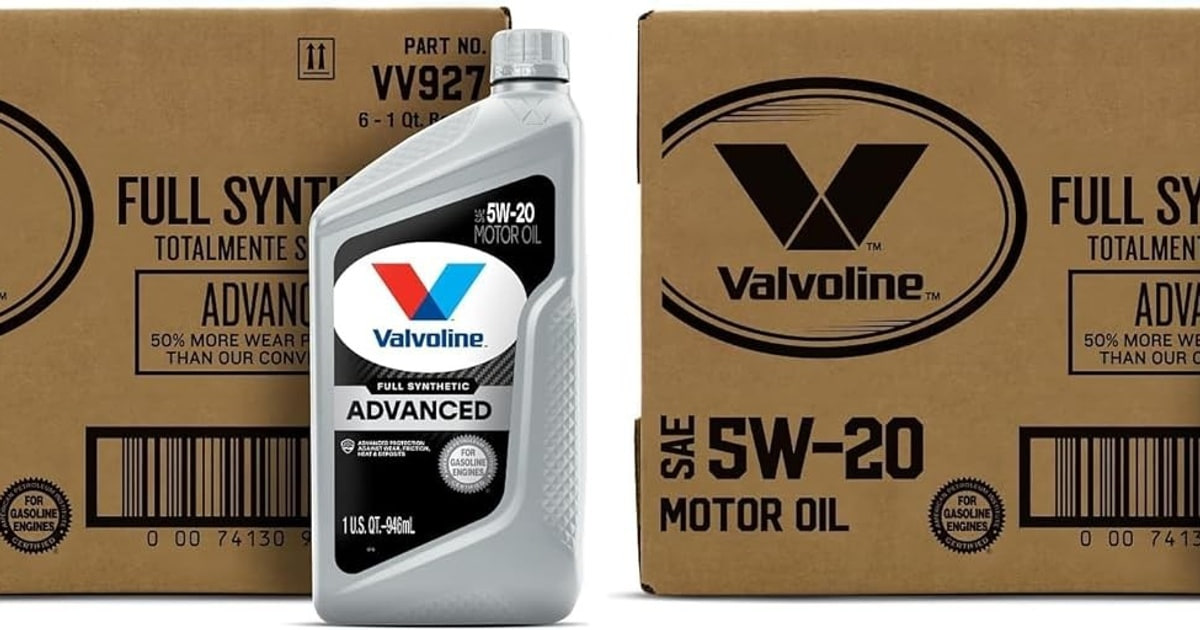
Kirkland Signature sells full synthetic in five-quart jugs that meet the same core API and ILSAC standards as the big brands. If you're doing routine changes on a daily driver that doesn't need an OEM approval, this covers the requirement at a cost per quart the name brands can't touch.
$46.50fromAmazonThe sticking point for most people buying oil is that premium brands feel like the safe choice and store brands feel like a gamble. On certification, they aren't. API SP and ILSAC GF-6 are pass-or-fail industrial standards, and an oil either carries the mark or it doesn't. A compliant store-brand synthetic has cleared the same wear, deposit, and low-speed pre-ignition hurdles as a compliant premium one.
What the extra money buys elsewhere is margin, not compliance. Premium oils tend to carry more additive headroom and more OEM approvals, which matter if you're running long drains or driving a car with a specific manufacturer spec. For a commuter sedan on a factory 7,500- or 10,000-mile schedule, that headroom is insurance you likely won't cash in.
This listing is sold as 0W-20 in a five-quart jug — the right size for one change in most four-cylinder engines, with a little left for topping off. One caveat worth flagging: the title mixes 0W-20 and 5W-20 in a way that's genuinely confusing, so confirm the grade on the bottle you receive matches what your manual asks for before you pour it in.
You'll need a Costco membership to buy it reliably, which is its own cost. If you already have one and you change oil twice a year on two cars, this is the easiest money you'll save all year on maintenance.
Flaws but not dealbreakers
It doesn't carry the OEM approvals that European cars often require, and it isn't marketed for extended drains. If you drive a VW, BMW, or Mercedes with a specific factory spec, this isn't the right oil no matter how good the cost per quart looks.
There's almost no independent owner feedback on this listing yet, so there's less of a track record to lean on than with the big brands. The certification is the evidence here, not accumulated reports.
Availability is tied to Costco, so if you're not a member or there's no warehouse nearby, restocking turns into a chore.
Also great
A strong choice for turbocharged and direct-injection engines
Castrol EDGE 5W-30 Advanced Full Synthetic Motor
Castrol EDGE 5W-30 is aimed squarely at modern turbo and direct-injection engines, where heat and load are highest. The listing advertises 20,000 miles between changes, or one year, and cites high-load Sequence IX results — the test family tied to low-speed pre-ignition protection.
$31.97fromAmazonIf your engine is small, turbocharged, and direct-injected, this is the category where oil choice actually earns its keep. Those engines run hotter, hold less oil, and are the ones low-speed pre-ignition was defined around. Castrol markets EDGE on exactly that kind of high-load performance, and the Sequence IX results it cites are the industry's LSPI test. That's the right evidence for the right problem.
5W-30 is the most common grade in North America, which makes this an easy fit for a huge range of crossovers, trucks, and sedans. It's sold here in a five-quart format, enough for most four- and six-cylinder changes. Owners run it in everything from an Acura V6 to a snowblower and report no drama across temperature extremes.
The 20,000-mile claim sits in the same territory as Mobil 1's, and the same caveat applies: your manual and your warranty terms still rule. Castrol's own footnote caps it at one year regardless of mileage, which is the more binding constraint for most people. Oil ages even when the car sits.
One practical note from owners: this is shipped in a cardboard eco-pack rather than a rigid bottle, and pouring from it is more awkward than from plastic. A funnel solves it. But if you change oil on a sloped driveway, the old jug shape is genuinely easier to handle.
Flaws but not dealbreakers
The cardboard packaging comes up repeatedly in owner feedback as a hassle to pour from, especially when you're trying to hit a filler neck one-handed. The oil inside is well regarded; the container is a step backward in usability.
The marketing leans hard on multiplier claims — three times stronger, ten times better high-stress performance — measured against specific test limits rather than against any particular competitor you'd actually compare it to. Treat those as directional, not as a ranking.
Upgrade pickOn sale
The one to buy when your car demands a European approval
Motul 8100 X-clean Gen2 5W-40 Full Synthetic
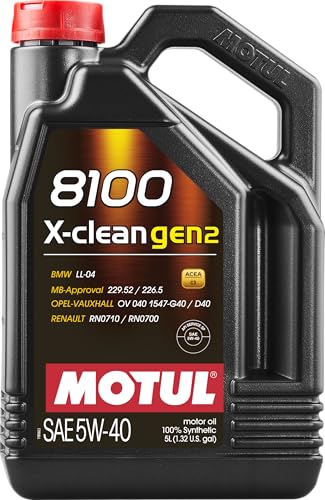
Motul 8100 X-clean Gen2 is a 5W-40 low-SAPS oil built for European OEM specs, and the listing names BMW LL-04, Mercedes-Benz 229.52 and 226.5, Opel OV 040 1547, and Renault RN0710. If your manual lists one of those, generic API-certified oil won't satisfy it.
$59.03fromAmazonList priceEuropean approvals are not interchangeable with API certification. BMW Longlife and VW 504/507 require testing beyond the baseline API standards, and the oil has to carry the approval itself to be compliant — not merely resemble an oil that does. If your service schedule names a spec, that spec is the shopping list. Everything else on this page is beside the point for you.
The low-SAPS chemistry here is the other half of the story. Reduced sulfated ash, phosphorus, and sulfur means less of the stuff that poisons catalytic converters and clogs diesel particulate filters. That's why so many late-model European engines mandate it. Running a high-ash oil in one of those cars risks an emissions component that costs far more than any oil.
5W-40 is a heavier grade than most American cars want, and that's deliberate. It holds film strength under sustained high temperature and load — the condition a turbocharged German engine lives in on a highway merge or a track day. Owners run it in M4s, Porsches, WRXs, and built Subaru motors, and the recurring theme is that viscosity holds up between changes.
It's sold in five-liter containers with an integrated pour spout, which sounds like a trivial detail until you're holding a jug over a hot engine bay. Several owners single out the spout as the reason they reorder. Small thing, real thing.
Flaws but not dealbreakers
It's the wrong oil for most mainstream American and Japanese cars. A 5W-40 low-SAPS European formula in an engine specified for 0W-20 is a mismatch, and the premium you pay buys approvals you don't need.
Availability is thinner than the mass-market brands, so you're typically ordering rather than walking in. Plan a few days ahead of a service.
Owner feedback on this listing is more scattered than on the high-volume oils, with a handful of reports of damaged or leaking shipments. That's a packaging-in-transit issue rather than a product one, but it's worth inspecting the box on arrival.
Who this is for
This guide is for anyone who changes their own oil, or who wants to hand a specific bottle to a shop instead of accepting whatever's in the bulk tank. If you drive a commuter car on a factory maintenance schedule, the top pick and the budget pick both cover you — the choice between them is mostly about how much you value a long-drain claim and a brand you can buy anywhere. If you own a turbocharged direct-injection engine, pay close attention to the API SP requirement. And if your manual names a European OEM spec, skip straight to the approvals section, because that spec is non-negotiable.
It's not for you if you're hoping oil will fix something. A new oil won't add power, won't smooth out a rough idle, and won't cure a mechanical noise — the occasional report of a quieter engine after a change usually means the old oil was overdue or the wrong grade. We also don't cover diesel-specific heavy-duty oils, racing oils that aren't street-legal for emissions equipment, two-stroke mixes, or additives sold separately from the oil. And we don't recommend stretching any drain interval past what your owner's manual and warranty allow, no matter what the jug says.
How we picked
We started from the spec sheet, not the brand. Certifications: an oil for a modern engine has to carry API SP and ILSAC GF-6, which is where low-speed pre-ignition and timing-chain wear protection come from. OEM approvals: for European cars we required named approvals like BMW Longlife or the Mercedes-Benz 229 series, since the oil must hold the approval itself to comply. Grade coverage: we favored products sold in the 0W-20 and 5W-30 grades that most manuals specify. Drain intervals: we read the conditions behind each mileage claim, not just the number, and deferred to the owner's manual as the real limit. Cost and availability: cost per quart and how easily you can restock both counted, because the oil you can actually find is the one that ends up in your engine.
Other synthetic motor oils worth considering
If you want an ester-based oil for a tuned or hard-driven engine: The Red Line 15305 SAE 5W30 Fully Synthetic ($69.90) — Red Line builds this 5W-30 on a polyol ester and PAO blend rather than a conventional synthetic base, and the listing names a long roster of approvals including VW 502/503/505, BMW LL-01, Ford WSS-M2C946-A, and GM dexos1. That's unusual breadth for one bottle. Enthusiasts favor it for film strength under load, and the high-detergency formula is pitched at cleanliness and extended drains. What you give up is cost and convenience: it's the most expensive oil here per quart, it's sold by the gallon rather than in a jug sized to one change, and the API ratings on the listing top out at SN rather than the current SP. For a street car with a factory turbo, the picks above are the better match. For a built engine or a track weekend, this is the one enthusiasts keep reaching for.
If you want the longest drain interval on the market: The Amsoil ASL1G-EA Signature Series 5W-30 Synthetic Motor ($104.08) — AMSOIL markets Signature Series for up to 25,000 miles or one year between changes, and it has a long-standing reputation for wear protection in independent lab-style comparisons. If you drive a lot of highway miles and genuinely want to cut your number of oil changes per year, this is the product built around that goal. Two things hold it back from a pick. It's sold through a narrower channel than the mass-market brands, so restocking takes planning. And owner feedback on this listing is noticeably more mixed than on the high-volume oils, with a meaningful share of low ratings — enough that we'd read recent reports before committing to a case. Whatever interval you choose, your manual and warranty terms still govern.
If you want a widely stocked 5W-30 in single quarts: The Quaker State Full Synthetic 5W-30 Motor Oil ($49.99) — Quaker State Ultimate Durability is a Shell-made full synthetic that shows up at nearly every big-box retailer, and this listing sells it as a six-pack of quarts — a convenient amount for one change in most engines with a quart left over. The listing points to Sequence IIIH and VH results for sludge and deposit protection and calls it out for modern turbocharged engines. It's a perfectly sound oil. It just doesn't do anything the picks don't do better: no OEM approvals, no long-drain claim, and a thinner owner track record than Mobil 1 or Castrol EDGE. If it's what's on the shelf and the grade matches your manual, buy it without worry.
The competition
This is what our research surfaced in a crowded aisle, not a complete census of synthetic motor oil. Dozens of brands sell API SP oils in common grades, and most of them are genuinely fine. We focused on products with broad availability, clear published specifications, or a specific reason enthusiasts and owners keep recommending them. If your manual names a spec and the bottle in front of you carries it, you're already most of the way to the right answer.
Changing your oil the right way
Two numbers decide everything: the viscosity grade and the certification your owner's manual specifies. Check the filler cap and the manual before you order, since 0W-20 and 5W-30 aren't interchangeable and a European spec can't be substituted. Replace the filter every time — a long-drain claim assumes a filter rated for the same interval. Warm the engine briefly so the oil drains more completely, then let it sit level while it empties. Use a new crush washer on the drain plug and torque it to spec rather than muscling it tight; a stripped oil pan is an expensive afternoon. Refill to the manual's capacity, run the engine a minute, then recheck on the dipstick after it settles. Overfilling is as bad as running low. If your driving is mostly short trips, idling, towing, or dusty roads, shorten the interval rather than stretching it.
Questions we get
Is full synthetic oil worth it?
For nearly any modern engine, yes — and in many cases it's required, not optional. Synthetics are built from uniform base molecules, which gives them better cold-start flow, lower volatility, and more oxidation resistance than conventional oil. That matters most in the first minute after a cold start, when the bulk of engine wear happens. The real question isn't synthetic versus conventional anymore; it's which grade and certification your manual calls for.
What do API SP and ILSAC GF-6 mean on the bottle?
They're the current oil standards from the American Petroleum Institute and ILSAC. Compared with older oils, they add protection against low-speed pre-ignition and timing-chain wear — both real failure modes in turbocharged direct-injection engines. GF-6A is backwards compatible with GF-5 and GF-4, so it's safe in older engines that specified those. GF-6B applies only to 0W-16 oils, so most drivers can ignore it.
What is low-speed pre-ignition, and does oil help prevent it?
LSPI is an uncontrolled combustion event in small turbocharged direct-injection engines, usually at low revs under load, and it can break pistons and rods. Certain oil additives make it more likely, which is exactly what the API SP and ILSAC GF-6 standards were written to address. So yes, oil choice matters here. If your engine is a turbo four, using an API SP oil is one of the few places where the label on the jug directly protects hardware.
How often should I change synthetic oil?
Follow the interval in your owner's manual, not the old 3,000-mile rule and not the number on the bottle. Consumer Reports makes this point plainly: modern engines and oils last far longer than the habit most of us grew up with. Extended-interval claims of 20,000 or 25,000 miles come from the oil makers and depend on their conditions, including a matching filter. Shorten the interval if your driving is mostly short trips, idling, towing, or dusty roads.
Does the brand matter if the oil meets API SP?
Much less than people assume. API SP and ILSAC GF-6 are pass-or-fail standards, so a certified store-brand synthetic has cleared the same wear, deposit, and LSPI hurdles as a certified premium one. Spending more generally buys additive headroom, OEM approvals, and longer drain claims rather than a different tier of basic protection. Where brand genuinely matters is European specs, since those require approvals beyond API.
Can I switch to synthetic in a high-mileage car, and will it cause leaks?
You can switch, and synthetic doesn't create leaks on its own. What it does is clean better, so a deposit that was plugging a marginal seal can wash away and reveal a leak that was already there. If your engine is dry now, a switch is low risk. If it already seeps, keep an eye on the level for the first few hundred miles and check your parking spot.
Can I mix different brands of synthetic oil?
For a top-off between changes, yes — oils meeting the same grade and certification are designed to be compatible, and a quart of a different brand won't hurt anything. It's better than running low. What you shouldn't do is mix grades or mix a European low-SAPS oil into an engine that doesn't call for one. At your next change, drain it all and start clean with the grade your manual specifies.
Why you should trust us
For this guide:
- We read manufacturer specification sheets and listing details for every oil here, including stated viscosity grades, certifications, named OEM approvals, and drain-interval claims with their conditions.
- We compared those claims against the published API, ILSAC, and OEM standards documentation, plus guidance from Consumer Reports and Edmunds on intervals and synthetic base oils.
- We reviewed recurring themes in owner feedback — packaging and pouring complaints, grade confusion, and reports of engine cleanliness over long seasons — to inform the flaws and caveats in each entry.
- We read owner reviews on every listing, weighted toward the critical ones, because that is where the recurring failures show up.
- We have a systematic way of automatically fetching the latest prices, so the numbers on this page stay current.
- This is a research-focused guide, so the team may not own every product listed — though we often do own the top winners, which gives us extra context for the recommendations.
- We don't accept free products, and the retailer commission never changes which product we recommend.
Sources
API Motor Oil Guide / Engine Oil Licensing and Certification System, American Petroleum Institute
ILSAC specifications overview, ILSAC / Lubricants industry
Mobil 1 Extended Performance product page, Mobil 1 (manufacturer)
AMSOIL Signature Series Synthetic Motor Oil, AMSOIL (manufacturer)
Pennzoil Platinum Full Synthetic, Pennzoil (manufacturer)
Consumer Reports: When to change your oil, Consumer Reports
Edmunds: Synthetic vs. conventional oil, Edmunds
Costco Kirkland Signature Full Synthetic Motor Oil, Costco (retailer/manufacturer listing)
Volkswagen / BMW / Mercedes OEM oil approval lists, OEM owner's documentation
Amazon product listings and owner reviews for all 8 products
Manufacturer specification pages for each product
Some passages in this guide may be paraphrased with AI help. Prices are refreshed automatically.
More like this.
Continue exploring lifestyle reviews and recommendations.

The 6 Best Oil Drain Pans on Amazon in 2026: Tested & Reviewed for DIY Mechanics
Find the best oil drain pan for your garage - from ultra-low-profile picks for motorcycles to 12-quart options for SUVs. Expert-tested, ranked by capacity and design.

The Best Oil Filter Wrenches
Changing your own oil is one of the easiest ways to save money on a car. But it falls apart at one step: getting the old filter off. A filter that a shop…

The Best Oil-Filled Radiator Heaters
An oil-filled radiator is the space heater you forget is running. There's no fan, no glowing coil, and no rush of hot air across the room. Instead,…

The Best Essential Oil Diffusers
A diffuser does one small job, and it does it in the room where you sleep, work or unwind. That means the details you'd normally shrug off start to…

The Best Fish Oil Supplements
Fish oil is one of those supplements people buy once, take for a week, and then forget in a cabinet. Usually it's the burps. A fishy aftertaste that shows…

The Best Lip Oils and Lip Glosses
A lip oil or gloss is the thing you reach for when you want to look put together in about four seconds. It sits somewhere between skincare and makeup, so…