The Best Oil-Filled Radiator Heaters
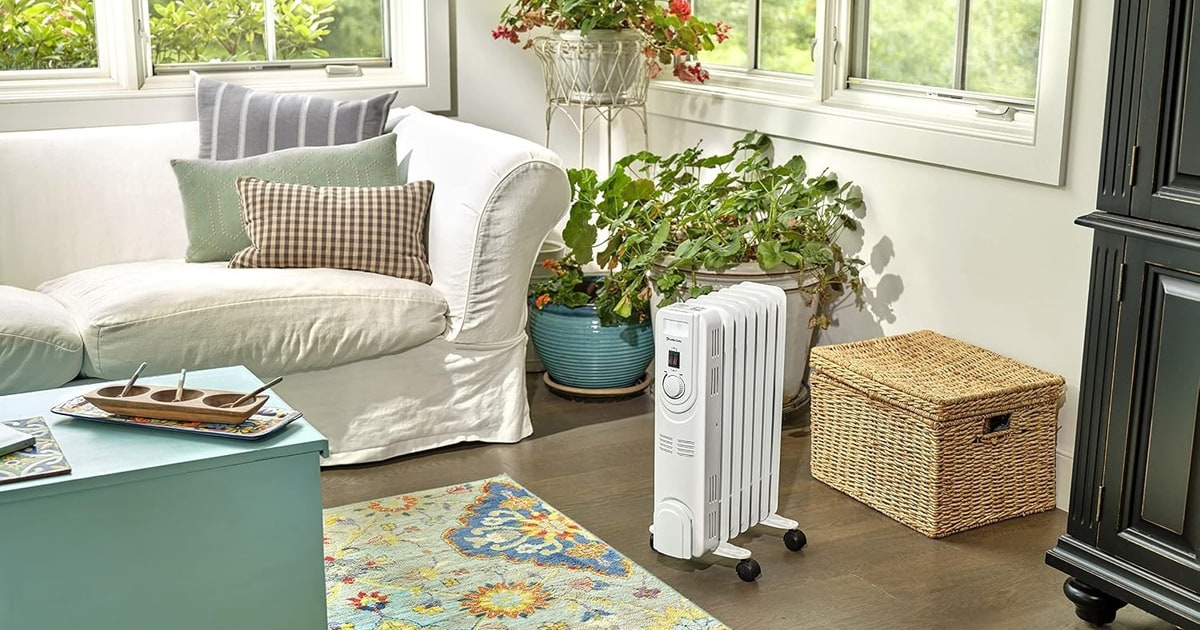
An oil-filled radiator is the space heater you forget is running. There's no fan, no glowing coil, and no rush of hot air across the room. Instead, electricity warms sealed oil inside the fins, and the metal radiates that heat slowly into the space around it. You feel it as a steady, even warmth rather than a blast. That's why these heaters end up in bedrooms, nurseries, and home offices, where a whirring fan heater would drive you up the wall by hour two.
Here's the honest trade-off: none of these heaters warm a cold room fast. Reviewed found that most 1500-watt radiators need roughly 20 to 40 minutes to bring a closed bedroom up to comfortable from a cold start, and Wirecutter's testing has repeatedly reached the same conclusion. If you want instant warmth at your desk, buy a ceramic heater instead. Radiators are also heavy and bulky for what they do, and none of them are cheap to run for hours on end.
We looked at published reviews, manufacturer specifications, and the themes that come up again and again in owner feedback. We think that the De'Longhi Dragon Digital TRD40615EBK is the best oil-filled radiator heater for most people, and that the De'Longhi EW7707CM is the one to buy if you'd rather skip the digital panel and just turn a dial.
Everything we recommend
The most control over how much heat you actually pay for
Fewer electronics to fail, and simpler to live with

Digital controls and a remote, without the premium price

Enough heat for a small room, and not a dollar more

Full 1500 watts with four casters, for cheap
Prices as of Oct 24, 6:27 AM PT · Details
At a glance
| Product | Max wattage | Weight | Price | |
|---|---|---|---|---|
| De'Longhi Oil filled Radiator HeaterRunner-up | 1500W | 23.15 lb | $129.95 |
 | 1PC Switch for Pelonis HO-0250 Heater RadiatorAlso in lineup | 1500W | — | $27.27 |
| Comfort Zone Electric Oil-Filled Radiant Radiator SpaceBudget pick | 1200W | 15.8 lb | $78.96 |
| DeLonghi Dragon Digital Oil Filled Radiator HeaterTop pick | 1500W | 26.6 lb | $189.95 |
| COSTWAY Oil Filled Radiator HeaterAlso great | 1500W | 18 lb | $79.99 |
| COMFORT ZONE 1500W Digital Oil-Filled Radiator HeaterAlso great | 1500W | 16 lb | $89.67 |
Prices as of Oct 24, 6:27 AM PT · Details
How we picked
Wattage and room size. Consumer Reports' guidance of roughly 10 watts per square foot gave us a baseline for weighing each unit's rated output against realistic room sizes. Any listing claiming coverage far beyond that math got a skeptical read.
Thermostat and timer. We compared control schemes across spec sheets, favoring units with either a programmable timer or an efficiency mode that modulates output. Running a radiator at full power all day is the most expensive way to use one.
Safety features. Every pick needed tip-over shutoff and overheat protection at minimum. We weighed that against the Consumer Product Safety Commission's three-foot clearance guidance, which applies no matter which heater you buy.
Fins and surface area. Bob Vila recommends 9 to 11 fins for rooms over 200 square feet and 5 to 7 for smaller spaces. We read fin count alongside wattage rather than treating either number alone as the answer.
Portability and weight. We compared shipping weights, caster designs, and handle placement from listing specs. A 26-pound heater and a 16-pound heater get used very differently in a two-story house.
Top pick
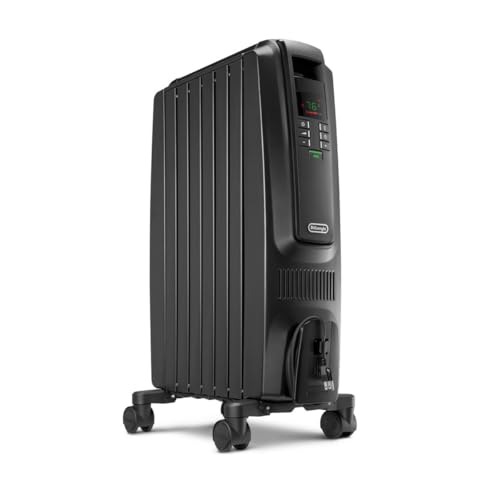
The most control over how much heat you actually pay for
DeLonghi Dragon Digital Oil Filled Radiator Heater
The Dragon Digital gives you a real digital thermostat, a 24-hour timer, and an ECO Plus mode that modulates power instead of slamming between full blast and off. It's the model to buy if you want to heat a bedroom overnight without babysitting a dial.
$189.95fromAmazonPrices as of Oct 24, 6:27 AM PT · Details
The programmable timer is the reason to spend more here. Most radiators give you a dial and a prayer. This one lets you schedule heat for the hours you actually want it, so the bedroom is warm at 6 a.m. and the heater isn't burning electricity at 2 p.m. while you're at work. If you're using a space heater to avoid running central heat, that scheduling is where the savings live.
De'Longhi's ECO Plus setting regulates power flow around your set temperature rather than cycling hard between maximum and nothing. Running a radiator flat-out on high all day is the most expensive way to use one. The Department of Energy notes that all portable electric heaters convert essentially all their electricity to heat, so your bill comes down to watts times hours. Anything that trims the watts trims the bill.
The fin design matters more than it sounds. De'Longhi claims 75% more radiant surface area than its RadiaS design, and more surface means more of the heat in that oil actually reaches you instead of sitting in the metal. Consumer Reports suggests budgeting roughly 10 watts per square foot for supplemental heating, which puts a 1500-watt unit like this one at about 150 square feet of solid coverage.
There's no fan, so there's no noise and no airflow. CNET points out that this is the whole reason allergy sufferers get steered toward oil-filled radiators: nothing is blowing dust, pollen, or dander around your bedroom. It also doesn't dry the air the way a forced-air heater can. If you wake up with a scratchy throat every winter, that difference is worth something.
Flaws but not dealbreakers
It's the heaviest heater here at about 26 pounds, and while it rolls on casters, you're not carrying it up a flight of stairs casually. Plan on it living in one room for the season.
Digital panels add failure points. A dial thermostat has almost nothing to break; a control board does. Owner feedback on digital radiators across brands tends to cluster around control panels and displays rather than the heating element itself, so that's the part to watch.
Like every radiator in this category, it's slow. Give it half an hour with the door closed before you judge whether it's working.
Runner-up
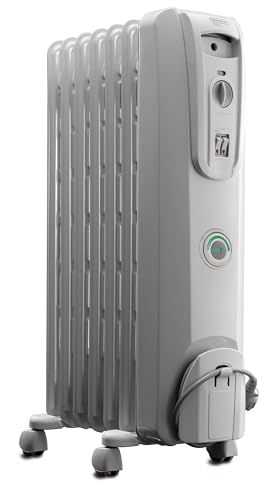
Fewer electronics to fail, and simpler to live with
De'Longhi Oil filled Radiator Heater
The EW7707CM swaps the digital panel for straightforward controls and a ComfortTemp button that holds a comfortable temperature automatically. De'Longhi says that feature makes it up to 20% more efficient than running the same unit's thermostat at maximum.
$129.95fromAmazonPrices as of Oct 24, 6:27 AM PT · Details
If you've ever inherited a space heater with a dead display, you already understand the appeal. This one has knobs and a button. You set the power level, set the temperature, and walk away. There's less here to stop working in year four, which is a real consideration for a seasonal appliance that spends eight months in a closet.
ComfortTemp does most of the thinking for you. Press it and the heater maintains what De'Longhi calls the optimal temperature and power level rather than running wide open. The company rates that as up to 20% more efficient than using the same unit's thermostat at its maximum setting. You give up scheduling, but you keep the part that actually saves money.
The thermal slot design is meant to push heat out into the room while keeping the outside of the unit cooler to the touch. Popular Mechanics cites that cooler exterior as a big reason oil-filled radiators get recommended for homes with kids or pets. There's no exposed coil anywhere on this thing. That doesn't make it safe to leave a blanket against it, but it's a different risk profile than a coil heater.
It's also the lightest of the two De'Longhi units, at roughly 23 pounds, with a built-in handle and snap-on wheels. If you're moving it between a home office during the day and a bedroom at night, those few pounds and the handle placement matter more than you'd think.
Flaws but not dealbreakers
No timer. If you want the heater to shut itself off at 3 a.m. or kick on before you wake up, you'll need a smart plug or a different model. That's the main thing you're giving up versus our top pick.
The controls are simple, not precise. You're setting a rough temperature level rather than dialing in a specific degree, so expect a little trial and error in the first week.
Also great
Digital controls and a remote, without the premium price
COMFORT ZONE 1500W Digital Oil-Filled Radiator Heater
This Comfort Zone radiator puts a digital thermostat, a 12-hour programmable timer, and a full-function remote in a lighter, cheaper package. If you want to change the temperature from bed without getting up, it's the obvious choice here.
$89.67fromAmazonPrices as of Oct 24, 6:27 AM PT · Details
The remote is the feature people actually use. Getting out from under the covers to nudge a thermostat dial is exactly the sort of small annoyance that makes a heater sit unused. This one lets you adjust heat setting, timer, and thermostat from across the room, which is a genuinely nice thing at 11 p.m.
You get real digital control for meaningfully less money than the De'Longhi units. An adjustable digital thermostat with a temperature display, three heat settings, and a 12-hour auto on/off timer covers most of what the top pick does. The timer window is shorter and the brand doesn't carry the same track record, but the core functionality is there.
At 16 pounds and under two feet tall, it's the easiest of the 1500-watt units here to move around. If you're heating a home office by day and a bedroom by night, that difference against a 26-pound unit is the difference between doing it and not bothering.
The oil reservoir is permanently sealed, like every heater in this guide. You'll never refill it, drain it, or replace it. Diathermic oil is designed to last the life of the unit, so the maintenance story here is just wiping dust off the fins.
Flaws but not dealbreakers
The listing claims coverage for rooms up to 1,200 square feet, which is not realistic for any 1500-watt heater. Using Consumer Reports' rough guidance of 10 watts per square foot, treat this as a heater for about 150 square feet of primary coverage and ignore the marketing number.
Owner feedback on this model is thinner and more mixed than on the De'Longhi units, which have far longer track records. If long-term reliability is your top concern, that's a reason to pay more elsewhere.
Cheaper digital panels are the component most likely to give out first, and there's less accumulated owner history here to tell you how this one holds up.
Budget pick
Enough heat for a small room, and not a dollar more
Comfort Zone Electric Oil-Filled Radiant Radiator Space
The Comfort Zone CZ7007J tops out at 1,200 watts with a simple dial thermostat and three heat settings. For a dorm room, a small home office, or a bedroom you just want to take the chill off, it's plenty.
$78.96fromAmazonPrices as of Oct 24, 6:27 AM PT · Details
Most people heating one small room don't need 1500 watts. At 500, 700, and 1,200 watts, this covers the range that matters for a bedroom or an office. Consumer Reports' rough sizing math puts 1,200 watts at around 120 square feet of primary coverage, which describes a lot of dorm rooms and spare bedrooms accurately.
It's the lightest heater in this guide at under 16 pounds, with oversized rear wheels and a solid front end for stability. Moving it is genuinely a one-hand job. If your heating needs migrate around the house through the day, that's not a small thing.
The safety basics are all here: tip-over shutoff and overheat protection, plus the sealed-oil design that keeps the exterior cooler than a coil heater. The National Fire Protection Association attributes heating equipment to roughly one in seven home fires, with portable heaters accounting for most of those, usually because something flammable was too close. No heater design saves you from that. Keep three feet clear, as the Consumer Product Safety Commission recommends, and the tip-over switch handles the rest.
There's no timer, no remote, and no display. That's the trade. What you get is a heater with almost nothing to break, which is a reasonable thing to want from something that runs unattended overnight.
Flaws but not dealbreakers
The 1,200-watt ceiling is a real limit. In a drafty room, a room over about 150 square feet, or anywhere with poor insulation, this will run continuously and still lose the fight. Buy 1500 watts instead.
A dial thermostat can't hold a specific temperature the way a digital one can. You'll find the setting that works for your room and mostly leave it there.
The listing quotes two different sets of dimensions, one in the specs and another in the bullets. Measure your space against the larger figures if clearance is tight.
Also great
Full 1500 watts with four casters, for cheap
COSTWAY Oil Filled Radiator Heater
The Costway pairs seven oil-filled thermal slots and 1500 watts with three heat settings and a dial thermostat. It's the pick if you want maximum output at a low price and don't care about a display.
$79.99fromAmazonPrices as of Oct 24, 6:27 AM PT · Details
You get the full 1500 watts without paying for electronics. Three settings at 600, 900, and 1500 watts cover a decent range, and the adjustable thermostat holds a rough temperature once you find your spot on the dial. For a chilly garage-adjacent office or a bedroom over a cold crawlspace, that top setting is what you're buying.
Four heavy-duty caster wheels and a front carry handle make this easier to reposition than its 18 pounds suggests. Cord wrap on the back means it stores without a tangle. These are unglamorous details that determine whether a heater gets used or shoved behind a door.
Seven fins is on the small side for a room over 200 square feet. Bob Vila's sizing guidance points toward 9 to 11 fins for larger spaces, with 5 to 7 fin models suiting smaller rooms like home offices. This one has the wattage for a bigger room but not the surface area, so it'll run hotter and cycle more than a wider unit doing the same job.
Like the rest of the category, the sealed oil never needs topping up, and the thermal slots keep the exterior surface cooler than a coil heater's. Costway calls it quiet, which is true of every fan-free radiator here. The Good Housekeeping Institute makes the same point generally: no fan means no fan noise, which is why these keep landing in nursery recommendations.
Flaws but not dealbreakers
Costway doesn't have the reliability track record of De'Longhi, and there's less accumulated owner feedback to lean on for a heater you'll leave running unattended.
No timer and no remote. You're getting to your feet every time you want to change something.
Seven fins pushing 1500 watts means a hotter surface per fin than a wider unit at the same output. Give it extra clearance from furniture and curtains.
Who this is for
Buy one of these if you want steady, quiet heat in a single room and you can wait for it. That covers renters adding warmth to a drafty bedroom, parents heating a nursery overnight, remote workers keeping one office warm instead of the whole house, and anyone whose sinuses object to forced-air heat. Because there's no fan, nothing gets stirred into the air, which is why allergy sufferers keep landing on this category. The cooler exterior surface also makes these a more common recommendation in homes with toddlers or pets than coil heaters are.
Skip these if you want a cold room warm in five minutes. A ceramic or fan heater does that job far better, and no radiator in this guide comes close. Also skip them if you're trying to heat an entire floor or replace a furnace. This guide covers portable, plug-in, oil-filled electric radiators for indoor residential rooms. It doesn't cover hardwired baseboard units, propane heaters, ceramic and fan heaters, or heat pumps, all of which solve different problems.
How we picked
We read manufacturer specifications, published reviews from outlets that test heaters, and recurring themes in owner feedback, then weighed each unit against five things. Wattage and coverage: Consumer Reports' roughly 10 watts per square foot served as our sanity check, and we discounted listings that claimed wildly more. Controls: a programmable timer or a modulating ECO mode beats a dial you leave on high, because your bill is watts times hours. Safety: tip-over shutoff and overheat protection were required, alongside the sealed-oil design that keeps exteriors cooler than exposed coils. Fins: more surface area moves more heat at the same wattage, and 9 to 11 fins suits rooms over 200 square feet. Portability: weight, casters, and handle placement decide whether a heater actually moves between rooms.
The competition
This is what our research surfaced, not a survey of every oil-filled radiator on the market. Several well-regarded models we read about weren't available to include, and the category turns over listings constantly. What follows is the one product from our lineup that didn't earn a spot above.
The 1PC Switch for Pelonis HO-0250 Heater Radiator — This is a replacement thermostat switch for the Pelonis HO-0250 radiator, not a heater. We've left it out of the comparisons entirely. If your Pelonis unit has stopped responding to its thermostat, a part like this is the sort of thing that fixes it, but it isn't something to shop against the heaters above.
Safety and maintenance
The oil inside these heaters is sealed for life. You'll never drain it, refill it, or replace it, so maintenance amounts to unplugging the unit and wiping dust off the fins a couple of times a season. Dust on hot metal is what produces that burning smell the first time you fire one up in the fall. Everything else is placement. The Consumer Product Safety Commission recommends keeping any space heater at least three feet from bedding, curtains, and furniture, and the National Fire Protection Association attributes heating equipment to roughly one in seven home fires, usually because something flammable sat too close. Plug the heater straight into a wall outlet, never an extension cord or power strip. Set it on a hard, level floor rather than carpet or a rug, and give the tip-over switch a flat surface to work with.
Questions we get
Are oil-filled radiators cheaper to run than electric fan heaters?
Not inherently. The Department of Energy notes that all portable electric heaters are essentially 100% efficient at the point of use, so a 1500-watt radiator and a 1500-watt fan heater cost the same per hour at full power. The savings come from behavior: because a radiator holds heat in its oil, it cycles off more once the room is warm. Models with an ECO mode or a timer stretch that advantage further.
How long does it take to heat up a room?
Plan on 20 to 40 minutes for a 1500-watt unit to bring a closed, moderately sized bedroom to comfortable from a cold start, which is what Reviewed found across the category. Wirecutter's testing has reached similar conclusions. The upside is that the room stays warm well after the heater cycles off, since the oil keeps radiating.
Are oil-filled heaters safe to leave on overnight?
They're the space heater type most often recommended for it, because the element is sealed inside the oil and there's no exposed coil or hot grille. Every pick here has tip-over shutoff and overheat protection. Still, keep three feet of clearance on all sides, plug it directly into a wall outlet, and put it on a hard floor. No heater is safe pushed against a curtain.
What size radiator do I need for a 200 square foot room?
Go with a full 1500-watt unit. Consumer Reports' rule of roughly 10 watts per square foot puts 200 square feet just past what a 1500-watt heater covers as primary heat, so it'll work well as supplemental warmth alongside your central system. Bob Vila's guidance also points toward 9 to 11 fins for rooms over 200 square feet, so favor a wider unit over a compact one.
Do oil-filled radiators dry out the air?
Less than fan-driven heaters do. There's no blower moving air across a hot element, so you don't get the same drying effect or the dust circulation that comes with it. CNET makes this point specifically about allergens: no forced airflow means nothing is pushing dust and dander around the room. That's the main reason people with allergies or asthma get steered toward this heater type.
Does the oil ever need to be refilled or replaced?
No. These are sealed units filled with diathermic heat-transfer oil, which is designed to last the life of the heater. There's no fill port and no service interval. If a radiator ever leaks oil, that's a failure, not a maintenance item, and the unit should be replaced rather than topped up.
Why you should trust us
For this guide:
- We read manufacturer specifications and listing details for every heater in this guide, then compared wattage, fin count, control schemes, and safety features side by side.
- We drew on published reviews and buying guidance from Consumer Reports, Wirecutter, Reviewed, Good Housekeeping, CNET, Popular Mechanics, and Bob Vila, plus safety guidance from the Department of Energy, the Consumer Product Safety Commission, and the National Fire Protection Association.
- We looked at recurring themes in owner feedback to identify which weaknesses show up repeatedly rather than in isolated complaints.
- We read owner reviews on every listing, weighted toward the critical ones, because that is where the recurring failures show up.
- We have a systematic way of automatically fetching the latest prices, so the numbers on this page stay current.
- This is a research-focused guide, so the team may not own every product listed — though we often do own the top winners, which gives us extra context for the recommendations.
- We don't accept free products, and the retailer commission never changes which product we recommend.
Sources
Best Space Heaters of 2026, Wirecutter (NYT)
Space Heater Buying Guide, Consumer Reports
Portable Heaters, U.S. Department of Energy
Home Heating Equipment Fires, National Fire Protection Association
Space Heaters, U.S. Consumer Product Safety Commission
The Best Space Heaters for Every Room, Good Housekeeping Institute
Best Space Heaters, Tested by Experts, Reviewed (USA Today)
How to Choose the Right Size Space Heater, Bob Vila
Best Space Heaters, CNET
The Best Space Heaters, According to Testing, Popular Mechanics
Amazon product listings and owner reviews for all 6 products
Manufacturer specification pages for each product
Some passages in this guide may be paraphrased with AI help.
Product prices and availability are accurate as of the date/time indicated and are subject to change. Any price and availability information displayed on Amazon.com at the time of purchase will apply to the purchase of this product.
More like this.
Continue exploring home reviews and recommendations.

The Best Radiator Covers and Heat Deflectors
A cast iron radiator is a strange piece of furniture. It's hot, it's heavy, it sits under the window in the best spot in the room, and it looks like it…

The Best Essential Oil Diffusers
A diffuser does one small job, and it does it in the room where you sleep, work or unwind. That means the details you'd normally shrug off start to…

The Best Synthetic Motor Oils
Oil is the simplest insurance your engine will ever get. It carries heat away from the pistons, keeps the timing chain from grinding itself thin, and…

The Best Lip Oils and Lip Glosses
A lip oil or gloss is the thing you reach for when you want to look put together in about four seconds. It sits somewhere between skincare and makeup, so…

The 6 Best Oil Drain Pans on Amazon in 2026: Tested & Reviewed for DIY Mechanics
Find the best oil drain pan for your garage - from ultra-low-profile picks for motorcycles to 12-quart options for SUVs. Expert-tested, ranked by capacity and design.

The Best Fish Oil Supplements
Fish oil is one of those supplements people buy once, take for a week, and then forget in a cabinet. Usually it's the burps. A fishy aftertaste that shows…