The Best Radiator Covers and Heat Deflectors
A cast iron radiator is a strange piece of furniture. It's hot, it's heavy, it sits under the window in the best spot in the room, and it looks like it was bolted in by a battleship crew. A cover fixes how it looks and, more usefully, keeps small hands and curious dogs off a surface that runs scalding all winter. The good ones also hand you a shelf you'll actually use. The bad ones warp, or quietly steal heat from the room you're trying to warm.
Here's the honest part. No cover makes a radiator heat better, and every cover makes it a little harder to reach the valve. Slat spacing plus an open bottom and top are what keep the loss small — This Old House puts a properly vented cover at under five percent. Consumer Reports found a solid front with no openings can cost you up to 22 percent of your output. And most covers sold online are MDF, which handles a dry living room fine and a steamy bathroom badly.
So shop for fit first. Measure the radiator's height, width and depth, add clearance on every side — NFPA guidance cited by Bob Vila calls for at least three inches all around — and only then worry about the finish. Renters get a break here, since a cover just stands on the floor and a foil reflector slips behind the radiator with no drilling. We think that the Wisfor Vertical-M radiator cover is the best radiator cover for most people, and that the Wisfor Vertical-L is the one to buy if your radiator stands shorter than about 32 inches.
Everything we recommend
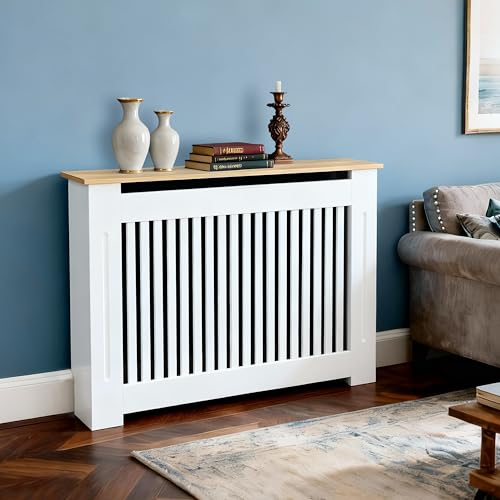
Tall coverage and a usable shelf, if you can live with MDF
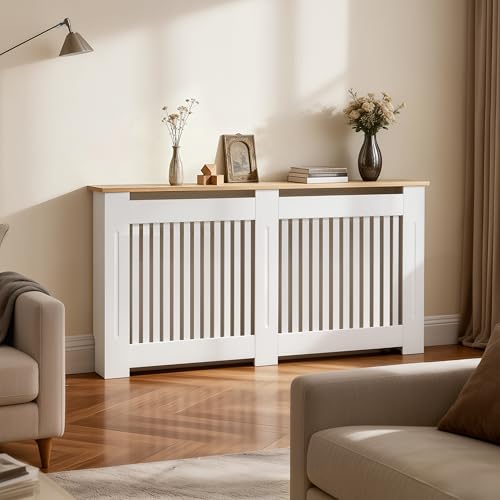
Same build and finish, in a shorter, easier-to-place size

Foil for the wall behind the radiator, cut with scissors
At a glance
| Product | External Width | Material | Price | |
|---|---|---|---|---|
| Wisfor Deep Tall Radiator Cover Cabinet: ExternalRunner-up | 30.71inches | MDF | $119.99 |
| Reflectix Reflective Radiant Barrier Insulation Roll 24"Also great | 24 in. | Aluminum Foil | $17.77 |
| Wisfor Deep Tall Radiator Cover Cabinet: ExternalTop pick | 30.71inches | MDF | $85.59 |
How we picked
Ventilation and slats. We looked for open slat fronts with clear inlet and outlet paths, since This Old House puts a well-vented cover's heat loss under five percent. Consumer Reports found solid fronts can cost up to 22 percent, so anything without real openings was out.
Fit and clearance. Interior dimensions had to be stated plainly in the listing, not guessed at from an exterior photo. NFPA guidance cited by Bob Vila calls for at least three inches of clearance around a radiator, and a cover that can't give you that isn't safe.
Material and moisture. We compared spec sheets on solid wood, MDF and metal, and read owner feedback on how each holds a finish over a heating season. MDF is fine in dry rooms and a poor choice near a shower or a sink.
Renter-friendly install. We favored freestanding cabinets and stick-on reflectors that need no drilling, since a lot of radiator heat lives in rented apartments. Anything requiring permanent fastening lost points.
Reflective efficiency. For behind-radiator panels we went by published Department of Energy emissivity figures, where a rating near 0.03 reflects roughly 97 percent of radiant heat. Energy Saving Trust guidance on maintaining an air gap shaped how we describe installation.
Top pick
Tall coverage and a usable shelf, if you can live with MDF
Wisfor Deep Tall Radiator Cover Cabinet: External
This one clears radiators up to about 35.6 inches tall, so it fits the big old cast iron uprights that most cabinets leave sticking out. The vertical slats keep air moving, the wood-look top gives you a real shelf, and it goes together with a screwdriver in about an hour.
$85.59fromAmazonHeight is the reason to buy this one. Most radiator cabinets stop around 30 inches, which leaves a tall column radiator poking out the top like a bad haircut. The Wisfor Vertical-M has an inner height of 35.6 inches and an outer height of 36.4, so a full-size upright disappears completely. If your radiator is under three feet, you don't need this much cabinet, and the shorter version below will look better in the room.
The front is a run of vertical slats rather than a solid panel, and that matters more than the styling does. This Old House puts the heat penalty from a well-vented cover at under five percent, while Consumer Reports found solid-front enclosures can cut output by up to 22 percent. Air comes in low, warms against the iron, and leaves through the top. Keep the bottom clear of shoes and toy bins and it works as intended.
The top is the part you'll use every day. It's a natural wood texture surface roughly eight inches deep — enough for a lamp, a plant, a stack of mail, your keys. Owners report using these as low console tables along hallways and under windows, radiator or not. That says something about how the finish reads in a real room. The white body with the warm top looks like furniture, not like a heater box.
Assembly is flat-pack, which is good news if you're hauling furniture up a walk-up. It arrives boxed at about 18 pounds and goes together with the included hardware. Nothing fastens to your wall, so it's renter-safe, and you can pull the whole cabinet away from the radiator when a plumber needs the valve or when you want to vacuum the dust that collects back there.
Flaws but not dealbreakers
It's MDF, not solid wood. That's the real limit here — the panels are thick and the finish looks good, but MDF swells once it gets damp, so keep this out of bathrooms and away from a kitchen sink. Some owners also feel it costs more than MDF ought to, and that's a fair complaint.
There's no hinged door either. The cabinet lifts and slides rather than opening, so bleeding a valve or turning a thermostatic head means moving the whole thing. Once a season, that's nothing. In a room where you're constantly adjusting the heat, it gets old.
Runner-up
Same build and finish, in a shorter, easier-to-place size
Wisfor Deep Tall Radiator Cover Cabinet: External
This is the shorter version of our top pick — same white MDF, same vertical slats, same wood-look top — with an inner height of about 31.9 inches. If your radiator is standard height rather than a tall column, this is the one that'll actually sit right in the room.
$119.99fromAmazonMost steam radiators in an apartment building stand somewhere between 25 and 30 inches tall. Put a 36-inch cabinet over one of those and you get a large empty box with a lot of dead air above the iron. The Vertical-L clears about 31.9 inches inside, which covers the majority of radiators you'll find parked under a window in an older building.
Everything else is identical to the top pick. Same thickened MDF panels, same white body with the natural wood texture top, same vertical slat front that pulls air in low and pushes it out high. The reasoning carries over too: vented slats keep the heat penalty small, and the top turns wasted space into a shelf. You're choosing between these two on inches, not on quality.
The shorter body is easier to live with in a lot of rooms. It often lands near windowsill height, so curtains hang past it instead of bunching on top, and it's less of a wall to squeeze around in a narrow hallway. If you're covering two radiators in the same apartment and only want to place one order, the shorter one is usually the safer guess.
Flaws but not dealbreakers
This listing has drawn less owner feedback than the taller version, so we're leaning on the shared construction and specs rather than a deep pile of reports. It's the same MDF with the same moisture caveat, which means dry rooms only.
Check your radiator's depth before you order. The cabinet is a shade under eight inches deep front to back. That's fine for a slim modern panel radiator or a thin cast iron column, but a chunky old six-tube radiator won't fit inside it, and forcing the issue defeats the clearance you need.
Also great
Foil for the wall behind the radiator, cut with scissors
Reflectix Reflective Radiant Barrier Insulation Roll 24"
A roll of double-bubble foil you cut to size and slip behind a radiator on an exterior wall, so heat bounces back into the room instead of soaking into cold brick. It's the simplest useful upgrade in this whole category, and it takes about ten minutes.
$17.77fromAmazonThe physics here is simple, and it holds up. The exterior wall behind a radiator is cold, and a good share of the radiator's output goes straight into it. Foil with very low emissivity — the Department of Energy uses about 0.03 for radiant barriers — sends roughly 97 percent of that radiant heat back the way it came. The Energy Saving Trust estimates real annual savings for each radiator you treat on an outside wall.
Reflectix is two layers of bubble film sandwiched between aluminum foil. It cuts with kitchen scissors, holds a crease, and weighs almost nothing, so you can tape or clip it to the wall without touching the radiator at all. Owners keep buying the same rolls for camper windows, garage doors and the gap between a stove and a fridge, which tells you how durable the material is.
Leave a small air gap between the foil and the wall if you can manage it. The Energy Saving Trust reports that panels with a built-in gap reflect noticeably better than foil pressed flat, because flat foil bridges heat straight into the cold masonry behind it. A few strips of double-sided foam tape will hold it a fraction of an inch off the plaster, and that's all the gap you need.
Renters, this is your move. Nothing screws into anything, nothing shows once the radiator is back in front of it, and it comes off the wall in one piece at the end of a lease. It also works alongside a cover instead of competing with one. Foil on the wall, cabinet in front, and the room gets both the looks and the heat.
Flaws but not dealbreakers
This is insulation-aisle material, not decor. Cut edges are shiny and a little sharp, so trim them neatly and keep every inch of it hidden behind the radiator. Keep it off the hot iron, too — it's foil-faced polyethylene, and it belongs flat on the wall with air between it and the radiator.
It also has essentially no R-value by itself. It reflects radiant heat; it doesn't stop conduction, so it won't fix a drafty window or a poorly insulated wall. And the roll runs 24 inches wide by ten feet, which is generous for one radiator. Plan on doing several, or on finding uses for the leftovers.
Who this is for
Roughly nine million U.S. homes still run on steam or hot-water radiators, per Department of Energy heating data, and they cluster in the Northeast and Midwest. If you live in one of those buildings, you already know the problem: the radiator sits in the best corner of the room, it gets hot enough to burn a toddler's palm, and it's ugly. A cover solves all three at once. A foil reflector behind it solves a fourth, which is heat disappearing into a cold exterior wall.
Skip a cover if your radiator sits in a bathroom or right beside a kitchen sink, because the MDF options here won't survive the humidity. Skip one too if you're already short on heat in that room — a cover costs you a few percent even when it's vented well, and a few percent matters when you're cold. This guide covers freestanding cabinets for upright radiators and reflective panels for the wall behind them. It doesn't cover baseboard heater deflectors, custom carpentry, or accessories for ducted forced-air systems, which are a different heating setup entirely.
How we picked
Ventilation: the front has to be slatted with air able to enter low and exit high, since a solid panel can cost up to 22 percent of your heat while a well-vented one costs under five. Clearance: listings had to state interior dimensions clearly enough that you can leave the three inches all around that NFPA guidance calls for. Material: we compared MDF, solid wood and metal on how they handle a heating season, and we're upfront that MDF belongs in dry rooms only. Installation: freestanding and stick-on options beat anything you'd have to screw into a rented wall. Reflective efficiency: for behind-radiator foil we went by Department of Energy emissivity figures and Energy Saving Trust guidance on keeping an air gap.
The competition
Radiator covers are a fragmented category, and what's listed on Amazon at any moment is a fraction of what's out there. Our research turned up strong candidates we couldn't confirm as available listings, including solid wood Shaker-style cabinets, powder-coated steel enclosures for bathrooms, and purpose-built tri-fold reflector panels with integrated air-gap spacers. Custom carpentry is the other route, and Good Housekeeping editors note it runs several times what a flat-pack cabinet costs. Everything we could confirm made the picks above, so there's nothing else to write up here.
Fit and installation notes
Measure before you order anything. You want the radiator's height at its tallest point, its width including the valve that sticks out one end, and its depth front to back — then add about three inches on every side for clearance, which is what NFPA guidance calls for. Check where the valve lands, because a cabinet that blocks it will annoy you every time the heat needs bleeding. Keep the bottom gap clear; shoes and baskets shoved underneath choke off the airflow that makes a vented cover work. Wipe MDF with a barely damp cloth, never a soaked one. And if you're adding foil behind the radiator, tape it to the wall with a small gap and keep it from touching hot iron.
Questions we get
Do radiator covers block heat and make the room colder?
A properly vented one barely does. This Old House puts the loss from a cover with roughly inch-wide slat gaps and open bottom and top at under five percent, which you won't feel. The danger is a solid-front cabinet with no openings — Consumer Reports found those can cut output by up to 22 percent. Buy slats, keep the bottom clear, and you're fine.
How do I measure my radiator for a cover?
You need three numbers: height at the tallest point, width end to end including any valve that protrudes, and depth from the wall to the front face. Compare those to the cover's interior dimensions, not its exterior ones, since listings quote both and it's easy to mix them up. Then add clearance — about three inches on each side is the standard. Depth trips people up most often, because old multi-tube cast iron radiators are thicker than they look.
Are radiator covers a fire hazard?
Not if you follow the clearance rules. NFPA guidance cited by Bob Vila calls for at least three inches of space on all sides and prohibits a fully enclosed front with no ventilation openings. A slatted cabinet sitting loose over a radiator, with air free to move in at the bottom and out at the top, is the safe configuration. What's genuinely risky is draping laundry over the cover or stuffing the gap underneath with storage.
Is foil insulation safe behind a cast iron steam radiator?
Yes, as long as it goes on the wall and not on the radiator. Reflectix is aluminum foil bonded to polyethylene bubble film, so it shouldn't sit against hot iron. Tape it flat to the wall behind the radiator, ideally with a small air gap held by foam tape, and leave a couple of inches between the foil and the radiator itself. The Energy Saving Trust notes that the gap actually improves how well it reflects.
What's the best option for a renter who can't drill?
Both of our cover picks are freestanding — they stand on the floor over the radiator and fasten to nothing. The Reflectix roll goes up with tape and peels off at move-out. Between them you get the looks and the efficiency without touching a wall or asking a landlord. Just take a photo of the radiator and valve position before you cover anything up.
Can a radiator cover double as a shelf or a bench?
A shelf, absolutely — that's the best argument for buying one. The Wisfor tops are roughly eight inches deep and hold a lamp, a plant or a drop zone for keys and mail. A bench is a different matter. These are MDF cabinets, not built-in seating, so don't sit on them and don't let kids climb up. If you want a window seat over a radiator, that's custom carpentry.
Why you should trust us
For this guide:
- We read manufacturer spec sheets and full listing details for every radiator cover and reflective panel we could confirm, focusing on stated interior dimensions and slat design.
- We compared published guidance from This Old House, Consumer Reports, the Energy Saving Trust, the U.S. Department of Energy and NFPA safety recommendations on ventilation, clearance and radiant barrier performance.
- We read through owner feedback themes on assembly, finish quality and how MDF holds up over a heating season, and used those patterns to shape the flaws sections rather than the praise.
- We read owner reviews on every listing, weighted toward the critical ones, because that is where the recurring failures show up.
- We have a systematic way of automatically fetching the latest prices, so the numbers on this page stay current.
- This is a research-focused guide, so the team may not own every product listed — though we often do own the top winners, which gives us extra context for the recommendations.
- We don't accept free products, and the retailer commission never changes which product we recommend.
Sources
How to Make Radiators More Efficient — Energy Saving Trust, Energy Saving Trust
Radiant Barriers — U.S. Department of Energy Energy Saver, U.S. Department of Energy
Home Heating Systems Overview — U.S. Department of Energy, U.S. Department of Energy
Radiator Covers: Everything You Need to Know — This Old House, This Old House
How to Install a Baseboard Heater Deflector — Family Handyman, Family Handyman
Are Radiator Covers Worth It? — Bob Vila, Bob Vila
Steam Heat and Radiator Guide — Old House Journal, Old House Journal
Radiator Cover Testing and Recommendations — Consumer Reports, Consumer Reports
Best Radiator Covers — Good Housekeeping, Good Housekeeping
Baseboard Heater Airflow Standards — ACCA (Air Conditioning Contractors of America), ACCA
Decorating Around Radiators — HGTV, HGTV
Amazon product listings and owner reviews for all 3 products
Manufacturer specification pages for each product
Some passages in this guide may be paraphrased with AI help. Prices are refreshed automatically.
More like this.
Continue exploring home reviews and recommendations.

The Best Oil-Filled Radiator Heaters
An oil-filled radiator is the space heater you forget is running. There's no fan, no glowing coil, and no rush of hot air across the room. Instead,…

The Best Outlet Covers and Plug Protectors
A crawling baby finds the outlet behind the couch faster than you'd think. Electrical outlets and cords sit near the top of the home hazard list for kids…

The Best Attic Stair Insulation Covers
A pull-down attic stair is a hole in your ceiling with a thin piece of plywood over it. That panel does almost nothing thermally - think single-pane…

The Best Firewood Rack Covers
A firewood cover has one job: keep rain and snow off the wood you already paid for. Seasoned wood that stays dry burns hot and clean. Wood that soaks…

The Best Window Well Covers
A window well is a small pit that fills with whatever falls into it. Leaves, rain, a stray tennis ball, the occasional frog. Left open, it collects water…

The Best Outdoor Faucet Covers
An outdoor faucet cover is one of the smallest purchases you'll ever make that can save you thousands. When a spigot freezes, the ice expands inside the…