The Best Attic Stair Insulation Covers
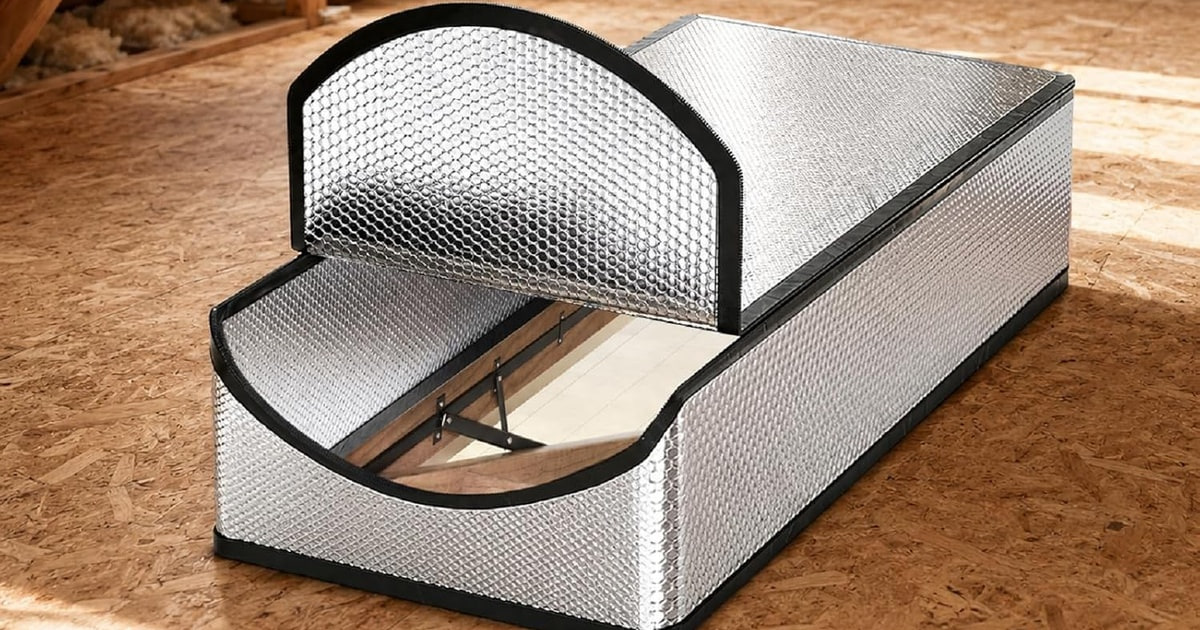
A pull-down attic stair is a hole in your ceiling with a thin piece of plywood over it. That panel does almost nothing thermally — think single-pane window, right above your head. In January, cold attic air pours down the stairwell and you feel it as a draft near the hallway. In July, a 140-degree attic pushes heat the other direction, and your AC runs longer to keep up. A cover that costs less than a tank of gas closes that gap in an afternoon, and you'll usually notice the difference in comfort before you see it on a bill.
But none of these covers get you to code-level insulation, and it's worth being clear about that. The Department of Energy recommends R-38 to R-60 for attic floors. The highest published rating in this lineup is R-15.5. Several products here publish no R-value at all, which means their energy claims are unverifiable. And every ceiling-side cover shares the same blind spot: it seals the panel face, not the joint where the stair box meets your drywall. Skip the perimeter caulking step and you'll wonder why the draft didn't go away.
Fit is the other thing that trips people up. Most of these are made for a 25-by-54-inch rough opening, and if yours is bigger or oddly shaped, a force-fit cover leaves gaps exactly where air moves fastest. Measure the framing, not the stair panel. We think that the LEMOONE Attic Door Insulation Cover is the best attic stair insulation cover for most people, and that the Attic Tent AT-4 is the one to buy if air leaks around the opening are your real problem.
Everything we recommend

The highest published R-value, stapled up in 20 minutes

Seals the whole opening from above, if leaks are the problem

Nearly the same insulation, with a tool that helps first-timers

Zipper access at the lowest cost, with nothing verified
At a glance
| Product | Fit Size | R-Value | Price | |
|---|---|---|---|---|
| YRBKBYBC Attic Door Insulation CoverBudget pick | 25x54x11 in | — | $19.99 |
| Attic Tent at-4 Attic Cover/Insulator 25" xUpgrade pick | 25x54x13 in | R-3.2 | $179.99 |
 | Joyfolk 30" x 60" x 11" AtticAlso consider | 30x60x11 in | — | $30.99 |
 | Duck Brand Stairway Attic CoverAlso in lineup | 25.5x54 in | — | $54.98 |
| LEMOONE Attic Door Insulation Cover 25"x54"x11"Top pick | 25x54x11 in | R-15.5 | $31.99 |
| Attic Stairway Insulation Cover - Premium EnergyRunner-up | 25x54x11 in | — | $35.59 |
 | Flehomo Insulation Cover Kit for Attic StairsAlso consider | Up to 39x55 in | — | $24.99 |
How we picked
Published R-value. We gave weight to covers that publish a specific thermal rating and treated unrated products as unverifiable on energy claims. For Zone 4 and colder, R-10 was our rough floor for taking a savings claim seriously.
Air sealing approach. We separated attic-side tents that seal the full rough-opening perimeter from ceiling-side covers that only insulate the panel face. Building science research points at infiltration, not conduction, as the dominant loss path at attic bypass points.
Opening fit. We checked each listing's stated dimensions against the common 22.5-by-54 and 25-by-54 rough openings, and kept options for larger and irregular openings in the mix. A cover that leaves a gap at the frame is worse than it looks.
Access without hassle. We favored covers with a full-length zipper over ones that must be fully removed. Owner feedback across this category consistently shows that covers requiring removal get left off.
Materials and longevity. We compared foil thickness, core construction, and stated fire and moisture resistance, since foil delamination and bubble-core compression are the failure modes that show up over years.
Top pick
The highest published R-value, stapled up in 20 minutes
LEMOONE Attic Door Insulation Cover 25"x54"x11"
The LEMOONE is a foil-and-bubble tent that goes over your attic opening from below and staples to the door frame. It publishes an R-value of 15.5, the highest here, and a full-length zipper lets you get into the attic without pulling it down.
$31.99fromAmazonIt publishes the highest R-value in this group, and that number is the whole point. LEMOONE rates the cover at R-15.5 using double-layer aluminum foil over a high-density bubble core. Against a bare stair panel sitting at roughly R-1 to R-2, that's a large jump in conductive resistance. Several covers in this lineup publish no rating at all. When you can't verify a number, you're buying a shape.
Installation is genuinely a one-evening job. You unfold it, set it over the opening from the ceiling side, and staple the flanges to the door frame. No drilling, no brackets, no trip into the attic. If you've never done anything like this, plan on about 20 minutes and a staple gun you probably already own.
The zipper means you won't resent it later. It runs the full length of the cover, so getting into the attic is a matter of unzipping and folding it back. That matters more than you'd think. Covers without a zipper turn every trip up the ladder into a full removal-and-reinstall chore, and people stop bothering to put them back properly.
The foil reflects most radiant heat, so it earns its keep in summer too. LEMOONE rates the double foil layer at 97% radiant reflection. In a hot climate, where the attic hits 130 degrees and the stair acts like a chimney, that reflective face is doing more work than the R-value alone suggests. It's a year-round product, not a winter one.
The materials are rated fireproof and waterproof. That matters in a spot where you're stapling a plastic-and-foil assembly to framing in a space that swings between humid and baking. Moisture resistance also helps against foil delamination, one of the more common ways these covers fail over years.
Flaws but not dealbreakers
It seals the panel, not the perimeter. As a ceiling-side cover, it does nothing about the gap between the stair box and your ceiling drywall. Air keeps moving through that joint. Run a bead of acoustical sealant or press in foam backer rod around the frame before you install — it takes 15 minutes and it's the single most common reason people feel let down by an otherwise good cover.
There's no track record to lean on. This listing carries essentially no owner feedback, so how the zipper holds up after a few hundred cycles is an open question. If you're in your attic weekly, that uncertainty is worth taking seriously.
The 25-by-54 sizing is fixed. There's no trimming it down or stretching it out. Measure your rough opening first, and if it's larger, look at the Joyfolk or the Flehomo instead.
Upgrade pick
Seals the whole opening from above, if leaks are the problem
Attic Tent at-4 Attic Cover/Insulator 25" x
The Attic Tent AT-4 drops over your stair assembly from inside the attic and seals the entire rough-opening perimeter at floor level. It's the most complete air barrier here, and its 13-inch depth lets blown-in insulation pack right against the sides.
$179.99fromAmazonIt stops air where air actually gets in. Every other cover here works on the panel face. The AT-4 works on the perimeter of the rough opening, from the attic side, which is where infiltration happens. If you've had an energy audit and the finding was leakage rather than poor insulation, this is the design that addresses it.
The 13-inch depth is built for blown-in insulation. Loose-fill can be packed directly against the tent walls, which closes the thermal gap at attic floor level instead of leaving a bare box sticking up out of the insulation. If your attic already has a deep blanket of blown-in, this integrates with it rather than sitting on top of it.
It's made to be opened and closed a lot. The tent stays in place and you use the stairs as usual, so there's no cover to unzip, fold, or restaple every time. For anyone who stores things in the attic and goes up monthly, that durability under repeated access is the real argument.
Attic Tent is the established name in this format. The AT-4 is spec'd for a 25-by-54 opening with 1x5 or 1x6 side rails, and the listing is specific about that fit. Precision about what it fits is a good sign in a category full of vague universal claims.
Flaws but not dealbreakers
Its conductive rating is low — R-3.2. That's not a typo, and it's not a flaw so much as a design choice: the AT-4 is an air barrier first. On its own, in a cold climate, it won't give you much resistance to conduction. It works when it's surrounded by insulation, not as a standalone fix.
You have to install it from inside the attic. That means hauling it up through the opening and fitting it over the stair assembly while crouched on joists. It's more work than stapling something up from a ladder, and if your attic is cramped or hot, it's a genuinely unpleasant hour.
It's the most expensive thing here by a wide margin. Several times what the foil-bubble tents cost. That's defensible if infiltration is confirmed as your dominant loss path, but it's a poor first guess if you haven't diagnosed the problem.
Runner-up
Nearly the same insulation, with a tool that helps first-timers
Attic Stairway Insulation Cover - Premium Energy
The DGSL is a foil-bubble tent rated R-14.5 that ships with a plier-style installation tool. It's a hair behind the LEMOONE on paper, but the tool solves the awkward two-hands problem of holding a cover flat while you staple it.
$35.59fromAmazonR-14.5 is close enough to the top pick that you won't feel the difference. Two layers of aluminum with a bubble core between them, rated to reflect 97% of radiant heat. The gap between R-14.5 and R-15.5 is real on a spec sheet and negligible in your hallway. Both are enormous upgrades over a bare panel.
The included tool matters more than it sounds like it should. Stapling a cover to a frame overhead means holding the flange flat with one hand while operating a staple gun with the other, on a ladder. The tool holds the flange against the frame for you. If this is your first time doing anything like it, that's a real reduction in fumbling.
The zipper runs the full perimeter and the body holds its shape. The foil-bubble construction is stiff enough that the cover doesn't sag down into the stairwell under its own weight, which is a common complaint with thinner covers. You get one-handed attic access without the whole thing drooping.
It's rated to handle moisture and humidity. Attics swing hard between damp and dry, and foil layers that delaminate are a known long-term failure. The listing calls out moisture resistance and fireproof construction, both of which you want in something stapled to framing above your head.
Flaws but not dealbreakers
The tool is a one-time benefit. After your first install you'll know the technique, and the pliers go in a drawer. You're paying a small premium for a training wheel.
It costs more than the top pick while rating slightly lower. That's a strange place to sit. If you're confident with a staple gun, the math points at the LEMOONE.
Same ceiling-side limitation, same fixed size. It seals the panel, not the frame joint, so the perimeter caulking step still applies. And 25 by 54 is the only size, so measure first.
Budget pick
Zipper access at the lowest cost, with nothing verified
YRBKBYBC Attic Door Insulation Cover
The YRBKBYBC is a standard 25-by-54 zippered foil tent at the bottom of the price range. It covers the opening and gives you zippered access, but it publishes no R-value, so treat it as a stopgap rather than a real energy investment.
$19.99fromAmazonIt does the basic job for the least money. Silver foil over the opening, a zipper for access, standard 25-by-54-by-11 sizing that matches most pull-down stairs. Going from nothing to this is a much bigger jump than going from this to a premium cover.
The zipper is the reason to pick it over a bare sheet. Plenty of cheap options are just a piece of foil you have to peel off and restick every time. This one lets you unzip and climb through, which is what keeps a cover in place instead of shoved behind the water heater by March.
It's a sensible choice if you're renting or moving soon. Spending real money on the ceiling of a place you'll leave in a year doesn't make sense. This covers the draft now and you won't wince when you leave it behind.
The form factor mirrors the pricier tents. Same tent shape, same zipper placement, same install method — staple the flanges to the frame. What you're giving up is material thickness and verification, not the fundamental approach.
Flaws but not dealbreakers
There's no published R-value at all. None. You cannot estimate savings from it, and anyone telling you what it saves is guessing. If you want a number you can defend, this isn't the one.
The construction is lighter than the covers above it. Thinner foil, a lighter-duty zipper. Zipper wear and bubble-core compression are the two things that kill these covers, and cheaper materials fail at both sooner.
It's a complete unknown on durability. No meaningful owner history exists for this listing, and there's no brand track record in attic insulation to fall back on. Buy it as a stopgap, not a decade-long fix.
Who this is for
Buy one of these if you have a pull-down attic stair with nothing over it — which is most homes with pull-down stairs. You'll get the most out of it if you live in a climate with real winters or real summers, if you can feel a draft near the stairwell, or if the hallway below the attic is always the wrong temperature. The install is a ladder, a staple gun, and an afternoon. It's one of the few home energy jobs where a beginner can get most of the available benefit on the first try.
Skip it if your attic is conditioned and inside the thermal envelope, since there's no boundary there to seal. Skip it too if your opening falls well outside these sizes; a rigid foam box built to your dimensions will fit better than any force-fit cover. This guide covers ready-made covers for standard residential pull-down stairs and scuttle hatches. It doesn't cover DIY foam-board builds, weatherstripping kits, or insulated attic hatches sold as complete replacement assemblies.
How we picked
We compared spec sheets, manufacturer claims, published reviews, and owner feedback themes across every cover in this lineup, weighing five things. R-value: whether the product publishes a thermal rating at all, and whether it clears roughly R-10 for cold-climate use — unrated covers are selling a shape, not a measured performance. Air sealing: whether the design addresses the rough-opening perimeter or only the panel face, since infiltration is usually the bigger loss path. Fit: whether the stated dimensions match a real rough opening, measured frame to frame rather than at the stair panel. Access: whether a full-length zipper lets you into the attic without removing the cover, because covers that must come off tend to stay off. Durability: foil thickness, core density, and stated fire and moisture resistance, since zipper wear and delamination are what end these covers early.
Other attic stair insulation covers worth considering
If you want a cover for a 30-by-60 opening: The Joyfolk 30" x 60" x 11" Attic ($30.99) — The Joyfolk is sized 30 by 60 by 11 inches, which fills a gap most of this category ignores. If you've already bought a standard 25-by-54 cover and watched it leave an inch of bare frame on every side, this is the fix. Reflective aluminum over a polyethylene bubble layer gives it enough rigidity to span the wider opening without sagging in the middle, and the heavy-duty zipper opens one-handed — useful when you're carrying something up. What you give up is a published R-value. There isn't one, so you can't put a number on the savings. Given the materials, expect meaningfully less conductive resistance than the LEMOONE's R-15.5. In Zone 5 and colder, treat it as a starting point and pair it with thorough perimeter sealing.
If your opening is oversized or an odd shape: The Flehomo Insulation Cover Kit for Attic Stairs ($24.99) — The Flehomo isn't a tent — it's a three-layer aluminum-foil-and-foam sheet that covers up to 39 by 55 inches and cuts with heavy scissors. That's the whole appeal. If your opening is L-shaped, out of square, or has a pipe or conduit running through it, no pre-formed tent will seal it and this will. It attaches with the included hook-and-loop tape or staples, and the same sheet works over ceiling shutters and vents if you have those to deal with too. The catch is that there's no zipper, so every attic trip means taking the whole thing down and putting it back. If you go up weekly, that gets old fast. There's also no published R-value. For a standard opening where convenience matters, the zippered tents are the better daily-use choice.
The competition
This is what our research turned up in a category that's mostly unbranded listings and reshuffled foil-bubble tents, not a survey of everything for sale. One product here didn't earn a pick or a nod, and it's worth explaining why — it's a reasonable product with a narrow reason to exist.
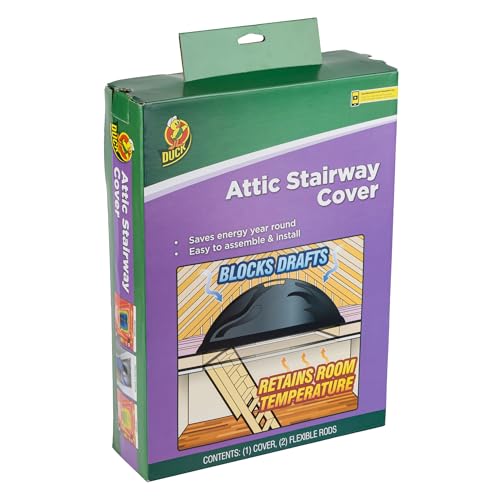
The Duck Brand Stairway Attic Cover ($54.98) — The Duck Brand Stairway Attic Cover is the only genuinely no-tools option here. Flexible rods thread through sewn channels and snap into four corner pockets, and the assembled cover lifts into place without a single staple or screw. Nothing gets attached to your ceiling, nothing gets damaged, and it comes right back down. The flexible structure also forgives an opening that isn't perfectly square, which older houses appreciate, and the black finish disappears in a finished ceiling better than silver foil does. But it publishes no R-value, which puts it in the same unverified bucket as the budget options while costing considerably more than they do. There's no zipper either, so attic access means taking the whole thing down. Choose it if you rent, if your lease or HOA forbids attaching anything to the ceiling, or if you need a draft block today with nothing but your hands. Otherwise the zippered tents give you more for the money.
Installation notes
Measure the rough opening — the framing-to-framing dimension in your ceiling — not the stair panel. That's the mistake people make most, and a cover sized to the panel sits inside the frame and leaves a gap on all four edges, right where air moves fastest. Measure width, length, and depth, since depth is the third number in most listings. Before you staple anything up, seal the joint where the stair box meets the ceiling drywall with acoustical sealant or foam backer rod. It costs almost nothing, takes about 15 minutes, and can matter as much as the cover itself. Last, check that blown-in insulation hasn't drifted over the opening from above; compressed insulation loses most of its value.
Questions we get
What R-value do I actually need?
The DOE recommends R-38 to R-60 for attic floors, and no stair cover here gets close — R-15.5 is the ceiling in this lineup. That's fine, because the comparison that matters is against an uninsulated panel at R-1 to R-2. Anything rated R-10 or better is a five- to ten-fold improvement in conductive resistance. In Zone 5 and colder, take the highest published rating you can get and seal the perimeter carefully.
What's the difference between an attic-side and a ceiling-side cover?
A ceiling-side cover staples up around the stair panel from below and insulates the panel face — that's the LEMOONE, DGSL, Joyfolk, Flehomo, and YRBKBYBC. An attic-side cover like the Attic Tent AT-4 goes over the whole stair assembly from inside the attic and seals the rough-opening perimeter at attic floor level. Attic-side is the better air barrier because it addresses the frame, not just the panel. Ceiling-side is far easier to install and works well for most homes if you seal the perimeter first.
How do I measure my attic stair opening?
Measure the rough opening in the ceiling framing, frame to frame, in both directions — not the stair panel. Then measure how far the folded stair assembly hangs below the attic floor; that's the height dimension in most listings. Standard sizes are 22.5 by 54 and 25 by 54 inches, but older homes vary, so verify before ordering. For anything larger, look at the Joyfolk at 30 by 60 or the Flehomo, which trims to fit up to 39 by 55.
Do these help in summer, or just winter?
Both, and in hot climates summer might be the bigger win. Attics regularly hit 130 to 150 degrees, and an uninsulated stair works like a chimney feeding that heat into your living space. Foil-faced covers reflect radiant heat in either direction — LEMOONE and DGSL both rate their foil at 97% reflection. If you're in a cooling-dominated climate, a reflective cover is the most direct thing you can do for comfort in the hallway below.
Do these work with existing blown-in insulation?
Yes, and the two complement each other. A ceiling-side cover handles the panel while blown-in handles the surrounding attic floor. The Attic Tent AT-4 is designed specifically for this pairing — its 13-inch depth lets you pack loose-fill right against the tent walls, closing the gap at floor level. Just check that blown-in hasn't migrated over the opening before you install a ceiling-side cover, since compressed insulation loses R-value.
How long should one of these last?
Roughly five to ten years for a well-built foil-bubble cover under normal use. The things that end them are zipper wear, foil delamination in damp attics, and the bubble core compressing under repeated handling. The Attic Tent AT-4 is built for frequent access and should outlast the lighter foil-bubble tents if you're up there often. Lighter-duty budget covers like the YRBKBYBC are the ones most likely to need early replacement.
Why you should trust us
For this guide:
- We compared published specifications, R-value claims, and stated dimensions across every cover in this lineup.
- We read manufacturer documentation and building science guidance on attic bypass air sealing to weigh air-barrier designs against panel-face insulation.
- We reviewed owner feedback themes for this category, including the recurring complaints about zipper wear and covers that get left off when access is inconvenient.
- We read owner reviews on every listing, weighted toward the critical ones, because that is where the recurring failures show up.
- We have a systematic way of automatically fetching the latest prices, so the numbers on this page stay current.
- This is a research-focused guide, so the team may not own every product listed — though we often do own the top winners, which gives us extra context for the recommendations.
- We don't accept free products, and the retailer commission never changes which product we recommend.
Sources
Insulation — U.S. Department of Energy Energy Saver, U.S. Department of Energy
Recommended Home Insulation R-Values by Climate Zone, U.S. Department of Energy
Building Science Digest BSD-014: Air Barriers, Building Science Corporation
Radiant Barriers — Energy Saver, U.S. Department of Energy
Seal and Insulate with ENERGY STAR, ENERGY STAR / U.S. EPA
Amazon product listings and owner reviews for all 7 products
Manufacturer specification pages for each product
Some passages in this guide may be paraphrased with AI help. Prices are refreshed automatically.
More like this.
Continue exploring home reviews and recommendations.

The Best Attic Ladders
An attic ladder is one of those things you never think about until you're halfway up one with a bin of holiday lights under your arm. Then you notice…

The Best Solar Attic Fans
Your attic is the hottest room in the house, and nobody lives in it. On a clear summer afternoon the air up there can push past 150°F, and that heat…

The Best Baby Gates for Stairs
A baby who can crawl will find the stairs within a week. That's the whole reason this category exists. A stair gate has to hold up to a toddler leaning on…

The Best Spray Foam Insulation Cans
A can of foam is a small fix for one of the biggest problems in your house. Air leakage accounts for 25 to 40 percent of heating and cooling losses in a…

The Best Water Heater Insulation Blankets
Your water heater sits there all day keeping 40 or 50 gallons hot, whether you're home or not. If the tank is old, a lot of that heat leaks straight into…

The Best Window Insulation Kits and Draft Stoppers
A drafty house doesn't announce itself. You just notice that the room with the big window stays cold no matter how high you set the thermostat, or that…