The Best Window Insulation Kits and Draft Stoppers
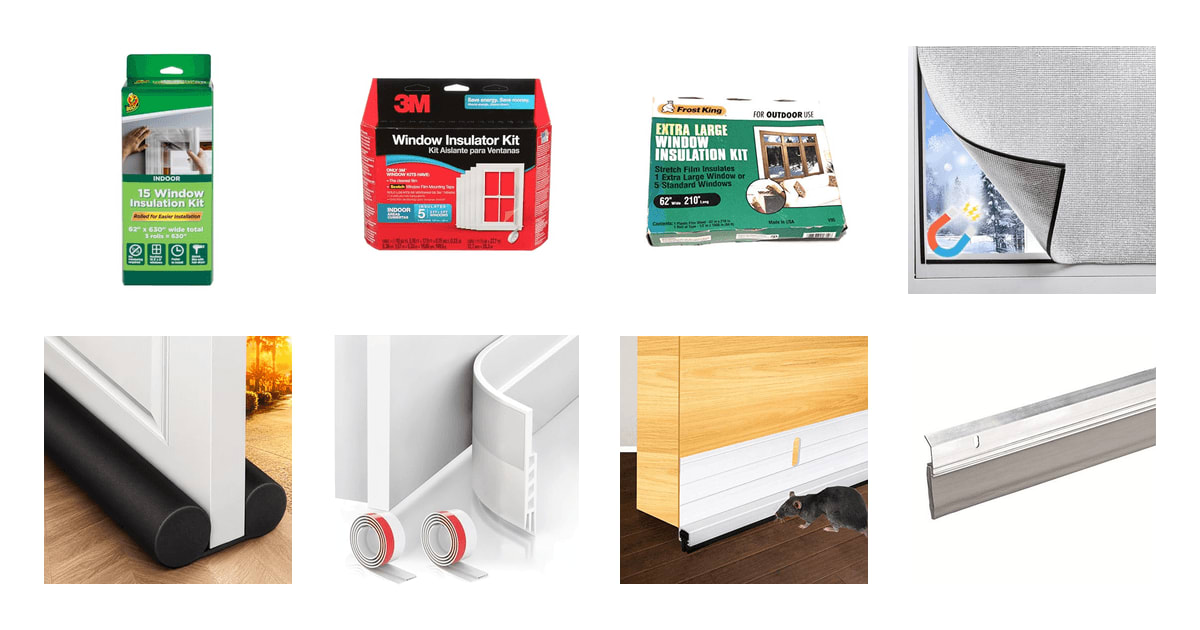
A drafty house doesn't announce itself. You just notice that the room with the big window stays cold no matter how high you set the thermostat, or that your feet get chilly on the couch nearest the front door. The Department of Energy estimates that air leaks around windows and doors account for 25 to 30 percent of a home's heating and cooling energy use. Sealing those leaks is cheap, it takes an afternoon, and it's one of the few home upgrades that pays for itself before the season is out.
But let's be honest about what these products can and can't do. Shrink film won't turn a rattly single-pane window into a modern double-pane unit — it roughly doubles the effective R-value at the glass, from about R-1 to R-2, which is real but modest. Most film kits are a one-season affair; you peel them off in spring and buy new ones in fall. Draft stoppers under doors help a lot with the cold-ankles problem, but the ones that don't attach to anything will get shoved around every time the door swings.
The good news is that you don't have to choose. Film on the windows and a seal under the door work on different leaks, and doing both cuts far more infiltration than either alone. We think that the Duck Brand Winter Window Insulation Kit is the best window insulation kit for most people, and that the MAXTID Under Door Draft Stopper is the one to buy if your worst drafts come from under a door rather than around the glass.
Everything we recommend

Enough film for a whole house, and no measuring required

Slides under the door, blocks both sides, damages nothing

A slim stick-on seal that stays out of the way

Reusable and removable, and it works in summer too
At a glance
| Product | Product Type | Coverage | Price | |
|---|---|---|---|---|
| Duck Brand Winter Window Insulation KitTop pick | Window Insulation Kit | Up to 15 Windows | $22.47On sale |
 | 3M Indoor Window Insulator Kit - FiveAlso in lineup | Window Insulator Kit | 5 Windows | $16.45 |
 | Frost King V95H Extra Large Window InsulationAlso consider | Window Insulation Kit | 1 XL or 5 Std Window | $11.60 |
| Magnetic Window Insulation Kit Suitable for WinterUpgrade pick | Window Insulation Kit | 24in x 36in | $19.99 |
| MAXTID Under Door Draft Stopper for BottomAlso great | Door Draft Stopper | Up to 38in Doors | $9.99On sale |
| Suptikes 2 Pack Door Draft Stopper,Door SweepBudget pick | Door Draft Stopper | 2in x 39in | $7.98On sale |
 | BAINING Metal Door Draft StopperAlso in lineup | Door Draft Stopper | 43.5in Long | $17.59 |
 | Frost King A82/36H Extra Wide Heavy DutyAlso consider | Door Sweep | 36 In Long | $16.19On sale |
How we picked
Real sealing performance. We prioritized products whose specifications and owner feedback both point to a genuine air seal — full-perimeter tape on window film, dual-layer or dual-sided seals on doors. Products that only cover one face of a gap were ranked lower.
Damage-free installation. Renters make up a large share of the people who need these products, so we favored kits that install with tape, magnets, or friction rather than screws. We noted which products bond permanently to a door or frame.
Fit range and coverage. We compared stated door widths and gap tolerances against the uneven half-inch to three-quarter-inch clearances common in older homes, and compared window film coverage per kit against typical 3-by-5-foot window sizes.
Indoor vs. outdoor rating. Film thickness and UV stabilization determine whether a kit survives on an exterior surface. We separated indoor-only kits from outdoor-rated ones rather than treating them as interchangeable.
Cost across seasons. Single-season film and multi-year magnetic or screw-mounted hardware aren't comparable on sticker price alone, so we weighed how many winters each product realistically lasts based on materials and owner reports.
Top pickOn sale
Enough film for a whole house, and no measuring required
Duck Brand Winter Window Insulation Kit
This rolled-film kit covers up to fifteen standard 3-by-5-foot windows, so one box usually handles an entire apartment or small house. You cut the film off the roll instead of unfolding pre-sized sheets, which makes odd window shapes far less annoying.
$22.47fromAmazonList priceThe roll format is the reason to pick this one. Most kits give you pre-cut sheets sized for a standard window, which is fine until you hit a narrow bathroom window or a wide living room slider. Here you unroll, eyeball a couple of inches of margin, and cut. Three rolls of film and three rolls of tape come in the box, and Duck rates the whole kit for up to fifteen 3-by-5 windows.
Installation is genuinely simple. You wipe the trim clean and dry, run the double-sided tape around the frame, press the film on, then walk around with a hair dryer until the wrinkles pull tight. Scissors and a hair dryer are the only tools. Owners who describe themselves as nervous first-timers generally report the job going fine as long as they don't rush the taping step.
Once shrunk, the film reads as a faint shine rather than a plastic sheet over your window. Several owners say visitors don't notice it at all. That matters more than it sounds — the main reason people skip window film is that they picture the old duct-tape-and-sheeting look, and this doesn't look like that.
Owner feedback on this kit is unusually consistent across seasons. A recurring theme is people buying it every fall for the same mobile home or the same drafty rental, year after year, which is about as good a durability signal as you get for a seasonal product. Several mention noticeably warmer rooms and less cold radiating off the glass, which lines up with the physics: you've added a still-air gap between you and the cold pane.
Flaws but not dealbreakers
The included tape is the weak link, and it's the same complaint you'll find across most film kits. On old, chalky, or previously painted trim, the tape can let go in a corner mid-winter. Some owners buy a roll of better double-sided tape separately and use only the film from the box. If your trim is rough or dusty, plan on cleaning it thoroughly first — that fixes most adhesion failures.
This is a one-season product. The film stretches permanently when you shrink it, so peeling it off in spring and trying to reuse it won't work. If you want something you install once and reuse for years, look at a magnetic panel system instead.
Fifteen windows is a lot of film if you only have three drafty ones. Smaller packs exist, and buying more coverage than you need is money sitting in a closet.
Also greatOn sale
Slides under the door, blocks both sides, damages nothing
MAXTID Under Door Draft Stopper for Bottom
This two-sided fabric sleeve slips under a door and grips both faces, so it moves with the door instead of getting kicked out of place. It fits doors up to 38 inches and covers gaps up to about 1.4 inches, with no adhesive and no screws.
$9.99fromAmazonList priceIf you rent, this is the door product to start with. Nothing sticks to your door, nothing screws into it, and nothing marks the floor. You cut the foam inserts to your door's width, slide the sleeve into place, and you're done. When you move out, it comes with you.
Two-sided coverage is what separates this from a rolled-up towel. A single-sided stopper only blocks air on the face you put it on, and it slides away the first time the door swings. Because this one wraps under and grips both sides, it travels with the door. Owners consistently report it staying put through normal daily use.
The side benefit is noise and light. Plenty of owners buy it for a bedroom door facing a bright hallway, or for a home office where they want to muffle the rest of the house, and report it helping with both. That makes sense — the same gap that leaks cold air leaks sound. If you've been putting a rolled blanket at the base of a door, this does that job properly.
It's also a good fit for interior doors with uneven floor clearance, which is common in older houses. Bob Vila's panel found dual-sided stoppers handled that unevenness best on pre-1990 interior doors, where gaps often run between a half inch and three quarters of an inch.
Flaws but not dealbreakers
Assembly confuses people. The foam cylinders ship separately and go into the fabric sleeve, and several owners describe fighting with the end caps or resorting to a staple to close it up. It's not hard once you've seen it done, but it's not obvious out of the box either.
It adds bulk under the door. On a door with very little clearance, you may feel drag when you open and close it, and on thick carpet the fit gets fussy. Measure your gap before you order.
It's fabric and foam, so it's a few-season product, not a decade-long one. That's the trade for not putting a single hole in your door.
Budget pickOn sale
A slim stick-on seal that stays out of the way
Suptikes 2 Pack Door Draft Stopper,Door Sweep
This self-adhesive silicone strip bonds to the bottom of the door and creates a low-profile sweep, with two sealing layers against the floor. You get two in a pack, and each cuts down with scissors to fit doors up to about 39 inches.
$7.98fromAmazonList priceThis is the least intrusive way to seal a door gap. It attaches to the door itself, so there's no bulk sitting on your floor and nothing to trip over or vacuum around. Two strips come in a pack, which usually covers a front door and a bedroom door for less than a lot of single-door solutions cost.
Installation takes about five minutes per door. Measure the door width, cut the strip with scissors, peel the backing, and press it on. In a cold room, warming the adhesive strip with a hair dryer first helps it bond — that's the manufacturer's own advice, and it's worth following. The two-layer silicone design seals against the floor while also cutting noise and dust.
Owners who've cycled through foam draft blockers tend to like this better on durability grounds. Silicone doesn't crush and compress the way foam does after a few months of a door dragging across it. It works on a range of door materials, including sliding and glass doors, which most under-door sleeves can't handle.
Flaws but not dealbreakers
Adhesive is the recurring complaint. Several owners report an end lifting after months of daily use, usually on the side that gets the most door swing. The kit includes small nails to pin the strip down, and using them from the start is the safer play — otherwise expect to reach for glue eventually.
Because it rides on the door bottom, it drags across whatever's underneath. On thick carpet or an uneven threshold, that drag makes the door harder to open, and it wears the strip faster. It's happiest on hard floors with a consistent gap.
This isn't a renter-invisible option. The adhesive bonds to the door, and if you also use the nails, you're putting holes in it. Check your lease.
Upgrade pick
Reusable and removable, and it works in summer too
Magnetic Window Insulation Kit Suitable for Winter
Magnetic strips hold a reflective aluminum panel over the window, so you can snap it off during the day and back on at night. It costs much more per window than shrink film, but you reinstall the same panel year after year with no tape and no tools.
$19.99fromAmazonThe case for this one is arithmetic, not comfort. Film kits are a recurring purchase every fall. A magnetic panel is bought once and reinstalled with a snap, so over three to five winters it can end up costing less per year than replacing film. If you're in a rental you plan to stay in for a while, that math gets attractive fast.
It's also the most lease-friendly window option here. No shrink film, no tape residue on trim, nothing that needs a hair dryer. The magnetic strips let you pull the panel off in seconds and put it back the same evening — useful in an RV, a bedroom, or anywhere you actually want to look out the window during the day.
The reflective aluminum construction means it works in both directions. Owners in hot climates use it to keep summer sun out of a room, and one common use is an uninsulated attic hatch or closet ceiling where a clear film wouldn't help anyway. That dual-season use is something no shrink-film kit offers.
You cut the panel to size with scissors, so odd-shaped windows and RV windows aren't a problem. The film is double-sided aluminum foil, so it's stiffer and more tear-resistant than shrink film, and you can wipe it clean between seasons.
Flaws but not dealbreakers
You lose the view and the daylight while it's installed. This is an opaque panel, not clear film. In a room where you want winter sun, that's a real downside — you're trading light for insulation, or committing to taking it down every morning.
Magnet strength is the thing owners disagree about most. Most report the strips holding fine season after season, but a few report weak hold out of the box. Adhesive backing on the strips also needs a clean, dry frame to bond properly.
It ships folded, so expect creases in the panel when you unbox it. Cosmetically that's noticeable at first, and it doesn't fully flatten the way a rolled product would.
Who this is for
Buy one of these if you live with single-pane or old double-pane windows, feel cold air moving near the glass or under a door, and either can't or don't want to replace windows yet. That covers a lot of renters in older buildings, first-time homeowners doing a weekend of weatherization, and anyone in the Midwest, Northeast, or Mountain West watching heating bills climb. Family Handyman estimates a full DIY film-and-foam sealing project can cut heating bills by 5 to 15 percent in homes built before 1980.
You can skip most of this if your windows are recent, tight double- or triple-pane units with intact weatherstripping — film adds little there and you'll notice the haze more than the savings. This guide covers window film kits, magnetic window panels, under-door draft stoppers, and door bottom sweeps. It doesn't cover attic or wall insulation, storm windows, replacement windows, or HVAC work, all of which move the needle more but cost far more too. Consumer Reports notes that drafty windows and doors rank among the top three issues found in professional energy audits, behind attic insulation gaps and HVAC problems — so if you've done this and you're still cold, look up next.
How we picked
Sealing performance: we favored full-perimeter window tape and dual-layer or dual-sided door seals over anything that blocks only one face of a gap. Damage-free installation: tape, magnets, and friction-fit designs came first, since so many people buying these products rent and can't drill into a door. Fit range: we checked stated widths and gap tolerances against the uneven half-inch to three-quarter-inch clearances typical in pre-1990 interior doors. Indoor vs. outdoor: thicker UV-stabilized film belongs outside and thinner film belongs inside, and we didn't treat those as interchangeable. Cost across seasons: a kit you rebuy every fall and hardware that lasts a decade aren't comparable on sticker price, so we weighed expected lifespan alongside coverage.
Other window insulation kits and draft stoppers worth considering
If you own the place and want to stop doing this every year: The Frost King A82/36H Extra Wide Heavy Duty ($16.19) — The Frost King A82/36H is a screw-mounted aluminum and vinyl sweep, and it's the permanent answer to a door gap. It's extra wide, sealing gaps up to 1-1/4 inch, with slotted screw holes so you can adjust the height for a tight fit rather than living with wherever the screws land. Fasteners are included and the job takes minutes. Family Handyman puts the expected service life of a screw-mounted aluminum sweep at 5 to 10 years, versus 1 to 3 seasons for adhesive foam. The catches: you're drilling into your door, so this is a homeowner product, and owners note the included screws are weak — plan on swapping in better ones, especially on a metal door. A few units also arrive slightly bent and need coaxing straight.
If you need to cover a window from the outside: The Frost King V95H Extra Large Window Insulation ($11.60) — The Frost King V95H is the only outdoor-rated kit here. It's a single extra-large 62-by-210-inch sheet of 2-mil plastic with cold-weather double-faced mounting tape, and it'll cover one very large window or up to five standard ones. Use it on a garage, a shed, a crawl space vent, or any window you can't reach from inside — indoor-only film and tape will peel off an exterior surface within weeks. It's also fine used indoors on a big picture window. Owner reports on the tape are mixed, though: at least one owner who'd had good luck with a competing outdoor kit found this one letting go during the first hard cold snap. Prep the surface carefully and press the tape down hard.
The competition
Here's what else our research turned up. This isn't every window kit and door seal for sale — it's the group we compared against the picks, and each of these lost on a specific point rather than being bad.
The 3M Indoor Window Insulator Kit - Five ($16.45) — The 3M Indoor Window Insulator Kit is the best-known name in this category and covers five 3-by-5-foot windows with a one-year limited warranty against defects. It reduces condensation and frost on the glass, which is the reason a lot of people buy film in the first place. But it lost to the Duck kit on two counts: pre-sized sheets are less flexible than a roll when your windows aren't standard, and owner feedback on the included tape is notably rougher — a recurring theme is the tape not sticking well and the backing tearing during application. It's still a solid kit if you have five standard windows and clean trim, and the brand's adhesive reputation isn't undeserved.
The BAINING Metal Door Draft Stopper ($17.59) — The BAINING door sweep is a 42-inch aluminum strip with two silicone sealing layers and 3M VHB adhesive backing, and it covers gaps up to 1.5 inches. Its real selling point isn't drafts — it's that mice can't chew through metal the way they get through rubber and foam, and owners dealing with critters under an apartment door are its happiest customers. It didn't make a pick because cutting aluminum to size needs a hacksaw or metal shears, which puts it out of reach of a scissors-and-five-minutes install, and owners describe the pre-applied tape as hit or miss. Choose it if you have a pest problem as well as a draft problem.
Installation notes
Almost every failure with these products traces back to surface prep. Before you tape anything, wipe the window trim or door bottom with a dry cloth and let it fully dry — dust and condensation are what make tape release in January. Apply film to a warm surface if you can, and if the room is cold, warm adhesive strips with a hair dryer before pressing them down. When you shrink the film, keep the dryer moving and a few inches off the plastic; holding it in one spot melts a hole. Work from the center out. If a corner does pop loose mid-winter, re-tape it right away rather than waiting, since the flapping edge will pull the rest free. In spring, peel tape off slowly and at a low angle to limit residue on painted trim.
Questions we get
Do window insulation kits actually save money on heating bills?
Yes, though the size of the savings depends on how leaky your windows are now. The Department of Energy attributes 25 to 30 percent of home heating and cooling energy use to air leaks around windows and doors, and Family Handyman estimates a full DIY sealing project can cut heating bills 5 to 15 percent in homes built before 1980. If your windows are newer and tight, expect much less.
What's the best option for renters who can't damage window trim or doors?
For windows, a magnetic panel like the Maguesh kit is the safest bet — it comes on and off without shrink film or trim tape. For doors, a slide-under stopper like the MAXTID attaches to nothing at all. Avoid screw-mounted sweeps entirely, since drilling into a door usually runs afoul of a lease.
Can you reuse window insulation film from season to season?
Not really. Shrink film stretches permanently when you heat it, so once it's taut it won't go back on cleanly next fall. Plan on buying film every year, and if that bothers you, go with a magnetic panel system, which is designed to be removed and reinstalled indefinitely.
What's the difference between indoor and outdoor window insulation kits?
Film thickness and adhesive formulation. Outdoor-rated kits use thicker, UV-stabilized polyethylene and tape formulated to bond in cold weather; indoor kits use thinner film and tape meant for clean interior trim. Putting an indoor kit on an exterior surface is a waste of an afternoon — it'll degrade and peel within weeks.
Does window film work on double-pane windows, or only single-pane?
It helps most on single-pane glass, which sits at roughly R-1 at the center of the glass. Adding an interior film layer raises that to about R-2, roughly halving conductive heat loss there. On a modern double-pane window, the gain is small enough that it usually isn't worth the haze and the effort.
What's the best draft stopper for a door with a large or uneven gap?
A dual-sided slide-under stopper handles uneven clearance best, because it conforms to whatever gap it finds rather than sealing at one fixed height. Bob Vila's panel found this style worked best on pre-1990 interior doors, where clearances commonly vary between a half inch and three quarters of an inch. For gaps over an inch and a quarter, step up to a wide screw-mounted aluminum sweep.
Why you should trust us
For this guide:
- We compared manufacturer specifications across every kit here, including film thickness, coverage per package, stated door widths and maximum gap tolerances.
- We read published guidance from the Department of Energy, ENERGY STAR, Consumer Reports, Family Handyman, Bob Vila, and The Spruce on weatherization and draft sealing.
- We reviewed themes in owner feedback for each listing, paying particular attention to recurring complaints about tape adhesion, foam durability and fit.
- We read owner reviews on every listing, weighted toward the critical ones, because that is where the recurring failures show up.
- We have a systematic way of automatically fetching the latest prices, so the numbers on this page stay current.
- This is a research-focused guide, so the team may not own every product listed — though we often do own the top winners, which gives us extra context for the recommendations.
- We don't accept free products, and the retailer commission never changes which product we recommend.
Sources
Air Sealing Your Home — U.S. Department of Energy Energy Saver, U.S. Department of Energy
Windows, Doors & Skylights — ENERGY STAR Product Finder, ENERGY STAR / U.S. EPA
Residential Energy Consumption Survey (RECS) 2020, U.S. Energy Information Administration
Windows and Window Technologies — Building Science Digest BSD-011, Building Science Corporation
Weatherization Assistance Program — Overview and Savings Data, DOE Weatherization Assistance Program Technical Assistance Center
How to Insulate Windows for Winter — This Old House, This Old House
Best Draft Stoppers — Bob Vila, Bob Vila
Best Window Insulation Kits — The Spruce, The Spruce
Home Energy Audit Guide — Consumer Reports, Consumer Reports
How to Stop Drafts Around Windows and Doors — Family Handyman, Family Handyman
Amazon product listings and owner reviews for all 8 products
Manufacturer specification pages for each product
Some passages in this guide may be paraphrased with AI help. Prices are refreshed automatically.
More like this.
Continue exploring home reviews and recommendations.

The Best Chimney Draft Stoppers and Flue Dampers
A fireplace you never light is still a hole in your roof. On a cold night you can stand a few feet away and feel the air slide down and pool around your…

The Best Door Draft Stoppers
Cold air doesn't need much of an opening. A 1/8-inch gap under a standard 36-inch door moves about as much air as a 2.4-square-inch hole punched in your…

The Best Garage Door Insulation Kits
A bare steel garage door is basically a heat sink bolted to your house. In July it soaks up sun all afternoon and radiates it into the space where your…

The Best Spray Foam Insulation Cans
A can of foam is a small fix for one of the biggest problems in your house. Air leakage accounts for 25 to 40 percent of heating and cooling losses in a…

The Best Attic Stair Insulation Covers
A pull-down attic stair is a hole in your ceiling with a thin piece of plywood over it. That panel does almost nothing thermally - think single-pane…

The Best Water Heater Insulation Blankets
Your water heater sits there all day keeping 40 or 50 gallons hot, whether you're home or not. If the tank is old, a lot of that heat leaks straight into…