The Best Door Draft Stoppers
Cold air doesn't need much of an opening. A 1/8-inch gap under a standard 36-inch door moves about as much air as a 2.4-square-inch hole punched in your wall — a comparison This Old House uses to explain why door gaps matter more than they look like they should. The Department of Energy puts air leakage through the building envelope at 25 to 40 percent of a home's heating and cooling energy. You feel it as a cold strip across the floor, hallway noise at night, and dust that keeps coming back.
No draft stopper here fixes a badly hung door. If your floor slopes, your threshold is worn, or the door has settled crooked, a sweep seals at one end and leaves daylight at the other. Adhesive strips need a clean, dry, room-temperature surface or they peel, and owners report exactly that. Fabric snakes and slide-on sleeves need you to nudge them back into place. And sealing the bottom only does part of the job, because air comes in around the sides and top too.
So think of these as small, fast wins rather than a renovation. Consumer Reports puts the savings from thorough air sealing at 5 to 20 percent a year on heating and cooling, and Angi's research says weatherstripping usually pays for itself within a single heating season. Start by measuring the gap under your door, then match the product to the number you get. We think that the Suptikes Door Draft Stopper is the best door draft stopper for most people, and that the MAGZO Under Door Draft Stopper is the one to buy if you rent or your gap is wider than an inch.
Everything we recommend

A silicone sweep that seals a one-inch gap and stays stuck

No adhesive, no screws, and it handles the widest gaps here

Nothing to install, but you'll be nudging it back into place

The seal only touches the floor when the door is shut

Built for sound first, with a double seal and real heft
At a glance
| Product | Fits Door Width | Mounting Type | Price | |
|---|---|---|---|---|
 | Twin Draft Guard Hug N Fit OriginalAlso consider | 28-36 in | — | $17.99 |
 | M-D Building Products 67967 Kerf Style 36Also consider | 36 in | Screws Included | $26.99 |
| MAGZO Under Door Draft StopperRunner-up | 30-36 in | Insert-Style | $17.99 |
| Suptikes 2 Pack Door Draft Stopper,Door SweepTop pick | 39 in | Self-Adhesive | $7.98On sale |
 | Weather Stripping Door Seal StripAlso in lineup | Cut to Size | Adhesive | $11.35 |
| Pemko 4131DRL36 Dark Bronze Finish Commercial Medium-DutyUpgrade pick | 36 in | Automatic | $78.38 |
| TMS Automatic Door BottomAlso great | 36 in | Surface Mounted | $87.49 |
| Marwood Under Door Draft Stopper Decorative WindBudget pick | 36 in | Weighted | $20.99 |
How we picked
Gap size first. We matched each product to the gap it's rated to seal, from a 3/8-inch replacement bottom up to 1.7 inches. Anything that couldn't tell us a number clearly went down the list.
Materials that last. The Department of Energy rates silicone and EPDM rubber at three to five times the compression cycles of open-cell foam, and Family Handyman found aluminum-backed vinyl sweeps lasting 7 to 10 years against 1 to 3 for foam strips. We favored silicone, neoprene, and rubber over foam.
How it installs. We separated no-tool options from adhesive and screw-in ones, because a renter and a homeowner face different constraints. Anything requiring the door to come off its hinges lost ground.
Floors and doors it fits. Drag on carpet is the most common reason a sweep gets removed, so we noted which products ride on the floor and which lift clear. We also checked stated door widths and whether the product can be trimmed.
Noise and light. Published specs put the Sound Transmission Class gain from an automatic door bottom at 3 to 5 points, so we treated noise as a real criterion rather than a bonus. Blocking the light strip under a bedroom door counts too.
Top pickOn sale
A silicone sweep that seals a one-inch gap and stays stuck
Suptikes 2 Pack Door Draft Stopper,Door Sweep
The Suptikes is a two-layer silicone strip that sticks to the bottom of your door and closes a gap up to an inch. It's the easiest good seal you can get in ten minutes without tools, and it comes two to a pack so you can do a second door.
$7.98fromAmazonList priceSilicone is the reason this one lasts. The Department of Energy says silicone and EPDM rubber survive three to five times more compression cycles than open-cell foam before they lose their spring. That's the difference between a sweep that still seals after a winter of slamming and one that's flattened by March. Foam strips are the default under most doors, and they're the ones that fail first.
The double fin matters more than it sounds. One layer sits against the floor, the other against the door face, so air that slips past the first gets caught by the second. Suptikes rates it for gaps up to an inch, which covers most interior doors and plenty of exterior ones. If your gap is wider than that, go to the MAGZO instead.
Installation takes about as long as making coffee. Measure, cut the strip with scissors, wipe the door clean, peel the backing, press it on. In a cold room, warm the strip with a hair dryer first so the adhesive grabs. That's the step people skip, and it's the one that decides whether the ends stay down.
It's not just a front-door product. Owners put these on garage doors, basement doors, and bedroom doors where a hallway light bleeds through at night. The strip is white, so it reads as trim on a light door and stands out on a dark one. Because it's silicone, you can peel it off, wash it, and stick it somewhere else if you change your mind.
Flaws but not dealbreakers
The adhesive is the weak link. Owners report the ends lifting after a season, usually on doors that get yanked open hard or on surfaces that weren't cleaned first. It's an easy fix with glue or a couple of small fasteners, but it's a fix you'll probably end up making.
It also adds height. On thick carpet or a raised threshold, the strip can drag or make the door harder to shut, and a door that already scrapes will scrape more. Check your clearance before you commit the adhesive, because peeling it off a painted door is not fun.
Runner-up
No adhesive, no screws, and it handles the widest gaps here
MAGZO Under Door Draft Stopper
The MAGZO is a fabric sleeve with six foam rods inside that slides under your door and grips both sides. It seals gaps up to 1.7 inches, trims down to fit doors from 30 to 36 inches, and leaves nothing behind when you take it off.
$17.99fromAmazonGaps under an inch have easy fixes. Bigger ones don't. If your door sits high over tile or a transition strip, an adhesive sweep can't reach the floor, and this is the one product here rated to close 1.7 inches. The six fan-shaped foam rods let you build up only as much thickness as your gap actually needs.
Renters should start here. Nothing sticks and nothing screws in, so there's no residue to argue about at move-out. The sleeve slides under the closed door, an elastic band and hook-and-loop tabs hold it, and it swings with the door instead of getting shoved aside. Pull it off when the weather turns, wash the cover, put it back when it turns again.
Apartment owners use it for more than cold. It blocks the light strip under a bedroom door, cuts the smell of a neighbor's cooking, and keeps hallway dust from drifting in. MAGZO says outright that it isn't a soundproofing product, and we'd take that at face value — expect somewhat less noise, not silence.
The cover is a cotton-linen blend, it comes off, and it goes in the washing machine. That matters more than it sounds for anything that lives on the floor next to a door. A fabric draft stopper you can't wash gets grubby fast, and then it gets thrown out and replaced.
Flaws but not dealbreakers
Trimming the foam is a one-way decision. Cut it to fit and you can't send it back if it turns out your door has a lip or a raised threshold that keeps the sleeve from sliding under. Test the fit uncut first, even though the packaging makes it tempting to start cutting.
It's built for smooth floors. MAGZO lists tile, wood, marble, and concrete — not carpet — and on anything with pile you'll feel the drag every time you open the door. Some owners also find the hook-and-loop tabs less grippy than they'd like after a few weeks.
Budget pick
Nothing to install, but you'll be nudging it back into place
Marwood Under Door Draft Stopper Decorative Wind
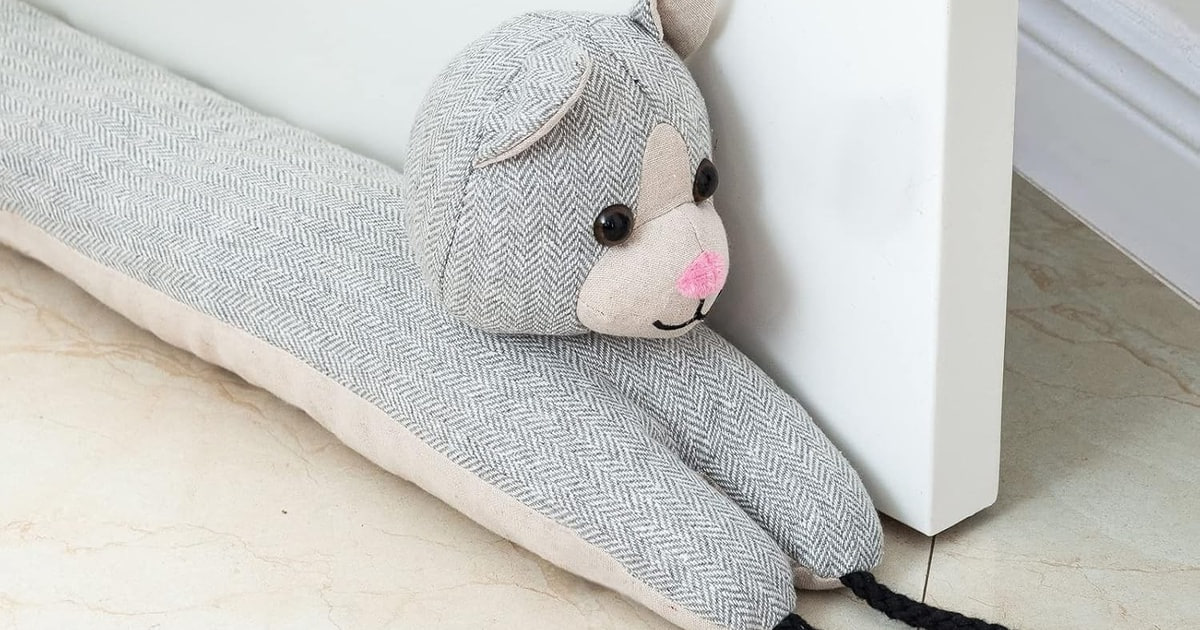
This is a 2.2-pound weighted fabric snake with seven internal sandbags, shaped like a sleeping cat. You set it against the bottom of the door and it stays where you put it — no tools, no adhesive, and no measuring beyond the 36-inch length.
$20.99fromAmazonWeight is what separates a good snake from a useless one. A light one skids away the first time the door opens. This one carries sand in seven separate pockets, so it holds a straight line against the door instead of bunching up in the middle and leaving both ends open.
A snake seals better than it looks like it should. Good Housekeeping's lab work put the reduction in detectable cold airflow from double-sided fabric draft stoppers at roughly 80 percent across a standard 36-inch door gap. A single-sided snake like this one won't match that number, but it gets you a good part of the way for none of the commitment.
It also earns its keep when you're not using it. Knitted loops at both ends let it hang on a door handle or a closet hook in summer instead of eating shelf space. Owners tend to buy it for nurseries and toddler rooms, where blocking the light strip and some hallway noise matters as much as the draft does.
Pet owners and allergy sufferers get something here too. The gap under a door is a highway for dust, pollen, and bugs, and a weighted snake plugs it without you touching the door at all. It's the only product in this guide you can pick up and move to another room in about two seconds.
Flaws but not dealbreakers
It's single-sided. It seals the room you set it in and leaves the other face of the door open, which is a real limitation on an exterior door. Owners also report light sneaking through at the ends, where the snake doesn't quite reach the jamb on either side.
And you have to reset it. Every time the door swings, the snake stays put while the door moves away from it. On a door you use twenty times a day, that gets old fast, and that's the argument for a mounted sweep instead.
Upgrade pick
The seal only touches the floor when the door is shut
Pemko 4131DRL36 Dark Bronze Finish Commercial Medium-Duty
The Pemko 4131DRL36 is a commercial medium-duty automatic door bottom sized for 36-inch doors. The seal drops when the door closes and lifts when it opens, so nothing drags across your carpet or your floor between uses.
$78.38fromAmazonThis is the answer for carpet and for doors you actually use. Every other sweep here rides on the floor, which means friction, wear, and a door that's harder to push. An automatic door bottom lifts clear the moment the door swings, so there's no drag on pile carpet and nothing scraping a wood floor. Pemko lists this model as well suited to carpeted interiors.
Seal quality is the other half of the case. Bob Vila's reporting found automatic door bottoms cut measured air infiltration by up to 90 percent against an unsealed door, while adhesive sweeps on imperfect floors landed nearer 60 to 70 percent. On a drafty exterior door over an uneven threshold, that gap is the whole point.
Noise is a genuine side benefit. Pemko's technical data puts the Sound Transmission Class improvement from a properly installed automatic door bottom at 3 to 5 points. That won't turn a hollow-core door into a recording booth. But in an open-plan house or a home office off a hallway, it's the difference between hearing a conversation and just knowing one is happening.
It's built to a commercial standard, non-handed and reversible, so it works on a door that swings either way. Popular Mechanics puts the residential life of an automatic door bottom at 10 to 15 years, against the one to three years Family Handyman found for foam-only adhesive strips. Over that stretch, the arithmetic favors the expensive hardware.
Flaws but not dealbreakers
You need tools and a willingness to drill. It's sized for a 36-inch door at 36-1/2 inches overall, so a narrower door means cutting aluminum. The end-cap screws thread into that aluminum, and an owner reports stripping them — use the right screwdriver and stop when it snugs.
It's the wrong product for a rental. You're putting fasteners into the door, and it costs several times what an adhesive sweep does up front. If you're not staying in the place long enough to collect the savings, the payback never shows up.
Also great
Built for sound first, with a double seal and real heft
TMS Automatic Door Bottom
The TMS automatic door bottom is a surface-mounted aluminum sweep with two neoprene bulb seals instead of one. It's aimed at people fighting noise — a home studio, a shared wall, a bedroom off a loud hallway — and it's the most serious piece of hardware in this guide.
$87.49fromAmazonTwo seals beat one for noise. Sound leaks through the same gap air does, and every bulb it has to squeeze past costs it energy. TMS specifies solid neoprene, which is also self-extinguishing and oil-resistant, and says the mechanism is rated through five million cycles. That's a commercial durability claim on a part most people put on a bedroom door.
Surface mounting is the practical advantage. It screws to the face of the door bottom rather than into a routed slot, so you're not pulling the door off its hinges or cutting a mortise. For most people that's the difference between a Saturday project and calling someone. It's clear anodized aluminum, so it looks like hardware rather than disappearing.
Like the Pemko, it lifts on opening and drops on closing, so carpet and raised thresholds stop being a problem. At three pounds, it's the substantial one in this group, and the mechanism feels that way when the door shuts. If your goal is a quiet room more than a warm one, this is where we'd start.
Flaws but not dealbreakers
Several owners describe a strong chemical smell out of the box that took a long time to fade. If you're sensitive to that, unwrap it and let it air out in a garage for a while before you hang it on a bedroom door.
Cutting it down is a real job. It's aluminum with a spring mechanism inside, so trimming a 36-inch unit to a narrower door calls for a power saw, not a hacksaw and optimism. And for a plain cold draft under an interior door, it's much more hardware than the problem needs.
Who this is for
Buy one of these if you can see daylight or feel moving air under a door — a front door in a cold climate, an interior door to an unheated garage or basement, a bedroom door onto a noisy hallway. Renters, in particular, get most of the benefit from the no-tool options without touching the door. If you're chasing pollen, dust, or a neighbor's cooking smells, the same gap is the culprit, and the same products close it.
This guide covers products that seal the gap under a swinging door. It doesn't cover full window kits, garage door bottom seals, or door frame weatherstripping for the sides and top, though the Department of Energy's numbers make clear that sealing all four sides saves more than sealing one. And if your door has a rotted threshold, a badly worn strike, or has dropped in the frame, fix that first — no sweep compensates for a door that no longer closes square.
How we picked
Gap size: we matched every product to a stated sealing range, from 3/8 of an inch to 1.7 inches, because the measurement under your door decides which products can even work. Material: silicone, EPDM, and neoprene over open-cell foam, following Department of Energy guidance that the former survive three to five times more compression cycles. Installation: we kept a mix of no-tool sleeves and snakes, adhesive strips, and screw-in hardware, so renters and homeowners each have a route. Floors: anything that rides on the floor drags on carpet, so we noted which products lift clear when the door opens. Noise and light: published specs put the sound gain from an automatic door bottom at 3 to 5 STC points, and blocking the light strip under a bedroom door matters to a lot of people.
Other door draft stoppers worth considering
If you want a slide-on guard that seals both sides of the door at once: The Twin Draft Guard Hug N Fit Original ($17.99) — The Twin Draft Guard is the original version of this design, with stretch fabric that hugs the door and a trimmable foam insert that fits doors from 28 to 36 inches. The double-sided shape means it blocks air on both faces, and the water-repellent cover suits a door that sees rain. It's thinner and lighter than the MAGZO, though, and that shows up in use — some owners find it flimsy, and it can roll up when a door is opened quickly. A few also note it makes a snug door stick slightly. For a modest gap on a door you don't slam, it's a fine no-tools option.
If your door already has a kerf-slotted bottom with a worn seal: The M-D Building Products 67967 Kerf Style 36 ($26.99) — This M-D replacement door bottom is the right part rather than a workaround. It slides into the existing groove on doors built to take one, has vinyl fins that seal gaps up to 3/8 of an inch, and comes two to a pack with hardware. Owners replacing tired factory seals on steel entry and garage doors report it fitting cleanly and stopping both drafts and blown rain. The catches are real, though: your door needs that kerf slot, the sealing range is the narrowest here, and getting it fully seated in the channel takes some deliberate pressing. It also isn't going to help a hollow-core interior door.
The competition
This is what our research surfaced, not a census of the category. Door sealing hardware is a deep, unglamorous aisle, and plenty of decent products never make it onto a bestseller list. Here's the one we looked at closely that didn't earn a spot above.
The Weather Stripping Door Seal Strip ($11.35) — The ZY PLUM silicone seal strip is a 16-foot roll of transparent adhesive weatherstripping, about 45mm wide, that you cut to length. It's genuinely useful and owners like it — it's the thing to reach for on a sliding patio door, around a frame that doesn't quite meet, or along the sides and top of an entry door, and the DOE's numbers say that perimeter sealing is where a lot of the remaining savings live. But it isn't an under-door sweep. There's no fin or bulb designed to bridge the space between the door and the floor, so it can't do the job our picks do. Buy it as a companion to a sweep, not instead of one, and expect the same adhesive caveats: clean the surface, warm it in cold weather, and accept that some owners still see it lift.
Measuring and installation
Measure before you buy anything. Close the door, slide a ruler or a stack of quarters into the gap at the hinge side, the middle, and the latch side, and use the largest number — floors are rarely level, and a sweep sized to the smallest gap seals nothing at the other end. For adhesive products, clean the door bottom with rubbing alcohol and let it dry, then warm the strip with a hair dryer if the room is cold, because adhesive that never fully bonds is the single most common failure here. Check your floor clearance too: a strip that adds half an inch will scrape a door that already brushes the carpet. For screw-in hardware, drill pilot holes and stop tightening as soon as the screw snugs, since the end caps thread into soft aluminum.
Questions we get
How do I measure the gap under my door before buying?
Close the door and measure the space between the bottom of the door and the floor at three points: hinge side, middle, and latch side. Use the biggest of the three numbers, because that's the gap you actually need to close. A ruler works, and so does sliding quarters into the gap and counting them. Most products here handle up to an inch; only the MAGZO goes to 1.7 inches.
What's the difference between a door sweep, a door bottom, and a draft snake?
A sweep attaches to the face of the door and hangs down to meet the floor, usually with adhesive or screws. A door bottom slots into or mounts on the bottom edge itself, and an automatic version lifts its seal when the door opens. A draft snake is a weighted fabric tube that just sits on the floor against the door. Sweeps and door bottoms seal better; snakes require zero installation.
Do these actually save money on heating and cooling?
The savings are real but modest on their own. The Department of Energy attributes 25 to 40 percent of a home's heating and cooling energy to air leakage through the envelope, and Consumer Reports puts the savings from thorough air sealing at 5 to 20 percent a year. A single sweep is one piece of that. Angi's research still ranks weatherstripping among the fastest-payback improvements you can make.
Will a draft stopper work on carpet?
It depends on the type. Anything that rides on the floor — adhesive sweeps, slide-on sleeves — will drag on pile carpet and make the door harder to open, and MAGZO lists only smooth floors for its sleeve. Automatic door bottoms like the Pemko and the TMS lift their seal when the door swings, so carpet isn't an issue. A weighted snake also works fine on carpet, since you move it anyway.
Can a draft stopper reduce noise from a hallway?
Yes, though how much depends on the product. Pemko's technical data puts the Sound Transmission Class improvement from a properly installed automatic door bottom at 3 to 5 points, which is noticeable. Fabric snakes and sleeves help less — MAGZO says plainly that its sleeve isn't a soundproofing product. If noise is your main problem, the TMS with its double neoprene seal is the one built for it.
What's the best option if I rent and can't modify the door?
Stick to the no-tool products. The MAGZO sleeve slides under the door and holds with an elastic band and hook-and-loop tabs, and the Marwood snake just sits on the floor. Both leave nothing behind. The Suptikes silicone strip is technically removable and washable, but it uses adhesive, so check your lease and test a corner on a painted door first.
Why you should trust us
For this guide:
- We read manufacturer specifications and listing details for every product here, including stated gap ranges, materials, door widths, and mounting method.
- We compared published guidance and reporting from the U.S. Department of Energy, Consumer Reports, This Old House, Bob Vila, Good Housekeeping, Family Handyman, Popular Mechanics, Angi, ENERGY STAR, Lawrence Berkeley National Laboratory, and Pemko's technical data.
- We read owner feedback across these listings for recurring themes — adhesive lifting at the ends, drag on carpet, off-gassing smell, and light leaking at the edges — and used those patterns to shape the flaws sections rather than quoting anyone.
- We read owner reviews on every listing, weighted toward the critical ones, because that is where the recurring failures show up.
- We have a systematic way of automatically fetching the latest prices, so the numbers on this page stay current.
- This is a research-focused guide, so the team may not own every product listed — though we often do own the top winners, which gives us extra context for the recommendations.
- We don't accept free products, and the retailer commission never changes which product we recommend.
Sources
Air Sealing Your Home — Energy.gov, U.S. Department of Energy
Weatherstripping — Energy.gov, U.S. Department of Energy
Best Door Draft Stoppers — Bob Vila, Bob Vila
The Best Door Sweeps — Family Handyman, Family Handyman
Best Draft Stoppers — Good Housekeeping, Good Housekeeping
Door Draft Stopper Reviews — This Old House, This Old House
Weatherstripping and Caulking — Consumer Reports, Consumer Reports
How to Choose a Door Sweep — Popular Mechanics, Popular Mechanics
Sound Transmission Class (STC) Ratings for Door Seals — Pemko Technical Data, Pemko
Energy Efficiency Upgrades That Pay Off — Angi (formerly Angie's List), Angi
Amazon product listings and owner reviews for all 8 products
Manufacturer specification pages for each product
Some passages in this guide may be paraphrased with AI help. Prices are refreshed automatically.
More like this.
Continue exploring home reviews and recommendations.

The Best Window Insulation Kits and Draft Stoppers
A drafty house doesn't announce itself. You just notice that the room with the big window stays cold no matter how high you set the thermostat, or that…

The Best Chimney Draft Stoppers and Flue Dampers
A fireplace you never light is still a hole in your roof. On a cold night you can stand a few feet away and feel the air slide down and pool around your…

The Best Door Threshold Seals and Weatherstripping
You can feel a bad door seal before you can see it. Stand near the front door on a cold morning and there's a cool ribbon of air across your ankles. In…

The Best Smart Door Locks and Keyless Entry Systems
A smart lock earns its keep in the small moments. You're carrying groceries in both arms and the door opens anyway. Your kid gets home from school and you…

The Best Garage Door Insulation Kits
A bare steel garage door is basically a heat sink bolted to your house. In July it soaks up sun all afternoon and radiates it into the space where your…

The Best Smart Wi-Fi Garage Door Openers
A garage door is the biggest moving thing most people own, and it's also the door you're most likely to leave open by accident. A smart opener fixes that.…