The Best Solar Attic Fans
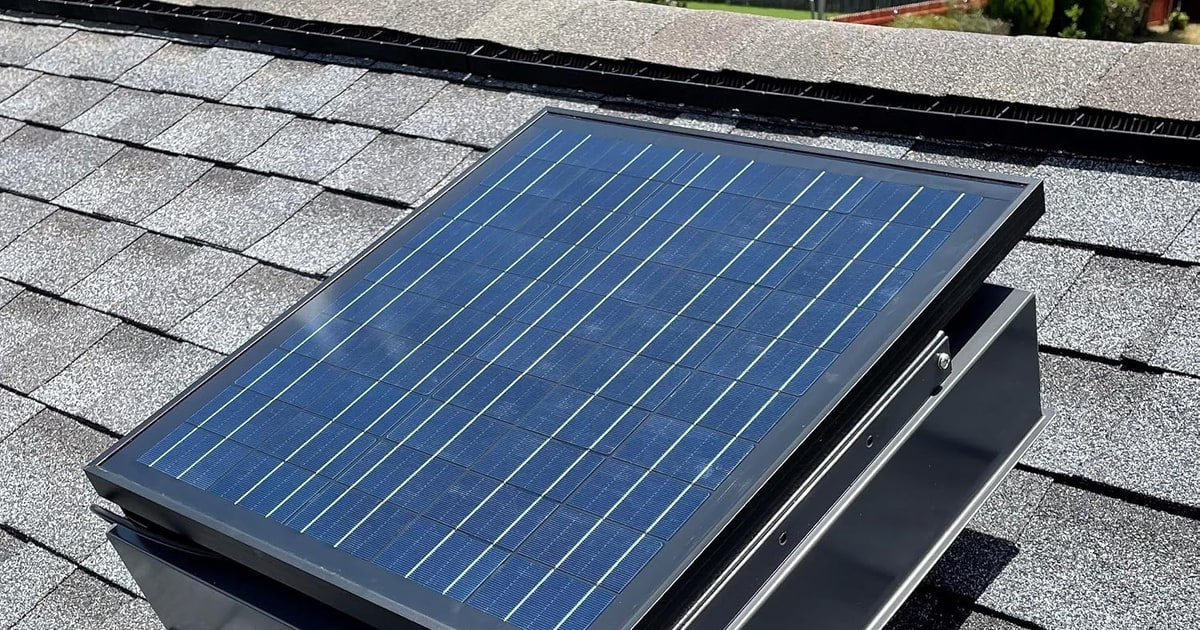
Your attic is the hottest room in the house, and nobody lives in it. On a clear summer afternoon the air up there can push past 150°F, and that heat doesn't stay put. It soaks down through the ceiling into your bedrooms, and your air conditioner spends the rest of the day fighting it. A solar attic fan pulls that superheated air out before it reaches you, and it runs on the same sun that created the problem. No wiring, no meter spinning, no monthly bill.
But no attic fan is magic, and parts of this category get oversold. Every solar fan slows when the sun does and stops after dark, so round-the-clock coverage means grid backup or a second strategy. The CFM number on the box comes from open-air ratings, not from your attic with its joists and ducts. And a powerful fan is useless — or worse — if your soffit vents can't feed it. Pull harder than your intake allows and you'll just draw conditioned air up out of your living room.
So treat one of these as part of a ventilation plan, not a replacement for it. The right choice depends less on wattage than on how big your attic is, how humid your summers get, and whether you want to think about the fan again once it's up on the roof. We think that the Remington Solar 30 Watt Roof Mount Solar Attic Fan is the best solar attic fan for most people, and that the Natural Light Energy Systems 48 Watt is the one to buy if you want a lifetime warranty on every component.
Everything we recommend

Automatic heat and moisture control, no wiring needed

A lifetime warranty on every part, if you can pay for it

The simplest true-solar option for a garage or gable vent

Quieter running and app control for rooms under the attic
At a glance
| Product | CFM | Wattage | Price | |
|---|---|---|---|---|
| Remington Solar 30 Watt Roof Mount SolarTop pick | — | 30 Watt | $398 |
| Natural Light Energy Systems 48 Watt RoofRunner-up | 1,881 CFM | 48 Watt | $709.70 |
 | iLIVING HYBRID Ready Smart Thermostat Solar RoofAlso consider | 1150 CFM | 40-Watt | $344.99 |
| Quietcool AFR SMT ES-2.0 Roof Mount SmartAlso great | 1950 CFM | 24.6 Watts | $399 |
 | VEVOR 42W Solar Attic FanAlso consider | 2800 CFM | 42W | $225.06 |
| Amtrak Solar 50-Watt Solar-Powered Exhaust FanBudget pick | — | 50-Watt | $179.95 |
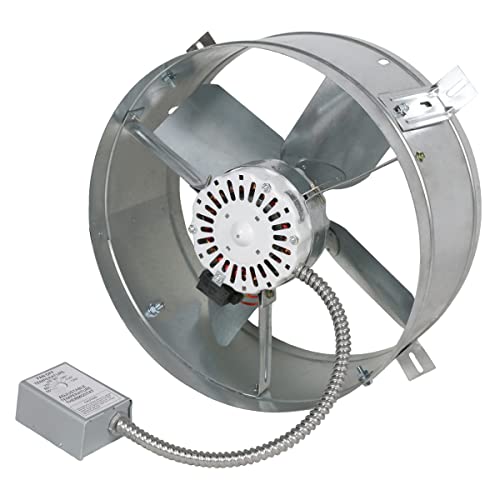 | Cool Attic CX1500 Gable Mount Power AtticAlso in lineup | 1500 CFM | — | $144.84 |
How we picked
Panel wattage. We compared rated panel output across every fan, because that's what keeps a blade turning when clouds pass. Anything in the 36-to-50-watt range holds up in partial sun; 20-watt units drop to almost nothing.
Airflow versus attic size. We checked manufacturer CFM ratings against the coverage areas they claim, using the standard of 1 CFM per square foot and 1.5 in hot climates. Fans whose stated coverage outran their airflow got marked down.
Motor and noise. We favored brushless and ECM motors, which published reviews and owner feedback both link to longer life and less drone. That matters most when a bedroom sits under the attic.
Controls that think. We looked for a thermostat, and ideally a humidistat, so the motor isn't running in cool or dry conditions for no reason. Owners of thermostat-free fans routinely report exhausting warm air all winter by accident.
Warranty coverage. We read the warranty terms for separate coverage on panel, motor and housing rather than a single vague number. Premium brands go to lifetime or 25 years; budget models often stop at one to three.
Top pick
Automatic heat and moisture control, no wiring needed
Remington Solar 30 Watt Roof Mount Solar
This is the rare solar attic fan that manages both heat and humidity on its own, with a built-in thermostat and humidistat deciding when the motor runs. It's sized for most single-family attics, installs without an electrician, and the brushless motor is quiet enough that you won't hear it downstairs.
$398fromAmazonThe thermostat and humidistat do the thinking, so you never touch it. Most solar fans in this range spin whenever the sun hits the panel, whether your attic needs it or not. This one watches temperature and moisture and runs the motor only when the readings call for it. That saves wear on a part you can't easily replace, and it means the fan keeps working on damp, overcast days when heat isn't the issue but rot is.
The 30-watt panel is matched to the attic most people actually have. Remington rates it for spaces up to about 2,400 square feet, which covers a typical two-story or ranch house at the standard 1 CFM per square foot. If your attic runs bigger, or you're in Phoenix or Houston where 1.5 CFM per square foot is the target, plan on two fans rather than reaching for one bigger unit.
A brushless motor is the part that decides how long this thing lasts. Brushes are the wear item in a cheap fan, and they're the reason budget models start groaning after a few summers. Brushless designs have no contact friction, so they run quieter and last far longer. Owners of this fan tend to report it as near-silent from inside the house, which matters if a bedroom sits under the attic.
You can add night running later instead of paying for it now. Remington sells a Hybrid Adapter that connects the fan to household power so it keeps going after dark or under heavy cloud. You don't need it on day one. If your first summer shows the attic still holding heat into the evening, you can add it without replacing anything.
Installation is a roofing job, not an electrical one. There's no circuit to find, no permit for wiring, no electrician. The unit ships with oversized 22.5-inch steel flashing, which is the single biggest defense against the leak that everyone worries about. If you're comfortable cutting a hole and setting flashing under shingle courses, this is a weekend job.
Flaws but not dealbreakers
Night and cloudy-day operation costs extra. The Hybrid Adapter is sold separately, and in a humid climate you'll probably want it. That's a real add-on cost on a fan that already sits above several higher-wattage rivals, and it's worth budgeting for up front rather than discovering later.
There's no app. You set the thermostat and humidistat by hand, then leave them. If you want to check attic conditions from your phone or shift the trigger temperature by season without climbing a ladder, the QuietCool is the better fit.
You're paying for the controls, not raw airflow. On paper, fans with 40- and 50-watt panels move more air for less money. The automation is what justifies the gap here. If your attic is large and simple and you just need volume, that math may not work in this fan's favor.
Remington backs the fan with a limited lifetime warranty and a 30-day satisfaction guarantee.
Runner-up
A lifetime warranty on every part, if you can pay for it
Natural Light Energy Systems 48 Watt Roof
Natural Light's 48-watt fan is the one roofers keep specifying, and the warranty explains why: panel, motor and materials are all covered for life. The bigger panel also holds airflow when clouds roll through, which is where smaller solar fans quietly give up.
$709.70fromAmazonThe warranty is the product. Lifetime coverage on the solar panel, the motor and the materials is not something anyone else here offers, and it changes how you should think about the purchase. You install it once and you're done. For a fan that lives on a roof for twenty or thirty years, that's worth more than any spec on the box.
Forty-eight watts buys you consistency, not just peak power. Rated at up to 1,881 CFM for attics as large as 2,825 square feet, this fan has enough panel to keep moving meaningful air when the sun goes thin. A 20-watt fan under the same clouds slows to almost nothing. If your roof gets afternoon shade from trees, that headroom is the whole point.
Contractors pick it because it doesn't generate callbacks. Professional installers eat the cost of warranty visits, so they gravitate to hardware that stays put. This fan's reputation among roofers is built on that, not on marketing. Published reviews of the category consistently place it at the reliability end of the field.
Nothing needs to be wired. Like the Remington, it mounts through the roof deck and runs entirely off its own panel. No circuit, no electrician, no inspection for electrical work. Your only real skill requirement is flashing the penetration correctly.
Flaws but not dealbreakers
It's the most expensive fan in this guide, by a wide margin. You're buying the warranty and the build, and there's no way around that. If your plan is to sell the house in five years, you probably won't see the value back.
The base configuration has no thermostat or humidistat. It runs when the sun shines. In cool weather that means exhausting attic air you'd rather keep, and it means no help at all with winter moisture. The Remington handles both automatically for less.
No app, no scheduling, no sensors to read. This is deliberately simple hardware. That's part of why it lasts, but if you want to see what your attic is doing without going up there, look elsewhere.
Natural Light covers the solar panel, motor and materials under a lifetime manufacturer's warranty.
Budget pick
The simplest true-solar option for a garage or gable vent
Amtrak Solar 50-Watt Solar-Powered Exhaust Fan
Amtrak's 50-watt fan is the easiest way to get real solar ventilation into a space that isn't your main attic. Connectors come pre-installed, the panel mounts separately on 15 feet of wire, and a physical switch lets you shut it off when you don't want it running.
$179.95fromAmazonIt goes almost anywhere, which is the point. Gable vent, garage, shed, greenhouse, cabin, RV — the mounting bracket and 15 feet of spare wire let you put the fan in the opening and the panel wherever the sun actually is. Roof-mount fans can't do that. If your problem is a garage that hits 120°F by mid-afternoon, this is the straightforward fix.
Fifty watts is generous for what it's asked to do. Because it's usually ventilating a single room or a small gable attic rather than a whole house, that panel keeps the blade turning even under partial cloud. Smaller panels stall in the same conditions.
The on/off switch solves a problem most attic fans ignore. Fans without a thermostat happily exhaust warm air all winter, which is exactly backwards. Here you just flip it off when the weather turns, and back on in spring. It's crude, and it works.
Installation is genuinely plug-and-play. The fan and panel leads arrive with matched connectors already attached, so there's no stripping wire or guessing polarity. The motor uses sealed ball bearings with thermal protection, which is the right build for something mounted in a dusty shed.
Flaws but not dealbreakers
There's no thermostat, so nothing is automatic. It runs whenever the sun is up and you've left the switch on, even on a mild day when the space doesn't need it. Remembering to shut it down is now your job.
This isn't a whole-attic solution. It's built for gable and wall openings, not for cutting into a roof deck and flashing. If you need to ventilate 2,000 square feet of attic from the ridge, buy one of the roof-mount picks instead.
The feature set is thin next to similarly positioned rivals. No humidistat, no app, no sensors. You're buying a motor, a panel and a switch.
Also great
Quieter running and app control for rooms under the attic
Quietcool AFR SMT ES-2.0 Roof Mount Smart
If a bedroom or home office sits directly beneath your attic, fan drone stops being a spec and starts being a daily annoyance. QuietCool built this one around that problem, with three speeds, a perforated housing and an app that lets you set thresholds from the couch.
$399fromAmazonThree speeds mean you can trade airflow for quiet. On high it moves up to 1,950 CFM, which is plenty for a large attic. On low it draws as little as 24.6 watts and gets correspondingly quieter. Most fans give you one speed and one noise level; here you choose based on what's happening in the room below.
The housing is designed for sound, not just weather. A one-piece perforated cylindrical housing and a one-piece stamped steel hood cut down the resonance that makes cheap fans buzz. The UV-resistant coating is about longevity — it's what keeps the paint from chalking and fading after years of direct sun.
The app is actually useful for something you can't reach. You can change the trigger temperature seasonally, check what the attic is doing, and confirm the fan is running without dragging a ladder out. Both a thermostat and a humidistat are included, so it manages heat and moisture the way the Remington does.
Efficiency at low speed is the quiet win. Energy Star's benchmark for certified powered attic ventilators is 2.8 CFM per watt, and a brush-free ECM running at 24.6 watts clears that comfortably. Low speed isn't a compromise mode — it's where this fan does most of its useful work.
Wiring is straightforward. It ships plug-and-play with a 20-foot power cord, so the connection side doesn't require an electrician's visit or a new circuit run across the attic.
Flaws but not dealbreakers
You need to be comfortable with an app to get your money's worth. Strip away the smart features and you're left with a competent fan at a price that assumes you'll use them. If setting up another connected device sounds like a chore, the Remington gives you automation without the phone.
Solar output is the weak link on gray days. The panel wattage here is modest compared with the 42- and 48-watt units, so performance drops more under heavy cloud. Owners in consistently overcast regions notice this.
Setup takes longer than a thermostat-only fan. Pairing, thresholds, speed selection — it's all easy, but it's all extra steps on installation day.
Who this is for
Buy one of these if you live somewhere your air conditioner runs hard for months at a stretch and your attic floor is reasonably well air-sealed. That second condition does more work than most shoppers realize. Research from the Florida Solar Energy Center found powered attic ventilators cut whole-home cooling energy by as much as 10% in tight homes — and delivered almost nothing in leaky ones, because the fan was pulling conditioned air up through ceiling gaps and recessed lights. If you have can lights with no gaskets and a pull-down attic hatch that doesn't seal, fix that first.
This guide covers roof- and gable-mounted attic ventilators sized for houses, garages and outbuildings. It doesn't cover whole-house fans, ridge vents, powered ridge products or solar panel systems that feed your house. And it isn't the right buy if you're in a cold climate where the attic rarely gets hot, or if you're renting and can't cut a hole in someone else's roof.
How we picked
We built the shortlist from manufacturer spec sheets, published reviews and recurring themes in owner feedback, then weighed five things. Panel wattage: enough capacity to keep moving air through cloud cover, which generally means 36 watts or more. Airflow versus attic size: rated CFM checked against the claimed coverage area, at 1 CFM per square foot and 1.5 in hot climates. Motor and noise: brushless and ECM designs preferred, since they run quieter and outlast brushed motors by years. Controls: a thermostat at minimum, a humidistat where moisture is the real enemy. Warranty: separate, stated coverage on the panel, the motor and the housing, not one number covering everything vaguely.
Other solar attic fans worth considering
If you want the best defense against moisture and salt air: The iLIVING HYBRID Ready Smart Thermostat Solar Roof ($344.99) — The iLIVING HYBRID Ready 40W has an IP68 waterproof brushless motor, which is a higher sealing rating than anything else here, and a 15-year motor warranty behind it. That combination makes it the sensible pick for coastal homes and places where heavy rain is routine. The solar panel adjusts to 0°, 15°, 30° or 45°, so an unusual roof pitch doesn't cost you output the way a fixed panel would, and the smart thermostat dials in anywhere from 50°F to 122°F. What you give up is airflow: 1,150 CFM is low for a 40-watt fan, and the coverage claim of 2,900 square feet leans on that number harder than we'd like. The thermostat is a physical dial, not an app. A separate AC/DC adapter kit is needed for day-and-night running.
If you want maximum airflow and round-the-clock coverage: The VEVOR 42W Solar Attic Fan ($225.06) — VEVOR's 42W is rated at 2,800 CFM, the highest number in this guide, and it backs that with an MPPT regulator that continuously tunes the panel's operating voltage instead of drawing a fixed load. In practice that means better output in weak morning and evening light. It also switches from solar to household power at sunset, so the attic keeps venting overnight, and it adds temperature and humidity sensors, a smoke-detection shutoff and a remote that works from about 30 feet. Two catches. The grid changeover means wiring, so this isn't an off-grid install. And VEVOR has a much shorter track record than Natural Light or Remington, which is worth weighing on something that has to survive a decade of roof weather.
The competition
This is what our research turned up, not a census of the category. Attic ventilation is a crowded aisle with a lot of rebadged hardware and inflated CFM claims, and new listings appear constantly. The fan below is worth knowing about, even though it lost out to a pick.
The Cool Attic CX1500 Gable Mount Power Attic ($144.84) — The Cool Attic CX1500 is a traditional gable-mount ventilator that runs on household AC power, not solar — which is why it isn't one of our picks. That distinction has two consequences: it adds to your electric bill every time it runs, and it doesn't qualify for the federal residential clean energy credit that the solar fans here do. What it does well is basic and useful. A thermostat handles activation automatically, the 14-inch blade moves 1,500 CFM through attics up to 1,850 square feet, and gable mounting means no roof penetration and no flashing to get wrong. Ventamatic has been building this kind of hardware for more than sixty years. Choose it if you have a wide, open, rectangular attic with a usable gable vent, a circuit nearby, and no interest in a solar panel. For most people, the Amtrak Solar is the better long-term buy at a similar level of simplicity.
Installation notes
Before you cut anything, check your intake. Exhaust capacity without matching soffit or eave venting depressurizes the attic and pulls conditioned air up from your living space, which raises bills instead of lowering them. Your intake net free area should at least match your planned exhaust. For roof-mount fans, set the unit high on the plane where heat collects, weave the flashing under the shingle courses above it, and seal fasteners properly — leaks come from sloppy flashing, not from the hole itself. Check your shingle warranty first, since some manufacturers require a licensed contractor for any penetration. Aim the panel south, and leave your ridge and passive vents in place. Code requires them, and they work at night when the fan doesn't.
Questions we get
What size solar attic fan do I need?
Start with 1 CFM per square foot of attic floor. So a 1,500-square-foot attic wants at least 1,500 CFM, and a 2,000-square-foot attic wants 2,000. In Texas, Arizona, Florida or inland California, where peak temperatures blow past 90°F for months, target 1.5 CFM per square foot instead — that same 2,000-square-foot attic now needs about 3,000 CFM, which usually means two fans.
Do solar attic fans work on cloudy days or at night?
Solar-only fans slow down under heavy cloud and stop completely after dark. A bigger panel helps: 40- and 50-watt units keep meaningful air moving through partial cloud, while 20-watt models drop to a crawl. If you need coverage around the clock, the VEVOR switches to household power at sunset, and both the Remington and the iLIVING accept an optional adapter that does the same thing.
Can I install one myself?
Most people with basic DIY confidence can. Solar fans need no electrical work, just standard roofing tools. The real skill is cutting the roof deck and flashing the unit so it doesn't leak — if that makes you nervous, hire a roofer. Gable-mount fans like the Amtrak skip roof penetration entirely and are much friendlier for a first-timer. Check local codes, since some jurisdictions want a permit for roof penetrations.
Gable mount or roof mount — which is better?
Roof-mount fans pull from the highest point of the attic, where the worst heat pools, and they're the better choice for hip roofs and segmented or complex attic layouts. Gable-mount fans sit in an existing gable-end opening and ventilate by cross-flow, which works well in wide, open rectangular attics. Gable installs are simpler because nothing gets cut into the roof.
Do solar attic fans qualify for the federal tax credit?
Yes. Solar-powered attic fans count as solar energy property under the 30% Residential Clean Energy Credit, claimed on IRS Form 5695, and the credit covers installation cost as well as equipment. AC-powered units like the Cool Attic CX1500 don't qualify. You claim it for the tax year the equipment is placed in service. Confirm your situation with a tax professional.
Can a solar attic fan replace ridge vents and passive ventilation?
No, and trying is a mistake. Building code sets a minimum for passive ventilation, and most fan manufacturers specifically say to leave existing ridge vents in place. Passive venting runs continuously, including overnight and through winter when a solar fan is idle. Use the fan to handle the peak daytime load and let passive ventilation cover everything else.
Why you should trust us
For this guide:
- We read manufacturer specification sheets for all seven fans, comparing panel wattage, rated CFM, motor type and stated coverage area against the industry sizing standard.
- We reviewed published reporting on attic ventilation from This Old House, the Florida Solar Energy Center and Oak Ridge National Laboratory to understand where these fans help and where they don't.
- We looked at recurring themes in owner feedback for each model — especially noise, leak complaints and how the fans behave in winter — to identify flaws that spec sheets don't show.
- We read owner reviews on every listing, weighted toward the critical ones, because that is where the recurring failures show up.
- We have a systematic way of automatically fetching the latest prices, so the numbers on this page stay current.
- This is a research-focused guide, so the team may not own every product listed — though we often do own the top winners, which gives us extra context for the recommendations.
- We don't accept free products, and the retailer commission never changes which product we recommend.
Sources
Best Solar Attic Fans – This Old House Reviews, This Old House
Powered Attic Ventilators Research – Florida Solar Energy Center, Florida Solar Energy Center (FSEC/UCF)
Residential Clean Energy Credit – IRS Publication 5695, Internal Revenue Service (IRS)
Attic Thermal Performance and Cooling Load – Oak Ridge National Laboratory, Oak Ridge National Laboratory (DOE)
Energy Star Key Product Criteria – Residential Ventilation Fans, Energy Star / U.S. EPA
Amazon product listings and owner reviews for all 7 products
Manufacturer specification pages for each product
Some passages in this guide may be paraphrased with AI help. Prices are refreshed automatically.
More like this.
Continue exploring home reviews and recommendations.

The Best Attic Ladders
Most people climb into the attic maybe three times a year - bins up, bins down, and one trip to chase a noise. That's exactly why the ladder matters.…

The Best Attic Stair Insulation Covers
A pull-down attic stair is a hole in your ceiling with a thin piece of plywood over it. That panel does almost nothing thermally - think single-pane…

The Best Ceiling Fans With Lights
A ceiling fan doesn't cool a room. It cools you, by moving air across your skin, and that difference is bigger than it sounds. The Department of Energy…

The Best Portable Solar Generators for Emergencies
A power outage is boring right up until it isn't. The fridge stays cold for a few hours, then it doesn't. The phones drain, the router dies, and if…

The Best Outdoor Solar Garden Lights
Solar garden lights solve a problem that used to mean digging a trench. You want the front walk lit so nobody trips on the step, or the back fence lit so…

The Best Solar Power Banks and Portable Chargers
A charger you carry outside has one job: keep your phone alive when there's no outlet for days. That sounds simple until you're three nights into a trip…