The Best Fermentation Kits
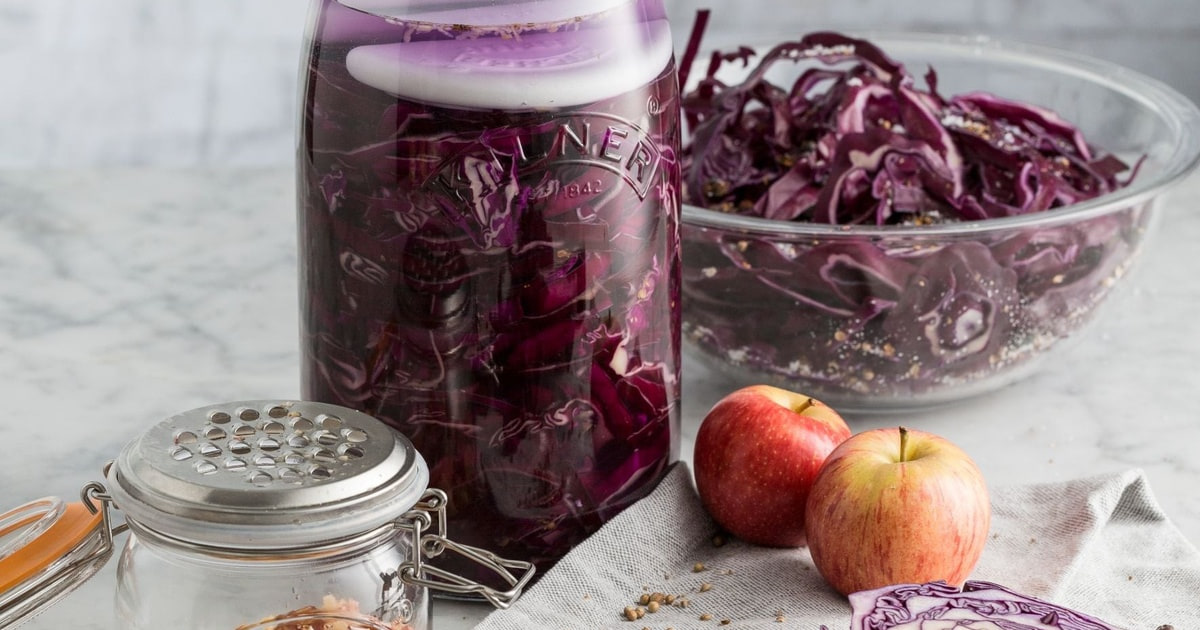
Fermenting cabbage at home sounds complicated until you do it once. Then you realize the hard part isn't the bacteria — it's keeping your vegetables under the brine. Anything poking above the liquid meets oxygen, and oxygen invites mold. That's the whole game. A good kit gives you a weight heavy enough to hold shredded cabbage down and a lid that lets carbon dioxide out without letting air back in. Everything else is convenience. Get those two things right and your first batch of sauerkraut will probably work.
No kit makes fermenting foolproof, though. You still have to weigh your salt, use water that isn't heavily chlorinated, and check on the jar for the first few days. Kits also split hard by what you're making: vegetable gear and kombucha gear share almost nothing, so a kraut kit won't help you brew tea and a SCOBY won't pickle a cucumber. And if a batch smells wrong or grows fuzzy color, you throw it out. No amount of hardware changes that.
Most people should start with Mason-jar hardware, because the jars are cheap, the batches are small, and a failed quart of kimchi costs you one head of napa cabbage. Big-batch fermenters and gardeners with a hundred pounds of cabbage need a crock instead. We think that the Masontops Complete Mason Jar Fermentation Kit is the best fermentation kit for most people, and that the Ohio Stoneware 5 Gallon Fermentation & Preservation Crock is the one to buy if you're putting up a whole harvest at once.
Everything we recommend
Turns four jars you already own into real fermenters

Buy it if you ferment cabbage by the bushel, not the quart

Three jars' worth of gear, plus a pump to pull the air out

One big handsome jar instead of a shelf of small ones
Prices as of Oct 22, 7:36 AM PT · Details
At a glance
| Product | Capacity | Weight material | Price | |
|---|---|---|---|---|
| Masontops Complete Mason Jar Fermentation Kit -Top pick | 4 wide-mouth jars | — | $51.29On sale |
| Nourished Essentials Fermentation Kit - 3 FermentationBudget pick | 3 wide-mouth jars | Glass | Check price |
| KILNER Fermentation SetAlso great | 3 liters | Ceramic | Check price |
 | Cultures for Health Kombucha Starter KitAlso consider | — | — | $35.99 |
| Ohio Stoneware 5 Gallon Fermentation & PreservationUpgrade pick | 5 gallons | — | $209.95 |
Prices as of Oct 22, 7:36 AM PT · Details
How we picked
Keeping food submerged. University extension guidance is clear that mold needs oxygen, so the single most important job of any kit is holding vegetables under the brine. We favored kits with heavy, flat, properly sized weights over anything that relies on a cabbage leaf or an improvised plate.
Airlock design. We compared manufacturer descriptions of how each lid vents carbon dioxide without admitting oxygen, including silicone one-way valves, waterless airlocks, and sealed covers with no water channel. Designs that remove the need to burp jars daily scored higher, because owner feedback repeatedly ties failed batches to skipped burping.
Jar compatibility. Manufacturers state which jars their weights and lids fit, and owner feedback flagged the gaps — several report that weights sized for wide-mouth quarts won't drop into a Ball half-gallon. We read those specs for each kit and noted the limits rather than assuming Mason-jar gear is universal.
Material safety. We looked for food-grade glass, BPA-free plastics and silicone, and explicit lead-free claims on anything ceramic, since fermenting means acidic food sitting against the vessel for weeks. Ohio Stoneware and Kilner both state their materials outright, which is what we wanted to see.
Beginner support. First batches fail for predictable reasons, so we gave credit to kits that include printed recipes, salt guidance, or a tamper. Published home-preservation guidance and extension pages fill the rest of the gap, but a booklet in the box makes a real difference on day one.
Top pickOn sale
Turns four jars you already own into real fermenters
Masontops Complete Mason Jar Fermentation Kit -
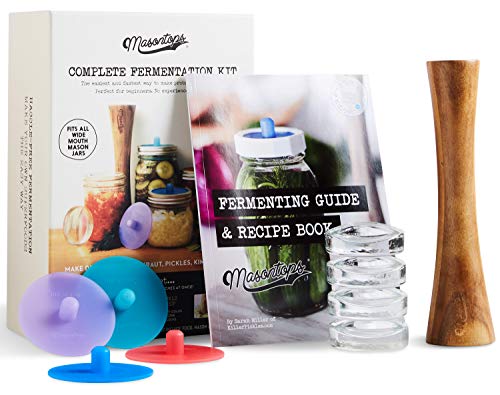
This kit gives you four silicone airlock lids, four glass weights, and a wooden tamper for wide-mouth Mason jars. You can run four different ferments at once, which is how you figure out what you actually like eating.
$51.29fromAmazonTypical pricePrices as of Oct 22, 7:36 AM PT · Details
The four-jar setup is the real reason to buy this one. Most beginners don't know whether they're a kraut person or a hot-sauce person. With four jars going, you find out in a week. Start a quart of cabbage, a quart of carrots, a jar of radishes, and a jar of sliced jalapeños on a Sunday. By the following weekend you know which one you'll keep making. One-jar kits can't teach you that.
The Pickle Pipe lids are solid silicone with a one-way valve, so there's no water to top off and no plastic airlock to fill. Masontops says gas vents out without letting oxygen in, which means you skip the daily burping that sinks a lot of first attempts. You screw the lid down with the metal band you already have and walk away. That's about as hands-off as vegetable fermenting gets.
The Pickle Pebble weights are food-grade glass, flat, and sized for wide-mouth jars. Glass is the easy pick here — it doesn't absorb garlic or chili, it goes in the dishwasher, and you never have to wonder about glaze. Extension guidance is blunt about this: mold needs oxygen, so keeping vegetables under the brine is the main thing that prevents it. A heavy flat disc does that better than a cabbage leaf or a baggie of water.
The acacia tamper is the piece people underrate. Dry-salted sauerkraut doesn't come with brine — you make the brine by bruising the cabbage until it releases its own water. A wooden packer lets you lean into the jar without cracking the glass or shredding your knuckles. The kit also comes with a printed recipe book, which matters more on your first batch than any spec on this page.
You're limited to wide-mouth jars, and you'll need to buy the jars separately if you don't have them. That's a fair trade. Quart jars are cheap and stackable, and small batches mean small mistakes.
Flaws but not dealbreakers
Nothing here is airtight in the water-seal sense. A silicone valve is simpler than a water lock, but it's also a seal you can't inspect — if a valve stiffens with age or gets a nick, you won't see it the way you'd see a dry water channel. Owners of silicone valve lids generally report them lasting fine, but they're the part most likely to need replacing eventually.
Quart jars cap you at small batches. If you're processing a bushel of cabbage from the garden, filling and tending a dozen jars is tedious work compared to packing one crock.
The weights are cut for wide-mouth jars only. Regular-mouth Mason jars, and half-gallon jars with a narrower shoulder, won't take them.
Upgrade pick
Buy it if you ferment cabbage by the bushel, not the quart
Ohio Stoneware 5 Gallon Fermentation & Preservation
This 5-gallon stoneware crock comes with a full-width lid and a two-piece pressing stone set. It's for the gardener who shreds twenty-five pounds of cabbage in an afternoon and wants it all going in one vessel.
$209.95fromAmazonPrices as of Oct 22, 7:36 AM PT · Details
Scale is the entire argument. Ohio Stoneware lists this as a 5-gallon crock weighing 28 pounds empty, with a 6-pound two-piece weight set and a 9-pound lid. An owner reports getting 20 to 25 pounds of shredded cabbage in and still having room. If you grow your own cabbage, that's one afternoon of work instead of a month of quart jars.
The pressing stones are what you're really paying for. They're matched to the crock's diameter, so they press the full surface of the cabbage rather than leaving a ring of exposed shreds around the edge. Six pounds of stone sitting on cabbage pushes brine up and over it and keeps it there for weeks. Improvised weights — plates, water-filled bags, a jar of marbles — tend to drift, tip, or let a corner float up.
Ohio Stoneware says it's made in the USA with lead-free, food-safe materials and glazes, and that it's dishwasher, microwave, oven, and refrigerator safe. For a ceramic vessel holding acidic food for weeks, lead-free glaze isn't a nice-to-have. Owners consistently describe the crock as heavy and well made, which is what you want from something that'll outlast several kitchens.
Read the lid description carefully before you buy. This is the sealed-lid style — the lid covers the full top of the crock and there's no water channel. That means it's not a water-seal crock, so you'll vent it yourself and you won't get the hands-off behavior of an airlock. Some owners expect the gutter and are surprised to find a smooth rim.
Flaws but not dealbreakers
It's enormous. At roughly 18 inches across and nearly 30 inches tall boxed, with 28 pounds of empty crock, this isn't going on a counter and it isn't going in a cabinet. You need floor space in a cool corner, and you'll want a sturdy stand.
The sealed lid without a water channel means it behaves like a covered crock, not an airlock vessel. You get less protection from oxygen than a water-seal jar gives you, and you have to pay more attention.
Stoneware this heavy travels badly. At least one owner received a crock in pieces because of thin packing, and a 28-pound ceramic vessel is unforgiving when a box gets dropped. Returns are easy enough, but inspect it the day it lands.
A 5-gallon minimum batch is a commitment. If you don't actually have a garden's worth of produce, you'll either make too much or run a huge vessel at a quarter full, which wastes the brine volume advantage.
Budget pick
Three jars' worth of gear, plus a pump to pull the air out
Nourished Essentials Fermentation Kit - 3 Fermentation
You get three waterless airlock lids, three glass weights, and a hand pump for wide-mouth jars. The pump lets you draw the headspace air out after sealing, which is a genuine advantage against mold in those first risky days.
Check priceatAmazonPrices as of Oct 22, 7:36 AM PT · Details
The pump is the feature worth paying attention to. Mold needs oxygen, and the air trapped above your brine is the oxygen it has to work with. Pulling that headspace down with a few strokes of the pump shortens the window where surface growth can get started. Owners report jars with floating bits staying clean, which is exactly the scenario where a normal airlock lid would let you down.
The lids are a waterless design on wide-mouth jars, so gas escapes and air doesn't come back in. No water to top off, nothing to refill if you forget about a jar for two weeks. Nourished Essentials also puts a date dial on the lid, which sounds like a gimmick until you're staring at three jars and can't remember which Sunday you started.
The weights are glass and sized to sit flat on top of your vegetables. Glass handles garlic and chili without holding the smell, washes clean, and doesn't raise glaze questions. Three sets is enough to keep a rotation going — one jar finishing in the fridge, one fermenting, one getting packed.
Owners who came to this kit after a failed first attempt with a drilled lid and a brewing-store airlock describe it as the fix that worked. That pattern tells you something: the engineering here is simple, and simple is what survives contact with a beginner. The included fermenting notes are basic but clear.
Flaws but not dealbreakers
The weights don't fit everything. Owners report they won't drop into a Ball half-gallon jar, so if you planned to scale up from quarts in the same system, check the jar shoulder first. Wide-mouth quarts are the safe bet.
Weight removal has frustrated some owners — a flat glass disc wedged under vegetables in a narrow jar is awkward to fish out, and you'll end up using a fork or tongs.
Three jars instead of four is a small step down from our top pick, and there's no tamper included. For dry-salted kraut you'll be pressing cabbage with whatever you have — a wooden spoon handle works, but not as well.
Also great
One big handsome jar instead of a shelf of small ones
KILNER Fermentation Set
Kilner's 3-liter glass jar comes with a silicone airlock lid, ceramic weights, and a recipe booklet in a gift box. It's the kit to buy when you want one substantial batch and a vessel that looks good on the counter.
Check priceatAmazonPrices as of Oct 22, 7:36 AM PT · Details
Three liters is a real middle ground. It's roughly three quart jars in one vessel, which is enough sauerkraut to last a household a month, but it still fits on a counter and lifts with one hand. Kilner suggests fermenting the big batch and decanting into smaller jars for storage or gifting, and that workflow makes sense — one pack, one wait, then portion it out.
The gift-box packaging is a legitimate reason to choose this one. If you're buying for somebody who has mentioned wanting to try fermenting, a complete jar-plus-lid-plus-weights set in a box lands better than a bag of lids for jars they don't own. Kilner has been making preserving glass for a long time, and the brand recognition does some work when you're giving it to someone who'll otherwise be intimidated.
The silicone lid includes an airlock that vents gas and blocks air coming back in, so this behaves like the Mason-jar kits rather than a crock you have to burp. The jar is BPA-free glass, and the ceramic weights are shaped for the jar's mouth. Everything matches, which removes the compatibility guesswork that trips people up with mix-and-match setups.
One jar also means one ferment at a time. That's a real constraint if you're still figuring out your preferences — you'll wait two or three weeks between experiments instead of running four in parallel. Buy this if you already know you want sauerkraut.
Flaws but not dealbreakers
The weights are ceramic rather than glass. Ceramic is heavier, which helps, but it's also opaque — you can't see what's happening directly beneath it, and glaze is one more thing to think about with acidic brine over weeks.
This kit has a noticeably wider spread of low owner ratings than the Mason-jar kits, with a cluster of one-star feedback. Glass jars with molded lids ship with more that can go wrong than a bag of silicone discs, and a cracked jar or an ill-fitting lid turns the whole set into a loss.
You're locked into Kilner's lid and weights. If the silicone perishes or the lid gets lost, you can't substitute hardware from your Mason-jar drawer the way you can with the other picks.
Who this is for
Buy a Mason-jar kit if you've never fermented anything. The jars are inexpensive, the batches are small enough that a failure costs you one vegetable, and you can run several ferments at once to find out what you actually want to eat. Buy a crock if you garden and you're putting up cabbage by the bushel, or if you've already made enough kraut in jars to know you want more of it. Buy a kombucha kit only if kombucha is the specific thing you want — a SCOBY and starter tea have nothing to do with pickling cucumbers, and vegetable hardware won't brew tea.
This guide covers equipment for lacto-fermented vegetables and one kombucha starter culture, which is what the research surfaced. It isn't a guide to yogurt makers, cheese kits, bread starters, or sourdough, and it doesn't cover pressure canning — fermenting and canning are different processes with different safety rules. We also don't cover the jars themselves; most of these kits assume you already own wide-mouth Mason jars or will buy them separately.
How we picked
We read manufacturer specifications, published home-preservation guidance from university extension sources, and themes in owner feedback for every kit here. Submersion: the weight has to be heavy, flat, and wide enough to hold shredded vegetables fully under the brine, because extension guidance is clear that mold needs oxygen to grow. Airlock design: we favored lids that vent carbon dioxide without letting air back in, so you aren't burping jars daily. Jar compatibility: manufacturers state which jar mouths their hardware fits, and owner reports flagged where those specs stop — half-gallon jars especially. Material safety: food-grade glass, BPA-free silicone, and explicitly lead-free glaze on ceramic, since acidic brine sits against these surfaces for weeks. Cleaning: glass and silicone that go in the dishwasher beat anything porous. Beginner support: printed recipes, a salt guide, or a tamper in the box moves a first batch from guesswork to a plan.
Other fermentation kits worth considering
If you want to brew kombucha instead of pickling vegetables: The Cultures for Health Kombucha Starter Kit — This is a different project from everything else here, and it's the only kombucha option the research surfaced. Cultures for Health supplies a live SCOBY, starter liquid, and step-by-step instructions, and says you can pull a new batch roughly every seven days once it's established. What it gives up is hardware — there's no jar, no cloth cover, no bottling gear, so you'll assemble the rest yourself. Live cultures also ship unpredictably, and owner ratings here are markedly more mixed than for the vegetable kits, with a real share of people reporting a culture that didn't take. Finished kombucha should land below 4.6 pH, and typically around 2.5 to 3.5, to be acidic enough to inhibit pathogens, so buy pH strips alongside it. Worth it if kombucha is specifically what you want; skip it if you're after sauerkraut.
The competition
This is what our research surfaced in this category, not a complete map of the market. Several kits we read about — including Fermentools' glass-weight-and-airlock sets, Humble House's water-seal kraut jar, and the Pickl-It airlock jar — weren't available to confirm, so we can't write about them here. Everything in the lineup above is either a pick or an also-consider, which happens in a category this small: there are only a handful of ways to hold cabbage under brine, and the kits that do it well converge on the same hardware.
Fermenting notes and maintenance
Use non-iodized salt and water that isn't heavily chlorinated — both iodine and chlorine can interfere with the bacteria you're trying to encourage, which is why kit makers and extension guides both call for them. Published home-preservation guidance generally puts sauerkraut around 2 to 3 percent salt by weight, so a kitchen scale beats a measuring spoon. Keep everything below the brine; top up with salted water if the level drops. A flat white wrinkly film on the surface is usually kahm yeast, which is harmless but can make things taste off, so skim it. Fuzzy growth with any color to it means mold, and that batch goes in the compost. Wash glass weights and silicone lids in the dishwasher between batches, and check silicone valves for nicks before you trust them again.
Questions we get
What's the best fermentation kit for a beginner?
A Mason-jar kit with multiple lids and weights, like the Masontops set. Small batches mean a failure costs you one head of cabbage instead of five gallons of it, and running several jars at once teaches you fast what you like eating. Start with wide-mouth quart jars — the hardware in most kits is cut for them.
Do I need an airlock to ferment vegetables?
No. People fermented cabbage for centuries in open crocks, and you can burp a plain lid by hand every day. But an airlock means you don't have to remember, and forgetting is how most first batches go wrong. If you want fermenting to be hands-off, an airlock lid is the piece that gets you there.
Are glass or ceramic fermentation weights better?
Both work, and weight matters more than material. Glass is easier to live with — it's dishwasher safe, doesn't absorb garlic or chili, and you can see through it. Ceramic is heavier for the same size, which helps with stubborn cabbage, but look for an explicit lead-free claim since acidic brine sits against it for weeks.
Is a crock worth it compared with Mason jars?
Only if you have the volume to justify it. A 5-gallon crock handles 20-plus pounds of shredded cabbage in one go, which is a real advantage if you garden. But it's heavy, it needs floor space, and a minimum batch that size is a commitment. For a household making kraut a few times a year, jars are the better tool.
Why is there white film on my ferment?
A flat, white, wrinkly film sitting on the surface is almost always kahm yeast. Extension guidance treats it as harmless, though it can give your ferment an off flavor, so skim it and carry on. Fuzzy growth with any color — green, black, pink — is mold, and that batch should be discarded.
How long do fermented vegetables last in the fridge?
Months, generally, once they're cold. Refrigeration slows fermentation down rather than stopping it, so the flavor keeps getting more sour over time. Keep the vegetables under the brine in the fridge too, and trust your nose — if something smells or looks wrong, don't eat it.
Why you should trust us
For this guide:
- We read manufacturer specifications and listing details for every kit here, including stated jar compatibility, materials, and what's in the box.
- We compared published home-preservation guidance from university extension sources on salt ratios, submersion, kahm yeast versus mold, and kombucha acidity.
- We reviewed themes in owner feedback to find the recurring complaints — weights that won't fit half-gallon jars, weights that are awkward to remove, and ceramic crocks damaged in shipping.
- We read owner reviews on every listing, weighted toward the critical ones, because that is where the recurring failures show up.
- We have a systematic way of automatically fetching the latest prices, so the numbers on this page stay current.
- This is a research-focused guide, so the team may not own every product listed — though we often do own the top winners, which gives us extra context for the recommendations.
- We don't accept free products, and the retailer commission never changes which product we recommend.
Sources
Fermenting Vegetables - National Center for Home Food Preservation, NCHFP (University of Georgia)
Home Food Preservation - USDA, USDA
Fermented Foods - Harvard T.H. Chan School of Public Health, The Nutrition Source, Harvard T.H. Chan School of Public Health
Fermented Foods - Stanford Medicine / Sonnenburg Lab research summary, Stanford Medicine
Kombucha safety and brewing guidance - Penn State Extension, Penn State Extension
Fermenting Vegetables - University of Minnesota Extension, UMN Extension
Fermentation guides - Cultures for Health, Manufacturer/educator
Fermentools product and salt-ratio guide, Manufacturer
Masontops fermentation product specifications, Manufacturer
Amazon product listings and owner reviews for all 5 products
Manufacturer specification pages for each product
Some passages in this guide may be paraphrased with AI help.
Product prices and availability are accurate as of the date/time indicated and are subject to change. Any price and availability information displayed on Amazon.com at the time of purchase will apply to the purchase of this product.
More like this.
Continue exploring home reviews and recommendations.

The Best Cordless Power Tool Combo Kits
A combo kit is how most people start a cordless collection, and the choice sticks around longer than you'd think. You're not really buying a drill and an…

The Best Concrete Crack Repair Kits for Driveways
A crack in your driveway isn't just ugly. It's an open door for water, and water is what turns a hairline into a trench. Rain seeps in, freezes, expands,…

The Best Epoxy Resin Kits
Epoxy resin turns a scratched-up plywood bar into something that looks like poured glass. It also seals a live-edge walnut slab, coats a tumbler, or fills…

The Best Indoor Hydroponic Herb Garden Kits
Fresh herbs are the one grocery item that always seems to rot before you use half the bunch. That's the pitch for a countertop hydroponic garden: you snip…

The Best Cocktail Smoker Kits
Smoked cocktails are a parlor trick that happens to taste good. You set a few wood chips on fire, trap the smoke over a glass of bourbon, and the drink…

The Best Toilet Flapper Replacement Kits
A running toilet is easy to ignore. It's a hiss behind a closed door, a refill that kicks on at 2 a.m., a water bill that creeps up without explanation.…