The Best Floor Lamps for Reading
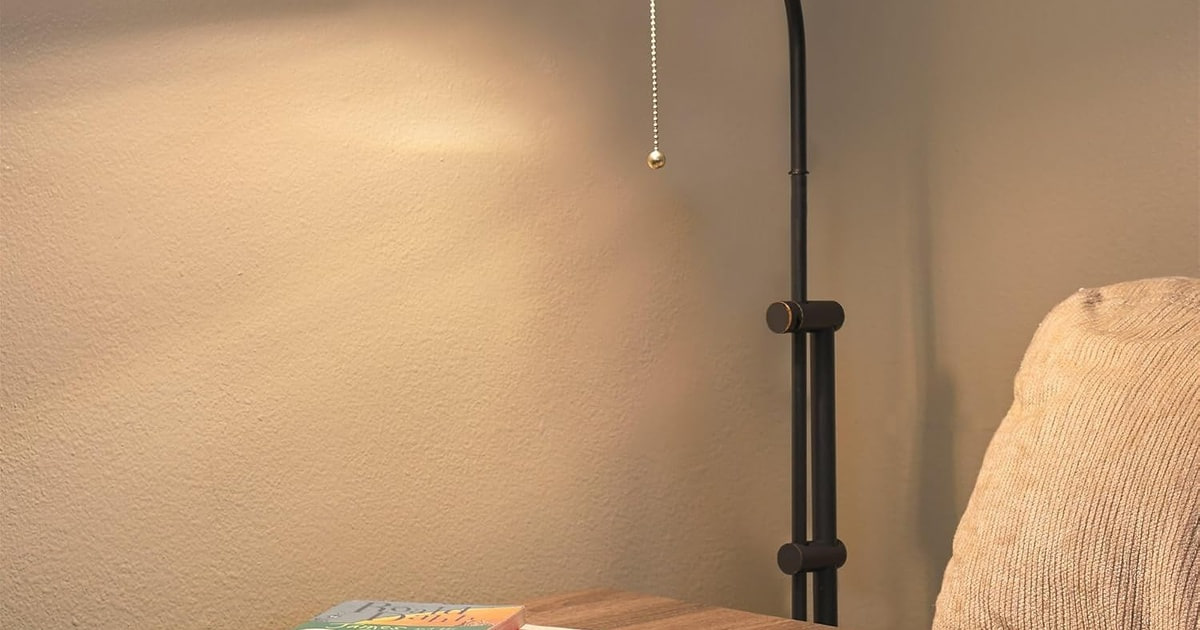
A good reading lamp does one job. It puts light on the page without putting it in your eyes. The ceiling fixture doesn't manage that. It washes the room, leaves your book in the shadow of your own shoulder, and has you squinting by chapter three. The American Academy of Ophthalmology suggests roughly 450 to 800 lumens for close work, which is more than most living rooms give you. And where that light lands matters as much as how much of it you have.
No floor lamp nails both jobs at once. Torchieres bounce light off the ceiling, which is soft and glare-free for the room but thin on a page, and close to useless if your ceiling is dark or vaulted. Task lamps aim beautifully and look like equipment. Brightness claims are slippery too. Some listings state lumens, some state watts, and plenty state neither. Several lamps here ship without bulbs, so the light you actually get depends on what you screw in.
So think about where you read before you think about lumens. A chair in a corner with a pale wall behind it does fine with a torchiere on a dimmer. A chair floating in the middle of a room needs an arm that reaches over your shoulder. And if there's a dog or a toddler in the house, weight the base. We think that the Brightech Sky LED Floor Lamp is the best floor lamp for reading for most people, and that the Kira Home Prescott is the one to buy if you want light aimed straight down onto the page.
Everything we recommend
Bright, warm and dimmable, with the glare bounced away
Light over your shoulder and onto the page

An uplight and a reading spot on one slim column

Built for close work, if looks are not the point
Prices as of Oct 25, 6:48 AM PT · Details
At a glance
| Product | Height | Dimming | Price | |
|---|---|---|---|---|
| Brightech Sky LED Floor lampTop pick | 63 in. | 3-way dimmer | $74.99 |
| Kira Home Prescott 58" Vintage Mid CenturyRunner-up | 45.5-58 in. | Pull chain | $114.99 |
| OttLite 18W WingShade Adjustable Floor Lamp forAlso great | 62 in. | — | $89.99 |
 | Versanora Romanza Modern LED Tripod Floor LampAlso in lineup | 60 in. | — | $141.49 |
 | JUNNAI LED Tree Floor Lamp with RemoteAlso consider | 66 in. | Stepless | $59.99 |
| Ikea Not Floor Uplight/Reading LampBudget pick | 69 in. | — | Check price |
 | JOOFO LED Floor Lamp for Living RoomAlso consider | 65 in. | Stepless | $39.99 |
Prices as of Oct 25, 6:48 AM PT · Details
How we picked
Light on the page. We took the American Academy of Ophthalmology's 450-to-800-lumen guidance for close reading as the bar. We favored lamps whose listings state actual output or come with a bulb spec, and we flagged the ones that leave you guessing.
Color and glare. Lighting designers quoted by The Spruce recommend 2700K to 3000K for living-room reading and up to 5000K for maximum print clarity, so we looked for lamps in that range or with a choice. We also noted where a listing states a CRI below the 90-plus threshold task-lamp reviewers prefer.
Aim and reach. Architectural Digest's lighting designers separate adjustable swing-arm lamps from fixed torchieres because you can put light on a page without moving furniture. We gave weight to stated arm reach, head rotation and height adjustment.
Base and stability. The Good Housekeeping Institute favors a base of at least 12 inches across for lamps set beside a reading chair. We compared stated base diameters and lamp weights, and we said so when a lamp comes up short.
Dimming and upkeep. Real Simple's lighting guide recommends dimmable fixtures for reading nooks so one lamp works morning and night. We checked for built-in dimming or dimmer compatibility, plus rated bulb life and whether the LED can be replaced at all.
Top pick
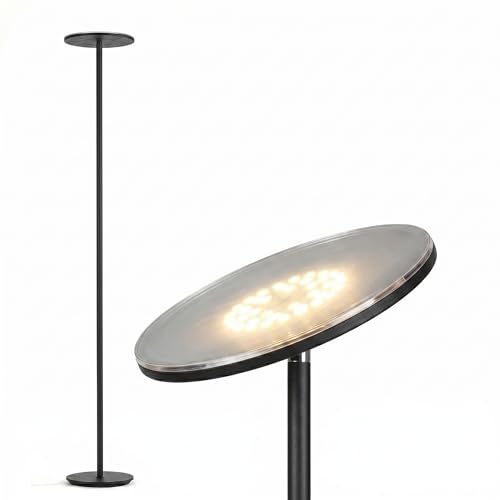
Bright, warm and dimmable, with the glare bounced away
Brightech Sky LED Floor lamp
The Sky is a 63-inch torchiere with a built-in LED that puts out 2,190 warm-white lumens and dims in three steps, so one lamp covers both evening reading and general room light. Its felt-bottomed, 8-pound base tucks behind an armchair and stays put.
$74.99fromAmazonPrices as of Oct 25, 6:48 AM PT · Details
It's bright enough to read by and warm enough to sit under. The Sky puts 2,190 lumens through 26 watts of LED at 3000K, well past the 450 to 800 lumens ophthalmologists suggest for close work. That headroom matters, because a torchiere throws its light at the ceiling first and you only get back what bounces. Off a pale ceiling, what reaches your book is soft, even and free of hot spots.
Three dimmer steps sound crude next to stepless lamps, and they are. But they're the right three. The top setting lights the room, the middle sits at a comfortable level for a novel, and the low setting is enough to cross the floor at night without waking anyone. The lamp remembers where you left it, so you're not resetting it every evening. Owners consistently call it easy to live with.
The column is slim, and the base measures about 10 inches across with 8 pounds of weight and a felt bottom that won't scuff your floor. It slides behind a chair or into a corner without eating usable space, which is the whole argument for a torchiere in a small apartment. That footprint does run under the 12-inch base diameter the Good Housekeeping Institute favors beside a reading chair, so keep it out of the main walking lane.
Running it costs almost nothing. The Department of Energy puts LED consumption at roughly 75 percent below incandescent, with about 25 times the life, and the Sky's integrated LEDs are rated for thousands of hours. Several owners bought it to retire a 300-watt halogen torchiere and got comparable light for a fraction of the draw. You also never buy a bulb for it, which cuts both ways.
Flaws but not dealbreakers
The LEDs are built in, so there's no bulb to swap. When the light module eventually fails, you're replacing the lamp, not a bulb. Some owners also mention a short pause between pressing the button and the light coming on, and that the housing directly under the LEDs gets warm to the touch even though the top of the bowl stays cool.
It's an uplight, and that's a real limit for reading. You can't aim it at your page. If your ceiling is dark, textured or a long way up, you lose a chunk of the output before it ever gets to you. The color temperature is fixed at 3000K too, so if you want a daylight-white light for small print, this isn't the lamp.
Brightech covers the Sky with a three-year warranty against defects, malfunctions and sudden failures when you buy it through them.
Runner-up
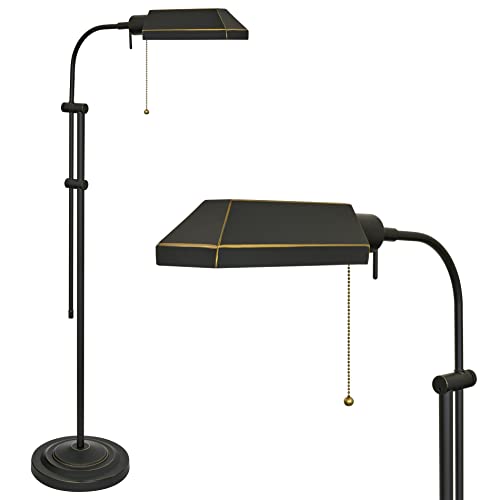
Light over your shoulder and onto the page
Kira Home Prescott 58" Vintage Mid Century
The Prescott is a classic pharmacy lamp: a bronze column with a 23-inch swing arm and a small tilting shade that drops light right where you're looking. The height adjusts from 45.5 to 58 inches, so it suits a low club chair or a tall wingback.
$114.99fromAmazonPrices as of Oct 25, 6:48 AM PT · Details
Pharmacy lamps have sat in reading corners for a century, and this is why. The arm reaches out 23 inches and the head tilts, so the base can live behind your chair while the light comes over your shoulder and down. That's exactly where Consumer Reports says a reading light belongs, slightly behind and to one side, so your own head and hands can't shadow the page.
It's the most adaptable lamp here. The height moves between 45.5 and 58 inches on a pull-chain column, so you can set it low over a deep club chair or high behind a sofa. Lighting designers interviewed by Architectural Digest single out adjustable swing-arm floor lamps for this reason: you aim the light instead of dragging the furniture around to meet it.
It comes with a 6-watt LED bulb, the 60-watt equivalent that lighting retailers treat as the baseline for a single-bulb reading lamp, at roughly 800 lumens. The socket also takes CFL or incandescent up to 60 watts, and it works with a dimmer, wall switch, timer or smart plug. So you pick the color: 2700K to 3000K for an evening chapter, or 5000K daylight white if you're fighting small print.
The build looks intentional rather than utilitarian. You get an oil-rubbed bronze finish with hand-painted gold trim, a heavy metal base, and UL listing for dry locations. At 10 pounds it feels planted, and the hardware for assembly is in the box. Next to a sofa it reads as furniture, which the craft-room task lamps in this guide never quite manage.
Flaws but not dealbreakers
There's no dimmer on the lamp itself, just a pull chain. If you want to dial brightness down for evening, you'll need to buy a dimmable bulb and add a smart plug or an inline dimmer. Fumbling for a chain in the dark gets old.
The base is about 10 inches across and the arm swings out 23 inches, which is a lever. Keep the head positioned over your chair rather than out over open floor, and think twice about it in a house with a boisterous dog. The shade is small too, so you get a tight pool of light on your book and not much else. That's the point, but don't expect it to light a room.
Kira Home backs the Prescott with a five-year warranty.
Budget pick
An uplight and a reading spot on one slim column
Ikea Not Floor Uplight/Reading Lamp
The NOT is a bare-bones black column carrying two lights on separate switches: an uplight for the room and a small reading spot below it. You buy both bulbs yourself, which is the catch and also the reason you can make it as bright as you like.
Check priceatAmazonPrices as of Oct 25, 6:48 AM PT · Details
Two lights on one pole is a genuinely useful trick in a small place. Flip the uplight for the room, flip the reading spot for your book, or run both. You get task light and ambient light from one plug and one square foot of floor, which is the argument for it in a studio, a dorm room or a rental where outlets are scarce.
The bulbs are the whole story here. It needs two different ones, an E26 for the uplight and an E17 for the reading spot, and neither is included. IKEA suggests a 400-lumen bulb up top and a 200-lumen reflector below. That 200 is well under the 450 to 800 lumens recommended for close work, so buy a brighter E17 reflector than the suggestion and you'll have a real reading light.
At 69 inches it's the tallest lamp here, with an 11-inch base diameter that clears the 12-inch guidance by a hair less than we'd like but beats most slim torchieres. Assembly is required and takes a few minutes. It's plain steel and plastic with no finish worth describing, which is fine if it's living behind a chair.
Flaws but not dealbreakers
Nothing about it dims. Both lights are simple on-off, so your only brightness control is which bulbs you buy and which switch you press. If you want to soften the light for a late chapter, you're out of luck unless you add a smart plug.
The listing doesn't promise an adjustable head or arm, so plan on positioning the lamp rather than the light. That makes chair placement matter more than it does with the swing-arm picks. And because the bulbs aren't included, the price you see isn't the price you pay to get it working.
Also great
Built for close work, if looks are not the point
OttLite 18W WingShade Adjustable Floor Lamp for
The WingShade is a task lamp on a 62-inch stand, with a wing-shaped shade that rotates to point light exactly where you're working. OttLite designs its lighting around long sessions of close visual work, and this is the one lamp here built for that first.
$89.99fromAmazonPrices as of Oct 25, 6:48 AM PT · Details
If your eyes tire before your attention does, this is the lamp to look at. OttLite's entire pitch is working longer with less eyestrain, and the company markets its bulbs as filtering glare while keeping brightness balanced for reading and close visual tasks. That's a manufacturer claim rather than an independent finding, but the design backs it up: the shade sits low and wide over your material instead of spraying light into the room.
The wing shade is the useful part. It rotates to direct light across whatever you've got open, which is what you want for a hardback, a magazine spread, or a crossword you're holding at an angle. Fixed torchieres can't do that at all. It's the same argument Architectural Digest's lighting designers make for adjustable heads over static uplights.
The 18-watt tube is rated for up to 10,000 hours, so this isn't a lamp you'll be servicing often. At 62 inches tall it stands beside a chair or a craft table without leaning over you, and the shade profile keeps the light source out of your direct line of sight. For sewing, model-building or reading fine print, that combination is hard to match at this size.
Flaws but not dealbreakers
It looks like what it is, a piece of equipment. In a craft room that's fine. Beside a nice sofa it stands out, and not in the way the Kira Home does.
The listing doesn't state lumens, CRI, base diameter or lamp weight, so you're taking OttLite's word on light quality and you can't check it against the 90-plus CRI bar that task-lamp reviewers use. There's no dimming and no color-temperature choice either, so it's one light level, all day. And when the tube does go, you're sourcing an OttLite tube rather than grabbing any bulb off a shelf.
Who this is for
If you read in the same chair most nights and you're relying on a ceiling fixture or a table lamp sitting behind you, a dedicated reading lamp is a small purchase that fixes a daily annoyance. It matters more as you get older, since eyes need noticeably more light for the same page. It also matters in a small apartment, where one dimmable lamp can be room light at dinner and task light at ten. Remote workers who read long documents from an armchair get the same benefit.
This guide covers floor lamps chosen specifically for reading: light on the page, glare control, the ability to aim, and a base that won't tip. It isn't a roundup of decorative floor lamps, and it isn't about desk lamps. If you're lighting a whole open-plan room, look at general floor lamps instead. And if you already have a bright, aimable light within arm's reach of your chair, you don't need any of these.
How we picked
Light on the page: we held every lamp to the 450-to-800-lumen range ophthalmologists recommend for close work, and preferred listings that state output rather than hint at it. Color and glare: 2700K to 3000K for comfortable evening reading, up to 5000K for fine print, with a preference for lamps that let you choose. Aim and reach: a head or arm you can point beats raw brightness, since a torchiere can't put light where a swing arm can. Base and stability: we compared stated base diameters against the 12-inch minimum Good Housekeeping favors beside a chair, and weighed the lamp itself. Dimming and upkeep: built-in or bulb-based dimming, rated bulb life, and whether you can replace the light source when it finally dies.
Other floor lamps for reading worth considering
If you want to share one lamp with someone who reads differently: The JUNNAI LED Tree Floor Lamp with Remote — The JUNNAI tree lamp splits into three heads, each rotating 350 degrees, flipping 90 degrees vertically, and dimming independently. So you can point one head at your book and leave the others low, or set a warm 3000K for yourself while someone across the room gets 5000K daylight for small print. It steps through four color temperatures up to 6000K, dims steplessly from 10 to 100 percent, takes a remote or a touch panel, and has a one-hour timer for falling asleep. What you give up is a stated lumen figure, which makes it hard to check against the 450-to-800 range, and the LEDs are integrated. The tree silhouette is also a look you either want or don't.
If you want a torchiere you can actually aim: The JOOFO LED Floor Lamp for Living Room — The JOOFO solves the main complaint about uplights. Its head turns 350 degrees horizontally and 180 degrees vertically, so you can tip it off the ceiling and toward your chair when you sit down to read. Stepless dimming and color-temperature control run off a magnetic remote or a foot switch, and it remembers your last setting. The LEDs are rated to 30,000 hours. Two things hold it back from a pick: the listing states 80-plus CRI, short of the 90-plus that task-lamp reviewers want for rendering text, and it never states lumens. The base is thick and weighted but only about 8 inches across, so it's not one for a busy hallway.
The competition
These are the lamps our research surfaced alongside the picks. It isn't a sweep of every floor lamp sold, and a lamp landing here doesn't make it bad, just harder to recommend for reading specifically.
The Versanora Romanza Modern LED Tripod Floor Lamp — The Versanora Romanza is a 60-inch tripod lamp with a matte black drum shade, and it's the best-looking thing in this guide by a distance. But it's a room lamp wearing a reading lamp's label. The shade diffuses light down and out with no way to aim it, there's no dimming built in, and the bulb isn't included, so the output depends entirely on the E26 you buy, up to 100 watts. The tripod legs also sprawl about 20 inches, which is a lot of floor to walk around in a tight nook. Buy it because you want that silhouette in the corner, then put a proper task lamp next to your chair.
Placement, bulbs and upkeep
Put the lamp slightly behind you and off to one side, roughly at shoulder height. Consumer Reports recommends that position because it stops your own head and hands from throwing a shadow across the page. Aim for 450 to 800 lumens landing on the book, not just floating around the room. If you're buying bulbs, look for a CRI of 90 or higher, since higher-CRI light renders black text on white paper more accurately, which is why lamp reviewers treat it as a threshold. Warm 2700K to 3000K suits evening reading, and 5000K helps with small print. Dust the shade and the inside of a torchiere bowl once or twice a year. A film of dust genuinely dims what you get back.
Questions we get
How many lumens do I need for a reading lamp?
Plan on 450 to 800 lumens reaching the page, which is what the American Academy of Ophthalmology suggests for close work. A 60-watt-equivalent LED, roughly 800 lumens, is the common baseline for a single-bulb reading lamp. Torchieres need more raw output than that, because you only get back what bounces off the ceiling. That's why the Brightech Sky's 2,190 lumens isn't overkill.
Warm or cool light for reading?
Most lighting designers recommend 2700K to 3000K warm white for living-room reading, since it's easier to sit under for an hour or more. If you're working through small print or thin paper, daylight-balanced light up to 5000K makes contrast crisper. There's no single right answer, which is the argument for a lamp with switchable color temperature like the JUNNAI. If you're picking one and can't decide, start warm.
What type of floor lamp is best for reading?
An adjustable swing-arm or pharmacy lamp, if you can fit one. Lighting designers interviewed by Architectural Digest point out that an arm lets you put light on your page without rearranging furniture, which a fixed torchiere can't do. Torchieres still work well in a corner with a pale ceiling, and they're better at lighting the whole room. Match the type to where your chair sits.
Do dimmable lamps help with eye strain?
They help by letting you match the light to the time of day, which is why Real Simple recommends dimmable fixtures for reading nooks. Bright daylight through the window needs a different level than a dark evening. Dimming also lets one lamp do double duty as ambient light, useful in a small living room. Look for stepless dimming or at least three steps.
Are LED bulbs better than incandescent for reading?
Yes, for almost everyone. The Department of Energy puts LED energy use at about 75 percent below incandescent, with roughly 25 times the lifespan, so a lamp you run several hours a night costs much less to keep going. LEDs also run cool, which matters if the lamp sits close to your arm. The one tradeoff is integrated LEDs, which you can't replace when they fail.
How tall should a floor lamp be next to a reading chair?
You want the light source at or just above shoulder height when you're seated, which usually lands between 55 and 65 inches for a task lamp. Adjustable-height models like the Kira Home Prescott, which moves from 45.5 to 58 inches, take the guesswork out. Torchieres are taller on purpose, since they need clearance to bounce light off the ceiling. Also check the base: the Good Housekeeping Institute favors at least 12 inches across for lamps beside a chair.
Why you should trust us
For this guide:
- We read the manufacturer specifications and full listing details for every lamp here, comparing stated lumens, wattage, color temperature, height, base diameter and warranty terms side by side.
- We weighed published lighting guidance from the American Academy of Ophthalmology, the U.S. Department of Energy, Consumer Reports and the Good Housekeeping Institute against what each listing actually claims.
- We read through owner feedback looking for recurring themes rather than one-off complaints, including the power-on delay and warm housing that Brightech owners bring up.
- We read owner reviews on every listing, weighted toward the critical ones, because that is where the recurring failures show up.
- We have a systematic way of automatically fetching the latest prices, so the numbers on this page stay current.
- This is a research-focused guide, so the team may not own every product listed — though we often do own the top winners, which gives us extra context for the recommendations.
- We don't accept free products, and the retailer commission never changes which product we recommend.
Sources
Best Floor Lamps for Reading - Wirecutter, Wirecutter
The Best Reading Lamps for Every Room - Good Housekeeping, Good Housekeeping
How to Choose Lighting for Reading - The Spruce, The Spruce
Lighting for Reading and Task Areas - Real Simple, Real Simple
Understanding Color Temperature and Lumens - ENERGY STAR / U.S. Department of Energy, U.S. Department of Energy
Home Lighting Recommendations for Eye Comfort - American Academy of Ophthalmology, American Academy of Ophthalmology
Best Lamps of 2026, Tested - Forbes Vetted, Forbes Vetted
The Best Reading Lights, According to Interior Designers - Architectural Digest, Architectural Digest
Floor Lamp Buying Guide - Consumer Reports, Consumer Reports
Best Floor Lamps Tested in Our Labs - Good Housekeeping Institute, Good Housekeeping Institute
Amazon product listings and owner reviews for all 7 products
Manufacturer specification pages for each product
Some passages in this guide may be paraphrased with AI help.
Product prices and availability are accurate as of the date/time indicated and are subject to change. Any price and availability information displayed on Amazon.com at the time of purchase will apply to the purchase of this product.
More like this.
Continue exploring home reviews and recommendations.

The Best LED Desk Lamps for Studying and Eye Comfort
If you read or work at a desk for hours, your lamp does more for your eyes than almost anything else on the desk. The problem isn't usually brightness.…

The Best SAD Light Therapy Lamps
By the time the sun sets before dinner, a lot of us are dragging. Seasonal affective disorder affects roughly 5% of American adults and can stretch across…

The Best UV LED Nail Lamps
A gel manicure only works if the gel actually cures. That's the whole job of a nail lamp, and it's why the wrong one can waste an hour of careful…

The Best Steam Mops for Hardwood and Tile Floors
Mopping with a bucket mostly moves dirty water around. A steam mop skips that entirely: you fill the tank with plain water, wait half a minute, and push a…

The Best Tineco Floor Cleaners
If you have hard floors and anything that makes a mess - a dog, a toddler, a partner who cooks - you already know the routine. You vacuum, then you mop,…

The Best Garage Floor Containment Mats of 2026
Winter doesn't stay outside. Every time you pull into the garage, your tires and wheel wells carry in slush, road salt and grit, and it all melts into a…