The Best SAD Light Therapy Lamps
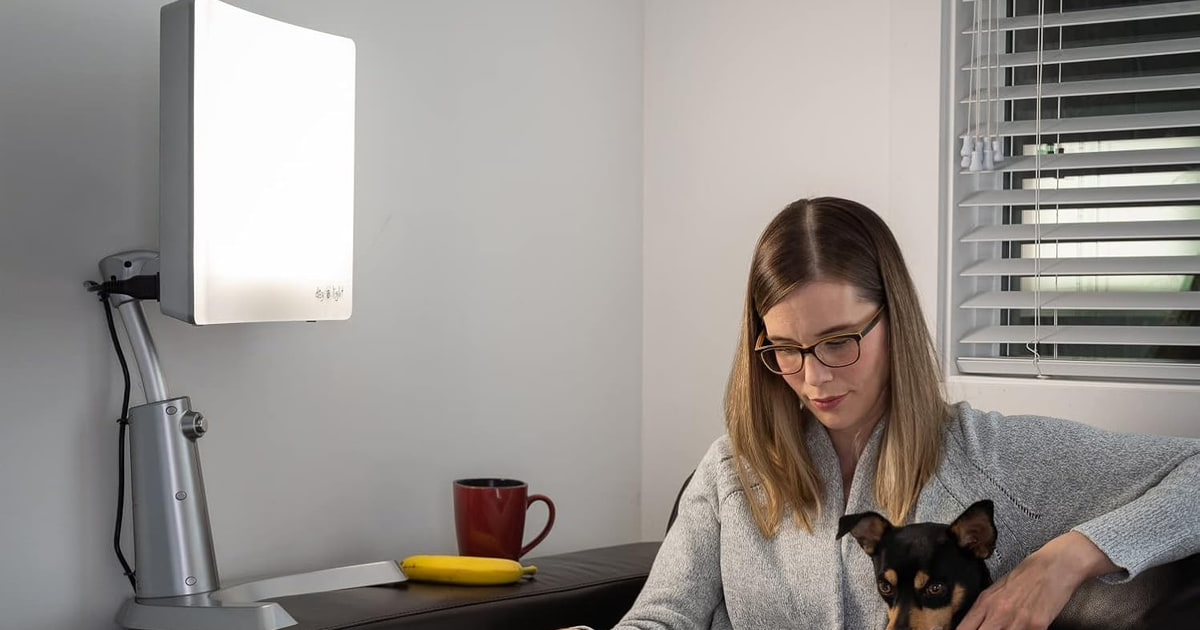
By the time the sun sets before dinner, a lot of us are dragging. Seasonal affective disorder affects roughly 5% of American adults and can stretch across about 40% of the year, and another 10 to 20% get the milder winter blues — low energy, carb cravings, no motivation. A light therapy lamp is the standard first-line answer. You sit near a bright, UV-free panel for 20 to 30 minutes each morning, and over a few weeks your body clock and your mood tend to follow.
Here's the honest part: no lamp on this list is pleasant to use, exactly. Ten thousand lux is startlingly bright, and you have to sit close — often closer than the box implies — for the dose to count. Every one of these lamps demands a daily habit you have to actually keep, at the same early hour, for weeks before you notice much. And none of them replaces a conversation with a doctor, especially if you take medication or have an eye condition.
We looked at panel size, verified lux at a stated distance, timers, dimming, and how each lamp actually sits on a real desk or nightstand. We think that the Carex Day-Light Classic Plus is the best SAD light therapy lamp for most people, and that the Verilux HappyLight Luxe is the one to buy if you want a slim, timer-equipped panel that fits a crowded desk.
Everything we recommend

A big, forgiving panel you can sit under and ignore

Slimmer, more adjustable, and easier to live with daily

10,000 lux on a swiveling arm that folds flat

Metal, flicker-free, and built for a clinician's office

A gradual sunrise for people who hate waking up
At a glance
| Product | Lux | Distance | Price | |
|---|---|---|---|---|
| Carex Day-Light Classic Plus Sunlight Therapy LampTop pick | 10,000 Lux | 12 Inches | $130.19 |
| Verilux HappyLight Luxe - Light Therapy LampRunner-up | 10,000 Lux | — | $69.99 |
| PHILIPS SmartSleep Sleep and Wake-Up LightAlso great | — | — | $179.99On sale |
| Northern Light Technologies Boxelite OS - 10000Upgrade pick | 10,000 Lux | 14 Inches | $230 |
 | Northern Light Technologies LiteUp - 10000 LuxAlso in lineup | 10,000 Lux | 14 Inches | $225 |
 | Lumie Vitamin L Light Therapy Lamp -Also consider | 10,000 Lux | 7.9 Inches | $109 |
| Circadian Optics Lumos 10Budget pick | 10,000 Lux | — | $69.99 |
How we picked
Verified 10,000 lux. We required each lamp's specifications to state 10,000 lux at a named distance, not just a peak number with no context. Anything rated lower demands sessions most people won't sustain.
Working distance. We compared how far you can sit and still get the full dose, since 12 inches and 24 inches are completely different experiences at a desk. Spec sheets that omitted the distance were a red flag.
Panel surface area. We favored larger diffused surfaces, because they forgive imperfect positioning and let you read or eat during a session. First-time buyers consistently underestimate how much this matters.
Timer and dimming. We looked for a countdown timer and multiple brightness steps, based on owner feedback showing that people who guess at session length under-dose and quit. Adjustable output also lets sensitive users build up gradually.
UV and flicker. We treated UV filtering as non-negotiable given daily 20-to-30-minute exposure, and we prioritized lamps whose specs document flicker-free operation for readers prone to migraines or eye strain.
Top pick
A big, forgiving panel you can sit under and ignore
Carex Day-Light Classic Plus Sunlight Therapy Lamp
The Day-Light Classic Plus puts 10,000 lux at 12 inches across a large diffused surface, angled down toward your eyes. It's the closest thing to the lamps used in the research, and it's easy to eat breakfast or read under without babysitting your posture.
$130.19fromAmazonThe panel is the whole argument. At roughly 15.5 by 13.5 inches, the treatment surface is one of the largest you can buy without moving into medical-supply pricing. That size buys you slack. Lean back, turn your head, reach for your coffee — you're still in the light. On a small lamp, those same movements drop your dose without telling you.
Carex angles the head downward and puts it above eye level, which is how the light boxes in the original NIMH research were set up. You get the intensity in your peripheral vision instead of staring into a glare panel. The stand adjusts for height, and the head tilts, so a tall desk and a low kitchen table both work.
The specs say 10,000 lux at 12 inches, and Carex states the screen blocks 99.3% of UV. Two brightness settings let you start lower if the full output makes you squint, which is common in the first week. Owners with SAD diagnoses and clinician recommendations behind them report steady improvement over a few weeks — the same 2-to-4-week window the clinical literature describes.
It's also backed by a five-year warranty, which is unusually long in this category and matters more than it sounds. Light therapy is a years-long habit for most people who need it, not a one-winter purchase.
Flaws but not dealbreakers
It's big and it's heavy — over nine pounds, and more than two and a half feet tall assembled. This is a lamp that lives in one place. If you were hoping to slide it into a drawer between sessions, look at the slimmer picks below.
Build quality draws the most consistent criticism. Some owners describe plastic parts that don't feel commensurate with the price, and a minority report failures after months of use along with a frustrating time getting them resolved. Unpack it carefully; the packaging isn't especially protective of the diffuser.
The Day-Light Classic Plus is backed by a five-year warranty.
Runner-up
Slimmer, more adjustable, and easier to live with daily
Verilux HappyLight Luxe - Light Therapy Lamp
The HappyLight Luxe is a tablet-thin panel with four brightness levels, three color temperatures, and a countdown timer you set in five-minute steps. It weighs two pounds and mounts on a wall, so it fits desks where the big boxes simply won't.
$69.99fromAmazonThe timer is the feature that makes the habit stick. You program it up to an hour in five-minute increments and stop watching the clock. That sounds minor until you've spent two weeks guessing whether you've hit 20 minutes. Consistent dosing is the entire mechanism here, and guessing tends to mean under-dosing.
Four brightness levels give you somewhere to start. Full 10,000-lux output is harsh for a lot of first-timers, and being able to run at a lower step for a longer session — then work up — is the difference between sticking with it and shoving the lamp in a closet. Three color-temperature options let you pick something less clinical-feeling for a home office.
At about a quarter-inch thick and two pounds, it leans against a monitor stand, sits behind a keyboard, or goes on a wall mount. Owners repeatedly describe being surprised by how bright it is for the size. It travels well too, which the large-panel picks flatly do not.
Verilux backs it with a three-year warranty and U.S.-based support, and psychiatrists recommend this specific model often enough that it shows up in owner accounts as a clinician's pick rather than a shot in the dark.
Flaws but not dealbreakers
The surface is smaller than the Carex panel, so positioning matters more. Drift back a foot or turn away from your screen and your effective exposure drops. You need to think about where your face is in a way the big box doesn't require.
The stand is detachable, which is good for portability and less good for stability — it's a light, thin panel and it's not the thing to have perched near a toddler or a cat.
Verilux covers the HappyLight Luxe with a three-year manufacturer's warranty.
Budget pick
10,000 lux on a swiveling arm that folds flat
Circadian Optics Lumos 10
The Circadian Optics Lumos gives you 10,000 lux, three brightness levels, and 5500K full-spectrum output on a 270-degree rotating panel. It stands 21 inches tall in use and folds down to something you can slide into a bag.
$69.99fromAmazonHeight is the underrated trick here. The Lumos extends to 21 inches, which puts the panel up near eye level on a normal desk instead of shining at your chest. Combined with a panel that rotates through 270 degrees on a weighted base, you can aim the light exactly where your face actually is — and re-aim it in a second when you shift.
For a first lamp, this is the low-risk way in. It's the least expensive lamp here, it hits the clinical 10,000-lux mark, it's UV-free, and it has three brightness steps so you can acclimate. If light therapy turns out not to help you, you haven't sunk much into finding out.
The build is better than the price suggests. The base is heavy enough that the lamp doesn't tip when you nudge it, which is not true of most folding desk lamps. LEDs are rated for 50,000 hours, and Circadian Optics offers a four-year replacement warranty handled by its own team in Minnesota. Owners who've dealt with support describe it as genuinely responsive.
The panel is small, though, and that's the trade. You have to sit close and stay reasonably still. Owners in the Pacific Northwest and other dark-winter regions still report real changes in sleep and mood, but this lamp asks more of your positioning than the Carex does.
Flaws but not dealbreakers
There's no built-in timer. You'll use your phone, which most owners do without complaint — but it's one more thing between you and the habit.
The small panel means a narrow effective zone. If you want to eat cereal, scroll your phone, and glance out a window during your session, the light won't stay on your face reliably. Sit down, face it, and give it the 20 minutes.
Circadian Optics offers a four-year replacement warranty on the lamp and power adapter.
Upgrade pick
Metal, flicker-free, and built for a clinician's office
Northern Light Technologies Boxelite OS - 10000
The Boxelite OS is a Canadian-made metal light box with an adjustable panel angle, five elevation settings, and an electronic ballast that runs without flicker or hum. It delivers 10,000 lux at up to 14 inches with UV blocked.
$230fromAmazonThis is the one clinicians hand out. Northern Light Technologies has been making therapy boxes for over 30 years, and the Boxelite shows up in psychiatrists' offices and their recommendations. The construction is metal rather than plastic, the panel angle adjusts, and five elevation settings let you dial in the exact geometry for your chair and desk.
The electronically powered ballast is the quiet reason to pay up. It runs with no flicker and no hum, and low EMF. If you get migraines or you're photosensitive, flicker is the thing most likely to make daily sessions unbearable — and it's the spec cheap lamps are least honest about.
You also get 10,000 lux out to 14 inches, a couple of inches more working room than the Carex spec allows. That doesn't sound like much until you're actually sitting at a desk trying to type. Two stand configurations let it stand on end at a fixed angle or lie on its side and rotate.
Owners who moved up from small desk lamps describe the difference as substantial, and several came to it on a psychiatrist's recommendation specifically because the panel is large enough to work at normal seating distances.
Flaws but not dealbreakers
It's fragile in shipping. Multiple owners report bulbs broken in transit or damage from being knocked around in an under-protected box, and the manufacturer's own carton is marked fragile for a reason. Inspect it the day it arrives.
The stand feels flimsier than the metal body suggests, and the whole unit is large and a bit awkward to reposition. A few owners have hit assembly-stage failures where the lights wouldn't come on and the diffuser screws wouldn't cooperate with a repair attempt.
Also greatOn sale
A gradual sunrise for people who hate waking up
PHILIPS SmartSleep Sleep and Wake-Up Light
The Philips SmartSleep HF3650 fades a light up over 30 minutes before your alarm, then fades it back down at bedtime. It's a nightstand device for sleep inertia and wake-up routines, not a substitute for a 10,000-lux therapy box.
$179.99fromAmazonList priceWaking to a slow sunrise instead of a buzzer changes the first ten minutes of your day. Philips-funded research found 92% of SmartSleep users felt more alert in the morning than with a conventional alarm after four weeks. That's a measure of sleep inertia, not SAD treatment — but grogginess is a real problem and this addresses it directly.
Buy it as an alarm clock, not as therapy. It doesn't put out 10,000 lux at a therapeutic distance, and pairing it with one of the light boxes above is the setup that makes sense if you have diagnosed SAD. Think of it as the thing that gets you out of bed and into the chair where your therapy lamp is.
The rest of the package is genuinely useful on a nightstand: sunset simulation, RelaxBreathe guided breathing, FM radio, nature sounds, a midnight light, a phone charging dock, and an auto-dimming display. Households with heavy sleepers — teenagers especially — report it working where phone alarms simply didn't.
It's also the pick for anyone with blackout curtains. If your bedroom stays pitch dark until you force yourself up, a device that manufactures dawn on schedule fixes a problem no amount of louder beeping will.
Flaws but not dealbreakers
The interface takes some learning. Owners describe getting lost in nested settings, and there's no way to set different wake times for different days of the week — a real annoyance if your schedule shifts.
This model doesn't pair with the Philips phone app, which trips up buyers who saw app support advertised for the SmartSleep line. And a few owners feel the feature set doesn't quite justify what it costs relative to simpler sunrise alarms.
Who this is for
Buy a light therapy lamp if your energy and mood reliably crater when the days get short — especially if you live in Alaska, New England, the Pacific Northwest, Canada, the UK, or anywhere else at high latitude. SAD prevalence runs around 1% in Florida and roughly 9% in Alaska, so geography is the strongest single predictor. Remote workers in dim home offices, shift workers fighting a scrambled body clock, and long-haul travelers dealing with jet lag all have good reasons to own one too. The American Psychiatric Association and Canadian guidelines both classify bright light therapy as first-line treatment, and a randomized trial in JAMA Psychiatry found a 43.8% remission rate versus 19.4% for placebo.
Skip it, or at least talk to a doctor first, if you have bipolar disorder, an eye condition, or take medication that increases light sensitivity — bright light can trigger problems in those cases. This guide covers lamps intended for bright light therapy: panels rated at 10,000 lux for daily morning sessions, plus one sunrise-simulation alarm that serves a different, complementary purpose. We don't cover red-light or near-infrared panels, blue-light acne devices, or general full-spectrum room lighting. And a lamp isn't a replacement for treatment if your depression isn't seasonal or isn't responding.
How we picked
We built the list around the specifications that determine whether a lamp can actually do the job. Intensity: 10,000 lux is the clinically validated standard, established in the original NIMH research, and lower-rated lamps require sessions most people abandon. Distance: we compared the stated working distance for full output, because a lamp that needs you at 12 inches lives differently on a desk than one rated to 14. Panel size: larger diffused surfaces forgive imperfect positioning and make reading or eating during a session realistic. Controls: a countdown timer keeps dosing consistent, and multiple brightness levels let sensitive users ease in. Safety: UV filtering is non-negotiable at daily exposure, and documented flicker-free operation matters for anyone prone to migraines. Support: we weighted warranty length and brand track record, since this is a habit measured in winters, not weeks.
Other sad light therapy lamps worth considering
If you want a slim panel that works upright or on its side: The Lumie Vitamin L Light Therapy Lamp - ($109) — The Lumie Vitamin L is a portrait-orientation lamp with a 7.87 by 11-inch surface and a rippled diffuser, rated at 10,000 lux at about 7.9 inches. It flips to landscape, the stand detaches, and at under two pounds it moves around the house easily. Lumie is one of the few brands that funds independent clinical research on its own devices, which counts for something in a category full of unverified claims. Owners consistently describe it as brighter than they expected. The catch is that close working distance — you really do need to be about arm's reach — and it costs more than lamps with comparable output.
The competition
Here's what our research turned up beyond the picks. This isn't the entire light therapy market — new lamps appear constantly, and plenty of capable options never crossed our path. It's the set of products we could evaluate against real specifications and owner feedback.
The Northern Light Technologies LiteUp - 10000 Lux ($225) — The Northern Light Technologies LiteUp is the wall-mountable sibling of our upgrade pick, and on paper it's compelling: 10,000 lux at 14 inches from a large front panel, all-metal construction, UV filtered, and only 36 watts of draw. It comes from the same 30-year-old Canadian manufacturer we recommend elsewhere. What holds it back is simply how little independent feedback exists — it's a recent enough listing that we can't say how it holds up in practice, and the Boxelite OS has years of clinician use behind it. If wall mounting solves a real space problem for you and you trust the brand, it's a reasonable bet.
How to use a SAD lamp
Timing does most of the work. Mayo Clinic, the APA, and CANMAT all recommend 20 to 30 minutes at 10,000 lux within an hour of waking — morning sessions advance your circadian phase, and evening sessions can push it the wrong way and wreck your sleep. Don't stare at the panel. Position it above eye level, angled down, off to one side, and let the light hit your eyes indirectly while you eat, read, or answer email. Measure the distance the first time rather than eyeballing it; the stated lux only holds at the stated distance. Start at a lower brightness if the full output makes you squint, then build up over a week. Give it two to four weeks of daily use before you judge whether it's working — response rates across trials run 50 to 80%, but almost nobody feels it on day two. Wipe the diffuser occasionally with a dry cloth, and check with your doctor first if you have bipolar disorder, an eye condition, or take photosensitizing medication.
Questions we get
How many lux does a light therapy lamp need to treat seasonal depression?
Ten thousand lux is the clinically validated standard, established in the NIMH research that first described SAD in 1984. Lower-intensity lamps can work, but they require proportionally longer sessions — and most people won't sit for an hour every morning. Just as important, check the distance that rating applies at. A lamp rated at 10,000 lux at 12 inches gives you far less at two feet.
How long should you use a SAD lamp each day, and when?
Clinical guidelines from Mayo Clinic, the APA, and CANMAT converge on 20 to 30 minutes at 10,000 lux, within about an hour of waking. Morning timing is consistently more effective because of circadian phase-advance effects. Evening sessions can delay your body clock and make it harder to fall asleep. Use a timer rather than guessing — consistency is what makes it work.
What's the difference between a SAD lamp and a sunrise alarm clock?
They solve different problems. A SAD lamp is a bright panel you sit in front of deliberately for a timed session at therapeutic intensity. A sunrise alarm gradually brightens before your wake time to ease you out of deep sleep, at intensities far below the clinical threshold. Sunrise alarms are excellent for grogginess and blackout-curtain bedrooms, but they don't substitute for a light box if you have diagnosed SAD.
How long before a SAD lamp starts working?
Most people notice measurable improvement within two to four weeks of consistent daily morning sessions. Response rates across randomized trials run between 50 and 80%. Some people feel more alert within days, but mood changes take longer. The most common reason light therapy fails is inconsistent use — skipping mornings resets the clock on your progress.
Can daily light therapy damage your eyes?
Reputable therapy lamps filter out UV entirely, which removes the main long-term risk, and every lamp in this guide meets that standard. You shouldn't stare directly into the panel; position it above eye level and angled down so the light reaches your eyes indirectly. If you have an existing eye condition, retinal disease, or take medication that increases light sensitivity, check with your doctor before starting.
Is light therapy as effective as antidepressants for seasonal depression?
In one 2016 randomized controlled trial published in JAMA Psychiatry, bright light therapy produced a 43.8% remission rate versus 19.4% for placebo — statistically comparable to antidepressant medication in that study population. The American Psychiatric Association and Canadian guidelines classify it as a first-line treatment. That said, one trial isn't the whole picture, and light therapy isn't a replacement for medication you're already taking. Talk to your prescriber before changing anything.
Why you should trust us
For this guide:
- We compared manufacturer specifications for every lamp here, focusing on stated lux at a named distance, panel dimensions, UV filtering, and warranty terms.
- We read published clinical guidance from NIMH, Mayo Clinic, the American Psychiatric Association, and CANMAT, along with the JAMA Psychiatry trial on bright light therapy, to set the thresholds these lamps had to meet.
- We reviewed recurring themes in owner feedback — positioning difficulties, shipping damage, build-quality complaints, and how long people used a lamp before noticing a change.
- We read owner reviews on every listing, weighted toward the critical ones, because that is where the recurring failures show up.
- We have a systematic way of automatically fetching the latest prices, so the numbers on this page stay current.
- This is a research-focused guide, so the team may not own every product listed — though we often do own the top winners, which gives us extra context for the recommendations.
- We don't accept free products, and the retailer commission never changes which product we recommend.
Sources
Seasonal Affective Disorder Treatment — Mayo Clinic, Mayo Clinic
Seasonal Affective Disorder — National Institute of Mental Health, NIMH
Best Light Therapy Lamps — Sleep Foundation, Sleep Foundation
Best SAD Lamps — Wirecutter (NYT), Wirecutter
Light Therapy for Depression — Healthline, Healthline
Seasonal Affective Disorder Overview — American Psychiatric Association, American Psychiatric Association
Efficacy of Bright Light Treatment, Fluoxetine, and the Combination in Patients With Nonseasonal MDD — JAMA Psychiatry, JAMA Psychiatry (Lam et al., 2016)
Light Therapy — Cleveland Clinic, Cleveland Clinic
Carex Day-Light Classic Plus Product Specifications, Carex Health Brands
Philips SmartSleep Wake-Up Light — Clinical Research Summary, Philips
Seasonal Affective Disorder — Verywell Mind, Verywell Mind
Light Therapy for SAD — PubMed / National Library of Medicine, PubMed (Neuropsychobiology)
Amazon product listings and owner reviews for all 7 products
Manufacturer specification pages for each product
Some passages in this guide may be paraphrased with AI help. Prices are refreshed automatically.
More like this.
Continue exploring health reviews and recommendations.

The Best Red Light Therapy Devices for Home Use
Red light therapy sounds exotic, but the routine is dull in the best way. You sit or stand in front of a panel for 10 to 20 minutes, a few times a week,…

The Best LED Face Masks and Red Light Therapy Devices
Red light therapy asks very little of you and gives back slowly. You put on a mask, sit still for a few minutes, and repeat that several times a week for…

The Best Hand Grip Strengtheners for Therapy
Hand strength shows up in the small stuff. Opening a jar, turning a key, holding a coffee cup without thinking about it. When an injury, surgery, or…

The Best Cold Therapy Knee Wraps
A knee that's just been operated on, twisted on a trail run, or flared up after a long day swells fast. Cold slows that down. But how you deliver the cold…

The Best UV LED Nail Lamps
A gel manicure only works if the gel actually cures. That's the whole job of a nail lamp, and it's why the wrong one can waste an hour of careful…

The Best Floor Lamps for Reading
A good reading lamp does one job. It puts light on the page without putting it in your eyes. The ceiling fixture doesn't manage that. It washes the room,…