The Best Hose-End Sprayers for Lawn Fertilizer
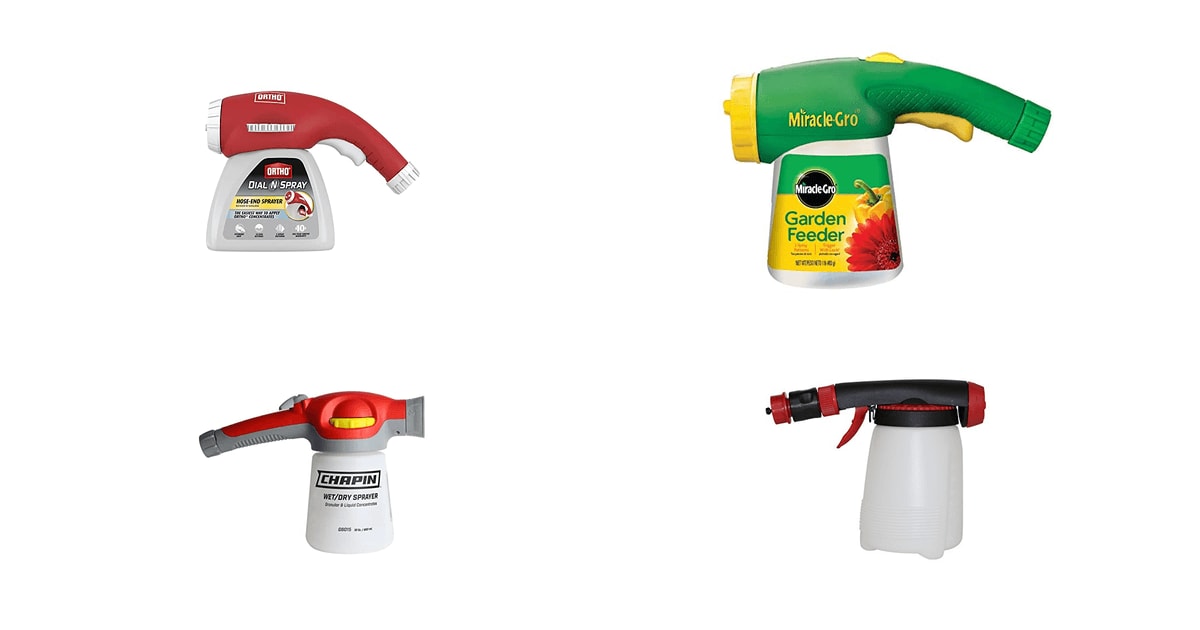
Liquid fertilizer is the fastest way to green up a lawn, and a hose-end sprayer is what makes it practical. You screw it onto the hose, pour concentrate into the jar, dial a ratio, and walk. There's no spreader to push, no granules to sweep off the driveway, and no waiting for rain to water anything in. NC State Cooperative Extension notes that foliar nitrogen moves through the leaf within four to six hours, which is why liquid feeding usually shows color days before granular does.
Here's the honest part: none of these sprayers is precise. They all rely on a venturi siphon, so the ratio you dial is a target, not a promise. Purdue University Extension found that uncalibrated hose-end sprayers can misapply by 20 to 40 percent as household pressure swings between 40 and 80 PSI. Below roughly 30 to 40 PSI, the siphon pulls too rich, which is how lawns get burned. Every model here also weeps a little at the connections.
So buy for control, not for lab accuracy. You want a wide dilution range so you can match whatever label you're holding, a shutoff you'll trust when you stop to drag the hose, and a body you can take apart and rinse. Spray patterns matter less than they sound. We think that the Ortho Dial N Spray is the best hose-end sprayer for lawn fertilizer for most people, and that the Bonide Auto Mix & Spray is the one to buy if you feed the lawn once or twice a season and want the least expensive option here.
Everything we recommend
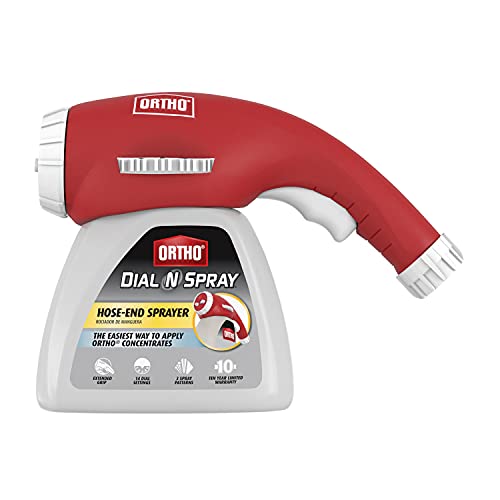
Fourteen dilution settings and a dial you can actually trust

Fourteen settings on a lighter, less sturdy body
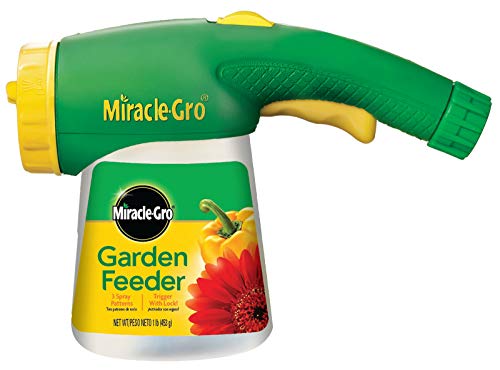
Preset feeding for beds and borders, with no math at all
At a glance
| Product | Capacity | Dilution Settings | Price | |
|---|---|---|---|---|
| Ortho Dial N Spray Hose End SprayerTop pick | — | 14 Settings | $15.97On sale |
| Miracle-Gro Garden Feeder with Water Soluble AllAlso great | 1 lb. | — | $14.97On sale |
 | Chapin International G6015 Wet/Dry Hose-End SprayerAlso consider | 32 oz | — | $15.88 |
 | SOLO 405-HE 32-Ounce Adaptable Hose-End SprayerAlso in lineup | 32-Ounce | — | $20.29 |
| Bonide Auto Mix & Spray Hose EndBudget pick | — | 14 Settings | $22.88On sale |
How we picked
Dilution range. We compared spec sheets for how many ratio settings each sprayer offers and how fine the increments are. Lawn Love's research suggests eight settings is the practical floor for covering residential fertilizer labels without doing your own math.
Accuracy at pressure. Purdue University Extension puts the error range for uncalibrated hose-end sprayers at 20 to 40 percent across normal household pressure. We favored sprayers with a clearly marked metering dial and a published ratio chart, because those are the ones you can verify yourself.
Seals and chemicals. Family Handyman found that Viton and EPDM seals outlast standard rubber by two to three seasons with low-pH concentrates like fish emulsion. We looked for chemical-resistant construction in the specs and for gasket failures in owner feedback.
Shutoff control. Bob Vila's reviewers identify weak shutoff valves as the top cause of over-application, since a leaky valve keeps siphoning concentrate onto one patch while you pause. We preferred a valve you can work without letting go of the sprayer.
Cleaning and durability. We read owner feedback for the problems that surface after a season: clogged pickup filters, cracked housings and weeping couplings. Sprayers you can take apart and flush ranked higher, since residue buildup is what makes a dial drift over time.
Top pickOn sale
Fourteen dilution settings and a dial you can actually trust
Ortho Dial N Spray Hose End Sprayer
The Dial N Spray covers 14 dilution settings, from a teaspoon up to 8 ounces per gallon, so it handles nearly any liquid concentrate label you'll run into. It's light, the collar is easy to read, and it's the sprayer most people already reach for.
$15.97fromAmazonList priceThe dial is the whole reason to buy this one. Fourteen settings run from a teaspoon to 8 ounces per gallon, which covers the label rates on nearly every residential liquid fertilizer sold. Lawn Love's roundup found that sprayers with eight or more settings handle over 90 percent of residential labels without any math on your part. You read the bottle, turn the collar to the matching number, and go.
Picture a Saturday morning, a jug of liquid iron, and 4,000 square feet of turf. You pour concentrate straight into the jar, thread the sprayer onto the hose, and cover the lawn in one pass. No bucket, no measuring cup, no pump to re-pressurize every few minutes. That's the practical case for a hose-end sprayer, and this one makes it about as painless as it gets.
Three spray patterns sound like marketing, and mostly they are. But the broadcast fan is genuinely useful on grass, where you want wide coverage and low drift, and the jet reaches shrubs and second-story eaves. The rotating hose connector keeps the body from twisting against your grip as you walk the yard, which matters more day to day than the pattern selector does.
Owners keep coming back to this one season after season. Feedback skews strongly toward longevity, and the anti-backflow fitting is worth caring about if you ever put anything besides fertilizer in the jar. It's also stocked almost everywhere, so a replacement gasket or a whole new unit isn't hard to find when something finally gives out.
Flaws but not dealbreakers
Leaks are the common complaint. The washer at the hose connection tends to weep, and plenty of owners end up keeping a spare on hand to fix it. A few also report the nozzle not seating firmly in the housing straight out of the box.
It's plastic, and it acts like it. Left outside through a freeze, the housing can crack, and the small filter at the end of the pickup tube eventually clogs or corrodes with regular use. Treat it as a seasonal tool you store in the garage, not a workhorse you leave hanging on the spigot all year.
Budget pickOn sale
Fourteen settings on a lighter, less sturdy body
Bonide Auto Mix & Spray Hose End
The Auto Mix & Spray gives you 14 dilution settings and four patterns for a fraction of what the sturdier sprayers cost. It's thin and it seeps at the seams, but for one or two feedings a season on a small yard, it gets the fertilizer down.
$22.88fromAmazonList priceIf you feed the lawn twice a year, you don't need much sprayer. This one attaches to any hose, mixes soluble fertilizers and thick liquid concentrates, and hands you the same 14-position range as our top pick. For a yard under about 2,000 square feet, that's the entire job, and you're spending a small fraction of what the heavier-duty options cost.
The thumb switch on top is the best thing about it. You shut the water off with the hand already holding the sprayer, so when you stop to pull the hose past a shrub, nothing keeps dripping in one spot. Bob Vila's reviewers point to weak shutoffs as the leading cause of over-application and burned turf. A control you'll actually use beats one you have to reach for.
It's also very light, which sounds trivial until you're twenty minutes into a lawn with a full jar and a wet hose. The insulated grip helps on a cold morning. The four patterns are coarse, though — owners find the stream and flat-fan settings too forceful for anything delicate — so think of this as a turf tool, not a flower-bed tool.
Flaws but not dealbreakers
Build quality is the trade-off, and it's a real one. Owners report leaks from the first use, thin plastic washers that never quite seal, and a feed tube that works loose mid-job. Some describe the top breaking off after a couple of months of gentle use.
Sentiment here is genuinely split: people who got a good one like it a lot, and people who didn't threw it away. If you're spraying an expensive specialty concentrate, those odds aren't worth it. Buy this for occasional, low-stakes feeding where a bad seal costs you a jug of cheap product and an afternoon.
Also greatOn sale
Preset feeding for beds and borders, with no math at all
Miracle-Gro Garden Feeder with Water Soluble All
The Garden Feeder arrives filled with Miracle-Gro's all-purpose soluble plant food and meters it for you — fill the jar to a line, hook up the hose, squeeze the trigger. It covers about 500 square feet, so it suits beds and shrubs more than a full lawn.
$14.97fromAmazonList priceThis is the one to hand a first-timer. There's no ratio to set and nothing to calculate. You fill the jar to the marked line for the area you're feeding, attach it to the hose, and pull the trigger. If the word venturi makes you want to close the tab, start here and worry about dilution charts later.
The catch is that it's built around Miracle-Gro's own water-soluble powder and it's happiest with that. You can't dial a custom rate for a third-party liquid concentrate the way you can with the Ortho. What you get in exchange is a system that's very hard to get wrong, and for a lot of people that's the better trade.
Coverage is the other limit. Roughly 500 square feet per fill means containers, roses, vegetables and young shrubs — not 5,000 square feet of fescue. Owners feeding a garden or a row of privacy hedges are the ones who like it most. Point it at a real lawn and you'll spend the afternoon refilling the jar.
Flaws but not dealbreakers
The reservoir is the weak point. Some owners find water bypasses the food jar through its small intake, so the powder barely moves and the mix comes out thin. Filling the jar with water before you start usually gets it flowing properly.
Leaks turn up here too, usually at the hose coupling, and they cost you pressure and reach. Spray distance is modest to begin with, so a drip you'd shrug off on a sturdier sprayer is more annoying on this one.
Who this is for
Get a hose-end sprayer if your lawn is under roughly 5,000 square feet and you'd rather not push a spreader across it. It's also the easiest way into liquid feeding if you're curious about iron, humic acid or seaweed extract but don't want to buy a pump sprayer to try them. And it's genuinely faster: you're limited by how quickly you can walk, not by how often you stop to refill.
Skip them if you need repeatable rates. Anyone spraying growth regulators, expensive selective herbicides, or a property over about half an acre is better served by a backpack or battery sprayer, where you mix a known volume and know exactly what went down. This guide covers reusable sprayers you fill yourself; it doesn't cover disposable ready-to-spray bottles, tow-behind units, or granular spreaders.
How we picked
Dilution range: enough settings, finely enough spaced, to match a label without doing arithmetic on the driveway. Accuracy: a legible metering dial and a published ratio chart, since extension research shows real-world siphon error runs 20 to 40 percent as pressure varies. Seals: chemical-resistant gaskets, which published reviews link to two or three extra seasons of life with acidic organic concentrates. Shutoff: a valve that stops flow completely and sits under the hand already holding the sprayer. Cleaning: a body you can open and flush, because residue in the metering orifice is what quietly ruins a good sprayer.
Other hose-end sprayers for lawn fertilizer worth considering
If you want to spray dry, water-soluble powders: The Chapin International G6015 Wet/Dry Hose-End Sprayer ($15.88) — The Chapin G6015 is the only sprayer here designed for both wet and dry product. It holds 32 ounces, has a filter basket that helps dissolve granular concentrate evenly, and its dial is marked in ounces, tablespoons and teaspoons rather than a numbered scale you have to translate. The translucent body lets you see how much is left, and Chapin lists chemical-resistant construction. It didn't make the picks because owner feedback is rocky: leaks at both the hose and bottle connections come up often, and several people describe the metering settings losing effect after a few uses. Worth a look if dry product is your main use, with clear eyes about the odds.
The competition
This is what our research surfaced, not a full census of the market. Hose-end sprayers are a crowded, low-margin category, and store-brand models come and go constantly. The one below is a legitimate design that lost out on execution.
The SOLO 405-HE 32-Ounce Adaptable Hose-End Sprayer ($20.29) — The Solo 405-HE takes a different approach: instead of pouring concentrate into a jar, you thread the sprayer onto the concentrate bottle itself, so your hands never touch the chemical. Its 32-ounce canister also works as a standalone container. That's a clever idea, and it appeals if you're handling a pesticide you'd rather not decant. But owner feedback describes the front end popping off when the canister is filled past about a quarter, leaks under normal use, and a flimsy hose connector. Solo builds serious sprayers; this particular one doesn't reflect that reputation. Consider it only if the no-pour bottle adapter solves a problem the others can't.
Care and cleaning
Flush the sprayer with clean water for 30 to 60 seconds after every use — fill the jar with plain water, set a mid-range ratio, and run it until it sprays clear. Residue in the metering orifice is what makes a dial drift out of spec, and a clogged pickup filter is the most common way these fail. Once a season, take the jar and pickup tube off and rinse them, and check the hose washer for cracks; a fresh washer solves most leaks. Store it indoors over winter, since a freeze can split a plastic housing. If you spray herbicide, dedicate a second sprayer to it and label it, because trace glyphosate in a fertilizer jar can kill what you're trying to feed.
Questions we get
How accurate are hose-end sprayers at diluting fertilizer concentrate?
Less accurate than the dial suggests. Purdue University Extension found that uncalibrated hose-end sprayers can apply 20 to 40 percent above or below the intended concentration as household water pressure moves between 40 and 80 PSI. That's usually fine for general feeding, but it's why you should start at a lower setting than the label maximum when you're using a new product.
What water pressure do I need for one of these to work properly?
Chapin's engineering documentation puts the floor at 30 to 40 PSI for a venturi siphon to pull concentrate at the right rate. Below that, the ratio drifts toward a stronger mix, which is the fast way to burn a lawn. If your spigot pressure is marginal, avoid long or narrow hoses and don't run a second fixture at the same time.
Can I use any liquid fertilizer concentrate, or only certain brands?
Any concentrate works in an adjustable sprayer like the Ortho or the Bonide, as long as you can match the label rate on the dial. Preset feeders like the Miracle-Gro Garden Feeder are the exception, since they're built around one manufacturer's soluble powder. Always read the label rate first, then set the dial to it.
Do these work with organic fertilizers like fish emulsion or seaweed?
Yes, but seals matter. Fish emulsion sits around pH 3 to 4.5, and Family Handyman found that Viton and EPDM gaskets outlast standard rubber by roughly two to three seasons under that kind of use. Thick emulsions also clog pickup filters, so flush thoroughly right after you finish.
Can I use one sprayer for both fertilizer and weed killer?
You can, but we'd rather you didn't. Trace herbicide left in the jar or tube can damage the plants you're feeding next time, and a residue you can't see is easy to underestimate. Buy a second unit, write what it's for on the jar in permanent marker, and keep them separate.
How much fertilizer should I put down in a single application?
EPA WaterSense guidance caps a single application at 1 pound of actual nitrogen per 1,000 square feet to keep nutrients out of storm drains. Work backward from your product's nitrogen percentage to find the volume, then pick the dial setting that gets you there. UF/IFAS Extension also recommends spraying dry turf during the cooler part of the day to limit volatilization and runoff.
Why you should trust us
For this guide:
- We read the manufacturer specifications and dilution charts for every sprayer in this guide, comparing ratio ranges, capacities and stated seal materials.
- We drew on published research and reviews from Purdue, NC State, Penn State and UF/IFAS Extension along with Bob Vila, Family Handyman and Lawn Love to set the accuracy, pressure and shutoff thresholds we screened against.
- We read through owner feedback looking for recurring failure patterns — leaking couplings, clogged pickup filters and ratio drift — rather than tallying scores.
- We read owner reviews on every listing, weighted toward the critical ones, because that is where the recurring failures show up.
- We have a systematic way of automatically fetching the latest prices, so the numbers on this page stay current.
- This is a research-focused guide, so the team may not own every product listed — though we often do own the top winners, which gives us extra context for the recommendations.
- We don't accept free products, and the retailer commission never changes which product we recommend.
Sources
Lawn Fertilization Basics — Penn State Extension, Penn State Extension
Fertilizing Your Lawn in Florida — University of Florida IFAS Extension, UF/IFAS Extension
Lawn Fertilizer Calibration and Application — Purdue University Extension, Purdue University Extension
Turfgrass Fertilization — NC State Cooperative Extension, NC State Cooperative Extension
Fertilizer and Stormwater Runoff — U.S. EPA WaterSense, U.S. Environmental Protection Agency
Best Hose-End Sprayers — Bob Vila, Bob Vila
Best Hose End Sprayers — The Spruce, The Spruce
Best Hose-End Sprayers for Lawns and Gardens — This Old House, This Old House
Best Hose End Sprayers — Family Handyman, Family Handyman
Best Hose End Sprayers for Lawns — Lawn Love, Lawn Love
Amazon product listings and owner reviews for all 5 products
Manufacturer specification pages for each product
Some passages in this guide may be paraphrased with AI help. Prices are refreshed automatically.
More like this.
Continue exploring lifestyle reviews and recommendations.

The Best Gifts for LEGO-Loving Adults
A good LEGO gift buys someone hours away from a screen. That's the real present here - a quiet evening at the kitchen table, a podcast on, a pile of…

The Best Sunscreens for Outdoor Activities
Sunscreen for a long day outside has a different job than the stuff you dab on before the commute. It has to survive sweat running down your forehead, a…

The Best RV Leveling Blocks
Pull into a campsite and the pad is never flat. One tire sits low, the trailer leans, and by dinner your soup slides to one side of the pot. Leveling…

The Best Waterproof Motorcycle Covers
A motorcycle parked outside takes a beating you don't see happening. Sun bleaches the paint and dries out rubber seals, rain finds its way into…

The Best Compound Bows for Beginners
A first compound bow has one job: let you shoot enough arrows to find out whether you like archery. That means it has to fit you right now and still fit…

The Best Backpacking Water Filters
Clean water is the one thing you can't carry enough of. A liter weighs about two pounds, so on any trip longer than an afternoon you're going to be…