The Best RV Leveling Blocks
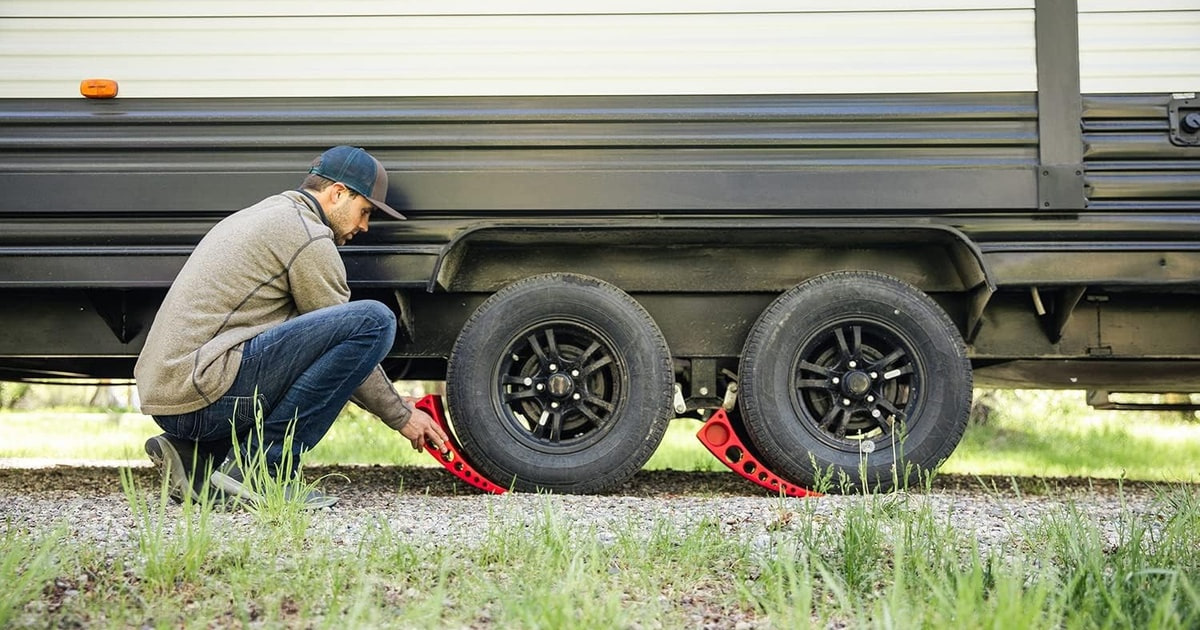
Pull into a campsite and the pad is never flat. One tire sits low, the trailer leans, and by dinner your soup slides to one side of the pot. Leveling blocks fix that. You stack them, drive up, and the rig sits square. It matters for more than comfort. Absorption-style RV refrigerators need to sit close to level to cool properly, and leveling experts suggest staying within about half a degree side to side. Doors latch better too. So does sleeping.
Here's the honest part: no leveling block does the whole job. Blocks lift a tire. They don't hold your trailer in place, so you still need real wheel chocks, and you should set them right after you level, even on a gentle grade. Blocks also handle side-to-side lean only. Front-to-back is your tongue jack's problem. And plastic is plastic. Park a heavy rig on a tall, sloppy stack and something will crack eventually. Sand and soft dirt swallow blocks unless you spread the load.
We read manufacturer specs, published RV guides and owner feedback for every set here, and the split is simple. Interlocking blocks are cheap, flexible and slow. Curved drive-on levelers are faster and pricier, and they only work on a rolling tire. Most people want the flexible option, because it also props up a stabilizer jack or a sagging picnic table. We think that the Camco FasTen RV Leveling Blocks are the best RV leveling blocks for most people, and that the RVMATE 12 Pack RV Leveling Blocks are the ones to buy if you want a bigger stack for less.
Everything we recommend

Slower to set up than a drive-on ramp, but far more useful

Twelve pieces and a bag, if you don't mind thinner blocks
Level in one drive-up, if you'd rather not stack anything

Drive-on speed with chocks and mats, for a heavier rig
Prices as of Oct 25, 6:48 AM PT · Details
At a glance
| Product | Pieces in set | Lift or thickness | Price | |
|---|---|---|---|---|
| Andersen Hitches Single Camper Leveler Block withUpgrade pick | 1 leveler + rubber mat | 1/2 to 4 in. | Check price |
| Camco FasTen RV Leveling Blocks - 8.5”Top pick | 10 blocks | — | $38.10On sale |
 | Camco 44512 RV Fasten Leveling BlocksAlso consider | Two 10-packs | — | $67.99 |
 | Homeon Wheels RV Leveling BlocksAlso in lineup | 9 blocks + 3 ramps | 1.3 in. per block | $29.99On sale |
| RVMATE 12 Pack RV Leveling BlocksBudget pick | 10 blocks + 2 tops | 1 in. per block | $28.10On sale |
| RVMATE Camper Levelers 8-Piece Kit RV LevelingAlso great | 2 levelers + 2 chocks | 1/2 to 4 in. | $29.99 |
Prices as of Oct 25, 6:48 AM PT · Details
How we picked
Capacity and margin. We compared published weight ratings against the per-tire load a loaded trailer actually puts down. Anything without a stated capacity had to earn its spot on other grounds.
Stack or drive-on. Interlocking blocks and drive-on ramps solve the same problem at different speeds. Published comparisons of setup time and owner feedback about fumbling with stacks shaped which kind of camper we'd point toward each.
Grip and stability. Spec sheets tell you about textured surfaces and rubber mats. Owner feedback tells you whether blocks skate on concrete, and we weighted the second more heavily.
What's in the box. We counted pieces and checked whether a set includes chocks, ramps, top caps or a bag. A kit that saves you a second purchase is worth more than its block count suggests.
Heat and cold. Plastic gets brittle in cold and soft in heat. We looked for stated materials and UV stabilization, and for owner reports of cracking after a season parked outdoors.
Top pickOn sale
Slower to set up than a drive-on ramp, but far more useful
Camco FasTen RV Leveling Blocks - 8.5”
These interlocking blocks stack to whatever height your low tire needs, then lock together so they can't skate apart under load. They're made in the USA, they carry with a twist-in T-handle, and they work under stabilizer jacks and tongue jacks as well as tires.
$38.10fromAmazonTypical pricePrices as of Oct 25, 6:48 AM PT · Details
The interlock is the whole point. Loose blocks squirt out sideways when a tire climbs them, which is how people end up chasing a yellow square across a gravel pad. These grip each other, so a three-high stack stays a stack. Camco says not to build higher than about four and a half inches, and that's a limit worth respecting on a windy night.
Ten blocks is enough for a typical campground pad. Guides for new owners generally suggest two blocks per side for a normal site, and double that if you camp off-grid on dirt. With ten, you can put a two-high stack under both tires on one side and still keep a couple in reserve for the tongue jack. Two sets is the answer for a long fifth wheel.
The T-handle sounds like a gimmick until you've carried blocks in the rain. Lift the handle, twist it into the bottom block, and the whole stack travels as one brick instead of a slippery armload. Then it collapses flat for storage. There's no bag, which is the small annoyance here, but the locked stack sits fine in a bumper compartment or a milk crate.
They're not just tire blocks. Camco lists them as compatible with hydraulic, tongue, stabilizer and fifth-wheel jacks, and with single wheels, duals and tandem axles. That flexibility is why we'd hand a set to a first-time owner over anything shaped for one job. A curved ramp can't hold up a stabilizer foot sinking into wet grass. A flat yellow square can.
Flaws but not dealbreakers
Stacking takes a few minutes, and you'll do it twice — once to guess the height, once to fix your guess. Comparisons of leveling methods put interlocking blocks at roughly two to three minutes against under a minute for a drive-on ramp. If you move sites every night, that adds up.
Each block is only about an inch and a half thick, and the stack limit is about four and a half inches. That's plenty for most paved and gravel pads. It's not enough for a badly tilted dispersed site, where you'd want a second set or a taller ramp.
Budget pickOn sale
Twelve pieces and a bag, if you don't mind thinner blocks
RVMATE 12 Pack RV Leveling Blocks
You get ten interlocking blocks, two smooth top caps and a carry bag, which is more pieces than most starter sets. Each block adds about an inch, so you can dial in a low tire in small steps instead of jumping an inch and a half at a time.
$28.10fromAmazonTypical pricePrices as of Oct 25, 6:48 AM PT · Details
An inch per block is the quiet advantage here. Thicker blocks make you choose between too low and too high, and you settle for whichever is less annoying. With inch increments you can actually land close to level, which matters if your fridge is the absorption kind that sulks on a slope. Two smooth top caps sit on the stack so the tire meets a flat surface.
The bag is worth more than it sounds. Twelve loose blocks in a storage bay become twelve loose blocks rattling down the highway. RVMATE includes a carrying bag, so the set lives in one place and comes out in one trip. Camco's own set skips the bag and gives you a handle instead. Which you prefer depends on whether you're a stack person or a duffel person.
The blocks interlock and work under the same things Camco's do: single wheels, duals, hydraulic jacks, tongue jacks, stabilizer jacks and fifth-wheel jacks. So this isn't a stripped-down design. It's the same idea, with more pieces and a lower price, from a smaller brand. Owners buy a lot of these, and the feedback skews positive on fit and stacking.
Twelve pieces also means you can leave a few under the stabilizer jacks and still have a stack for a tire. That's the situation that catches new owners out. You level the trailer, drop the jacks, and one of them hangs in the air over a rut. Having spares in the bag beats hunting for a flat rock in the dark.
Flaws but not dealbreakers
RVMATE doesn't publish a per-block weight rating, and the blocks are a bit thinner than Camco's. For a light travel trailer that's academic. For a heavy fifth wheel parked on hot asphalt, we'd rather have a set with a stated capacity and a longer track record.
The set includes no wheel chocks. Blocks are not chocks, and a stack under a tire does nothing to stop the trailer rolling, so budget for a real pair before your first trip.
Upgrade pick
Level in one drive-up, if you'd rather not stack anything
Andersen Hitches Single Camper Leveler Block with
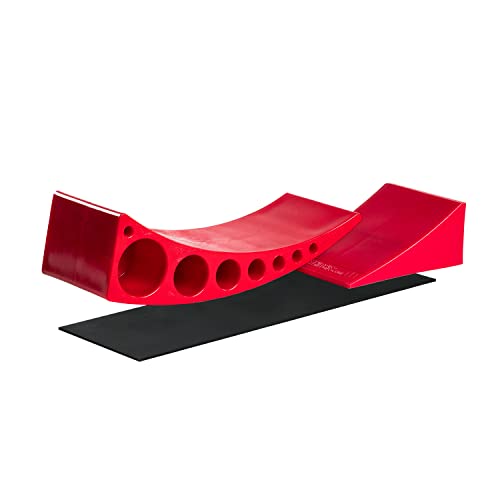
Drive up the curved ramp, stop when the trailer sits right, and set your chock. You land anywhere between a half inch and four inches without stacking a thing, and Andersen rates it for trailers up to 30,000 pounds on tires up to 32 inches.
Check priceatAmazonPrices as of Oct 25, 6:48 AM PT · Details
Picture the end of a long tow day. It's dark, the site slopes, and you'd like to be inside. This is where the drive-on design earns its keep. You lay the rubber mat, set the leveler in front of the low tire, pull forward until the bubble reads right, and stop. No guessing a stack height, no getting out to add another block.
Andersen builds these in the USA and backs them with a money-back satisfaction guarantee, which is the only warranty language in this whole lineup. The rubber mat matters more than it looks like it should. On concrete or hard-packed gravel, a bare curved leveler wants to slide forward as the tire climbs it. The mat is what keeps it planted.
You're buying one leveler, though, and that's the catch new buyers miss. A single-axle trailer needs one. A tandem-axle trailer needs two of these side by side under the pair of tires on the low side, so plan on buying twice. That's a real cost difference against a ten-pack of blocks, and it's the main reason this isn't our top pick.
The capacity headroom is what makes this the upgrade. Thirty thousand pounds on a single unit, on tires up to 32 inches, covers big fifth wheels and Class A motorhomes that would flatten a thin plastic block. If your rig is heavy, buy capacity well above what each tire actually carries. Cracking a leveler under load is not the kind of surprise you want at a campsite.
Flaws but not dealbreakers
It costs considerably more than a bag of plastic blocks, and you'll likely need two of them for a tandem axle. It also does one job. A curved leveler won't sit under a stabilizer jack or shim a wobbly picnic table, so most owners who buy these still keep a few plastic blocks in the bay.
Four inches is the ceiling. On a badly tilted dispersed site you'll run out of ramp, and there's no stacking your way past it.
Andersen builds every Camper Leveler in the USA and backs it with a money-back satisfaction guarantee.
Also great
Drive-on speed with chocks and mats, for a heavier rig
RVMATE Camper Levelers 8-Piece Kit RV Leveling
This kit gives you two curved levelers, two chocks and two rubber grip mats in a carry bag, so one box covers a tandem-axle trailer. RVMATE rates the levelers for vehicles up to 35,000 pounds on tires up to 32 inches, the highest capacity in this lineup.
$29.99fromAmazonPrices as of Oct 25, 6:48 AM PT · Details
If the Andersen approach appeals but buying two units doesn't, this is the practical answer. You get a matched pair, plus the chocks and the non-slip mats that you'd otherwise buy separately. For a tandem-axle travel trailer, that's the complete side-to-side setup in one purchase, bag included.
The chocks are the part we like. They mesh into the underside of the leveler with a gear pattern, so the wedge can't creep backward once the tire settles. Loose plastic chocks on a curved ramp are a known weak point of cheap kits. Pair that with the rubber mats under everything and the whole assembly stays where you put it on concrete.
Speed is the reason to go this route at all. Published comparisons of leveling methods put interlocking blocks at roughly two to three minutes and drive-on ramps at under one. That gap is nothing if you park for a week. It's the difference between a pleasant arrival and a chore if you're moving every day, or if you're doing it alone in the rain.
High-density polyethylene and a 35,000-pound rating give you margin, which matters more than the headline number suggests. Your rig's gross weight spreads across several tires, but ruts, curbs and a bad approach angle concentrate load on one. Buying well above what you think each tire carries is the cheap kind of insurance. This kit has the most headroom here.
Flaws but not dealbreakers
Two curved levelers cover one side of a tandem axle and nothing else. There's no stacking, no propping up a stabilizer jack, no shimming a jack pad. If this is your only leveling gear, you'll want a handful of flat blocks in the bay anyway.
Owner feedback on drive-on levelers generally is mixed on very soft ground. On sand or wet grass the ramp digs in rather than lifting, and the mats only help so much. Bring a wide board if you camp off pavement often.
Who this is for
Buy leveling blocks if you own any towable or drivable RV, full stop. Even a small pop-up on a gravel pad sits crooked, and an absorption fridge doesn't like it. First-time owners should start with an interlocking set, because it does the most jobs for the least money. If you're a weekend camper who returns to the same paved site, one ten-pack will probably last you years.
This guide covers blocks and ramps that lift a tire. It doesn't cover automatic hydraulic leveling systems, scissor stabilizers, or Bluetooth sensors that tell you how much lift you need without providing any. It also doesn't cover wheel chocks bought on their own, though we'll say again that you need them. If you boondock on rock and dirt, buy more blocks than you think, and expect to use them.
How we picked
Capacity: we compared published ratings against what a loaded tire actually carries, and looked for margin rather than a bare match. Method: interlocking blocks are slower but do more jobs, while drive-on ramps are quicker and do one, so we picked the best of each. Grip: textured surfaces and rubber mats matter, and owner feedback on sliding matters more. Contents: chocks, ramps, top caps and a bag change what a set is worth. Durability: we favored stated materials, UV stabilization and brands with a long track record over unlabeled plastic.
Other rv leveling blocks worth considering
If you want twenty FasTen blocks in one order: The Camco 44512 RV Fasten Leveling Blocks — This listing is the same Camco FasTen system as our top pick, sold as two ten-packs in one order. Twenty blocks is the right number for a long fifth wheel, or for a tandem-axle trailer where you'd rather build a stack under every tire than shuffle blocks between sides. It's also what boondockers tend to end up with after a season on dirt. The listing gives almost no detail of its own, so use the single ten-pack's specs as your reference. Same blocks, same T-handle, twice as many.
The competition
This is what our research surfaced, not a census of every leveling block sold. Plenty of decent sets from smaller brands never turn up in published comparisons, and RV parts move in and out of stock constantly. Here's the one that came close.
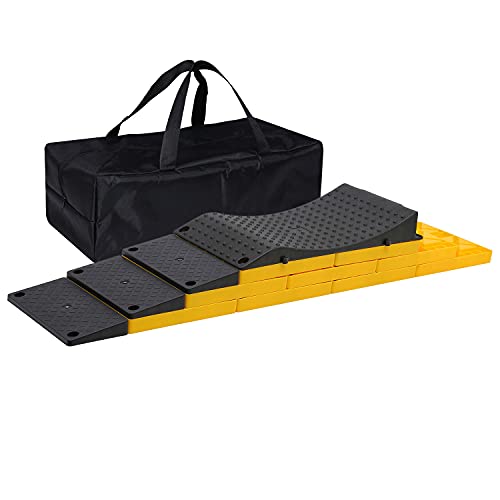
The Homeon Wheels RV Leveling Blocks — The Homeon Wheels kit is the most complete starter bundle here: nine interlocking blocks, three sloped drive-on ramps, a wheel chock, two securing pegs and a carry bag. The ramps are a genuinely nice touch, since they let a tire climb a stack instead of bumping into its edge. It loses to our picks on two counts. Owner feedback runs a little more mixed than for the sets above, mostly around flex under heavier rigs, and one chock isn't enough for a tandem axle. But if you're outfitting a small travel trailer from nothing and want everything in one box, this is a reasonable place to start.
Setup and storage
Level side to side first, then front to back with the tongue jack, because doing it the other way means redoing both. Put your blocks in front of the low tire, drive up slowly with a spotter, and stop when the bubble sits right. Chock the wheels immediately, even on a grade that looks harmless. Most setup checklists treat chocking as a step you never skip. Afterward, rinse the mud off before the blocks go back in the bag, because grit ground into the interlocking teeth is what stops them locking cleanly. Store them somewhere they won't bake in a closed bay, and check for hairline cracks now and then, especially on a set that lives outside.
Questions we get
Are leveling blocks necessary for an RV?
Yes, unless every site you visit is poured flat. A trailer that sits tilted makes doors swing on their own and can stop an absorption-style refrigerator from cooling properly. Leveling guidance generally puts the target within about half a degree in both directions. A stack of plastic blocks is a lot cheaper than a new fridge.
How many leveling blocks do I need for a travel trailer?
Two per side covers a typical campground pad, which is why ten-packs are the standard. Boondockers on dirt and rock often carry twice that. If you have a tandem axle, count both tires on the low side, and leave a few spare for the stabilizer jacks.
What's the difference between leveling blocks and wheel chocks?
Blocks lift a tire. Chocks stop it rolling. They aren't interchangeable, and a stack of blocks under a wheel does nothing to hold the trailer in place. Setup checklists recommend chocking before or right after leveling, even on grades under five percent.
Can I use leveling blocks on a motorhome?
Yes, and the same rules apply, with one caveat about weight. A motorhome puts far more load on each tire than a small trailer, so check the per-block or per-unit rating and leave margin. Drive-on levelers rated for tens of thousands of pounds are the safer choice for a Class A.
Are drive-on levelers worth it over interlocking blocks?
It depends on how often you move. Ramps level in one motion, roughly a minute against two or three for stacking, which is a real gain if you change sites daily. They also cost more and do one job. If you park for a week at a time, blocks are the better buy.
Do plastic leveling blocks crack in cold weather?
Cheap unstabilized plastic does. Blocks made from UV-stabilized ABS or high-density polyethylene hold up far better, and some manufacturers rate them for use well below freezing. The bigger risk is overloading a tall stack, which cracks blocks at any temperature. Keep your stacks low and wide.
Why you should trust us
For this guide:
- We read the manufacturer specifications and listing details for every set here, comparing stated weight ratings, block dimensions and stack limits.
- We reviewed published RV setup guides and leveling comparisons for how long each method takes and how much lift a typical site needs.
- We looked at recurring themes in owner feedback, especially complaints about blocks sliding, cracking or not stacking cleanly.
- We read owner reviews on every listing, weighted toward the critical ones, because that is where the recurring failures show up.
- We have a systematic way of automatically fetching the latest prices, so the numbers on this page stay current.
- This is a research-focused guide, so the team may not own every product listed — though we often do own the top winners, which gives us extra context for the recommendations.
- We don't accept free products, and the retailer commission never changes which product we recommend.
Sources
Camco FASTEN Leveling Blocks — Product Specifications, Camco
Andersen Camper Leveler — Official Product Page, Andersen Hitches
Tri-Lynx Leveling System — Product Overview, Tri-Lynx
How to Level Your RV: A Complete Guide, Do It Yourself RV
Best RV Leveling Blocks Compared, Camper Report
RV Leveling 101: Blocks, Ramps, and Automatic Systems, RV Lifestyle
Why Every RVer Needs Leveling Blocks, The Fun Times Guide
RV Setup Checklist: Leveling, Chocking, and Stabilizing, Good Sam
Beginner's Guide to Leveling a Travel Trailer, RVshare
LevelMatePRO LX — Bluetooth RV Leveling System, LevelMate
Valterra Leveling Blocks — Specifications and Warranty, Valterra
Boondocking Gear Essentials: Leveling on Rough Terrain, Outdoorsy
Amazon product listings and owner reviews for all 6 products
Manufacturer specification pages for each product
Some passages in this guide may be paraphrased with AI help.
Product prices and availability are accurate as of the date/time indicated and are subject to change. Any price and availability information displayed on Amazon.com at the time of purchase will apply to the purchase of this product.
More like this.
Continue exploring lifestyle reviews and recommendations.

The Best RV Accessories and Camper Upgrades
An RV is a house that shakes at 65 miles an hour, and most of the parts that make it livable didn't come from the factory. You add them. Power that lasts…

The Best RV Surge Protectors
Shore power at a campground isn't the same thing as power at home. A pedestal sits outside for years, gets plugged and unplugged thousands of times, and…

The Best Laser Levels for DIY Home Projects
A laser level turns a guess-and-check chore into a five-minute job. Hanging a run of upper cabinets, tiling a backsplash, running chair rail, laying out a…

The Best Smart Propane Tank Level Monitors
Propane always runs out at the worst moment. The burgers are half done, or the camper's furnace quits overnight, or the water heater goes cold on a…

The Best Yoga Blocks
A yoga block is the least glamorous thing in your gear bag and probably the most useful. It brings the floor up to your hands in a standing forward fold.…

The Best Yoga Blocks and Props for Beginners
A yoga block is just a brick you can't fall through, and that's the whole point. When your hamstrings won't let your hand reach the floor in Triangle, a…