The Best Smart Propane Tank Level Monitors
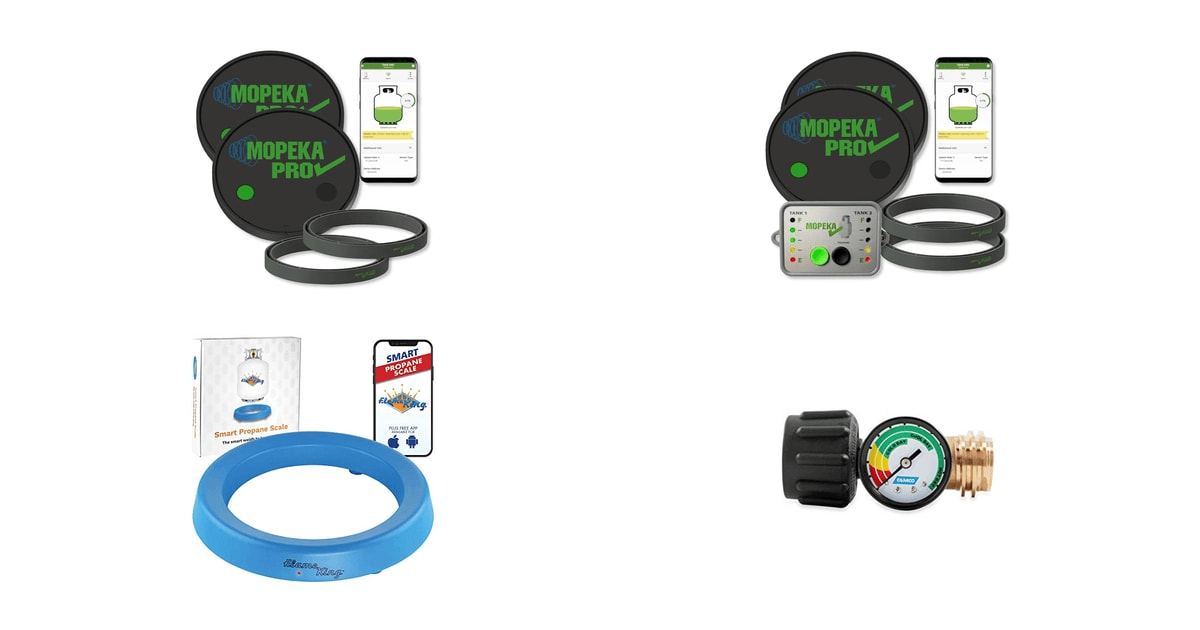
Propane always runs out at the worst moment. The burgers are half done, or the camper's furnace quits overnight, or the water heater goes cold on a Sunday. About 5.7 million U.S. households heat with propane, and more than 63% of American homes own a grill or smoker, so a lot of us are guessing at a steel cylinder we can't see inside of. A smart monitor turns that guess into a number on your phone. It's a small fix for a genuinely annoying problem.
None of these read propane directly, though. Ultrasonic sensors bounce a sound wave through the tank bottom and infer the liquid height, which is good to about ±10% — better than the analog dial gauges that miss by 20% or more, but not exact. Pressure gauges get worse as it gets colder, because propane vapor pressure falls from roughly 110 psi at 70°F to about 24 psi near 0°F. And most of these devices are Bluetooth, so "remote" really means the length of your driveway.
So think about where you'll be standing when you want the answer. On the patio, Bluetooth is plenty. Three states away from your camper, you'll need a bridge on your home network. Tank size matters too — a 20-pound BBQ cylinder needs a bottom-mount sensor, not a clip-on dial reader. We think that the Mopeka Pro Check Universal two-sensor bundle is the best smart propane tank level monitor for most people, and that the Pro Check Universal bundle with the LED display is the one to buy if you want a readout mounted in your RV.
Everything we recommend

Accurate ultrasonic readings, and an app you'll actually keep

The same sensors, plus a readout you can see from the dinette
A simple sanity check, as long as you know what it can't do
At a glance
| Product | Sensor Type | Connectivity | Price | |
|---|---|---|---|---|
| Mopeka Pro Check Universal Bundle - 2Top pick | Ultrasonic | Wifi Bridge | $155.99On sale |
| Mopeka Pro Check Universal Bundle - 2Runner-up | Ultrasonic | LED Display | $185.99On sale |
 | Flame King Smart Wireless Propane Tank ScaleAlso in lineup | — | Bluetooth | $19.99On sale |
| Camco RV Propane Gauge and Leak DetectorBudget pick | Propane Gauge | — | $43.98 |
 | Truma Gas Fill Level Check 50501-01Also consider | — | — | $81.59 |
How we picked
Sensing that works cold. We weighted ultrasonic liquid-level sensing over pressure-based gauges, because published industry data shows propane vapor pressure collapsing as temperatures drop. A monitor that's only honest in July isn't much use during heating season.
Real-world range. We looked at each device's connection type against published Bluetooth range figures of 30 to 100 feet, then discounted for the metal tanks, walls and concrete that owners describe cutting range in half. Anything claiming remote access had to say plainly what extra hardware that requires.
Tank compatibility. We checked each product's spec sheet for the tank sizes it actually supports, from 20-pound BBQ cylinders up to 250-gallon residential tanks. Clip-on dial readers were ruled out for small cylinders, which have no float gauge to read.
App and alerts. We compared what each app allows — number of tanks, custom low-level thresholds, temperature readings — and read owner feedback for recurring complaints about pairing and dropped connections. Persistent connection trouble counted heavily against a product.
Batteries and fees. We compared manufacturer battery-life ratings, which range from a few months on AA cells to three to five years on a purpose-built sensor. We also checked whether basic alerts require an ongoing service plan.
Top pickOn sale
Accurate ultrasonic readings, and an app you'll actually keep
Mopeka Pro Check Universal Bundle - 2
Two ultrasonic sensors stick magnetically to the bottom of your tanks and report the liquid level to a free app, with alarms you set yourself. It's the most trustworthy reading you'll get short of hauling the cylinder onto a bathroom scale.
$155.99fromAmazonList priceUltrasonic sensing is the only approach here that warns you before the tank is nearly empty. The sensor times the echo of a sound wave sent up through the tank bottom and works out how deep the liquid is. Mopeka puts the accuracy at about ±10%, roughly twice as good as the analog pressure dials that miss by 20% or worse. And because it reads liquid rather than vapor pressure, a cold morning doesn't wreck the number.
Setup takes a couple of minutes per tank. The sensor snaps onto the steel bottom with magnets strong enough to stay put on washboard roads, and the included Tank Halo ring keeps the full weight of the tank off the sensor body — skip that ring and you'll be re-centering the thing after every refill. The same sensors cover standard BBQ cylinders, RV tanks, patio heaters and custom LPG tanks up to 250 gallons.
The free Tank Check app is the part owners keep coming back to. You can add unlimited tanks and sensors, set your own low-level alarms, check tank temperature, use the built-in bubble level to confirm the sensor is sitting flat, adjust how often it reports, and push firmware updates. If you want the reading from somewhere other than your backyard, Mopeka's WiFi bridge relays it — but you buy that separately.
You won't be swapping batteries every season. Mopeka rates the Pro Check Universal for three to five years of service, a 63% jump over the original Pro Check. That matters more than it sounds. A monitor you have to maintain is a monitor you'll eventually ignore, and the whole point of buying one is to stop thinking about propane until it tells you to.
Flaws but not dealbreakers
It's Bluetooth on its own. The nominal range for these low-energy sensors is 30 to 100 feet in the open, and a steel tank, a concrete pad or a house wall can cut that to 30 feet or less. If you want to see your levels from work or a hotel, budget for the WiFi bridge too — and this bundle is already one of the more expensive ways to answer a simple question.
There's some fussiness. The sensor needs acoustic coupling grease between it and the tank, and owners report reapplying it now and then. It has to sit level and centered to read well, and a few people describe signal that comes and goes. Aluminum cylinders are a different problem entirely: magnets won't hold, so you'll need an adhesive collar.
Runner-upOn sale
The same sensors, plus a readout you can see from the dinette
Mopeka Pro Check Universal Bundle - 2
This bundle pairs the same two Pro Check Universal sensors with an LED display that mounts in a dash or cabinet and shows both tanks wirelessly. If you'd rather not unlock your phone every time you wonder, buy this one instead.
$185.99fromAmazonList pricePicture the camper at night with the furnace cycling. You want a number, not a phone, not an app, not a Bluetooth handshake. The LED display sits in your control panel and reads both tanks at once, so anyone in the rig can glance at it — including the people who never installed the app in the first place.
Everything good about the top pick carries over unchanged. Same patented ultrasonic sensors, same magnetic mount and Tank Halo rings, same three-to-five-year battery rating, same free app with unlimited tanks and programmable alarms. You're not trading accuracy for the display. You're just adding a second way to see the same reading.
It's the better buy for a permanent dual-tank setup — a travel trailer, a food truck, a fifth wheel you live in for months at a stretch. Owners with paired 20- and 30-pound cylinders describe the same install experience as the sensor-only bundle, with the display handled during setup.
Flaws but not dealbreakers
You're paying for hardware you may not need. If your tanks are twenty feet from the back door and your phone is always in your pocket, the display is dead weight, and the two-sensor bundle does the same job for less.
The display also has to go somewhere and get power, which means picking a spot in the dash or a cabinet and running a wire. And the sensors are still Bluetooth — the display doesn't extend your range or let you check levels from the road.
Budget pick
A simple sanity check, as long as you know what it can't do
Camco RV Propane Gauge and Leak Detector
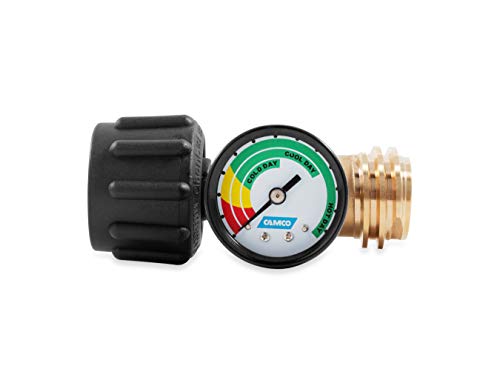
This is an inline pressure gauge that threads between your tank valve and the hose, with a color band you read at a glance. It also works as a leak detector and cuts off flow if a gas line breaks.
$43.98fromAmazonLet's be honest about what this is: not a smart monitor. There's no app, no Bluetooth, no battery and no alert. It's here because plenty of people don't want any of that. If you grill a few times a month and keep a spare cylinder in the garage, a gauge you glance at while lighting the burners is enough.
The safety hardware is the real argument for it. Beyond the level indicator, it gives you excess flow protection if a line breaks and thermal protection in a fire, and it doubles as a leak detector when you're chasing a propane smell. That's a useful thing to have permanently attached to a tank, whether or not you also run a sensor underneath.
It uses the Type 1 connection, so it fits DOT cylinders with the modern ACME/OPD valve — the ones on grills, RVs and boats. The dial carries temperature-compensated markings, which at least acknowledges that ambient temperature moves the reading. Owners describe the build as solid brass-and-metal hardware rather than the flimsy gauges that come bundled with regulators.
Flaws but not dealbreakers
Pressure gauges don't track how full a tank is. Propane sits as liquid under fairly constant vapor pressure until it's nearly gone, so the needle stays parked in the green and then drops fast. Owners with 40-pound bottles describe exactly that. Treat it as a low-fuel light, not a fuel gauge.
It also won't read anything until gas is actually flowing, so you can't check a disconnected spare. And in cold weather the underlying physics goes against it — vapor pressure at 0°F is less than a quarter of what it is at 70°F, which is precisely when a heating season reading matters most.
Who this is for
Buy one of these if you've ever run out of propane and had to deal with it — mid-cook, mid-trip or mid-January. Grillers get the most obvious benefit, since a standard 20-pound cylinder holds about 4.6 gallons and a grill on high burns roughly 1.5 to 2 pounds an hour, which is only 8 to 11 hours of cooking. RV owners get more, because you can't heft a strapped-down tank to guess its weight. And if you heat with propane, an alert at the 20% mark that the industry recommends as a refill threshold is worth real money in avoided emergency delivery surcharges.
This guide covers monitors for portable and above-ground cylinders — BBQ tanks, RV and camper bottles, patio heaters and larger above-ground LPG tanks. It doesn't cover buried tanks, which need equipment your propane dealer usually installs, and it doesn't cover dealer-side telemetry systems. If your tank has a working dial gauge you can see from a window, and you're never away from home for long, you probably don't need any of this.
How we picked
We started from spec sheets, published technical guidance and owner feedback themes, then judged every product against the same five things. Sensing: ultrasonic liquid-level reading beats pressure, because vapor pressure falls apart in the cold. Range: we took manufacturer Bluetooth figures and discounted them for the steel and concrete owners actually install around. Tank fit: each device had to state the cylinder sizes it supports, and small BBQ tanks rule out clip-on dial readers. App: custom low-level alarms, multiple tanks and a pairing process people don't complain about. Upkeep: battery life measured in years rather than months, and no ongoing plan required for the alert that keeps you from running dry.
Other smart propane tank level monitors worth considering
If you want one checker you can carry from tank to tank: The Truma Gas Fill Level Check 50501-01 ($81.59) — The Truma LevelCheck is a handheld ultrasonic reader rather than a mounted sensor. You hold it flat against the side of the bottle and an LED tells you whether there's liquid at that height, and it works on steel and aluminum cylinders from 200 to 350mm in diameter. There's even a flashlight built in for the dark corner of a storage bay. What you give up is everything automatic: no app, no alerts, no reading unless you walk out and take it. It also won't work on fillable tank-style bottles, and some owners report units that read empty on tanks that clearly weren't.
The competition
Here's what the research turned up beyond our picks — not everything sold in this category, but the products that came up often enough to warrant a look.
The Flame King Smart Wireless Propane Tank Scale ($19.99) — The Flame King Smart Propane Tank Scale takes a different approach: the tank sits on a Bluetooth scale, and weight is inherently the most direct measure of how much propane you have. It handles 20-, 30- and 40-pound cylinders and fits inside many grill cabinets. But owner feedback is split hard, and the complaints cluster around the same places — an app that refuses to pair, a power switch mounted underneath where you can't reach it with a tank on top, and a flimsy battery door on the two AA cells it needs. Manufacturer support seems responsive about replacements. If your grill cabinet fits it and you like the idea of a direct weight reading, it's worth a shot, but the ultrasonic sensors are the safer buy.
Installation notes
Ultrasonic sensors are only as good as their contact with the tank. Clean the bottom with alcohol first, apply the acoustic coupling grease, and set the sensor flat and centered — the app's bubble level exists for a reason. Use the included ring so the tank's weight rests on the ring, not the sensor, or you'll be re-seating it after every refill. Aluminum cylinders need an adhesive collar, since magnets won't grip. Once it's reading, set your low alert around 20%, which is the refill threshold propane industry groups recommend. That buffer isn't just convenience. Under NFPA 58, a system that runs completely empty needs a licensed technician to pressure test it and relight the pilots before service resumes.
Questions we get
Do smart propane monitors work on a standard 20 lb BBQ tank?
Bottom-mount ultrasonic sensors and Bluetooth scales do, and both of our Mopeka picks support standard 20-pound cylinders. Clip-on readers that sit over a dial gauge won't, because small cylinders don't have a float gauge to read. If a product's spec sheet doesn't name 20-pound tanks, assume it isn't meant for one.
Can I check my propane level from anywhere, or do I have to be near the tank?
Bluetooth sensors have a nominal range of 30 to 100 feet, and steel tanks, walls and concrete often cut that to 30 feet or less. So on their own, they're proximity devices — great from the patio, useless from a hotel. Mopeka sells a WiFi bridge that relays readings to the internet, and that's what you'll need for real remote monitoring. It's a separate purchase.
Will a propane monitor still work below freezing?
Ultrasonic sensors will, because they measure the height of the liquid rather than the pressure of the vapor. Pressure-based gauges are the problem: propane vapor pressure drops from roughly 110 psi at 70°F to about 24 psi near 0°F, which makes the needle nearly meaningless in winter. If you're monitoring a tank that feeds home heating, go ultrasonic.
How do ultrasonic propane sensors work, and how accurate are they?
The sensor sends a sound pulse up through the bottom of the tank and times the echo coming back off the surface of the liquid, which gives it the liquid height. Mopeka states about ±10% accuracy for its sensors. That's roughly twice as accurate as a standard analog pressure gauge, which can be off by 20% or more. Good enough to plan a refill, not a precision instrument.
How long do the batteries last?
It depends entirely on the design. Mopeka rates the Pro Check Universal sensors at three to five years, a big improvement over its earlier sensors. Coin-cell sensors reporting every 30 seconds typically run 12 to 18 months at normal temperatures. Scales running on AA batteries are measured in months, especially if you leave them powered on between cooks.
What happens if I let a propane tank run completely empty?
For a grill, nothing worse than a ruined dinner. For a home heating system it's a bigger deal: NFPA 58 requires a licensed technician to pressure test the system and inspect every appliance pilot before gas service can be restored. You'll also likely pay an emergency delivery surcharge on top of that. Setting a low-level alert at 20% is the whole reason to own one of these.
Why you should trust us
For this guide:
- We read the manufacturer specifications and product documentation for every monitor here, comparing stated accuracy, tank compatibility, connection type and battery ratings side by side.
- We drew on published technical guidance from propane industry and safety organizations for the underlying facts about vapor pressure, gauge accuracy and refill thresholds.
- We read through owner feedback looking for repeated themes — pairing failures, mounting problems, battery complaints — rather than treating any single account as decisive.
- We read owner reviews on every listing, weighted toward the critical ones, because that is where the recurring failures show up.
- We have a systematic way of automatically fetching the latest prices, so the numbers on this page stay current.
- This is a research-focused guide, so the team may not own every product listed — though we often do own the top winners, which gives us extra context for the recommendations.
- We don't accept free products, and the retailer commission never changes which product we recommend.
Sources
Best Propane Tank Gauges — Bob Vila, Bob Vila
Best Propane Tank Gauges — Popular Mechanics, Popular Mechanics
Best Propane Tank Monitors — The Spruce, The Spruce
Best Propane Tank Level Monitors — This Old House, This Old House
Mopeka Technology: How Ultrasonic Propane Sensing Works, Mopeka (Manufacturer)
Tank Utility Smart Home Integrations and Features, Tank Utility (Manufacturer)
NFPA 58: Liquefied Petroleum Gas Code, National Fire Protection Association
U.S. Propane Use by Sector — EIA Energy Explained, U.S. Energy Information Administration
Consumer Propane Safety Information — NPGA, National Propane Gas Association
Propane Tank Safety and Usage Guidance — PERC, Propane Education & Research Council
Truma LevelControl Product Page, Truma (Manufacturer)
Bluetooth Low Energy Range and Performance Overview, Bluetooth SIG
Amazon product listings and owner reviews for all 5 products
Manufacturer specification pages for each product
Some passages in this guide may be paraphrased with AI help. Prices are refreshed automatically.
More like this.
Continue exploring electronics reviews and recommendations.

The Best Portable Propane Heaters
A propane heater earns its keep in the places your furnace never reaches. The garage where you're changing oil with the door cracked. An ice shanty at…

The Best Laser Levels for DIY Home Projects
A laser level turns a guess-and-check chore into a five-minute job. Hanging a run of upper cabinets, tiling a backsplash, running chair rail, laying out a…

The Best RV Leveling Blocks
Pull into a campsite and the pad is never flat. One tire sits low, the trailer leans, and by dinner your soup slides to one side of the pot. Leveling…

The Best Portable USB-C Monitors
A second screen changes how a laptop feels. Spreadsheets stop hiding behind browser tabs, and a video call stops covering your notes. What makes a…

The Best Tire Pressure Monitoring Systems
Your tires are losing air right now. Nothing dramatic - just the ordinary seep of one to two pounds a month, according to the Tire Industry Association,…

The Best Monitor Arms and Desk Mounts
Your monitor's factory stand puts the screen at one height, one angle, and one spot on the desk. That's fine until you actually work there all day. A…