The Best Laser Levels for DIY Home Projects
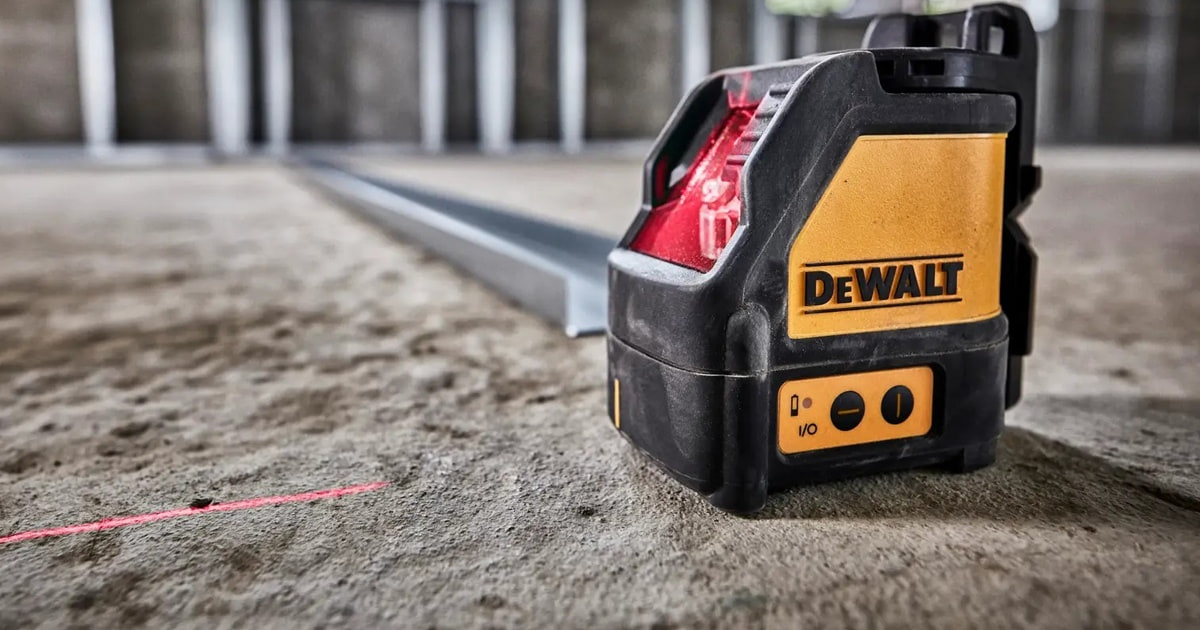
A laser level turns a guess-and-check chore into a five-minute job. Hanging a run of upper cabinets, tiling a backsplash, running chair rail, laying out a gallery wall — all of it gets easier when a straight line is already on the wall. You set the tool down, it levels itself, and you stop squinting at a bubble vial. Most homeowners need something simple: press a button, get a horizontal and a vertical line, move on. The rest of the decision comes down to a beam you can actually see.
No laser level does everything, and the spec sheets hide that. A red beam washes out in a sunny kitchen or under bright shop lights, and green costs more and drinks batteries faster. Outdoors in daylight, no beam here is visible to your eye at working distance without pulse mode and a matching detector. Self-leveling only works within a few degrees of level, so an older sloping floor means shimming the base. And published accuracy is measured at the stated range, so it loosens as the line gets longer.
We looked at seven models across the range: red and green, cross-line and three-plane, AA-powered and tool-battery powered. For most people the choice is between a rugged cross-line laser that lives in a case in the garage and a three-plane tool that covers a whole room at once. We think that the DEWALT DW088K is the best laser level for DIY home projects for most people, and that the Bosch GLL 100 GX is the one to buy if your rooms are big, bright, or open-plan.
Everything we recommend

Tough, simple, and enough laser for most rooms in a house

A brighter green line and twice the range, for more money
The least fussy way to get a straight line on a wall

Three full planes and dust-tight sealing, if you'll use them

Whole-room coverage and app control, with softer build quality
At a glance
| Product | Range | Beam Color | Price | |
|---|---|---|---|---|
| DEWALT Line LaserTop pick | 165 ft w/ detector | Red | $135.95On sale |
| BOSCH GLL 100 GX 100 Ft Green-BeamRunner-up | 100 ft | Green | $229 |
| Huepar Laser Level 360 Self LevelingAlso great | — | Green | $179.99 |
| Johnson Level & Tool 40-6648 Self-Leveling CrossBudget pick | 30 ft | Red | $84.79 |
 | DEWALT 20V/12V MAX Laser Level KitAlso consider | — | Green | $670.39 |
| Bosch GLL300-42GL 360º Green-Beam Three-Plane Leveling andUpgrade pick | 100 ft | Green | $349.95 |
 | Leica Geosystems 864420 LINO L2G Green BeamAlso in lineup | — | Green | $574.87 |
How we picked
Beam you can see. We compared published beam specs and lab comparisons from tool review outlets, which consistently put green beams at roughly four times the apparent brightness of red and close to twice the readable distance under overhead fluorescents. Anything meant for a bright or large room had to be green.
Accuracy that holds. We treated 1/8 inch at 30 feet as the floor, since that's the tolerance published across the category and more than a shelf or cabinet run demands. We also checked whether accuracy specs loosen at the maximum stated range, because several do.
Sealing and durability. We read the IP ratings and drop ratings on each spec sheet and treated IP54 as the minimum for anything going into a garage, a bathroom, or a basement. Listings with no published IP rating got flagged as indoor-only rather than given the benefit of the doubt.
Setup you'll tolerate. We favored tools with built-in magnetic mounts, standard 1/4-inch-20 tripod threads, and one-button operation, because owner feedback across this category is dominated by setup friction rather than accuracy complaints. A laser that's slow to mount doesn't get used.
Power and range. We looked at battery type, published runtime, and whether pulse mode with a detector is available, since that's the only way any of these work outdoors in daylight. AA compatibility counted as a plus for anyone who uses a laser a few times a year.
Top pickOn sale
Tough, simple, and enough laser for most rooms in a house
DEWALT Line Laser
The DW088K is a self-leveling cross-line laser that sticks to metal, shrugs off dust and splashes, and holds about 1/8-inch accuracy at 30 feet. That covers shelves, backsplashes, chair rail, and cabinet runs in a normal house, which is most of what you'll ever ask a laser to do.
$135.95fromAmazonList priceThe magnetic bracket is the reason you'll actually use it. DEWALT builds a patented magnetic mount into the tool, so it grabs a steel door frame, an HVAC register, or stud track and stays put. You skip the tripod for most indoor jobs. That matters more than it sounds: a laser that takes ten seconds to set up gets used for a two-shelf project, and one that needs a tripod gets left in the case.
It's built for the way tools actually get treated. The over-molded housing carries a 1-meter drop rating, so a knock off a ladder step isn't automatically a trip to recalibration. The IP54 rating covers dust and splashes from any direction, which is what you want near a wet-cut tile saw, in a dusty garage, or during a bathroom remodel. It ships in a hard case, and that case is what keeps it accurate over years.
The accuracy is more than a home project needs. DEWALT lists roughly 1/8-inch accuracy at 30 feet. For a gallery wall, a picture ledge, or a run of uppers, that's finer than you can hang hardware anyway, since most frame hangers have several millimeters of play. Spec sheets across this category agree that 1/8 inch at 30 feet is the practical DIY threshold, and this one meets it without a premium instrument's cost.
When it can't level itself, it says so. Push the tool outside its self-leveling range and the beam blinks instead of quietly drawing a crooked line. That's the failure mode that ruins a cabinet run, and the blink is a cheap insurance policy. On an older house with a sloping floor, shim the base until the beam goes solid, then start marking.
It stretches outdoors if you add a detector. DEWALT lists a working range up to 165 feet with a detector, sold separately. That's a second purchase, so budget for it if deck posts or fence lines are on your list. Without one, treat this as an indoor tool and plan around 30 feet.
Flaws but not dealbreakers
The red beam fades before the tool runs out of range. In a room with bright overhead fluorescents or a wall of windows, you'll be hunting for the line past about 30 feet. Published comparisons put green beams at roughly twice the readable distance of red under that kind of lighting. If your main room is big and bright, buy green instead.
There's no green version of this model, and no included detector. So the two things that would extend it — a brighter beam, longer outdoor range — both mean buying a different tool or another accessory. It's a cross-line laser, full stop. For whole-room flooring or a drop ceiling, you'll reposition it several times instead of setting one tool in the middle of the room.
Runner-up
A brighter green line and twice the range, for more money
BOSCH GLL 100 GX 100 Ft Green-Beam
The GLL 100 GX is the same idea as our top pick with a green beam and a 100-foot working range. If your kitchen is bright, your living room is open-plan, or your garage is wide, this is the line you'll be able to see without cupping your hands around it.
$229fromAmazonGreen is the upgrade you'll actually notice. Bosch rates the beam up to four times brighter than a standard red line, and published lab comparisons put green beams at close to twice the readable distance under fluorescent overhead lighting. In a south-facing kitchen at noon, that's the difference between a usable layout line and a faint smudge. You don't need better accuracy than the DEWALT here. You need to see the line.
The range covers rooms a cross-line laser usually can't. Bosch lists a 100-foot total working range, roughly double what our top pick reaches on its own. That's enough to run one level line the length of an open-plan living space, align cabinetry across a U-shaped kitchen, or set a reference across a two-car garage floor. You set it once and work from the same line all afternoon.
VisiMax keeps the line bright as the batteries drain. The tool manages its own power output rather than running at a fixed setting, so the beam doesn't dim noticeably toward the end of a pack of AAs. Three AA batteries come in the box. Alkalines are easy to replace mid-job from any grocery store, which is a quiet advantage over rechargeable-only tools.
You can split the lines, and the extras are useful. Project horizontal, vertical, or both, depending on whether you're setting cabinet height or plumbing a door casing. Bosch includes a green target plate, a positioning device, and a heavy-duty pouch, so the long-range line stays findable on a far wall. The housing is over-molded and IP54 rated for dust and water, same protection class as our top pick.
Flaws but not dealbreakers
Accuracy loosens at the far end of that range. Bosch lists ±1/8 inch at 33 feet but ±3/8 inch at 100 feet. That's fine for framing and layout, and it's not fine for precision alignment across a long room. Work closer when the tolerance matters, and treat the 100-foot number as a reach spec rather than a working default.
It's still a cross-line laser, and it costs more than our top pick. You get two planes across a limited fan angle, not a full circle, so whole-room flooring and drop-ceiling work still means moving the tool. There's no magnetic bracket built into the body the way DEWALT does it, so you'll lean more on a tripod or the included positioning device.
Budget pick
The least fussy way to get a straight line on a wall
Johnson Level & Tool 40-6648 Self-Leveling Cross
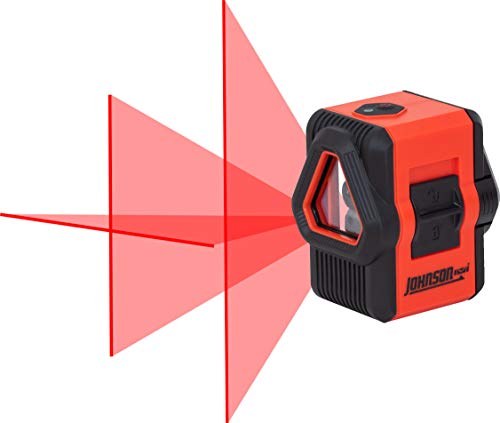
The Johnson 40-6648 projects a horizontal and vertical line the second you set it down, and it costs less than anything else here. For a renter, a first-time homeowner, or someone who levels something two or three times a year, it does the fundamentals and nothing else.
$84.79fromAmazonThere's almost nothing to learn. Set it down, and it throws a cross-line and self-levels within seconds. Johnson also includes a 90-degree plumb line for squaring off a post or a beam. If you've never owned a laser level and you just want a shelf that isn't crooked, this is the shortest path from box to wall.
Any camera tripod works as a stand. The base uses the industry-standard 1/4-inch-20 thread, so the adjustable tripod from a hardware store or a photography shelf screws right on. You don't need a brand-specific accessory, which is where a lot of the hidden cost lives in this category. That flexibility also lets you get the line up to countertop or upper-cabinet height easily.
The pendulum lock protects it between jobs. Engage the lock before you toss the tool in a drawer or carry it between rooms, and the internal pendulum stops rattling around. That's the part that goes out of calibration first on cheap lasers, and a factory recalibration costs more than this tool is worth. It's a small detail that changes how long the laser stays trustworthy.
Manual mode handles the lines that aren't level. Lock the beam at any angle for a stair stringer, a graded ramp, or a deliberately sloped run. When it's in self-leveling mode and it can't reach level, the beam flashes as an out-of-level warning rather than lying to you. At about half a pound, it also goes anywhere without thought.
Flaws but not dealbreakers
Thirty feet of red beam is the ceiling here. That's fine in a bedroom or a standard bath, and it runs out in a big open living space or a bright garage. If your projects live in rooms wider than about 25 feet, or the room is well lit, you'll want green.
Johnson doesn't publish an IP rating for it. So treat it as an indoor, dry-conditions tool. Keep it away from wet tile cutting, concrete dust, and rain-exposed deck work, or accept that you're gambling with a tool that isn't rated for it. It's also light enough that a bumped tripod leg moves the whole reference.
Upgrade pick
Three full planes and dust-tight sealing, if you'll use them
Bosch GLL300-42GL 360º Green-Beam Three-Plane Leveling and
The GLL300-42GL puts three 360-degree green planes around the room from one position, and it's sealed to IP65 — dust-tight, not just dust-resistant. For a drop ceiling, a full floor of tile, or cabinets spanning multiple walls, you stop repositioning and start working.
$349.95fromAmazonThree planes at once means you set the tool down once. One horizontal circle and two perpendicular vertical circles wrap the whole room, so the perimeter line for a drop-ceiling ledger and the reference lines for main tees and cross tees are all live at the same time. Published comparisons of three-plane setups against cross-line lasers put the repositioning savings on whole-room layouts around 40 percent. On a weekend tile job, that's real time back.
IP65 is the best sealing in this guide. Dust-tight and water-resistant, a step above the IP54 that most of this category tops out at. That matters in the specific places laser levels die: next to a wet-cut tile saw, in a garage full of concrete dust, under a ceiling you're cutting drywall into. If your projects are messy, this is the one that survives them.
The power setup is flexible in a way that matters mid-job. A rechargeable 3.7V Li-ion pack comes in the box, and the USB-C cord charges it even while the laser is running — so a dying battery is a cord away from a fix rather than an hour off. AA batteries work as a fallback if you're somewhere without power. You're never stranded halfway through a layout.
The green beam is managed, not just bright. Bosch rates it up to four times brighter than red, and VisiMax adjusts power consumption to hold line visibility and stretch runtime. A power-saving mode dials brightness down when you don't need full output. The 100-foot working range covers every room in a normal house from a central spot on the floor.
Flaws but not dealbreakers
It's one of the most expensive tools here, and most people don't need three planes. If your list is shelves, a backsplash, and a gallery wall, a cross-line laser does all of it and costs a fraction as much. Buy this because you have a drop ceiling or a full floor of tile ahead of you, not because the spec sheet is longer.
The Li-ion pack isn't a fast field swap. Popping in fresh AAs takes seconds; charging a pack doesn't, even over USB-C. On a multi-day job, plan on plugging in overnight or keeping AAs on hand as the backup. Bosch also doesn't list an outdoor pulse mode for it, so daylight work with a detector isn't the plan here.
Also great
Whole-room coverage and app control, with softer build quality
Huepar Laser Level 360 Self Leveling
The Huepar S03CG gives you three 360-degree green planes, an LCD status screen, Bluetooth control, and outdoor pulse mode for far less than the premium three-plane tools. The trade is long-term toughness, which matters less if the laser lives in a closet between projects.
$179.99fromAmazonYou get three-plane coverage without premium-brand pricing. One horizontal and two vertical 360-degree green planes cover a bathroom floor, a full kitchen cabinet run, or a basement partition layout from a single spot in the room. Five years ago that combination cost several times as much. If three-plane coverage is the thing you actually need, this is the least painful way to get it.
The LCD screen tells you what the tool is doing. Battery level, angle, pendulum state, and pulse mode all show on the display, so you're not guessing at blinking LEDs from across the room. The pendulum self-levels and flags an out-of-level condition, and the laser beeps when it's pushed past its ±3.5-degree range. That's a clear warning rather than a quietly wrong line.
Bluetooth and the remote keep your hands free. Toggle individual planes or switch on pulse mode from the Huepar app or the included remote without touching the tool. When you're balancing a tile on a layout line or standing on a ladder, reaching down to press a button is exactly when you nudge the laser out of position. This is the rare app feature that earns its place.
Pulse mode is the one here built for outdoors. Pair it with a compatible receiver and the usable range stretches well past what your eye can see in daylight, which is what deck framing, fence lines, and grading actually require. Power comes from a rechargeable pack with a Type-C port or four AA batteries. The magnetic bracket has fine-tuning knobs for small position nudges, and the metal laser window is IP54 rated and replaceable with a screwdriver.
Flaws but not dealbreakers
The self-leveling window is narrow. At ±3.5 degrees, it's tighter than some competing three-plane tools, and older houses have floors that exceed it. You'll shim the base more often than you'd like. It's a minor annoyance on a flat basement slab and a real one on a hundred-year-old second story.
Build quality trails DEWALT and Bosch over the long haul. For a few projects a year in a closet-stored case, that's a fine trade. For a tool that lives in a truck and gets knocked around weekly, the premium housings and higher sealing ratings hold calibration better. Bluetooth pairing has also been reported as inconsistent on some Android phones, so treat the app as a convenience and not the only way to run the tool.
Huepar backs the S03CG with a five-year warranty plus lifetime technical support and a worldwide maintenance network.
Who this is for
This guide is for homeowners and renters doing their own work: shelves, backsplashes, chair rail, gallery walls, door casings, cabinet runs, tile floors, and drop ceilings. If that's your list, a self-leveling cross-line laser handles roughly nine out of ten of those jobs, and you should start with our top pick and stop there. Step up to a three-plane tool only if a full floor of tile or a suspended ceiling grid is genuinely on the calendar, because three planes solve a repositioning problem you may not have.
Skip this guide if you're doing commercial layout, site grading, or anything that needs a rotary laser, which spins a single beam mechanically and is a different, more expensive class of tool. The three-plane models here project fixed 360-degree planes and aren't rotary lasers. We also don't cover detectors, tripods, or receivers in depth, though we note where you'll need one — and if outdoor daylight work is the point, buy a model with pulse mode and budget for the matching receiver from the start.
How we picked
We built this list from spec sheets, published reviews, and owner feedback themes rather than a workshop. Visibility: green beams read roughly four times brighter than red and about twice as far under overhead lighting, so anything for a big or bright room had to be green. Accuracy: 1/8 inch at 30 feet was the floor, and we checked whether that tolerance loosens at maximum range. Sealing: IP54 was the minimum for garage, bath, or basement use, and unpublished ratings meant indoor-only. Setup: magnetic mounts, 1/4-inch-20 threads, and one-button operation, since setup friction is what keeps a laser in its case. Power: we noted AA fallback, USB-C charging, and whether pulse mode exists for daylight work with a detector.
Other laser levels for diy home projects worth considering
If you already own DEWALT 20V MAX batteries: The DEWALT 20V/12V MAX Laser Level Kit ($670.39) — The DCLE34030G puts three 360-degree green planes on the same battery platform as the rest of your DEWALT tools, and it runs 10 hours on a single 2.0Ah 20V MAX pack. That's an all-day cabinet install or flooring run without thinking about power. It's accurate within 1/8 inch at 30 feet across all three planes, it's IP54 rated, and a fine adjustment knob lets you nudge a plane without re-leveling the base. The magnetic pivoting base takes both 1/4-inch-20 and 5/8-inch-11 tripod threads. What it gives up is portability and cost sanity if you're not already in the ecosystem: the kit weighs close to 10 pounds boxed, batteries aren't included in every configuration, and buying into 20V MAX just for a laser makes the Bosch GLL300-42GL the smarter three-plane buy.
The competition
This is what our research surfaced across the price range, not a census of the market. Laser levels turn over constantly, especially at the budget end, and plenty of capable models sit outside this lineup. The one below is a serious tool that lost to our picks on fit rather than quality.
The Leica Geosystems 864420 LINO L2G Green Beam ($574.87) — The Leica LINO L2G is the sharpest cross-line laser here. Leica's green laser technology projects bright, precisely squared lines built for low light and long range, and the company has been making surveying instruments for a very long time. At about 1.2 pounds it stays genuinely portable, and registering through Leica myWorld gets you a three-year warranty, longer coverage than most of this guide. But it costs multiples of what our top pick does, and it's cross-line only — no simultaneous point projection, so multi-point plumb referencing needs a different Leica model. The listing doesn't publish an IP rating or a battery runtime, which is a real gap if the tool is headed for a bathroom or a dusty garage. Buy it if you do precision alignment work where a standard cross-line beam genuinely isn't crisp enough. For hanging shelves or a backsplash, the DEWALT DW088K is more accurate than the job requires at a fraction of the cost.
Setup and care
Every laser here uses a 1/4-inch-20 thread, the same one on camera tripods, so a basic adjustable tripod from a hardware or photography store works fine. You don't need a brand-specific stand unless you want a magnetic wall mount. Engage the pendulum lock before you move the tool between rooms — an unlocked pendulum takes the impact, and that's what knocks a laser out of calibration. Store it in its case rather than a drawer. Check accuracy occasionally by marking the line on a wall, rotating the tool 180 degrees, and confirming the line lands in the same place. If the beam blinks or beeps, the tool is outside its self-leveling range, so shim the base until it goes solid instead of ignoring it.
Questions we get
What's the difference between a red and a green laser level?
Green beams look about four times brighter to your eye than red at the same power output, and published lab comparisons put them at nearly twice the readable distance under fluorescent overhead lighting. Red costs less and works fine in dim indoor conditions out to about 30 feet. Green is the better choice for well-lit rooms, garages, or any space wider than about 25 feet. Both project lines with the same geometric accuracy — this is purely about seeing the line.
Do I need a three-plane laser to hang kitchen cabinets?
No. A cross-line laser gives you a level horizontal line for cabinet height and a vertical line to plumb each run, which is everything the job needs. A three-plane laser saves repositioning when cabinets wrap multiple walls in an L- or U-shaped kitchen, but careful repositioning with a cross-line tool reaches the same result. Save the three-plane upgrade for full-floor tile or a drop ceiling.
Can I use a laser level outdoors in direct sunlight?
Not with your eyes alone. In daylight, even a bright green beam disappears at any useful working distance, so outdoor work means pulse mode plus a compatible detector. The Huepar S03CG lists outdoor pulse mode, and the DEWALT DW088K lists a range up to 165 feet when paired with a detector sold separately. Check the spec sheet for the model you're considering before you count on outdoor use, and budget for the receiver.
What does IP54 mean, and do I need it?
The 5 means dust can't get in far enough to cause harm, and the 4 means the tool handles water splashed from any direction. For a garage, a bathroom remodel, a basement, or anywhere near a wet-cut saw, IP54 is the minimum worth buying. The Bosch GLL300-42GL goes further at IP65, which is fully dust-tight. If a listing doesn't publish a rating, treat that tool as indoor-only.
Will a laser level work on a sloped or uneven floor?
Only within its self-leveling range, which is typically ±3.5 to 4 degrees on consumer models. Past that, the tool blinks or beeps and stops projecting rather than drawing a falsely level line. The fix is shimming the base until it's back in range, which is common in older houses. Some models, including the Johnson 40-6648 and the Huepar S03CG, also have a manual mode that locks the beam at any angle for deliberately sloped work.
Do I need to buy a special tripod?
No. Every laser in this guide uses the standard 1/4-inch-20 thread, the same as a camera tripod, and reviewers who've compared large groups of consumer lasers find that thread near-universal. A basic adjustable tripod from a hardware store or a photography retailer works as a laser stand. The only reason to buy a brand-specific accessory is if you want a magnetic wall mount for attaching to metal.
Why you should trust us
For this guide:
- We read the manufacturer spec sheets and full listing details for all seven models, comparing published accuracy, working range, IP ratings, self-leveling range, and power options side by side.
- We reviewed published evaluations from established tool and home-improvement outlets, particularly their comparisons of green versus red beam visibility and of three-plane versus cross-line layout workflow.
- We looked at recurring themes in owner feedback across this category — setup friction, calibration drift after drops, and app connectivity — and weighted our flaws sections toward the problems buyers actually run into.
- We read owner reviews on every listing, weighted toward the critical ones, because that is where the recurring failures show up.
- We have a systematic way of automatically fetching the latest prices, so the numbers on this page stay current.
- This is a research-focused guide, so the team may not own every product listed — though we often do own the top winners, which gives us extra context for the recommendations.
- We don't accept free products, and the retailer commission never changes which product we recommend.
Sources
Best Laser Levels — Popular Mechanics. Green-beam models readable at nearly 2× the distance of red-beam equivalents under fluorescent overhead lighting in lab tests., Popular Mechanics
Amazon product listings and owner reviews for all 7 products
Manufacturer specification pages for each product
Some passages in this guide may be paraphrased with AI help. Prices are refreshed automatically.
More like this.
Continue exploring home reviews and recommendations.

The Best DIY Smart Home Security Systems
A home security system earns its keep on the days nothing happens. You leave for a long weekend, glance at your phone in an airport line, and see every…

The Best Smart Propane Tank Level Monitors
Propane always runs out at the worst moment. The burgers are half done, or the camper's furnace quits overnight, or the water heater goes cold on a…

The Best RV Leveling Blocks
Pull into a campsite and the pad is never flat. One tire sits low, the trailer leans, and by dinner your soup slides to one side of the pot. Leveling…

The Best DIY Windshield Repair Kits
A rock kicks off the back of a gravel truck, and a second later there's a small white star in your glass. It looks harmless. Then a cold morning and a…

The Best DIY Car Window Tint Film
Window tint is one of the few car upgrades you notice every single day. A black interior parked in July stops being an oven. Glare off wet pavement at…

The 6 Best Oil Drain Pans on Amazon in 2026: Tested & Reviewed for DIY Mechanics
Find the best oil drain pan for your garage - from ultra-low-profile picks for motorcycles to 12-quart options for SUVs. Expert-tested, ranked by capacity and design.