The Best Tire Pressure Monitoring Systems
Your tires are losing air right now. Nothing dramatic — just the ordinary seep of one to two pounds a month, according to the Tire Industry Association, plus another pound for every 10-degree drop in outside temperature. That's how a healthy tire goes soft between oil changes without anyone noticing. NHTSA roadside surveys found at least one significantly underinflated tire on 26% of passenger cars, 29% of light trucks and 32% of SUVs. A monitor won't put air in for you. It just makes sure you know.
Every one of these systems asks something of you in return. Most of these kits use cap-style sensors that screw onto your valve stems, and Popular Mechanics puts their battery life at roughly 12 to 18 months, versus five to ten years for sensors mounted inside the wheel. Caps also sit out in the weather where road salt, curbs and the occasional thief can get to them. Internal sensors fix all of that, but you'll need a shop to mount them.
The good news is the payoff is real. NHTSA estimates underinflated tires contribute to about 660 deaths and 33,000 injuries a year in the US, and the Department of Energy figures correct pressure is worth up to 3% better gas mileage. Consumer Reports has shown that a tire running 25% low builds serious heat at highway speed, which is how tread separations start. We think that the Tymate TM2 is the best tire pressure monitoring system for most people, and that the Avutrel Solar TPMS is the one to buy if you want to set your own alert thresholds and put the display wherever your dash has room.
Everything we recommend

Solar-charged, quick to set up, and it grows with a trailer
Alert points you choose, on a screen that aims anywhere

Internal sensors and a repeater, built for long rigs

Flow-through caps and six sensors for a truck and trailer
At a glance
| Product | Sensors | PSI Range | Price | |
|---|---|---|---|---|
| Tymate TM12 RV Tire Pressure Monitoring SystemAlso great | 6 Sensors | 0-144 PSI | $119.99 |
 | FOBO Bike 2 for Trike Smart BluetoothAlso consider | — | — | $148 |
| Truck System Technologies TST 507 Series 6Upgrade pick | 6 Sensors | 1-218 PSI | $663 |
| Solar TPMS with 4 External SensorsRunner-up | 4 Sensors | 22-87 PSI | $29.99 |
| Tymate TM2 RV Tire Pressure Monitoring SystemTop pick | 4 Sensors | 0-87 PSI | $69.99On sale |
 | PressurePro FX 2 Wheel TPMS KitAlso in lineup | 2 Wheel Kit | — | $239.57 |
How we picked
Sensor type and install. We compared external cap sensors against internal valve-stem sensors on accuracy, theft exposure and how much shop labor each one demands. A kit had to be either genuinely driveway-installable or clearly worth the tire-mounting bill.
Alerts you control. The federal factory standard only warns at 25% below spec, which is far too late for most drivers. We favored systems with adjustable pressure and temperature thresholds plus a separate slow-leak alarm.
Power and display. Solar-charged displays never need a battery swap and don't occupy your 12V socket, so we treated that as close to a requirement. USB backup for garage-parked cars mattered too.
Tire count and range. Four sensors is plenty for a car, but trailers and duallies need six or more and pressure ranges above 87 PSI. We checked each spec sheet's stated tire capacity and psi limits against real towing setups.
Weather and durability. Sensors live in road salt, rain and summer heat, so we looked for IP67-class ratings and for owner feedback themes around sensors failing early or corroding onto valve stems.
Top pickOn sale
Solar-charged, quick to set up, and it grows with a trailer
Tymate TM2 RV Tire Pressure Monitoring System
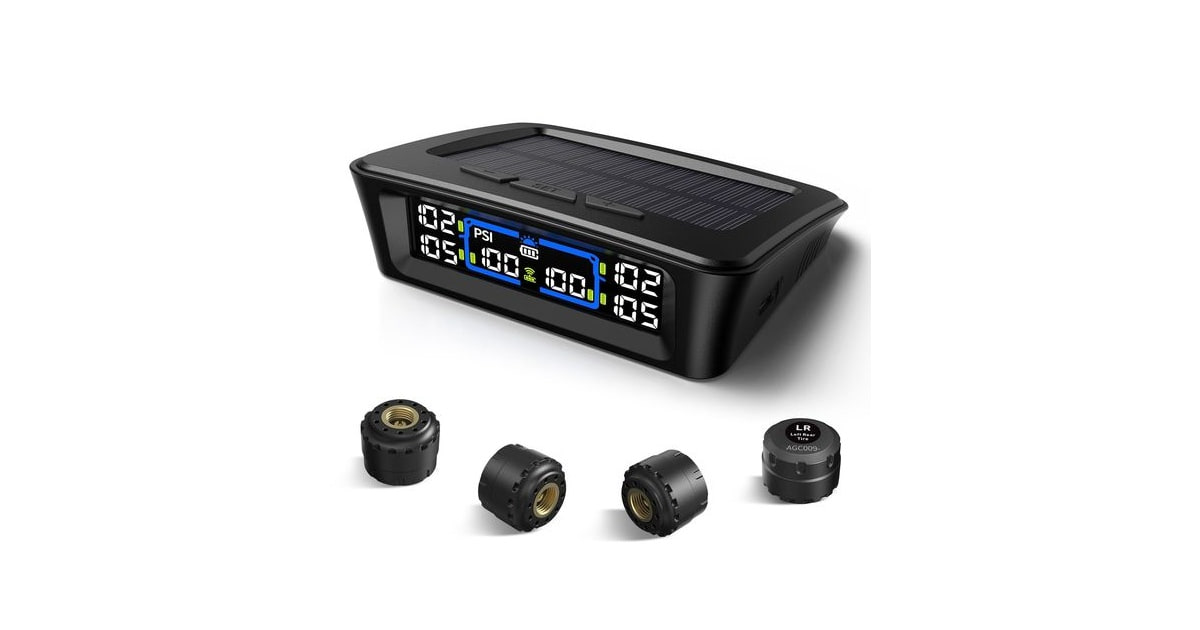
The Tymate TM2 shows live pressure and temperature for all four tires on a color screen that tops itself up from the sun. The sensors screw onto your valve stems, so you can have the whole thing running in your driveway in about ten minutes.
$69.99fromAmazonList priceThe solar panel means you'll never think about the display's battery. That sounds minor until you've owned a monitor that died in a parking garage and stayed dead. The TM2 charges off its own panel on the dash, and if you park indoors for a week you can top it up over USB or from the cigarette lighter. Your 12V socket stays free for a phone charger, which is where most people want it anyway.
Setup doesn't involve a tire shop. Each sensor threads onto a valve stem like a fancy cap, and the display pairs with them out of the box. If you can check your own oil, you can do this. That matters more than it sounds: Tire Rack's service data suggests roughly a third of TPMS-equipped vehicles come in with a sensor problem, and every one of those visits costs you an appointment.
It watches heat, not just pressure. The TM2 runs alarms for fast leaks, high and low pressure, high temperature, low sensor voltage and lost signal. Temperature is the one people underrate. A tire that's running low heats up, and heat is what actually causes a blowout. Getting a temperature warning on a long summer drive gives you a reason to pull over before the pressure number looks scary.
It scales past a four-tire car. The system handles up to 10 tires, with the display swapping between the tow vehicle and the trailer. Pressure range runs 0 to 87 PSI, which covers sedans, SUVs, minivans, pickups and most travel trailers. Tymate recommends adding a repeater if your rig is 36 feet or longer, since the signal has a lot of metal to get through.
Flaws but not dealbreakers
You'll be buying coin cells. Tymate rates the CR1632 in each sensor at up to six months, and Popular Mechanics puts external sensors generally at 12 to 18 months. Either way, plan on a battery ritual once or twice a year across four caps. It's a five-minute job, but it's a job.
These caps aren't flow-through. To add air, you unscrew the sensor, inflate, then screw it back on and wait for the reading to settle. Not a dealbreaker if you check pressure a few times a year. Annoying if you're adjusting pressure constantly for towing or track days.
The 87 PSI ceiling rules out heavy-duty use. Dually rear tires and many trailer tires run above that, so this isn't the kit for a big fifth-wheel or a work truck. For a car, crossover or half-ton pickup, you'll never come close to the limit.
Runner-up
Alert points you choose, on a screen that aims anywhere
Solar TPMS with 4 External Sensors
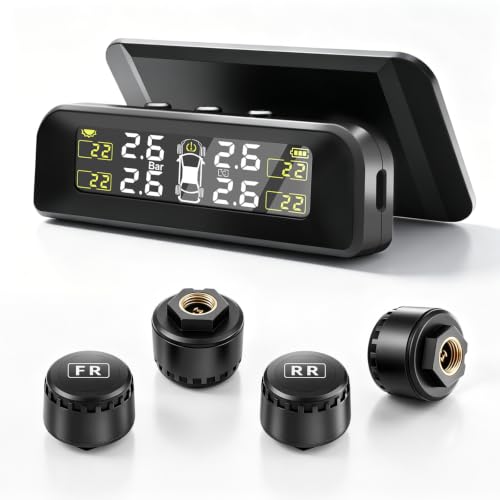
The Avutrel solar monitor covers four tires with external sensors and lets you set your own pressure and temperature alarm points instead of living with whatever the factory picked. The display swivels a full 360 degrees, so you can put it where you'll actually see it.
$29.99fromAmazonYou pick the thresholds. Federal rules only require a factory warning light at 25% below spec, which is far lower than you'd ever want to drive on. This system lets you dial in your own pressure and temperature limits, so a truck running heavier loads and a sedan running 32 PSI each get a warning that means something. Six alarm types cover fast leaks, slow leaks, high pressure, high heat, sensor faults and low sensor battery.
The slow-leak alarm is the one you'll be glad you have. A nail that's barely weeping can take days to show up as a soft tire, and a factory light won't say a word until you're already 25% down. Catching that drift early is usually the difference between a plug at the tire shop and a ruined sidewall on the shoulder of the interstate.
The display rotates and charges two ways. You can spin it 360 degrees to kill glare, set it on the dash and leave it there. Solar keeps it going day to day, and USB covers you through a stretch of garage parking or a gray week. Like the Tymate, it doesn't tie up your lighter socket.
Installation is genuinely a five-minute job. Four waterproof sensors thread onto the valve stems, nothing gets dismounted, and readings start showing up almost immediately. If you've been putting off adding a monitor because you assumed it meant a shop visit, this is the level of effort involved.
Flaws but not dealbreakers
The pressure window is narrow. It reads 22 to 87 PSI. That's fine for cars and light trucks, but a badly flat tire can drop below the bottom of the range, and heavy trailer tires live above the top of it. Know your numbers before you buy.
Four sensors, and that's the kit. There's no trailer expansion here the way there is with the six-sensor systems. If a camper or utility trailer is in your future, start with something that already has room for it.
Same cap-sensor upkeep as any external system. Batteries to swap, sensors to unscrew before you inflate, and hardware sitting exposed to salt and curbs. It's the price of not paying a shop to mount sensors inside your wheels.
Upgrade pick
Internal sensors and a repeater, built for long rigs
Truck System Technologies TST 507 Series 6
The TST 507 kit puts six sensors inside your wheels, where nobody can steal them and you never unscrew anything to add air. The color display handles up to 115 tires including spares, and a signal repeater comes in the box.
$663fromAmazonInternal sensors erase almost every complaint people have about cap systems. They mount to the valve stem inside the wheel, so there's nothing to steal, nothing to snap off on a curb and nothing to bake in UV. Popular Mechanics puts internal sensor battery life at five to ten years, against 12 to 18 months for caps. You inflate normally, straight through the valve, like the sensor isn't there.
Nothing else here scales this far. The 507 reads from 1 to 218 psi and can track up to 115 tires including spares. For a motorhome towing a car, or a dually pulling a triple-axle trailer, that headroom is the whole point. The display has dedicated spare tire positions too, which is how you find out a spare has gone flat before you need it.
The repeater is included, not an upsell. Long fifth-wheels and toy haulers put a lot of aluminum and steel between the rear axle and the dash, and a weak signal shows up as phantom dropouts that train you to ignore the alarm. Getting the repeater in the box means the system works at full length on day one.
Alerts come three ways. The 507 flags a problem visually on the color screen, audibly, and with plain text telling you which position is in trouble. On a rig with ten or more tires, knowing it's the inner rear right specifically — not just that something is wrong — saves you crawling around a hot shoulder with a gauge.
Flaws but not dealbreakers
You can't install these yourself. Internal sensors mean dismounting every tire, so this is a shop job on all six wheels. The Tire Industry Association's figures for sensor service make clear that labor per wheel adds up, and it's charged again whenever a sensor battery finally dies.
It's the most expensive setup here by a wide margin. For a commuter car, that's money spent on capability you'll never use. This makes sense when you're responsible for six or more tires carrying serious weight.
The display is a dedicated box, not your phone. That's a feature for always-on monitoring, but it's one more thing suction-cupped to the windshield and one more cable to route.
Also great
Flow-through caps and six sensors for a truck and trailer
Tymate TM12 RV Tire Pressure Monitoring System
The Tymate TM12 ships with six flow-through sensors, so you can top off a tire without unscrewing anything. It tracks up to 12 tires across four zones, reads all the way to 144 PSI, and charges from the sun or a USB-C cable.
$119.99fromAmazonFlow-through caps fix the most irritating part of external sensors. You put the air chuck straight onto the sensor and inflate. No unscrewing, no losing a tiny cap in the gravel, no re-pairing and waiting for a reading. If you adjust pressures for towing loads or seasonal swings, this alone justifies picking the TM12 over a cheaper four-sensor kit.
Six sensors out of the box, with room for twelve. The display splits into four zones — tow vehicle, vehicle spare, trailer, trailer spare — showing the front six at once and cycling through the rest. For a crew-cab pickup with a dual-axle camper behind it, that's the right shape of information, and spares get their own slots instead of being forgotten.
The 0 to 144 PSI range covers heavy tires. Trailer tires and dually rears often run well above what a car-focused system can read. The TM12 has the headroom, so you're not stuck buying a commercial kit just to see an accurate number on a loaded axle.
Signal and weatherproofing are built for length. The sensors carry an IP67 rating, and Tymate quotes a stable 50-foot transmission range, extendable past 100 feet with its repeater. Sensors arrive pre-programmed to labeled positions, so setup is matching each one to the right wheel and screwing it on.
Flaws but not dealbreakers
Past six tires, you're reading in shifts. The display shows the front group at once and cycles the rest through split screens. It works, but you'll glance a beat longer to confirm everything's fine on a twelve-tire rig.
The repeater isn't included. If your combined rig runs long, budget for it as a separate purchase, and know that a marginal signal is the most common source of nuisance dropout alerts.
These are still cap sensors. Flow-through solves the inflation hassle, but the batteries, the exposure to weather and road grime, and the theft risk all remain. Locking nuts help with the last one.
Who this is for
Buy one of these if your vehicle predates the federal TPMS mandate, or if you tow anything. Factory systems don't monitor trailer tires at all, and that's exactly where a blowout does the most damage. An aftermarket kit also helps if your factory light is the vague single-lamp kind that tells you something is wrong somewhere. Live in a place with real winters and you'll get more use out of it than you expect, since every 10-degree drop pulls another pound out of every tire.
You can probably skip this if you drive a newer car, check your pressures with a gauge every month or two, and never pull a trailer. Your factory system already does the safety-critical job. This guide covers aftermarket monitoring systems — the sensors and displays that show you live pressure and temperature. It doesn't cover diagnostic and relearn tools for reprogramming factory sensors, which is a different product for a different job, and it doesn't cover the pressure gauges or inflators you'll still want in the trunk.
How we picked
We weighed each system on the things that actually decide whether you'll still be using it a year from now. Sensor type: external caps install in your driveway but need fresh batteries every 12 to 18 months; internal sensors last five to ten years and can't be stolen, but a shop has to mount them. Alerts: we wanted adjustable pressure and temperature limits plus a slow-leak alarm, not just the 25% drop the federal rule requires. Power: solar-charged displays don't need battery swaps and leave your 12V socket open. Capacity: four sensors covers a car, but towing means six or more and a pressure range that reads past 87 PSI. Durability: IP67-class weatherproofing and owner feedback showing sensors survive road salt and summer heat.
Other tire pressure monitoring systems worth considering
If you ride a trike or a three-wheeled motorcycle: The FOBO Bike 2 for Trike Smart Bluetooth ($148) — The FOBO Bike 2 is built for exactly that, and none of the car systems above are. It skips the dash display entirely and sends live pressure and temperature to your phone, smartwatch or Bluetooth headset over Bluetooth, with six alert levels and no internet connection required. On a bike there's nowhere good to mount a screen anyway, so a buzz in your helmet is the better delivery. The trade-off is the one every phone-based system makes: monitoring only happens when your phone is awake, nearby and paired. Leave it in a jacket pocket in the wrong spot and you're riding blind.
The competition
This is what our research turned up, not a census of everything for sale. TPMS is a category full of near-identical kits under rotating brand names, and we focused on systems with enough of a track record to say something useful about.
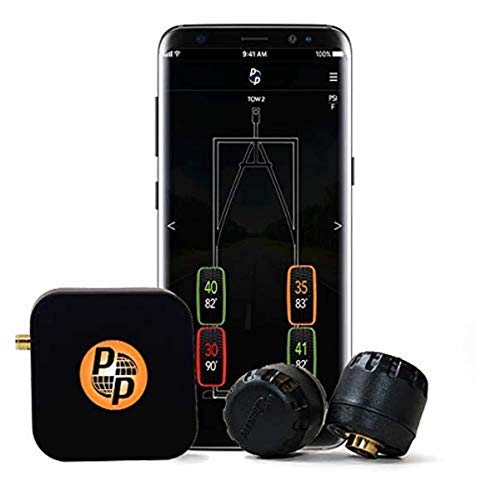
The PressurePro FX 2 Wheel TPMS Kit ($239.57) — The PressurePro FX 2 Wheel Kit comes from a company with a long history in fleet and long-haul trucking, it's built in the USA, and it pushes real-time pressure and temperature to iOS or Android with configurable layouts, push notifications and a capacity above 40 tires. It lost to our picks on shape, not quality: this listing is a two-wheel starter kit, so a car needs a second one and an RV needs several, which makes the entry point awkward for most drivers. It's also phone-dependent, and a dedicated always-on display is more reliable for daily monitoring. Consider it if you're outfitting a fleet, already trust the brand, or want a system you can build out one axle at a time.
Installation and upkeep
Set your alert thresholds against the number on your driver's door jamb sticker, not the number molded into the tire sidewall — that one is a maximum, not a target. Set them cold, before you've driven, since a few miles of highway will add several pounds of heat. With cap sensors, use the locking nuts that come in the box; they won't stop a determined thief, but they stop a casual one. Expect to swap sensor coin cells once or twice a year, and put a couple of spares in the glovebox now rather than hunting for CR1632s later. When you get a low-pressure alert in the first cold snap of the season, don't assume it's a leak. A 30-degree drop pulls about three pounds out of every tire.
Questions we get
What's the difference between direct and indirect TPMS?
Direct systems use a pressure sensor at each wheel, either screwed onto the valve stem or mounted inside it, and report an actual number. Indirect systems infer pressure from ABS wheel-speed data, since a soft tire has a smaller rolling diameter and spins faster. Car and Driver notes that indirect systems are slower to catch a gradual leak and, in some implementations, can't tell you which tire is affected. Every system in this guide is direct.
Do I need an aftermarket system if my car already has factory TPMS?
Maybe not, if you drive a modern car and never tow. The federal rule requires a warning only once a tire is 25% or more below its recommended cold pressure, which is well past the point where you'd want to know. An aftermarket kit gives you the live number for every tire, lets you set your own alert point, and covers trailer tires your factory system ignores completely.
Are external cap sensors as accurate as internal ones?
They're close enough for the job. Published testing from The Drive found cap-style sensors from major brands landing within about 1 PSI of a calibrated digital gauge across a range of temperatures. Internal sensors have the edge because they sit in the tire's own air and aren't exposed to weather. The bigger practical difference is upkeep, not accuracy.
Can I install an aftermarket TPMS myself?
If it uses external cap sensors, yes, and it takes about ten minutes. You screw each sensor onto a valve stem, add the locking nut, and pair the display. Internal sensors are a different story: the tire has to come off the wheel, so that's a shop job on every wheel you're doing.
How often do sensor batteries need replacing?
External cap sensors typically need fresh cells every 12 to 18 months, according to Popular Mechanics, though it varies with climate and how often the sensor transmits. Internal sensors run five to ten years, and factory-style sensors are usually rated for five to seven years or 100,000 miles. Buy a few spare coin cells when you buy the kit.
Why does cold weather set off low-pressure alerts?
Air contracts as it cools. The Tire Industry Association puts the loss at roughly 1 PSI for every 10-degree drop in ambient temperature, on top of the 1 to 2 PSI a month tires lose naturally. So the first hard freeze can pull three or four pounds out of a tire that was fine in October. Add air to bring it back to the door-jamb number, measured cold.
Why you should trust us
For this guide:
- We read NHTSA's TPMS regulation and its roadside underinflation surveys, plus the Tire Industry Association's figures on how quickly tires lose air, and checked those against every manufacturer spec sheet in this guide.
- We compared sensor counts, pressure ranges, alarm types, weatherproofing ratings and power sources across all seven listings, line by line.
- We drew on published reviews and testing from The Drive, Consumer Reports, Car and Driver and Popular Mechanics, and on recurring themes in owner feedback about sensor battery life, signal dropouts and theft.
- We read owner reviews on every listing, weighted toward the critical ones, because that is where the recurring failures show up.
- We have a systematic way of automatically fetching the latest prices, so the numbers on this page stay current.
- This is a research-focused guide, so the team may not own every product listed — though we often do own the top winners, which gives us extra context for the recommendations.
- We don't accept free products, and the retailer commission never changes which product we recommend.
Sources
NHTSA Tire Safety and TPMS Requirements, National Highway Traffic Safety Administration
Keeping Tires Properly Inflated — Fuel Economy Guide, U.S. Department of Energy / fueleconomy.gov
NHTSA TPMS Research and Safety Data, National Highway Traffic Safety Administration
Best Tire Pressure Monitoring Systems — The Drive, The Drive
Best RV Tire Pressure Monitoring Systems, RV Travel
Tire Pressure Monitoring Systems Buying Guide, Popular Mechanics
Tire Pressure, Safety, and Blowout Risk, Consumer Reports
TPMS Sensor Battery Life and Replacement Costs, Tire Industry Association
How TPMS Works: Direct vs. Indirect Systems, Car and Driver
TPMS Service Data and Tire Industry Statistics, Tire Rack
Amazon product listings and owner reviews for all 6 products
Manufacturer specification pages for each product
Some passages in this guide may be paraphrased with AI help. Prices are refreshed automatically.
More like this.
Continue exploring electronics reviews and recommendations.

The Best Tire Pressure Gauges
Air leaks out of tires slowly, and you can't see it happening. A tire can look completely normal and still be several pounds low. That's a mileage…

The Best Home Blood Pressure Monitors
Blood pressure moves all day. It's higher after coffee, higher when you're running late, and often higher in a doctor's office than anywhere else. That's…

The Best Portable Blood Pressure Monitors
If your doctor has asked you to track your blood pressure at home, the box on your nightstand matters more than you'd think. A reading taken with the…

The Best Tire Chains and Snow Traction Cables
Chains live in your trunk for years and matter for about twenty minutes. But those twenty minutes tend to happen on a dark shoulder, in falling snow, with…

The Best Tire Tread Depth Gauges
Tread depth is the one safety check on your car that costs almost nothing to make and almost nothing to fix - if you catch it early. Worn tread doesn't…

The Best Garage Tire Inflators
Tire pressure is the one bit of car maintenance you can actually do yourself in two minutes. Tires lose roughly a pound of pressure a month, and more when…