The Best Yoga Blocks and Props for Beginners
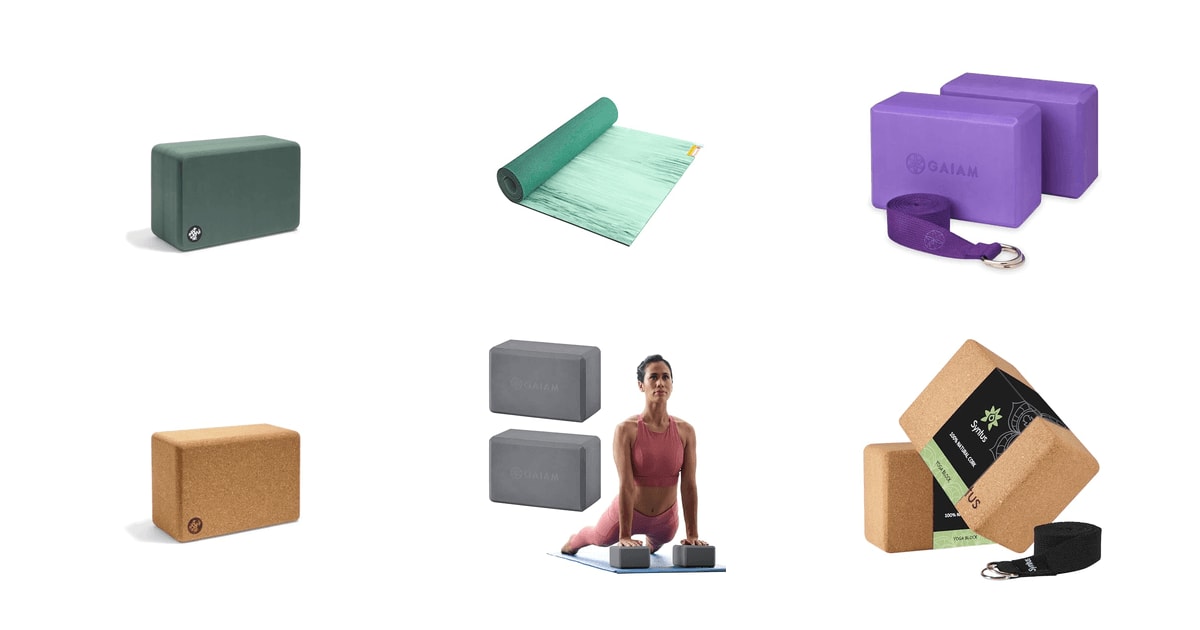
A yoga block is just a brick you can't fall through, and that's the whole point. When your hamstrings won't let your hand reach the floor in Triangle, a block brings the floor up to meet you. Research from the American Council on Exercise found that beginners using blocks in foundational poses held roughly a third better alignment than those going without. You'll put one under a hand, under a hip, or between your thighs, and if you practice regularly you'll reach for it every session.
Here's the catch nobody mentions at the studio: no block is both firm and comfortable. Cork is dense enough to stand on, and it also feels like a curb under your forearm. Foam is kinder to your shins but dents over time, especially if you're heavier or you press hard. Nothing in this category solves that. Blocks won't stretch you, either. A study in the Journal of Bodywork and Movement Therapies found prop-based beginner programs beat prop-free ones on hamstring flexibility, but only over weeks of practice.
You also need two of them. Yoga Journal's survey of teachers found the large majority tell students to buy a pair rather than a single block, because most poses want one under each hand. Budget for that, and for a strap, which does more for tight shoulders than a third block ever will. We think that the Manduka Recycled Foam Yoga Block is the best yoga block for most beginners, and that the Syntus Cork Yoga Block and Strap Set is the one to buy if you want cork and a strap in one box.
Everything we recommend

Firm support in a light block, if you don't mind buying two
Two cork blocks and a long strap, if you can carry the weight

Soft, light foam and a strap, if firmness isn't your priority

The firmest, most planted block here, and the heaviest
At a glance
| Product | Material | Dimensions | Price | |
|---|---|---|---|---|
| Manduka Foam Yoga Block - Recycled EVATop pick | Recycled EVA Foam | 9"x6"x4" | $26 |
| Gaiam Essentials Yoga Block 2 Pack &Budget pick | — | 9"Wx6"Hx4"D | $18.99 |
| Manduka Yoga Block - Fine-Grain Cork BlockUpgrade pick | Cork | 4"x6"x9" | $26 |
 | Gaiam Yoga Block - Supportive Latex-Free EvaAlso in lineup | EVA Foam | 4"Hx6"Wx9"L | $15.78 |
| Syntus Cork Yoga Block and Strap SetRunner-up | Cork | 9x6x4 inch | $25.99On sale |
 | YogaAccessories Extra Wide 1/4'' Deluxe Yoga MatAlso consider | — | 72"x36"x1/4" | $28.99 |
How we picked
Firmness and density. We compared spec sheets and published density figures, where cork lands around 0.12 to 0.15 g/cm³ against 0.04 to 0.07 for standard EVA foam. Blocks that owners described as compressing under body weight were ruled out for standing poses.
Grip when sweaty. We read owner feedback for the complaint that shows up constantly in heated rooms: palms sliding off the block. Texture and a matte finish mattered more to us than any listing claim about non-slip surfaces.
Standard size. We stuck to the standard 4-by-6-by-9-inch shape, because beginners with tight hamstrings need the 9-inch side and every class cue assumes those three heights.
A usable set. Yoga Journal found that most teachers tell students to buy two blocks rather than one, so we weighed what a complete pair costs relative to a single block and favored sets that bundle a strap.
Materials and wear. We looked for recycled or renewable content and for published durability results, then cross-checked against owner reports of denting, chipping and scuffing after months of use.
Top pick
Firm support in a light block, if you don't mind buying two
Manduka Foam Yoga Block - Recycled EVA
Manduka's recycled foam block is firm enough to stand on but light enough to toss in a tote, with contoured edges that don't dig into your palms. It's sold one at a time, so plan on buying two — and you'll probably still have them in five years.
$26fromAmazonThis is the rare foam block that behaves like cork. Manduka builds it from high-density recycled EVA, and owners consistently describe it as stiff rather than squishy — the kind of block that doesn't compress when you load it in Half Moon. If you've used the soft blocks at a gym and felt one buckle under your hand, that's exactly the problem this one fixes.
Weight is where it pulls ahead of cork. At under a pound, it won't drag your bag down on the walk to class, and it won't hurt if it topples onto your foot. Manduka's own cork block weighs more than twice as much. For a beginner who practices at home on weeknights and hauls gear to a studio on Saturday, that difference adds up fast.
The foam is 50 to 75 percent recycled content, which matters if you'd rather not add a fresh brick of virgin plastic to your living room. Durability backs it up: Wirecutter's testing found less than three percent compression after six months of daily use, the best result among the foam blocks in that comparison. Owners who've had theirs for years say the edges still look sharp.
One small thing that matters daily is the shape of the edges. A block with hard corners gets uncomfortable in a long-held Triangle, and this one is beveled enough that your fingers wrap it without pinching. The surface has a slight matte texture, too, so it doesn't skate away when you press into it on a hardwood floor.
Flaws but not dealbreakers
It's sold one block at a time. Since you want two, that turns a mid-priced block into a mid-priced pair, and it's most of the reason our budget pick exists. Read the listing carefully, because the photo shows a single block.
And it really is firm. If you like sitting on a block through a long meditation, or resting a knee on one in a supported pose, this isn't the forgiving surface you want — some owners say flatly that it's too hard for foam. The packaging is stubborn plastic, too, and it's easy to nick the block while you're wrestling it open.
Runner-upOn sale
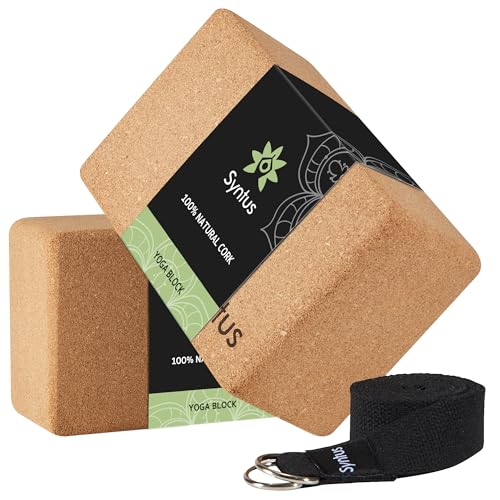
Two cork blocks and a long strap, if you can carry the weight
Syntus Cork Yoga Block and Strap Set
You get two solid cork blocks and an eight-foot strap in one box, which is most of a beginner prop kit sorted in a single order. Cork is firmer and grippier than foam, and this set costs a fraction of what name-brand cork runs.
$25.99fromAmazonList priceCork is simply denser than foam — roughly 0.12 to 0.15 grams per cubic centimeter against 0.04 to 0.07 for standard EVA, per Yoga Journal's equipment guide. In practice, the block stays precisely where you put it in Half Moon or Revolved Triangle, and the textured surface grabs your palm even when your hands are damp. That's why teachers push cork for standing balance work.
The strap is the sleeper here. Eight feet is longer than the six-foot strap most starter sets include, and the extra length matters if you're tall or your shoulders are tight — you can loop it behind your back and still have slack to work with. The metal D-ring holds under load. For a stiff beginner, a good strap does more than a third block ever would.
Owners coming from foam are usually surprised by how planted these feel. The rounded edges keep the corners from cutting into your hands, and the plain cork finish doesn't look like gym equipment sitting in the corner of a living room. Plenty of people use them outside yoga entirely, as push-up handles or deficit blocks, which tells you how rigid they are.
It's also the most complete first purchase in this guide. Two blocks, a strap and a short instruction booklet mean you're not placing a second order next week when a class calls for a prop you don't own. If you're building a home practice from nothing, that matters more than the badge printed on the block.
Flaws but not dealbreakers
Cork is heavy. The pair plus the strap runs about four and a half pounds, so this is the set you leave at home rather than the one you carry across town. Cork also has no give whatsoever, which is unforgiving under a knee or a shoulder in restorative poses.
Some owners report denting or chipping at the corners under heavy repeated use, which foam tolerates better because it springs back. Cork also soaks up sweat instead of shedding it, so it wants a wipe-down more often than a foam block does.
Budget pick
Soft, light foam and a strap, if firmness isn't your priority
Gaiam Essentials Yoga Block 2 Pack &
Two lightweight foam blocks and a six-foot strap, from the brand whose blocks you've probably already used at a studio. They're softer than our other picks, which makes them kinder to your joints and less trustworthy under your full body weight.
$18.99fromAmazonFor a first-ever yoga purchase, this is the sensible box to buy. You get everything a beginner class asks for: two blocks, so you can set one under each hand in a wide-legged fold, plus a strap for the seated stretches where your fingers don't reach your feet. Nothing here is fancy. It's also what most studios stock, so home practice feels like class.
The foam is soft in a way that's genuinely useful. Sit on one to lift your hips in a cross-legged seat and it gives a little under your sit bones, which beats perching on cork. For restorative and yin work, where you rest on a prop for minutes at a time, softer is the right answer. Verywell Fit's panel notes that the four-inch height eases lower-back strain in seated folds.
They're also barely there. Each block weighs a few ounces, so a pair plus the strap vanishes into a backpack and adds nothing to your commute. If you practice in a small apartment and stash props behind the couch, light and easy to replace beats heirloom-grade.
Flaws but not dealbreakers
Soft foam dents. Press hard into one in a standing pose and you'll feel it compress, and after a year of regular use the corners round off and the surface scuffs. If you're heavier or you practice daily, expect to replace these long before you'd replace cork.
The included strap is six feet, not eight. That's fine if you're average height and reasonably mobile, but tall practitioners and anyone with tight shoulders will run short in binds. The non-slip surface is only mildly non-slip, too — in a hot room with wet palms, foam turns greasy.
Upgrade pick
The firmest, most planted block here, and the heaviest
Manduka Yoga Block - Fine-Grain Cork Block
Fine-grain cork that doesn't budge, doesn't compress and grips your hands when they're damp. It's heavy, it's sold singly and it's hard on your joints, but for standing balance and arm-balance drills nothing else in this guide feels as solid.
$26fromAmazonPress into a foam block while you lift into Crow and you'll feel it squash under your fingers. This one doesn't move. The fine-grain cork is dense and completely rigid, which is what you want when a block bears your body weight instead of just propping up a hand. Owners who use theirs for jump-throughs and jump-backs single out that stability.
Grip is the real reason to pay up for cork. The surface has enough texture that damp palms stick instead of sliding, and unlike a plastic foam finish it doesn't get slicker as you warm up. If you practice in a heated room, or your hands sweat within five minutes of starting, that's the difference between trusting the block and babying it.
There's a decent environmental case, too. Cork oaks aren't felled to be harvested — the bark comes off roughly every nine years and the tree keeps producing for up to two centuries, per the Cork Forest Conservation Alliance. Manduka says its cork is sourced without toxic chemicals, and there's no coating on the block to flake off onto your mat.
It's the kind of block studios buy in bulk, which is a reasonable proxy for durability. Cork doesn't dent the way foam does, and long-term owners report the corners still square years on. Buy a pair and they'll likely outlast a couple of mats. Cats seem far less interested in chewing cork than foam, which foam owners will recognize as a real benefit.
Flaws but not dealbreakers
Two and a bit pounds each doesn't sound like much until you're carrying two of them plus a mat up a flight of stairs. This is a home block, not a commuter block.
And it's hard. Really hard. Resting a forearm on it in Lizard, or laying your head on it in a supported pose, is uncomfortable in a way foam never is, and several owners say exactly that. It's sold as a single as well, so a usable pair costs double what the listing first suggests.
Who this is for
This guide is for you if you're starting yoga and own nothing yet, or if you've been borrowing studio props and want your own. Blocks help most when your hamstrings, hips or shoulders limit the pose rather than your strength — which describes almost every beginner. They're also worth it if you're older, recovering from an injury, or working around cranky knees, since a block lets you take a pose at a height your body actually tolerates. Yoga Alliance's survey work with Ipsos puts the number of American practitioners around 38 million, with more than half using props regularly, so you're in good company.
You can skip this if you already own two blocks that aren't crumbling — buy a strap instead, since that's the prop most beginners are missing. We cover blocks, block-and-strap starter sets, and the mats those props sit on. We don't cover bolsters, wheels, wedges, sandbags or blankets, and we don't cover the specialty gear used in Iyengar rope work. If you want a single block for propping a knee at a desk, any of these will do the job.
How we picked
We built the shortlist around five things. Firmness: the block has to hold its shape when you put weight on it, which is where published density figures separated cork from soft EVA foam. Grip: texture that still works when your palms are damp, since that's the failure beginners hit first in a warm room. Size: the standard 4-by-6-by-9-inch shape, so the 9-inch side is there when your hamstrings are tight and class cues make sense. Kit completeness: teachers recommend two blocks, so sets that include a pair or a strap got credit. Materials and wear: recycled or renewable content, plus owner reports about denting and chipping after months of real use.
Other yoga blocks and props for beginners worth considering
If you want more room than a standard mat gives: The YogaAccessories Extra Wide 1/4'' Deluxe Yoga Mat ($28.99) — The YogaAccessories Extra Wide Deluxe Mat is 36 inches across, half again as wide as the usual mat, and that's the fix if your knees land on bare floor in Down Dog or you keep shuffling sideways to stay on the rubber. Taller and broader practitioners are the obvious audience, but it's also useful on a concrete basement floor. Grip is the trade-off: several owners find the surface a little slick and use a towel over it. It's heavy to roll up and carry, too.
The competition
This is what our research turned up, not a map of the entire market. Blocks are a crowded, low-margin category, and dozens of near-identical foam bricks ship under names you've never heard of. We focused on products with enough published coverage and owner feedback to say something useful about how they hold up.
The Gaiam Yoga Block - Supportive Latex-Free Eva ($15.78) — The standard Gaiam Yoga Block is a good foam block that lost on packaging rather than performance. Gaiam says the foam runs about 50 percent denser than typical EVA, and owners back that up — it's noticeably firmer than the softest studio blocks while staying feather-light, with beveled edges and a matte non-slip face. But it doesn't include a strap, and the configurations on offer make it easy to end up with one block when you wanted two. If you already own a strap and just want firmer Gaiam foam, it's a fine choice; otherwise the Essentials set gets you further for less fuss.
Care and maintenance
Foam and cork want different treatment. For foam, wipe the block with a damp cloth or a 50/50 solution of white or apple cider vinegar and water, then let it air-dry fully before you stack it — trapped moisture is how blocks start to smell. Skip harsh cleaners, which break the surface down and make it slick. Cork takes the same damp wipe but hates soaking; don't run it under a tap and don't leave it in a hot car, where the binder can dry out and the corners crumble. Straps are poly-cotton and spot-clean fine, or you can hand-wash and hang them. Store everything out of direct sun, and rotate which block goes under your dominant hand so they wear evenly.
Questions we get
How many yoga blocks do beginners need?
Two. Yoga Journal's survey found that the large majority of teachers tell students to buy a pair rather than a single block, because plenty of poses want one under each hand. A single block gets awkward the moment a class calls for symmetry. If money is tight, two soft foam blocks beat one premium cork block.
Are cork or foam yoga blocks better for beginners?
It depends on what you practice. Cork is roughly three times denser than standard EVA foam, so it stays put in standing balance poses and grips damp hands better. Foam is lighter, cheaper and much more comfortable to sit or rest on, which suits restorative and yin work. If you can only pick one, dense foam like our top pick splits the difference well.
What size yoga block should a beginner buy?
Get the standard 4-by-6-by-9-inch block, which every product in this guide uses. That shape gives you three heights, and instructors cue all of them. If your hamstrings are tight, stand the block on its 9-inch end for standing folds; for seated forward folds, the 4-inch height is the one Verywell Fit's panel points to for easing lower-back strain.
Can I use a book instead of a yoga block?
For a few sessions, sure — a thick hardcover under your hand is better than nothing. But books slip on a mat, compress unevenly and have hard corners that dig into your palms, and you can't grip one the way you grip a beveled block. They're also the wrong height for most cues. Once you're practicing weekly, a real block is worth owning.
Do I need a yoga strap if I already have blocks?
Probably, yes. A strap is the one prop that does something blocks can't: it extends your reach for hamstring and shoulder work, so you can hold a stretch with a straight spine instead of hunching. Six feet works for most people, eight feet if you're tall or your shoulders are tight. Two of our picks include one in the box.
Are yoga blocks safe for seniors or people with joint pain?
That's one of the best reasons to use them. A block raises the floor so you can take a pose without forcing a range of motion your joints don't have, which is exactly what ACE's alignment findings point to. Foam is friendlier here than cork, since it gives a little under a knee or a hip. Just make sure the block is firm enough not to collapse if you put weight on it.
Why you should trust us
For this guide:
- We read manufacturer spec sheets for every block and mat here, comparing stated dimensions, weight, density and material content side by side.
- We reviewed published equipment coverage from Yoga Journal, Wirecutter, Verywell Fit and the American Council on Exercise for what separates firm blocks from soft ones.
- We worked through owner feedback across all seven listings, looking for repeated themes about denting, grip in sweaty conditions, smell and long-term wear.
- We read owner reviews on every listing, weighted toward the critical ones, because that is where the recurring failures show up.
- We have a systematic way of automatically fetching the latest prices, so the numbers on this page stay current.
- This is a research-focused guide, so the team may not own every product listed — though we often do own the top winners, which gives us extra context for the recommendations.
- We don't accept free products, and the retailer commission never changes which product we recommend.
Sources
The Best Yoga Blocks of 2026 — Wirecutter, Wirecutter
Best Yoga Blocks Tested by Yoga Instructors — Good Housekeeping, Good Housekeeping
Best Yoga Blocks 2026: Cork vs. Foam — Forbes Health, Forbes Health
The Best Yoga Blocks, According to Yoga Teachers — Verywell Fit, Verywell Fit
Yoga Props for Beginners: A Complete Guide — Yoga Journal, Yoga Journal
The Science of Yoga Flexibility and Props — ACE Fitness, ACE Fitness (American Council on Exercise)
Yoga Industry Statistics & Market Data 2025 — Wellness Creative Co, Wellness Creative Co
Best Yoga Blocks: Expert-Tested Picks — Sports Illustrated, Sports Illustrated
Yoga Equipment Buying Guide — REI Co-op, REI Co-op
Cork vs. Foam Yoga Blocks: Which Is Better for You? — Healthline, Healthline
Best Yoga Accessories Tested by Real Athletes — Shape Magazine, Shape Magazine
Amazon product listings and owner reviews for all 6 products
Manufacturer specification pages for each product
Some passages in this guide may be paraphrased with AI help. Prices are refreshed automatically.
More like this.
Continue exploring health reviews and recommendations.

The Best Yoga Blocks
A yoga block is the least glamorous thing in your gear bag and probably the most useful. It brings the floor up to your hands in a standing forward fold.…

The Best Yoga Mats
A yoga mat is one of the few pieces of fitness gear you touch with your whole body. You kneel on it, sweat on it, press your palms into it while upside…

The Best Yoga Wheels
A yoga wheel is a simple thing: a rigid hoop with padding wrapped around the outside. You lie back over it, let it hold the arch of your spine, and…

The Best Blue Light Blocking Glasses
If you spend your workday staring at a screen, you've probably had that late-afternoon feeling: gritty eyes, a dull ache behind your forehead, and the…

The Best RV Leveling Blocks
Pull into a campsite and the pad is never flat. One tire sits low, the trailer leans, and by dinner your soup slides to one side of the pot. Leveling…

The Best Home Gym Equipment for Beginners
The gear that actually gets used is the gear that's already out. That's the whole game when you're starting out. A dumbbell pair sitting by the couch gets…