The Best Smart Scales for Body Composition
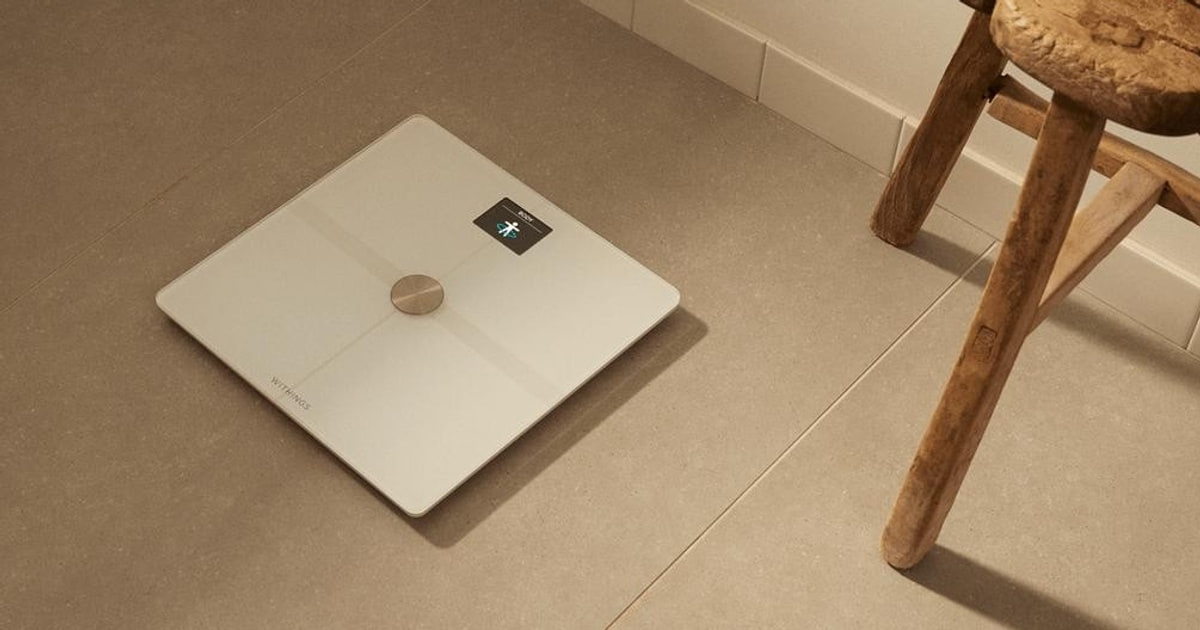
A smart scale earns its place by making the boring part automatic. You step on, it reads your weight, and the number lands in an app before you've finished brushing your teeth. The body-composition metrics — fat percentage, muscle mass, water, visceral fat — come from a tiny current the scale sends up through your feet. What you actually get out of that is a trend line. Watching your body fat drift down over two months is useful. Watching it jump around Tuesday to Wednesday is not.
Here's the honest caveat: no bathroom scale measures body fat accurately. Every one of these uses bioelectrical impedance, and impedance changes with how hydrated you are, when you last ate, whether your feet are damp, and how hard you trained yesterday. Owners regularly report readings that look nothing like a DEXA scan, and a few report numbers that are simply absurd. Treat the fat percentage as a rough direction of travel, not a fact. The weight reading is the part you can trust.
The other thing to know is that a smart scale is really a piece of software you stand on. The app decides whether you'll keep using it, and the Wi-Fi setup decides whether you'll throw it in a closet in week two. We think that the Withings Body Smart is the best smart scale for body composition for most people, and that the Garmin Index S2 is the one to buy if you already live inside Garmin Connect.
Everything we recommend

Steady weight readings and an app you'll actually keep

The one to get if your watch is already a Garmin

Thirteen metrics and a rechargeable battery for far less
More health metrics than any scale here, and more to go wrong
At a glance
| Product | Price | |
|---|---|---|
| WITHINGS Body Comp WLAN Smart Scales withUpgrade pick | $229.95 |
| Garmin Index S2Runner-up | $179.99On sale |
| RENPHO Elis 1 Smart ScaleBudget pick | $29.99 |
| WITHINGS Body Smart - Accurate Scale forTop pick | $129.95 |
 | Fitbit Aria Air Smart ScaleAlso in lineup | $57.31On sale |
 | Tanita RD-953 InnerScan PRO Bluetooth Body CompositionAlso consider | $229.99 |
 | InBody Dial H30 Body Composition ScaleAlso consider | $379 |
How we picked
Weight consistency. We looked hardest at whether owners get the same number twice in a row. A scale that swings a pound between back-to-back weigh-ins fails at its one non-negotiable job, and that pattern shows up clearly in owner feedback.
Setup and syncing. Published reviews and owner reports both point to connectivity as the main failure mode, not hardware. We favored scales that sync reliably over Wi-Fi and penalized ones with a long trail of network-pairing complaints.
App quality. The app is where you'll actually read your data, so we weighed how it charts trends, how it handles multiple people, and how aggressively it pushes upsells or notifications.
Honest metrics. Every scale here uses bioelectrical impedance, so we compared what each manufacturer claims against what owners say the numbers do over time. Steady trends matter more than a long list of readings.
Living with it. Battery type, platform size, weight capacity, carpet feet and how many profiles you get all decide whether a scale stays in the bathroom or ends up in a closet.
Top pick
Steady weight readings and an app you'll actually keep
WITHINGS Body Smart - Accurate Scale for
The Withings Body Smart connects over both Wi-Fi and Bluetooth, tracks weight to within 50 grams, and pushes everything to Apple Health without a fight. It gives you fat percentage, water, muscle and heart rate at each weigh-in, with a color screen that shows your trend before you step off.
$129.95fromAmazonThe setup is the part that usually breaks, and this is where Withings pulls ahead. Owners who came from other brands after months of failed syncs describe getting this one linked in a few minutes. Wi-Fi means the scale talks to the cloud on its own, so your numbers are waiting whether or not your phone was in the room. Bluetooth is there as a fallback. That redundancy is why fewer people end up troubleshooting a bathroom appliance.
Day-to-day weight readings are the thing most people actually care about, and this is the metric owners consistently call consistent. Withings quotes tracking to within 50 grams, and the reports back that up — step on twice, get the same number. Several people who switched from a scale that swung a pound between readings mention that alone as the reason they kept it. If you're dieting, a scale that lies by a pound is worse than no scale.
You get a genuinely broad read at each weigh-in: weight, body fat percentage, water, muscle mass, heart rate and a daily energy estimate. The heart-rate reading is a nice extra rather than a medical measurement, but it costs you nothing — it happens while you're standing there. The color display shows your trend right on the scale, which matters more than it sounds. Most mornings you won't open your phone at all.
It plays well with the phone you already have. Withings pushes data into Apple Health cleanly, and owners with an Apple Watch describe it as the piece that made their health picture complete. There's a baby mode for weighing an infant or a cat by holding them. Family members can each have a profile, and the scale sorts out who's standing on it.
Flaws but not dealbreakers
The app pushes. Owners who otherwise like the scale complain about the volume of notifications and prompts toward paid features, and it's the single most common gripe. You can turn most of it off, but you'll spend a few minutes in settings doing it.
Withings support has a rough reputation. There's a real thread of owners who hit a hardware fault and found the warranty process slow or unhelpful, and a smaller group whose scale worked well for a few months and then started dropping syncs. It doesn't happen to most people, but it happens often enough that we'd register the product and keep the receipt.
The body-fat number is still a bioimpedance estimate. It's steady enough to trend, but don't compare it against a gym scan and expect them to agree.
Runner-upOn sale
The one to get if your watch is already a Garmin
Garmin Index S2
The Index S2 syncs weight, body fat, skeletal muscle and bone mass straight into Garmin Connect over Wi-Fi, alongside your runs and sleep. It holds up to 16 profiles and runs about nine months on four AAA batteries, with a color screen showing your weight trend.
$179.99fromAmazonList priceIf you already track everything in Garmin Connect, this is the scale that belongs there. Your weight lands next to your runs, your sleep and your recovery numbers with no third-party bridge in between. Owners who are deep in the Garmin ecosystem describe it as the missing piece rather than another app to check. That integration is the whole argument — if you don't use Garmin, buy something else.
Sixteen user profiles is a lot, and it's genuinely useful in a full house. Everyone gets their own goals and their own history, and the scale figures out who's on it. Battery life runs to about nine months on four AAAs, which are included along with carpet feet if your scale has to live on a bathroom rug. Small thing, but carpet is where a lot of scales give inconsistent readings.
The color display shows your weight trend line right on the scale, not just today's number. That framing helps on the mornings when the raw number is up two pounds for no reason. You still get the usual composition metrics — body fat percentage, skeletal muscle mass, bone mass, body water — pulled from the same bioimpedance approach everything here uses.
Flaws but not dealbreakers
Wi-Fi setup is the weak point. It only sees 2.4 GHz networks, and owners on mesh routers, dorm networks or combined-band SSIDs report the scale simply not listing their network. Several people who eventually got it working describe the process as fiddly, and some never did and returned it.
Syncing isn't bulletproof even after setup. There's a persistent thread of owners whose readings don't reliably reach Garmin Connect, and a few who found the scale reporting different weights seconds apart until they re-tared it. For a product at this price, that's the complaint that stings.
It's expensive for what it measures. Cheaper scales here track more metrics. You're paying for the Garmin pipeline, not for extra numbers.
Garmin includes four AAA batteries and carpet feet in the box; the listing does not state a warranty term.
Budget pick
Thirteen metrics and a rechargeable battery for far less
RENPHO Elis 1 Smart Scale
The RENPHO Elis 1 reads 13 body metrics over Bluetooth, charges by USB-C instead of eating AAAs, and handles up to 400 pounds on tempered glass. It syncs to Apple Health, Samsung Health and MyFitnessPal, and supports unlimited profiles for a whole household.
$29.99fromAmazonThis is the one to buy if you mostly want your weight logged automatically and everything else is a bonus. It costs a fraction of what the Withings and Garmin scales do, and it's the most consistently well-liked scale in this guide by a wide margin. People who'd given up on smart scales after two failed attempts describe this as the one that finally just worked.
USB-C charging deserves more credit than it gets. You're not hunting for AAAs in a drawer at 6 a.m., and you're not throwing batteries away twice a year. A full charge lasts a long stretch of daily use. The tempered glass platform is 11 inches square, which is enough room to stand square-footed without hanging over the edge.
You get 13 readings — weight, BMI, body fat, water, skeletal muscle, muscle mass, bone mass, protein, basal metabolism, visceral fat, subcutaneous fat, fat mass and body age. Most of those are derived estimates rather than distinct measurements, so don't read too much into any single one. But the app charts them daily, weekly and monthly, and it hands weight off to Apple Health, Samsung Health or MyFitnessPal if you'd rather live there.
Household setup is unlimited and free. You can add every person in the house plus a baby mode for weighing an infant or a pet by difference. There's no per-profile cap and no subscription gate on the basic tracking, which is not true of every scale here.
Flaws but not dealbreakers
There's no Wi-Fi. The scale needs your phone nearby with the app to sync, and if you step on without it, that weigh-in waits until next time. For most people that's fine — you have your phone in the bathroom anyway. It's still a real step down from the Withings and Garmin scales.
Skip athlete mode. Owners who train seriously and enabled it report body-fat numbers that swing wildly from the standard mode reading, which makes the trend line useless. Pick one mode and never touch it again.
It's glass, and glass breaks. Drop it on tile and you'll be sweeping up cubes.
Upgrade pick
More health metrics than any scale here, and more to go wrong
WITHINGS Body Comp WLAN Smart Scales with
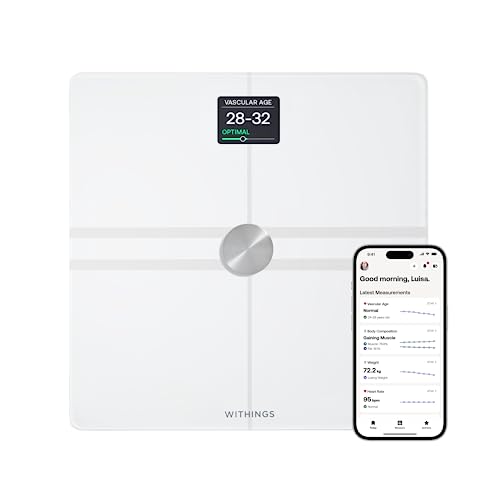
The Withings Body Comp adds vascular age and a nerve-health assessment on top of full body composition, all on a color display with both Wi-Fi and Bluetooth. Withings says it was developed with hospitals and clinically validated, and it tracks weight to within 50 grams.
$229.95fromAmazonThis is the Body Smart with a much deeper set of health readings bolted on. Beyond weight, fat, muscle and bone, it assesses arterial condition each day and evaluates sweat gland activity in your feet as a proxy for nerve health. Withings describes the platform as developed with hospitals and clinically validated. If you're managing a specific health concern with a doctor, those extra data points might mean something to you.
The build quality is the part owners agree on without argument. It sits flat and stable, the color screen is sharp, and stepping on is the entire interaction — no buttons, no waking it up. Wi-Fi and Bluetooth together mean it can push readings without your phone in the room, then fall back to Bluetooth when the network is down. Weight tracking to within 50 grams matches the Body Smart.
It fits into a broader health setup better than most. Owners running Apple Health, Oura or a Withings account describe the data flowing where they want it without babysitting. If you're building one picture of your health from several devices, this is the scale that contributes the most to it.
Flaws but not dealbreakers
The heart-rate and vascular readings are the least reliable thing here. Owners report heart-rate measurements that don't match a chest strap or a watch, and the more exotic metrics are hard for anyone to verify. That's a lot of money for numbers you can't check.
This is the scale most likely to become a project. A meaningful group of owners describe recurring sync failures, firmware fussiness and hours spent troubleshooting, sometimes after months of trouble-free use. Combine that with Withings support complaints and the risk is real enough that we'd only recommend it to someone who wants these specific metrics.
Some of the headline features sit behind a Withings subscription, which is worth knowing before you commit.
Who this is for
Buy a smart scale if you weigh yourself often and want the numbers logged without thinking about it. That's the real benefit — a trend line you didn't have to build by hand. It's most useful if you're losing weight, gaining muscle, or tracking a health metric alongside a watch or a fitness app. If you weigh yourself twice a year, a cheap dial scale does the job and never needs a firmware update.
Don't buy one expecting clinical body-fat numbers. These are consumer bioimpedance devices, and if a doctor needs your body composition, they'll order a proper scan. This guide covers home smart scales that measure composition and sync to an app; it doesn't cover gym-grade analyzers, medical devices, or plain digital scales that only report weight.
How we picked
Weight consistency: we prioritized scales owners describe as repeatable, because a reading that moves a pound between steps is worse than useless. Setup and syncing: connectivity, not hardware, is what kills these products, so we favored reliable Wi-Fi syncing and marked down long trails of pairing complaints. App quality: the app is where you read your data, so we weighed trend charts, multi-user handling and how pushy it is about upgrades. Honest metrics: every scale here uses bioelectrical impedance, so we compared manufacturer claims against what owners report over months rather than counting features. Living with it: battery type, platform size, capacity, carpet feet and profile limits decide whether you keep using it past week two.
Other smart scales for body composition worth considering
If you want the closest thing to a gym body-composition machine: The InBody Dial H30 Body Composition Scale ($379) — The InBody Dial H30 adds a handle with thumb electrodes, so the current travels through your torso and arms instead of just up and down your legs. That's the same principle as the InBody machines in gyms and clinics, and it's a real methodological upgrade over foot-only scales — it runs triple-frequency analysis and auto-syncs over Wi-Fi and Bluetooth. Owners coming from gym InBody units say their history carried across and the readings line up. It's expensive, though, and the app integration is patchy: Samsung Health users have to route through Health Connect and only weight comes through. A few owners also report long delays before readings appear. It's FSA and HSA eligible, which softens the cost.
If you want multi-frequency measurement and don't care about the app: The Tanita RD-953 InnerScan PRO Bluetooth Body Composition ($229.99) — The Tanita RD-953 uses multi-frequency bioimpedance rather than the single-frequency approach most of these scales rely on, which in principle gives you a better read on where body water sits. Tanita has a long reputation in this space, and owners who compared it against a calibrated scale found the weight readings hold up. It gives you 11 measurements including muscle quality, physique rating and metabolic age, on a color-coded display, and it runs over a year on four AA batteries. The catch is the North American app, which owners describe as the worst part of the product by a wide margin — clumsy, hard to set up, and worse than the version sold in Europe. Buy it if you're happy reading numbers off the scale itself.
The competition
This is what our research surfaced in this category, not a survey of every smart scale on the market. New models arrive constantly, and plenty of good ones never cross our path. What follows is the product we looked at and didn't recommend, with our reasoning.
The Fitbit Aria Air Smart Scale ($57.31) — The Fitbit Aria Air is the odd one out here: it doesn't measure body composition at all. It reads weight, displays it, and syncs to the Fitbit app over Bluetooth, where the app estimates BMI from your height. That's the whole feature set. It's simple and it's the least expensive way into a connected scale, but if body composition is what brought you to this guide, it can't do the job. Owners also report a recurring quirk where the first reading comes in low and you have to step off and back on, plus syncing that only works with the Fitbit app open. It also needs a hard floor — several owners traced inconsistent readings to floating wood flooring. Worth considering only if you're already on Fitbit and genuinely want weight and nothing else.
Getting readings you can actually use
Weigh yourself at the same time every day, ideally first thing in the morning after using the bathroom and before eating or drinking. Hydration swings your body-fat and water readings more than anything else, so a weigh-in after a workout or a salty dinner will look nothing like your baseline. Stand with bare, dry feet squarely on the electrodes — damp feet and socks both throw the impedance reading off. Put the scale on a hard, flat floor. Tile or sealed concrete is ideal; carpet and floating wood floors are a common cause of readings that drift between steps, and some scales include carpet feet for exactly this reason. If your number looks wrong, step off, let the scale re-zero, and try again before you panic. And judge yourself on the two-week trend, never on today.
Questions we get
How accurate are body-fat readings on a smart scale?
Not very, in absolute terms. These scales send a small current through your body and estimate fat from the resistance, which shifts with hydration, meal timing and skin moisture. Owners routinely find their number is well off a professional scan. The trend over weeks is the useful part; the specific percentage isn't.
Do I need Wi-Fi, or is Bluetooth enough?
Bluetooth is fine if you keep your phone in the bathroom, which most people do. Wi-Fi means the scale uploads on its own, so a weigh-in never gets lost because your phone was downstairs. Wi-Fi also tends to cost more and it's where most setup headaches start, particularly on 2.4 GHz-only requirements.
Can several people share one scale?
Yes, and all of our picks handle it. The scale recognizes you by weight and assigns the reading to your profile, though it can guess wrong if two people are close in weight. The RENPHO allows unlimited profiles and the Garmin holds up to 16. Everyone needs the matching app on their own phone.
Is it safe to use if I'm pregnant or have a pacemaker?
Skip the body-composition function if you have a pacemaker or any implanted electronic device — the current these scales use is tiny, but manufacturers advise against it. During pregnancy, the composition estimates aren't meaningful anyway. In both cases you can still use the scale for weight alone.
Why does my weight change between two readings a minute apart?
Usually the floor. Carpet, floating wood and uneven tile all let the scale flex, which shifts the load across its sensors. Move it to a hard, flat surface and use the carpet feet if your scale came with them. If it still drifts on solid ground, that's a genuine fault worth returning.
Do these scales require a subscription?
The core tracking doesn't on any of our picks — you'll get weight and composition in the app for free. Withings and some others gate extra programs, deeper analysis or coaching behind a paid tier, and their apps will remind you about it. Check what's included before you buy if a specific feature sold you on the scale.
Why you should trust us
For this guide:
- We read manufacturer specifications and published reviews for every scale in this guide, then compared what each brand claims about its measurement method against what long-term owners report.
- We paid particular attention to recurring themes in owner feedback around setup, Wi-Fi pairing and app behavior, since those are the failures that make people abandon a scale.
- We did not use, install or measure anything ourselves; this guide is built entirely from published sources and owner reports.
- We read owner reviews on every listing, weighted toward the critical ones, because that is where the recurring failures show up.
- We have a systematic way of automatically fetching the latest prices, so the numbers on this page stay current.
- This is a research-focused guide, so the team may not own every product listed — though we often do own the top winners, which gives us extra context for the recommendations.
- We don't accept free products, and the retailer commission never changes which product we recommend.
Sources
Best Smart Scales 2026 — Wirecutter, Wirecutter
Smart Scale Reviews & Ratings — RTINGS.com, RTINGS.com
Body Composition Scale Reviews 2026 — Consumer Reports, Consumer Reports
Bioelectrical Impedance Analysis: A Review — National Institutes of Health / PubMed, NIH / PubMed
Tanita Body Composition Analyzer Clinical Validation — Tanita Corporation, Tanita Corporation
Withings Body Comp Review — PCMag, PCMag
Garmin Index S2 Review — DC Rainmaker, DC Rainmaker
Best Smart Scales — Tom's Guide 2026, Tom's Guide
Renpho Smart Scale Review — Healthline, Healthline
InBody vs. Consumer BIA Scales — Sports Medicine Journal, Sports Medicine (Springer)
Accuracy of Consumer Smart Scales — Cleveland Clinic, Cleveland Clinic
Smart Scale Market Report 2026 — Statista / Grand View Research, Statista / Grand View Research
Amazon product listings and owner reviews for all 7 products
Manufacturer specification pages for each product
Some passages in this guide may be paraphrased with AI help. Prices are refreshed automatically.
More like this.
Continue exploring health reviews and recommendations.

The Best Smart Kitchen Scales
Weighing your food is the fastest way to stop guessing. A cup of flour can swing by a third depending on how you scoop it, and a serving of peanut butter…

The Best Body Lotions for Dry Skin
Dry skin isn't just a winter annoyance. It itches, it flakes on your shins, it cracks at the knuckles, and it turns black leggings into a lint trap. The…

The Best Sunscreens for Face and Body
Sunscreen only works if you actually wear it. That sounds obvious, but it's the whole game. The formula you like - the one that doesn't sting your eyes,…

The Best Digital Kitchen Scales for Precision Baking
Baking by volume is the reason your cookies come out different every time. King Arthur Baking found that a cup of all-purpose flour can weigh anywhere…

The Best Luggage Scales
A checked bag that's three pounds too heavy costs real money at the counter, and you don't find out until the suitcase is already on the belt. A luggage…

The Best Lumbar Support Cushions
Your chair's backrest is flat. Your lower back isn't. A lumbar cushion fills that hollow just above your beltline so your spine keeps its natural inward…