The Best Mini Projectors
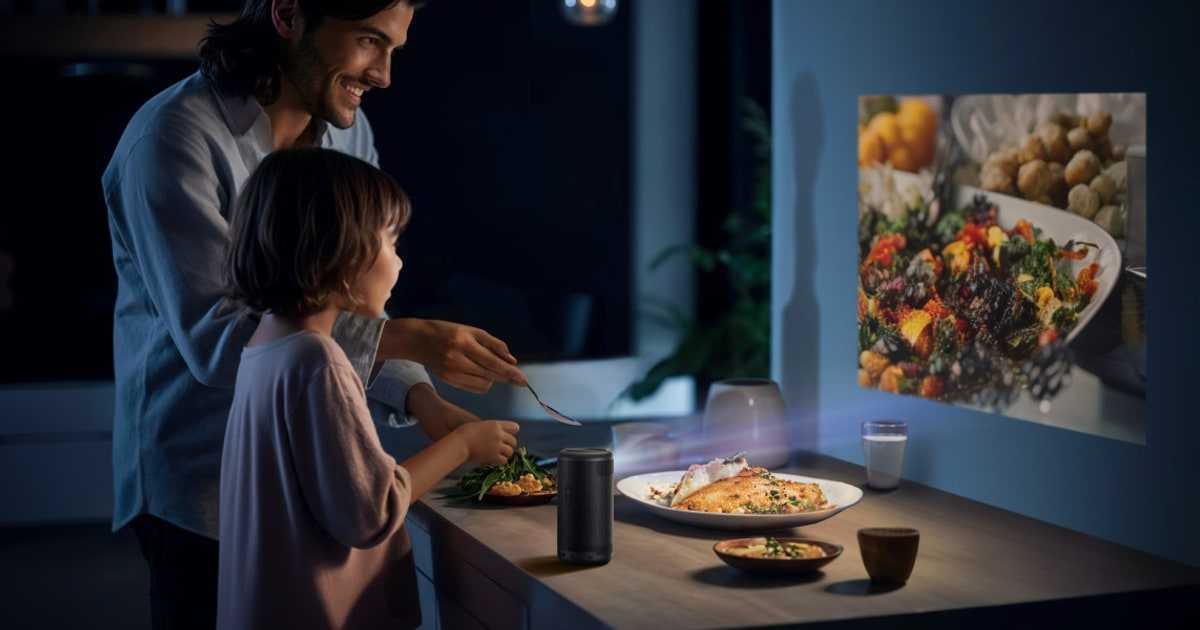
A mini projector's job is simple. It turns a blank wall into a hundred-inch screen, then disappears into a drawer. That's a good trade if you rent, if your living room can't fit a big TV, or if you want movies in the backyard. What decides whether you actually use it isn't the screen size on the box. It's setup speed and brightness. A projector that needs five minutes of keystone fiddling stays in the closet. One that focuses itself and streams on its own gets pulled out on a Tuesday.
The honest caveat is light, and the specs make it hard to see. Budget brands quote LED lumens or lux figures that can run five to ten times higher than the ANSI or ISO standard that reputable makers publish. So a projector claiming nine thousand lumens might land somewhere near five hundred real ones. Even the brightest model here gives up when sunlight hits the wall. Plan on curtains, or plan on waiting until after dark. No portable projector in this size class beats a window.
Screen size is the other trap. All of these can throw a hundred inches, but a dim hundred-inch image looks worse than a sharp sixty-inch one. Work out how dark your room gets first, then pick brightness, then pick size. Decide too whether you want smart software built in or you'd rather plug in a streaming stick you already trust. We think that the Anker Nebula Capsule 3 GTV is the best mini projector for most people, and that the XGIMI MoGo 2 Pro is the one to buy if your room won't go fully dark.
Everything we recommend

Real Netflix and a real battery, in a soda-can body

Brighter and smarter, if you can carry the extra bulk

Short throw for tight rooms, with a vague brightness spec

A home-theater picture that survives a lamp being on
At a glance
| Product | Resolution | Brightness | Price | |
|---|---|---|---|---|
| Anker Nebula Capsule 3 GTV ProjectorTop pick | 1080P | 200 ANSI Lumens | $299.99On sale |
| XGIMI MoGo 2 ProRunner-up | 1080P | 430 ISO Lumens | $299On sale |
| Epson EpiqVision Mini EF21 Portable Smart LaserUpgrade pick | FHD 1080p HDR | 1,000 Lumens | $448.08 |
 | Loakdsa Replacement VS18039 Remote Control for ViewSonicAlso in lineup | — | — | $12.88 |
 | HCDZ Replacement Remote Control for Artlii EnergonAlso in lineup | — | — | $17.94 |
 | KODAK Luma 350 Portable Smart Projector w/Also in lineup | Ultra HD | — | $349.99 |
 | HCDZ Replacement Remote Control for Vankyo LeisureAlso in lineup | — | — | $16.23 |
 | Replacement Remote Control for Bomaker Projector ParrotAlso in lineup | 1080P | — | $16.99 |
| [Short Throw/Adjustable Stand]Mini projector with WiFi andBudget pick | 1080P | 15000:1 | $68.99 |
 | Remote Control Only forAlso in lineup | 1080P | — | $16.99 |
How we picked
Honest brightness. We only compared brightness where a manufacturer published an ANSI or ISO figure, since LED lumen and lux claims can run five to ten times higher for the same picture. A missing standardized number counted against a projector rather than being taken on faith.
Native resolution. We separated the panel's real pixel count from the highest input signal it accepts, because a lot of listings blur the two. Native 1080p earned credit; 1080p-supported panels got flagged as softer.
Setup and alignment. Autofocus and automatic keystone correction were close to required, because published reviews and owner feedback agree that manual alignment is the thing that turns a projector into a closet ornament. Obstacle avoidance was a bonus.
Streaming that works. We favored projectors with a current smart platform and officially licensed Netflix, since sideloaded apps break with updates and often stream at reduced quality. Projectors without a smart OS had to be good enough to justify adding a streaming stick.
Power and portability. We looked at weight, battery capacity where one exists, and whether the projector can run while charging. Owner feedback also shaped how we weighed fan noise and heat, which spec sheets never mention.
Top pickOn sale
Real Netflix and a real battery, in a soda-can body
Anker Nebula Capsule 3 GTV Projector
The Capsule 3 GTV runs Google TV with a properly licensed Netflix app, projects 1080p at 200 ANSI lumens, and lasts about two and a half hours off its battery. It's the rare portable projector you can hand to someone else and expect them to figure out.
$299.99fromAmazonList priceThe Netflix licensing is the whole argument. Plenty of cheap smart projectors run a sideloaded Netflix app, and those break the moment Netflix pushes an update. When they do work, they often cap you at standard definition. Anker's licensing means the real app, the real catalog, and HD streaming that keeps working. If you're the person who ends up doing tech support for the household, that's worth more than any spec.
Google TV means you're not shopping for a streaming stick. You get the Play Store and the same thousands of apps you'd find on a smart TV, plus your account and your watch history already in place. Nothing dangles off the back of the projector, and there's one remote instead of two. For a device you're carrying to a friend's house or a campsite, that matters more than it does at home.
Two hundred ANSI lumens is a number you can trust. Anker publishes to the standard rather than inflating with LED lumens, so you can compare it honestly against anything else that does the same. In a genuinely dark room it's satisfying up to about eighty inches. Push toward the maximum hundred and twenty and you'll want the room pitch black. That's a fair ceiling for something this small.
The battery is sized for an actual movie. Anker rates it at two and a half hours of video or roughly eight hours of music, which covers most films with room to spare. It also runs while charging over USB-C, so a decent power bank turns a backyard screening into an all-night one. Very few projectors this size give you that without an extension cord snaking across the lawn.
Setup takes about as long as unfolding a chair. The projector's environment-adaptation system handles autofocus, keystone correction and obstacle avoidance in roughly three seconds after you set it down. You aren't nudging sliders in a menu while everyone waits. That's the difference between a projector you use casually and one you use twice a year.
Flaws but not dealbreakers
You need the lights all the way off. At two hundred lumens, a single lamp in the corner washes out contrast and flattens dark scenes. This is a bedroom-after-lights-out or after-sunset-outside device, not a living room one. If your space can't get properly dark, buy the brighter XGIMI instead.
The speaker is small, and it sounds small. Dolby Digital processing helps, and dialogue is clear enough for one or two people on a couch. Add a third person and some background noise and it thins out fast. Pair a Bluetooth speaker and the gap closes immediately.
This is a renewed listing. Refurbished units go through functional inspection, and the optics should behave like new, but cosmetic condition varies and the coverage isn't the same as a factory-fresh unit. Check the return window the day it arrives and run it for an hour before the clock runs down.
Runner-upOn sale
Brighter and smarter, if you can carry the extra bulk
XGIMI MoGo 2 Pro
The MoGo 2 Pro puts out 430 ISO lumens, sets itself up in seconds, and has genuinely good dual 8W speakers. It's the pick if your room has a lamp you can't turn off, and it's the one we'd hand to someone who hates fiddling with settings.
$299fromAmazonList priceIt's more than twice as bright as the Capsule 3. At 430 ISO lumens, soft lamp light stops being a dealbreaker. You can watch in a bedroom with a reading light on, or start a backyard movie a little before full dark. That's a real difference in how often the projector comes out, not a spec-sheet difference.
The auto setup is the best thing about it. XGIMI's screen-adaption system uses onboard sensing to find the wall, square up all four corners, focus itself and dodge objects that wander into the beam. Put it on a table and you've got a sharp, rectangular picture before you've sat down. If you've ever spent five minutes on a keystone slider, you'll notice.
The speakers are good enough to skip the Bluetooth speaker. Two 8W drivers with Dolby Audio give you actual stereo separation and enough body for a score. Most mini projectors manage dialogue and fall apart on music. This one holds together for a movie night in a normal-sized room, which means one less thing to charge and carry.
Color is calibrated, not just cranked. XGIMI quotes 90% of the DCI-P3 gamut and the D65 white point that Hollywood grades to. In practice that means skin tones look like skin and grass looks like grass, instead of the blue-pushed, oversaturated look budget panels use to seem punchy. If you care about how a film was meant to look, this is the cheaper of the two projectors here that respects it.
Flaws but not dealbreakers
It's not pocketable. At a bit over four pounds and roughly the size of a small speaker, this rides in a backpack, not a jacket. If the appeal of a mini projector is that you forget it's in your bag, the Capsule 3 is the one you want.
The 4K support is input only. It accepts a 4K signal and then displays it on a 1080p panel. That's useful for compatibility with a console or a streaming box, but you aren't getting 4K resolution on the wall. Read the listing carefully before you assume otherwise.
Budget pick
Short throw for tight rooms, with a vague brightness spec
[Short Throw/Adjustable Stand]Mini projector with WiFi and
The WiMiUS S27 throws a hundred-inch image from under three feet, which no other projector here can do. It's the answer for a dorm room, an RV or a small apartment where you simply don't have the depth for a normal projector.
$68.99fromAmazonThe 0.98:1 throw ratio solves a problem money usually can't. Most projectors need eight to ten feet of clearance for a hundred-inch picture. This one does it from about two and a half feet, so a coffee table or a shelf works. If your room's short dimension is what's blocking a big screen, this is the fix, and short-throw optics at this end of the market are unusual.
The stand is more useful than it looks. It swivels through 270 degrees and has a quarter-inch screw thread underneath, so it takes a camera tripod or a ceiling mount without an adapter. You can aim it up at the ceiling for bed viewing or hang it properly if the setup becomes permanent. Most budget projectors give you a plastic foot and a shrug.
Connections cover everything you already own. There's dual-band Wi-Fi with Miracast and AirPlay mirroring, Bluetooth for a speaker, plus HDMI, USB and a 3.5mm jack. Plug in a streaming stick, a console or a laptop and it just works. WiMiUS also pushes firmware updates for HDMI and mirroring issues, which is more follow-through than this price bracket usually gets.
Flaws but not dealbreakers
WiMiUS doesn't publish an ANSI or ISO brightness figure. When a manufacturer leaves that number out, it's rarely because the number is flattering. Owner feedback points the same way: fine in a dark room, washed out with any real ambient light. Treat this as a lights-off projector and you won't be disappointed.
1080p here means supported, not native. It accepts a 1080p signal and scales it down to the panel. The picture is fine for movies at moderate sizes and gets soft on fine text and sharp edges. If you're projecting spreadsheets or playing text-heavy games, look at the Bomaker-class native panels instead.
There's no smart software and no battery. You'll need a streaming stick for apps and an outlet for power, so the true cost and cable count are both higher than the listing suggests. That's a fair trade at this price, but budget for the stick.
Upgrade pick
A home-theater picture that survives a lamp being on
Epson EpiqVision Mini EF21 Portable Smart Laser
The EF21 puts out 1,000 lumens of both color and white brightness from a three-chip 3LCD laser, which is a different class of image from everything else here. If you want to watch films without blackout curtains, this is the only portable that manages it.
$448.08fromAmazonA thousand lumens changes what the room has to be. Epson rates 1,000 lumens of color brightness and 1,000 of white brightness, measured to published standards. With overhead lights on, the picture stays contrasty instead of collapsing into gray. At around eighty inches in a moderately lit room, published reviews describe an image that reads like a large TV. Nothing else portable gets close.
Three-chip 3LCD kills the rainbow effect. Single-chip DLP projectors spin a color wheel, and some people catch brief color fringes on bright edges against dark backgrounds. Once you see it, you can't unsee it. Three-chip designs put all three colors on screen at once, so it never happens. Color also lands more naturally, without the pumped saturation budget panels use to compensate.
The laser light source outlives the projector. Epson rates it at 20,000 hours with nothing to replace, and lasers hold their brightness better over time than LEDs do. At three hours a night, that's decades. You will never buy a bulb for this, and it won't quietly dim on you after a few years the way older lamp projectors did.
It's still a smart projector, not a bare box. Google TV with licensed Netflix is built in, so no streaming stick, and Epson's auto-setup system resizes, focuses and aligns the picture on most surfaces. It'll go to a hundred and fifty inches if you have the wall for it. You're paying for the optics, but you aren't giving up convenience to get them.
Flaws but not dealbreakers
Portable here means bag, not pocket. At over five pounds and roughly the footprint of a small stereo, this is the heaviest projector in the guide by a wide margin. It travels to the backyard or a friend's place. It does not travel in a jacket.
It's more projector than most rooms need. If your viewing happens in a dark bedroom at eighty inches, the extra brightness sits unused and you're carrying the weight for nothing. The XGIMI covers most practical situations for considerably less.
This is a renewed listing. Coverage on refurbished units differs from new, so read the terms before you buy and test it thoroughly inside the return window. Confirm the laser hour count and check the lens for marks on arrival.
Who this is for
Buy one of these if you want a big picture in a space that can't hold a big TV, or if you want movies you can carry to the backyard, a dorm room, an RV or a hotel. They're also a sensible second screen for a room where you'd rather not hang a permanent panel. If your main viewing happens in a bright living room during the day, don't. A TV will be better and cheaper for that job, and no projector in this size class wins against a window.
This guide covers portable, roughly hand-luggage-sized projectors, including battery models and short-throw designs. It doesn't cover fixed home-theater projectors, ultra-short-throw laser TVs, or the accessories and replacement remotes that show up alongside these listings in search. If you need daylight viewing in a normally lit room, you're shopping in a much brighter and much more expensive category than this one.
How we picked
Brightness: we compared only ANSI and ISO figures, and treated a missing standardized number as a warning rather than a neutral omission. Resolution: we checked what the panel actually renders, not what the projector will accept, since a 1080p-supported 720p panel looks noticeably softer on text and edges. Setup: autofocus and auto keystone were near-requirements, because published reviews and owner feedback both point at manual alignment as the reason projectors stop getting used. Streaming: a current smart platform with licensed Netflix beat sideloaded workarounds that break on update. Power: we weighed battery capacity, whether the unit runs while charging, and how much weight you're carrying for the picture you get.
The competition
This is what our research surfaced in this category, not a full accounting of every projector on the market. New models arrive constantly, and plenty of them are fine. The projector below is one we looked at closely and didn't pick, along with the reason, in case your priorities differ from ours.
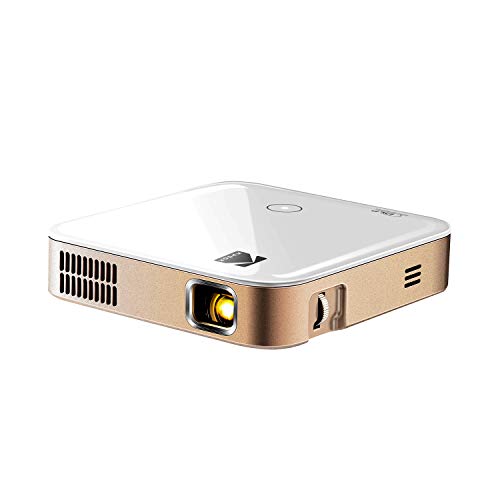
The KODAK Luma 350 Portable Smart Projector w/ ($349.99) — The KODAK Luma 350 is a well-built little DLP projector with a real brand behind it, and its optics are genuinely sharp on text and fast motion. The iOS Luma app is a thoughtful touch, turning your phone into a proper remote. What sinks it is the software: it runs Android 6.0, and major streaming services have moved on from that generation, so app availability is thin and the Play Store is limited. Kodak also quotes LED-lumen brightness, which isn't comparable to the ANSI figures the picks publish, and owners note the bundled remote can only power the unit off. It still makes sense if you plan to treat it as a dumb HDMI display and plug in a modern streaming stick, but at that point the WiMiUS gives you more.
Setup and placement
Give the projector a straight, level shot at the wall before you touch a keystone menu. Auto correction cleans up small angles, but it can't fix a hard sideways throw without cropping the picture and softening it. A plain white wall works fine; a matte screen works better and costs little. Keep the vents clear, because a projector boxed in on a shelf runs hot and the fan gets louder. Clean the lens with a microfiber cloth, never a paper towel. If you're using a streaming stick, run its power from the projector's USB port so you're not hunting for a second outlet. And measure your throw distance before you buy, not after.
Questions we get
How many lumens do I actually need?
In a fully dark room, 150 to 200 true ANSI lumens looks good at 60 to 80 inches. For a dim room with a lamp on, aim for 280 to 400. Be skeptical of any figure that doesn't say ANSI or ISO, because unqualified claims of nine or twelve thousand lumens are usually LED lumen or lux numbers inflated five to ten times over the standard.
Can a mini projector work in a bright room?
Not really. These are dark-room devices, and even the Epson EF21 at 1,000 lumens struggles against direct sunlight. Outdoors, wait until after sunset. Indoors, blackout curtains do more for your picture than upgrading the projector would.
What's the difference between native and supported resolution?
Native resolution is how many pixels the panel actually has. Supported resolution is the highest signal it will accept before scaling that signal down to the panel. A projector that supports 1080p on a 720p panel shows you a shrunken 1080p image, which beats a 720p source but looks softer than a true 1080p display. Check the native figure, especially at the budget end where marketing tends to blur it.
Do the built-in speakers sound good enough for movies?
It depends on the projector. The XGIMI MoGo 2 Pro's dual 8W stereo speakers are genuinely fine for a movie in a medium room, and the Capsule 3's Dolby Digital processing punches above its size. Most other mini projectors use a modest mono driver that handles dialogue and thins out on music. For more than two people, a Bluetooth speaker makes a bigger difference than any picture setting.
How long does the light source last?
Longer than you'll own the projector. LED sources, which most mini projectors use, are rated for 20,000 to 30,000 hours, and lasers like the Epson's are rated for 20,000 while holding brightness better over time. At three hours a day that's roughly two decades. None of these use replaceable lamps, so there's no bulb to buy.
Is built-in Google TV worth paying for?
Usually, yes. A current smart platform means no extra stick, no second remote and apps that keep working, and officially licensed Netflix only exists on projectors certified for it. The Capsule 3 GTV, the MoGo 2 Pro and the EF21 all carry that licensing. If you go with a projector that has no smart software, plan on a streaming stick and count it as part of the purchase.
Why you should trust us
For this guide:
- We read the published spec sheets for every projector in this lineup and compared brightness only where a manufacturer stated an ANSI or ISO figure.
- We reviewed published coverage of these models alongside owner feedback themes for the things specs hide, like fan noise, setup fussiness and how the built-in speakers hold up.
- We cross-checked each listing's resolution and throw-distance claims against the category's common marketing shortcuts to separate native panels from supported input signals.
- We read owner reviews on every listing, weighted toward the critical ones, because that is where the recurring failures show up.
- We have a systematic way of automatically fetching the latest prices, so the numbers on this page stay current.
- This is a research-focused guide, so the team may not own every product listed — though we often do own the top winners, which gives us extra context for the recommendations.
- We don't accept free products, and the retailer commission never changes which product we recommend.
Sources
Best Portable Projectors 2026 — Wirecutter, Wirecutter
Best Mini Projectors Under $200 — PCMag, PCMag
Best Budget Projectors 2026 — Tom's Guide, Tom's Guide
Mini Projector Buying Guide — RTINGS.com, RTINGS
Best Cheap Projectors 2026 — TechRadar, TechRadar
Amazon product listings and owner reviews for all 10 products
Manufacturer specification pages for each product
Some passages in this guide may be paraphrased with AI help. Prices are refreshed automatically.
More like this.
Continue exploring electronics reviews and recommendations.

The Best Portable Projectors
A portable projector turns a bedsheet, a garage door or a hotel wall into a screen bigger than any TV you'd carry up a flight of stairs. That's the…

The Best Dash Mini Appliances
A mini appliance earns its keep by being easy to grab. If it lives in a cabinet behind the stockpot, you'll stop using it by the second week. Dash builds…

The Best Mini Trampolines and Rebounders
A rebounder is one of the few pieces of home cardio gear that people actually keep using. It takes up about as much floor space as an armchair, it doesn't…

The Best Mini Skincare Fridges
A skincare fridge is a small box that keeps your serums, eye creams and sheet masks cold. That's it. But the appeal is real: a chilled eye cream feels…

The Best Dorm Room Mini Fridges
A mini fridge is the one appliance in a dorm room that runs all day, every day, right next to where you sleep. That changes what matters. Capacity gets…

The Best Car Covers for Outdoor Protection
A car that sleeps outside takes a beating you don't really see day to day. Sun bleaches the clear coat, sap drips from whatever tree you parked under, and…