The Best Moisture Meters
A moisture meter answers one question you can't answer by looking: is that damp, or was it damp? A stain on the ceiling, a soft spot under the sink, a stack of lumber that's been sitting in the garage for weeks — they all look about the same whether they're wet or dry. A meter turns a guess into a number. It's cheap insurance before you close up a wall, glue down a floor, or decide that a leak has finally stopped.
No meter is as precise as the marketing suggests. Pin meters give you an absolute percentage only in wood, and only if the meter knows the species — otherwise dense oak reads lower than it should. Pinless meters don't give a real percentage on drywall or concrete at all. They give a relative number that means something only when you compare it with a known-dry spot in the same room. Budget models drift most at high moisture, which is exactly where you care. And no meter finds the leak. It tells you where the water ended up.
So buy for the job you actually have. If you're chasing a leak or spot-checking framing before the drywall goes up, a simple pin meter does everything you need. If you're laying hardwood or splitting firewood, you want sharper pins and clearer thresholds. If you inspect buildings for a living, you want both modes and logged readings. We think that the General Tools MMD4E is the best moisture meter for most people, and that the Calculated Industries 7440 AccuMASTER XT is the one to buy if you work with wood rather than just check on it.
Everything we recommend
A simple pin meter that answers wet or dry for most jobs

Sharper pins and clearer thresholds for working with wood

Pin and pinless in one, with logging, if you can pay for it

Scans finished walls and floors without leaving a mark
At a glance
| Product | Sensing Method | Moisture Range (%) | Price | |
|---|---|---|---|---|
| General Tools MMD4E Digital Moisture MeterTop pick | Pin Type | 5-50%/1.5-33% | $39.98 |
 | General Tools Digital Moisture Meter MMD7NP -Also consider | Pinless | 0-53%/0-35% | $48.95 |
| Klein Tools ET140 Pinless Moisture Meter forAlso great | Pinless | — | $49.97 |
 | EXTECH Instruments MO290-RK - Water Restoration KITAlso in lineup | — | — | $1,199 |
| Calculated Industries 7440 AccuMASTER XT Digital MoistureRunner-up | Pin Type | 5-11/12-15/16-50% | $50.29 |
 | Orion® 910 Pinless Wood Moisture Meter KitAlso consider | Pinless | — | $430 |
| Protimeter SurveyMaster Dual-Function Moisture Meter - BLD5375Upgrade pick | Dual-Function | — | $649 |
 | FLIR MR176 - Thermal Imaging Moisture MeterAlso in lineup | Pin and Pinless | — | $1,299 |
How we picked
Pin, pinless, or both. Pin meters give you an absolute percentage in wood; pinless meters scan fast and leave no marks but read relative. We matched each meter to the job it's genuinely good at instead of ranking them against each other.
Accuracy that holds up. Published reviews put quality pin meters within a point or two of oven-dry references, while budget pinless models drift several points at high moisture. We treated tighter accuracy as essential only where a number gets documented or a floor gets installed.
Species correction. Dense oak and maple conduct differently than pine, so a meter with no correction reads hardwood low. We required it on anything we'd recommend for flooring or woodworking.
Reading it in the dark. Nearly every moisture check happens in a crawl space, an attic, or a cabinet. We ruled out anything without a backlit display or clear LED indicators, based on spec sheets and repeated owner complaints about unreadable screens.
Pins and durability. Soft pins bend before they seat in hardwood, which quietly produces readings that are too dry. We favored stainless pins, available replacements, and housings that published reviews and buyer feedback describe as surviving job-site use.
Top pick
A simple pin meter that answers wet or dry for most jobs
General Tools MMD4E Digital Moisture Meter
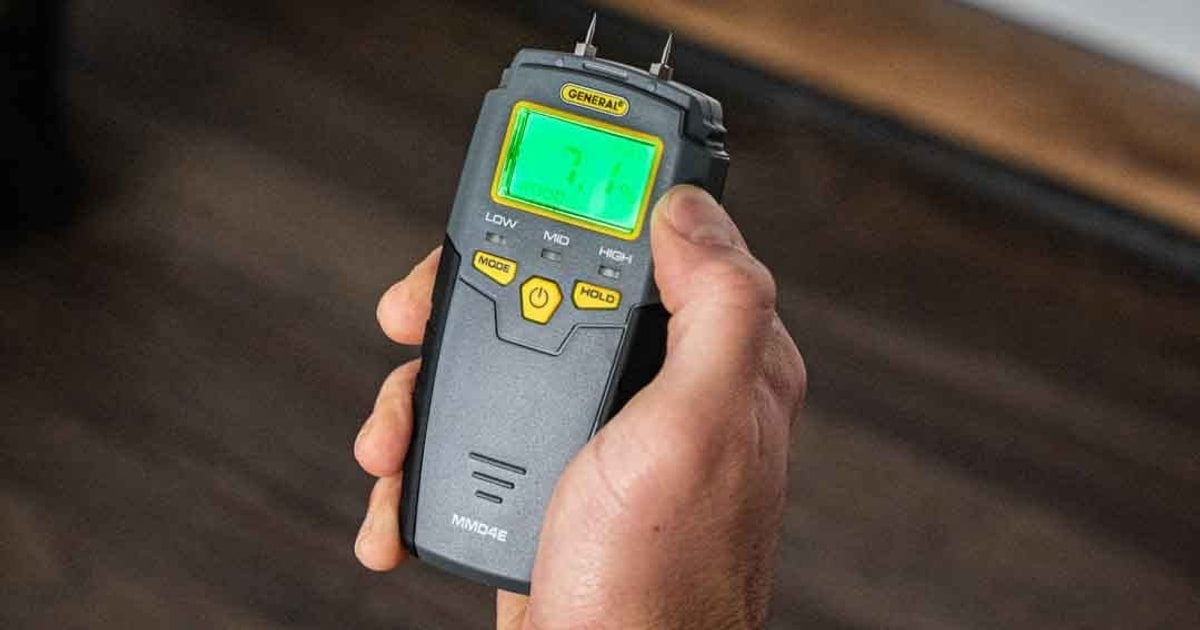
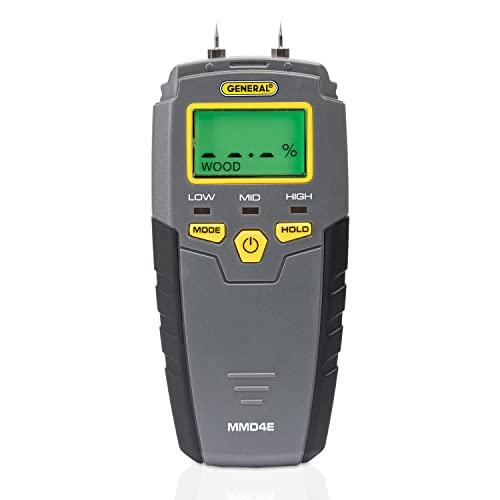
The MMD4E pushes two stainless pins into wood or drywall and tells you whether the spot is dry, borderline, or soaked. You get a backlit screen you can read in a crawl space, audible alerts, spare pins, and a battery in the box.
$39.98fromAmazonMost of the time you only need to know wet or dry, and that's exactly what this does. It reads 5 to 50 percent in wood and 1.5 to 33 percent in building materials like drywall and concrete, then sorts every reading into low, medium, or high with a beep and an on-screen indicator. You don't have to interpret anything or remember what a number means. Press the pins in, listen, move to the next spot.
You can read it where you'll actually use it. Moisture problems live in crawl spaces, attics, and the cabinet under the kitchen sink, and none of those places have good lighting. The digits are 0.3 inches tall on a backlit LCD, so you can take a reading with a flashlight in your teeth and still see it. That sounds like a minor detail until you've squinted at a dim display upside down under a joist.
The small stuff is all in the box. You get spare 8mm stainless steel pins, a protective cap that doubles as a calibration checker, and a 9V battery. Stainless pins hold up far better than the soft-alloy points that ship with no-name meters, and the cap lets you confirm the meter is reading sensibly before you trust it on something expensive. There's nothing else you need to buy to start using it.
For the check that matters most, it's accurate enough. Framing lumber and subfloor sheathing shouldn't be enclosed above 19 percent moisture content — the long-standing threshold from the USDA Forest Products Laboratory, above which decay fungi get established. Published reviews put decent pin meters within roughly a percentage point of oven-dry references on framing lumber. Telling 14 from 22 isn't a hard job, and that's the call you're usually making.
Flaws but not dealbreakers
There's no species correction, so hardwood reads low. The meter works from a softwood baseline. Dense red oak, maple, or hickory holding the same amount of water shows a smaller number than pine would, which means a borderline problem can look fine. For drywall and framing that doesn't matter much. For a hardwood floor that's about to be nailed down, it's the wrong tool, and a low reading there is worse than no reading.
It leaves holes. Two of them, every time, and they're small but visible. On framing, subfloor, or firewood nobody will ever notice. On a painted wall or a pre-finished floor you're choosing between a measurement and a blemish. That trade-off is the whole reason pinless meters exist, and it's why we'd pair this with a scanner if you check finished surfaces often.
Nothing gets saved. There's no memory, no app, no timestamps. If you're documenting a water loss for an insurer or writing up an inspection, you'll be copying numbers into a notebook by hand, room by room. Hand transcription is where readings get mixed up, and a disputed claim is a bad place to discover that. For a homeowner tracking one wet wall, it's a non-issue.
Runner-up
Sharper pins and clearer thresholds for working with wood
Calculated Industries 7440 AccuMASTER XT Digital Moisture
The AccuMASTER XT 7440 is a pin meter for people who build with wood rather than just check on it. The pins are sharp enough to seat in hickory without bending, and every reading gets labeled low, medium, or high so you know whether to start or wait.
$50.29fromAmazonThe pins are the real upgrade here. Cheap pin meters fail at the points first — soft pins flex before they seat in hickory, hard maple, or Brazilian cherry, and a pin that only goes in partway gives you a reading that's too dry. These are ground sharp and go in cleanly. If you're checking dense hardwood before you cut or nail it, that's the difference that decides whether the number is worth anything.
The thresholds tell you what to do, not just what it says. Low is 5 to 11 percent, medium is 12 to 15, and high runs from 16 to 50, each with an icon and an audio alert. That lines up with how flooring work actually goes: hardwood should acclimate to roughly 6 to 9 percent before installation under NWFA guidance, with no more than about two points of difference between the flooring and the subfloor.
It settles the firewood argument in about three seconds. Split a piece, stick the pins into the fresh face, and see where it lands. Wood that reads high will hiss, smoke, throw little heat, and glaze your chimney with creosote. The same meter reads walls, ceilings, carpet, and concrete, so it doubles as your leak-hunting tool the rest of the year.
The handling details are thought through. The body is solid enough to lean on when you're pressing pins into oak. There's a backlit screen, a hold key that freezes the reading so you can pull the pins out and then look, built-in calibration test pins, automatic shut-off, and a 9V battery included. It's a tool you can use one-handed on a ladder.
Flaws but not dealbreakers
Pins only, so finished surfaces are off-limits. There's no scan mode. If you need to check a pre-finished floor, a painted wall, or a client's furniture, you either accept two small holes or you use a different meter. Most installers end up owning both, using a pinless meter to sweep and this one to confirm the spots that look suspicious.
The range starts at 5 percent. Kiln-dried stock for indoor furniture can sit below that in a heated house in winter, and this meter simply won't resolve it — you'll bottom out and lose the fine detail. For construction lumber, flooring, and firewood that's irrelevant, since everything interesting happens well above 5 percent.
No logging, no app, no way to prove anything. Readings live on the screen until you take the pins out. If you're doing paid inspection or remediation work where the numbers end up in a report, you'll want a meter that timestamps them for you.
Upgrade pick
Pin and pinless in one, with logging, if you can pay for it
Protimeter SurveyMaster Dual-Function Moisture Meter - BLD5375
The SurveyMaster BLD5375 switches between a non-invasive scan mode and pin contact mode without swapping tools, then sends readings to your phone with time and date stamps. It's built for people who write reports about moisture for a living.
$649fromAmazonIt does the two-step method professionals use, with one tool. You sweep a wall in Search mode to find the elevated zones without touching the finish, then flip to Measure mode and put pins into the spots that lit up for a calibrated percentage. Combination meters are the approach the NWFA points to for pre-installation flooring checks, and doing both steps without putting one meter down is genuinely faster.
The readings log themselves. Bluetooth pairs it with the Protimeter Connect app, which saves each reading with a time and date stamp so you can pull them off later. You end up with a moisture map that builds as you walk the building, instead of a page of numbers you have to type up afterward and hope you got right.
It checks its own calibration. The meter runs a built-in calibration check every 50 power cycles, supports field calibration for the non-invasive mode, and takes firmware updates over the air. Most meters at any price ask you to trust them indefinitely. This one gives you a way to confirm it's still telling the truth before a reading goes into a report someone might contest.
It's set up for full days. Battery life runs about three times that of the previous model, the display is larger than before, and you can tune the auto shut-off anywhere from zero to ten minutes along with the backlight, buzzer, and moisture indicators. It reads wood, drywall, concrete, and even fiberglass boat hulls, which covers most of what an inspector runs into.
Flaws but not dealbreakers
It costs many times what our other picks do. That only pencils out if moisture measurement is part of how you earn money. For a homeowner checking one suspicious wall a year, almost all of what you're paying for — the logging, the calibration checks, the dual modes — will sit unused.
Stock comes and goes. Availability on this one has been inconsistent, so if you have an inspection or a remediation job on the calendar, confirm the unit is actually shipping before you count on it. Ordering a professional instrument that arrives after the job is a problem the spec sheet won't warn you about.
There's no thermal imaging. It measures moisture wherever you point it, but it won't show you the cold evaporative signature of water moving behind a wall. If your work depends on finding hidden sources rather than confirming known ones, you'll still need a separate thermal camera.
Also great
Scans finished walls and floors without leaving a mark
Klein Tools ET140 Pinless Moisture Meter for
The ET140 finds damp behind a painted wall or a finished floor without putting a hole in either one. It reads relative moisture to about 3/4 inch in drywall, masonry, hardwood, and softwood, in a housing built for the back of a work van.
$49.97fromAmazonNo pins means no holes, which changes where you can use it. It uses an electromagnetic field to sense moisture up to 3/4 inch below the surface, so you can run it across a client's freshly painted living room wall or a pre-finished floor and leave nothing behind. That's the whole argument for pinless. When the surface is something you'd have to patch, a pin meter stops being an option.
It's built like the rest of Klein's line. Electricians and remodelers buy these tools because they get dropped off ladders, ride around in dusty bags, and sit in an unheated truck overnight. Consumer-grade meters with thin plastic shells don't survive that treatment for long. This one's housing is the main reason to pick it over a similarly priced meter aimed at homeowners.
The LED bars make sweeping fast. Nine bars show the moisture range at a glance, and the reverse-contrast display stays readable in bad light, so you can keep moving instead of stopping to read a number at every spot. A hold button freezes a reading, and there's auto power-off and a low-battery indicator. Sweep the wall, watch the bars climb, mark where they peak.
Treat it as a search tool and it's excellent. The right workflow is to find a section of wall you know is dry, note what it reads, then sweep the suspect area and pay attention to anything clearly above that baseline. You're comparing, not measuring. Used that way it will find a wet zone behind drywall faster than any pin meter can.
Flaws but not dealbreakers
The readings are relative, not absolute. It won't hand you a moisture content percentage you can put in a report or check against the 19 percent decay threshold. For finding where the water is, that's fine. For proving how wet something was, you need a pin meter alongside it.
Three-quarters of an inch isn't very deep. It reads the surface layer, which covers drywall and thin flooring well. It will miss water sitting in a subfloor under thick hardwood, under a tile assembly, or below concrete underlayment — and that's often where the expensive damage is hiding.
It's calibrated for four material types only. Drywall, masonry, hardwood, and softwood. Point it at anything else and the number on screen doesn't mean much, which is easy to forget once you get used to sweeping everything in sight.
Who this is for
Buy a moisture meter if you own a house. That's not a stretch — the moment you have a stain on a ceiling, a musty smell in a basement, or a floor that feels soft, you're either guessing or you're measuring. A meter also earns its keep before work: checking framing before drywall, checking a slab before flooring, checking firewood before you stack it inside. If you have an active leak right now, buy the pin meter and start taking readings today, since the useful information is how a spot changes over the next week.
Skip it if you're planning to diagnose a problem you already know you have to hire out. A meter tells you where water is, not where it came from or what it cost you. This guide covers handheld meters for wood and building materials — pin, pinless, and combination — from homeowner models up to professional instruments used for inspection and restoration work. It doesn't cover concrete relative-humidity probe systems, standalone thermal cameras, whole-house humidity monitors, or the grain moisture testers used in agriculture.
How we picked
Measurement type: we matched pin, pinless, and combination designs to the jobs each actually suits, rather than treating one as universally better. Accuracy: published reviews put good pin meters within a point or two of oven-dry references while budget pinless models drift several points at high moisture, so we demanded tighter accuracy only where a reading gets documented or a floor gets installed. Species correction: dense hardwood reads low on a softwood baseline, so we required correction on anything recommended for flooring or woodworking. Readability: almost every reading happens in bad light, so a backlit display or clear LED bars was non-negotiable. Pins and build: stainless pins that seat in hickory without bending, available replacements, and a housing that owner feedback says survives a work van. Documentation: for professional picks, timestamped logging that removes hand transcription from the process.
Other moisture meters worth considering
If you want pinless scanning with a bigger screen and an alarm: The General Tools Digital Moisture Meter MMD7NP - ($48.95) — The General Tools MMD7NP does the same non-invasive job as our Klein pick with a couple of homeowner-friendly extras. The sensor auto-calibrates, so there's less to get wrong on your first sweep, and the 2-inch backlit LCD plus a three-color LED bar graph makes elevated zones obvious without stopping to read digits. There's a hold button, an audible alert, an out-of-range alarm, and a low-battery warning. It reads 0 to 53 percent in softwood and 0 to 35 percent in hardwood, with relative readings on wallboard and masonry, to the same 3/4-inch depth. What you give up is the tougher housing — this is a lighter, more plastic tool, better suited to a home than a truck bed.
If you install hardwood floors for a living: The Orion® 910 Pinless Wood Moisture Meter Kit ($430) — The Wagner Orion 910 kit is the pinless meter flooring pros reach for, and the reason is the calibrator that comes with it. You can verify the meter's accuracy on site, right before a pre-installation check, instead of shipping it off for recalibration and hoping in the meantime. The sensor reads to 3/4 inch, which covers the full thickness of most flooring boards, and Wagner's IntelliSense design is largely unaffected by the surface temperature of the wood — useful when a pallet has been sitting in a cold garage. There's also a relative mode for engineered wood and drywall. It costs far more than our picks, it's pinless only, and it can't give you an absolute reading at a single point for documentation.
The competition
These are the other meters our research surfaced, not a survey of everything sold. Both are professional instruments aimed at restoration and forensics work, and both lost to our picks for the same reason: they solve documentation problems that most buyers don't have.
The EXTECH Instruments MO290-RK - Water Restoration KIT ($1,199) — The Extech MO290-RK is a complete water restoration kit rather than a meter, and it should be judged that way. In the hard case you get the MO290 combination pin and pinless meter, the RHT10 USB humidity and temperature datalogger for tracking ambient conditions and calculating grains per pound, plus the probes and accessories needed to work a claim from first response through drying verification. That pairing of moisture readings with logged room conditions is what insurance adjusters want on a large loss. It lost to our picks because it's priced and scoped for contractors billing claims — if you just want the dual-mode measurement, the MO290 meter is sold on its own for much less. Worth a look if restoration is your business and you're building a kit from nothing.
The FLIR MR176 - Thermal Imaging Moisture Meter ($1,299) — The FLIR MR176 combines pin and pinless measurement with Infrared Guided Measurement, which uses a thermal sensor to point you toward cold spots that suggest water behind a surface before you place a probe. A replaceable hygrometer adds ambient humidity and dew point, which matters in a crawl space where you're trying to tell condensation from an actual leak, and Bluetooth logging assembles the record as you go. It's the most expensive meter here by a wide margin, and it carries a limited ten-year warranty. Two cautions: the listed key features describe oscilloscope specifications — 20MHz bandwidth, peak detect, waveform math — which have nothing to do with a moisture meter, so confirm exactly which unit and documentation you're getting before ordering. For restoration pros who need to find hidden sources rather than confirm known ones, it's still the only option here that does it.
Care and calibration
Check the meter against its calibration pins or cap before any reading you're going to act on — it takes five seconds and catches a dying battery or a bent pin. Wipe the pins after use, especially if you've been in something wet or salty, and replace them once they're dull or bent, since a pin that won't seat fully reads too dry. Let cold lumber and a cold meter warm up to room temperature before you trust a number. With a pinless meter, always find a known-dry spot in the same room and same material first, then compare against it. Store the meter somewhere dry with the battery in, and keep a spare 9V in the bag, because it will die in the crawl space.
Questions we get
What's the difference between a pin and a pinless moisture meter?
A pin meter drives two probes into the material and measures electrical resistance between them, which converts to an actual moisture content percentage in wood. A pinless meter uses an electromagnetic field to sense moisture below the surface without touching anything, so it leaves no marks but gives you a relative number rather than a true percentage on most materials. Pins are for precision and proof; pinless is for scanning a large area quickly. Combination meters do both, which is why professionals prefer them.
What moisture reading means there's a mold risk?
Wood above 19 percent moisture content can support fungal decay and mold, a threshold that traces back to the USDA Forest Products Laboratory's Wood Handbook. Below that, decay fungi generally can't sustain themselves. Any framing, sheathing, or subfloor reading above 19 percent needs investigating and drying before it gets covered up. Drywall and other porous materials are judged differently — you compare a suspect area against a dry area in the same room instead of chasing an absolute number.
How dry does wood need to be before installing a hardwood floor?
NWFA guidance calls for interior hardwood flooring to acclimate to roughly 6 to 9 percent moisture content before installation, with no more than about a 2 percent difference between the flooring and the subfloor. Install outside those ranges and you're inviting cupping, gapping, or buckling months later. You need a species-corrected pin meter or a quality pinless meter to verify it, since a meter without species correction will read dense hardwood low and make a wet floor look ready.
How do I check drywall for moisture without wrecking it?
Use a pinless meter so you don't leave holes in the finish. Start by reading a section of wall you're confident is dry — same room, same material — and note where the bars sit. Then sweep slowly across the suspect area and mark anything clearly above that baseline. Drywall readings are relative, so the comparison is the measurement. If you need an actual number for a report, follow up with a pin meter.
Are budget moisture meters accurate enough for home use?
For homeowner purposes, yes. Published reviews put inexpensive pinless meters within about 3 to 5 percentage points of oven-dry references and quality pin meters within roughly 1.5 to 2, which is plenty for telling a wet wall from a dry one or checking framing against the 19 percent threshold. Where that variance bites is professional work — flooring compliance, certified inspection, insurance documentation — because a few points can mean a failed installation or a disputed claim. For those jobs, buy a combination meter.
Do I really need to adjust for wood species?
For pin readings in wood, yes. Density and fiber structure affect how wood conducts electricity, so the same resistance means different moisture levels in red oak than in pine. Meters without a correction table default to a softwood baseline and under-read hardwoods like oak, maple, and hickory — the exact species where a missed reading costs the most. If you're only checking drywall and framing lumber, it doesn't matter much.
Why you should trust us
For this guide:
- We compared manufacturer specifications for every meter here — measurement ranges, scan depth, species correction, calibration features, display size, and battery type — and lined them up against what published reviews report about accuracy versus oven-dry references.
- We read owner feedback looking for repeated complaints rather than one-off ones, and the patterns that shaped our picks were bent pins, unreadable displays in low light, and confusion between relative and absolute readings.
- We drew the thresholds that decide a job from published wood-industry and building sources, including the 19 percent decay limit for structural lumber and the 6 to 9 percent acclimation range for hardwood flooring.
- We read owner reviews on every listing, weighted toward the critical ones, because that is where the recurring failures show up.
- We have a systematic way of automatically fetching the latest prices, so the numbers on this page stay current.
- This is a research-focused guide, so the team may not own every product listed — though we often do own the top winners, which gives us extra context for the recommendations.
- We don't accept free products, and the retailer commission never changes which product we recommend.
Sources
Wood Handbook: Wood as an Engineering Material — USDA Forest Products Laboratory. Establishes that below 19% MC fungal decay cannot be sustained in most wood species; the fiber saturation point of most species is approximately 28–30% MC., USDA Forest Products Laboratory
Amazon product listings and owner reviews for all 8 products
Manufacturer specification pages for each product
Some passages in this guide may be paraphrased with AI help. Prices are refreshed automatically.
More like this.
Continue exploring home reviews and recommendations.

The Best Wireless Meat Thermometers
Cooking meat by time is guessing. A thick pork shoulder and a thin one look the same from across the yard, and the difference between juicy and dry is…

The Best Garage Ceiling Storage Racks
Garage floors fill up in a way that sneaks up on you. A cooler here, a bin of holiday lights there, and one day the second car doesn't fit. Ceiling…

The Best Patio String Lights
String lights turn a patio into a room for very little effort. Hang a strand over the table and dinner stretches an hour longer. But the ones that look…

The Best Cocktail Smoker Kits
Smoked cocktails used to be a bar-only trick. Now they're a countertop one. The idea is simple: you burn a pinch of wood chips, trap the smoke over a…

The Best Water Heater Insulation Blankets
Your water heater sits there all day keeping 40 or 50 gallons hot, whether you're home or not. If the tank is old, a lot of that heat leaks straight into…

The Best Wood Routers
A router is the tool that makes furniture look finished. It cuts the round-over on a tabletop edge, the dado that carries a shelf, the groove for a drawer…