The Best Wireless Meat Thermometers
Cooking meat by time is guessing. A thick pork shoulder and a thin one look the same from across the yard, and the difference between juicy and dry is often twenty minutes you didn't know you had. A wireless thermometer takes that guessing away. You put a probe in the meat, walk back inside, and your phone tells you what's happening. Consumer Reports found that most grill owners who switched to one started hitting the right internal temperature more consistently than they did cooking by the clock.
Here's the honest part: no wireless thermometer is set-and-forget. Bluetooth models drop out when you go inside, apps require accounts you didn't want, and probes eventually fail — usually the one you rely on most. Cheap units drift a few degrees once your grill climbs past 250°F, which is exactly when accuracy matters. Serious Eats saw budget Bluetooth models wander 3–5°F at those temperatures while the better ones held within a degree. You're buying a tool, not a guarantee.
So the real question is how far you walk away and how many things you're cooking. If it's one roast and you stay near the kitchen, a simple alarm unit does everything. If it's an overnight brisket and you'd like to sleep, you want Wi-Fi. We think that the ThermoWorks DOT is the best wireless meat thermometer for most people, and that the ThermoWorks Signals is the one to buy if you cook multiple proteins or run long smokes and want to monitor them from inside the house.
Everything we recommend

Accuracy and a loud alarm, with nothing else to fuss with

Four channels and Wi-Fi, so you can leave the yard

Wire-free probes and step-by-step coaching for newer cooks

Four probes and long battery life, at a fraction of the cost
At a glance
| Product | Probes | Connectivity | Price | |
|---|---|---|---|---|
| ThermoWorks DOTTop pick | — | — | $57 |
 | MEATER Pro XL WiFi Thermometer Bundle w/BBQAlso in lineup | 4-Probe | WiFi | $277.38 |
| Inkbird IBT-4XS Bluetooth Thermometer and Rechargeable InstantBudget pick | 4 probes | Bluetooth | $54.01On sale |
| ThermoWorks Signals BBQ Alarm Thermometer with Wi-FiUpgrade pick | Four Channels | Wi-Fi and Bluetooth | $259 |
 | WiFi Display & Predictive Thermometers Bundle -Also consider | — | WiFi | $229 |
| CHEF iQ SenseAlso great | 3 Probes | WiFi | $129.92On sale |
 | Weber Connect Smart Grilling HubAlso consider | — | Bluetooth | $118.75On sale |
How we picked
Accuracy under heat. We compared published lab results and manufacturer tolerance specs, and weighted heavily toward units that hold within about a degree above 250°F, where cheaper models tend to drift.
Range and connection. We looked at measured real-world Bluetooth range in published reviews and separated Bluetooth-only units from Wi-Fi ones, since only Wi-Fi lets you monitor a long cook from inside the house.
Probes and channels. We favored thermometers that track at least two things at once, and noted which ones read pit temperature alongside internal meat temperature.
Battery and durability. We compared published battery-life figures, IP water-resistance ratings and probe heat ratings, plus owner feedback about which parts fail first.
App and setup burden. We read owner reports about app reliability, forced account creation and alert behavior, since a thermometer whose alerts you don't trust is worse than none.
Top pick
Accuracy and a loud alarm, with nothing else to fuss with
ThermoWorks DOT
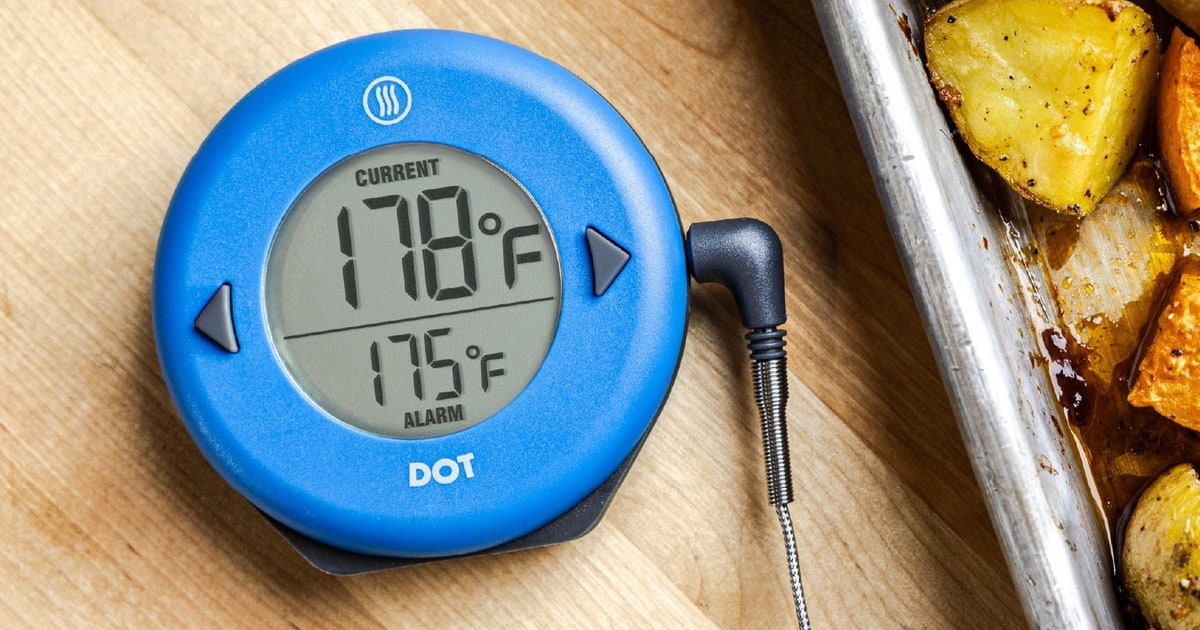
The DOT is a two-button alarm thermometer with a ThermoWorks Pro-Series probe. You set a target temperature, clip the probe in, and it beeps when the meat gets there — no app, no pairing, no account.
$57fromAmazonMost people don't need an app; they need to be told when the meat is done. That's the whole DOT. Two buttons set your target. A big display shows the current temperature from across the kitchen. The alarm is loud enough to hear over a range hood or a running dishwasher. America's Test Kitchen recommends it as a leave-in thermometer, and it's a fixture in competition BBQ circles for exactly this reason.
ThermoWorks is the accuracy benchmark in this category, and it's not close. Serious Eats found that budget units drifted 3–5°F above 250°F while ThermoWorks probes stayed within a degree under the same conditions. Owners who compare the DOT against IR guns, oven thermostats and other probes report readings that line up within a couple of degrees. If you bake, make candy or care about a medium-rare target, that margin is the entire point.
The build feels like equipment, not a gadget. It's a small, chunky puck that magnets onto your oven door or sits next to the grill without sliding around. The Pro-Series probe handles oven, smoker and grill duty. ThermoWorks runs its own support out of Utah, which matters more than it sounds — probes are the part that dies, and being able to reach a human for a replacement is worth something.
The trade-off is that it monitors one thing at a time. One probe, one target, one alarm. For a weeknight chicken or a single roast, that's exactly right. For a Thanksgiving spread with a turkey, a ham and a pit temperature you also want to watch, you'll want more channels — and that's the Signals below.
Flaws but not dealbreakers
There's no phone connection at all, so you have to be within earshot. If your grill is at the far end of the yard and you're inside with the TV on, you'll miss the alarm. That's a real limitation, and it's the main reason to spend more.
Setting the target temperature means tapping the button once per degree — you can't hold it down to scroll. Going from 40°F to 203°F is a lot of tapping. It's a small annoyance you'll notice every single cook.
One probe means one protein. Cooking two steaks to different doneness levels means buying a second unit, which several owners do.
Upgrade pick
Four channels and Wi-Fi, so you can leave the yard
ThermoWorks Signals BBQ Alarm Thermometer with Wi-Fi
Signals tracks up to four probes at once over both Wi-Fi and Bluetooth, with a standalone display that works even if your phone is dead. It's the one to get for long smokes and multi-dish holiday cooking.
$259fromAmazonFour channels changes what you can cook. Run one probe in the brisket, one in the pit to watch your smoker's actual grate temperature, and two more in whatever else is going. Each channel gets its own high and low alarm, so you'll know when the fire dies before the meat suffers. If you've ever lost a cook because the pit dropped 60 degrees while you were asleep, this is the fix.
Wi-Fi is the feature you're actually paying for. Bluetooth caps out somewhere around 100 to 165 feet, which is fine until you walk into the house and a wall kills the signal. Signals uses your home network, so you can check a 14-hour brisket from bed, from the couch or from the grocery store. The app graphs everything, which is genuinely useful for figuring out where your stall happened.
ThermoWorks publishes NIST-traceable calibration certificates for Signals — a level of transparency that's rare at consumer prices. Combine that with the same probe accuracy that made the DOT our top pick and you get a unit you can trust for competition work. AmazingRibs-tier accuracy is table stakes for pitmasters, and Signals clears it.
It's built for the weather. The housing is IP66 splash-resistant, so a surprise rain shower during a long cook isn't a crisis. Strong magnets stick it to the side of a smoker and a stable base keeps it upright on a folding table. And it works as a plain alarm thermometer with no phone involved, which is a nice hedge against app problems.
Flaws but not dealbreakers
It's the most expensive thermometer here, and the jump from the DOT is significant. If you cook one thing at a time and stay near the kitchen, you're paying for channels you'll never use.
Wi-Fi setup means dealing with your router, and 2.4 GHz networks are the norm for this class of device. If your network is finicky, expect some fiddling before the first cook.
Four probes plus wires means four wires running out of your smoker lid. It works, but it's not tidy, and lids don't seal as well around a bundle of cables.
Also greatOn sale
Wire-free probes and step-by-step coaching for newer cooks
CHEF iQ Sense
CHEF iQ Sense uses three fully wireless probes with no wires at all, rated to 1000°F ambient and good for about 40 hours per charge. Its guided cooking library walks beginners through target temps, flips and rest times.
$129.92fromAmazonList priceIf you're still looking up target temperatures on your phone mid-cook, this is the one. The guided system covers a huge library of preset programs across dozens of proteins and cuts, so you pick "pork tenderloin, medium" and it handles the rest — target temp, flip reminders, rest timer, estimated finish. The Spruce Eats counted over a thousand preset programs. For a first-time griller, that's the difference between confidence and anxiety.
Wire-free probes are a genuine convenience upgrade. Nothing runs out of the oven door or the smoker lid, so the seal stays tight and you're not fishing a cable out of a hot grill. Each probe carries four internal sensors plus an ambient sensor, so it reads the coolest part of the meat and the cooking environment at the same time. Owners who moved from wired hubs consistently call this the thing they didn't know they were missing.
Three probes means three steaks at three doneness levels, or a chicken and a couple of sides. The hub charges all three at once and gets around 40 hours on a charge, which covers an overnight brisket with room to spare. It also connects over Wi-Fi through the hub, so you get long-range monitoring without the base needing to sit within Bluetooth reach of your phone.
It's rated to 1000°F ambient, which matters if you sear hot or run a pizza oven. Earlier wireless probes from various brands had a bad habit of throwing overheat warnings on a hot grill. Owners who upgraded from the previous generation specifically call out that this one stopped complaining.
Flaws but not dealbreakers
You have to create a cloud account to use it, and there's no way around that. Some owners find this genuinely frustrating — they wanted a thermometer, not a service. If you'd rather not hand over an email address, buy the DOT.
The estimated cook time is the weak spot. Owners report that the temperature readings are accurate but the finish-time predictions can be well off, especially on small cuts or a crowded smoker where racks cook at different rates. Treat it as a rough hint, not a schedule.
Ultra-thin probes are easier on the meat but they're also the part that fails. Reliability reports are mixed enough that you should expect to replace a probe eventually.
Budget pickOn sale
Four probes and long battery life, at a fraction of the cost
Inkbird IBT-4XS Bluetooth Thermometer and Rechargeable Instant
The IBT-4XS gives you four wired probes, Bluetooth, a rechargeable battery and IPX5 water resistance for far less than anything else here. It's the sensible pick for a casual weekend griller.
$54.01fromAmazonList priceFour probes at this price is the reason to buy it. Most budget thermometers give you one or two; this one lets you watch a couple of steaks, a chicken and the grate temperature at once. Readings come back in a few seconds and it reads down to -58°F and up to 572°F, so it covers everything from a cold brine to a hot grill.
Battery life is where it quietly beats units costing several times more. Grilling24x7 measured about 40 hours per charge, against the 8 to 12 hours typical of competing budget models. That means a full overnight cook without hunting for a charger at 3 a.m. It's rechargeable rather than eating AAAs, and IPX5 water resistance means a rain shower won't end your cook.
Accuracy is good enough for the cooking most people do. BBQ Guys found it within about 2°F of a ThermoWorks reference, holding a stable Bluetooth connection at 80 feet through a wood fence. It's rated to ±2°F and offers a calibration adjustment if you want to dial it against a known reference. For burgers, chicken thighs and weeknight pork chops, that's plenty.
There's a real argument for starting here. If you're not sure whether you'll use a wireless thermometer enough to justify a Signals, this one costs a small fraction as much and does the core job. Plenty of people buy it, use it constantly, and upgrade a year later knowing exactly which features they missed.
Flaws but not dealbreakers
It's Bluetooth only. Once you step inside the house and put a wall or two between you and the base, expect the connection to drop. It's fine in the yard and useless from the couch.
The probes have to click firmly into the ports or you'll get garbage readings — the listing itself warns about this. It's an easy mistake to make in the dark, and it's the source of most complaints about accuracy.
Above 250°F, budget Bluetooth units in this class tend to drift a few degrees. If you're chasing a precise medium-rare on an expensive steak, that margin is bigger than you want.
Who this is for
Buy one of these if you cook meat and want to stop guessing. That covers weekend grillers, anyone who roasts a turkey once a year, sous vide and oven cooks, and pitmasters running twelve-hour smokes. The upgrade from cooking by time is real — most grill owners who make the switch report hitting their target temperature more consistently. If you already own a good instant-read thermometer and you only ever cook thin steaks you check by hand, you can skip all of this.
This guide covers leave-in wireless thermometers: probes that stay in the food during the cook and report to a display or your phone. It doesn't cover instant-read spot-check thermometers, oven thermometers or grill-mounted dome gauges. We also focus on what the research surfaced rather than everything sold — a lot of near-identical budget Bluetooth units exist, and the ones we cover are the models with published testing behind them.
How we picked
Accuracy: we weighted published lab comparisons and manufacturer tolerances most heavily, especially performance above 250°F where cheap probes drift. Range: we separated Bluetooth-only units, which realistically cap out around 100 to 165 feet in the open, from Wi-Fi models that work from anywhere. Channels: we favored thermometers that watch meat and pit temperature at once, since a dying fire ruins a cook faster than a mis-set alarm. Durability: we compared IP ratings, probe heat ratings and battery life, and read owner feedback about which components fail. App burden: we noted forced cloud accounts, unreliable alerts and clumsy setup, because an app you fight with defeats the purpose.
Other wireless meat thermometers worth considering
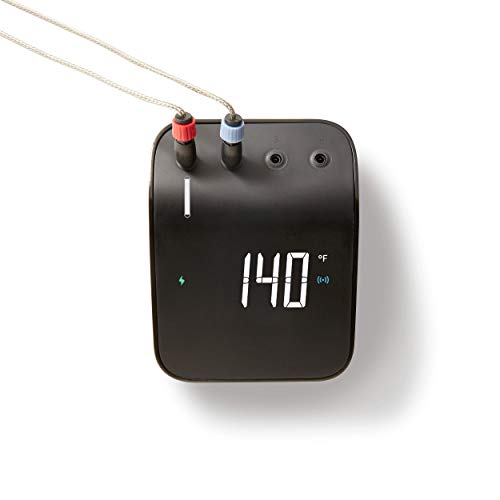
If you want the friendliest coaching for a beginner griller: The Weber Connect Smart Grilling Hub ($118.75) — The Weber Connect hub is less a thermometer than a grilling tutor. It walks you through a cook step by step — when to flip, how long is left, when to pull and rest — and Food & Wine's panel rated the app experience highly, crediting those flip-and-rest prompts with eliminating overcooked steaks across their sessions. It works with any grill, not just Webers, and handles up to four probes. What you give up is accuracy pedigree and long-term reliability: it doesn't have the calibration record of the ThermoWorks units, the app draws mixed reviews depending on your phone, and some owners report the hub failing after a couple of seasons. Buy it for the guidance, not the precision.
If you want the smartest finish-time prediction available: The WiFi Display & Predictive Thermometers Bundle - ($229) — The Combustion Inc. bundle pairs a wire-free predictive probe with a Wi-Fi display, and its party trick is genuinely useful. The probe packs eight sensors along its length, which lets it model how heat is moving through the meat rather than just reporting one number. America's Test Kitchen found its predicted completion time landed within about four minutes of the actual finish across twenty controlled cooks on beef and poultry. For a novice, knowing dinner is 40 minutes out is more useful than knowing the meat is currently 138°F. The catch is cost and newness — it's expensive, the ecosystem is young, and you're buying into a smaller company's app roadmap. Enthusiasts will love it; cautious buyers should wait.
The competition
This is what our research surfaced, not a census of the whole category. Wireless thermometers are a crowded, fast-moving segment — sales grew sharply last cycle and wire-free probe models now take a large share of premium revenue — so new entrants appear constantly. The units below are ones we looked at closely and passed over.
The MEATER Pro XL WiFi Thermometer Bundle w/BBQ ($277.38) — The MEATER Pro XL is the best-known wire-free thermometer, and on paper it's compelling: four wire-free probes, dual internal and ambient sensors, and cloud connectivity that removes the Bluetooth range limit. RTINGS measured its real-world Bluetooth range at about 157 feet in the open and confirmed the ambient sensor reads within a few degrees of a calibrated reference. But this particular bundle pairs it with BBQ mitts, and owner feedback on the package is thin and rough — reports of charger failures and unhelpful support responses. If you specifically want MEATER's wire-free design, you'd get most of the same benefit from the CHEF iQ Sense with a better-established track record, or from Combustion if prediction is what you're after.
Care and probe life
Probes are the part that dies, so treat them accordingly. Never put one in the dishwasher and never submerge the cable end or the transmitter — wipe the stem with a hot soapy cloth and dry it immediately. Bend the cable gently where it meets the probe, since that joint is where most wired probes fail. Route wires out the side of a lid rather than pinching them in the hinge. For wire-free probes, let them cool before you drop them in the charging dock. Check your readings against boiling water once a season: at sea level you should see about 212°F, and a consistent offset tells you it's time to calibrate or replace. Keep a spare probe on hand before a big cook, not after one fails.
Questions we get
What's the most accurate wireless meat thermometer?
ThermoWorks is the accuracy benchmark, and both the DOT and Signals use the same Pro-Series probe technology. Published comparisons repeatedly show ThermoWorks probes holding within about a degree at high heat while cheaper units drift several degrees. ThermoWorks also publishes NIST-traceable calibration certificates for Signals, which almost no consumer brand does.
What's the difference between Bluetooth and Wi-Fi, and which do I need?
Bluetooth connects your phone directly to the thermometer, so range is limited — figure 100 to 165 feet in the open, and much less through walls. Wi-Fi routes through your home network and the cloud, so distance stops mattering. If you stay in the yard, Bluetooth is fine. If you want to monitor an overnight brisket from bed or check on a roast from the store, get Wi-Fi.
Can I leave a wireless probe in the meat the whole time?
Yes — that's the entire point of a leave-in thermometer. Insert the probe into the thickest part of the meat before it goes on, avoiding bone and large fat pockets, and leave it until you pull. Just check the probe's heat rating: wired probes and their cables have limits, and wire-free probes like the CHEF iQ are rated for much higher ambient temperatures than most.
How many probes do I need for a whole turkey and Thanksgiving sides?
For a turkey alone, one probe in the thigh is workable, but two lets you watch breast and thigh separately — they finish at different times. If you're also cooking a ham or want to track your oven's actual temperature, four channels earns its keep. That's the case for the Signals or the four-probe Inkbird.
Do these work with pellet grills and smokers?
Yes, all of them. For smokers specifically, the useful feature is a second channel for pit temperature, so you'll know if your fire dies overnight — the Signals and the Inkbird both do this. Wire-free probes have an extra advantage on smokers since no cable runs through the lid gasket.
What temperature should brisket hit to be tender?
Most pitmasters pull brisket somewhere around 200°F to 205°F internal, but temperature alone doesn't tell the whole story. Tenderness comes from connective tissue breaking down, so probe feel matters — the thermometer should slide in with almost no resistance. Use the temperature reading to know when to start checking, then trust the feel.
Why you should trust us
For this guide:
- We read published lab comparisons from Wirecutter, Serious Eats, America's Test Kitchen, RTINGS, AmazingRibs and BBQ Guys covering accuracy, range and battery life across these models.
- We compared manufacturer specifications for probe heat ratings, IP water resistance, channel counts and connectivity type against each brand's published documentation.
- We reviewed recurring themes in owner feedback — forced cloud accounts, probe failures, app reliability and connection drops — to identify flaws that spec sheets don't show.
- We read owner reviews on every listing, weighted toward the critical ones, because that is where the recurring failures show up.
- We have a systematic way of automatically fetching the latest prices, so the numbers on this page stay current.
- This is a research-focused guide, so the team may not own every product listed — though we often do own the top winners, which gives us extra context for the recommendations.
- We don't accept free products, and the retailer commission never changes which product we recommend.
Sources
The Best Meat Thermometers of 2026 — Wirecutter, Wirecutter
Best Wireless Meat Thermometers — Serious Eats, Serious Eats
MEATER Pro XL Review — RTINGS.com, RTINGS.com
Combustion Inc. Predictive Thermometer Review — America's Test Kitchen, America's Test Kitchen
FireBoard 2 Drive Long-Term Review — AmazingRibs.com, AmazingRibs.com (Meathead's BBQ)
Best Grilling Thermometers 2026 — Consumer Reports, Consumer Reports
CHEF iQ Smart Thermometer Review — The Spruce Eats, The Spruce Eats
ThermoWorks Signals Wi-Fi Thermometer — ThermoWorks Lab Specs, ThermoWorks (Manufacturer)
Wireless Meat Thermometer Comparison — Grilling24x7, Grilling24x7
Weber Connect Smart Grilling Hub Review — Food & Wine, Food & Wine
State of the Smart Grill Market 2025 — NPD Group / Circana, NPD Group / Circana
Inkbird IBT-4XS Full Review — BBQ Guys, BBQ Guys
Amazon product listings and owner reviews for all 7 products
Manufacturer specification pages for each product
Some passages in this guide may be paraphrased with AI help. Prices are refreshed automatically.
More like this.
Continue exploring home reviews and recommendations.

The Best Meat Thermometers for Grilling
A grill lies to you. The outside of a steak looks done long before the middle gets there, and chicken thighs stay pink near the bone even when they're…

The Best Wireless Bluetooth Grill Thermometers
A wireless thermometer changes how you cook more than almost any other grill accessory. You stop lifting the lid every ten minutes. You stop cutting into…

The Best Meat Grinders And Sausage Stuffers
Grinding your own meat is one of the few kitchen upgrades where the difference shows up on the first bite. You pick the cut, you pick the fat ratio, and…

The Best Wireless Video Doorbell Cameras
A video doorbell earns its keep on ordinary days. A driver drops a box while you're at work. A neighbor stops by and you're in the shower. Someone knocks…

The Best Wireless Mice for Productivity
You touch your mouse thousands of times a day, and most of those touches are boring. You're scrolling a long spreadsheet, dragging a window to a second…

The Best Wireless Backup Camera Kits
Backing up is where most parking-lot damage happens, and mirrors alone won't show you the toddler's scooter lying behind your bumper. A wireless backup…