The Best Meat Thermometers for Grilling
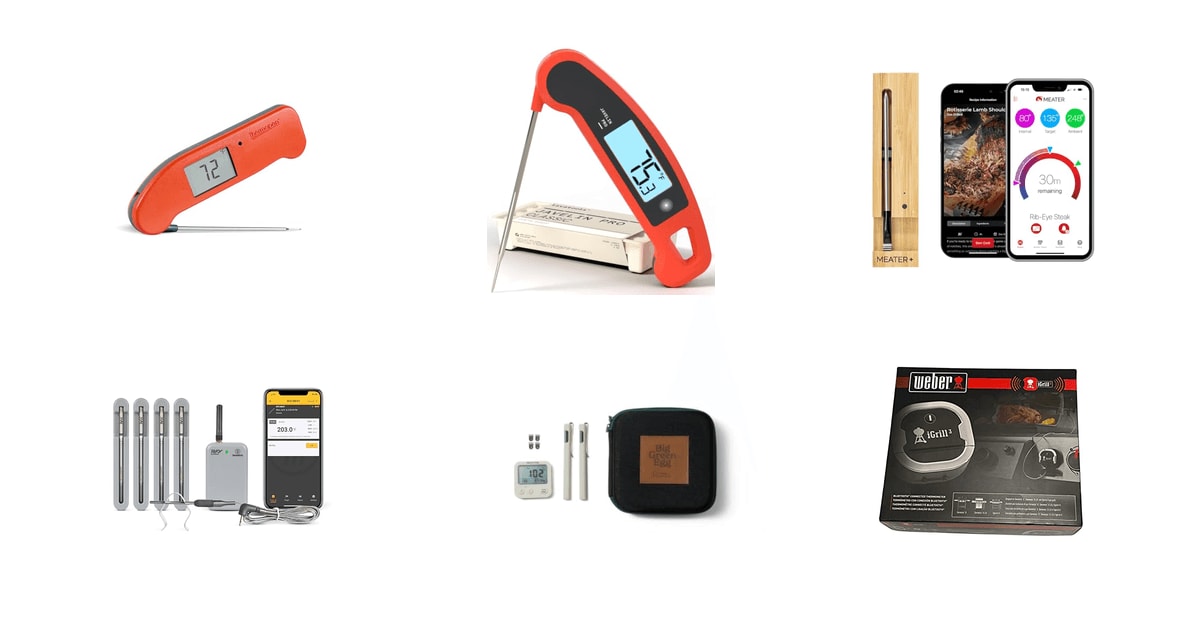
A grill lies to you. The outside of a steak looks done long before the middle gets there, and chicken thighs stay pink near the bone even when they're perfectly safe to eat. Food & Wine editors found that roughly 78% of home grillers overcook chicken when they rely on visual cues and the poke test. A thermometer is the fix, and it's a cheap one. Once you start pulling meat at a number instead of a hunch, everything off your grill gets better.
Here's the catch: no single thermometer does both jobs well. An instant-read is what you want for burgers and steaks, where you're checking a dozen times in five minutes. A leave-in probe is what you want for a nine-hour brisket, where you never open the lid. Manufacturers keep promising one device that handles everything, and the wireless ones in particular oversell their range. Bluetooth numbers on the box assume open air and a clear line of sight, which is not your backyard.
Most people should start with one fast, accurate instant-read and add a leave-in probe later if they get into smoking. We think that the ThermoWorks Thermapen ONE is the best meat thermometer for most people, and that the ThermoWorks RFX 4-Probe Kit is the one to buy if you smoke long cuts and want to walk away from the grill without losing signal.
Everything we recommend

The fastest, most accurate read, if you can pay for it

Signal that actually holds through a smoker and a wall

Nearly the same read, at a fraction of the outlay

No cable near the fire, which sealed cookers demand
At a glance
| Product | Read Time | Connectivity | Price | |
|---|---|---|---|---|
| ThermoWorks Thermapen ONETop pick | 1-Second | — | $125 |
| Lavatools Javelin® PRO Classic Ultra-Fast 2-Second ProfessionalBudget pick | 2-3 Second | — | $43.99 |
| MEATER Plus Smart Meat ThermometerAlso great | — | Bluetooth 165ft | $79.99On sale |
| ThermoWorks RFXUpgrade pick | — | Wi-Fi & Radio Frequency | $399 |
 | Weber iGrill 3 Grill ThermometerAlso consider | — | Bluetooth 4.0+ | $109.99 |
How we picked
Accuracy you can trust. We looked for stated accuracy of ±1°F or better, since that's the practical threshold for food-safe cooking. Serious Eats found cheap models drifting up to ±5°F, so published specs and independent test findings both mattered here.
How fast it reads. For instant-reads, we treated anything over about three seconds as too slow for grilling a crowd. Manufacturer response-time specs lined up well with what owners describe in practice.
Real wireless range. We weighed radio technology over advertised distance, because Bluetooth numbers assume open air. America's Test Kitchen found RF models held connection past 200 feet where Bluetooth models dropped through a single exterior wall.
Probes and pit temp. For smoking, we wanted multiple channels and the ability to read grate temperature alongside the meat. One probe covers a weeknight chicken but not a full smoker.
Durability and support. We favored water resistance ratings, long warranties and NSF certification, and read owner feedback for patterns of failure after months of use rather than first impressions.
Top pick
The fastest, most accurate read, if you can pay for it
ThermoWorks Thermapen ONE
The Thermapen ONE reads a steak in one second with ±0.5°F accuracy, and it ships with a NIST-traceable calibration certificate. It's waterproof, it turns on when you flip the probe out, and the display rotates so you can read it from any angle.
$125fromAmazonSpeed is the whole point of an instant-read, and nothing here is faster. One second, per ThermoWorks' specifications. That sounds like a small thing until you're checking eight burgers with the lid open and flames licking your knuckles. A three-second thermometer turns that into half a minute of standing over the fire. With the Thermapen you poke, read, move on.
The accuracy claim is backed up in a way most brands don't bother with. Each unit gets individually tested and ships with a NIST-traceable certificate rating it to ±0.5°F. That matters most on the cuts where a few degrees separate medium-rare from gray — a thick ribeye, a pork chop, a piece of salmon. Serious Eats found that cheaper thermometers can drift by up to ±5°F, which is the difference between juicy and ruined.
The small design touches add up. The probe flips out and the unit wakes up on its own, so you're not hunting for a power button with greasy hands. The display auto-rotates a full 360 degrees, which means it reads right side up whether you're left-handed, right-handed, or reaching across a hot grate at an awkward angle. The backlight kicks in when it's dark. You'll notice all of this the first time you grill after sunset.
It's built for abuse. The IP67 waterproof rating means you can rinse it under the tap instead of wiping it with a paper towel, and ThermoWorks backs it with a five-year warranty and NSF certification for commercial kitchens. Owners who've burned through a drawer of cheap thermometers tend to describe this as the last one they bought.
Flaws but not dealbreakers
It costs a lot for a device that does one job. If you only grill a few times a summer, the speed advantage over a good budget instant-read is real but probably not worth the gap in price.
It won't help you with a brisket. There's nothing to leave in the meat and no app, so you're opening the lid and walking out to the grill every time you want a number. For long smokes you'll want a probe thermometer alongside it.
The Thermapen ONE comes with a five-year warranty.
Upgrade pick
Signal that actually holds through a smoker and a wall
ThermoWorks RFX
The RFX kit uses sub-1GHz radio between the probes and its gateway instead of Bluetooth, so the connection survives a closed smoker and thick walls. Four probes let you track a brisket, ribs and pit temperature at once, and a 10-minute charge runs over 50 hours.
$399fromAmazonDropped signal is the number one complaint about wireless thermometers, and RFX is built specifically to solve it. Bluetooth struggles with metal and masonry. America's Test Kitchen found that Bluetooth-only models frequently lost connection through a standard exterior wall, while RF-based models held at 200-plus feet. ThermoWorks rates the probe-to-gateway link at up to 1,500 feet line of sight, then hands off to WiFi so you can check your phone from anywhere.
Four probes is the right number for a real cook. You can run one in the brisket, one in the pork butt, one in the ribs and one clipped to the grate for pit temperature. If you smoke, you already know that pit temp is half the battle — a stall isn't scary when you can see that your fire dropped 30 degrees an hour ago.
Each probe carries four sensors and tracks the thermal center of the cut to ±0.9°F. That's the same problem the Combustion probe attacks, and it matters on anything thick. A single sensor tip that lands an inch off center can read the coldest part of a brisket 10°F too high.
Battery anxiety mostly goes away. A 10-minute charge gets you past 50 hours, which covers an overnight brisket with room to spare. That said, owner feedback on battery life is genuinely mixed — some report full charge nine hours into a cook, others say their probes died early.
Flaws but not dealbreakers
The owner feedback here is the most divided of anything we looked at. Plenty of people describe rock-solid connections through a ceramic kamado on a 12-hour cook. Others report probes that disconnect for no clear reason and an app that's the only troubleshooting resource when things go wrong. This is a newer product, and it reads like one.
It's expensive, and the app is a single point of failure. If setup frustrates you, there's no display on the gateway to fall back on. Buy from somewhere with a return window.
Budget pick
Nearly the same read, at a fraction of the outlay
Lavatools Javelin® PRO Classic Ultra-Fast 2-Second Professional
The Javelin PRO Classic reads in two to three seconds and sticks to the side of your grill with a magnet on the back. It's IP65 water resistant, NSF certified, and the battery is rated for 4,000-plus hours, so you're not swapping cells mid-cookout.
$43.99fromAmazonYou give up a second or two versus the Thermapen. That's it, for most of what you cook. Two to three seconds is fast enough for burgers, chicken thighs and pork chops, and the Japanese sensor inside is accurate enough that Good Housekeeping's finding about digital models — averaging ±1.2°F variance against ±5°F for dial thermometers — applies squarely here.
The magnet on the back is the feature you'll actually use every day. It sticks to the side of a gas grill, the hood of a smoker, or the fridge door. A thermometer you can find in two seconds is a thermometer you'll use, and the ones that live in a drawer under the takeout menus mostly don't get used at all.
The display handles the same awkward moments the Thermapen does, for less money. The 2-inch screen auto-rotates 180 degrees and lights up on its own, so gloves, low light and reaching across a hot grate aren't a problem. It wakes on motion and sleeps by itself, and with 4,000-plus hours of rated battery life you can ignore it for years.
IP65 means splash resistance, not submersion. You can rinse the probe and wipe the body without worrying, which is really all a home cook needs. Lavatools also adds NSF certification, which is unusual at this price and a decent proxy for build quality.
Flaws but not dealbreakers
It's not as fast as the Thermapen, and if you cook for crowds you'll feel it. Checking twelve burgers at three seconds each while the lid is open adds up.
The stated ±0.5°F accuracy depends on laboratory calibration, not on every unit shipping pre-certified. In practice most owners find it plenty accurate, but you don't get the individually tested certificate that comes with the ThermoWorks unit.
Also greatOn sale
No cable near the fire, which sealed cookers demand
MEATER Plus Smart Meat Thermometer
The MEATER Plus is a single wireless probe with no cable at all, so you can shut a kamado or pellet grill lid completely. Dual sensors read internal meat temperature and ambient grill temperature at once, and the app walks you through a cook with alerts and finish-time estimates.
$79.99fromAmazonList priceIf your cooker seals shut, this is the probe that fits. Every wired leave-in thermometer routes a cable out past the lid gasket, which is a nuisance on a kamado and a small heat leak on any smoker. MEATER has no cable. You push it into the roast, close the lid all the way, and the probe transmits from inside.
The dual sensors do more than they sound like. One reads the meat up to 212°F, the other reads ambient up to 527°F, so you're watching your pit temperature and your roast on the same screen without a second probe. The app layers on a guided cook system with step-by-step prompts and estimated finish times, which is genuinely useful the first few times you cook a prime rib.
Range is the honest weak spot, and MEATER's fix is partial. The rated 165 feet is line of sight; the charging block doubles as a Bluetooth repeater to stretch coverage through the house. Owners consistently report you have to keep that block reasonably close to the grill or the connection drops. Plan on setting it just inside the door, not on the far side of the kitchen.
Cleanup is easy in a way that matters more than it should. The probe is dishwasher safe, so it goes in the rack with everything else. Compare that to wiping down three feet of braided cable after every cook.
Flaws but not dealbreakers
It's one probe. If you want to watch a brisket and a pork butt at the same time, you're buying a second unit or a different system entirely.
There's no battery level indicator on the probe itself, which is a real annoyance on a long cook — you find out you're low when the app tells you. Owner feedback on connection reliability is the most mixed part of the picture, and the pattern points at range rather than the probe itself.
Who this is for
If you grill and you don't own a thermometer, buy one now. It's the simplest upgrade to your cooking you can make, and it eliminates the guessing that ruins chicken and expensive steaks. The USDA sets 165°F for all poultry, 160°F for ground meats, and 145°F with a three-minute rest for whole cuts of beef, pork, lamb and veal. Those numbers are useless without something accurate to check them with.
This guide covers instant-read thermometers for quick checks and leave-in probes for long cooks. It doesn't cover dial or analog thermometers, which Good Housekeeping found average around ±5°F variance — too loose for anything you care about. If you already own a good instant-read and only cook burgers on weekends, you probably don't need a multi-probe wireless system. If you smoke brisket or run a pellet grill overnight, one instant-read won't be enough.
How we picked
Accuracy: We wanted ±1°F or better on paper, since anything looser stops being useful for doneness and food safety. Speed: For instant-reads, under three seconds — slower than that and you're standing over an open grill too long. Range: We looked at the radio technology rather than the number on the box, because Bluetooth ratings assume open air and your backyard has walls and a metal smoker in it. Probes: Multi-channel systems needed to read grate temperature alongside the meat, since pit control is half of smoking. Durability: Water resistance ratings, warranty length and NSF certification, plus owner feedback about how these hold up months in rather than on day one.
Other meat thermometers for grilling worth considering
If you own a compatible Weber gas grill: The Weber iGrill 3 Grill Thermometer ($109.99) — The iGrill 3 mounts into the side table of a Genesis II, Genesis II LX or Spirit II with an iGrill 3 Ready plate, and that integration is the whole appeal. You get four probe capacity, two color-coded probes in the box, and a claimed 250 hours of battery life, which is more than any other unit here. Owners like the setup and find it accurate, and the ability to watch four steaks separately is a real advantage on a big grill. The trade-offs are Bluetooth range, which drops as you move inside, and an app that takes some figuring out. It also isn't waterproof — Weber says never submerge it. And if you don't have the right Weber, you're improvising a mount.
The competition
This is what our research surfaced, not a complete map of the market. Thermometers turn over quickly, and there are capable units from other brands we didn't have listings for.
Care and cleaning
Wash the probe, not the whole unit, unless the maker says otherwise. The MEATER Plus is dishwasher safe and the Thermapen carries an IP67 rating, so both handle water fine. The Javelin's IP65 rating means splashes and a rinse, not submersion. Weber is explicit that the iGrill 3 should never go in liquid — wipe it with a lint-free cloth and a non-abrasive cleaner. For wired probes, keep the cable away from direct flame and off the hot grate; the cable is the part that fails first on nearly every multi-probe system. Check your thermometer against ice water now and then. It should read 32°F, and if it's off by more than a degree or two, that's worth knowing before you cook a roast for company.
Questions we get
Do I need separate thermometers for grilling steak and smoking brisket?
Mostly, yes. An instant-read like the Thermapen ONE is built for quick spot checks when you're standing at the grill, and it has nothing to leave in the meat. A leave-in probe system like the RFX or MEATER Plus is built to sit in a brisket for nine hours while you're inside. Serious grillers tend to own one of each.
How far can I really get from a Bluetooth thermometer before it drops?
Less far than the box says. Rated ranges assume open air and clear line of sight, so real-world performance through a wall is often 30 to 100 feet. America's Test Kitchen found Bluetooth-only models frequently losing signal through a single residential exterior wall. RF systems like the ThermoWorks RFX hold connection much better at those distances.
Can I use a MEATER probe in a sealed kamado or pellet grill?
That's exactly what it's for. Because there's no cable, you can close the lid completely without routing anything past the gasket. The ambient sensor is rated to 527°F, which covers normal grilling and smoking. Just keep the charging block, which acts as a Bluetooth repeater, reasonably close to the cooker.
What temperature should I pull chicken thighs off the grill?
The USDA sets 165°F as the safe minimum for all poultry, and that's the number to hit. Thighs are forgiving above that because of their fat and connective tissue, so many cooks take them higher for better texture. Breast meat is the opposite — pull it right at 165°F or it dries out fast.
Are cheap thermometers accurate enough?
Digital ones usually are; dial thermometers usually aren't. Good Housekeeping found dial and analog models averaging ±5°F variance compared with ±1.2°F for digital instant-reads under the same conditions. Serious Eats found a similar split by price, with budget models drifting up to ±5°F. A solid mid-priced digital unit like the Javelin PRO Classic gets you most of the way to the expensive stuff.
Are thermometer probes dishwasher safe?
It depends on the model, so check before you load one in. The MEATER Plus is explicitly dishwasher safe. Wired probes generally aren't — water gets into the cable junction and kills them. For those, wipe the stem clean and keep the cable and connector dry.
Why you should trust us
For this guide:
- We compared manufacturer specifications for response time, accuracy, temperature range, water resistance and wireless technology across every model in this guide.
- We read published findings from America's Test Kitchen, Good Housekeeping, Serious Eats and Food & Wine on thermometer accuracy and wireless reliability, plus USDA guidance on safe internal temperatures.
- We read through owner feedback for each product looking for repeated themes — dropped connections, battery life, cable failures — rather than one-off complaints.
- We read owner reviews on every listing, weighted toward the critical ones, because that is where the recurring failures show up.
- We have a systematic way of automatically fetching the latest prices, so the numbers on this page stay current.
- This is a research-focused guide, so the team may not own every product listed — though we often do own the top winners, which gives us extra context for the recommendations.
- We don't accept free products, and the retailer commission never changes which product we recommend.
Sources
The Best Instant-Read Thermometers — Wirecutter, Wirecutter (NYT)
The Best Instant-Read Thermometers, Tested — Serious Eats, Serious Eats
Equipment Review: Best Wireless Grill Thermometers — America's Test Kitchen, America's Test Kitchen
ThermoWorks Thermapen ONE — Official Specifications, ThermoWorks (Manufacturer)
MEATER 2 Plus — Official Product Page and Specifications, MEATER (Manufacturer)
ThermoWorks Smoke X4 — Official Specifications, ThermoWorks (Manufacturer)
Combustion Inc. Predictive Thermometer — Product Overview, Combustion Inc. (Manufacturer)
Best Meat Thermometers, Tested by the GH Institute — Good Housekeeping, Good Housekeeping
USDA Safe Minimum Internal Temperature Chart, USDA Food Safety and Inspection Service
Best Meat Thermometers for Grilling and Smoking — Food & Wine, Food & Wine
ThermoPro TP25 — Official Product Page, ThermoPro (Manufacturer)
FireBoard 2 Drive — Official Specifications, FireBoard (Manufacturer)
Amazon product listings and owner reviews for all 5 products
Manufacturer specification pages for each product
Some passages in this guide may be paraphrased with AI help. Prices are refreshed automatically.
More like this.
Continue exploring home reviews and recommendations.

The Best Wireless Meat Thermometers
Cooking meat by time is guessing. A thick pork shoulder and a thin one look the same from across the yard, and the difference between juicy and dry is…

The Best Wireless Bluetooth Grill Thermometers
A wireless thermometer changes how you cook more than almost any other grill accessory. You stop lifting the lid every ten minutes. You stop cutting into…

The Best Meat Grinders And Sausage Stuffers
Grinding your own meat is one of the few kitchen upgrades where the difference shows up on the first bite. You pick the cut, you pick the fat ratio, and…

The Best Patio Furniture and Grills
A patio only gets used if sitting on it is easy. That means seating you don't have to drag inside before a thunderstorm, cushions that don't go blotchy…

The Best Pellet Grills
A pellet grill runs on compressed hardwood and a small electric brain. An auger feeds pellets into a firepot, a fan pushes the heat around, and a…

The Best Outdoor Grills and BBQ Smokers
Most of the cooking you'll do on a grill isn't brisket. It's burgers on a Tuesday, chicken thighs before the kids melt down, a couple of steaks when…