The Best Wireless Bluetooth Grill Thermometers
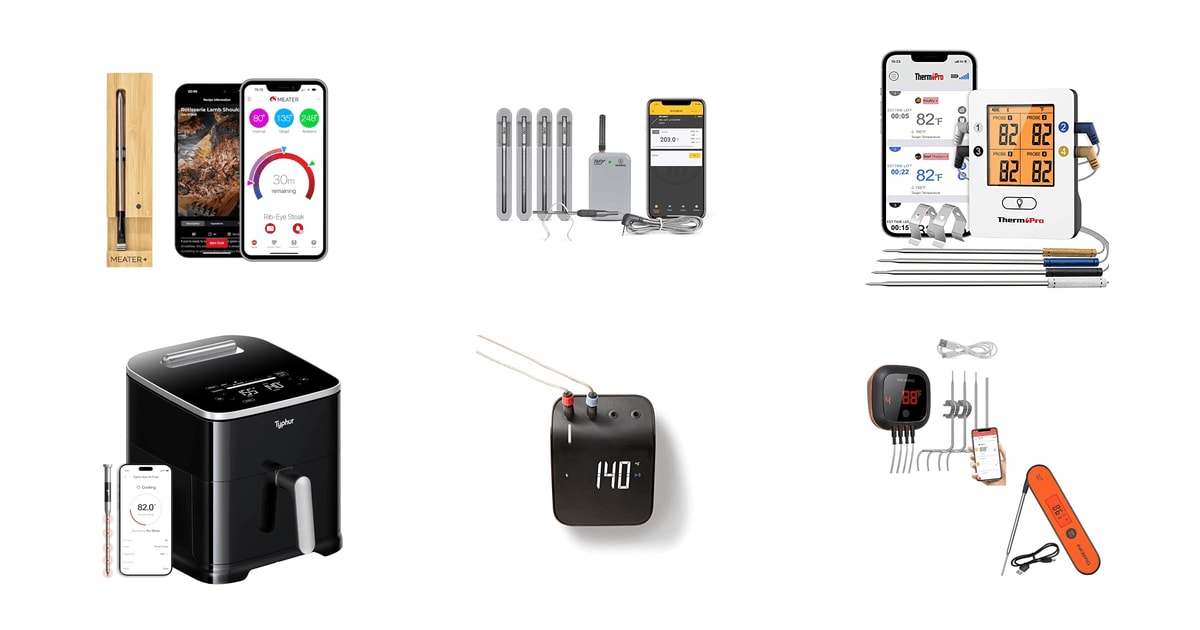
A wireless thermometer changes how you cook more than almost any other grill accessory. You stop lifting the lid every ten minutes. You stop cutting into a chicken thigh to check, then watching the juice run out onto the cutting board. Instead you slide a probe into the thickest part, close the grill, and go back to your guests. Your phone buzzes when the meat hits temperature. For most people that's the whole pitch, and it holds up — the guesswork is what ruins dinner, not the fire.
Here's the honest part: nothing in this category connects as reliably as the box claims. Every one of these products lists a range figure measured in open air with nothing in the way. A metal grill lid, a brick wall and forty feet of house will eat most of it. Owners across brands report the same thing — the connection that worked fine on the patio drops the moment they walk into the kitchen. Battery complaints and finicky pairing show up in the feedback for cheap and expensive units alike.
The other tradeoff is probes versus cords. Fully cordless probes are wonderful for a roast and awkward for an overnight brisket. Wired systems are ugly on the grate and rock-solid for twelve hours. You'll want to pick based on what you actually cook. We think that the MEATER Plus is the best wireless Bluetooth grill thermometer for most people, and that the ThermoPro TP25 is the one to buy if you regularly run several proteins at once.
Everything we recommend

No cords at all, and an app that tells you what to do next
Four probes and a screen that works without your phone

Real accuracy and four probes, minus the polish

Radio, not Bluetooth — for people who've had drops ruin a cook
The one that teaches you to grill, if you're just starting
At a glance
| Product | Probes | Range | Price | |
|---|---|---|---|---|
| MEATER Plus: Smart Bluetooth Wireless Meat ThermometerTop pick | 1 Probe | — | $79.99On sale |
| ThermoWorks RFXUpgrade pick | 4 Probes | 1,500 Ft | $399 |
| ThermoPro TP25 650FT Wireless Meat Thermometer withRunner-up | 4 Probes | 650FT | $49.99On sale |
 | Typhur Sync 8QT AI Smart Air FryerAlso consider | 1 Probe Built-In | — | $159On sale |
| Weber Connect Smart Grilling HubAlso great | — | — | $118.75On sale |
| Inkbird IBT-4XS Bluetooth Thermometer and Rechargeable InstantBudget pick | 4 Probes | — | $54.24On sale |
How we picked
Accuracy on paper. We looked for a published tolerance — ±1–2°F across normal cooking ranges — rather than vague claims about precision. Any model without a stated accuracy figure in its specifications didn't make the shortlist.
Probe count and ambient reading. One probe covers a roast or a steak; four cover a full spread plus a pit reading. We treated the ability to monitor ambient grill temperature as close to essential for anyone cooking on charcoal.
How it connects. We compared Bluetooth, sub-GHz radio and WiFi against what owners report about walls, metal lids and distance. Published range figures are open-air, so we weighted owner feedback about drops more heavily than the number on the box.
Heat rating of the probe. A probe rated below about 482°F continuous isn't safe for a hot charcoal grill or a kamado. We checked each listing's stated ambient limit against the temperatures those cookers actually reach.
App and battery. We read published reviews and owner feedback on app quality across iOS and Android, and on whether a charge survives a long cook. USB-rechargeable beat disposable batteries for anyone grilling regularly.
Top pickOn sale
No cords at all, and an app that tells you what to do next
MEATER Plus: Smart Bluetooth Wireless Meat Thermometer
The MEATER Plus is a single cordless probe that reads the inside of your meat and the air around it at the same time. The app turns those two numbers into flip alerts, a finish estimate and a rest timer, which is what most people actually want.
$79.99fromAmazonList priceThe absence of a cord matters more than it sounds like it should. There's nothing to drape over a hot grate, nothing to pinch in the oven door, nothing to route around a rotisserie. You push the probe into the meat up to the marked line and shut the lid. When you're done, it goes in the dishwasher. That simplicity is why this is the one people keep using instead of leaving it in a drawer.
The probe carries two sensors. One reads internal meat temperature up to 212°F, the other reads ambient heat up to 527°F. Because the app sees both numbers, it can estimate when your roast will finish rather than just telling you where it is now. Owners cooking briskets describe watching the stall play out on the app's graph, which is a genuinely useful thing to see when you're deciding whether to wrap.
Charging is refreshingly undemanding. Five minutes in the wooden charger gets you roughly two hours of monitoring, and the charger itself doubles as a Bluetooth repeater to push the signal further into the house. Owners report getting through long cooks with charge to spare. Leave the charger plugged in somewhere near a window facing the grill and you'll have a better time.
The app is the reason to pay MEATER's premium. Pick your protein and doneness, and it walks you through the cook — flip now, pull now, rest for this long. Weber's app does something similar, but MEATER's runs entirely off the probe with no separate hub to power. If you've never cooked a prime rib before, this is the difference between anxiety and mingling with your guests.
Flaws but not dealbreakers
It's one probe. If you're running a pork shoulder and a rack of ribs and want an ambient reading too, you're buying more probes at full price. That gets expensive fast, and it's the single clearest reason to look at a four-probe system instead.
The range claim doesn't survive real houses. Owners repeatedly note that the charger has to stay reasonably close to the probe or the connection drops, and going through a couple of interior walls is often where it gives up. There's also no battery-level indicator, which owners find genuinely annoying — you can't tell whether you have enough charge for a long cook until it dies.
The internal sensor tops out at 212°F. That's fine for everything you'd probe, but it means the probe isn't the tool for a screaming-hot sear where you want to know what's happening at the surface.
MEATER does not publish a warranty term in this listing.
Runner-upOn sale
Four probes and a screen that works without your phone
ThermoPro TP25 650FT Wireless Meat Thermometer with
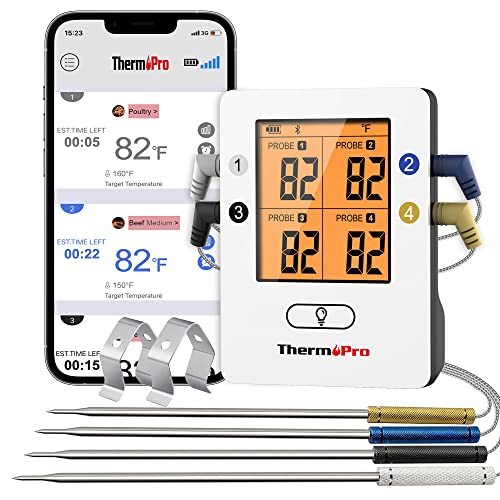
The ThermoPro TP25 gives you four color-coded probes, Bluetooth 5.0 and a small backlit receiver you can stick on the fridge. It's the practical choice when you're cooking for a crowd and don't want your phone to be the only way to see temperatures.
$49.99fromAmazonList priceFour probes solve a problem one probe can't. A holiday cook usually means a turkey, a ham, a side in the oven and an ambient reading from the smoker. With color-coded probes you know at a glance which cable belongs to which piece of meat. Owners who grill on charcoal single out the ambient reading as the reason they chose a wired system in the first place — pit temperature is what you actually manage on a kettle or a kamado.
The standalone receiver is the underrated feature here. It has a magnetic back and a backlit display, so you can park it on the counter and read temperatures without unlocking anything. If your phone dies mid-cook, or you'd rather not carry it around a wet backyard, the cook keeps going. MEATER and Weber Connect both need a paired phone nearby.
The app covers nine USDA meat types with editable presets and doneness levels, plus high/low ambient alarms for a smoker and up to four timers for side dishes. There's a cook-time estimator and a temperature graph you can look back at afterward. It's not coaching you the way MEATER does, but everything you'd want to set is there.
Owners describe it as the one that finally stuck after returning several others, and accuracy comes up consistently in their feedback. The battery is USB-rechargeable, so you're not hunting for AAs at hour seven of a brisket. For a lot of people this is simply the sensible amount of thermometer.
Flaws but not dealbreakers
The probes are wired to a transmitter, and cords on a grill are a nuisance. You have to route them so they don't sit across a hot edge, and the wire insulation is the part that eventually fails on any system like this.
The 650-foot range figure is open-air and line-of-sight. Through a normal exterior wall, expect a fraction of that — enough to reach the kitchen from the patio, usually not enough to reach the far end of a big house.
Owners note the app and the connection can be fussy, and the alarm is loud enough to startle you the first time. The app is functional rather than polished; there's no step-by-step coaching if that's what you're after.
Budget pickOn sale
Real accuracy and four probes, minus the polish
Inkbird IBT-4XS Bluetooth Thermometer and Rechargeable Instant
The Inkbird IBT-4XS covers four probes with a tight ±1°C accuracy spec and a fast three-to-five-second response. The app is plain and the probes need a firm push to seat properly, but the underlying measurement is honest.
$54.24fromAmazonList priceThe spec sheet is the reason to consider this one. Accuracy is stated at ±1°C/±2°F with user calibration from -5°F to +5°F, and the range runs from -58°F to 572°F. Response time is three to five seconds. Those are numbers you'd expect from a more expensive unit, and there's no vague hand-waving about "high precision" in place of an actual tolerance.
There's one setup detail you have to get right, and Inkbird says so on the box. Each probe must be pushed into its port until you hear a click. A loose probe doesn't fail quietly — it throws wildly wrong readings, and the documentation cites values as high as 572°F as an example. It's a thirty-second habit once you know about it, but it catches people out.
The transmitter also works as an instant-read thermometer when you pull a probe out of the port, with a reading lock so the number holds while you move. That's a small thing that saves you owning a second tool for checking burgers. The battery is USB-rechargeable, which matters more than it sounds like on a long cook.
Flaws but not dealbreakers
The app is basic. You get temperatures, alarms and not much else — no guided cooking, no coaching, none of the interface polish that MEATER and Weber put real work into.
The charging port isn't waterproof, and the rubber cover has to be fully seated before you wipe the unit down. Ignore that and you'll corrode the port.
This listing has almost no owner feedback behind it, which is why it isn't ranked higher. The specs are strong and the brand has a long track record in this category, but we'd rather be upfront that there's less real-world evidence here than for the ThermoPro or MEATER.
Upgrade pick
Radio, not Bluetooth — for people who've had drops ruin a cook
ThermoWorks RFX
The ThermoWorks RFX uses sub-1GHz radio between the probes and a gateway, then WiFi for remote access. It's built for overnight smoking, where a Bluetooth drop at 3 a.m. means waking up to a ruined brisket.
$399fromAmazonBluetooth is the weak link in this whole category, and the RFX routes around it. Sub-1GHz radio penetrates smoker walls, oven doors and residential construction far better than 2.4GHz Bluetooth, and ThermoWorks rates the probe-to-gateway link at up to 1,500 feet line-of-sight. Pair the gateway to WiFi and the range from your phone stops mattering — you can check a brisket from the grocery store.
The accuracy claim is the tightest here. Four sensors inside each probe identify the thermal center of the cut within ±0.9°F, which is the sort of specification ThermoWorks has built its reputation on. Wired named it the best overall wireless meat thermometer. Owners who cook fish and thin cuts, where a few degrees is the difference between good and chalky, tend to be the most enthusiastic.
It's a four-probe kit, so you can run three proteins and an ambient zone at once. Charging is fast — ThermoWorks rates ten minutes for over fifty hours — and several owners specifically report the charge outlasting twelve-hour smokes on a ceramic grill. That combination of range, battery and probe count is what nobody else here offers.
It also works through foil. One owner switching from another wireless system pointed out that wrapping food had killed their old setup, and the RFX doesn't care. If you wrap a brisket partway through a cook, that's not a small detail.
Flaws but not dealbreakers
It's the most expensive thing here by a wide margin, and replacement probes add ongoing cost. That alone rules it out for most backyard grillers.
Owner feedback is genuinely split, and it's the main reason this isn't our top pick. A meaningful share of buyers report probes disconnecting for no clear reason, battery life falling short of the claim, and troubleshooting that lives entirely inside an app with no other documentation to fall back on. Others report flawless twelve-hour cooks. That variance is hard to ignore at this price.
The gateway needs power and network setup, so it's not the plug-and-pair experience of a MEATER probe. If you're new to this, the feature depth is more than you need.
Also greatOn sale
The one that teaches you to grill, if you're just starting
Weber Connect Smart Grilling Hub
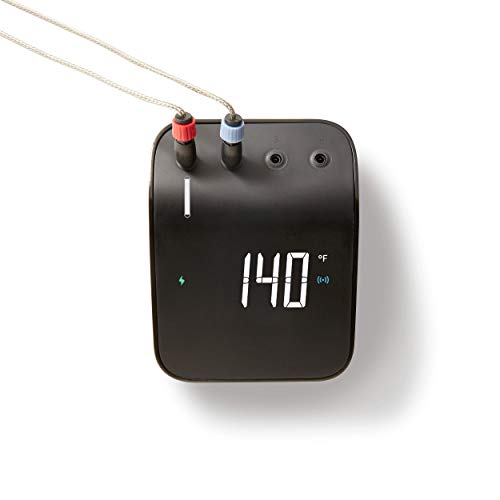
The Weber Connect Smart Grilling Hub supports four probes and pairs them with an app that tells you when to flip, when it's done and how long to rest. It works with any grill, not just Weber's.
$118.75fromAmazonList priceIf you've overcooked more steaks than you'd like to admit, this is the fix. You choose medium-rare in the app, insert the probe and let the hub run the cook. It tells you when to flip, counts down to readiness and starts a rest timer. Owners consistently describe it as the thing that made grilling stop feeling like a gamble, and several say the app is the specific reason they picked it over cheaper hubs.
It isn't locked to Weber grills. The hub clips onto any grill, kettle or smoker and supports up to four probes, so you can run a couple of proteins plus an ambient reading on someone else's kamado. That flexibility surprises people who assume it's an accessory for Weber's own line.
The hardware is straightforward — plug it in and it wakes up, with no power button to hunt for. Setup takes a few minutes and pairing is generally painless. For anyone who wants software doing the thinking, this is the least intimidating way in.
Flaws but not dealbreakers
Bluetooth-only means the range limits are real. You'll be fine on the patio and in the nearest room; you won't be checking a smoker from the far side of a two-story house. And every guided feature needs your phone in range, since there's no standalone display.
The app draws mixed reactions. Some owners find it excellent, others describe the iPhone version as more cookbook than control panel, and there's a scattering of reports of units going dark after a couple of years of light use.
The hub needs USB power, which means one more cable in an outdoor setup that probably already has enough of them.
Who this is for
This guide is for people who cook meat on a grill, a smoker or in the oven and want to stop guessing. If you cook a couple of steaks a week, a single cordless probe is plenty and you'll use it more often than a four-probe kit. If you smoke, host, or manage several things at once, probe count and ambient monitoring matter more than cord-free convenience. And if you've already got a thermometer you trust, none of these is a big enough leap to justify replacing it.
We cover wireless probe thermometers you can use with any grill or oven, plus one countertop appliance with a probe built in. We're not covering instant-read pen thermometers, permanently installed grill controllers, or the multi-probe WiFi systems built into specific pellet grills — those are a different purchase decision. Serious competition cooks will want more probes than any of these kits include.
How we picked
Accuracy: we required a published tolerance in the ±1–2°F range rather than a marketing adjective. Probes: one is enough for a roast, four is the practical standard for a spread, and an ambient channel matters most on charcoal. Connection: we weighed Bluetooth against sub-GHz radio and WiFi using owner reports about walls and metal lids, since every published range figure is open-air. Heat rating: probes need at least 482°F continuous to be safe in a hot kettle or kamado. App and power: we looked at guided-cooking depth, iOS and Android parity, and whether a charge lasts a long cook, favoring USB-rechargeable designs.
Other wireless bluetooth grill thermometers worth considering
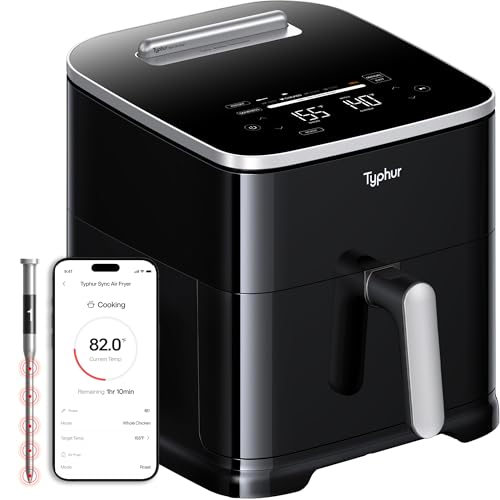
If you want the thermometer built into an air fryer: The Typhur Sync 8QT AI Smart Air Fryer ($159) — The Typhur Sync is an 8-quart air fryer with a wireless probe integrated into the machine, and it's the only thing here that isn't a standalone thermometer. The probe charges magnetically in the base, and both the front panel and the app show internal temperature as a chicken breast or a pork chop comes up to doneness. The ceramic basket is free of PFAS and PFOA, the fan is genuinely quiet, and owners repeatedly describe it as the best air fryer they've owned. What you give up is flexibility — the probe only works inside the fryer, so it's no help at the grill. Some owners also report the probe nagging about cleaning or charging. Buy it if you want both appliances in one; skip it if you already have an air fryer.
The competition
This is what our research surfaced in this category, not a survey of everything on the market. Wireless thermometers turn over quickly and plenty of capable units — including several from these same brands — aren't represented here. Every product in this guide earned a place in the picks or the also-consider section, so there's nothing left over that we'd steer you away from outright.
Care and probe longevity
Probes are the part that dies, and how you treat them decides when. Hand-wash them and dry them fully rather than running them through a dishwasher, unless the manufacturer specifically says it's fine — MEATER does. Keep the cable of a wired probe away from the hot edge of a grate or a lid seal, because melted insulation is the most common failure by far. Store probes straight and dry; bent tips from a drop and corroded connector pins from trapped moisture account for most of the rest. Treated well, a good stainless probe should give you several years of regular use. When one starts reading oddly, check the connector seating before assuming the probe is dead — on multi-probe units a loose port explains most wild readings.
Questions we get
What's the difference between a WiFi and a Bluetooth grill thermometer?
A Bluetooth model talks directly from the transmitter to your phone, so your phone has to stay within range. A WiFi model connects through your home router, which means you can check the cook from any room, another floor, or off the property on cellular. The ThermoWorks RFX takes it a step further by using radio between the probes and its gateway, then WiFi from there. WiFi costs more but removes the range problem entirely.
Do Bluetooth thermometers actually work from inside the house?
Usually, but not as far as the box claims. Every stated range is measured in open air with nothing in the way, and a metal grill body plus an exterior wall typically cuts that to a fraction. In practice you can expect to reach the nearest room or two, not the far corner of a large house. Brick, concrete and a closed smoker all make it worse.
How many probes do I actually need?
One probe is enough for a steak, a chicken or an oven roast, which covers most weeknight cooking. Two lets you watch one piece of meat and your pit temperature at the same time, and that's the setup most charcoal cooks want. Four earns its keep if you regularly run a full spread with different target temperatures. Beyond that you're into competition territory.
Is a MEATER worth the premium over a cheap four-probe kit?
It depends on what annoys you more: cords or buying extra probes. The MEATER Plus gives you a cordless probe, dual sensors and much better guided cooking, but it's one probe. A wired kit like the ThermoPro TP25 gives you four channels and a standalone display for less. If you mostly cook one thing at a time and want the app to walk you through it, MEATER earns the money.
Can I use one of these inside my oven?
Yes, as long as the probe's ambient rating is above your oven's temperature, which it will be for anything here. The MEATER Plus is explicitly sold for oven use and handles ambient heat up to 527°F. With a wired unit you route the thin cable out through the door gasket — it works, though it's less tidy. Note that some owners report cordless probes struggling to hold a signal through an oven door.
What's the best option for smoking a brisket overnight?
For pure reliability, the ThermoWorks RFX — radio and WiFi mean you're not depending on Bluetooth holding through a smoker wall at 3 a.m. If that's more than you want to spend, the ThermoPro TP25 is the sensible alternative, because its standalone receiver lets you monitor without keeping your phone within Bluetooth range all night. Either way, check your charge before you go to bed.
Why you should trust us
For this guide:
- We read the manufacturer specifications for every model here, comparing stated accuracy tolerances, probe counts, ambient temperature ratings and charging claims side by side.
- We reviewed published coverage of this category alongside owner feedback themes, paying particular attention to repeated reports of connection drops, battery shortfalls and probe failures.
- We weighted consistent patterns in owner feedback over individual complaints, and we note where a product's real-world record is thinner than its specification sheet suggests.
- We read owner reviews on every listing, weighted toward the critical ones, because that is where the recurring failures show up.
- We have a systematic way of automatically fetching the latest prices, so the numbers on this page stay current.
- This is a research-focused guide, so the team may not own every product listed — though we often do own the top winners, which gives us extra context for the recommendations.
- We don't accept free products, and the retailer commission never changes which product we recommend.
Sources
The Best Meat Thermometers — Wirecutter (NYT), Wirecutter
Best Wireless Meat Thermometers — Serious Eats, Serious Eats
Best Wireless Meat Thermometers, Tested by Food Network Kitchen, Food Network
MEATER 2 Plus Equipment Review — America's Test Kitchen, America's Test Kitchen
Best Wireless Meat Thermometers — Good Housekeeping Institute, Good Housekeeping
Amazon product listings and owner reviews for all 6 products
Manufacturer specification pages for each product
Some passages in this guide may be paraphrased with AI help. Prices are refreshed automatically.
More like this.
Continue exploring lifestyle reviews and recommendations.

The Best Wireless Meat Thermometers
Cooking meat by time is guessing. A thick pork shoulder and a thin one look the same from across the yard, and the difference between juicy and dry is…

The Best Meat Thermometers for Grilling
A grill lies to you. The outside of a steak looks done long before the middle gets there, and chicken thighs stay pink near the bone even when they're…

The Best Waterproof Outdoor Bluetooth Speakers
A speaker that lives outdoors leads a rough life. It gets set down in wet sand, splashed by a cannonball, knocked off a picnic table, and left in a hot…

The Best Car Bluetooth and Aux Adapters
Most cars on the road still have a stereo that can't talk to your phone. If yours has an aux jack, a small receiver bridges that gap without touching your…

The Best Bluetooth Label Makers
Most of us buy a label maker for one project - the pantry, the craft bin, the cable spaghetti behind the TV - and then keep using it for years. That's why…

The Best Bluetooth Trackers for Luggage and Keys
A Bluetooth tracker earns its keep in about four seconds - the moment you tap your phone, hear a chirp from under the couch cushion, and stop tearing the…