The Best Pellet Grills and Smokers
A pellet grill is a wood-fired oven that happens to live on your patio. You dump hardwood pellets in the hopper, set a number on a dial, and an auger feeds the fire to hold that number for hours. That's the whole appeal. You can put a pork shoulder on at ten at night and go to bed instead of babysitting a charcoal fire. The same machine will roast a chicken on a Tuesday, or bake a pizza if you're feeling ambitious.
Here's what no pellet grill does well. Pellets burn clean, so the smoke flavor comes out politer than what a stick burner or a charcoal kettle gives you, and people stepping over from an offset often miss the bark. Most of these grills top out somewhere around 450°F to 500°F, so a hard sear takes a workaround. They need an outlet. And they all need regular ash and grease cleanout, or the fire pot chokes and your temperature starts wandering.
We looked at what's actually available here, and it's a short list: three real grills, plus a pile of covers, shelves and replacement parts that turn up in the same searches. The three that qualify are genuinely different animals — a smoke-forward mid-size unit, a value workhorse, and a tabletop model you can throw in a truck. We think that the Camp Chef Woodwind Pro WiFi 24 is the best pellet grill for most people, and that the Z Grills 700D6 is the one to buy if you want the same set-and-forget cooking for a lot less money.
Everything we recommend

More real smoke flavor than pellets usually give you

Nearly the same set-and-forget cooking for much less

Real pellet smoke on a tabletop you can actually carry
At a glance
| Product | Cooking Space | Weight | Price | |
|---|---|---|---|---|
| Camp Chef Woodwind Pro WiFi 24 PelletTop pick | — | 152 lbs | $1,399.99 |
| Z GRILLS 2026 Electric Pellet Smoker &Budget pick | 700 sq in | 120 lbs | $539On sale |
| Traeger Ranger Portable Wood Pellet Grill &Also great | — | 54 lbs | $479.98 |
How we picked
Temperature control. We treated a PID controller as close to a requirement, since spec sheets and published reviews put PID accuracy at roughly ±5°F against ±25°F for basic digital controllers. On a long cook, that's the whole ballgame.
Hopper and run time. We compared rated hopper run times against the one-to-three pounds of pellets an hour these grills typically burn. A grill that can't clear an overnight cook without a refill loses much of the point.
Smoke flavor control. We looked for any mechanism that raises smoke output independently of temperature, whether that's a wood chunk box or a smoke intensity dial, since owner feedback across the category keeps returning to thin pellet smoke.
Build and heat retention. We read spec sheets for steel gauge, insulation and ventilation design, because heavier bodies and insulated bases hold temperature better in wind and cold. Owner reports of rust and warping counted against a grill.
App and monitoring. We favored grills with working Wi-Fi or Bluetooth monitoring and built-in meat probes, and we weighted owner feedback about app reliability at least as heavily as the feature list itself.
Top pick
More real smoke flavor than pellets usually give you
Camp Chef Woodwind Pro WiFi 24 Pellet
This one solves the biggest complaint about pellet grills: the smoke is too polite. A separate box burns wood chunks alongside the pellets, and the app lets you set a temperature from the couch and leave it alone for the next twelve hours.
$1,399.99fromAmazonThe smoke box is the reason to buy this grill. Pellets burn efficiently and cleanly, which is exactly why pellet smoke tastes thinner than charcoal or a stick fire. The Woodwind Pro adds a separate chamber for hardwood chunks or chips, so you get real wood smoke layered on top of the pellet fire. Owners coming from propane smokers or older pellet units point at that box as the difference.
Camp Chef's Smoke Control dial also lets you turn smoke intensity up or down separately from temperature, which most pellet grills simply can't do. Published reviews rate it the most effective independent smoke adjustment on a production pellet grill. That means you can run it low for a chicken and crank it for ribs without touching your cook temp. It's a real lever, not a marketing setting.
The Wi-Fi and Bluetooth connection matters more than it sounds like it should. On a twelve-hour brisket you'll want to check the grate temp from bed, or nudge it up fifteen degrees without putting shoes on. The app handles timers and alerts too. Owner feedback keeps circling the same point: people cook on it more often once they stop feeling chained to the patio.
Build quality sits a clear step above the budget tier. There's stainless where it counts, and the down-and-out ventilation moves heat and smoke across the whole chamber instead of pooling it over the fire pot. If you later want a griddle or a side burner, the Sidekick attachment bolts on. At 152 pounds it's substantial without being a two-person move across the yard.
Flaws but not dealbreakers
Owner feedback isn't spotless. Several buyers report a dead meat probe out of the box, and at least one describes the grill struggling to hold temperature after a few months of use. Camp Chef's support comes up as quick to send replacements, which helps. But a warranty claim on a 152-pound grill is still a weekend you didn't plan on.
Pushing the smoke setting near the top of its range appears to widen the temperature swing by roughly fifteen degrees, based on owner reports. That's a non-issue for pork butt and it matters if you're chasing a precise number. The smoke box is also one more thing to load, tend and empty, so this isn't set-and-forget the way a plain pellet grill is.
Budget pickOn sale
Nearly the same set-and-forget cooking for much less
Z GRILLS 2026 Electric Pellet Smoker &
This is the grill to buy if you want to find out whether you actually like smoking meat. The PID controller holds a steady temperature, a full hopper runs long enough for an overnight brisket, and a cover comes in the box instead of on the upsell list.
$539fromAmazonList priceA PID controller is the one spec that matters most in this category, and this grill has a good one. PID systems hold within about five degrees of your set point, while older-style digital controllers drift by twenty-five or more. Across a fourteen-hour cook, that gap is the difference between a smooth ride and a stall you can't explain. Owners of the previous Z Grills controller describe wide swings and say this one fixed them.
The hopper is the other quiet advantage. Z Grills rates a full load at up to 28 hours of cooking, and pellet grills burn roughly one to three pounds an hour depending on your temperature and the weather outside. Run the math on a 225°F overnight brisket and you won't be shuffling out at 3 a.m. with a flashlight and a bag of pellets.
You get 697 square inches, two meat probes, a dual-wall insulated base, and a twist-out hopper cleanout for swapping pellet flavors between cooks. That insulation earns its keep in cold weather, when thin-walled grills bleed heat and chew through pellets trying to keep up. The top end is 450°F, which is plenty for wings and burgers, if not for a steakhouse crust.
Owners describe ribs, pizza, sourdough and spatchcock chicken all coming off it without drama, and assembly comes up as straightforward. Nobody's calling this a competition rig. It's an ordinary, well-sorted grill that does the main job — hold a number for a long time — and skips the parts you'd otherwise pay extra for.
Flaws but not dealbreakers
The 450°F ceiling means searing is a stretch. Plan on finishing steaks in a cast iron pan indoors, or accepting grill marks that are more suggestion than sear. Smoke flavor lands on the mild side too, which tracks with how cleanly pellets burn when there's no dedicated smoke system helping them along.
It ships in two boxes and often shows up under a single tracking number, which owners find alarming until the second box lands. The steel is lighter than what the heavy-gauge competition tier uses, so keep it covered and off wet ground if you want it to last. The included cover makes that easy, at least.
Also great
Real pellet smoke on a tabletop you can actually carry
Traeger Ranger Portable Wood Pellet Grill &
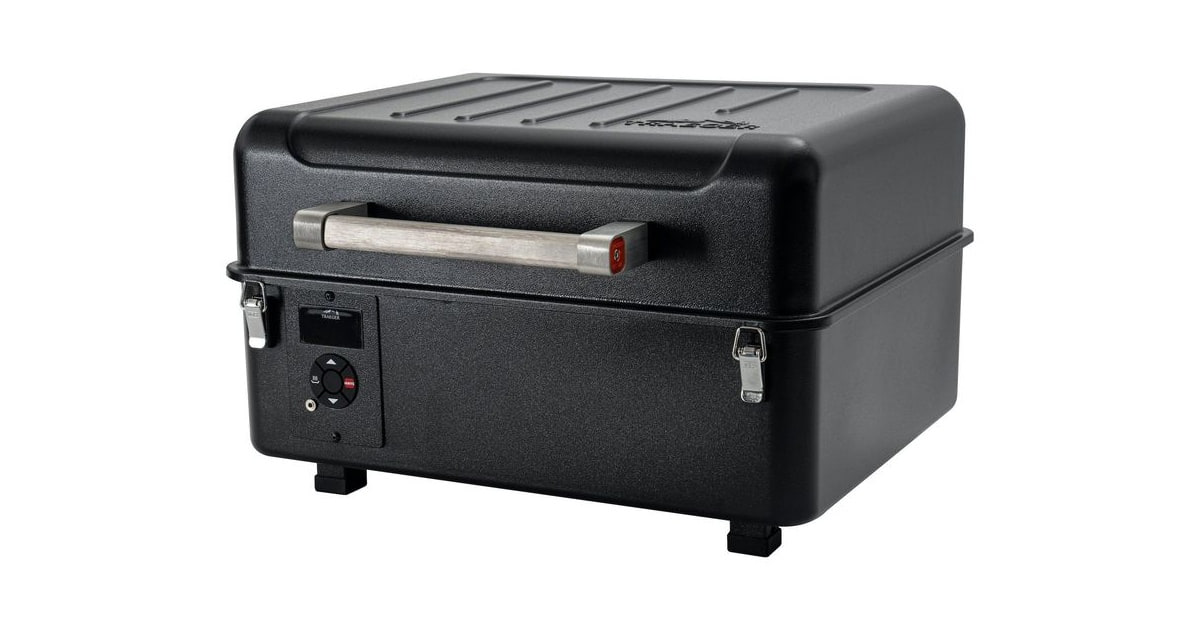
The Ranger gives up almost everything except the part that matters. It's a real pellet grill with a real auger and controller, shrunk down to 184 square inches and 54 pounds, which makes it the one to get for a balcony, a campsite or the bed of a truck.
$479.98fromAmazonPicture a tailgate, an RV pad, or an apartment balcony where a full-size grill is simply not happening. The Ranger works on the same principle as its big siblings: hardwood pellets, an auger, a controller holding your set temperature. Owners who downsized from full-size Traegers say the food tastes the same. It just comes out in much smaller batches.
It gets up to temperature faster than any other portable pellet grill in the category. Published testing put it at cooking temperature in about twelve minutes, which changes the math on a weeknight. A cast iron griddle and porcelain-coated grates come in the box, so breakfast at a campsite is eggs and smash burgers on the same machine, not a separate pan and a separate burner.
The Digital Arc controller, a built-in meat probe and a keep-warm mode cover the basics without fuss. There's no Wi-Fi, but that's a smaller loss when the grill is sitting on the table next to you. Owners running it off solar generators and truck inverters report no trouble, and plenty of them describe hauling it hundreds of miles without anything shaking loose.
Flaws but not dealbreakers
184 square inches is genuinely small. Two racks of ribs won't fit and a packer brisket is out of the question, so think a pork tenderloin, a few chicken breasts, or dinner for two. The tabletop hopper doesn't hold much either, which means long cooks need refills and a bit of attention every few hours.
The rubber feet are the one part owners complain about again and again — they loosen and fall off. It's a small annoyance on an otherwise sturdy grill, but it's the kind of thing you notice on a machine that gets moved constantly.
Who this is for
Buy a pellet grill if you want smoked food on a normal schedule. If you've been running a charcoal kettle or a propane smoker and you're tired of tending vents, this is the upgrade that gets you back into your own weekend. It also suits families who want one machine for ribs, roast chicken, burgers and the occasional pizza, and it suits anyone whose cooking window is a workday rather than a free Saturday.
Skip it if you're chasing the deepest possible smoke ring and you enjoy the fire management — a stick burner or a good offset will beat these on flavor, and you already know that. Skip it too if you want a hard steakhouse sear as your main event, since most pellet grills stop short of the heat you'd need. This guide covers full-size and portable pellet grills only. Covers, shelves, burn pots, diffuser plates and replacement control boards are accessories and parts, so they're listed separately below rather than compared against actual grills.
How we picked
Temperature control: we treated a PID controller as near-mandatory, since it holds within about five degrees of your set point where older digital controllers drift by twenty-five. Hopper and run time: we checked rated run times against the one to three pounds of pellets these grills burn per hour, because a grill that can't clear an overnight cook makes you set an alarm. Smoke flavor control: we looked for a wood chunk box or a smoke dial that works independently of temperature, since thin pellet smoke is the category's standing complaint. Build and heat retention: we read spec sheets for steel, insulation and airflow design, and counted owner reports of rust or warping against a grill. App and monitoring: Wi-Fi and built-in probes had to actually work, judged by owner feedback rather than the box copy.
The competition
This is what our research surfaced in this category, not a survey of every pellet grill sold. Several well-regarded machines from Traeger, Weber, Pit Boss, Yoder and Green Mountain Grills didn't turn up as buyable listings here, so we can't fairly compare them alongside the three grills above. Everything else the search returned was an accessory or a replacement part rather than a grill, and those are listed below with a note on what they actually are.
Care and maintenance
Two chores keep a pellet grill honest. Vacuum the ash out of the fire pot and barrel every few cooks — a choked pot is the most common cause of a grill that won't hold temperature or won't light at all. Then keep the grease path clear, foiling the drip tray and emptying the bucket before it overflows onto the cabinet. Store your pellets somewhere dry and sealed, because damp pellets swell, jam the auger and smoke badly. Empty the hopper if the grill is going to sit for weeks. And use 100% hardwood pellets rather than blends with flavor additives; comparative testing found solid hardwood produced a smoke ring about 35% deeper. Keep it covered between cooks and it'll last years longer.
Questions we get
Are pellet grills worth it compared to charcoal smokers?
It depends on what you're optimizing for. A charcoal smoker or an offset gives you deeper smoke flavor and a better bark, but it wants attention every 30 to 45 minutes for the length of the cook. A pellet grill trades some of that flavor for the ability to set a temperature and walk away. Most people who switch cook more often, which is its own kind of win.
What's the difference between a PID controller and a basic digital controller?
A PID controller constantly adjusts pellet feed and fan speed to hold your set point, staying within roughly five degrees. A basic digital controller cycles more crudely and can swing about twenty-five degrees either way. For burgers you'd never notice. For a long brisket cook where you're managing a stall, PID is the difference between a predictable finish and guesswork.
Can a pellet grill get hot enough to sear a steak?
Usually not on its own. Most pellet grills top out around 450°F to 500°F, and a proper crust wants considerably more direct heat than that. Some models add a flame-broiler slider or a sear zone to work around it. If searing matters to you, plan on finishing in a cast iron pan or on a side burner.
How long does a 20-pound bag of pellets last?
Figure one to three pounds an hour, depending on your set temperature and how cold it is outside. At 225°F in mild weather you're at the low end, so a 20-pound bag can carry you through a long overnight cook. Crank it to 400°F on a windy day in January and you'll burn through it in well under ten hours.
Do I need Wi-Fi on a pellet grill, or is it a gimmick?
It's genuinely useful on long cooks and mostly pointless on short ones. Being able to check grate temperature and internal meat temperature from your phone, and nudge the set point without going outside, changes how a twelve-hour cook feels. If you're mainly grilling burgers on weeknights, skip it and save the money.
What wood pellets give the best flavor for ribs?
Fruit woods like apple and cherry are the safe pick for pork, and hickory adds more punch if you want it. What matters more than the species is buying 100% hardwood pellets rather than blends with flavor additives — comparative testing found solid hardwood produced a smoke ring roughly 35% deeper. Keep them dry, or the auger will jam.
Why you should trust us
For this guide:
- We read the manufacturer specifications for every grill here, focusing on controller type, hopper run time, temperature range and cooking area.
- We compared published reviews and lab findings on PID accuracy, preheat times and pellet consumption across the category.
- We read through owner feedback for each listing and looked for repeated themes — probe failures, temperature swings, assembly hassles — rather than one-off complaints.
- We read owner reviews on every listing, weighted toward the critical ones, because that is where the recurring failures show up.
- We have a systematic way of automatically fetching the latest prices, so the numbers on this page stay current.
- This is a research-focused guide, so the team may not own every product listed — though we often do own the top winners, which gives us extra context for the recommendations.
- We don't accept free products, and the retailer commission never changes which product we recommend.
Sources
Best Pellet Grills of 2026 — Wirecutter / NYT Cooking, Wirecutter
Pellet Grill Reviews & Ratings — Consumer Reports, Consumer Reports
Best Pellet Grills 2026 — CNET, CNET
Pellet Grill Comparisons & Lab Tests — Serious Eats, Serious Eats
Best Pellet Grills for 2026 — Popular Mechanics, Popular Mechanics
Pellet Grill Reviews 2026 — Food & Wine, Food & Wine
Best Pellet Smokers — BBQ Guys, BBQ Guys
Pellet Grill Buying Guide — The Spruce Eats, The Spruce Eats
Best Pellet Grills 2026 — Good Housekeeping, Good Housekeeping
Traeger Ironwood XL Full Specifications — Traeger, Traeger (Manufacturer)
Yoder YS640s Specifications — Yoder Smokers, Yoder Smokers (Manufacturer)
How Pellet Grills Work — AmazingRibs.com, AmazingRibs.com
Amazon product listings and owner reviews for all 3 products
Manufacturer specification pages for each product
Some passages in this guide may be paraphrased with AI help. Prices are refreshed automatically.
More like this.
Continue exploring lifestyle reviews and recommendations.

The Best Pellet Grills
A pellet grill runs on compressed hardwood and a small electric brain. An auger feeds pellets into a firepot, a fan pushes the heat around, and a…

The Best Outdoor Grills and BBQ Smokers
Most of the cooking you'll do on a grill isn't brisket. It's burgers on a Tuesday, chicken thighs before the kids melt down, a couple of steaks when…

The Best Electric Smokers for Backyard BBQ
Smoking meat used to mean babysitting a fire for twelve hours. An electric smoker takes that job away. You set a temperature, load some wood chips, and…

The Best Pellet Stoves
Heating with pellets is a daily habit, not a set-and-forget system. You fill a hopper with bagged wood pellets, set a burn level or a temperature, and the…

The Best Cocktail Smoker Kits
Smoked cocktails used to be a bar-only trick. Now they're a countertop one. The idea is simple: you burn a pinch of wood chips, trap the smoke over a…

The Best Wireless Bluetooth Grill Thermometers
A wireless thermometer changes how you cook more than almost any other grill accessory. You stop lifting the lid every ten minutes. You stop cutting into…