The Best Nail Drill Kits
A nail drill isn't really about drilling. Most of what you'll do with one is gentle: knocking the shine off a gel top coat, smoothing a cuticle line, filing down a stubborn edge that a hand file won't touch. The work happens in the low and middle part of the speed range, with a light hand and a bit that's barely making contact. That's why the machine's steadiness matters more than its headline number. You want it to hold speed when you press, stay cool against your fingertip, and not wander when you're working near skin.
Here's the honest part. No nail drill protects you from your own technique. Every one of these can thin a nail plate if you hold a coarse bit in one spot, and every one of them gets warm on the finger if you linger. The quiet ones are quieter, not silent. The cordless ones lose a little grunt as the battery drains. And bits wear out faster than anyone expects, so the kit you buy today is going to need consumables in a few months no matter which brand is on the box.
We read the spec sheets, compared what the manufacturers claim against what published reviews and owner feedback describe, and sorted the lineup by who each machine actually suits. We think that the Medicool Pro Power 35K is the best nail drill kit for most people, and that the COSLUS C40 is the one to buy if you're new to e-filing and want a full starter kit without committing much money.
Everything we recommend

Salon-grade torque in a cordless body you can carry
The handpiece pros reach for, with the warranty to match

A complete beginner kit that stays quiet and cool
The quietest of the bunch, if noise is what bothers you
Prices as of Oct 25, 6:48 AM PT · Details
At a glance
| Product | Max speed | Motor type | Price | |
|---|---|---|---|---|
 | MelodySusie Portable Clip-On Nail Drill SC320H forAlso consider | 30,000 RPM | Carbon brush | $69.99 |
| Makartt Portable Nail Drill for Beginner &Also great | 30,000 RPM | — | $59.55On sale |
 | Professional Nail Drill MachineAlso consider | 35,000 RPM | Brushless | $62.99 |
| COSLUS C40 Electric Nail Drill ProfessionalBudget pick | — | Upgraded motor | $9.99 |
| Medicool Pro Power 35K Portable Cordless NailTop pick | 35,000 RPM | Brushless | $362.17 |
| Kupa MANIPro Passport Complete Nail DrillUpgrade pick | 30,000 RPM | — | $374.98 |
 | SAVILAND 2026 Electric Nail Drill Kit 30SAlso in lineup | 40,000 RPM | Carbon brush | $31.34On sale |
Prices as of Oct 25, 6:48 AM PT · Details
How we picked
Low-speed torque. We weighted manufacturer torque claims and stall resistance far above headline RPM, because nail technicians surveyed by NAILS Magazine name low-speed torque as the spec that governs safe hard gel and acrylic removal. Machines that only advertise a top speed got read more skeptically.
Noise and heat. We looked for stated decibel figures, heat-dissipation design and vibration control, since published comparisons find entry-level drills run audibly louder than salon-grade units. Anything claiming under 60 decibels earned real credit for client and housemate comfort.
Bit compatibility. We required a standard 3/32-inch shank, which industry coverage describes as the cross-brand norm. A proprietary chuck locks you into one supplier for a consumable you'll replace constantly.
What's in the box. We separated complete kits from bare machines, because premium handpieces are typically sold without bit sets while budget kits usually include 6 to 10 bits and sanding bands. That gap changes what you actually pay to get started.
Owner-reported reliability. We read owner feedback for patterns rather than one-offs, watching for repeated reports of chuck failures, early motor death and support problems. A recurring complaint across many buyers shaped our flaws sections.
Top pick
Salon-grade torque in a cordless body you can carry
Medicool Pro Power 35K Portable Cordless Nail
The Pro Power 35K pairs a brushless motor with a twist-lock chuck and a battery rated for up to 20 hours. It's built for someone who files acrylic and hard gel regularly and doesn't want the machine to bog down halfway through a fill.
$362.17fromAmazonPrices as of Oct 25, 6:48 AM PT · Details
This is the one that won't stall on you. Medicool rates the Pro Power 35K's brushless motor for high torque across its 35,000 RPM range, and it's specified for continuous professional use rather than the stop-start pattern a home machine sees. That distinction matters if you're doing a full set of acrylic. The bit keeps turning when you lean into it, so you're not compensating with pressure and heat.
Most of your time won't be spent near the top of that range anyway. What the extra headroom buys you is a motor that isn't working hard at 12,000 RPM, which is roughly where you'd sit for gel removal. A machine straining at mid-range runs hot and sounds it. This one has room left over.
The chuck is a twist-lock, and it takes any standard 3/32-inch bit. That's worth more than it sounds. You're not locked into Medicool's own bits, so when a carbide barrel dulls out you can replace it with whatever's in stock. Bit changes are a twist rather than a key hunt, which adds up over a day of switching between a barrel, a safety bit and a buffer.
Cordless here isn't a compromise pick. Medicool specifies up to 20 hours per charge, which is the longest runtime in this lineup by a clear margin. If you're a mobile tech, that's a full week of appointments between charges. If you work at a desk, it just means you stop thinking about the cable and the charger stays in a drawer.
Flaws but not dealbreakers
Owner feedback on this unit is genuinely mixed, and it's the reason we hesitate before calling it a slam dunk. A meaningful share of buyers report units that arrived defective or failed early, with the chuck refusing to open being a recurring complaint. Several also describe frustration with the return-for-repair process rather than a straight replacement. Keep the box, and test the chuck and both rotation directions the day it arrives.
It also ships as a machine, not a kit. There are no bits or sanding bands in the package, so budget for a bit set on top. If you're coming from a starter drill you may already have what you need, but a first-time buyer should expect a second purchase before the first manicure.
The handpiece rubber feet get mentioned as too slippery to hold the unit in place on a desk, and at least one owner notes the power cord working loose at the machine end. Neither is a dealbreaker, but neither reads like a premium-price finish.
Upgrade pick
The handpiece pros reach for, with the warranty to match
Kupa MANIPro Passport Complete Nail Drill
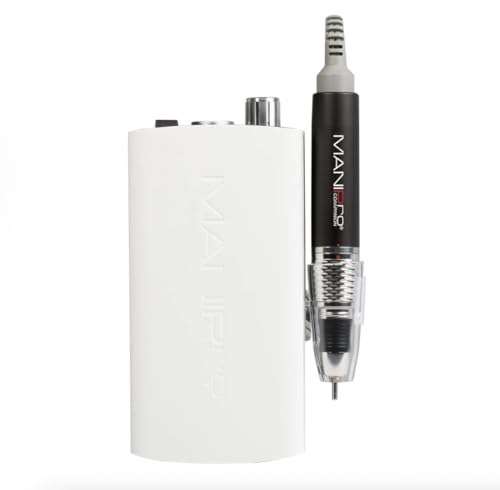
Kupa's MANIPro Passport Complete is the full system: KP-Companion handpiece, acetone-resistant control box, cradle, holster and belt clip. Its 5-ounce, 0.8-inch handpiece is the reason licensed techs keep buying it.
$374.98fromAmazonPrices as of Oct 25, 6:48 AM PT · Details
Pick up a heavy handpiece for the tenth client of the day and you'll understand what you're paying for here. The KP-Companion weighs 5 ounces and measures 0.8 inches across the body, which is closer to a fat pen than a tool. Kupa specifies it as balanced and vibration-free, and the torque-to-weight ratio is the reason this handpiece has become a default in licensed salons.
The control box is the part nobody thinks about until acetone spills. Kupa builds it acetone-resistant, which is a specific answer to a specific way these machines die. Soak-off dishes tip. Cotton pads drip. A control box that shrugs that off lasts through the daily mess a home unit never sees, and the durability claim is backed by a limited one-year parts-and-labor warranty.
Top speed is 30,000 RPM, lower than a couple of machines here, and that's fine. Kupa's claim is zero stalling under pressure through filing, shaping, backfills and removal, which is the spec that actually governs how a fill goes. Forward and reverse are on the box, so left- and right-handed techs both get a natural bit direction rather than fighting the rotation.
Battery runtime is 8 to 10 hours with a roughly 2-hour full charge, and the automatic 110V/220V switching means it works on either side of an ocean without an adapter beyond the plug shape. For a mobile tech that's the difference between a machine you trust and one you plan around.
Flaws but not dealbreakers
It's the most expensive option in this lineup by a wide margin, and it arrives without a single bit. You're buying the system, then buying consumables separately, which is normal at this tier but stings if you expected a kit.
This particular Amazon listing has very little owner feedback behind it, so we're leaning on Kupa's specifications and the handpiece's broader reputation among licensed techs rather than a deep pool of buyer reports. If you want the reassurance of thousands of owners weighing in, the top pick has more of a track record on that front.
Thirty thousand RPM is plenty, but if you specifically want the highest top-end number on the page, this isn't it.
Kupa includes a limited one-year parts-and-labor warranty.
Budget pick
A complete beginner kit that stays quiet and cool
COSLUS C40 Electric Nail Drill Professional
The COSLUS C40 is a pen-shaped, 0.38-pound e-file that ships with 6 bits and 31 sanding bands. It handles gel, acrylic and dip powder removal plus cuticle work, and the speed dial is simple enough that a first-timer won't overshoot.
$9.99fromAmazonPrices as of Oct 25, 6:48 AM PT · Details
If you've never held an e-file, start here. The C40 weighs 0.38 pounds and is shaped like a fat marker, so it sits in your hand the way a pen does. That grip is what keeps a beginner's angle steady, and a steady angle is most of what separates a clean fill from a thin spot. The speed dial and direction switch are both on the barrel, within thumb reach.
The kit is genuinely complete. Six bits cover shaping, removal, cuticle work and polishing, and 31 sanding bands is a real supply rather than a token three. You can do gel, acrylic and dip powder out of the box, plus thick toenails and dead cuticle skin. Nothing else to buy on day one.
COSLUS specifies low noise and low heat from an upgraded motor with heat dissipation built in, and heat is the practical one. A drill that warms up transfers that heat straight through the bit to your fingertip, which is where most beginners bail out mid-removal. Cooler running means you can finish the nail instead of stopping every ten seconds.
Among everything here this is easily the most widely bought machine, and that popularity has a practical upside beyond reassurance. Replacement bands and bits sized for it are everywhere, and there's a deep well of owner experience if something goes sideways.
Flaws but not dealbreakers
The listing doesn't state a maximum RPM or a torque figure, which makes it hard to compare directly against the professional units on paper. Treat it as a light-to-moderate-duty machine. Thick, well-cured acrylic is where a small pen-style drill runs out of grunt, and this one will remind you of that.
There's no foot pedal and no LED display, so speed changes happen by feel and by dial position rather than by number. That's fine for at-home use. If you want to return to exactly 12,000 RPM every time, you'll want a machine with a readout.
Also greatOn sale
The quietest of the bunch, if noise is what bothers you
Makartt Portable Nail Drill for Beginner &
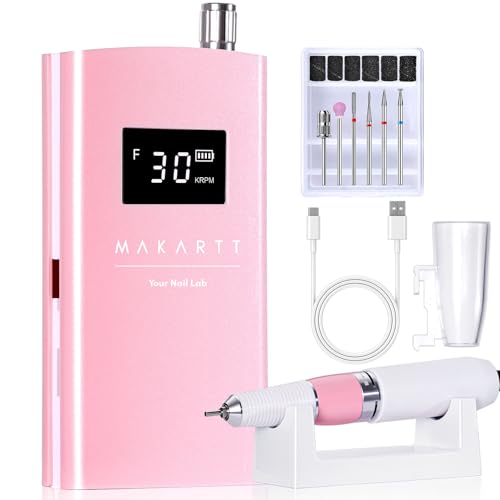
Makartt rates the Perlarie under 40 decibels, with an aluminum handpiece and a cooling system to keep vibration down. It runs 0 to 30,000 RPM with forward and reverse, and includes 6 bits and 6 sanding bands.
$59.55fromAmazonTypical pricePrices as of Oct 25, 6:48 AM PT · Details
Under 40 decibels is the quietest figure any manufacturer here claims. That's the difference between a machine you can run during a phone call and one that fills the room. If you're doing your own nails on the sofa in the evening, or working in a shared apartment, or filing while a client is trying to relax, the noise is the thing you'll notice first and complain about longest.
The aluminum handpiece is doing double duty. It pulls heat away from the motor, and its mass damps the buzz that makes a cheap plastic drill feel like it's vibrating your wrist. Makartt pairs it with a cooling system, and the combination is aimed squarely at long sessions where hand fatigue creeps up on you.
Speed control is stepless from zero to 30,000 RPM, with forward and reverse for either hand. The 3000mAh battery is rated at up to 8.5 hours, and Makartt specifies that runtime even at maximum speed rather than at a gentle cruise. It needs a 5V/2A adapter to charge, which is worth checking before you plug it into whatever cube is nearest.
You get 6 bits and 6 sanding bands, and the chuck takes standard 3/32-inch bits, so upgrading later means buying bits rather than buying a new machine.
Flaws but not dealbreakers
Six sanding bands won't last long. Bands are consumables and they dull fast on acrylic, so plan on ordering a bulk pack alongside the drill.
Thirty thousand RPM with a compact cordless body means this is a maintenance and prep machine more than a heavy-removal one. Published comparisons consistently find that budget cordless drills lose noticeable torque against thick acrylic compared with corded professional units, and nothing about this one exempts it from that pattern.
Who this is for
Buy a nail drill if you're already doing your own gel or acrylic and the hand-filing part has become the worst hour of your week. An e-file turns a 40-minute soak-and-scrape into a few minutes of controlled filing, and it's the only practical way to shape an enhancement evenly. It's also the right tool if you're a working tech and your current machine bogs down under pressure, because that stalling is what forces you to press harder and generate heat.
Skip it if you wear only regular polish, or if you're not willing to practice on a few nails before going near your cuticle line. This guide covers handheld and desktop electric files for manicures and pedicures, including cordless units and full starter kits. It doesn't cover rotary craft tools, standalone bit sets, dust collectors, UV lamps or replacement handpieces sold on their own.
How we picked
We ranked these on five things. Low-speed torque: whether the motor holds speed under pressure, since that's the spec techs say governs safe acrylic and hard gel removal, not the top RPM number. Noise and heat: stated decibel figures, heat dissipation and vibration damping, because a loud, hot drill is one you stop using. Bit compatibility: a standard 3/32-inch shank, so you can buy replacement carbides and bands from anyone. What's in the box: whether bits and sanding bands are included or a separate purchase, which changes the real cost of getting started. Owner-reported reliability: repeated patterns in buyer feedback around chucks, motors and support, not isolated bad luck.
Other nail drill kits worth considering
If you want a brushless motor without the salon price: The Professional Nail Drill Machine — The HoMove 35000RPM is the only other machine here with a brushless motor, which generally means less friction, less heat and a longer life than a carbon-brush design. It runs 0 to 35,000 RPM with an LCD showing speed and battery, has an aluminum alloy handpiece, and HoMove rates it at up to 10 hours cordless from a 1.5 to 2 hour charge. Six bits are included. What you give up is a track record: this listing has drawn very little owner feedback so far, so there's no deep pool of buyer reports to check the durability claim against. HoMove offers a 60-day return window, which softens that a bit.
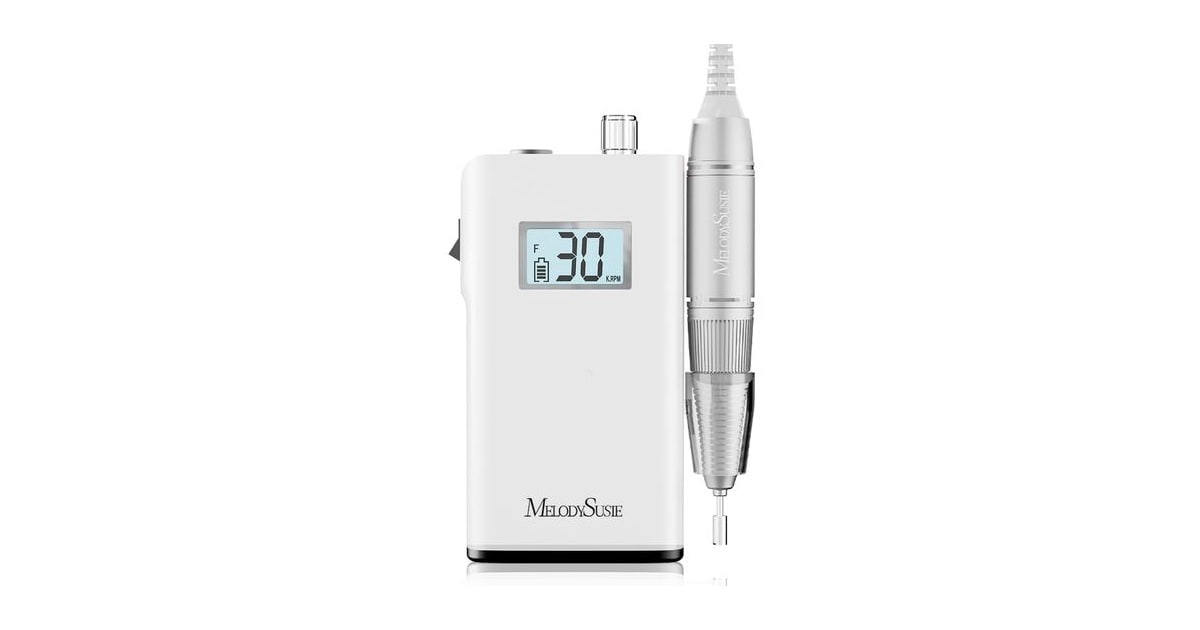
If you want to file standing up or on the move: The MelodySusie Portable Clip-On Nail Drill SC320H for — The MelodySusie Scamander SC320H clips to your waist, which sounds gimmicky until you're doing a pedicure on someone in an armchair. The pen-shaped handpiece runs to 30,000 RPM with 320 gf·cm of torque, and the 6000mAh battery is rated for 10 to 14 hours from a 2.5-hour charge — the longest runtime here after the top pick. An LED display shows speed, direction and power level. The trade-off is the motor: it's carbon brush rather than brushless, so expect more heat and a shorter service life than the professional units. MelodySusie positions it as entry-level, and that's the right frame.
The competition
This is what our research surfaced, not a survey of every nail drill for sale. The category is enormous and much of it is the same machine under different branding, so we focused on units with specifications we could check and enough of a paper trail to say something honest about.
The SAVILAND 2026 Electric Nail Drill Kit 30S — The SAVILAND Electric Nail Drill Kit has the biggest number on the page: 40,000 RPM, with a claim of removing stubborn gel and acrylic in 30 seconds. It's also the most generous kit here, with 6 metal bits, a ceramic corn bit, 5 polishing bits and 26 sanding bands, plus a 4000mAh battery good for 7 to 8 hours. But the motor is carbon brush, not brushless, which caps how long it'll hold up under daily professional use, and SAVILAND's own listing acknowledges that many drills in this class fail within months. More to the point, 40,000 RPM isn't a reason to buy. The Good Housekeeping Institute advises beginners stay at or below 15,000 to 20,000 RPM with a fine-grit bit to avoid thinning the nail plate, so most of that range is headroom you'll never touch. Worth a look if you want a big bit collection in one box and you're comfortable treating the machine as semi-disposable.
Care and safe use
Keep the speed low and the bit moving. The Good Housekeeping Institute recommends beginners stay at or below 15,000 to 20,000 RPM with a fine-grit bit, and the single biggest cause of nail damage is holding a coarse bit in one place rather than sweeping it across the surface. If your fingertip feels warm, you've already been there too long — lift off and come back. Use reverse rotation when you switch hands so the bit pulls away from the cuticle rather than into it. Sanding bands are consumables and dull faster than you'd think; a band that's stopped cutting makes you press harder, which generates the heat you're trying to avoid, so swap them often. Clean dust out of the chuck and let the handpiece cool between clients.
Questions we get
Are nail drills safe to use at home?
Yes, with a light hand and a slow start. The risk isn't the machine, it's technique — pressing too hard or parking a coarse bit in one spot thins the nail plate. Begin with a fine-grit bit at low speed and practice on a nail you don't mind messing up. Keep the bit moving and stop the moment your fingertip feels warm.
What RPM should a beginner start at?
The Good Housekeeping Institute recommends beginners work at or below 15,000 to 20,000 RPM with a fine-grit bit. That's well under the top speed of every machine here, and that's fine — the headroom is for the motor's benefit, not yours. Speed up only once your angle and pressure feel automatic.
Cordless or corded for home use?
Cordless is more convenient and almost all of these are cordless. The catch is torque: published comparisons find budget cordless drills lose noticeable grunt against thick acrylic compared with corded professional units. If you're mostly doing gel removal and prep, cordless is plenty. If you're filing a lot of hard acrylic, prioritize a high-torque brushless motor.
How do I know if a bit will fit my machine?
Check for a 3/32-inch shank. Industry coverage describes that size as the cross-brand standard rather than the exception, and every machine in this guide that states a shank size uses it. That means a carbide barrel from one brand drops into another brand's chuck without an adapter.
Do I need a foot pedal?
Only if you're working on other people. A pedal lets you change speed while both hands stay on the client's nail, which is why it shows up on professional desktop units and rarely on cordless kits. Doing your own nails, you've got a free hand for the dial anyway. None of the cordless machines in this guide include one.
How often should I replace nail drill bits?
Sanding bands are single-use to a few-use items and should go in the bin as soon as they stop cutting cleanly. Carbide and diamond bits last much longer but dull gradually, and the tell is that you're pressing harder to get the same result. That extra pressure is what causes heat and nail damage, so replace sooner than you think you need to.
Why you should trust us
For this guide:
- We compared manufacturer specifications for every machine in this lineup, focusing on motor type, stated torque, speed range, battery runtime and shank compatibility.
- We read published coverage from NAILS Magazine, Nailpro, Byrdie, Good Housekeeping, Real Simple, Cosmopolitan and InStyle on what separates salon-grade drills from home units.
- We reviewed owner feedback for recurring themes around chuck failures, motor longevity and manufacturer support, and reflected those patterns in the flaws sections.
- We read owner reviews on every listing, weighted toward the critical ones, because that is where the recurring failures show up.
- We have a systematic way of automatically fetching the latest prices, so the numbers on this page stay current.
- This is a research-focused guide, so the team may not own every product listed — though we often do own the top winners, which gives us extra context for the recommendations.
- We don't accept free products, and the retailer commission never changes which product we recommend.
Sources
The Best Nail Drills for At-Home Manicures, Allure
We Tested the Best Nail Drills for DIY Gel and Acrylic Removal, Byrdie
Good Housekeeping Institute Nail Drill Reviews, Good Housekeeping Institute
Best At-Home Nail Drills, According to Manicurists, Cosmopolitan
How to Choose an E-File: A Buying Guide for Nail Technicians, NAILS Magazine
Professional Electric File Buyer's Guide, Nailpro Magazine
Medicool Pro Power 35K Product Specifications, Medicool (manufacturer)
Kupa Passport Elite Technical Specs and Manual, Kupa Inc. (manufacturer)
The Best Nail Drills for Beginners in 2026, Real Simple
Nail Drill Noise and Torque Comparison Testing, InStyle
Amazon product listings and owner reviews for all 7 products
Manufacturer specification pages for each product
Some passages in this guide may be paraphrased with AI help.
Product prices and availability are accurate as of the date/time indicated and are subject to change. Any price and availability information displayed on Amazon.com at the time of purchase will apply to the purchase of this product.
More like this.
Continue exploring beauty reviews and recommendations.

The Best Nail Care Kits for Home Manicures
A home manicure kit earns its keep in small, boring ways. You get twenty minutes on a Sunday night, you shape your nails, you paint them, and they still…

The Best At-Home Gel Nail Kits
A gel manicure is the rare beauty product that actually does what it says. Color stays glossy for two weeks or more, it doesn't smudge on the drive home,…

The Best Gel Nail Polish Kits
A gel manicure is really three things working together: a bond that grips the nail, a color that resists chipping, and a lamp that cures both all the way…

The Best Benchtop Drill Presses for Woodworking
A handheld drill wanders. Even with a steady hand you'll drift a couple of degrees, and that shows up later as a shelf that rocks or a dowel joint that…

The Best Cordless Drill Sets for Home Improvement
A cordless drill is the tool you'll reach for more than any other, and most of the time you're not doing anything heroic with it. You're hanging a curtain…

The Best Rotary Hammer Drills
A rotary hammer isn't just a beefier hammer drill. It drives a pneumatic piston that hits the bit with measured force, so it bores into concrete instead…