The Best Outdoor Fire Pits
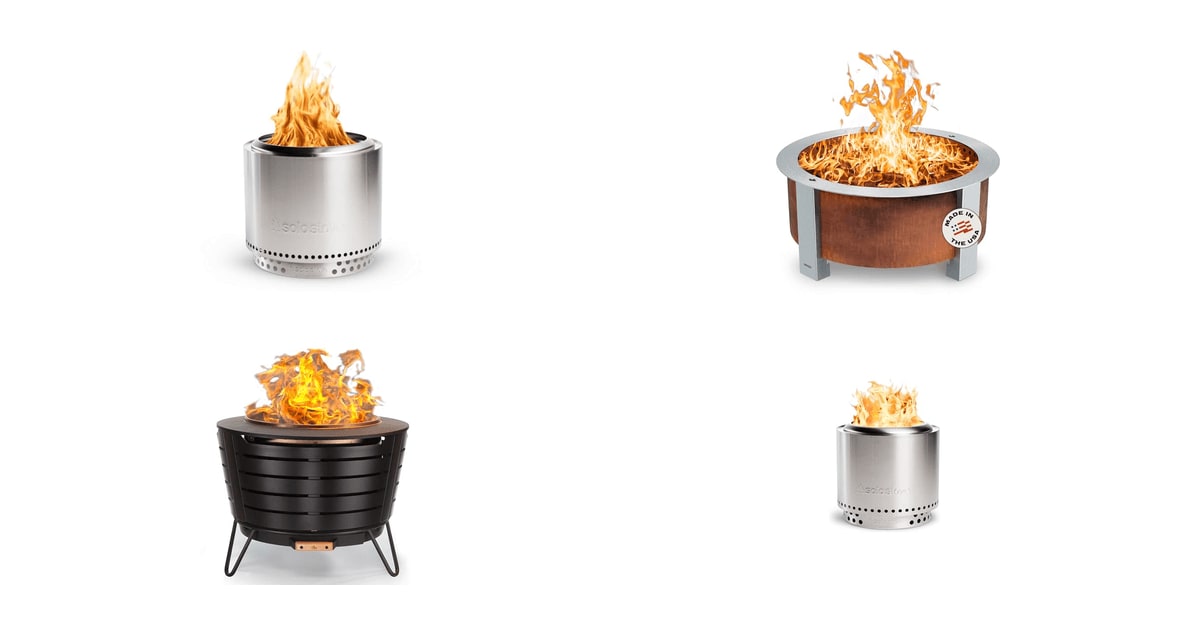
A fire pit earns its keep on the nights nobody planned. Someone finds a bag of marshmallows, chairs get dragged over, and two hours disappear. What separates a good pit from a frustrating one is mostly smoke and cleanup. Smoke follows you around the circle, stings your eyes, and soaks into your jacket. And ash caked into a one-piece bowl turns every fire into a chore the next morning. Everything else — the looks, the accessory catalog, the finish — matters less than you'd expect.
Here's the honest part: none of these are actually smokeless. They all work the same way, pulling air through a double wall and burning the smoke off a second time, and that only happens once the walls get hot. Popular Mechanics reports that passive designs like these need roughly 15 to 20 minutes of burn time before smoke drops off noticeably. Wet wood, a smothered fire, or logs stacked above the top vents will bring it right back, on any brand you buy.
Smokeless pits span a wide price range, and the gap between the expensive ones and the affordable ones is narrower than the marketing suggests. What separates them is build quality, support, and how well they hold up through a wet winter. So we sorted this lineup by who you are: someone furnishing a patio, someone hauling a pit to a campsite, someone who wants to cook over the flame. We think that the Solo Stove Bonfire 2.0 is the best outdoor fire pit for most people, and that the TIKI 25-Inch Smokeless Fire Pit is the one to buy if you want nearly the same smoke reduction for a lot less.
Everything we recommend

The easiest smokeless fire to light, move, and clean up after
A wider, heavier bowl that burns nearly as clean
Corten steel and a cooking-first design, if it can stay put

The one to throw in the trunk for camping or a small balcony
At a glance
| Product | Diameter | Weight | Price | |
|---|---|---|---|---|
| Solo Stove Bonfire w/StandTop pick | 19.5 in | 21.75 lbs | $299.95 |
| Breeo X Series 30 Corten Steel SmokelessUpgrade pick | 34.5 in | — | $1,189On sale |
| TIKI Patio Smokeless Fire PitRunner-up | 25 in | 45 lbs | $295On sale |
| Solo Stove Ranger 2.0 15" Smokeless FireAlso great | 15 in | 16.5 lbs | $206.99On sale |
 | Cuisinart Outdoor Fire PitAlso in lineup | 24 in | 22 lbs | $399.99 |
How we picked
How smokeless, really. We compared manufacturer claims against published reviews and recurring themes in owner feedback, looking for pits that stay low-smoke in ordinary use and not just under a perfect fire. Popular Mechanics reports that passive double-wall designs need roughly 15 to 20 minutes of burn time to get there.
Size for your group. Specs and category guidance point to a 19-to-24-inch bowl for four to six people, with 26 inches and up for groups of eight. We checked each pit's usable bowl against how many chairs it can realistically keep warm.
Metal that lasts. We favored 304 stainless and corten steel over thin rolled steel, since both survive weather without paint. Owner reports on rust, warping and finish wear after a season outdoors settled the close calls.
Cleanup and weight. A removable ash pan and a weight one person can lift are what make a pit get used instead of ignored. We also noted which models include a stand, cover or carry case rather than selling them separately.
Safety and clearance. We looked for stable stands, available spark screens and heat shields, and weighed each pit against the clearance rules most municipalities enforce. Bob Vila's guidance notes a 10-foot minimum setback from structures is typical, with HOAs often requiring 25.
Top pick
The easiest smokeless fire to light, move, and clean up after
Solo Stove Bonfire w/Stand
This 19.5-inch stainless pit burns hot and clean once it's up to temperature, and at just over 20 pounds you can carry it from the deck to the car by yourself. The base and ash pan lift out, so cleanup takes a minute instead of a morning.
$299.95fromAmazonThe Bonfire's 19.5-inch bowl is the right size for most yards. Four to six people can sit around it without leaning in or roasting their shins. Go smaller and you're feeding it constantly. Go much bigger and you need a woodpile and a permanent spot to put it. This one splits the difference, and it's light enough that you can pick it up and move it when the wind shifts.
The way it burns is simple enough. Air gets pulled in at the base, heats up in the gap between the double walls, and comes back out through the ring of holes at the rim, where it ignites the smoke a second time. Solo Stove says that cuts visible smoke dramatically compared with an open campfire. It doesn't happen instantly, though — plan on a smoky first fifteen minutes while the walls come up to heat.
It's built to live outside. The bowl is 304 stainless steel with a high-heat ceramic coating, and owners who keep theirs on a composite deck through the seasons report it still looks fine. Stainless shows soot around the rim, and it won't stay showroom-silver. But you're not fighting flaking paint or a rusted-through bottom the way you would with a cheap rolled-steel bowl.
Cleanup is the quiet reason people keep recommending this thing. The base and ash pan lift straight out, so you tip the ash into a bag and you're done. Anyone who's tried to scrape cold ash out of a one-piece bowl with a dustpan knows why that's worth something. It's a five-minute job, and it's the difference between a pit you use every week and one you stop bothering with.
Flaws but not dealbreakers
The spark screen and heat deflector are separate purchases. If you're burning on a wood or composite deck, the screen isn't optional, so plan on buying it with the pit rather than later.
It costs considerably more than pits that burn nearly as clean, the TIKI below included. You're paying for the finish, the brand's support, and a bowl that's genuinely lighter than most rivals. Whether that's worth it depends on how often you'll actually move it.
The bowl is deep but not wide, so long logs won't lie flat. Stacking wood above the top row of holes chokes the second burn and the smoke comes back. Cut or split to fit, and keep the pile low.
Runner-upOn sale
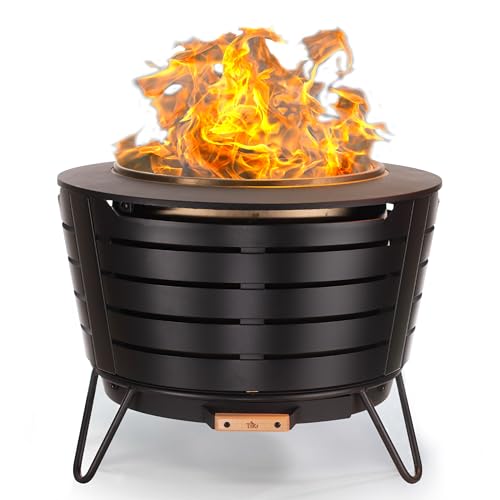
A wider, heavier bowl that burns nearly as clean
TIKI Patio Smokeless Fire Pit
The TIKI is a 25-inch double-wall pit in 16-gauge stainless with a black powder-coated finish, and it arrives with a stand and a cover. It's the pit to get if your gatherings run bigger than four people and the pit is staying in the backyard.
$295fromAmazonList priceA 25-inch bowl changes the shape of the evening. You can put eight chairs around this one and everybody still gets heat — TIKI says warmth carries out about four feet in every direction. The bowl also swallows full-size splits, so you're not repacking it every twenty minutes. If your fires tend to grow into something bigger than you planned, that extra width earns its footprint.
It's the most complete package here out of the box. A stand and a weather-resistant cover come with it, which is unusual in this category — most of these pits make you buy the cover separately. The black powder-coated finish also hides soot far better than bare stainless, so it still looks presentable on a patio between fires.
The airflow design is the same idea as the Solo Stove's: double walls, preheated air, a second burn at the top. Owners consistently report very little smoke once the fire is established, and plenty of them say they landed here after pricing the better-known brand. It burns ordinary cut firewood, so you're not locked into anything proprietary, and the ash pan pulls out like the Bonfire's.
Flaws but not dealbreakers
At 45 pounds, this is a backyard pit, not a camping pit. You can wrestle it into a car, but you won't enjoy it, and there's no carry case for it.
Owner feedback on the included cover is mixed — several report it wearing out well before the pit does. The screen, poker, heat deflector and griddle are all sold separately, so if you want the full setup, the accessory list adds up.
Upgrade pickOn sale
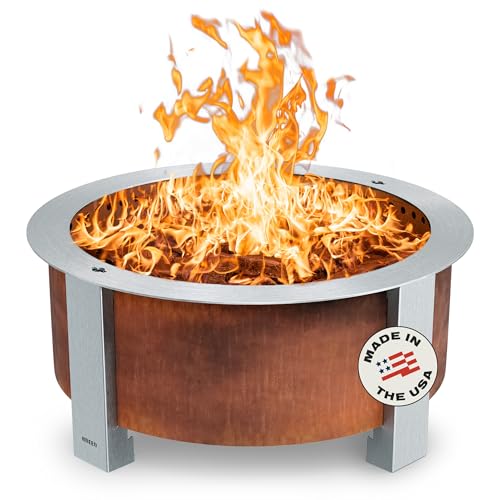
Corten steel and a cooking-first design, if it can stay put
Breeo X Series 30 Corten Steel Smokeless
The X Series 30 is the widest, heaviest pit here, built from 3/16-inch corten steel in the USA and designed around live-fire cooking. Breeo's sear plates and grates bolt right on, which turns it into an outdoor cooktop rather than just a place to burn logs.
$1,189fromAmazonList priceBuy this one if the fire is the point, not the backdrop. It's the widest pit in this lineup, the steel is thick, and the whole thing is built around Breeo's accessory line — sear plates, grates, kettle hooks. The Outpost sear plate holds a cooking surface above 600 degrees, which is steak territory, not just s'mores. If you've been wanting to cook over live flame, nothing else here comes close.
Corten is the interesting part. Instead of a coating, it grows its own protection: a tight, rust-colored patina forms over the first six to twelve weeks outdoors and then seals the metal underneath. No paint, no annual treatment, nothing to flake off. It darkens and evens out over time. If you like the way weathering steel looks, this pit only gets better the longer it sits there.
Heat is the trade-off you're making. Thick steel and a wide, shallow bowl push a lot of warmth outward, which is exactly what you want on a cold night with a crowd around it. It's also what makes this a permanent installation rather than something you carry. Pick the spot carefully, because you're not going to move it on a whim once it's there.
Flaws but not dealbreakers
It needs a big, hot fire to do the smokeless part. Those tall inner walls have to get genuinely hot before secondary combustion kicks in, and owner feedback splits sharply here — people running small, lazy fires report plenty of smoke, and they're not wrong. If you want a quick fire from three sticks, buy something smaller.
It's the most expensive pit in this guide by a wide margin, and the accessories that make it a cooking rig cost extra on top of that. Several owners also report boxes arriving beaten up with little protective packing inside, so look yours over before the first burn.
Also greatOn sale
The one to throw in the trunk for camping or a small balcony
Solo Stove Ranger 2.0 15" Smokeless Fire
The Ranger 2.0 is the Bonfire shrunk to about 16 pounds and 15 inches across, with a carry case in the box. It's a two-to-four-person fire you can carry in one hand, which makes it the practical choice for campsites and tight patios.
$206.99fromAmazonList priceThis Old House called the Ranger the lightest standalone smokeless wood-burning pit they tested, and the numbers back that up — it's roughly 16 pounds, about 15 inches across, and a carry case is included. It fits behind a car seat, on a small balcony, or beside two camp chairs. If you've ever skipped bringing a fire pit because loading it was a hassle, this solves that.
Small doesn't mean it burns badly. It's the same 304 stainless, the same 360-degree airflow, the same removable ash pan — just less of everything. Owners who take it camping report it stays impressively clean-burning as long as the fire stays lively. That's the trick with all of these: a starved fire smokes, and a small firebox starves faster, so feed it steadily.
Think of it as a fire for two to four people. You'll reach in to add wood more often, and it won't warm a big circle on a cold night. But it's the only pit here you can carry one-handed, and for camping, tailgating, or a balcony where a full-size bowl is out of the question, that's the entire argument.
Flaws but not dealbreakers
Small bowl, short logs. You'll be breaking or cutting wood down to fit, and an evening's fire takes more tending than the Bonfire's does.
Owners occasionally report surface rust after it's been left out in the rain, so store it in the case or under cover. And as with the Bonfire, the spark shield and heat deflector are separate purchases.
Who this is for
Get one of these if you have open ground or a patio, somewhere to keep firewood dry, and nothing in your local rules stopping you from burning it. Every pit in this guide burns wood, and that's the appeal — the crackle, the smell, the fact that you can cook on most of them. If you host four to eight people a few times a month, a mid-size smokeless bowl will change how often you're outside after dark.
Skip them if wood is off the table where you live. Drought-season burn bans increasingly hit wood-burning pits in the West, and plenty of HOAs allow gas only. In those cases, a CSA-certified propane pit is the answer instead — it lights in under 30 seconds, sidesteps most burn restrictions, and this guide doesn't cover that category. Also skip these if your only spot is under a covered porch or a low branch; none of them are safe there, smokeless or not.
How we picked
Smoke: we weighed manufacturer airflow claims against published reviews and owner reports, knowing every passive design needs 15 to 20 minutes to reach a low-smoke burn. Size: roughly 19 to 24 inches for four to six people, 26 inches and up for a crowd of eight. Materials: 304 stainless or corten steel, not thin rolled steel that rusts through in a season. Cleanup: a removable ash pan, a weight one person can carry, and whether the stand, cover or case come included. Safety: a stable base, an available spark screen, and enough clearance to satisfy the 10-foot setback most towns require.
The competition
This is what our research surfaced in the smokeless wood-burning category, not a survey of everything for sale. One pit here didn't make the picks, and a few listings in the lineup turned out to be accessories rather than fire pits at all.
The Cuisinart Outdoor Fire Pit ($399.99) — The Cuisinart Cleanburn is a reasonable pit that lands awkwardly between our picks. It's 24 inches and about 22 pounds, with double-wall construction, bottom vents, an enamel-coated stainless exterior, an ash base tray and an integrated handle, and it takes logs up to 18 inches. On paper that's appealing: nearly TIKI width at close to Bonfire weight. But it doesn't clearly beat either one — the Bonfire is better supported and easier to move, the TIKI is bigger and comes with a cover and stand, and Cuisinart's accessory ecosystem is thinner than both. Consider it if you specifically want a 24-inch bowl with a carry handle and a coated exterior that hides soot.
Placement, safety, and cleanup
Give it room. Most municipalities require at least 10 feet between a wood-burning pit and any structure, and HOA rules often stretch that to 25. The NFPA points to wind-blown embers and too little clearance as the two leading causes of fire pit incidents, so a spark screen is non-negotiable on a wood or composite deck. So is a heat shield or a couple of pavers underneath, because these bowls radiate straight down and will scorch grass and decking. Never light one under an overhang or a low branch. When you're done, let the fire burn down and cool on its own rather than dousing it, keep water within reach, and empty the ash pan only once the ash is stone cold.
Questions we get
Are smokeless fire pits actually smokeless?
No, and anyone who tells you otherwise is selling something. They're low-smoke once they're hot, because the double wall preheats air and burns the smoke a second time on its way out. Popular Mechanics reports that passive designs need roughly 15 to 20 minutes of burn time before smoke drops off noticeably. Wet wood or an overstuffed firebox will smoke in any of them.
What's the best fire pit for a wood or composite deck?
A smokeless pit on a stand, with a spark screen and a heat shield underneath. The Solo Stove Bonfire 2.0 is the easiest fit — it's light, it sits on a stand, and owners report using it on composite decking without trouble. Buy the screen with it, since embers popping onto a deck board are the real risk, not the heat.
How far does a fire pit need to be from a house or fence?
Ten feet is the minimum most U.S. municipalities enforce between a wood-burning pit and any structure. HOAs commonly require 25. Check your local ordinance before you buy, because that clearance also has to account for overhead branches, eaves and anything flammable stored nearby.
Can I use a wood-burning fire pit in an HOA neighborhood?
Sometimes, but read your covenants first. Many HOAs allow gas only, and those that permit wood often impose larger setbacks than the town does. A smokeless pit helps your case with neighbors, since less smoke drifting over the fence is usually what triggers complaints. If wood is banned outright, a CSA-certified propane pit is the workaround.
What size fire pit do I need for six to eight people?
Look for 25 inches or wider. A 19-to-24-inch bowl comfortably warms four to six people, but once you're seating eight, the outer chairs stop feeling the heat. The TIKI's 25-inch bowl and the Breeo X Series 30 both work for that size group; the Solo Stove Ranger 2.0 does not.
Corten or stainless steel — which lasts longer?
Both outlast cheap rolled steel, and they age differently. Corten forms a self-sealing patina over about six to twelve weeks outside that protects the metal underneath, with no paint or annual treatment needed, but it will look rusty by design. Stainless stays silver, weighs less and travels better, though it shows soot around the rim. Choose corten for a permanent backyard pit, stainless if you plan to move it.
Why you should trust us
For this guide:
- We read manufacturer spec sheets from Solo Stove, Breeo and TIKI alongside published reviews from Popular Mechanics, This Old House and Bob Vila, plus NFPA guidance on ember safety and clearance.
- We compared airflow designs, bowl dimensions, materials, weight and included accessories across every pit in this lineup.
- We read through owner feedback for recurring themes around smoke, rust, cleanup and what people wish they'd known before buying.
- We read owner reviews on every listing, weighted toward the critical ones, because that is where the recurring failures show up.
- We have a systematic way of automatically fetching the latest prices, so the numbers on this page stay current.
- This is a research-focused guide, so the team may not own every product listed — though we often do own the top winners, which gives us extra context for the recommendations.
- We don't accept free products, and the retailer commission never changes which product we recommend.
Sources
Best Fire Pits of 2026 — Wirecutter (NYT), Wirecutter
Best Fire Pits, Tested by Editors — Good Housekeeping, Good Housekeeping
Best Fire Pits — Popular Mechanics, Popular Mechanics
Best Fire Pits — The Spruce, The Spruce
Best Fire Pits — Bob Vila, Bob Vila
Best Fire Pits for Every Backyard — This Old House, This Old House
Solo Stove Bonfire 2.0 — Official Product Specs, Solo Stove
Breeo X Series 30 — Official Product Page, Breeo
BioLite FirePit+ — Official Product Page, BioLite
Outland Living Mega Series 863 — Official Page, Outland Living
Outdoor Entertaining & Fire Pit Market Trends 2025–2026, Mordor Intelligence
Outdoor Fire Safety — National Fire Protection Association, NFPA
Amazon product listings and owner reviews for all 5 products
Manufacturer specification pages for each product
Some passages in this guide may be paraphrased with AI help. Prices are refreshed automatically.
More like this.
Continue exploring lifestyle reviews and recommendations.

The Best Backyard Fire Pits
A fire pit is the rare backyard purchase that actually changes how you use your yard. It pulls people outside on a chilly evening, it stretches your patio…

The Best Home Fire Extinguishers for the Kitchen
A kitchen fire gives you about a minute to make a good decision. Grease flares up, a towel catches, and the difference between a scorched pan and a gutted…

The Best Outdoor Grills
A grill gets used more than almost anything else you keep outside. On a Tuesday you want it hot in ten minutes so the chicken is done before the kids melt…

The Best Sunscreens for Outdoor Activities
Sunscreen for a long day outside has a different job than the stuff you dab on before the commute. It has to survive sweat running down your forehead, a…

The Best Gas Grills for Outdoor Entertaining
A grill that's fine for two pork chops on a Tuesday falls apart when twelve people show up. You need enough grate space to get everything off at once,…

The Best Waterproof Outdoor Bluetooth Speakers
A speaker that lives outdoors leads a rough life. It gets set down in wet sand, splashed by a cannonball, knocked off a picnic table, and left in a hot…