The Best Home Fire Extinguishers for the Kitchen
A kitchen fire gives you about a minute to make a good decision. Grease flares up, a towel catches, and the difference between a scorched pan and a gutted room is whether you can reach the right extinguisher without walking through flame. Most homes fail this test in a boring way. The extinguisher is in the basement, or it's the wrong class, or nobody has looked at the pressure gauge since it was mounted. Where you put it matters as much as which one you buy.
Here's the honest part: no extinguisher you can buy for a home kitchen is great at cooking-oil fires. ABC dry chemical knocks down the flame, but hot oil can reignite once the powder settles. And that powder is corrosive — discharge a big unit indoors and you'll be cleaning fine grit out of appliance vents and cabinet hinges for weeks. Commercial kitchens use Class K wet chemical for a reason. Nothing here fully replaces it, and any guide claiming otherwise is selling you something.
So think in layers. A properly rated ABC cylinder mounted near the exit is the backbone, and something smaller and faster within arm's reach of the stove covers the first few seconds. We think that the First Alert DHOME1 is the best home fire extinguisher for the kitchen for most people, and that the Kidde Pro 210 Commercial is the one to buy if you deep-fry, use a wok, or cook on a high-BTU range.
Everything we recommend

Rechargeable metal build in a size you'll actually mount
More reach and more agent, if you cook hot and often

No residue, no training, and it fits in a drawer

The build-once cylinder, if you'll live with the weight
At a glance
| Product | UL Rating | Weight | Price | |
|---|---|---|---|---|
| First Alert DHOME1 Rechargeable Standard Home FireTop pick | 1-A:10-B:C | 0.000625 lbs | $28.99 |
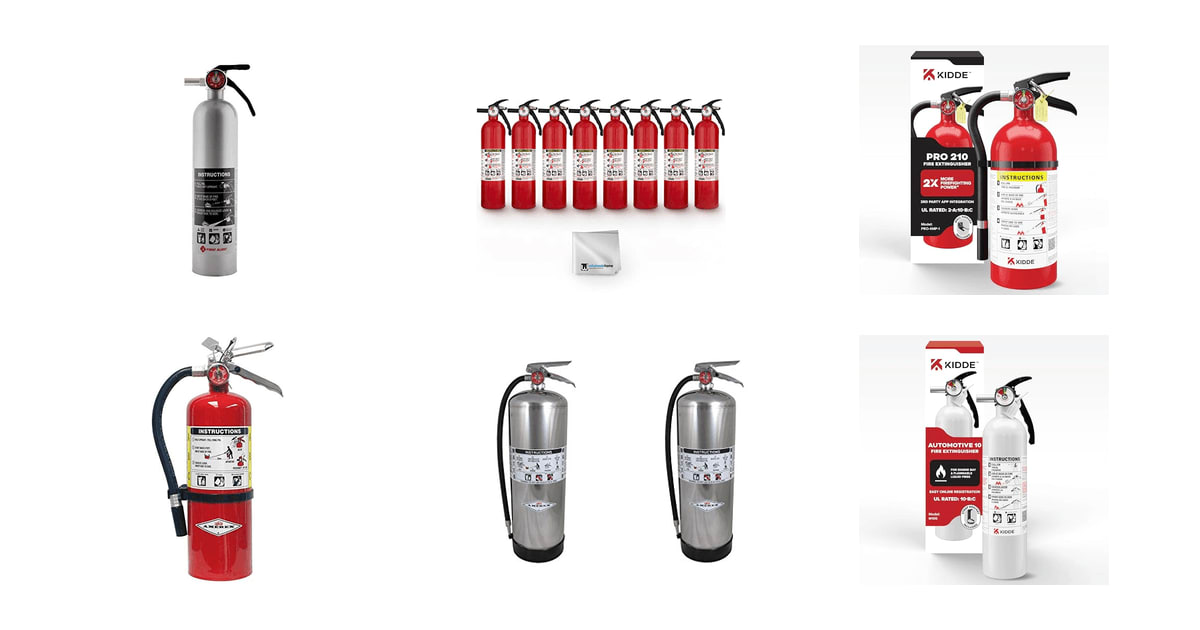
 | Kidde FA110 Multipurpose Fire Extinguishers 8 PackAlso consider | 1-A:10-B:C | — | $258.99 |
| Kidde Pro 210 Commercial Fire ExtinguisherUpgrade pick | 2-A:10-B:C | 6.5 Pounds | $54.97On sale |
| Amerex B500 5 lbs ABC Dry ChemicalAlso great | 2A:10B:C | 2 Pounds | $75 |
 | Amerex 240Also in lineup | Class A | 15.2 pounds | $366 |
 | Kidde Auto 10 Fire Extinguisher for CarsAlso consider | 10-B:C | 4 Pounds | $20.85 |
| AmzBoom 2-Pack Fire Extinguisher for HomeBudget pick | A,B,C,K | 1 pounds | $19.80On sale |
How we picked
UL fire class rating. We treated a 1-A:10-B:C listing as the floor for anything we'd call a kitchen extinguisher, since a stovetop fire can involve grease, cabinetry and live wiring at once. Units missing Class A coverage were disqualified from primary-unit consideration regardless of how well they're reviewed.
Range and discharge time. We compared published discharge ranges and durations across manufacturer spec sheets, favoring units that let you fight a fire from a doorway rather than an arm's length away. Anything under roughly eight seconds of discharge we treated as a supplement, not a primary.
Build and serviceability. We looked for all-metal valves and rechargeable designs, because plastic-head disposables are the parts that fail after years of kitchen heat and humidity. Rechargeability also means a partial discharge doesn't force a full replacement.
Cleanup burden. We weighed what happens after you pull the trigger, since dry chemical residue is corrosive and expensive to remediate indoors. Residue-free options earned credit as first-response tools even where their agent volume is small.
Owner-reported reliability. We read through owner feedback looking for people who'd actually discharged a unit or serviced one over several years, and for recurring complaints about gauges, seals and shipping damage. Recurring problems mattered more to us than isolated ones.
Top pick
Rechargeable metal build in a size you'll actually mount
First Alert DHOME1 Rechargeable Standard Home Fire
The DHOME1 is a rechargeable 1-A:10-B:C extinguisher with an all-metal valve and trigger, sized to live in a kitchen rather than a utility closet. It covers wood and paper, grease and cooking oil, and live electrical gear — the three things most likely to catch fire near a stove.
$28.99fromAmazonThis is the rating most kitchens actually need. A 1-A:10-B:C listing means it's cleared for ordinary combustibles, flammable liquids and energized electrical equipment. That's a pan of oil, a smoldering dish towel and a shorting toaster, all with one cylinder. Anything rated for fewer classes forces you to identify the fire correctly while it's spreading, and nobody does that well at two in the morning.
The valve and trigger are metal, not plastic. That matters more than it sounds, because a kitchen extinguisher lives through years of heat cycling and humidity, and plastic heads on disposable units are the part that fails quietly. It's also rechargeable by a certified shop, so a small discharge doesn't mean throwing away the whole thing. Owners who've had it for years report it still reading in the green.
The pewter finish is a small thing that changes behavior. Fire-engine red gets hidden behind a cabinet door because it's ugly, and a hidden extinguisher is one you fumble for. This one looks fine mounted in the open near a doorway, which is exactly where it should be. Owners consistently mention buying it partly because it doesn't look industrial.
Owner feedback here includes people who actually used it — a backyard grease flare-up, brush that spread from a fire pit — and the pattern is that it worked fast and was easy to operate one-handed. The metal pull pin with its safety seal also tells you at a glance whether anyone's messed with it. It's Coast Guard approved for marine use too, if you keep a boat.
Flaws but not dealbreakers
The dry chemical agent is corrosive monoammonium phosphate, and cleanup after a discharge is genuinely unpleasant. Fine powder gets into appliance vents, cabinet tracks and electronics, and professional remediation isn't cheap. That's true of every ABC unit here, but it's worth knowing before you pull the pin on a fire a pot lid could have smothered.
The 10-B portion is entry-level. It's fine for a pan fire on a burner. It's not enough for an oven fully involved or a deep fryer that's gone up, and for high-temperature cooking oil it may knock the flame down without stopping reignition. If that's how you cook, step up.
A few owners report receiving a different variant than pictured, apparently a fulfillment mix-up rather than a product problem. Check the gauge and the rating stamped on the label the day it arrives, not the day you need it.
First Alert does not state a warranty term in its listing information for this model.
Upgrade pickOn sale
More reach and more agent, if you cook hot and often
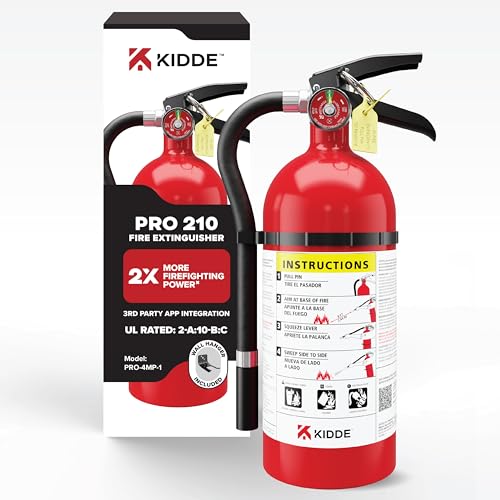
Kidde Pro 210 Commercial Fire Extinguisher
The Pro 210 is a commercial-spec 2-A:10-B:C unit that throws agent 12 to 18 feet and discharges for 13 to 15 seconds. If you deep-fry, run a wok burner, or just want to fight a fire from the doorway instead of the stove, this is the one.
$54.97fromAmazonList priceReach is the specification that actually keeps you safe. Entry-level units make you close to six or eight feet to be effective, which puts you next to the thing that's burning. The Pro 210's 12-to-18-foot range lets you stand at the kitchen entrance with your escape route behind you. That's the positioning fire safety agencies recommend, and no other feature here changes your odds as much.
It also doubles the Class A rating to 2-A, which means more agent and more capacity for a fire that's jumped from the pan to the cabinets. Discharge runs 13 to 15 seconds at 100 PSI. That sounds like a technicality until you've watched an eight-second unit run dry with flame still visible. Longer discharge means you can sweep the base of the fire properly instead of emptying it in one panicked squeeze.
Construction is all-metal — valve assembly, impact-resistant handle, easy-pull safety pin — and it's rechargeable, so a partial discharge sends it to a service shop rather than a landfill. It's built to commercial code compliance, which is why you'll find owners buying it for rental units and small businesses where an insurer is checking. Home buyers get the same build.
Owners describe it as heavy and solid, and several make a point that the bigger bottle is the one worth having. That extra mass is a real trade-off, not just a virtue. But if the choice is a unit you can lift comfortably that runs out early, or one that's a bit of a handful and finishes the job, most people should take the handful.
Flaws but not dealbreakers
It costs roughly double the DHOME1, and at 6.5 pounds it's noticeably heavier. One-handed operation under stress is harder for smaller adults, and for an older parent living alone it may be the wrong call entirely. Lift one before you commit if you can.
The Class B rating is 10-B — numerically identical to the entry-level pick. The upgrade buys you Class A capacity and range, not better grease-fire chemistry. For oil above roughly 300°F, it's still dry chemical, and dry chemical still doesn't prevent reignition the way a Class K agent does.
Same corrosive residue problem, and more of it. Discharging this indoors coats a larger area than a smaller unit would.
Kidde provides warranty and registration information through the QR code on the unit; no specific term is stated in the listing.
Budget pickOn sale
No residue, no training, and it fits in a drawer
AmzBoom 2-Pack Fire Extinguisher for Home
The AmzBoom two-pack is a water-based spray rated for A, B, C and K fires that you press, aim and spray — no pin, no cylinder technique. It leaves no residue, which means a small stovetop flare-up doesn't turn into an appliance cleanup bill.
$19.80fromAmazonList priceThe best extinguisher is the one you can reach in three seconds. This one fits in the drawer next to the stove or clips to a bracket on the wall, and the pack includes two units and two brackets so you can cover the kitchen and the garage at once. Owners repeatedly mention keeping one under the sink and one in the car. That accessibility is the entire argument for it.
It's the only thing here that doesn't wreck your kitchen when you use it. The formula is water-based, non-toxic and residue-free, so after a small fire you wipe down and move on. Compare that to a dry chemical discharge, which drives corrosive powder into every appliance seam in the room. For a flare-up caught early, that difference is the whole decision.
The listing claims coverage for cooking oils and lithium-ion battery fires along with wood and gasoline, plus a barrier that helps prevent reignition. Whether it holds up against a serious oil fire is not something specifications can settle. But for a laptop battery starting to smoke or a small pan flare, having something you can operate without thinking is worth a lot.
Operation genuinely requires no skill. There's no pin to pull, no PASS sequence to remember, no weight to manage. If your household includes kids old enough to cook or a grandparent who'd struggle with a five-pound cylinder, that matters more than any rating on the label.
Flaws but not dealbreakers
This is an aerosol spray, not a UL-listed pressurized extinguisher, and it shouldn't be your only line of defense. Agent volume, discharge duration and range are all well below a traditional cylinder. Treat it as the thing you grab first, backed by a real ABC unit mounted near the door.
There's no pressure gauge, so you can't verify readiness during a monthly check the way you can with a cylinder. You're trusting the seal and the expiration date. Several owners also note the cans are smaller in person than product photos suggest — 500ml each, which goes fast.
AmzBoom lists a six-year warranty covering support and replacement.
Also great
The build-once cylinder, if you'll live with the weight
Amerex B500 5 lbs ABC Dry Chemical
The Amerex B500 is a five-pound ABC unit with UL and ULC 2A:10B:C listings, all-metal construction and a 14-second discharge. It's the extinguisher safety professionals mount when they want something that still works a decade later with annual service.
$75fromAmazonAmerex builds to industrial and commercial standards, and the B500 is that standard shrunk to a size a house can use. Every component is metal. The valve is machined to service tolerances, so a shop can inspect, recharge and recertify it year after year rather than telling you to buy a new one. Owners in the fire service and the trades buy these specifically because they've serviced them professionally.
Five pounds of agent is the real upgrade over an entry-level unit. That's twice the charge of a typical 2.5-pound kitchen cylinder, feeding a 14-second discharge across a 12-to-18-foot range. More agent means you can be imprecise and still win. On a fire that's spread past the stovetop, running out early is the failure mode that matters.
Owner feedback includes people who've actually discharged one — a generator fire, a trailer fire on a semi — and the reports are consistent: it went out immediately. That's about as much real-world confirmation as you get for a product nobody wants to test.
It arrives with a bracket but you may need your own screws and anchors, and at least one owner found the tamper seal missing on delivery. Neither is a dealbreaker. Both are reasons to inspect it on arrival rather than mounting it sight unseen.
Flaws but not dealbreakers
It's heavy and awkward. Five pounds of agent in a metal cylinder is a lot to aim one-handed while adrenaline is running, and for elderly users or kids it's likely too much. In a small apartment kitchen it's also physically large for the wall space you've got.
Discharging five pounds of monoammonium phosphate indoors is a serious mess. If your kitchen is full of built-in appliances and open electronics, the remediation may cost more than the fire damage would have. That's an argument for reaching for something smaller first, not for skipping this.
Owners have been caught out by service-life dating — an extinguisher that's technically past its certification window isn't compliant for inspected properties even if it still reads full. Know your local requirements if that applies to you.
Amerex does not state a warranty term in its listing information for this model.
Who this is for
This guide is for anyone equipping a home kitchen — whether you own the place or you're renting and can't drill into a backsplash. If you cook at all, you should have something rated for Class A, B and C within reach of the stove but not directly above it. If you deep-fry regularly or run a high-BTU range, buy the upgrade pick, and consider adding a dedicated Class K wet chemical unit on top of it. Nothing in this lineup fully substitutes for Class K on hot oil.
We covered portable, hand-operated units suitable for residential kitchens. We did not cover automatic stovetop suppression systems, which are the only real protection against unattended cooking — the leading residential ignition scenario — and which need a professional to spec and install. We also didn't cover whole-house sprinkler systems. If you've got an existing extinguisher that's more than a decade old, or a gauge needle outside the green, replace it before you shop for a second one.
How we picked
Fire class rating: we required a minimum 1-A:10-B:C for anything recommended as a kitchen primary, so one cylinder covers grease, cabinetry and live electrical. Range and discharge: we favored longer reach and longer discharge, because standing at the doorway with your exit clear beats standing over the pan. Build: all-metal valves and rechargeable designs, since plastic heads crack from years of kitchen heat cycling. Cleanup: we counted corrosive residue against a unit and gave credit to no-residue formulas as first-response tools. Owner reliability: we looked for feedback from people who'd actually discharged or serviced a unit, and for recurring gauge, seal and packaging complaints.
Other home fire extinguishers for the kitchen worth considering
If you're equipping a whole building at once: The Kidde FA110 Multipurpose Fire Extinguishers 8 Pack ($258.99) — The Kidde FA110 eight-pack carries the same 1-A:10-B:C rating as our top pick and drops the per-unit cost meaningfully, which makes it sensible for landlords, property managers or anyone covering a house plus a garage plus two cars in one order. Kidde's service network is broad, so recharging is easy to arrange. The catch is discipline: NFPA calls for a monthly visual check on every mounted unit, and extinguishers in back bedrooms and laundry rooms are the ones people skip. If you won't check all eight every month, buy fewer better ones. Confirm whether the individual units are rechargeable or disposable when they arrive.
If you want a cheap unit for the car or garage: The Kidde Auto 10 Fire Extinguisher for Cars ($20.85) — The Kidde Auto 10 is a 10-B:C vehicle extinguisher with an all-metal valve, 100 PSI operating pressure, an 8-to-12-second discharge and a 6-to-8-foot range, plus a UL-approved mounting strap. It's a compact metal-valve unit, and owners love it for trucks and track cars. But it has no Class A rating, which rules it out as a kitchen primary — a grease flare that jumps to a paper towel roll or wooden cabinet becomes a fire it can't touch. Buy it for the garage or the glovebox, alongside an ABC unit in the kitchen.
The competition
This is what our research turned up for kitchen-appropriate extinguishers on one retailer, not a survey of everything sold. Plenty of good units — including dedicated Class K wet chemical extinguishers, which we'd like to see more of in home kitchens — sit outside this lineup. The product below came up in the same search but lost out for a reason worth explaining.
The Amerex 240 ($366) — The Amerex 240 is a 2.5-gallon pressurized water extinguisher sold as a two-pack with wall brackets, and it's Amerex's usual all-metal build quality. It's rated Class A only, which makes it flatly wrong for a kitchen: water on burning grease causes a steam explosion that sprays flaming oil across the room, and water on energized equipment is an electrocution risk. It also ships empty — you fill and pressurize it yourself with a compressor or tire pump, a fact several owners had to discover the hard way. Where it makes real sense is a workshop, a garage, or a paper-heavy home office, and firefighters and welders in the owner feedback swear by it for exactly those settings. Buy it only as supplemental Class A coverage, never as your kitchen unit.
Mounting, inspection and disposal
Mount your extinguisher near a room exit, not above or beside the stove. If the range ignites, an overhead unit means reaching through flame to get it. NFPA guidance puts it within 30 feet of the cooking area with your escape route clear, hung 3.5 to 5 feet off the floor so an adult can grab it one-handed. Check it monthly: needle in the green, pin seated, ring intact, nozzle clear, no corrosion. It takes under a minute — set a phone reminder. Any discharge, even a one-second burst, means the unit comes off the wall for recharge or replacement. And never put a pressurized cylinder in household trash; call your fire department's non-emergency line for disposal options.
Questions we get
What type of fire extinguisher is best for a home kitchen?
An ABC dry chemical unit rated at least 1-A:10-B:C is the standard answer, because it covers ordinary combustibles, flammable liquids including grease, and electrical equipment. That's every likely kitchen fire in one cylinder. If you deep-fry regularly, fire safety professionals recommend adding a Class K wet chemical extinguisher, which handles high-temperature cooking oil better than dry chemical can.
Can I use an ABC extinguisher on a grease fire?
Yes. ABC dry chemical will knock down a grease fire, and it's far better than nothing. The limitation is reignition — on cooking oil above roughly 300°F, the powder suppresses the flame but the oil can relight once it settles. For an occasional pan fire that's fine. For a deep fryer, Class K is the professional recommendation.
Where should I mount it in the kitchen?
Near a room exit, never directly above or beside the stove. The whole point is that you can reach it without walking toward the fire, and with your way out still open behind you. NFPA guidance suggests within 30 feet of the stove, mounted 3.5 to 5 feet off the floor. That height keeps it reachable for adults and older kids without being a trip hazard.
How long does a home extinguisher last?
Disposable units carry a stated service life of roughly 5 to 12 years. Rechargeable ones can last much longer with annual professional service. NFPA 10 calls for a six-year internal examination and a twelve-year hydrostatic test on stored-pressure dry chemical units. Between those, a monthly glance at the gauge is the habit that actually matters.
Are aerosol sprays as good as a traditional extinguisher?
No, and they aren't meant to be. Agent volume, discharge time and range are all well below a pressurized cylinder. What they give you is zero residue, zero training and drawer accessibility — real advantages in the first few seconds. Fire safety agencies recommend a UL-listed cylinder as your primary tool, with a spray as a supplement.
What's the PASS technique?
Pull, Aim, Squeeze, Sweep. Pull the safety pin by the ring, aim the nozzle at the base of the fire rather than the flames, squeeze the handle, and sweep side to side across the base until it's out. Aiming at the flames instead of the fuel is the most common mistake. Walk through the sequence once with everyone in the house who cooks.
Why you should trust us
For this guide:
- We compared manufacturer specification sheets across all seven listings for UL and ULC ratings, discharge time, range and operating pressure.
- We read published fire safety guidance from NFPA and the U.S. Fire Administration on extinguisher classes, mounting placement and inspection intervals.
- We read owner feedback for each product, weighting reports from people who had actually discharged or professionally serviced a unit over general impressions.
- We read owner reviews on every listing, weighted toward the critical ones, because that is where the recurring failures show up.
- We have a systematic way of automatically fetching the latest prices, so the numbers on this page stay current.
- This is a research-focused guide, so the team may not own every product listed — though we often do own the top winners, which gives us extra context for the recommendations.
- We don't accept free products, and the retailer commission never changes which product we recommend.
Sources
Home Structure Fires Report — NFPA 2024, National Fire Protection Association (NFPA)
Extinguisher Safety and Selection Guide — NFPA, NFPA
NFPA 10: Standard for Portable Fire Extinguishers, NFPA
Cooking Fire Safety — U.S. Fire Administration, U.S. Fire Administration (USFA / FEMA)
Best Fire Extinguishers — Wirecutter, Wirecutter (NYT)
Amazon product listings and owner reviews for all 7 products
Manufacturer specification pages for each product
Some passages in this guide may be paraphrased with AI help. Prices are refreshed automatically.
More like this.
Continue exploring home reviews and recommendations.

The Best Backyard Fire Pits
A fire pit is the rare backyard purchase that actually changes how you use your yard. It pulls people outside on a chilly evening, it stretches your patio…

The Best Outdoor Fire Pits
A fire pit earns its keep on the nights nobody planned. Someone finds a bag of marshmallows, chairs get dragged over, and two hours disappear. What…

The Best Anti-Fatigue Kitchen Mats
Standing on tile or concrete for an hour does something quietly awful to your body. Your heels ache first, then your knees, then your lower back around…

The Best Pull-Down Kitchen Faucets
A kitchen faucet is the thing you touch most and think about least. You grab it with wet hands, greasy hands, a stockpot hooked in one arm. A pull-down…

The Best Small-Kitchen Organizers
A small kitchen doesn't hold less stuff. It holds the same stockpots, the same sheet pans, the same drawer full of spatulas - packed into a fraction of…

The Best Reusable Kitchen Swaps for Cutting Plastic Waste
Kitchen plastic doesn't leave your house in one big pile. It leaves a sandwich bag at a time, a sheet of cling film at a time, a produce bag at a time.…