The Best Pull-Down Kitchen Faucets
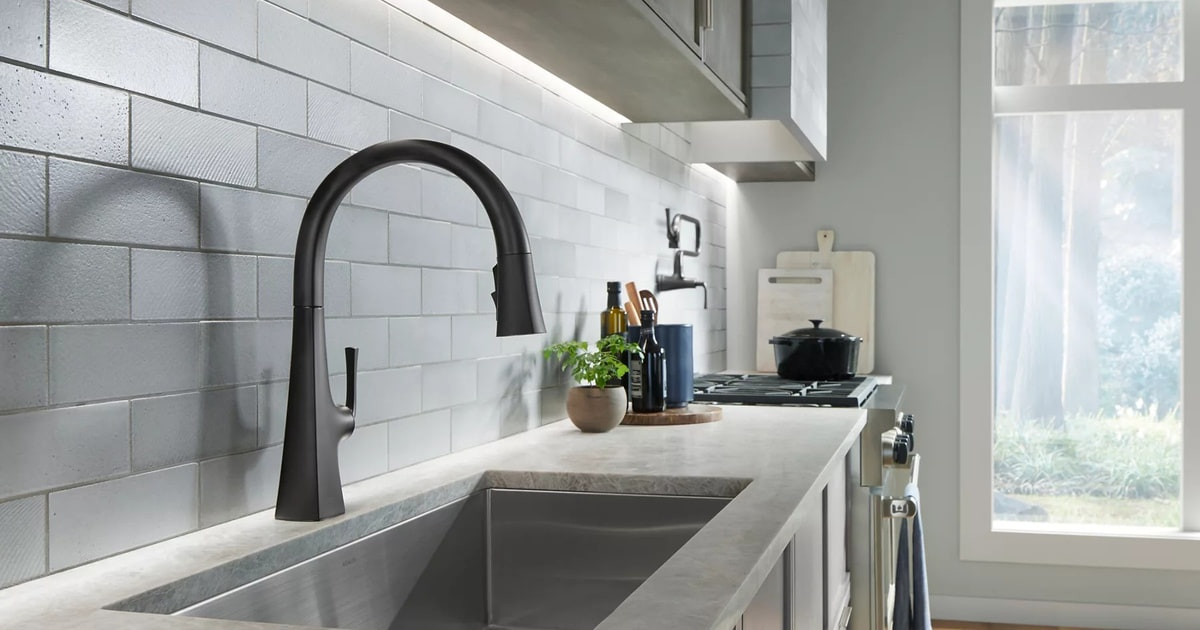
A kitchen faucet is the thing you touch most and think about least. You grab it with wet hands, greasy hands, a stockpot hooked in one arm. A pull-down model helps because the spray head comes to the mess instead of the other way around. You can rinse the far corner of a double basin, knock rice out of a colander, and fill a pot that would never fit under the spout. Once you've lived with one, a fixed spout feels like a downgrade.
No faucet solves hard water. If your tap runs mineral-heavy, every finish here will spot, and every aerator eventually clogs and needs a soak in vinegar. Hoses are the other weak point. Even good ones drag a little after a few years, and weighted return systems let the head sag. Nearly every brand also relies on a cartridge you'll swap once in the faucet's life. Plan for that instead of hoping you'll dodge it.
So the real question isn't which faucet is flawless. It's which one fits your sink, your water, and how much you actually cook. A single-hole sink narrows things fast, and a three-hole sink usually just needs the deck plate that comes in the box. If you scrub a lot of baked-on pans, spray power matters more than looks. We think that the Moen Arbor 7594SRS is the best pull-down kitchen faucet for most people, and that the Delta Leland is the one to buy if splashback drives you up the wall.
Everything we recommend

Strong spray, easy parts, and a head that stays docked

Far less splashback, if you cook messy and clean often

Solid build and a tall spout, with fewer spray tricks

The best-feeling hardware here, with a shorter warranty
At a glance
| Product | Spray Modes | Installation | Price | |
|---|---|---|---|---|
| Moen Arbor Spot Resist Stainless One-Handle PulldownTop pick | Power Boost | 1 or 3-Hole | $262.99 |
| Delta Leland Brushed Nickel Kitchen FaucetRunner-up | ShieldSpray | 1 or 3-Hole | $204.96On sale |
 | KOHLER K-24982-2MB Purist® Semi-Professional Pull-Down Kitchen SinkAlso consider | — | — | $831.93 |
| KRAUS Oletto Single Handle Pull Down KitchenBudget pick | — | Single Hole | $214.95 |
 | Moen Align Spot Resist Stainless Pulldown KitchenAlso consider | Power Clean | Single Hole | $399 |
 | Delta Essa Brushed Nickel Kitchen Faucet withAlso consider | — | 1 or 3-Hole | $135.82 |
 | Pfister Stellen Kitchen Faucet with Pull DownAlso in lineup | 3 Settings | 1 or 3-Hole | $263.99 |
 | GROHE 32665DC3 Concetto Pull-Down Kitchen Faucet withAlso in lineup | Dual Function | Single Hole | $592.60 |
 | American Standard 18SB.9332211.075 Edgewater Zero Radius DualAlso in lineup | — | — | $640.25 |
| hansgrohe Talis S² Stainless Steel High ArcUpgrade pick | — | — | $557On sale |
How we picked
Spray that works. We compared spray modes across spec sheets and published reviews, looking for more than a token second setting. A useful pull-down gives you an aerated stream plus at least one mode with real force behind it, and a pause or boost is a genuine upgrade.
Docking and hose. We favored magnetic docking over weighted-hose returns, because owner feedback across brands points to sag as the failure people notice first. Where a faucet uses a counterweight, we said so plainly.
Finish and hard water. We read manufacturer finish claims against what owners report in mineral-heavy areas. PVD and spot-resistant coatings cleaned up with a wipe; polished chrome and plain brushed nickel needed more attention.
Parts and warranty. A faucet outlives its cartridge, so we weighted how easy replacements are to find and what the warranty actually covers. Lifetime coverage from a brand stocked at every home center beats a longer spec sheet.
Install difficulty. We looked at what ships in the box — deck plates, pre-attached supply lines, quick-connect hoses — since that's what decides whether a single-hole swap takes half an hour or half a Saturday.
Top pick
Strong spray, easy parts, and a head that stays docked
Moen Arbor Spot Resist Stainless One-Handle Pulldown
The Arbor is a high-arc, single-handle pull-down that fits a one- or three-hole sink and holds its spray head with a magnet instead of a tired counterweight. A button on the head kicks the stream up when you're filling a pot or blasting a crusted pan.
$262.99fromAmazonPower Boost is the button you'll actually use. Press it and the faucet pushes a faster, harder stream, which is exactly what you want when a stockpot is filling or dried egg is welded to a skillet. The rest of the time you're on a normal aerated stream that doesn't soak the counter. It's a small thing. But it's the difference between standing there waiting and getting on with dinner.
The Reflex docking holds, and it keeps holding. Magnets don't fatigue the way a hose counterweight does. Pull the head down, let go, and it snaps back flush instead of hanging an inch proud of the spout. Anyone who's owned an older weight-return faucet knows the droop we mean. It's the most common way a pull-down goes sour, and this design mostly sidesteps it.
Spot Resist is the finish to pick if your water is hard. It won't stop mineral deposits from forming, but it lets you wipe them away with a damp cloth instead of reaching for a descaler. Fingerprints come off the same way. If your kitchen sees a lot of hands and a lot of hard water, that's the gap between a faucet that looks cared for and one that looks neglected by Wednesday.
Parts are the quiet reason we picked Moen. A faucet is a ten-to-twenty-year purchase, and at some point the cartridge starts dripping. Moen cartridges sit on the shelf at most hardware stores and home centers, and the brand's warranty covers parts and finish. That matters more than any spray mode. A faucet you can fix beats a faucet you have to replace.
It fits whatever sink you already have. The escutcheon is in the box, so a three-hole deck gets covered without a trip back to the store, and a single-hole sink just skips it. Moen also certifies its residential faucets to NSF 61 and the federal drinking water rules, which is worth knowing if you fill water bottles at the tap.
Flaws but not dealbreakers
There's no touch or motion activation on this version. Moen sells sensor Arbors, and they cost more. If you want to start water with a wave while your hands are covered in raw chicken, go look at those instead. For everyone else, bumping the lever with the back of a wrist does the same job and never needs batteries.
The hose needs breathing room under the sink. The counterweight travels through whatever you've stashed below, and a crowded cabinet will stop the head from retracting all the way. Clear a lane before you install, and don't wedge a bin against the supply lines. Owners who skip that step usually end up blaming the faucet.
The Arbor is covered by Moen's limited lifetime warranty on parts and finish.
Runner-upOn sale
Far less splashback, if you cook messy and clean often
Delta Leland Brushed Nickel Kitchen Faucet
Delta's ShieldSpray wraps a hard cleaning jet inside a ring of water, so the splatter stays in the sink. Otherwise it's a conventional single-lever pull-down with magnetic docking, a deck plate in the box, and a valve Delta rates to last twice the industry standard.
$204.96fromAmazonList priceShieldSpray is the one spray mode here that changes how you clean. The idea is simple: a forceful jet in the middle, a curtain of droplets around it. Delta rates it at roughly 90 percent less splatter than a standard spray. Aim it at a crusted casserole dish and the mess stays in the basin instead of on your shirt. If you soak pans because spraying them makes a bigger mess, this is the fix.
The DIAMOND Seal valve is built to outlast everything around it. Delta uses a diamond-coated ceramic disc and cuts down the internal connection points where leaks start, then rates the whole thing to last twice as long as the industry standard. In plain terms, the drip you'd normally get somewhere around year eight probably never shows up.
Magnetic docking keeps the head flush and quiet. The magnet pulls the sprayer into its seat instead of relying on a weight to drag it home. You get a clean line at the spout and no slow slide over the years. It also means you can yank the hose out hard, mid-rinse, without worrying about knocking the dock out of alignment.
It fits either sink, and the finish is built to take abuse. The Leland covers one-hole and three-hole eight-inch-center installs, with the deck plate and a gasket seal included. Delta tests its Brilliance finishes for corrosion resistance to at least twice industry standards, and third-party certifies them against cracking, peeling and color shift.
Flaws but not dealbreakers
The Arctic Stainless finish spots faster than a PVD coating. In a hard-water kitchen you'll see mineral haze on the spout within a day or two if nobody wipes it. It cleans off easily enough. But it wants a quick pass with a cloth after heavy use, which the Moen and hansgrohe finishes tolerate better.
The shape is traditional, not minimal. The curved spout and lever read classic, which is great in a transitional kitchen and out of place in a stark modern one. If you're matching flat-front cabinets and square hardware, this will look like the odd piece on the deck.
Delta backs the Leland with a limited lifetime warranty covering mechanical parts and finish.
Budget pick
Solid build and a tall spout, with fewer spray tricks
KRAUS Oletto Single Handle Pull Down Kitchen
The Oletto is a single-handle pull-down with a brass body, a spout that swivels a full 360 degrees, and a head that flips between an aerated stream and a spray. The water lines come pre-attached, so a straightforward single-hole swap goes fast.
$214.95fromAmazonBrass is the part of this faucet you can't see and should care about. Plenty of inexpensive faucets use zinc alloy bodies that corrode at the joints within eight to twelve years. Brass doesn't do that. It's the reason this one has a shot at outliving your cabinets, and it's unusual at this end of the market.
The spout clears a real stockpot. The faucet stands about 16 5/8 inches tall with roughly 8 3/4 inches of spout height and nearly 9 inches of reach. That's enough room to drop a big pot in the basin and fill it without tilting anything. The 360-degree swivel helps if you're working across a double bowl.
The nozzles wipe clean with a fingertip. The sprayer holes are soft rubber, so limescale rubs right off instead of hardening into a clogged, sideways-squirting mess. If you've ever thrown out a faucet head over that, you know how much it matters. Hard-water households should treat this as a real feature, not a footnote.
Everything you need is in the box. Kraus ships it with the water lines attached, a quick-connect sprayer hose, mounting hardware and a snap-on counterweight. There's no hunting for adapters mid-install with the water shut off. For a first-time DIY swap on a single-hole sink, that's most of the battle.
Flaws but not dealbreakers
There's no magnetic docking. The head returns on a counterweight, and counterweights lose the argument with gravity eventually. Hoses stretch and soften with years of hot water, and the sprayer starts sitting a little low. You can usually reposition the weight to buy time, but it's the flaw most likely to bug you down the road.
You get two spray modes, and that's the whole menu. Stream and spray, nothing else. There's no pause for switching tasks mid-rinse and no boost for a fast fill. If you cook constantly and lean on a pause button, this will feel thin compared with the Pfister or the Delta picks.
Kraus covers the Oletto with a limited lifetime warranty supported by a U.S.-based service team.
Upgrade pickOn sale
The best-feeling hardware here, with a shorter warranty
hansgrohe Talis S² Stainless Steel High Arc
The Talis S² is a high-arc pull-down in a PVD stainless finish, with a spout that swivels 150 degrees and a magnetic dock. A button right at the spout switches between a clear laminar stream for filling pots and a soft shower for rinsing produce.
$557fromAmazonList priceThe finish is the reason to want this one. It's a PVD stainless look, bonded rather than lacquered, and it shrugs off the scratches that dull a coated brass faucet over a decade. It also sheds mineral film more readily than polished chrome. If the faucet is meant to be a visible piece of the kitchen rather than a utility, this is the one that ages best.
Two genuinely different jets, switched at the spout. The aerated stream fills a pot quickly. The soft shower is gentle enough for strawberries and herbs that a hard spray would bruise. You change modes with a button under your thumb while the head is already in your hand, so you're not fumbling with a collar or a slider mid-rinse.
The 150-degree swivel opens up the sink. You can push the spout aside to load a big roasting pan, then swing it back over the drain. In a double-bowl setup that's the difference between reaching and just rotating. Combined with the high arc, it makes the awkward jobs — sheet pans, tall pitchers, a full colander — a lot less awkward.
Magnetic docking on a hose that's designed to behave. The head seats itself instead of drifting, which keeps the whole fixture looking deliberate rather than half-collapsed. Published reviews of hansgrohe's pull-downs consistently single out hose retraction as the part that stays right over time, and it's the most common complaint owners have about lesser faucets.
Flaws but not dealbreakers
The warranty is five years, not lifetime. Moen, Delta and Kraus all promise more on paper. Five years is respectable, but it's a real gap when you're paying a premium, and it's worth weighing against a domestic brand that will hand you a free cartridge in year twelve.
Parts mostly come from specialty suppliers. You won't find a hansgrohe cartridge in the plumbing aisle of your local hardware store. Ordering online is fine when you plan ahead and miserable when the faucet is dripping on a Sunday. Buy a spare cartridge with the faucet if you hate that kind of scramble.
The look is strictly modern. The geometry is clean and a bit severe. In a farmhouse or traditional kitchen it'll read as a mismatch no matter how good the metal is.
hansgrohe backs the Talis S² with a five-year warranty.
Who this is for
This guide is for anyone replacing a kitchen faucet on a standard residential sink, whether that's a full remodel or a Saturday swap because the old one drips. Pull-down models suit deep single-basin sinks and anyone who fills big pots or rinses a lot of produce. If your overhead cabinets sit low, measure first — a high-arc spout can crowd the space, and commercial-style coil designs need even more room. Renters should check with a landlord before touching the supply lines, though a like-for-like single-hole swap is usually the easiest fixture change in the whole apartment.
You should skip a new faucet if your current one still shuts off cleanly and only spots up. A ten-dollar aerator and a cartridge will fix most of what people replace faucets over. We also stayed inside pull-down territory here: no pull-out spouts, no bar or prep faucets, no wall-mount pot fillers, and no touchless-only models. And we didn't rank sinks, even where a listing bundles one.
How we picked
We built this list from manufacturer specifications, published reviews and recurring themes in owner feedback, weighting five things. Spray: a faucet needs an aerated stream plus a mode with real force, and a pause or boost setting earns extra credit. Docking: magnetic docks hold indefinitely, while counterweights let the head sag as the hose softens, so we called that out wherever it applies. Finish: in hard water, PVD and spot-resistant coatings wipe clean while polished chrome clouds, and that decides how the faucet looks in year three. Parts and warranty: cartridges fail eventually, so we favored brands whose replacements sit on a shelf nearby and whose coverage includes finish as well as function. Installation: deck plates, pre-attached lines and quick-connect hoses in the box are the difference between a quick job and a long one.
Other pull-down kitchen faucets worth considering
If you want the simplest possible install: The Delta Essa Brushed Nickel Kitchen Faucet with ($135.82) — The Delta Essa is the least intimidating faucet here to put in yourself. It's built for a single deck hole, the optional deck plate for three-hole sinks is included, and the gasket seal cuts down the odds of a slow drip under the cabinet. You get the same DIAMOND Seal valve and corrosion-tested Brilliance finish as the Leland, plus magnetic docking to keep the head seated. What you give up is ShieldSpray, so cleanup splashes more, and the reach is a bit short for very wide double bowls. For a straight swap of a dead faucet, it's the low-drama choice.
If you want a commercial-style faucet as the centerpiece: The KOHLER K-24982-2MB Purist® Semi-Professional Pull-Down Kitchen Sink ($831.93) — Kohler's Purist Semi-Pro brings the restaurant-kitchen look home, with an exposed spring coil, extra clearance overhead and an oversized sprayhead that moves serious water. The sweep mode is the standout: a wide fan that pushes vegetable trimmings across the basin instead of nudging them. Kohler's DockNetik magnet is tuned for the heavier head, so it still seats properly. But this is the most expensive faucet in the guide and the least practical for small jobs — the head feels clumsy when all you want is a glass of water. Measure your cabinet clearance before you commit, and consider having it installed.
If you want the most minimal look: The Moen Align Spot Resist Stainless Pulldown Kitchen ($399) — The Moen Align is the design piece of the lineup: a slim spring-style spout, a single lever and no decorative curves anywhere. It shares the Arbor's Spot Resist Stainless finish and the Duralock quick-connect system, and Moen rates its Power Clean spray at about 50 percent more spray power than its faucets without it. Hose reach is generous too. The catch is that you're paying mostly for the silhouette — there's no touch or motion activation at this tier, and the skinny handle gives you fewer places to grip with a soapy hand. Worth it if the kitchen's whole look hangs on this fixture.
The competition
Here's what the research turned up beyond our picks. This isn't every pull-down faucet on the market — it's the set we compared, drawn from widely reviewed models across the major brands. A faucet landing here usually isn't bad. It just lost on one specific thing to something else in the guide.
The Pfister Stellen Kitchen Faucet with Pull Down ($263.99) — The Pfister Stellen packs more spray modes than its price suggests: stream, spray and a pause that holds water while you reposition a pot or swap a cutting board. It uses a ceramic disc valve, the high-arc spout clears tall pots, and the box covers both single-hole and three-hole installs. Two things kept it out of the picks. It returns the head on a counterweight rather than a magnet, and this version comes in polished chrome, which is the worst finish you can choose in a hard-water kitchen — mineral haze etches it fast. Pfister's parts also aren't as easy to walk into a store and buy as Moen's or Delta's. If you specifically want a pause button and chrome suits your hardware, it still makes sense.
The GROHE 32665DC3 Concetto Pull-Down Kitchen Faucet with ($592.60) — The GROHE Concetto is the best-engineered faucet here on paper. The German-made ceramic disc valve is built for smooth, drip-free operation over decades, the SpeedClean rubber nozzles let you rub limescale off with a fingertip, and the lead-free inner waterways keep the water off metal entirely. At 1.75 GPM it uses meaningfully less water than the federal ceiling without feeling weak. So why isn't it a pick? The sprayhead does two things — stream and spray — and that's a lot to give up when the Delta and Moen picks do more. Replacement parts also tend to come from plumbing supply houses rather than the aisle down the street. Buy it if mechanical smoothness and water use matter more to you than spray modes.
Installation notes
Count your sink's holes before you order. A single-hole faucet on a three-hole deck needs an escutcheon, and most of our picks include one, but not all faucets do. Then measure twice more: the height from the deck to the underside of your cabinets, and the height of your tallest pot. You want a couple of inches of clearance above the pot to fill it comfortably. Under the sink, clear a path for the hose and counterweight so nothing blocks retraction, and don't cram a bin against the supply lines afterward. Most single-hole installs take a confident DIYer half an hour to an hour with a basin wrench. Commercial-style coil faucets are the exception — those are worth handing to a plumber. Finally, shut off both supply valves and test them before you loosen anything.
Questions we get
What's the difference between a pull-down and a pull-out faucet?
A pull-down has a taller arc and the hose pulls straight down into the basin, which suits deep single-bowl sinks and big pots. A pull-out sits lower and the hose extends outward toward you, which helps if you have low cabinets or need to reach a pot on the counter. Pull-downs dominate new kitchens and offer more spray options. Pull-outs are the better answer only when overhead clearance is tight.
Are pull-down faucets hard to install yourself?
Not really. Most install through a single deck hole with quick-connect supply lines and snap-in hardware, and a basin wrench is usually the only special tool you need. Budget half an hour to an hour if you're comfortable working under a sink. The exception is a commercial-style faucet with a spring coil, or a deck with an odd hole configuration — those are worth a plumber's time.
Is magnetic docking actually better than a weighted hose?
Yes, and the gap widens with age. A magnet keeps its grip indefinitely, so the head sits flush in year ten the same as it did on day one. A counterweight depends on a hose that stretches and softens with repeated hot water and use, which is why older weighted faucets start hanging low. You can often reposition the weight to compensate, but you'll be doing it again.
How long should a pull-down faucet last?
A brass-body faucet with a ceramic disc cartridge should run fifteen to twenty-five years in a normal household. Zinc alloy bodies tend to start corroding at the joints closer to eight to twelve years. The single biggest factor in longevity isn't the faucet — it's whether you can buy the cartridge when it finally drips. That's why we lean toward brands whose parts are stocked widely.
Does flow rate matter, or is it just a sticker?
It matters more than people expect. The federal maximum is 2.2 gallons per minute, and WaterSense certification means 1.5 or less — a difference of hundreds of gallons a year for an average household. Modern aerators mix air into the stream, so a lower-flow faucet still feels full and strong. If your utility bill or a drought restriction is on your mind, prioritize it.
My water is hard. Which finish should I choose?
Skip polished chrome and plain brushed nickel — mineral deposits cloud both within months of daily use. Spot-resistant stainless and PVD-bonded coatings are the ones designed to release deposits when you wipe them. Whatever you pick, plan on soaking the aerator and sprayhead in vinegar once or twice a year. Rubber-nozzle sprayheads make that job far easier.
Why you should trust us
For this guide:
- We read manufacturer specification sheets and listing details for every faucet here, comparing spray modes, valve types, spout heights, flow rates and what ships in the box.
- We compared published reviews and recurring themes in owner feedback, paying particular attention to hose sag, finish spotting and cartridge replacement.
- We weighted parts availability and warranty terms heavily, because a faucet's real lifespan depends on whether you can fix it a decade from now.
- We read owner reviews on every listing, weighted toward the critical ones, because that is where the recurring failures show up.
- We have a systematic way of automatically fetching the latest prices, so the numbers on this page stay current.
- This is a research-focused guide, so the team may not own every product listed — though we often do own the top winners, which gives us extra context for the recommendations.
- We don't accept free products, and the retailer commission never changes which product we recommend.
Sources
Best Kitchen Faucets of 2026, Wirecutter / NYT
Best Pull-Down Kitchen Faucets, Bob Vila
Best Kitchen Faucets Tested by Experts, Forbes Home
Kitchen Faucet Reviews & Ratings, Consumer Reports
Best Kitchen Faucets Reviewed, This Old House
WaterSense Labeled Faucets, U.S. EPA
Moen Arbor 7594ESRS Product Specs & Warranty, Moen
Delta ShieldSpray Technology Overview, Delta Faucet
Amazon product listings and owner reviews for all 10 products
Manufacturer specification pages for each product
Some passages in this guide may be paraphrased with AI help. Prices are refreshed automatically.
More like this.
Continue exploring home reviews and recommendations.

The Best Outdoor Faucet Covers
An outdoor faucet cover is one of the smallest purchases you'll ever make that can save you thousands. When a spigot freezes, the ice expands inside the…

The Best Faucet Aerators
A faucet aerator is a small screen that threads into the end of your spout, and it's one of the simplest ways to cut your water bill. Swapping a standard…

The Best Packable Down Jackets for Travel
A packable jacket earns its place in your bag by disappearing. You want something that squashes down to the size of a loaf of bread, sits in the bottom of…

The Best Pull-Out Cabinet Organizers
A base cabinet is mostly dead space. You've got 22 inches of depth, and you can comfortably reach maybe 14 of them. Everything past that turns into a…

The Best Doorframe Pull-Up Bars
A pull-up bar is one of the simplest ways to build real upper-body strength at home. It hooks over your door molding, comes down in seconds, and doesn't…

The Best No-Pull Dog Harnesses
A dog that pulls turns a walk into a workout. You brace, they lean, and by the third block your shoulder aches and nobody's having fun. A good no-pull…