The Best Travel Backpacks for Carry-On
A good carry-on backpack ends the part of travel you dread. No baggage claim, no gate-check roulette, no wondering whether your bag made the connection. You walk off the plane and you're done. But the bag has to earn that. It needs to slide into an overhead bin without a fight, open wide enough that you can find a charger without unpacking everything, and sit on your shoulders comfortably during a long walk between terminals. Most bags nail one of those three. The good ones nail all of them.
Here's the honest catch: no single backpack clears every airline. US carriers publish a 22 by 14 by 9-inch limit, which comfortably fits a 40L pack. Ryanair's carry-on allowance is 55 by 40 by 20 cm, and a stuffed 45L bag won't make that. So you're always choosing a compromise. Bigger packs give you room for two weeks of clothes but risk a gate agent's sizer on budget European routes. Smaller packs travel anywhere and force you to pack lean. There's no bag that dodges this.
The other trade-off is weight against comfort. Real suspension — a load-lifting frame, a padded hip belt, a ventilated back panel — costs you pounds you'd rather spend on clothes. Skip it and a fully loaded pack digs into your shoulders by the second concourse. The packs we'd recommend land in the middle. We think that the Osprey Farpoint 40L is the best carry-on travel backpack for most people, and that the Cotopaxi Allpa 35L is the one to buy if you fly budget European carriers with strict sizers.
Everything we recommend

Real suspension that hides away when you board

Tougher fabric and a size that clears strict sizers

Expands to 45L, shrinks to 35L, and shrugs off rain
Light, three ways to carry it, and it fits anywhere
At a glance
| Product | Capacity | Weight | Price | |
|---|---|---|---|---|
| Osprey Farpoint 40L Men's Travel BackpackTop pick | 40L | — | $192.25On sale |
| Peak Design Travel Backpack 45LUpgrade pick | 35-45L | — | $299.95 |
 | NOMATIC 40L Travel Bag- Convertible Duffel/BackpackAlso consider | 40L | 3.42 lbs | $329.99 |
| Cotopaxi Allpa 35L Travel PackAlso great | 35L | — | $229.95 |
 | Away The Everywhere Zip BackpackAlso consider | — | 2.45 lbs | $198 |
| Patagonia Black Hole Mini MLC 30LBudget pick | 30L | 2 lb 13 oz | $255 |
How we picked
Airline size compliance. We compared each pack's published external dimensions against the carry-on limits airlines actually post — 22 by 14 by 9 inches at Delta, United and American, and 55 by 40 by 20 cm at Ryanair. Any pack that couldn't clear a major carrier's sizer at full capacity had to earn its place another way.
Empty weight. We treated anything under about 3.5 pounds as the target, because every pound of bag is a pound of gear you leave behind. Spec sheets gave us empty weights; we weighed those against what each pack's suspension and materials buy you in return.
Access and packing style. We prioritized full clamshell and wrap-around zip openings over top-loading designs, based on the consistent theme in published reviews and owner feedback that suitcase-style access makes security lines and hotel-room repacking dramatically less painful.
Harness and load carry. We looked for adjustable torso length, a padded hip belt that genuinely transfers weight, and a stowaway harness so the pack reads as luggage overhead. Owner feedback repeatedly flags shoulder pain on packs that skip these.
Shell durability. We favored higher-denier and laminated fabrics — 900D tarpaulin, 400D weatherproof nylon, TPU-film laminate — over standard 300D nylon, since manufacturer abrasion specs and long-term owner reports both point the same direction on which shells survive years of bin edges.
Top pickOn sale
Real suspension that hides away when you board
Osprey Farpoint 40L Men's Travel Backpack
The Farpoint 40L carries like a hiking pack when you need it to, then zips its harness away so it looks like ordinary luggage overhead. It's light for a fully featured 40L bag, and it fits the published carry-on limits of every major US airline.
$192.25fromAmazonList priceIt's the rare travel pack with a real suspension system you can hide. The Farpoint has a load-lifting frame, an adjustable torso length and a padded hip belt — the kind of hardware you'd expect on a trekking pack. Then the whole harness zips away behind a panel. That matters more than it sounds. You get genuine comfort on a long walk to the gate, and a clean, snag-free profile when you shove it into a bin.
At about 3.3 pounds empty, it leaves you the most room to pack. Weight budget is the whole game with carry-on-only travel. Every pound the bag itself eats is a pound of clothes you don't bring. The Farpoint is roughly two pounds lighter than the Peak Design 45L, and you'll feel that difference by the third day of a trip. OutdoorGearLab ranked it first overall against 11 competitors, citing exactly this comfort-to-weight balance.
The 21.7 by 13.8 by 9.1-inch footprint clears US airline sizers. Delta, United and American all publish a 22 by 14 by 9-inch maximum. The Farpoint sits just under it on every axis. You're not gambling on a sympathetic gate agent. Osprey's own listing hedges — always check your airline — but for domestic US flying, this is about as safe as a 40L pack gets.
The organization is focused rather than exhaustive, which is the right call. You get a direct-zip 3-1-1 pocket for liquids, a front pocket for the stuff you grab constantly, water bottle pockets, dual internal compression straps and a big mesh lid pocket. That's enough structure to keep a week of gear sorted. It's not so much that you forget which of 20 pockets holds your passport.
The WingJacket compression pulls a half-packed bag back into shape. Under-packing is its own problem — a floppy bag sags off your back and shifts around. The compression system cinches the load tight against the frame. If you're doing a three-day trip in a 40L pack, it still carries like it was built for that.
Flaws but not dealbreakers
It's cut for a men's fit, and torso length is the thing to check. Osprey sells a women's-specific version under a different name for a reason. The adjustable torso helps, but if you're shorter through the back, the hip belt may not land on your hips where it does the work. Try it loaded before you commit to a long trip.
The laptop sleeve isn't a separate lay-flat compartment. TSA wants your laptop in its own bin at standard lanes, and packs with a dedicated exterior sleeve let you pull it out in one motion. The Farpoint makes you open the main compartment. It's a few extra seconds and a little more fumbling at the checkpoint.
The daypack that expands it costs extra. Osprey designs a companion Travel Daypack that clips to the front, which is genuinely useful for day trips once you've dropped your bag at the hotel. It's sold separately. Budget for it if that's part of your plan.
Osprey backs the Farpoint with its All Mighty Guarantee, which covers repair or replacement for any reason.
Also great
Tougher fabric and a size that clears strict sizers
Cotopaxi Allpa 35L Travel Pack
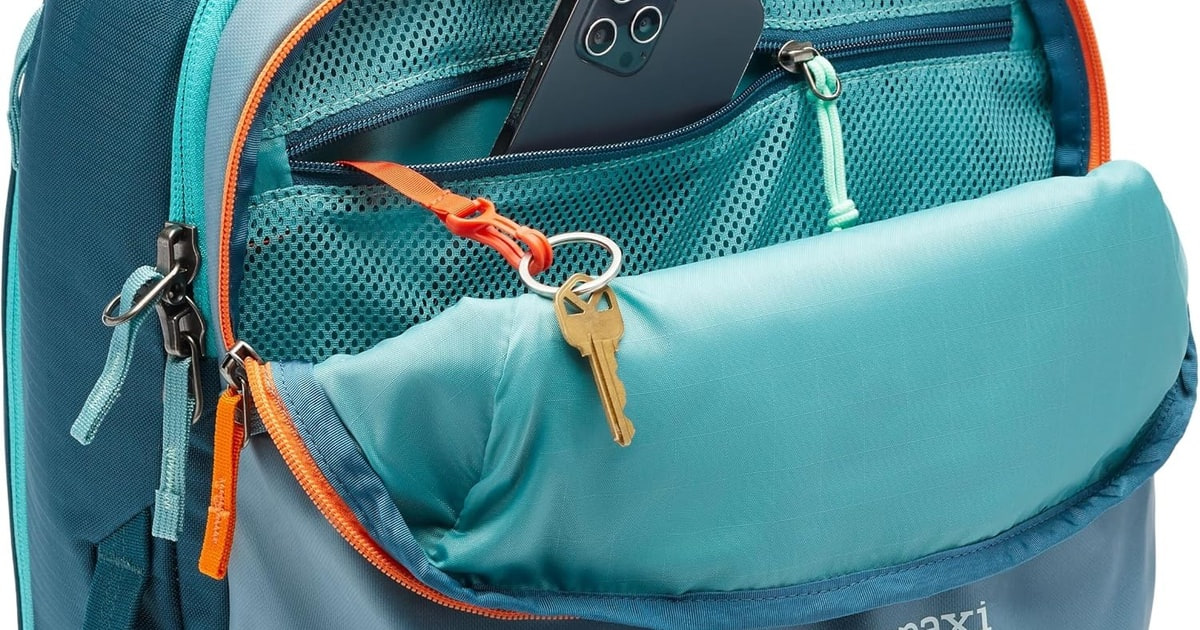
The Allpa 35L wraps a suitcase-style clamshell in 900D tarpaulin that shrugs off scraped-up bin edges and rain. At 19 by 12 by 9 inches, it slips under the tighter carry-on limits that budget European carriers enforce.
$229.95fromAmazonThe 35L size is the safe ceiling for budget international flying. Ryanair's carry-on allowance is 55 by 40 by 20 cm, and easyJet is similarly tight. A packed 45L bag simply won't go. The Allpa's 19 by 12 by 9-inch footprint gives you margin at the sizer. If most of your flying is on carriers that actually measure bags, this is the volume to buy.
The 900D tarpaulin shell is built for abuse that kills ordinary nylon. Cotopaxi rates the fabric at 50,000-plus abrasion cycles — roughly five times what the 300D nylon on entry-level travel packs handles. In practice that means overhead bin rails, gravel guesthouse floors and unexpected rain don't leave marks. Owners consistently point to the shell as the reason these bags stay looking new.
The full-wrap zipper opens it flat like a suitcase, which changes how you pack. You get one large, one medium and one small internal pocket, all visible at once. No digging through a top-loaded tube. Finding a shirt at 6 a.m. in a dark hostel room takes seconds, and repacking after a security check doesn't turn into a project.
The details are the ones frequent flyers actually use. Lockable zippers on the main opening, three grab handles on the side, top and bottom, a roller-bag pass-through strap, a 15-inch fleece-lined laptop sleeve and four exterior webbing loops for gear that won't fit inside. The shoulder straps and hip belt tuck away, and the harness is designed to transfer weight onto your hips.
It weighs under three pounds, which is light for how tough it is. Durable fabric usually means a heavy bag. The Allpa comes in around 2.9 pounds empty, so the abrasion resistance doesn't cost you packing allowance. That combination is unusual at this size.
Flaws but not dealbreakers
Thirty-five liters is genuinely less room, and you'll notice. If you pack for a week without doing laundry, or you travel with bulky layers, this bag will fight you. It's the right size for strict airlines and the wrong size for over-packers. Be honest with yourself about which you are.
The laptop sleeve tops out at 15 inches. A 16-inch MacBook Pro isn't going in. And the sleeve sits inside the main compartment rather than in a dedicated lay-flat panel, so you're opening the bag at security.
The tarpaulin shell holds its shape whether or not it's full. That's great when the bag is packed and less great when it isn't — a half-empty Allpa still takes up a full-size footprint. There's no meaningful compression to shrink it for a short trip.
Upgrade pick
Expands to 45L, shrinks to 35L, and shrugs off rain
Peak Design Travel Backpack 45L
The Peak Design Travel Backpack is the only pack here that meaningfully changes size, going from 35L to 45L depending on the trip and the airline. Its weatherproof 400D recycled nylan shell and multiple access points make it the most flexible bag in this lineup.
$299.95fromAmazonThe expansion is the whole reason to pay up. Most packs are one size forever. This one runs 35L to 45L, so a single bag handles a two-night work trip and a two-week vacation. Cinch it down and it meets the tighter carry-on limits that stricter international carriers enforce. Open it up and you've got real volume for a long trip. Nothing else here does both.
Top, side and rear access means you never dig. Rear access opens the whole pack flat for packing at home. The side panels let you pull a jacket or a camera body out without setting the bag down. The top hatch handles the thing you need mid-flight. If you've ever unpacked half a bag on an airplane floor, you'll understand why this matters.
The weatherproof shell is built for the parts of travel nobody plans for. The 400D recycled nylon canvas is weatherproof, the #10 UltraZip is oversized and the bottom liner is reinforced. That's the combination that survives a rainy walk from the train station and a bag tossed onto a wet curb. Peak Design builds this stuff to last, and the hardware reflects that.
The carry hardware is thought through end to end. Shoulder straps and the hip belt tuck away for gate-checking or bin-stuffing. There's a luggage pass-through, 360-degree handles so you can grab it from any angle, and hidden external carry straps. Moving through a terminal with it is genuinely easier than with a bag that only has a top handle.
Side pockets expand for bottles or a tripod. This is a photographer's pack as much as a traveler's, and the external carry options reflect that. If you bring a camera, a tripod or anything else awkwardly shaped, this bag has somewhere to put it.
Flaws but not dealbreakers
It's heavy — about 5.3 pounds empty. That's roughly two pounds more than the Farpoint, and those two pounds come straight out of your packing allowance. On weight-restricted international carriers, that's a real constraint, not a rounding error.
It's the most expensive pack here by a wide margin. The features justify it if you fly constantly or carry camera gear. If you take three trips a year, you're paying for flexibility you won't use.
The internal packing cubes are sold separately. Peak Design's system works best with its own cubes, and the pack's organization feels sparse without them. Factor that into what you're actually spending.
Budget pick
Light, three ways to carry it, and it fits anywhere
Patagonia Black Hole Mini MLC 30L
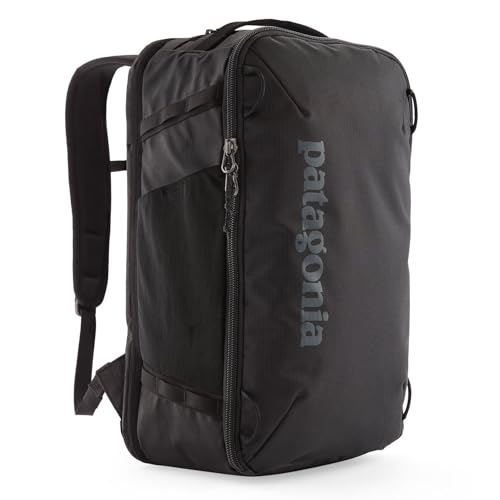
The Black Hole Mini MLC 30L is the smallest and most flexible bag here — it converts between backpack, shoulder bag and briefcase. At 30L it clears the tightest European carry-on limits without you having to think about it.
$255fromAmazonThirty liters means you stop worrying about sizers entirely. At 20 by 12 by 7 inches, this bag fits limits that turn away 40L packs. Ryanair, easyJet, regional jets with tiny bins — none of it is a problem. If your travel is mostly short international hops on budget carriers, that peace of mind is worth more than the extra liters.
Three carry modes make it a different bag depending on the day. Backpack for the walk to the gate, cross-body shoulder bag for a train, briefcase for walking into a meeting. Most packs make you choose one identity. This one adapts, which is why it works for both a weekend trip and a client visit.
The laptop carrier zips open and lies flat for TSA. This is the feature the Farpoint and Allpa both lack. You unzip a dedicated tech compartment, it lies flat, and your 15-inch laptop goes into a bin without you excavating the main compartment. At a busy checkpoint that's the difference between smooth and flustered.
It's built from recycled ripstop with a TPU-film laminate. Patagonia's Black Hole line uses 100% recycled polyester and a recycled TPU laminate, and the company backs its gear with the Ironclad Guarantee. Its Worn Wear repair program serviced over 110,000 items in 2024. If you'd rather repair a bag than replace it, that infrastructure actually exists.
At about 2 pounds 13 ounces, it's the lightest bag here. Less bag weight means more of your allowance goes to what you're bringing. On carriers that weigh cabin bags, that margin matters.
Flaws but not dealbreakers
Thirty liters is a real constraint, not a marketing number. This is a long-weekend bag, or a full-week bag if you're disciplined and do laundry. Pack a winter coat and you've used a third of it. Know what you're signing up for.
There's no meaningful hip belt. Once a loaded bag crosses about 20 pounds, a hip belt is what saves your shoulders. This one carries on straps alone. At 30L you probably won't hit that weight, but if you do, you'll feel it.
The organization is minimal — two interior pockets and an exterior mesh pocket. Compared to the Allpa's clamshell or the Nomatic's compartment grid, this is a mostly open bucket. Packing cubes fix it, but you'll need them.
Who this is for
This guide is for anyone who wants to stop checking bags. That includes business travelers who need one pack that works for a two-night trip and a two-week one, first-timers switching to carry-on-only, digital nomads hauling a laptop and a nest of cables, and light packers flying budget European routes where the sizer is real. If you already own a bag that fits your airline and doesn't hurt your shoulders, you don't need a new one. Replace yours when the zippers fail or when the size stops matching where you fly.
We're covering dedicated travel backpacks in the 30L to 45L range — packs designed around airline bin dimensions, with luggage pass-throughs, stowable harnesses and suitcase-style access. We're not covering hiking packs, which top-load and have external straps that snag, or wheeled luggage, or personal-item bags meant to slide under a seat. If you're packing for more than about two weeks without laundry, no bag here will be enough, and you should be looking at checked luggage instead.
How we picked
Size compliance: we checked each pack's published dimensions against what Delta, United, American and Ryanair actually post, since a bag that fails a sizer fails at everything else too. Weight: we aimed under about 3.5 pounds empty, because bag weight comes straight out of your packing allowance. Access: clamshell and wrap-around openings beat top-loaders for security lines and repacking, a point published reviews and owner feedback agree on. Carry comfort: adjustable torso, a hip belt that transfers real weight, and a harness that stows away so the pack looks like luggage overhead. Durability: higher-denier and laminated shells — tarpaulin, weatherproof nylon, TPU laminate — over standard nylon, based on manufacturer abrasion specs and long-term owner reports. Laptop handling: a dedicated lay-flat sleeve speeds up TSA screening, which advises pulling laptops into a separate bin at standard lanes.
Other travel backpacks for carry-on worth considering
If you want the most organized interior for tech and shoes: The NOMATIC 40L Travel Bag- Convertible Duffel/Backpack ($329.99) — The Nomatic 40L converts between duffel and backpack and packs in more than 20 dedicated compartments — separate spaces for shoes, liquids and tech, plus a luggage pass-through strap. If you're a digital nomad juggling chargers, adapters, drives and a laptop, that structure keeps everything findable without a single packing cube. The silhouette is low-profile enough to carry into a meeting without looking like you came from a trailhead. What you give up is suspension: at roughly 3.4 pounds it's not heavy, but the harness is closer to a commuter bag's than a travel pack's, so a fully loaded 40L will sit on your shoulders rather than your hips.
If you want a personal-item bag that looks like an office bag: The Away The Everywhere Zip Backpack ($198) — Away's Everywhere Zip Backpack is sized as a personal item at 12 by 5.9 by 17.7 inches, so it fits under the seat rather than in the bin. Water-repellent nylon with leather trim, a full wraparound zip, a padded 16-inch laptop pocket with a magnetic locking zipper, a hidden back zip pocket for your passport and a built-in trolley sleeve. It's the cleanest-looking bag here by a wide margin, and at about 2.45 pounds it's light. But it's a personal item, not a carry-on — you won't fit a week of clothes in it. Buy it as your second bag or your commuter, not your only one.
The competition
This is what our research surfaced across published reviews, manufacturer spec sheets and the recurring themes in owner feedback — not a survey of everything on the market. The one-bag travel category moves fast, and there are good packs from smaller brands we didn't have listing data for. Every product below is worth considering for the right traveler; each lost to a pick on a specific point, and we've said which.
Fit, sizing and airline compliance
Before your first trip, pack the bag the way you actually travel and check two things. First, put it in a home sizer or measure it loaded — packs bulge, and a 40L bag that measures fine empty can fail a gate sizer when it's stuffed. Second, walk around the house with it for 20 minutes. Adjust the torso length so the hip belt sits on your hip bones, not your waist, then tighten the load lifters. If your shoulders carry the weight instead of your hips, the fit is wrong. Airline rules also differ by carrier and route, so check the specific policy before you fly a budget European carrier — those are the ones that measure. When the bag gets dirty, spot-clean with mild soap and let it air dry rather than putting it in a machine, which breaks down water-repellent coatings.
Questions we get
What size backpack counts as a carry-on on most airlines?
Delta, United and American all publish the same maximum: 22 by 14 by 9 inches, or 55.9 by 35.6 by 22.9 cm. That works out to roughly 40 to 45 liters when a bag is realistically packed. European budget carriers are stricter — Ryanair's carry-on allowance is 55 by 40 by 20 cm, which makes 32 to 35 liters the safe ceiling if that's where you fly.
Is 40L or 45L better for a carry-on travel backpack?
Forty liters is the safer choice. It clears every major US airline's sizer with margin and still holds about a week of clothes. Forty-five liters gives you more room for long trips or bulky layers, but a fully packed 45L bag will fail stricter international sizers. If you buy 45L, get one that compresses down.
Do I need to remove my laptop from a travel backpack at security?
At standard TSA checkpoint lanes, yes — laptops go in a bin separately from your bag. That's why a dedicated lay-flat laptop compartment is worth looking for. You unzip one panel, the sleeve opens flat, and the laptop comes out in a second. If your laptop lives inside the main compartment, you're unpacking to reach it.
Are clamshell travel backpacks better than top-load designs for flying?
For flying, yes. A clamshell opens flat like a suitcase, so you see everything at once and can repack after a security check without emptying the bag onto a bench. Top-loaders make you dig, which is fine on a trail and miserable in an airport. Every pack we recommend opens either fully or wide.
Can I use a hiking backpack as a carry-on instead of a travel pack?
You can, but it's a worse tool for the job. Hiking packs top-load, so finding anything means unpacking, and their external straps and dangling buckles snag on bin hardware. Travel packs solve both problems with suitcase-style access and harnesses that zip away. If you already own a hiking pack and travel twice a year, it'll do.
What's the best carry-on backpack for a bad back or shoulder pain?
Look for an adjustable torso length and a padded hip belt that actually transfers weight to your hips — the Osprey Farpoint and the Cotopaxi Allpa both have these. Once a packed bag passes about 20 pounds, the hip belt does most of the work, and skipping it is what causes shoulder pain. Going down a size helps more than any feature. A 30L bag you can lift is better than a 45L bag you can't.
Why you should trust us
For this guide:
- We compared published external dimensions and empty weights from each manufacturer's spec sheet against the carry-on policies Delta, United, American and Ryanair post publicly.
- We read published reviews of this category, including OutdoorGearLab's ranking of 11 travel packs, and reviewed the recurring themes in owner feedback around harness comfort, zipper durability and real-world sizer compliance.
- We compared fabric specifications — denier ratings, laminates and abrasion figures — across the lineup rather than relying on brand claims about toughness.
- We read owner reviews on every listing, weighted toward the critical ones, because that is where the recurring failures show up.
- We have a systematic way of automatically fetching the latest prices, so the numbers on this page stay current.
- This is a research-focused guide, so the team may not own every product listed — though we often do own the top winners, which gives us extra context for the recommendations.
- We don't accept free products, and the retailer commission never changes which product we recommend.
Sources
Best Travel Backpacks — Wirecutter / The New York Times, Wirecutter
Best Travel Backpack 2026 — OutdoorGearLab, OutdoorGearLab
Best Carry-On Backpacks — Clever Hiker, Clever Hiker
Best Travel Backpacks — The Points Guy, The Points Guy
Best Carry-On Backpacks — Condé Nast Traveler, Condé Nast Traveler
Carry-On Baggage Rules by Airline — SeatGuru, SeatGuru
Peak Design Travel Backpack 45L Full Review — Gear Junkie, Gear Junkie
How to Choose a Travel Backpack — REI Expert Advice, REI
Cotopaxi Allpa 35L Product Page & Material Specs, Cotopaxi
Osprey Farpoint 40 Official Specifications, Osprey
Amazon product listings and owner reviews for all 6 products
Manufacturer specification pages for each product
Some passages in this guide may be paraphrased with AI help. Prices are refreshed automatically.
More like this.
Continue exploring lifestyle reviews and recommendations.

The Best Carry-On Luggage
A carry-on is the one bag you actually live with. You lift it into a bin, drag it over cobblestones, and shove it under the seat when the flight fills up.…

The Best Travel Blankets for Airplanes
Cabin air runs cold. You're sitting still for hours in thin clothes, usually next to a window that's a lot colder than the seat, and the vent above you…

The Best Hiking Backpacks
A backpack is the one piece of gear you can't set down. Your tent gets pitched, your stove gets stowed, but the pack rides with you every step. That's why…

The Best Ultralight Backpacking Stoves
A backpacking stove is the one piece of gear you use every single day on trail, usually twice. It's the first thing you reach for at 6 a.m. when your…

The Best Gifts for Travelers and Frequent Flyers
A frequent flyer's gear gets used harder than almost anything else you could buy someone. A carry-on gets heaved into an overhead bin a few hundred times…

The Best Contigo Travel Mugs
Most travel mugs fail in the same boring way. You toss one in a bag, and an hour later your laptop sleeve smells like coffee. Contigo built its name on…