The Best Wheel Chocks for RVs and Trailers
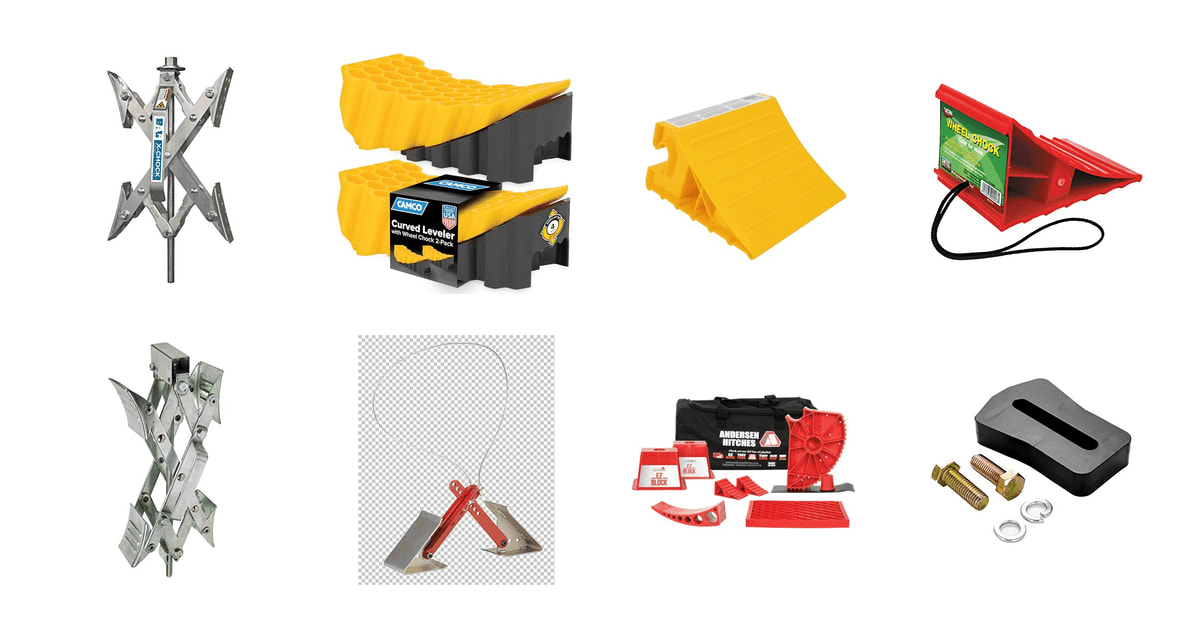
A wheel chock is one of those things you don't think about until the trailer moves. Park on a slight grade, crank down the stabilizer jacks, and you'd assume you're set. You're not. Jacks fight sway, not rolling. A good chock does two jobs at once: it keeps the trailer where you put it, and it kills the boat-at-anchor rocking you feel every time somebody walks to the fridge. It's cheap insurance for a very expensive thing sitting in your campsite.
Here's the honest part. No chock here works for every trailer, and the split isn't about quality — it's about axles. The interlocking chocks owners love only work on tandem axles, because they need two tires to push against. Single-axle owners are stuck with wedges, and one wedge blocks one direction, so you need four for real coverage. Plastic gets slick on wet pavement and turns brittle in hard cold. Rubber grips better but weighs more and costs more.
So start with your axle count, then your trailer's loaded weight, then how much bending you're willing to do at every site. Everything else is detail. Most rigs need two of whatever you buy, sometimes four, so factor that in before anything looks cheap. We think that the BAL 28010 X-Chock is the best wheel chock for most people, and that the Fastway ONESTEP Wheel Chock is the one to buy if kneeling at every campsite is hard on your back.
Everything we recommend

Blocks both directions with one device, if you run tandem axles
Set it and pull it without ever kneeling down

A big, tough wedge for single-axle trailers on pavement

Padlockable, wide reaching, and grippy on chunky treads
At a glance
| Product | Chock Type | Fits Tire Size | Price | |
|---|---|---|---|---|
| BAL 28010 X-Chock Tire Locking ChockTop pick | X-Chock | — | $33.18 |
 | Camco Curved Camper/RV Leveler & Wheel ChockAlso consider | Curved Leveler | — | $68.73 |
| Camco Super Wheel Chock for Trailers &Budget pick | Super Wheel Chock | Up to 29 inches | $16.99 |
 | Valterra A10-0908 RV Wheel ChockAlso in lineup | Wheel Chock | — | $5.84 |
| Super Grip ChockAlso great | Super Grip Chock | 1"-10.25" spacing | $52.54 |
| Fastway ONESTEP Wheel Chock for Tandem AxleRunner-up | Wheel Chock | 16"-24" axles | $63.05 |
 | Andersen Hitches Single Axle Travel Trailer KitAlso consider | Tuff Chocks | — | $220.98On sale |
 | Eaz-Lift 48629 EazLift - Fifth Wheel WedgeAlso in lineup | Wedge Kit | — | $31.89 |
How we picked
Axle fit. The first cut was mechanical: between-tire chocks need tandem axles, wedges work on anything. We sorted every product by which trailers it can physically serve before judging anything else.
Load rating. We checked published ratings against realistic loaded trailer weights. A chock with no stated rating got treated as a light-duty or backup option, not a primary one.
Grip on real surfaces. Owner feedback about gravel, wet concrete and sloped sites carried more weight than any traction claim on a box. Repeated slipping reports were disqualifying for a top spot.
Setup effort. We favored designs that cut kneeling and fumbling, since a chock you resent is a chock you'll skip on a short stop. Standing deployment and ratchet mechanisms both scored well.
Season-to-season durability. We looked for patterns across long-term owner reports — brittle plastic, rubber pads tearing off, mechanisms seizing — rather than first-week impressions.
Top pick
Blocks both directions with one device, if you run tandem axles
BAL 28010 X-Chock Tire Locking Chock
This steel chock threads between your tandem tires and ratchets outward until it presses firmly on both. That one move blocks forward and backward rolling and takes most of the rock out of the trailer, which is why owners keep it on the rig all weekend.
$33.18fromAmazonOne chock here does the work of four wedges. You slide it between the tandem tires, turn the ratchet handle until it's snug against both sidewalls, and you're done. Setup runs well under a minute per side once you've done it twice. Two units cover a tandem trailer, one on each side. With wedges you'd be placing four, and you'd still feel more movement inside.
The rocking is what surprises people. Owners who spent years stacking wedge chocks describe the same thing after switching: someone walks to the back bedroom and nothing shifts. It won't turn a travel trailer into a house, because nothing does. But the fore-aft sway that makes the whole rig feel like a boat at anchor mostly goes away. If you've got a light sleeper in the bunk, that alone earns it a spot.
Steel is the reason these last. There's no flex once it's tightened and no plastic to go brittle in a cold storage lot. Owners report running the same pair for many seasons, and the failures they describe are usually self-inflicted — pulling out of a site with one still clamped between the tires. That's a real risk with any between-tire chock, so hang something bright on the steering wheel.
It's also easier on your body than it looks. You reach in from the side of the trailer at roughly waist height instead of crouching at the tread. You'll still bend some, but it beats kneeling in gravel four separate times. The ratchet takes ordinary hand strength, and it releases in seconds when you're breaking camp in the rain.
Flaws but not dealbreakers
The hard limit is two axles. Single-axle owners can't use it at all, and there's no workaround. You also need two of them for a tandem trailer, one per side, so think of it as a pair rather than a single purchase.
Seating it the first time is fiddly. Owners describe wrestling to hold the chock in position while they start expanding it — once the pads touch rubber it settles right down, but those first few seconds are awkward. And it's heavy. Next to a plastic wedge you're adding real weight to the cargo bay, doubled.
Runner-up
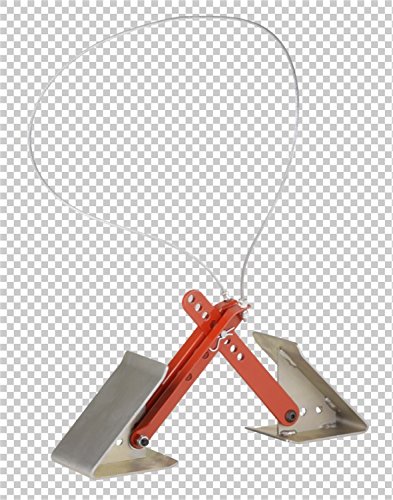
Set it and pull it without ever kneeling down
Fastway ONESTEP Wheel Chock for Tandem Axle
The ONESTEP does the same between-the-tires job as our top pick, but the entire cycle happens from a standing position. You press it closed with your foot and lift it out by the cable. If bending at every campsite is the part you dread, this is the one.
$63.05fromAmazonPicture the end of a six-hour tow. You're tired, the site is loose gravel, and the last thing you want is to get down on your knees twice on each side of the trailer. The ONESTEP is built around exactly that moment. Drop it between the tandem tires, step down on it, walk away. Removal is a tug on the cable while you're standing upright.
The stability is close enough to our top pick that most people won't notice a difference. Owners coming off wedge chocks report the same result: the trailer stops rocking front to back when people move around inside. It adjusts across a wide span of tandem spacings, so it fits most travel trailers and plenty of fifth wheels without you measuring anything first.
The cable is a quiet bonus. It's the handle you use to pull the chock free, and owners also run a padlock through it to keep the chock with the trailer in a storage lot or a crowded rally field. It's less deliberate security than a purpose-built lock, but it's there and it works.
It's light for a steel tandem chock, so carrying two doesn't punish your cargo weight the way our top pick does. That matters more than it sounds on a small trailer where every pound is spoken for.
Flaws but not dealbreakers
It's the priciest single tandem chock in this guide, and you need two. The long shape also eats more bay space than the X-Chock, and it doesn't nest with anything.
A few owners report a unit getting stiff and hard to seat after a couple of seasons of grit. Rinsing it off before storage seems to help, but it's a mechanism, and mechanisms in campground dust eventually complain. Tandem axles only, same as our top pick.
Budget pick
A big, tough wedge for single-axle trailers on pavement
Camco Super Wheel Chock for Trailers &
This is the plain plastic wedge done properly: oversized, UV-stabilized, and shaped with a grip built into the body. It fits tires up to 29 inches, so it works on nearly any travel trailer, and it costs a fraction of the interlocking chocks.
$16.99fromAmazonIf you tow a single-axle trailer, this is where to start. Interlocking chocks are simply off the table for you, so the question becomes which wedge holds best. This one is noticeably larger and stiffer than the freebies dealers hand out, with a broad contact face that doesn't want to tip. Owners who replaced dealer chocks with these describe the difference in one word: solid.
The shape is smarter than it looks. There's a molded grip so you can pick it up without getting your fingers under a tire, and a drilled hole most owners run a rope through for no-bend retrieval. It weighs almost nothing, which means you can carry four without thinking about it — and four is what you actually need.
UV inhibitors in the plastic matter more than they sound. Chocks live outside, and cheap plastic chalks and cracks after a summer or two in the sun. Owners who've had these under a stored trailer for years report them still holding shape. It's the kind of durability you only notice by its absence.
Flaws but not dealbreakers
Plastic gets slippery. Owners are consistent about this: on wet or smooth concrete, and especially on a real incline, this chock can slide rather than dig in. On dry pavement and packed gravel it's fine. On a wet boat ramp it isn't the tool you want.
One wedge blocks one direction. That's not a defect, it's how wedges work, but it means a proper single-axle setup takes four of them — front and back of one tire on each side. Plan on that. And like all plastic, it can crack under load in deep freezing cold, so year-round cold-climate campers should go rubber or steel.
Also great
Padlockable, wide reaching, and grippy on chunky treads
Super Grip Chock
This tandem chock swaps sidewall pads for self-adjusting louvers that bite into tire tread, and it opens wider than most competitors. A padlock comes with it, which makes it the pick for trailers that sit in unattended lots.
$52.54fromAmazonThe lock is the real reason to choose this one. If your trailer lives in a storage yard, a rally field, or a driveway you can't see from the house, a chock that can be secured in place does two jobs — it stops a rollaway and it stops someone walking off with the chock itself. No other option here comes with that built in.
The louvers grip differently from a smooth pad. Instead of pressing only on the sidewall, they settle into the tread pattern, which helps on aggressive off-road tires where a flat pad leaves gaps. Owners with big travel trailers describe the rocking disappearing completely, including on rigs lifted several inches on leveling blocks.
The expansion range is the other quiet advantage. It opens wider than most between-tire chocks, so it covers fifth wheels and wide-track trailers where our top pick can run out of reach. If you've measured your tandem gap and found it unusually wide, check this one first.
Owners generally like the ratcheting setup and mention the included wrench, though a few report the wrench missing from the box and just using their own. It's a minor thing. Any standard socket handles it.
Flaws but not dealbreakers
It's bulkier and heavier than our top pick for the same coverage, and you still need two. For nightly campsite use where you're setting and pulling chocks every couple of days, the extra bulk and the lock routine start to feel like work.
The louvers collect dirt. On dusty or muddy sites they need an occasional rinse to keep moving freely, which is one more chore in the pack-up routine.
Ultra-Fab lists a lifetime warranty on the Super Grip Chock.
Who this is for
Buy now if you tow anything — travel trailer, fifth wheel, boat trailer, utility trailer — and you're still using whatever came free with the rig, or a couple of scrap 2x4s. Dealer chocks tend to be undersized, and lumber splits under sustained load and rots after a wet season. If you already own a set rated above your trailer's loaded weight that grips the surfaces you actually park on, nothing here will change your life.
This guide covers chocks and chock systems for towable RVs and trailers: plastic wedges, between-tire interlocking chocks, and one combination leveler. We're not covering aircraft or heavy-equipment chocks, motorhome-specific systems, or leveling jacks. And a chock isn't a replacement for stabilizer jacks or for setting the tow vehicle's parking brake. It's one layer in a setup that should have several.
How we picked
Axle fit: a chock only helps if it matches your rig, so we sorted everything by whether it serves tandem or single axles before comparing anything else. Load rating: published ratings had to clear a realistic loaded trailer weight, and a missing rating counted against a product. Grip: owner reports from gravel, wet concrete and sloped sites outweighed any traction claim printed on the packaging. Setup effort: we favored designs that cut kneeling, fumbling and cleanup, because a chock that's annoying is a chock you'll skip. Durability: we looked for repeated multi-season reports of cracking, tearing or seizing rather than first-weekend impressions.
Other wheel chocks for rvs and trailers worth considering
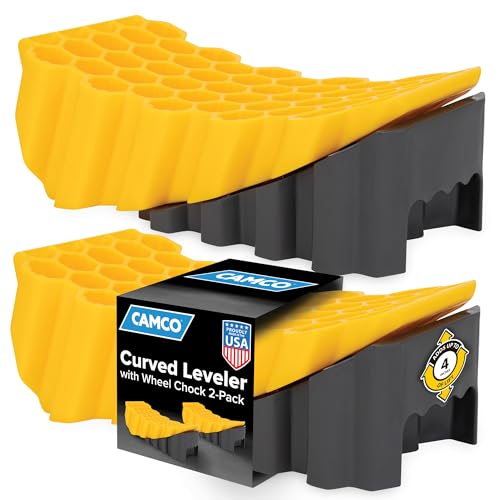
If you want leveling and chocking from one product: The Camco Curved Camper/RV Leveler & Wheel Chock ($68.73) — These curved drive-on levelers lift a tire up to about four inches and include a matching chock with rubber grippers, so one pair replaces a stack of blocks plus a set of chocks. That's a real space win in a small bay, and the honeycomb body is rated for very heavy trailers. But the grippers are the weak point: owners repeatedly report the rubber pads tearing off on gravel, after which the whole thing can slide out from under the tire. On pavement and firm ground they're great. On loose gravel, be careful, and check your setup before you trust it overnight.
If you want a first-trailer setup in one box: The Andersen Hitches Single Axle Travel Trailer Kit ($220.98) — This Andersen kit bundles a rapid jack for tire changes, leveling blocks, a camper leveler, a clean step and a pair of the company's well-regarded chocks, all sized for single-axle travel trailers. For a brand-new owner it collapses weeks of gear research into a single order, and the components are meant to work together. The catch is that it's the most expensive thing here by a wide margin, and it's single-axle only. If you already own leveling blocks and a jack — which most people accumulate in their first season — you're paying a lot for the chocks.
The competition
This is what our research surfaced, not a full census of every chock sold. There are dozens of near-identical plastic wedges out there, and a handful of between-tire designs that are functionally similar to the ones above. Here's the remaining product we looked at and where it lands.
The Valterra A10-0908 RV Wheel Chock ($5.84) — The Valterra A10-0908 is a small polyethylene wedge with molded grooves and a nylon retrieval cord, and it's the least expensive option here. Owners like it a lot for what it is: an emergency chock in the trunk, a second chock on a pop-up, something to keep a utility trailer from creeping. Several report a decade of use without a break. But it's small — owners with full-size trucks note it barely covers the tire — and there's no published load rating, so it shouldn't be the only thing holding a heavy trailer. The red color also hides in low light. Buy it as a backup, not as your main chock.
Placement and storage
Chock before you unhitch, not after. Once the trailer is off the ball it can move, and that's when the bad stories start. On a grade, set the downhill side first. On gravel or soft ground, press the chock down into the surface instead of perching it on loose stones, and check it again after the first night, because chocks settle. Rinse salt and grit off steel chocks before they go back in the bay, and let them dry so the threads don't seize. Store the bulky ones in a mesh bag so they aren't rattling into your leveling blocks down the highway. And leave something bright on the steering wheel — driving off with a chock still clamped between the tires is the most common way people destroy one.
Questions we get
Do I still need chocks if my RV has stabilizer jacks?
Yes, and it isn't close. Stabilizer jacks are designed to cut sway and vibration while you're inside, not to hold a loaded trailer against gravity. A jack foot can shift on soft ground, and a trailer on a modest grade can overcome that friction. Chocks stop rolling; jacks stop wobble. Use both.
How many chocks do I need for a tandem-axle trailer?
Two interlocking chocks, one between each tandem tire pair, left and right. Designs like the BAL X-Chock, the Fastway ONESTEP and the Ultra-Fab Super Grip block both directions per side, so two units cover the whole trailer. If you're using wedges instead, you need four — one ahead of and one behind a tire on each side.
How do I chock a single-axle trailer correctly?
Put one wedge tight in front of and one tight behind a tire on each side, so four total. The front chock stops it rolling toward the tow vehicle, the rear one stops the other direction. Don't chock only one side. Trailers can drift diagonally, not just straight forward and back.
Are rubber chocks better than plastic?
On wet concrete, wet asphalt and in cold weather, yes. Plastic loses grip when it's wet and can go brittle in sustained deep cold. If you camp year-round or in a rainy region, rubber is worth the extra weight and cost. For fair-weather camping on paved sites, a good UV-stabilized plastic wedge is fine and much lighter to carry.
Can I just use 2x4 blocks?
Not as a permanent solution. Wood splits under sustained trailer load, soaks up water and rots within a season or two, and has no designed grip face for wet pavement or grass. A basic purpose-built chock costs very little. Treat lumber as a one-time emergency measure and replace it before your next trip.
What rating do I need for a heavy trailer?
Match or exceed your trailer's gross vehicle weight rating, which you'll find on the sticker near the front left corner. The Camco curved leveler publishes a 30,000-pound rating, which covers essentially any towable. Products with no published rating should be treated as light-duty or backup only. When you're unsure, spec up.
Why you should trust us
For this guide:
- We read manufacturer spec sheets for load ratings, adjustment ranges and tire-size limits across every product in this guide.
- We compared published RV-gear reviews and long-running owner discussion about which chock designs actually stop trailer rock on tandem axles.
- We looked for repeated failure themes in owner feedback — cracked plastic, rubber pads tearing loose on gravel, mechanisms stiffening with grit — rather than isolated complaints.
- We read owner reviews on every listing, weighted toward the critical ones, because that is where the recurring failures show up.
- We have a systematic way of automatically fetching the latest prices, so the numbers on this page stay current.
- This is a research-focused guide, so the team may not own every product listed — though we often do own the top winners, which gives us extra context for the recommendations.
- We don't accept free products, and the retailer commission never changes which product we recommend.
Sources
Wheel Chock Expert Q&A and Product Comparisons, etrailer.com
RV Wheel Chock Buying Guide, Camping World
Best RV Wheel Chocks: Staff Picks and Field Notes, RV Travel Newsletter
Andersen No-Sway Chock Official Specs and Load Rating, Andersen Hitches
RV Safety Essentials: Wheel Chocks and Leveling, RVshare
Amazon product listings and owner reviews for all 8 products
Manufacturer specification pages for each product
Some passages in this guide may be paraphrased with AI help. Prices are refreshed automatically.
More like this.
Continue exploring electronics reviews and recommendations.

The Best Steering Wheel Locks
A steering wheel lock is the rare piece of car security you can put to work the day it arrives. There's nothing to wire, nothing to pair with your phone,…

The Best Steering Wheel Covers
You touch your steering wheel more than anything else in your car. And most factory wheels are built to a price, not to your hands: hard plastic on the…

The Best Yoga Wheels
A yoga wheel is a simple thing: a rigid hoop with padding wrapped around the outside. You lie back over it, let it hold the arch of your spine, and…

The Best Trailer Hitch Cargo Carriers
Every road trip has the same moment. The trunk is full, there's still a cooler and a folding chair on the driveway, and someone in the back seat is about…

The Best Trailer Wiring Harness Adapters
Trailer wiring is the part of towing nobody thinks about until the lights don't work. You hitch up the boat trailer at 5 a.m., flip on the turn signal,…

The Best Trailer Hitch Locks
A trailer sitting in your driveway is one of the easiest things on your property to steal. Someone backs a truck up, drops your coupler onto a ball, and…