The Best Trailer Hitch Cargo Carriers
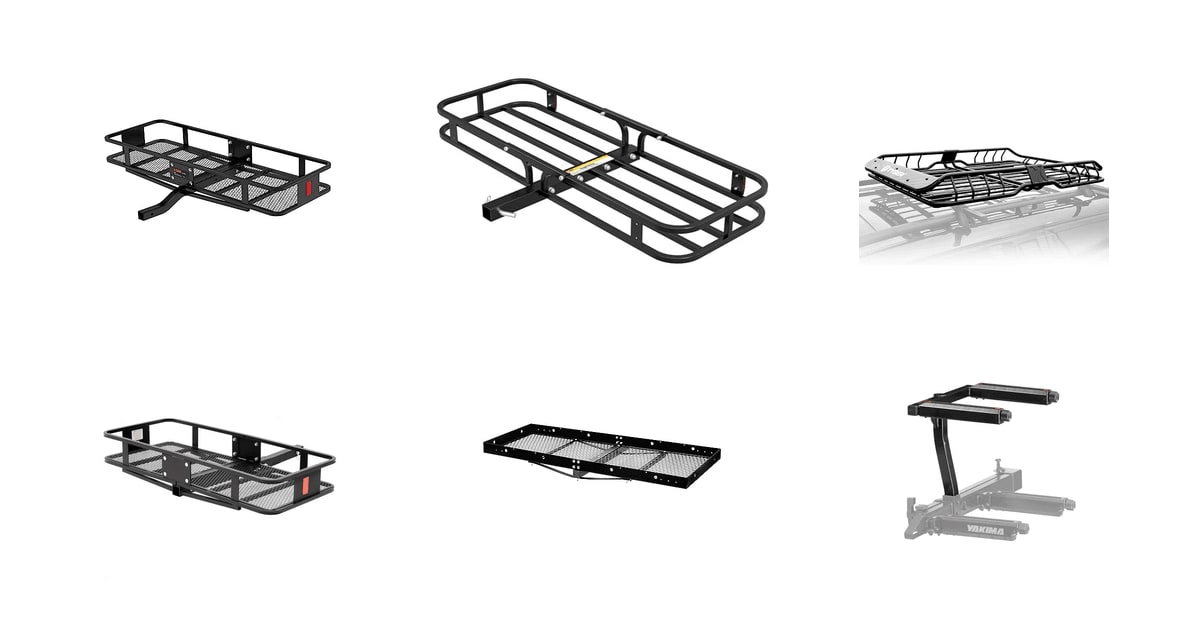
Every road trip has the same moment. The trunk is full, there's still a cooler and a folding chair on the driveway, and someone in the back seat is about to lose legroom. A hitch cargo carrier fixes that. It slides into a 2-inch receiver, pins in place, and gives you a steel platform for the bulky, dirty, or wet stuff you'd rather not put next to a sleeping toddler. No roof rails needed, no trailer to tow, and you load everything at waist height instead of over your head.
But no carrier here is a clean win. Steel platforms are heavy — most weigh 20 to 55 pounds, and you'll wrestle them into the receiver alone. None of them ship with anti-rattle hardware, so expect some clunking on rough pavement until you add a stabilizer bolt. They block your license plate and backup camera. They cost you fuel economy at highway speeds, more so past 65 mph. And every open basket in this guide leaves your gear exposed to rain unless you buy a cover.
We looked at what owners report after real trips, what the specs actually say, and where each design gives something up. We think that the CURT 18150 is the best trailer hitch cargo carrier for most people, and that the Apex CCB-F6020-DLX is the one to buy if you need rear hatch access without pulling the carrier out of the receiver every time.
Everything we recommend
Tall rails and a stiff frame, if you can carry the weight

Folds out of the way, at the cost of a moving part

Real side rails and real capacity, on a shorter platform

The widest deck here, for gear that won't fit anywhere else
At a glance
| Product | Weight Capacity | Weight | Price | |
|---|---|---|---|---|
| CURT 18150 Cargo Basket Hitch Trailer HitchTop pick | 500 lbs | 54 lbs | $221.49 |
| MaxxHaul 70107 53" x 19-1/2" Hitch CargoBudget pick | 500 lbs | 22.3 lbs | $61.99 |
 | Tyger Auto TG-RK1B942B Heavy Duty Roof MountedAlso consider | 150 lbs | 30 lbs | $277 |
| Apex CCB-F6020-DLX 60” Long Steel Basket FoldingRunner-up | 500 lbs | 46.5 lbs | $149.99 |
| Stromberg Carlson CC-100 Cargo Carrier - 23"Also great | 500 lbs | 20 lbs | $149.95 |
 | Yakima Second Level Bike or Cargo CarrierAlso in lineup | — | 33.5 lbs | $478.95 |
 | Thule Arcos Hitch PlatformAlso in lineup | — | 23.5 lbs | $439.95 |
How we picked
Capacity that holds up. We compared published load ratings against what owners describe after real loads, and weighted frame construction over the number on the box. A 500-pound rating on thin tubing doesn't mean the same thing as 500 pounds on heavy-wall steel.
Cargo containment. Side rail height decides whether you strap once or strap everything. We favored carriers with rails tall enough to hold soft bags in place through a sharp turn, and flagged the flat decks that need a ratchet strap for every item.
Platform size and fit. Sixty inches by roughly 20 to 24 inches is the size that takes two large rolling suitcases, so we treated that as the full-size benchmark. Anything shorter got scoped as a lighter-duty option rather than penalized outright.
Living with it. We looked at carrier weight, whether one person can install it, and whether the design blocks the rear hatch. Owner feedback on assembly headaches and pivot maintenance mattered here more than spec sheets did.
Rust and drainage. Powder-coated and E-coated steel both need care, and mesh or expanded-metal floors shed water where solid trays hold it. We noted which carriers drain and which finishes owners report holding up outdoors.
Top pick
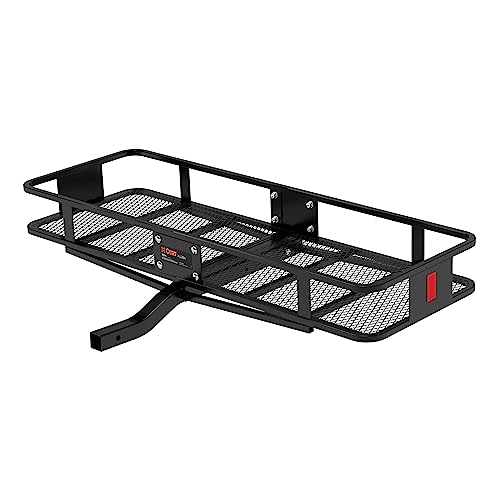
Tall rails and a stiff frame, if you can carry the weight
CURT 18150 Cargo Basket Hitch Trailer Hitch
The CURT 18150 is a 59.5-by-20.25-inch steel basket rated for 500 pounds distributed, with 6-inch side rails that keep duffels and bin lids from wandering. It's the sturdiest open carrier here, and owners who load it hard don't report frame flex.
$221.49fromAmazonThe 6-inch sides are the reason to buy this one. Most baskets in this category give you 4 to 5 inches of rail, which is enough to stop a bag from sliding but not enough to keep it in on a sharp on-ramp. The CURT's taller walls let you stack soft duffels above the rail line and strap once across the top instead of tying down every piece. If you've ever pulled over to re-secure a load, you'll understand what that's worth.
It's built from heavy-duty tubular steel, and it feels like it. Owners hauling recumbent bikes on the back of an RV and families loading coolers for a mountain trip both describe the same thing — the platform doesn't give. The angled shank tilts the basket up a little, which buys back some of the ground clearance you lose with a loaded carrier. On a Jeep or a lifted truck that's a nice bonus. On a low sedan it's closer to a necessity.
The mesh base matters more than it sounds. Loose small items — a tent stake bag, a bundle of straps, a kid's shoe — don't fall through, and hosing mud off is a two-minute job. Compare that to an expanded-metal floor, where anything smaller than a fist needs its own container. At 59.5 inches, the platform swallows two rolling suitcases laid lengthwise with room left over.
It fits any standard 2-inch Class III or IV receiver, which is the class you want. A 1.25-inch Class I receiver flexes under a heavy distributed load and turns every expansion joint into a bang. If your vehicle has a 2-inch tube, this bolts up in under ten minutes: slide the shank, drop the pin, clip it.
Flaws but not dealbreakers
At 54 pounds it's the heaviest carrier here, and several owners — including ones who love it — mention that lifting it into the receiver alone is a real chore. If you plan to take it off between trips, budget for either a second set of hands or a spot in the garage where you can slide it rather than carry it.
The 20.25-inch inner width is narrower than the Stromberg Carlson's 23 inches. A large rectangular camp cooler will overhang the edges. And like every carrier here, it ships with a plain pin and clip, so you'll want an anti-rattle bolt before your first long highway run. A handful of owners also report a visible gap where the frame sections meet during assembly — cosmetic in most cases, but worth checking before you torque everything down.
Runner-up
Folds out of the way, at the cost of a moving part
Apex CCB-F6020-DLX 60” Long Steel Basket Folding
The Apex CCB-F6020-DLX gives you a full 60-inch steel basket that pivots vertically against the vehicle when it's empty. You get your rear hatch back without pulling 46 pounds of carrier out of the receiver, and it still carries the same 500 pounds.
$149.99fromAmazonIf you drive the same vehicle every day, this is the design that makes sense. Fixed carriers block the liftgate, and the workaround is removing the whole thing — which nobody does for a quick grocery run. The Apex releases two latch pins and swings up flat against the bumper, and you're back to a normal car. Owners who've logged 500-mile trips with it describe it as a second trunk, which is exactly the right frame of mind.
The 60-inch platform is the size you actually want. Two standard 22-inch rolling suitcases fit side by side with a soft bag wedged at one end. The MaxxHaul's 53 inches is fine for a weekend; this is the length that handles a family of four with camping gear. At 46.5 pounds it's also lighter than the CURT, and owners consistently say one person can install it.
The expanded-metal floor is a genuine engineering choice, not a cost cut. Mud, snowmelt, and beach sand wash straight through instead of pooling in a tray. If you're hauling wet gear back from a lake or a ski day, that's the difference between a carrier you rinse and one you scrub.
It's rated for a Class III or IV 2-inch receiver at 500 pounds, same as the fixed steel carriers here. You give up nothing on capacity to get the fold mechanism — a rare thing in this category, where convenience features usually cost you a rating.
Flaws but not dealbreakers
The fold mechanism is a moving part, and moving parts are where things go wrong. Owners report pivot points that need re-tightening after a season of use, and more than one has had to drill out the locking-pin hole because it didn't line up when folded. Assembly quality is the weak spot generally — a few buyers describe welds and mounting points that arrived misaligned. Inspect it carefully before the first trip.
The expanded-metal floor gives small loose items nothing to sit on. A cargo bag or a plastic bin solves it, but that's another purchase. And the hitch pin is sold separately, so don't plan on installing it the day it arrives unless you already have one.
Budget pick
Real side rails and real capacity, on a shorter platform
MaxxHaul 70107 53" x 19-1/2" Hitch Cargo
The MaxxHaul 70107 is a 53-by-19.5-inch steel basket rated for 500 pounds with genuine 4.5-inch inner rails. It costs a fraction of what the bigger carriers do, and for two or three trips a year it does everything most families need.
$61.99fromAmazonThis is the carrier that punches above its class. Cheap platforms in this category usually mean a flat deck with decorative lips, and you strap everything or lose it. The 70107 gives you an actual basket — a 51-by-17.5-inch inner footprint with 4.5-inch walls. A large duffel, camp chairs, and a medium cooler go in without a fight.
At 22.3 pounds it's the lightest steel carrier here by a wide margin, and that changes how you live with it. You can pull it off after a trip and hang it in the garage without recruiting help. Owners who took it through a Sierra winter storm with two loaded bins report it held up fine, and a 1,200-mile road trip shows up in the feedback with no complaints.
Assembly has a trick to it, and owners have figured it out: leave every bolt loose until all of them are in place, then rock the frame square and tighten. Do it in order and you'll fight misaligned holes. Do it the owners' way and it goes together in half an hour.
It fits the same standard 2-by-2-inch receiver as everything else here, so nothing about the mounting is unusual. The value is simply that you get a functional basket at an entry-level price instead of a compromise.
Flaws but not dealbreakers
The 53-inch length is seven inches short of the full-size standard, and that gap is real. Two big rolling suitcases won't sit side by side. If you're packing for four people and a week, you'll fill this in one load.
The tubing is thinner than what you'll find on the CURT, and some owners are openly skeptical of the 500-pound rating because of it. It's rated for large light items — coolers, totes, bedding — more than dense heavy ones. Several owners also note it hangs low on a normal-height car, so check your clearance if you drive a sedan or a low crossover. No anti-rattle hardware is included, despite what some listing photos suggest.
Also great
The widest deck here, for gear that won't fit anywhere else
Stromberg Carlson CC-100 Cargo Carrier - 23"
The Stromberg Carlson CC-100 gives you a 23-by-60-inch platform — the widest in this guide — sized for camp grills, big rectangular coolers, and stacked dry boxes. It's aimed squarely at RV owners who need supplemental storage on day trips.
$149.95fromAmazonWidth is the whole argument. A 54-quart cooler sits fully inside the CC-100 with clearance on both sides, where it hangs over the edge of the CURT and won't fit the MaxxHaul at all. If your loads are wide and boxy rather than long and soft — a folded grill, a pair of dry boxes, a generator — this is the deck shape that matches.
It's built for the RV crowd and it shows. Owners run it off the back of fifth wheels and swap it to a truck when they need to, and the expanded-metal floor drains water instead of holding it. The powder coat gives you baseline rust resistance, though it's not a substitute for keeping it dry.
Be honest with yourself about load weight before you buy this one. It weighs just 20 pounds, and that lightness comes from thinner material. Owners who load it with light bulky gear are happy. Owners who tried a small mower or heavy water jugs report the floor flexing more than they'd like. The 500-pound rating is the receiver-side number, not an invitation.
Assembly is the other thing to plan for. Multiple owners describe holes that don't line up and hardware that needs persuading — a socket set, a clamp, and patience. A few needed to open up a hole to get everything to seat. It's a weekend-morning job, not a fifteen-minute one.
Flaws but not dealbreakers
There are no raised side rails. The perimeter framing is low, so this is a flat deck in practice, and everything on it needs active strapping. That's fine for a grill you're ratcheting down anyway and annoying for a pile of soft bags.
Build quality is the least consistent in this guide. A meaningful share of owners describe thin metal, rough welds, and misdrilled holes. It's also fixed — no fold — so any time you want the rear hatch, the whole carrier comes out.
Who this is for
Buy a hitch cargo carrier if your vehicle has a 2-inch Class III or IV receiver and you regularly run out of room — road trips, camping, hauling something from the store that won't fit inside. It's the easiest way to add serious external capacity, and unlike a rooftop box you load it at waist height. If your vehicle only has a 1.25-inch Class I receiver, skip this category entirely; those tubes flex under distributed load and the wobble gets ugly fast.
This guide covers open-basket carriers and the mounting hardware around them. It doesn't cover enclosed cargo boxes, bike-specific racks, or trailers. And a carrier's rating is not your vehicle's rating — check the tongue weight limit in your owner's manual or on the door jamb sticker before you load anything. A 500-pound carrier on a vehicle rated for 300 pounds of tongue weight is a problem no matter how good the carrier is.
How we picked
We built the shortlist around five things. Capacity: published ratings checked against what owners say after loading them, with frame construction weighted over the number on the box. Containment: rail height tall enough to hold soft bags through a turn, since flat decks mean strapping every single item. Size: roughly 60 inches long and 20 to 24 inches wide is what takes two large rolling suitcases, so that's the full-size bar. Livability: carrier weight, whether one person can mount it, and whether the design lets you open the rear hatch. Durability: finish quality, drainage, and the assembly problems owners actually run into.
Other trailer hitch cargo carriers worth considering
If your hitch is already taken: The Tyger Auto TG-RK1B942B Heavy Duty Roof Mounted ($277) — The Tyger Auto TG-RK1B942B mounts to roof rail crossbars instead of a receiver, which is the answer when a bike rack or trailer already owns your hitch. The 57.5-by-42-inch platform is far wider than any basket here — ski bags, tent poles, and awkward camp gear fit easily — and the included wind fairing cuts buffeting at speed. The E-coated 1-inch steel frame holds up well outdoors, and owners a year in report no rust. What you give up is capacity and convenience: 150 pounds is the ceiling, roughly a third of the steel hitch carriers, and lifting a loaded cooler over your head after six hours of driving is genuinely unpleasant. You also need existing crossbars, since Tyger assumes that hardware is already on the car.
The competition
These are the other listings our research turned up in this category — not everything on the market, and not everything that didn't make the cut is bad. Two of them are ecosystem components rather than standalone carriers, which is the main reason they sit here instead of above.
The Yakima Second Level Bike or Cargo Carrier ($478.95) — The Yakima EXO TopShelf is a second tier that bolts onto a Yakima EXO SwingBase, and the SwingBase is sold separately. That's the catch. If you're already running the EXO system, this doubles your carrying levels, and the 180-degree swing means you can open the rear hatch with everything still loaded — a real advantage at a trailhead. The tool-free EXO Cleat mounting with locking SpeedKnobs works as advertised, and the SKS lock cores share keys with the rest of your Yakima gear. But owners running bikes on the top tier consistently report more wobble than they expect, and the 31-by-25-inch platform is small next to a full steel basket. Buy it only if you're committed to the EXO platform.
The Thule Arcos Hitch Platform ($439.95) — The Thule Arcos Hitch Platform is a dock for the Thule Arcos enclosed cargo box, not a carrier on its own. Nothing rides on it directly. Its one standout feature is that a single person can attach the Arcos box, which normally takes two, and Thule's tolerances mean a tight, rattle-free fit once it's on. That's worth something if you're loading alone before dawn. It's also the only route to fully enclosed, weather-sealed hitch storage in this lineup, so you skip the waterproof bag every other carrier here needs. But owners point out it doesn't fold when the box is off, and it's expensive for a part that carries nothing by itself. If you want a plug-and-play basket, look at the CURT or the Apex instead.
Installation and maintenance notes
Add an anti-rattle bolt before your first highway trip. None of these carriers include one, and the play between the shank and the receiver turns into constant clunking under load — a through-bolt design closes that gap and installs in about two minutes. When you assemble a steel basket, leave every bolt loose until they're all started, then square the frame and tighten; owners who torque bolts one at a time end up fighting misaligned holes. For rust, rinse and dry the carrier after any wet or salted trip, hit it with a corrosion inhibitor once a season, and store it indoors between trips. Powder coat and E-coating both slow oxidation, but neither survives a coastal winter outdoors untouched. Last thing: a carrier will block your license plate and backup camera, so check your state's rules and plan on a plate relocation bracket.
Questions we get
What size hitch receiver do I need?
You want a 2-inch Class III or IV receiver. Every carrier in this guide is built for one. A 1.25-inch Class I receiver — common on small cars and older SUVs — flexes under a heavy distributed load and makes the wobble much worse. Check the tube on your vehicle directly or look it up in the owner's manual.
How much weight can one of these safely hold?
Most steel hitch carriers are rated for 500 pounds distributed, but that's the carrier's number, not your vehicle's. Your tongue weight limit may be lower, and it's the one that governs. Check the owner's manual or the door jamb sticker before you load. Going over it stresses the receiver and changes how the car handles, no matter what the carrier is rated for.
Will it block my license plate and backup camera?
Yes, partially or completely. Most states require a supplemental plate mount when a carrier obstructs the original. For the camera, you can use a relocation bracket or a hitch-mounted camera that sits below the platform. Check your state's rules on obstructed plates before a long trip.
Do these rattle at highway speeds?
All of them do with the standard pin-and-clip hardware, because there's play between the shank and the receiver tube. An anti-wobble bolt assembly replaces the pin with a through-bolt that takes up that gap, and it makes a large, immediate difference. None of the carriers here include one, so plan to add it.
Hitch carrier or rooftop box?
A hitch carrier is easier for most people. You load it at waist height instead of over your head, and it carries several times the weight of a rooftop box. A rooftop box wins on weather protection and leaves your rear hatch clear. If your hitch is free and your gear can handle a cover, go with the hitch carrier.
How much fuel economy will I lose?
Expect a noticeable hit at highway speeds, and a bigger one above 65 mph where aerodynamic drag climbs sharply. A loaded carrier costs more than an empty one, and a roof-mounted basket costs more than a hitch-mounted one because of where it sits in the airflow. Slowing down a few miles per hour recovers more than you'd think.
Why you should trust us
For this guide:
- We read the manufacturer spec sheets and listing details for every carrier here, comparing load ratings, platform dimensions, rail heights, and receiver requirements side by side.
- We went through owner feedback for each product to find the failure modes that show up repeatedly — assembly misalignment, frame flex under dense loads, pivot hardware loosening, and rattle at speed.
- We did not use, install or load any of these carriers ourselves; every judgment here comes from published specifications and reported owner experience.
- We read owner reviews on every listing, weighted toward the critical ones, because that is where the recurring failures show up.
- We have a systematic way of automatically fetching the latest prices, so the numbers on this page stay current.
- This is a research-focused guide, so the team may not own every product listed — though we often do own the top winners, which gives us extra context for the recommendations.
- We don't accept free products, and the retailer commission never changes which product we recommend.
Sources
Hitch Cargo Carrier Buying Guide and Expert Reviews — eTrailer.com, eTrailer.com
Best Cargo Carriers — Car and Driver, Car and Driver
Best Cargo Carriers for Road Trips — Popular Mechanics, Popular Mechanics
Best Hitch Cargo Carriers — OutdoorGearLab, OutdoorGearLab
SAE J684: Trailer Couplings, Hitches, and Safety Chains — Automotive Type, SAE International
Amazon product listings and owner reviews for all 7 products
Manufacturer specification pages for each product
Some passages in this guide may be paraphrased with AI help. Prices are refreshed automatically.
More like this.
Continue exploring electronics reviews and recommendations.

The Best Trailer Hitch Locks
A trailer sitting in your driveway is one of the easiest things on your property to steal. Someone backs a truck up, drops your coupler onto a ball, and…

The Best Trailer Hitches and Towing Accessories
Towing gear is the rare purchase where the boring choice is the right one. A hitch bolts to your frame, sits in road salt and spray for years, and then…

The Best Rooftop Cargo Carriers
A rooftop carrier buys you back the space your family took away. Once the third row is up and the cooler is in, there's nowhere left for duffels, sleeping…

The Best Roof Racks and Cargo Carriers
Your roof is the only empty space left once the car is packed. Skis, a week of luggage for four, a stroller, folding chairs - it all has to go somewhere,…

The Best Hitch-Mounted Bike Racks
A hitch rack is the difference between a bike trip you look forward to and one you dread. Roof racks mean lifting a 30-pound bike over your head in a…

The Best Waterproof Roof Cargo Bags
A soft roof bag is the simplest way to buy back space in a packed car. You strap it down, you load it, and suddenly the middle seat isn't a luggage shelf…