The Best Hitch-Mounted Bike Racks
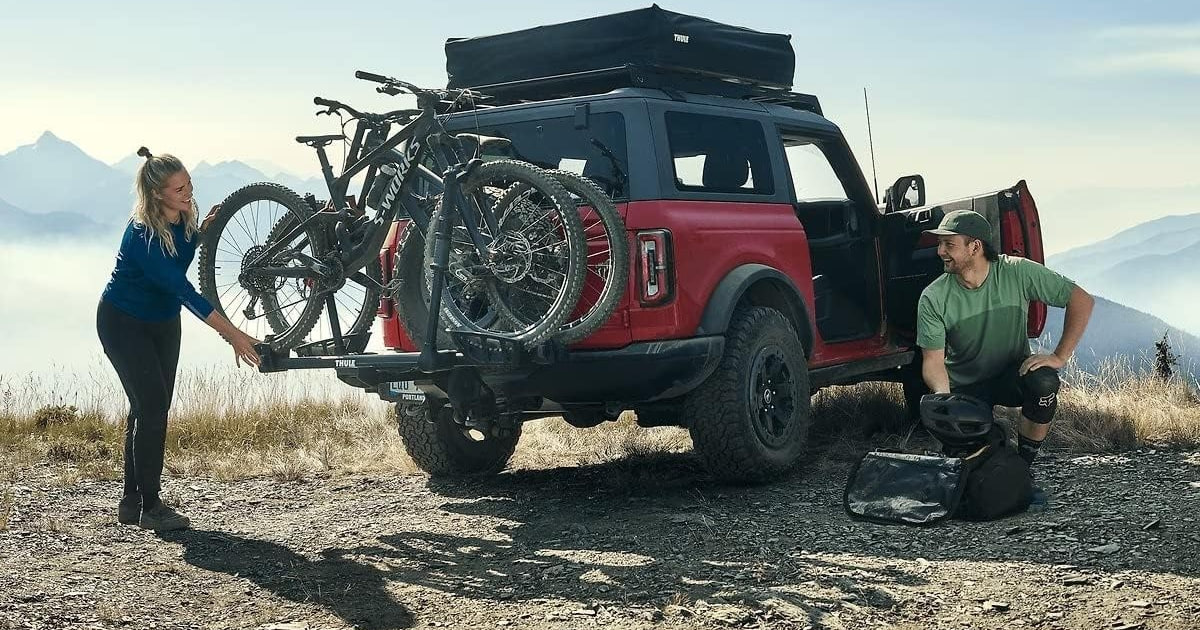
A hitch rack is the difference between a bike trip you look forward to and one you dread. Roof racks mean lifting a 30-pound bike over your head in a windy parking lot. Trunk straps press pads against your paint and shift on the highway. A hitch rack sits at waist height, holds bikes by the wheels, and lets you load a bike with one hand on the saddle. If you ride more than a few times a year, this is the upgrade that actually changes how often you go.
Here's the honest part: no hitch rack is light, cheap and easy all at once. The racks that hold a 60-pound e-bike without flexing weigh 50 pounds themselves, and you'll feel every one of them wrestling the thing into a receiver. The ones you can lift with one arm cap out well below e-bike weight. And every rack blocks some rear access — even the tilting ones ask you to unload or crouch. You're picking which compromise you can live with.
You also need a hitch already installed, and the receiver size matters more than most buyers expect. A 2-inch receiver is far steadier under load than a 1.25-inch one, which usually caps out around 100 to 120 pounds total. We think that the Thule T2 Pro XTR 2 is the best hitch-mounted bike rack for most people, and that the Kuat NV 2.0 is the one to buy if you want the most refined rack on the market and don't mind paying for it.
Everything we recommend

Holds almost any bike by the wheels, and holds it still

The most polished version of the same idea, with a repair stand

Four bikes for the price of a nice tire, with real trade-offs

Roll a heavy e-bike on instead of lifting it

Full rear access with bikes on, if you can handle the weight
At a glance
| Product | Bike Capacity | Weight Per Bike | Price | |
|---|---|---|---|---|
| Kuat NV 2.0-2" - 2-Bike Hitch RackUpgrade pick | 2 Bikes | 60 Lbs/Bike | $989 |
| Thule T2 Pro XTR 2 Hitch BikeTop pick | 2 Bikes | 60 Lbs/Bike | $859.95 |
| Allen Sports Deluxe 4-Bike Hitch Mount RackBudget pick | 4 Bikes | — | $178.31 |
 | Thule Helium Platform XT 2-BikeAlso consider | 2 Bikes | — | $899.95 |
| Yakima OnRamp LX 2-Bike Hitch Mount RackAlso great | 2 Bikes | 80 Lbs/Bike | $998.95 |
| RockyMounts BackStage 2" Receiver Swing Away platformRunner-up | 2 Bikes | 60 Lbs/Bike | $899.99 |
 | Swagman XC2 Hitch Mount Bike RackAlso in lineup | 2 Bikes | 35 Lbs/Bike | $99.15On sale |
How we picked
Frame safety. We prioritized platform racks that hold bikes by the wheel only, because published reviews and manufacturer guidance agree that top-tube clamping is a bad idea on carbon and often impossible on full-suspension frames. Hanging racks had to earn their place on price and capacity alone.
Weight per bike. We checked every spec sheet for per-tray capacity against the 45-to-65-pound range typical of mid-drive e-bikes. Racks capped at 35 pounds per bike were treated as non-starters for e-bike buyers, since the majority of racks on the market fall short there.
Rear vehicle access. We compared how far each rack tilts or swings and whether it does so with bikes loaded, using published reviews and listing specs. A rack that only clears the tailgate when empty solves nothing for someone living out of an SUV.
Sway and security. We looked for anti-wobble hitch hardware, integrated cable locks and locking hitch knobs, then weighed owner feedback about highway movement and paint rub. Independent testing shows an anti-wobble tightener cuts lateral movement dramatically, so we treated it as a baseline feature.
Weight and handling. We recorded each rack's own weight from spec sheets, since anything past about 50 pounds becomes a two-person job to install. Owner feedback about the lift was consistent enough across brands that we treated it as a real buying factor.
Top pick
Holds almost any bike by the wheels, and holds it still
Thule T2 Pro XTR 2 Hitch Bike
The T2 Pro XTR 2 grabs bikes by the front wheel with a ratcheting arm, so nothing ever touches your frame. It handles 20- to 29-inch wheels and tires up to 5 inches wide without adapters, carries 60 pounds per tray, and locks both the bikes and itself.
$859.95fromAmazonIf you own a carbon or full-suspension bike, the no-frame-contact design is the whole argument. Hanging racks clamp a bar across your top tube, which is a bad idea on carbon and often impossible on a modern full-suspension frame with a sloping or interrupted top tube. The T2 Pro XTR touches only the tires. Road.cc testers called its ratcheting wheel-strap system the gold standard for protecting high-end bikes, noting zero frame contact across more than 500 miles of road testing.
The tire range is what makes it a one-rack-for-everything answer. Twenty-inch kids' wheels, 29-inch mountain wheels, 5-inch fat tires — all of it fits without buying an adapter tray. If your household has a road bike, a kid's bike and a fat bike, you're not sorting out compatibility every time you load up. Owners report the wheel wells are deep and wide enough that the rear wheel actually sits in something rather than perched on a flat plate.
It's rated for 60 pounds per bike, which covers most e-bikes. That matters more than it sounds. Electric Bike Report found that over 60 percent of standard hitch racks sold recently cap out under 40 pounds per bike, while mid-drive e-bikes typically land between 45 and 65. The T2 Pro XTR's 120-pound total capacity puts two average e-bikes inside the limit, though a heavy cargo e-bike will still push past it.
Consumer Reports rated it Excellent for bike security and Very Good for ease of use, putting it at the top of their hitch rack evaluation alongside the Kuat. The HitchSwitch lever tilts the rack down for rear access or up against the car when it's empty. Integrated cable locks secure the bikes, and a locking knob secures the rack to the receiver. None of that stops a determined thief, but it stops the guy walking through a trailhead lot.
Small thing that turns out to matter: it has wheels built into the frame. At 52 pounds, this is not a rack you casually carry across a garage. Being able to roll it to a corner instead of hauling it is a real quality-of-life feature, and one that a surprising number of heavy racks skip.
Flaws but not dealbreakers
It's heavy. At 52 pounds, getting it into the receiver is a two-hands, bent-knees job, and owners regularly mention the lift as the one annoying part of an otherwise easy rack. If you plan to take the rack on and off between every ride, look at the lighter Thule instead.
The instructions have a reputation for being confusing, and a few owners report needing a second pair of hands or a call to Thule to sort out assembly. There are also scattered reports of the tire ratchet mechanism failing, though Thule's warranty support gets consistently good marks for replacing parts.
It's expensive, and the tilt still doesn't give you full access to a tailgate or liftgate with bikes loaded — it drops the bikes down and out of the way, but you'll be reaching over them.
Upgrade pick
The most polished version of the same idea, with a repair stand
Kuat NV 2.0-2" - 2-Bike Hitch Rack
The NV 2.0 does what the Thule does but with a foot-operated tilt lever and a fold-out Trail Doc repair stand built into the hitch post. It's the rack that reviewers keep calling the nicest one to live with, and it also carries 60 pounds per tray.
$989fromAmazonOutdoor Gear Lab gave the NV 2.0 its Editors' Choice for premium hitch racks, singling out the foot-activated tilt lever and the integrated work stand as the features that separate it from everything else. The foot pivot is the one you'll use constantly. Hands full of groceries, rack in the way — step on the lever, rack tilts. It sounds like a gimmick until you've used a rack that makes you crouch and yank a handle every time.
The Trail Doc stand is genuinely useful, not marketing. It folds out of the hitch post and clamps a bike at working height, so you can true a brake or adjust a derailleur at the trailhead instead of flipping the bike upside down in the dirt. If you ride trails where a mid-ride mechanical means a long walk, this is worth real money to you. If you ride bike paths, it's mostly a nice thing to own.
Like the Thule, it holds bikes by the front tire with an adjustable cradle, so nothing presses on your frame. The cradle adjusts across wheelbases and handles fat-bike tires. Owners with heavier e-bikes — including Aventon-class bikes with batteries installed — consistently report it stays planted. Consumer Reports put it alongside the T2 Pro XTR at the top of their evaluation for security and ease of use.
It's expandable, so a two-bike NV can become a four-bike NV later with an add-on. That's the pattern with premium racks generally: buy the base now, add capacity when the kids get bigger. Owners who've had theirs for years describe the build as rugged rather than merely nice-looking, which is the useful kind of praise for something that lives outside in road salt.
Flaws but not dealbreakers
It costs more than the Thule for a similar core function, and the gap buys you refinement rather than capability. The Trail Doc and the foot pivot are lovely. They don't carry a bike your top pick can't.
At roughly 51 pounds it's just as awkward to lift as the T2 Pro XTR, and it doesn't have the Thule's built-in transport wheels. Assembly is manageable solo but easier with a second person.
The orange anodized accents are polarizing. That's cosmetic, but you're going to look at this thing every time you walk behind your car.
Budget pick
Four bikes for the price of a nice tire, with real trade-offs
Allen Sports Deluxe 4-Bike Hitch Mount Rack
The Allen Deluxe carries four bikes on fold-away hanging arms and weighs just 23 pounds. It's the rack for casual riders with a garage full of mixed bikes who can't justify spending platform-rack money on a few trips a year.
$178.31fromAmazonFour bikes is the headline. Platform racks that carry four cost several times what this does and weigh more than twice as much, and most families with two adults and two kids don't need trailhead-grade hardware to get to the county park. The Allen holds four bikes on a rack you can lift with one arm.
The design has real limits, and you should know them before you buy. It's a hanging rack, so bikes rest on their top tubes in padded cradles. That means it's a poor match for carbon frames and for most full-suspension mountain bikes, whose sloping top tubes don't sit level in a cradle without an adapter bar. Bicycling Magazine's position on this is blunt: platform racks are the only style they recommend for carbon.
For steel and aluminum hardtails, kids' bikes and hybrids, it works fine. The tie-down cradle system secures each bike individually so they're not clacking into each other, the arms fold flat when the rack is empty, and it tilts back for lift-gate access. A no-wobble bolt takes the slop out of the receiver connection — the same trick that Adventure Alan found cuts lateral movement at highway speeds by roughly 80 percent.
Owners who've driven a thousand-plus miles with three or four bikes on it describe the steel construction as heavier and better welded than they expected at the price. It needs some assembly, and the retainer clips are tethered with lanyards so you don't lose them in a parking lot at dusk.
Flaws but not dealbreakers
With four bikes hanging off the arms, bike-to-bike contact is a real problem. Alternating the direction of each bike helps, and you'll want to add your own straps between frames if you're driving far. Expect some paint rub over time regardless.
There's no integrated lock at all — not for the bikes, not for the rack itself. You'll need a cable lock and a locking hitch pin, and you shouldn't leave bikes on it unattended.
It fits 2-inch receivers only, and depending on your vehicle it may not clear a rear-mounted spare tire. Owners of older SUVs with swing-out spares report needing a hitch extender.
Also great
Roll a heavy e-bike on instead of lifting it
Yakima OnRamp LX 2-Bike Hitch Mount Rack
The Yakima OnRamp LX has a ramp that stows on the rack, so you push a 60-pound e-bike up instead of deadlifting it into a tray. It's rated for 80 pounds per bike on-road, the highest capacity of anything here.
$998.95fromAmazonIf you own an e-bike, the ramp is the feature that decides this purchase. Loading a 60-pound bike into a tray 20 inches off the ground is a genuine back injury waiting to happen, especially if you're doing it alone in a gravel lot. Pinkbike testers loaded a 62-pound e-bike onto a Yakima OnRamp solo and rated the process 4 out of 5 for ease, well ahead of competing e-bike racks. The ramp folds and stores on the rack itself, so it's not one more thing to forget.
The 80-pound-per-bike road rating is the highest number in this guide, and it's what lets the OnRamp handle bikes the Thule and Kuat can't. Owners report carrying an 85-pound e-bike alongside a 60-pound one. Note the off-road rating drops to 48 pounds per bike — if you're taking a heavy e-bike down washboard forest roads, that's the number that applies to you.
Yakima's StadiumSeating trays sit at different heights and offset side to side, which keeps handlebars from tangling with the other bike's saddle. That's a small design decision with an outsized effect when you're loading two wide, awkward e-bikes. A three-position tilt drops the rack for trunk access with bikes loaded and folds it flat against the car when empty.
It takes 2-inch receivers only, and that's the right call for this rack. Two e-bikes plus the rack lands well past what a 1.25-inch receiver is typically rated to carry — REI's guidance puts 1.25-inch receivers at 100 to 120 pounds total versus 150 to 200 for 2-inch. Yakima sells an adapter, but we'd treat a 2-inch hitch as a requirement here, not a suggestion.
Flaws but not dealbreakers
Assembly gets mixed reports. Several owners describe a difficult bolt fit joining the two main sections, with one resorting to reaming it out because the problem surfaced on a weekend when support was closed. Budget extra time and don't assume it goes together in ten minutes.
The HitchLock secures the rack to the receiver, but a few owners still wish for a heavier chain-style lock and note the bike-to-rack security is thinner than what Thule and Kuat include. Plan on a separate cable lock through the frames.
This is a newer product with a thin feedback record compared to the established racks here, and at least one owner reported a bike that simply didn't fit the trays. Check your bike's wheelbase against the spec before ordering.
Runner-up
Full rear access with bikes on, if you can handle the weight
RockyMounts BackStage 2" Receiver Swing Away platform
The RockyMounts BackStage swings 180 degrees out of the way with two bikes loaded, so you get complete access to a tailgate, liftgate or camper doors. It's the answer for Jeeps, trucks and vans where a tilting rack still leaves you blocked out.
$899.99fromAmazonTilting racks all promise rear access, and they all half-deliver. You get the bikes lowered and angled down, and then you reach over them. The BackStage instead swings the entire loaded rack out to the side. Switchback Travel verified the full 180-degree swing with both bikes loaded, giving complete liftgate access — a capability no competing platform rack matched in their independent testing.
For anyone living out of the back of a vehicle, this changes the trip. Overlanders, van campers and truck owners who need the tailgate constantly aren't going to unload two bikes every time they want a cooler. Owners with pickup beds, Class B camper vans and hatchbacks all describe the swing working exactly as advertised. It also still tilts down 30 degrees and folds flat when you don't need the full swing.
The bike-holding hardware matches the premium racks: front-wheel-only contact with no frame clamping, 60 pounds per tray, tires from road width up to 5-inch fat, wheels from 20 to 29 inches, wheelbases from 34 to 49 inches. So you're not sacrificing bike compatibility to get the swing feature — you're paying for it in weight.
There's a mechanical caveat worth knowing before assembly. Owners report that the pivot points need careful attention during setup, and at least one found a lower pivot binding until it was properly adjusted. Take the time to check the full swing clearance against your specific vehicle before you load bikes on it.
Flaws but not dealbreakers
It weighs 75 pounds, by far the heaviest rack here. Getting it into a receiver alone is a serious lift, and taking it off between trips isn't realistic for most people. This is a rack that lives on the vehicle.
It doesn't accept an add-on, so two bikes is the ceiling — permanently. Families who might grow into four bikes should look at the Thule, Kuat or Yakima instead.
There are scattered but consistent reports of the rack rubbing paint off bikes and of hardware issues traced to over- or under-torqued assembly bolts. Follow the torque specs and re-check them after your first long drive.
Who this is for
Buy a hitch rack if you already have a receiver installed and you ride often enough that the roof-rack routine has started to feel like a chore. It's the right call if you own a carbon or full-suspension bike that shouldn't be clamped, if you have an e-bike too heavy to lift overhead, or if you regularly haul more than two bikes. If you don't have a hitch, factor in the cost and shop labor of adding one before you compare racks — for many crossovers and sedans that's a meaningful add.
Skip this category if you ride a few times a summer and can borrow a trunk rack, or if your vehicle has no receiver and no easy path to one. This guide covers hitch-mounted racks only, so roof trays, trunk-strap racks, spare-tire mounts and truck-bed racks are out of scope. We also focus on two-bike platform racks and one four-bike hanging option, which is what the research surfaced — larger platform racks generally start as one of these bases plus an add-on.
How we picked
We built our shortlist around a handful of things that actually change how a rack behaves in your driveway. Frame safety: we favored wheel-contact platform designs, because clamping a top tube is risky on carbon and awkward on full-suspension bikes. Weight per bike: we checked per-tray ratings against real e-bike weights, since most racks on the market cap out below what a mid-drive e-bike weighs. Rear access: we compared tilt and swing mechanisms and whether they work with bikes loaded, not just empty. Sway and security: we looked for anti-wobble hitch hardware, integrated locks, and owner reports of highway movement or paint rub. Handling: we tracked each rack's own weight, because past about 50 pounds, installing it alone stops being a one-person job.
Other hitch-mounted bike racks worth considering
If you take the rack on and off constantly: The Thule Helium Platform XT 2-Bike ($899.95) — The Thule Helium Platform XT 2 is the aluminum answer to the weight problem. Thule's Helium platform line is the lightest full-featured aluminum platform design in its class, and owners repeatedly describe installing this one solo in about two minutes — including a self-described mildly fit 60-year-old who takes it on and off without help. You get the same no-frame-contact ratcheting wheel loops and the same HitchSwitch tilt as the T2 Pro XTR. What you give up is capacity headroom and some of the burliness. If your bikes are heavy e-bikes, get the T2 Pro XTR or the OnRamp instead. If they're road and gravel bikes and you value being able to lift the rack yourself, this is the one.
The competition
Here's what our research surfaced, not everything sold. The hitch rack market is deep, and brands like 1UP, Küat's other lines and Saris all make racks worth a look that didn't come up in the sources we worked from. The one rack below lost to a pick for specific reasons, but it still makes sense for a particular buyer.
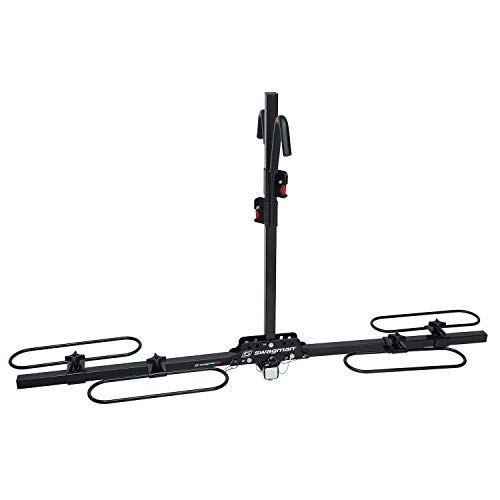
The Swagman XC2 Hitch Mount Bike Rack ($99.15) — The Swagman XC2 splits the difference between the budget and premium tiers, and it's the mid-range pick a lot of people land on. It fits both 1.25-inch and 2-inch receivers, weighs only 28 pounds, includes an anti-wobble hitch device, folds for storage, and costs a fraction of the platform racks here. It lost to our picks on one number: 35 pounds per bike. That rules out every e-bike and some heavier full-suspension mountain bikes. Its ratcheting upright arms also contact the frame rather than the wheel, and owner feedback includes exactly the complaint you'd expect — a friend with a carbon bike giving it the side eye, plus tray adjustments needed to keep bikes from touching. But owners who've run it for years across Subarus and pickups report it holding up over thousands of miles. If your bikes are ordinary and light and you have a 1.25-inch receiver, it's a reasonable buy.
Installation and fit notes
Check your receiver size first, since it caps everything else. A 1.25-inch receiver is typically rated for 100 to 120 pounds total, a 2-inch for 150 to 200 — and rack plus two e-bikes blows past the smaller number fast. Tighten the anti-wobble bolt or hitch tightener properly on install, then re-check it after your first 200 miles; that hardware is what separates a rack that sits still from one that sways all trip. Before your first long drive, load the bikes and walk around the car to confirm nothing touches: handlebar to saddle, tire to bumper, rack to spare tire. Alternate bike directions on multi-bike racks. And when you're done for the season, fold the trays or arms flat and store the rack indoors if you can — road salt is what kills the hardware, not the miles.
Questions we get
What's the difference between a platform rack and a hanging rack?
A platform rack holds bikes by the wheels, sitting in trays below. A hanging rack suspends bikes by the top tube from two arms. Platform racks are steadier, safer for carbon and full-suspension frames, and easier to load since you never lift the bike above waist height. Hanging racks are lighter and much cheaper, and they carry more bikes in less space.
Can I use a hitch bike rack with a 1.25-inch receiver?
Yes, but check the rack — many premium platform racks are 2-inch only. A 1.25-inch receiver is also usually rated for around 100 to 120 pounds total, versus 150 to 200 for a 2-inch. That's fine for two normal bikes on a light rack. It's not enough for a 50-pound rack plus two e-bikes.
Are hitch racks safe for carbon fiber frames?
Platform racks are. They hold the bike by the tires and never touch the frame, which is why review sites recommend them as the only style for carbon. Hanging racks clamp a padded cradle onto the top tube, and that pressure is a real risk on carbon. If you own a carbon bike, treat wheel-contact-only as a requirement.
What's the best hitch rack for e-bikes?
Look for at least 60 pounds per tray and, ideally, a loading ramp. Most racks on the market cap out under 40 pounds per bike, which rules them out for typical mid-drive e-bikes weighing 45 to 65. Our Yakima OnRamp LX pick handles 80 pounds per bike on-road and includes a stowable ramp so you roll the bike up instead of lifting it.
Can I open my trunk or tailgate with the rack on?
Partly, on most racks. Tilting racks drop the loaded bikes down and away, which gets you into a hatch but means reaching over the bikes. Only a swing-away rack like the RockyMounts BackStage moves the whole loaded assembly out of the way for full access. If you use your cargo area constantly, that's worth the extra weight and cost.
Do hitch racks wobble at highway speeds?
A properly installed one shouldn't. The play comes from the gap between the rack's shank and your receiver, and an anti-wobble bolt or hitch tightener takes it out — independent testing found that hardware cuts lateral movement by roughly 80 percent. Most quality racks include one. Re-tighten it after your first couple hundred miles, because it can settle.
Why you should trust us
For this guide:
- We read published reviews and comparative evaluations from Wirecutter, Consumer Reports, Outdoor Gear Lab, Switchback Travel, Pinkbike, Road.cc and Bicycling Magazine, along with retailer buying guidance from REI.
- We compared manufacturer spec sheets for every rack here on per-bike weight limit, receiver size, tire and wheelbase range, tilt or swing behavior, and rack weight.
- We read owner feedback across these listings for recurring themes — installation difficulty, highway sway, paint rub and lock quality — and used those patterns to inform the flaws in each pick.
- We read owner reviews on every listing, weighted toward the critical ones, because that is where the recurring failures show up.
- We have a systematic way of automatically fetching the latest prices, so the numbers on this page stay current.
- This is a research-focused guide, so the team may not own every product listed — though we often do own the top winners, which gives us extra context for the recommendations.
- We don't accept free products, and the retailer commission never changes which product we recommend.
Sources
Best Bike Racks 2025 – Wirecutter, Wirecutter
Best Hitch Bike Racks – Outdoor Gear Lab, Outdoor Gear Lab
Hitch Bike Rack Reviews & Ratings – Bicycling Magazine, Bicycling Magazine
Best Hitch Bike Racks Reviewed – Road.cc, Road.cc
Hitch Bike Rack Buyer's Guide – REI Co-op, REI Co-op
E-Bike Carrier Compatibility Guide – Electric Bike Report, Electric Bike Report
Yakima OnRamp Review – Pinkbike, Pinkbike
RockyMounts BackStage Review – Switchback Travel, Switchback Travel
Thule Helium Platform 2 Review – Clever Cyclist, Clever Cyclist
Hitch Rack Sway & Stability Testing – Adventure Alan, Adventure Alan
Best Bike Racks of 2025 – Consumer Reports, Consumer Reports
Amazon product listings and owner reviews for all 7 products
Manufacturer specification pages for each product
Some passages in this guide may be paraphrased with AI help. Prices are refreshed automatically.
More like this.
Continue exploring electronics reviews and recommendations.

The Best Trailer Hitch Cargo Carriers
Every road trip has the same moment. The trunk is full, there's still a cooler and a folding chair on the driveway, and someone in the back seat is about…

The Best Trailer Hitch Locks
A trailer sitting in your driveway is one of the easiest things on your property to steal. Someone backs a truck up, drops your coupler onto a ball, and…

The Best Trailer Hitches and Towing Accessories
Towing gear is the rare purchase where the boring choice is the right one. A hitch bolts to your frame, sits in road salt and spray for years, and then…

The Best E-Bike Accessories and Upgrades
An e-bike changes what you ask of your gear. The bike is heavier, faster, and worth more than the commuter you probably owned before, and that shifts what…

The Best Bike Lights
A bike light does two jobs, and they pull in opposite directions. One is seeing: throwing enough light down the road to catch a pothole at speed. The…

The Best Commuter E-Bike Accessories
A commuter e-bike gets you to work. The gear bolted to it decides whether the ride is pleasant or grim. You're out in traffic at speeds a regular bike…