The Best Window Air Conditioners

A window air conditioner is the difference between sleeping through a July night and lying awake on top of the covers. If you rent, or if your house has no ducts, it's usually the only real option. The choice comes down to a few things you'll live with every day: how loud it is at 2 a.m., how much it adds to the power bill, whether it fits your window, and whether you can get it up there without hurting yourself. Everything else is marketing.
Here's the honest part. Every window unit is a heavy metal box you have to lift into a hole in your wall, and none of them make that pleasant. They all block some light and some view. They all need the filter cleaned every few weeks, and they all collect condensation that can turn musty if the unit never gets a chance to dry out. Owners of even the best models run into rattles, leaks and app disconnects. Quiet and efficient models cost more, and the payback takes seasons, not weeks.
The variable-speed inverter models have pulled far enough ahead on noise and efficiency that we'd steer most people there. Fixed-speed units still cool a room fine, but they lurch between blasting and silent, and you hear every cycle. We think that the Midea 8,000 BTU U Shaped Smart Inverter is the best window air conditioner for most people, and that the LG LW1022FVSM Dual Inverter is the one to buy if your window can't take the U-shape's saddle-style mount.
Everything we recommend

Quiet enough to sleep next to, and your window still opens

A conventional install with nearly the same quiet and efficiency
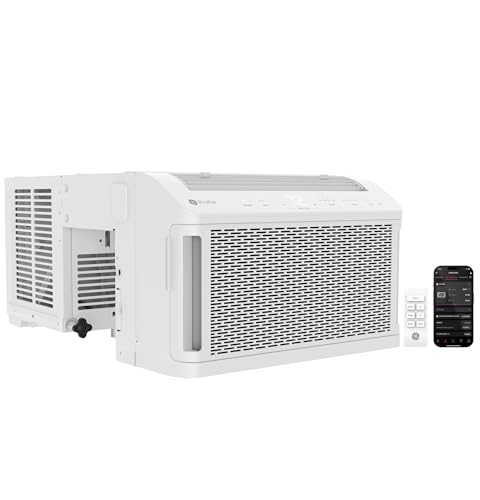
Full window view and deep smart-home hooks, with more fussing

The easiest install here, for a small room you want cooled fast
At a glance
| Product | BTU (Cooling) | Coverage Area | Price | |
|---|---|---|---|---|
| Midea 8Top pick | 8,000 BTU | 350 Sq Ft | $399.99On sale |
 | Friedrich Chill Premier Window/Wall Air Conditioner 6KAlso consider | 6K BTU, 115V | — | $385 |
| GE Profile ClearView Inverter Window Air ConditionerAlso great | 10,300 BTU | 450 Sq Ft | $319.95 |
| LG 10000 BTU Window Air Conditioners [2023Runner-up | 10,000 BTU | 450 Sq Ft | $499 |
| Windmill 6Budget pick | 6,000 BTU | 250 sq ft | $339On sale |
How we picked
Noise at night. We compared manufacturer dB ratings against independent measurements from RTINGS.com and HVAC.com, and weighted low-fan numbers most heavily. Anything meaningfully above the roughly 56 dB category average on high didn't make the cut.
Efficiency and inverter type. We prioritized ENERGY STAR certification and variable-speed inverter compressors, since published testing puts their savings at 20 to 35% over a season. ENERGY STAR now requires an EER of at least 12.1 in the 8,000 to 13,999 BTU range.
Sizing and coverage. We matched each unit's rated coverage to real room sizes rather than headline BTU numbers, because oversizing causes short-cycling and clammy rooms. We looked for a lineup spanning a single bedroom up to a full living room.
Installation and window fit. We read spec sheets for minimum and maximum window dimensions, sill depth, weight, and what hardware is included. Units needing a separately purchased support bracket got marked down.
Owner-reported durability. We read through owner feedback looking for repeated themes rather than one-off complaints, focusing on drainage, mold, app reliability and support experiences after the first season.
Top pickOn sale
Quiet enough to sleep next to, and your window still opens
Midea 8
The Midea U straddles your window sash instead of blocking it, so the glass closes around the unit and the compressor noise stays outside. It cools a 350-square-foot room, runs an inverter compressor for steady temperatures, and answers to Alexa or Google.
$399.99fromAmazonList priceThe U-shape isn't a gimmick — it's the reason this thing is quiet. On a normal window AC, the compressor sits a few inches from your face with an open sash above it. Midea splits the unit so the window closes down through the middle, putting the glass between you and the loud half. Tom's Guide reports the design cuts outside noise intrusion by roughly 60% versus a conventional install. Midea rates operation as low as 32 dBA.
You also get your window back. The sash slides up and down normally with the unit installed, so you can crack it for fresh air on a mild evening instead of choosing between AC and a breeze. Renters in cities care about this more than they expect to. There's an anti-theft catch that locks the window when it's closed, which matters on a ground floor.
The inverter compressor ramps up and down instead of slamming on and off. Popular Mechanics found inverter units hold a room within about a degree of the set point, where single-speed compressors swing four to six degrees. In practice that means fewer of those cold blasts followed by a slow, clammy warm-up. Midea claims better than 37% energy savings against conventional units, and this was the first window AC to earn ENERGY STAR certification.
Installation is more involved than a standard unit, but it's well thought out. You snap in the included bracket, set the AC on it, then secure the sidearms. It needs a single- or double-hung window between 22 and 36 inches wide with at least 13.75 inches of height. At about 56 pounds, this is a two-person lift — don't be a hero on a second floor.
Flaws but not dealbreakers
The most consistent owner complaint is mold. Because of the saddle shape, water can sit in the base if the unit never runs in fan-only mode to dry out, and several owners describe finding growth inside after a season. Run the fan for a half hour after cooling, and pull the filter monthly. Some owners also report the remote being flaky.
The saddle design rules out a lot of windows. If you have casements, sliders, security bars, or a sill that won't take the bracket, this isn't your unit. Measure before you order, not after.
At 8,000 BTU it tops out around 350 square feet. Owners cooling more than one room consistently wish they'd gone up to the 10,000 BTU version instead.
Runner-up
A conventional install with nearly the same quiet and efficiency
LG 10000 BTU Window Air Conditioners [2023
LG's dual-inverter unit puts 10,000 BTU into a standard double-hung window and runs as low as 44 dB in sleep mode. It's the pick if the Midea's saddle mount won't work in your window, and it covers a bigger room.
$499fromAmazonThis is the normal-shaped window AC that finally got quiet. LG's dual inverter compressor and BLDC motor drop sleep-mode noise to around 44 dB. RTINGS.com measured a closely related LG inverter model at 51.5 dB on high and 44 dB on low, against a category average near 56 dB on high. That gap is the difference between a unit you notice and one you forget is running.
It covers more room than our top pick. At 10,000 BTU it handles up to 450 square feet, which is a real living room rather than a bedroom. If your space gets more than four hours of direct sun a day, This Old House suggests adding about 4,000 BTU to your base calculation — this unit gives you that headroom where an 8,000 BTU model wouldn't.
The efficiency case is strong. LG claims up to 35% better energy savings than the ENERGY STAR requirement, and Wirecutter found LG's dual-inverter design uses roughly 25% less energy than fixed-speed competitors at the same output. Over a full cooling season in a hot climate, that adds up meaningfully on the bill.
The ThinQ app handles scheduling and remote start, and it works with Alexa and Google Assistant. Scheduling is worth setting up: running the AC on a schedule rather than always-on can cut runtime 15 to 20%, and the Department of Energy estimates that raising the setpoint 7 to 10 degrees for eight hours a day saves about 10% on cooling. The filter slides out for washing, which you should do monthly.
Flaws but not dealbreakers
It's heavy — about 63 pounds — and it installs in a conventional fixed chassis, so it blocks your window. Multiple owners strongly recommend adding a support bracket, which isn't included. Get the tilt right during install or condensation will drain the wrong way, which is the most common complaint here.
Startup is slower than a fixed-speed unit. The compressor eases in rather than jumping to full blast, so the first few minutes feel underwhelming if you're used to an old rattler.
Also great
Full window view and deep smart-home hooks, with more fussing
GE Profile ClearView Inverter Window Air Conditioner
GE's ClearView is a saddle-style inverter unit that keeps your whole window view and works with SmartHQ, Alexa and Google Assistant. Its flex-depth chassis adjusts for unusually thick or thin walls, which solves fits that defeat other units.
$319.95fromAmazonThe pitch is the view. Like the Midea, the ClearView sits low in the window so you keep the glass and the light, and the window opens and closes after installation. GE rates it as low as 40 dB and calls itself the quietest window AC brand in the US. At 10,300 BTU it covers up to 450 square feet, and it's ENERGY STAR certified with inverter technology GE says is 34% more efficient.
The flex-depth chassis is the reason to pick this over the Midea. It expands to fit walls and sills between 4.5 and 13.75 inches thick, and it handles windows 20 to 40 inches wide. Older houses with deep sills, or apartments with odd trim, defeat a lot of window ACs. This one has an actual adjustment for it rather than asking you to improvise with foam.
If you already live in Google Home or SmartThings, the SmartHQ integration is the deepest here. You get remote control, monitoring and filter alerts from your phone, plus Alexa and Google voice control. For a unit in a guest room or a second floor you don't visit daily, being able to check on it remotely is genuinely useful.
Flaws but not dealbreakers
Owner feedback on reliability is mixed, and that's the reason this isn't higher. The most common failure reports involve condensation not pumping out to the exterior, throwing an error code and stopping cooling. Others describe the width adjustment being imprecise enough that getting a tight seal takes real work.
Installation is the most demanding of our picks. Several owners describe measuring, trimming and repositioning before it sat right, and at roughly 76 pounds it's the heaviest unit here. Budget an afternoon and a second person.
Budget pickOn sale
The easiest install here, for a small room you want cooled fast
Windmill 6
Windmill's 6,000 BTU unit cools up to 250 square feet and ships with a pre-assembled kit that goes in without tools or L-brackets. It's the one to get for a bedroom or home office if you dread the installation more than the electricity bill.
$339fromAmazonList priceInstallation is the whole argument. The kit arrives pre-assembled with a carry strap, and Bob Vila puts first-time installation at around 28 minutes, against a 45 to 60 minute industry average for units that need tools and brackets. Owners describe getting it in without reading the instructions. If you've ever balanced an AC on a sill while hunting for a screwdriver, that's worth something.
It's designed to be lived with. The vents push air out at a 45-degree angle so it spreads through the room instead of blowing straight at your desk, the LEDs auto-dim at night, and the facade looks like a piece of furniture rather than a beige appliance. There's a washable mesh filter plus an optional activated carbon filter, three cooling settings and three fan speeds.
It's the least powerful unit here, and that's the point. At 6,000 BTU and 250 square feet it's sized for one bedroom, and correct sizing matters more than people think. An oversized unit short-cycles: it hits the temperature fast, shuts off, and never runs long enough to pull humidity out, leaving the room cold and clammy. For a small room, this is the right size rather than a compromise.
The app is a real one, with remote control and scheduling plus voice assistant support. Double-insulated side panels help keep cool air in and street noise out, and owners consistently describe it as a gentle hum rather than a rattle.
Flaws but not dealbreakers
It isn't a true inverter. The fan ramps at a fixed rate and the compressor cycles on and off, so you'll get the temperature swings that inverter units avoid, and the efficiency won't match our top picks. Owners who've lived with both models are direct about this difference.
Long-term reliability is the open question. Some owners report app disconnects and odd behavior after a couple of seasons. It also costs more than a plain 6,000 BTU unit of similar output, so you're paying for the design and the install experience.
Who this is for
Buy a window AC if you rent, if your place has no ductwork, or if one room runs hot while the rest of the house is fine. It's also the right call for supplementing central air in a west-facing bedroom that bakes all afternoon. If you're a light sleeper, this is the category where spending more actually changes your life — the gap between a cheap fixed-speed unit and a good inverter is the difference between waking up at every cycle and not noticing it's on.
Skip this guide if your windows are casements or sliders, since almost nothing here will fit and you'll want a casement-specific or portable unit instead. Skip it too if you're cooling a whole house — several window units cost more to run than a mini-split, and the install starts to look silly. We've focused on standard window-mounted room air conditioners for single- and double-hung windows, from about 6,000 to 10,300 BTU. Portable ACs, through-the-wall sleeve units and mini-splits are out of scope.
How we picked
Noise: We weighted independently measured decibel figures at low fan speed above marketing claims, since that's the number you hear at 2 a.m. Efficiency: We favored ENERGY STAR certification and variable-speed inverter compressors, which published testing credits with 20 to 35% seasonal savings over fixed-speed designs. Sizing: We matched rated coverage to actual room sizes, because an oversized unit short-cycles and leaves the room cold and humid. Installation: We read spec sheets for window width, sill depth, weight and included hardware, and marked down units that need a support bracket you have to buy separately. Durability: We looked through owner feedback for repeating themes — drainage failures, mold, app dropouts — rather than isolated bad units.
Other window air conditioners worth considering
If you want a slide-out chassis for a through-the-wall install: The Friedrich Chill Premier Window/Wall Air Conditioner 6K ($385) — The Friedrich Chill Premier is a 6,000 BTU unit with commercial-leaning build quality, QuietMaster construction, Wi-Fi and voice control, three cooling and fan speeds, eight-way airflow and a washable filter with a check-filter alert. HVAC.com measured a Chill Premier at 42 dB on low, about the level of a whispered conversation. The slide-out chassis lets some owners mount it through a wall, which none of our picks do. But it's the least consistent unit here on owner-reported reliability, with several accounts of failures inside the first year and support that was slow to respond. One owner found the top inside vent makes a true in-wall sleeve install impossible despite the listing language, so check the manual against your opening before you commit.
The competition
This is what our research turned up, not a census of the market. Window AC lineups change constantly and a lot of capable units — particularly higher-BTU models for large open rooms — weren't part of this lineup. If a unit you're considering isn't here, that doesn't mean it's bad.
Installation and maintenance notes
Measure your window opening — width and height — before you buy anything, and check the sill depth too if you're looking at a saddle-style unit. Most of these need a second person; the heaviest here is around 76 pounds and none are one-person lifts on an upper floor. Set the unit with a slight tilt toward the outside so condensation drains away from your floor, which is the single most common install mistake owners report. Wash the filter monthly through cooling season. And before you shut things down, run the unit in fan-only mode for a half hour to dry the interior — trapped moisture is what turns into the musty smell and mold that show up in owner complaints across every brand.
Questions we get
What size window air conditioner do I need for a 300-square-foot room?
An 8,000 BTU unit covers roughly 350 square feet, which fits a 300-square-foot room with a little margin. Add about 4,000 BTU if the room gets more than four hours of direct sun a day, per This Old House guidance. Don't just round up for safety — an oversized unit short-cycles and leaves the room cold and humid.
What's the quietest window air conditioner for a bedroom?
Our top pick, the Midea U, is rated as low as 32 dBA because the window sash closes between you and the compressor. Among conventional-shape units, the LG dual inverter runs around 44 dB in sleep mode. Independent measurements put the category average near 56 dB on high, so either one is a large step down from a typical unit.
Are inverter window air conditioners worth the extra cost?
For most people, yes. Published testing credits inverter models with 20 to 35% lower electricity use over a season, and they hold room temperature within about a degree of the setpoint instead of swinging four to six degrees. The comfort difference is honestly more noticeable than the savings. If you only run the AC a few weeks a year, the math is weaker.
Can a window AC work in a casement or sliding window?
Not the units in this guide. Everything here is built for single- or double-hung windows, where the sash slides vertically. Casement and sliding windows need a purpose-built casement AC or a portable unit vented through the opening.
Does a window AC dehumidify as well as it cools?
It removes humidity as a side effect of cooling, and most units here have a dedicated dry mode. But it only works if the compressor runs long enough — that's why a correctly sized unit feels drier than an oversized one that short-cycles. If humidity is your main problem rather than heat, a standalone dehumidifier does it better.
Will a window AC noticeably raise my electricity bill?
It will, but how much depends on the unit and how you run it. ENERGY STAR-certified models use at least 10% less energy than the federal minimum, and the current standard requires an EER of 12.1 for 8,000 to 13,999 BTU units. The Department of Energy estimates that raising the thermostat 7 to 10 degrees for eight hours a day cuts about 10% off cooling costs, so scheduling is the easiest win.
Why you should trust us
For this guide:
- We read manufacturer spec sheets for every unit in this lineup, comparing rated coverage, decibel figures, window dimensions and included hardware side by side.
- We compared published measurements and findings from RTINGS.com, HVAC.com, Tom's Guide, Popular Mechanics, Bob Vila, Consumer Reports and Wirecutter, plus ENERGY STAR and Department of Energy efficiency guidance.
- We read owner feedback for each product looking for repeated themes — drainage and mold, app reliability, and support experiences after the first season — rather than isolated complaints.
- We read owner reviews on every listing, weighted toward the critical ones, because that is where the recurring failures show up.
- We have a systematic way of automatically fetching the latest prices, so the numbers on this page stay current.
- This is a research-focused guide, so the team may not own every product listed — though we often do own the top winners, which gives us extra context for the recommendations.
- We don't accept free products, and the retailer commission never changes which product we recommend.
Sources
Best Window Air Conditioners — Wirecutter (NYT), Wirecutter
Best Window Air Conditioners 2026 — Consumer Reports, Consumer Reports
Window Air Conditioner Reviews — RTINGS.com, RTINGS.com
Best Window Air Conditioners — Tom's Guide, Tom's Guide
Best Window AC Units — Good Housekeeping, Good Housekeeping
Best Window Air Conditioners — Bob Vila, Bob Vila
Window AC Energy Guide — U.S. Department of Energy, U.S. Department of Energy
ENERGY STAR Certified Room Air Conditioners List, ENERGY STAR / EPA
Best Window Air Conditioners — Popular Mechanics, Popular Mechanics
Window AC Market Data — AHAM 2025 Annual Report, Association of Home Appliance Manufacturers (AHAM)
Friedrich Chill Premier Review — HVAC.com, HVAC.com
Room Sizing Guide for Window ACs — This Old House, This Old House
Amazon product listings and owner reviews for all 5 products
Manufacturer specification pages for each product
Some passages in this guide may be paraphrased with AI help. Prices are refreshed automatically.
More like this.
Continue exploring appliances reviews and recommendations.

The Best Portable Air Conditioners for Small Spaces
A portable air conditioner is what you buy when a window unit isn't an option. Maybe your lease forbids anything hanging outside. Maybe your windows slide…

The Best Deep Conditioning Hair Masks
Most people don't think about a hair mask until the damage is already obvious. Your ends feel like straw, a comb snags halfway down, and the conditioner…

The Best Window Fans
A window fan does something an air conditioner can't: it swaps the air in your house. On a summer night when it's cooler outside than in, a fan sitting in…

The Best Air Purifiers for Allergies
Allergy season doesn't stop at your front door. Pollen rides in on your clothes, dust mites live in the mattress, and a cat sheds protein-carrying dander…

The Best Toaster Oven Air Fryers
A toaster oven air fryer earns its counter space by replacing three things at once: the toaster, the little baking oven, and the basket fryer you'd…

The Best Air Fryers
An air fryer is really just a small, very fast convection oven, and that's exactly why it's useful. It gets to temperature in a couple of minutes instead…