The Best Smart Water Bottles
Most of us know we should drink more water, and most of us don't. CDC analysis of NHANES data found that roughly 43% of U.S. adults drink fewer than four cups of plain water a day — less than half the commonly cited target. The Mayo Clinic puts total daily fluid needs around 125 ounces for men and 91 ounces for women. That gap is where smart water bottles come in. They light up, buzz your phone, or log every sip so you can see the number instead of guessing at it.
Here's the honest part: no bottle in this category tracks perfectly, and none of them fix the habit by themselves. Sensor accuracy depends on how you fill and hold the bottle, and every model has conditions where the count drifts. Forbes Health reported that notification fatigue and awkward charging were the two most common reasons people quit these bottles within 60 to 90 days. A smart bottle is a training wheel, not a permanent fixture. Plenty of owners describe using one until drinking enough becomes automatic, then going back to a plain bottle.
We also want to be clear about what a connected bottle can't do. It can't tell water from coffee, it can't hydrate you while it sits in the car, and the electronics in the lid usually mean hand-washing. If the app gets abandoned by its maker, you're left with an expensive cup. We think that the HidrateSpark PRO 2 is the best smart water bottle for most people, and that the ULLA Smart Hydration Reminder is the one to buy if you already own a bottle you like.
Everything we recommend

The most accurate tracking and the best app to go with it

Nearly as useful, with a silent halo light and a screen on the lid

Turns the bottle you already own into a reminder, no app needed

Cleans the water itself, if you drink from questionable taps
At a glance
| Product | Capacity | Battery Life | Price | |
|---|---|---|---|---|
| HidrateSpark PRO 2 21 oz StrawTop pick | 21 oz | Up to 21 Days | $79.99 |
| LARQ Bottle Movement PureVis 24 oz- LightweightAlso great | 24 oz | Up to 1 Month | $89 |
 | THERMOS Hydration Bottle with MeterAlso in lineup | 24 oz | — | $12.59On sale |
| ULLA Smart Hydration Reminder to Drink MoreBudget pick | — | 6 Months | $29.95 |
| WaterH BOOST Smart Water Bottle Tracker withRunner-up | 24 oz | — | $49.99 |
 | Hydracy Water Bottle with Time Marker -LargeAlso consider | 32 oz | — | $24.99 |
How we picked
Tracking accuracy. We compared manufacturer accuracy claims against published evaluations, favoring bottles that measure intake with a sensor over ones that estimate from tilt or fill count. Anything reporting a margin wider than about 15% had to earn its place some other way.
Reminders that stick. We weighted on-bottle light alerts above phone push notifications, because published reviews and owner feedback both point to notification fatigue as the reason people quit. A glow you catch peripherally beats an alert you swipe away.
Battery and charging. We looked at rated battery life and independent battery testing, and treated a weekly recharge as a real strike against a bottle. Coin-cell models that run for months got credit for never becoming a chore.
App and ecosystem. We checked which platforms each app supports and whether it feeds Apple Health, Fitbit, or Garmin Connect. Owner reports of glitchy or abandoned apps counted heavily, since a dead app turns a smart bottle into a cup.
Bottle basics. Insulation, lid seal, mouth width, and cleaning access all had to hold up on their own merits. We read owner feedback for leaks, lids popping open in bags, and hand-wash-only electronics.
Top pick
The most accurate tracking and the best app to go with it
HidrateSpark PRO 2 21 oz Straw
The HidrateSpark PRO 2 logs each sip automatically with a sensor in the base, glows to nudge you, and syncs to Apple Health, Fitbit, and smart rings. It's the closest thing to a set-and-forget hydration tracker, and the app is the most polished in the category.
$79.99fromAmazonIf you want a number you can actually trust, this is the bottle. HidrateSpark's SipSense sensor measures what leaves the bottle rather than guessing from how often you tip it. The company specifies tracking within about 5% of actual intake when the bottle is filled from the top and not submerged. Good Housekeeping Institute's evaluation of smart bottles put sensor-based models like this one within roughly 6% of measured volume, while time-marker bottles offered no electronic measurement at all.
The reminder is the part that actually changes behavior. A 360-degree glow ring around the base pulses when you're behind, and you catch it out of the corner of your eye while you're working. Phone notifications are easy to swipe away without thinking; a bottle sitting on your desk that starts breathing light at you is harder to ignore. You can also add sounds and app alerts if the glow alone doesn't get through to you.
Battery life is where the PRO 2 pulls ahead of its own predecessors. HidrateSpark rates it at up to 21 days per charge, and Tom's Guide measured about 30 days on the earlier PRO STEEL under a typical 10-hour active day. That's the difference between a bottle you charge once a month and one that becomes a chore. Owners who abandoned earlier rechargeable bottles usually blame the charging cadence, not the tracking.
The ecosystem matters more than it sounds. If you already wear a Fitbit, a Garmin, or an Apple Watch, your water intake lands next to your steps and sleep instead of living in a separate app you forget to open. Built-in Apple Find My is a small thing that turns out to be useful — a bottle left in a conference room or a gym locker is findable. Goals adjust to you rather than defaulting to a flat eight glasses.
Flaws but not dealbreakers
The straw lid is divisive. Some owners find it stiff to draw from and say they have to pull harder than they'd like for a real mouthful. If you prefer a chug-style spout, this may bug you every single day, and it's the kind of thing you can't tell from a listing photo.
Bluetooth connections drop sometimes, and a few owners report needing to reset the bottle to get it talking to the phone again. It reconnects, but it's an occasional annoyance. Owner feedback also includes durability complaints from people on their second bottle in under two years, which is worth weighing given what this costs relative to a plain insulated bottle.
It's heavy for its size. At 21 ounces of capacity and just over a pound empty, the steel build feels solid but adds real weight to a bag. And like every bottle here, the lid electronics mean hand-washing rather than a run through the dishwasher.
Runner-up
Nearly as useful, with a silent halo light and a screen on the lid
WaterH BOOST Smart Water Bottle Tracker with
The WaterH BOOST tracks intake with a flow-and-angle algorithm, shows your progress on an LED display, and glows quietly instead of beeping. Tracking is looser than the HidrateSpark's, but the insulation is good and it fits a car cup holder.
$49.99fromAmazonThe BOOST's best trick is that it tells you where you stand without making you pick up your phone. There's a small LED display on the lid and a halo light that glows as a silent nudge. No beeps, no buzzing — useful if you sit in an open office or a shared room. It also pushes notifications to your phone and smartwatch if you want the redundancy, and it syncs to Apple Health.
Tracking here is estimated, not measured, and that's the real trade-off. WaterH says its algorithm infers intake from water flow and bottle angle, with third-party lab testing typically landing within about 15% under test conditions. That's a wider margin than the HidrateSpark's roughly 5% claim. For habit-building it's plenty — you're trying to go from three cups to eight, not audit yourself to the ounce. For anyone who wants precision, it isn't close.
As a plain bottle it holds up well. It's insulated stainless steel with a wide mouth for ice and fruit, a handle, and a 24-ounce body sized for a car cup holder. Owners consistently mention that water stays cold for a long stretch and that the bottle survives drops without cosmetic damage. Calibration on a flat surface after pairing is part of setup, and skipping it is a common source of complaints.
It's the friendlier pick if you find the HidrateSpark's straw lid annoying. You get a normal drinking experience, a light you can change the color of, and a battery owners describe as long-lasting. The catch is the app: several owners report it getting glitchy when you walk away from the bottle and come back, and the lid pops open more easily than it should when the bottle's tossed in a bag.
Flaws but not dealbreakers
The ±15% tracking window is wide enough that your daily total is a decent estimate, not a fact. If you're managing a medical condition where intake actually needs to be counted, that margin matters, and you should measure rather than trust an algorithm.
The lid's easy-open button is convenient in your hand and a problem in a backpack. Multiple owners describe it popping open in a bag. The app has rough edges too, including connection hiccups that require re-pairing.
Budget pick
Turns the bottle you already own into a reminder, no app needed
ULLA Smart Hydration Reminder to Drink More
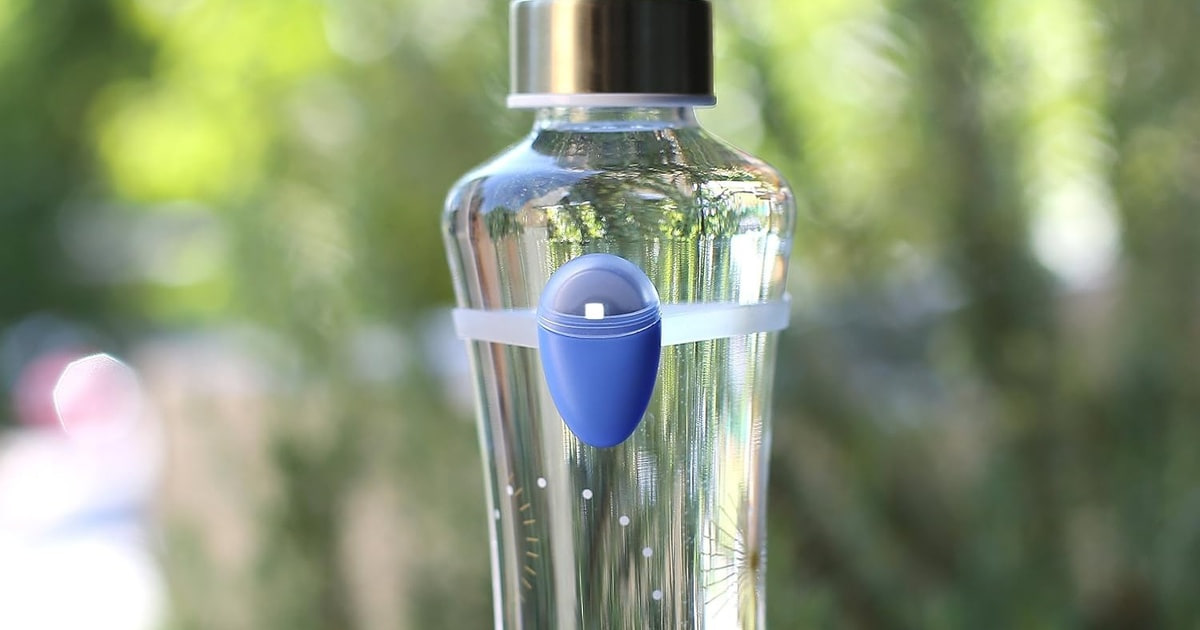
The ULLA is a small sensor puck that straps onto almost any bottle and blinks when you haven't taken a sip in a while. There's no app, no charging, and no tracking — just a light that's very good at catching your eye.
$29.95fromAmazonThe smartest thing about the ULLA is what it leaves out. There's no app to set up, no account, and no Bluetooth pairing. You band it onto whatever bottle you already like, and it blinks about once an hour if you haven't been drinking. Motion and proximity sensors mean it only nags when you're actually nearby, and a daylight sensor keeps it quiet at night. A pre-installed coin cell runs roughly six months.
That last part solves the problem that kills most smart bottles. Forbes Health found that inconvenient charging and notification fatigue were the top reasons people quit these devices inside three months. A blinking light on a six-month battery sidesteps both. You don't manage it, you just look at it. Owners repeatedly describe it working where phone alarms and computer pop-ups stopped registering.
It's also the answer if you already own a bottle you love. Nothing else here lets you keep your Hydro Flask, your YETI, or the insulated bottle you got for free at a conference. The silicone band fits a wide range of diameters, and you can move the puck between bottles — one on your desk, one in the car. ULLA's own post-purchase survey found 78% of buyers said they were drinking more after 30 days, though that's self-reported and not a controlled study.
Be clear about what you're giving up. The ULLA doesn't measure anything. It doesn't know whether you drank two ounces or ten, and there's no daily total to look back on. If seeing the number is what motivates you, this isn't your device. If a nudge is all you needed, it's the sensible thing to try before spending several times as much.
Flaws but not dealbreakers
It falls off. This is the most common complaint by a wide margin — the puck slips out of the silicone band somewhere between home and the office, and it's small enough that you never find it. Check the band's fit before you leave the house, and don't clip it to a smooth neoprene sleeve if you can help it.
No tracking means no data, no app history, and no syncing to Apple Health or Fitbit. It's a reminder, full stop. And the hourly interval is fixed rather than tuned to your body weight or how hard you worked out.
Also great
Cleans the water itself, if you drink from questionable taps
LARQ Bottle Movement PureVis 24 oz- Lightweight
The LARQ Bottle Movement PureVis uses a UV-C LED in the cap to neutralize bacteria in the water and on the bottle's inner walls. It doesn't track your intake at all, but for travel and trail refills, it does something no other bottle here can.
$89fromAmazonLARQ solves a different problem than everything else on this list. A UV-C LED in the cap runs a 60-second cycle that the company says neutralizes up to 99.99% of bio-contaminants — E. coli, Salmonella, Giardia — based on third-party lab validation cited on its technology page. It also self-activates every two hours to keep the inside from going stale and funky. If you refill from hotel taps abroad or filtered river water on a trail, that's genuinely valuable.
It is not a hydration tracker, and you shouldn't buy it as one. There's no sensor counting ounces, no app logging your day, and no reminder to drink. We include it because it's the bottle people mean when they say smart bottle and water quality in the same sentence. If tracking is your goal, the HidrateSpark does that job and this one doesn't.
This is the Movement version, which is single-walled and non-insulated. It's light — under three quarters of a pound empty — and easy to carry all day. But it will not keep water cold, and owners who expected insulation are consistently the disappointed ones. Buy it for weight and purification, not for ice at hour six.
Charging is reasonable. LARQ rates it at up to a month per charge over a waterproof MicroUSB port. Owners commonly report going a couple of months between charges with daily use. Wired's review flagged the obvious friction: waiting 60 seconds for the cycle to finish is irritating mid-workout, when you want the water now.
Flaws but not dealbreakers
The Movement model is single-walled, so your water goes room temperature quickly and the outside sweats. Some buyers clearly expect a vacuum-insulated bottle and are unhappy when they get a light one instead.
There's no intake tracking whatsoever, which makes it an odd fit for anyone shopping this category for accountability. It's also among the most expensive bottles here, and the lid's UV function is subtle enough that a few owners couldn't tell it was doing anything at all.
Who this is for
Buy one of these if you routinely get absorbed in work and look up at 3 p.m. having drunk nothing since coffee, or if a doctor has told you that intake matters for kidney stones, recurring UTIs, or headaches. The evidence that tracking helps is reasonable: a study in JMIR mHealth and uHealth found participants using app-connected hydration tools raised daily intake by roughly 18% over eight weeks compared with an untracked control group. A meta-analysis in Nutrients covering 33 controlled studies found that losing just 1–2% of body mass to dehydration was consistently linked to measurable dips in attention, working memory, and reaction speed. So the stakes aren't imaginary.
Skip these if you already drink enough, or if you suspect you'll resent charging one more thing. Many owners describe using a smart bottle for a couple of months, building the habit, then going back to a plain bottle — treat that as a feature, not a failure. This guide covers bottles and clip-on devices sold for hydration tracking and reminders, plus a couple of low-tech alternatives that compete for the same money. It doesn't cover filtration pitchers, electrolyte products, or plain insulated bottles with no reminder function at all.
How we picked
We built the shortlist around what actually changes behavior rather than what sounds impressive on a box. Accuracy: we favored sensor-based measurement over tilt-and-fill estimation, and compared manufacturer claims against published evaluations. Reminders: on-bottle lights beat phone notifications, which people learn to dismiss within weeks. Battery: rated life and independent battery testing mattered, and a weekly recharge counted against a bottle because charging friction is what ends most of these habits. App and ecosystem: we checked Apple Health, Fitbit, and Garmin Connect support, and read owner reports about apps going glitchy or unmaintained. Bottle basics: insulation, seal integrity, mouth width for ice and cleaning, and whether the lid electronics force hand-washing.
Other smart water bottles worth considering
If you want to try the habit before spending on electronics: The Hydracy Water Bottle with Time Marker -Large ($24.99) — The Hydracy is the control case in this lineup — a 32-ounce Tritan bottle with time markings printed up the side and nothing else. No battery, no app, no pairing. A glance tells you whether you're behind schedule, and that's often enough. It costs a small fraction of what the sensor bottles do, comes with a neoprene sleeve that stops condensation and a fruit infuser, and it's leakproof in a bag. What you give up is any record of what you actually drank. The markings only work if you're honest with yourself, and there's nothing to nudge you when you've stopped looking at the bottle. Start here if you're skeptical the smart premium is worth it, and upgrade only if the markings stop registering.
The competition
This is what our research surfaced in this category, not a census of every bottle for sale. Smart bottles turn over quickly, small brands come and go, and the one below is here because it competes for the same shelf space and the same money — not because it does the same job.
The THERMOS Hydration Bottle with Meter ($12.59) — The Thermos Hydration Bottle with Meter isn't a connected bottle at all, despite showing up in most smart-bottle searches. It's a 24-ounce Tritan bottle with a rotating meter dial on the lid that you turn by hand each time you finish a fill. There's no Bluetooth, no app, and no sensor. As a plain bottle it's excellent — the one-handed push-button spout is the feature owners rave about, it's dishwasher-durable, and the seal holds as long as both gaskets stay seated. But the manual dial takes more discipline than the Hydracy's printed timeline, since you have to remember to turn it. It's not insulated either. Choose it if you want a well-made everyday bottle from a brand you trust and the tracking is a bonus rather than the point.
Care and cleaning
Assume the lid is hand-wash only. On every connected bottle here, the electronics live in the cap or the base, and running them through a dishwasher is how you kill them. The bodies are usually more forgiving — check whether yours is dishwasher-safe on the bottom rack, and wash the lid separately in warm soapy water with a small brush for the spout and any straw. Pull the gaskets out every couple of weeks and clean under them, because that's where slime hides and where leaks start once a seal gets gummy. Let everything dry fully before reassembling. If your bottle needs calibration after pairing, redo it on a flat surface any time your numbers start looking wrong, and refill from the top rather than dunking the bottle in a fountain basin, which throws sensor readings off.
Questions we get
Do smart water bottles actually track how much you drink accurately?
Sensor-based bottles get reasonably close. HidrateSpark specifies tracking within about 5% of actual intake when you fill from the top and don't submerge the bottle, and Good Housekeeping Institute's evaluation put sensor models within roughly 6% of measured volume. Bottles that estimate from tilt and flow, like the WaterH BOOST, cite a wider margin near 15%. None of them can tell water from coffee, so pour something else in and your log is wrong regardless.
Are smart water bottles worth it, or is a regular bottle just as good?
It depends on whether a number motivates you or a nudge does. A study in JMIR mHealth and uHealth found app-connected tracking raised daily intake by roughly 18% over eight weeks versus no tracking, which is real but not magic. If a printed timeline on a cheap bottle gets you drinking, you've saved a lot of money. Try the low-tech version first and upgrade only if you stop noticing it.
Do the reminders actually help, or do you tune them out?
Lights on the bottle work better than phone alerts. Push notifications get swiped away reflexively within a few weeks, while a bottle glowing on your desk sits in your peripheral vision and is harder to dismiss. Forbes Health identified notification fatigue as one of the two main reasons people abandon these bottles within 60 to 90 days. The ULLA leans entirely on this — it blinks and does nothing else.
How long does the battery last, and how annoying is charging?
The HidrateSpark PRO 2 is rated at up to 21 days per charge, and Tom's Guide measured about 30 days on the previous PRO STEEL under a normal active day. LARQ rates its cap at up to a month. The ULLA is the outlier: it runs on a coin cell for roughly six months, so there's nothing to plug in. Charging friction is a leading reason people give up on these, so weigh it seriously.
Do they work with Apple Watch, Fitbit, or Garmin?
The HidrateSpark PRO 2 has the broadest reach, syncing with Apple Health, Fitbit, Garmin Connect, and smart rings, so your intake sits alongside your other health data. The WaterH BOOST syncs to Apple Health and pushes alerts to a smartwatch. The ULLA has no app or connectivity at all, and LARQ's PureVis doesn't track intake, so neither will feed anything to your wearable.
Is LARQ's UV purification worth paying for?
Only if water quality is a real concern for you. LARQ cites third-party lab validation for neutralizing up to 99.99% of bio-contaminants in a 60-second cycle, which is genuinely useful for travel or backcountry refills. But it doesn't improve hydration tracking, because the PureVis doesn't track at all. Wired also noted the 60-second wait is disruptive mid-workout, when you want to drink immediately.
Why you should trust us
For this guide:
- We read manufacturer specifications and accuracy claims for every bottle in this lineup and compared them against published evaluations from Good Housekeeping Institute, Tom's Guide, Forbes Health, and Wired.
- We reviewed peer-reviewed research in Nutrients and JMIR mHealth and uHealth on dehydration effects and on whether app-based tracking changes intake, plus CDC and Mayo Clinic guidance on daily water needs.
- We read owner feedback across all six listings for recurring themes — lids popping open, clip-on sensors going missing, app connection drops — and used those patterns to shape the flaws sections.
- We read owner reviews on every listing, weighted toward the critical ones, because that is where the recurring failures show up.
- We have a systematic way of automatically fetching the latest prices, so the numbers on this page stay current.
- This is a research-focused guide, so the team may not own every product listed — though we often do own the top winners, which gives us extra context for the recommendations.
- We don't accept free products, and the retailer commission never changes which product we recommend.
Sources
Best Smart Water Bottles — Good Housekeeping Institute (hands-on lab testing), Good Housekeeping Institute
Best Water Bottles 2026 — Wirecutter / New York Times, Wirecutter
Best Smart Water Bottles, Tested and Reviewed — Forbes Health, Forbes Health
HidrateSpark PRO STEEL Review — Tom's Guide, Tom's Guide
LARQ Bottle PureVis Review — Wired, Wired
Water: How Much Should You Drink Every Day? — Mayo Clinic, Mayo Clinic
Plain Water, the Healthier Choice — CDC Nutrition Data and Statistics, CDC
Mild Dehydration and Cognitive Performance: A Review — Nutrients (MDPI peer-reviewed), Nutrients / MDPI
Mobile Health Technology and Hydration Behavior Change — JMIR mHealth and uHealth, JMIR mHealth and uHealth
BPA in Food Packaging — FDA Regulatory Guidance, FDA
UV-C LED Technology for Water Disinfection — LARQ Third-Party Lab Summary, LARQ (Manufacturer / Third-Party Lab)
Smart Water Bottle Market Size and Growth Forecast — Grand View Research, Grand View Research
Amazon product listings and owner reviews for all 6 products
Manufacturer specification pages for each product
Some passages in this guide may be paraphrased with AI help. Prices are refreshed automatically.
More like this.
Continue exploring health reviews and recommendations.

The Best Owala Water Bottles
A water bottle only works if you actually carry it. That means it has to fit the pocket of your bag, survive a drop in a parking lot, and open with one…

The Best Insulated Stainless Steel Water Bottles
A good insulated bottle is the rare thing you use every single day and barely think about. You fill it with ice water in the morning, forget it in a hot…

The Best Reusable Water Bottles and Coffee Cups
A reusable bottle only helps if you actually carry it. That comes down to small things: a lid you can open one-handed at a red light, a base that drops…

The Best Smart Water Leak Detectors
A burst washing machine hose can put hundreds of gallons on your floor before you get home from work. That's the whole problem with water damage - it's…

The Best Nalgene Bottles
A water bottle isn't complicated. You fill it, you carry it, you drink from it, and a couple of times a week you wash it. What separates a good one from…

The Best CamelBak Bottles and Hydration Packs
Staying hydrated sounds simple until you're halfway up a hot trail with a bottle buried in your pack. That's the gap CamelBak has spent decades filling.…