The Best Bedside Sleepers for Babies
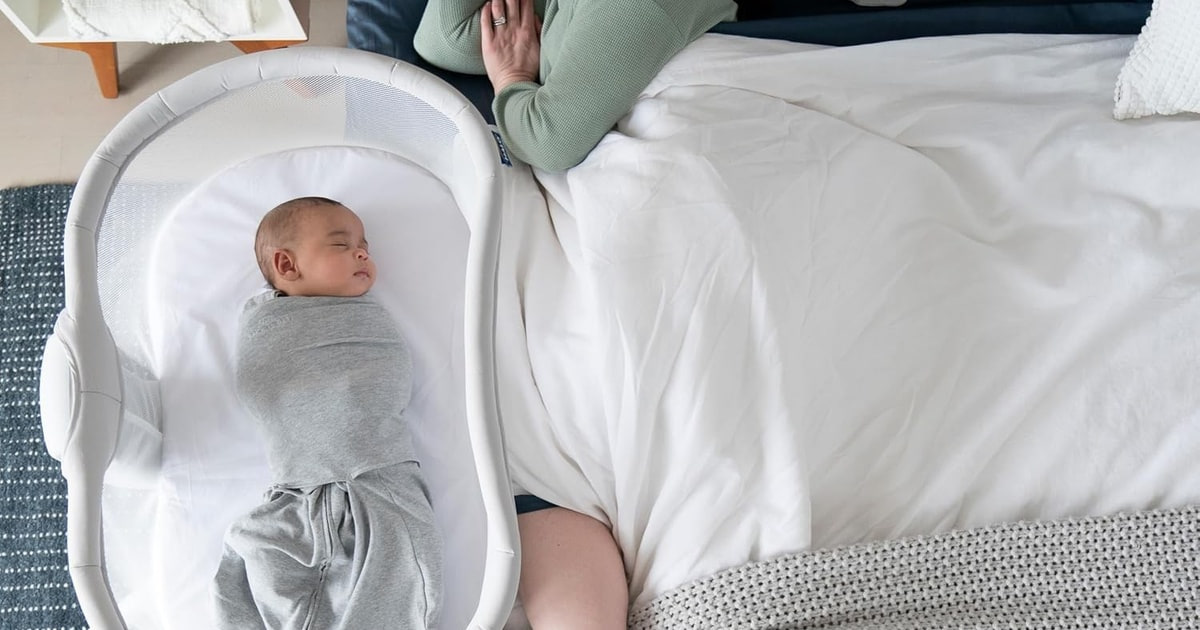
For the first few months, your baby sleeps in short bursts and wakes up hungry. The American Academy of Pediatrics recommends room-sharing without bed-sharing for at least six months, and says it can cut the risk of SIDS by as much as half. A bedside sleeper is how you do that without a walk down the hall at 3 a.m. The good ones come level with your mattress, open on the side facing you, and hold a firm, flat pad and nothing else.
Here's the part that isn't on the box: you'll outgrow one of these fast. Most bedside sleepers stop around 20 to 25 pounds, or the night your baby first pushes up on hands and knees. That's usually somewhere between four and six months. None of them get you to a first birthday. They're also bulky in a small bedroom, and the height adjustment that fits your bed perfectly may not work at all on a friend's platform frame.
So shop for the months you'll actually use it. Federal rules already keep bassinet mattresses under an inch and a half thick, and JPMA certification means an independent lab checked stability, mattress fit and side height. Past that, what separates these is reach. How far do you lean? How easily does the side open? How tight does it lock to your bed? We think that the HALO BassiNest Soothing Swivel Sleeper 3.0S is the best bedside sleeper for most people, and that the Baby Delight Beside Me Dreamer is the one to buy if your bed sits unusually high or low.
Everything we recommend

Swivels over the bed and drops its wall, but it's big and heavy
The lightest, thinnest-folding option, but no motion or sound
Converts to a play yard and packs into a bag for travel
Prices as of Oct 25, 6:48 AM PT · Details
At a glance
| Product | Height adjustment | Unit weight | Price | |
|---|---|---|---|---|
| HALO BassiNest Soothing Swivel Sleeper 3.0STop pick | Yes, beds up to 30 in | 22.7 lb | $299.95 |
| Arm’s Reach Ideal Ezee 3 in 1Also great | — | 28 lb | $260 |
 | Fisher-Price Baby Bedside Sleeper Soothing Motions BassinetAlso consider | — | 27.4 lb | $179.99 |
| Baby Delight Beside Me Dreamer BassinetRunner-up | 7 positions | 19 lb | $143.99 |
Prices as of Oct 25, 6:48 AM PT · Details
How we picked
Safety fundamentals. We started with what the standards agree on: a firm, flat surface, a mattress no thicker than the federal limit, breathable sides and independent lab certification where a brand claims it. Anything that needed extra padding to be comfortable was out.
Bed height fit. A sleeper only works if it comes level with your mattress and pulls tight with no gap. We looked at stated height ranges, frame clearance requirements and the owner complaints that cluster around both.
Nighttime reach. We gave weight to designs that let you lift your baby without sitting all the way up, since that's the difference maker for nursing parents and anyone healing from a C-section.
Cleaning and upkeep. Sheets should come off and go in the machine, and the mesh should wipe clean. Published reviews flag the models where spit-up gets into seams you can't reach.
Usable lifespan. Every one of these ends around 20 to 25 pounds or when a baby pushes up on hands and knees. We noted which ones keep doing something useful afterward.
Top pick
Swivels over the bed and drops its wall, but it's big and heavy
HALO BassiNest Soothing Swivel Sleeper 3.0S
It swings the whole sleeping basket over your mattress, so you can feed and settle your baby without getting out of bed or twisting a sore incision. The side wall lowers with a push, and you get vibration, four sounds and a nightlight when you want them.
$299.95fromAmazonPrices as of Oct 25, 6:48 AM PT · Details
The swivel is what you're paying for. The basket rotates a full 360 degrees, so you can bring your baby over your mattress and then push it back out of the way. You never swing your legs out of bed. For the first six weeks, when you're up four or five times a night, that's the difference between getting back to sleep and giving up on it.
If you're recovering from a C-section, pay attention to that wall. It lowers with a push, and BabyGearLab put the lowered side at about four and a half inches shorter than a standard bassinet wall. You slide your baby out instead of hoisting them over a rail. Published reviews and pediatric sleep consultants keep circling back to this one feature, and it isn't hard to see why.
The soothing extras are modest, and that's fine. You get two vibration levels, four sounds and a nightlight that shuts itself off. It's not a smart bassinet. It won't listen for crying or ramp up motion on its own the way the automated sleepers do. But most newborns settle with white noise and a hand on the chest, and this one keeps your hand close.
Measure before you order. HALO built it for beds up to 30 inches tall, and the base needs a frame sitting at least four and a half inches off the floor so it can slide underneath. Solid platform beds and storage bases are the usual problem. Check both numbers with a tape measure, because a sleeper that can't pull flush against your mattress defeats the entire idea.
Flaws but not dealbreakers
It's big. The footprint runs about 34 inches square and the unit weighs roughly 23 pounds, so this isn't something you carry to the guest room or fold into a closet. In a small bedroom, you'll be sidestepping it every time you get up. And if your bed frame doesn't clear the floor, it simply won't work at your bedside.
Like everything here, it's a short-term purchase. Once your baby pushes up on hands and knees, usually between four and six months, you're done. The mesh walls also catch spit-up in the corners, and they're attached to the frame, so cleaning means a damp cloth and some patience rather than a trip through the wash.
Runner-up
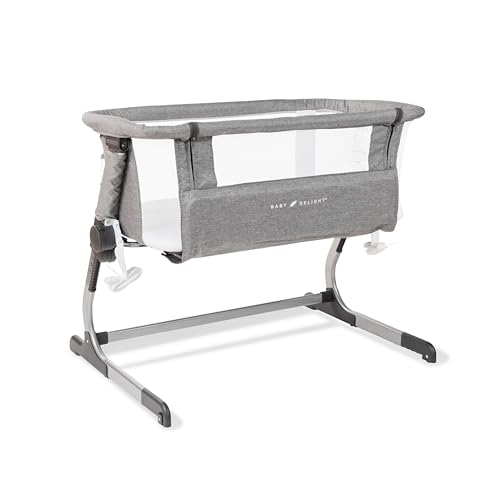
The lightest, thinnest-folding option, but no motion or sound
Baby Delight Beside Me Dreamer Bassinet
This is the sleeper that fits when others don't, with a knob that raises and lowers it to match your bed and anchors that strap underneath to hold it in place. It's also the lightest one here, and it folds thin enough to store behind a door.
$143.99fromAmazonPrices as of Oct 25, 6:48 AM PT · Details
Bed height is the quiet reason bedside sleepers get returned. A knob on the side steps this one up and down, so it works with a low platform frame or a tall mattress-and-boxspring stack. You set it once, level with the top of your mattress, then strap the anchors under your bed so it can't drift away in the night. That's the whole setup.
It's the lightest sleeper here at 19 pounds, and it folds. Good Housekeeping's lab measured the folded depth at under 12 inches, thin enough to slide behind a door or into a car trunk. If you're splitting nights between two homes, or you want the bedroom back during the day, that's worth more than any feature list.
Bedside access is a zipper, not a drop-down wall. You unzip the panel closest to your bed and the side opens so you can nurse or check on your baby without standing up. It's simple, and there's nothing to break. It does mean remembering to zip it shut whenever the sleeper isn't pulled tight against your mattress, which is easy to forget at 4 a.m.
The basics are all where they should be. The mattress is firm and flat, the walls are breathable mesh, and Baby Delight lists it as Baby Safety Alliance Certified. Assembly is tool-free, which sounds like marketing copy until you're doing it on a bedroom floor at 38 weeks pregnant. Owner feedback on this line runs steady rather than dramatic, which is what you want here.
Flaws but not dealbreakers
There's no motion, no vibration and no sound. If your baby only goes down to white noise, you'll be buying a separate machine. That's less a knock than a matter of scope. This is a sleeping box that gets close to your bed, and it does that job and stops.
The height knob isn't something you can adjust with a sleeping baby inside, so set it before the baby arrives. The mesh also collects dust and lint the way all mesh does. And the useful life still ends at four to six months, same as everything else in this guide.
Also great
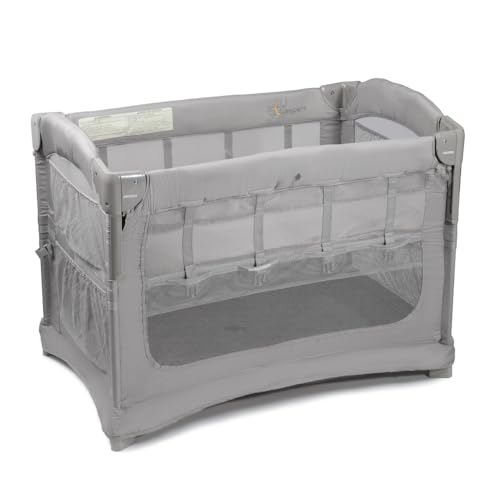
Converts to a play yard and packs into a bag for travel
Arm’s Reach Ideal Ezee 3 in 1
The original bedside co-sleeper still does the most jobs. It attaches to your bed, stands alone as a bassinet, and converts into a play yard once your baby outgrows sleeping in it. It also folds into a carry bag for the drive to grandma's house.
$260fromAmazonPrices as of Oct 25, 6:48 AM PT · Details
Arm's Reach invented this category. The Ideal Ezee descends from the first patented bassinet that attached to a parent's bed, and the design has had a long time to get sorted out. It attaches at your bedside, stands on its own as a bassinet, and opens into a play yard when you want a contained spot on the living room floor.
Three uses in one frame is the real argument here. The other sleepers stop earning their space the month your baby pushes up. This one keeps going as a play yard well past that. It also packs into a carry bag, which is why it turns up so often at grandparents' houses and in the back of the car before a holiday week away.
Small practical touches add up over a few hundred nights. Mesh on the sides keeps air moving and lets you see your baby from across the room. Storage pockets on the outside hold burp cloths and a spare sheet, so you're not opening a dresser drawer at 2 a.m. And it tucks against a bed without much wrestling.
Flaws but not dealbreakers
Portable is doing some work in that description. At 28 pounds it's the heaviest thing in this guide, and the folded package is a two-hand carry, not something you sling over a shoulder. It moves between houses fine. It isn't a suitcase-and-stroller travel companion.
The listing doesn't state a bed-height range, so measure your mattress before you commit. There's no motion, sound or light of any kind. And the footprint is wide, roughly 39 by 25 inches, which is a real amount of floor in a tight bedroom.
Who this is for
Buy one of these if you're expecting, or if you're a few weeks in and done with the walk down the hall. A bedside sleeper covers the first four to six months, full stop. If your baby is already rolling or pushing up on hands and knees, skip this category and go straight to a crib. And if your bedroom can't spare a couple of feet of floor next to the bed, a compact standalone bassinet will serve you better than a sleeper you can't pull flush.
This guide covers bedside sleepers: bassinets built to attach to or sit level with an adult bed. It doesn't cover full-size cribs, mini cribs, or in-bed sleepers that sit on your mattress, and it doesn't cover the automated smart bassinets that cost several times as much. We also left out swings, loungers and sound machines. None of those are safe places for unsupervised sleep, however well they settle a fussy baby.
How we picked
Safety: we started with the fundamentals every standards body agrees on, a firm flat surface, a thin mattress, breathable sides and independent certification. Fit: a sleeper only works if it comes level with your mattress and locks tight, so height range and frame clearance mattered more to us than any feature list. Reach: we favored designs that let you lift your baby out without sitting all the way up. Upkeep: washable sheets and mesh you can actually wipe down. Lifespan: we noted where each one stops being useful, and gave credit to the few that keep going afterward.
Other bedside sleepers for babies worth considering
If you want built-in motion and a mobile: The Fisher-Price Baby Bedside Sleeper Soothing Motions Bassinet — The Fisher-Price Soothing Motions Bassinet sways side to side, either from a nudge or from your baby's own movement, with a lock-out for when you want it still. You also get 30 minutes of vibration, music and sound, an overhead mobile, and a projection nightlight that detaches later and works as a tabletop soother. The sleep surface is flat and firm, rated to 20 pounds. What you give up is the reach. There's no lowering wall and no swivel, so you're still sitting up and leaning over a rail every time.
The competition
This is what our research surfaced, not a census of the market. Search for a bedside sleeper and you'll get swings, sound machines and accessories mixed in with the real thing, which is a big part of why this category is confusing to shop. The four sleepers above are the ones here that genuinely attach to or sit beside your bed. If you're cross-shopping the automated smart bassinets, know that the published evidence on those is mostly about how often parents wake up, not about whether a baby is safer. The safety piece is the same firm, flat, bare surface in every one of them.
Setup and safe use
Set the height before your baby arrives, with the sleeping surface level with the top of your mattress, and pull the sleeper tight so there's no gap alongside. Use only the mattress that came in the box. Federal rules cap bassinet mattresses at an inch and a half thick for a reason, and adding a pad, a positioner or a folded blanket undoes that protection. Buy fitted sheets made for that exact model, and put nothing else inside: no bumpers, no loose blankets, no stuffed animals. Wipe the mesh with a damp cloth and let it dry fully before the next nap. Re-check the anchor straps every week or so, since they work loose as you move around at night.
Questions we get
What's the difference between a bassinet and a bedside sleeper?
A bassinet is a freestanding baby bed. A bedside sleeper is a bassinet built to attach to or sit flush against an adult bed, usually with a side that lowers, unzips or swivels out of the way. Most bedside sleepers work both ways, so you can start beside your bed and move it across the room later.
Are bedside sleepers safer than bed-sharing?
Yes, and that's the whole reason the category exists. The American Academy of Pediatrics recommends room-sharing without bed-sharing for at least six months and ideally a full year, and says it can reduce the risk of SIDS by as much as half. A bedside sleeper gives you arm's-reach access with a separate firm surface. Keep it bare and keep it pulled tight against your mattress.
How long can a baby use a bedside sleeper before switching to a crib?
Plan on four to six months. Most models cap out around 20 to 25 pounds, and all of them end the moment your baby can push up on hands and knees, whichever comes first. Have the crib assembled before you think you need it, because that milestone tends to show up overnight.
What's the best bedside sleeper for C-section recovery?
The HALO BassiNest. Its wall lowers so you slide your baby out instead of lifting over a rail, and BabyGearLab put that lowered side at about four and a half inches shorter than a standard bassinet wall. The swivel also lets you bring the baby to you without twisting your torso. In the first two weeks, both of those matter more than you'd guess.
Can a bedside sleeper attach to any bed height or frame?
No, and mismatched heights are the most common reason these get returned. Measure two things first: the floor-to-top height of your mattress, and the clearance under your bed frame. The HALO needs a frame at least four and a half inches off the floor, which rules out a lot of platform and storage beds. The Baby Delight's adjustable knob covers a wider range.
Do bedside sleepers need a special fitted sheet or mattress pad?
Buy fitted sheets made for that exact model, and skip pads and toppers entirely. A sheet that bunches or pops off a corner is a suffocation risk, and a crib sheet folded over a bassinet mattress is the classic mistake. The mattress that came with it, one snug sheet, nothing else.
Why you should trust us
For this guide:
- We read published reviews and lab writeups from outlets including BabyGearLab and Good Housekeeping alongside each manufacturer's own spec sheets and dimension charts.
- We compared safe-sleep guidance from the American Academy of Pediatrics, the Consumer Product Safety Commission's bassinet mattress rule and JPMA's certification requirements.
- We looked for recurring themes in owner feedback, especially complaints about bed-height mismatch and how quickly babies outgrow this category.
- We read owner reviews on every listing, weighted toward the critical ones, because that is where the recurring failures show up.
- We have a systematic way of automatically fetching the latest prices, so the numbers on this page stay current.
- This is a research-focused guide, so the team may not own every product listed — though we often do own the top winners, which gives us extra context for the recommendations.
- We don't accept free products, and the retailer commission never changes which product we recommend.
Sources
Best Bedside Bassinets of 2026 - What to Expect, What to Expect
Safe Sleep and Your Baby - American Academy of Pediatrics (HealthyChildren.org), American Academy of Pediatrics
Bassinets Business Guidance - U.S. Consumer Product Safety Commission, CPSC
SNOO Smart Sleeper Review - Consumer Reports, Consumer Reports
HALO BassiNest Luxe Series Review - BabyGearLab, BabyGearLab
Best Bassinets 2026 - Wirecutter, Wirecutter
SNOO Smart Sleeper Bassinet Product Specifications - Happiest Baby, Happiest Baby (Manufacturer)
Graco Sense2Snooze Bassinet with Cry Detection Technology - Graco, Graco (Manufacturer)
Best Baby Bassinets, Tested by Parents - Parents.com, Parents
Bassinet Buying Guide - Juvenile Products Manufacturers Association (JPMA), JPMA
mamaRoo Sleep Bassinet Review - The Bump, The Bump
Best Bedside Sleepers and Co-Sleepers - Good Housekeeping Institute, Good Housekeeping
Amazon product listings and owner reviews for all 4 products
Manufacturer specification pages for each product
Some passages in this guide may be paraphrased with AI help.
Product prices and availability are accurate as of the date/time indicated and are subject to change. Any price and availability information displayed on Amazon.com at the time of purchase will apply to the purchase of this product.
More like this.
Continue exploring home reviews and recommendations.

The Best Bedside Sleep Trackers
You spend a third of your life asleep and remember almost none of it. That's the appeal of a bedside sleep tracker. It fills in the blanks: when you…

The Best Mattresses for Side Sleepers With Back Pain in 2026
Most adults sleep on their side, and if your lower back hurts, that position asks a lot of a mattress. Your shoulder and hip press in hard while your…

The Best Pillows for Side Sleepers
When you sleep on your side, your pillow has one job: fill the gap between your ear and the mattress so your neck stays level with your spine. That gap is…

The Best Cooling Pillows for Hot Sleepers
If you wake up at 3 a.m. flipping your pillow to find the cool side, you already know the problem. Your head and neck sit against the same patch of fabric…

The Best Sleep Aids and Gadgets
Sleep problems rarely have one cause. Sometimes the room's too bright, sometimes a neighbor's TV bleeds through the wall, and sometimes your brain just…

The Best Sleep Tracker Rings
A sleep ring earns its place by being something you forget you're wearing. That's the whole pitch. A watch on your wrist gets in the way when you roll…