The Best Blink Security Cameras
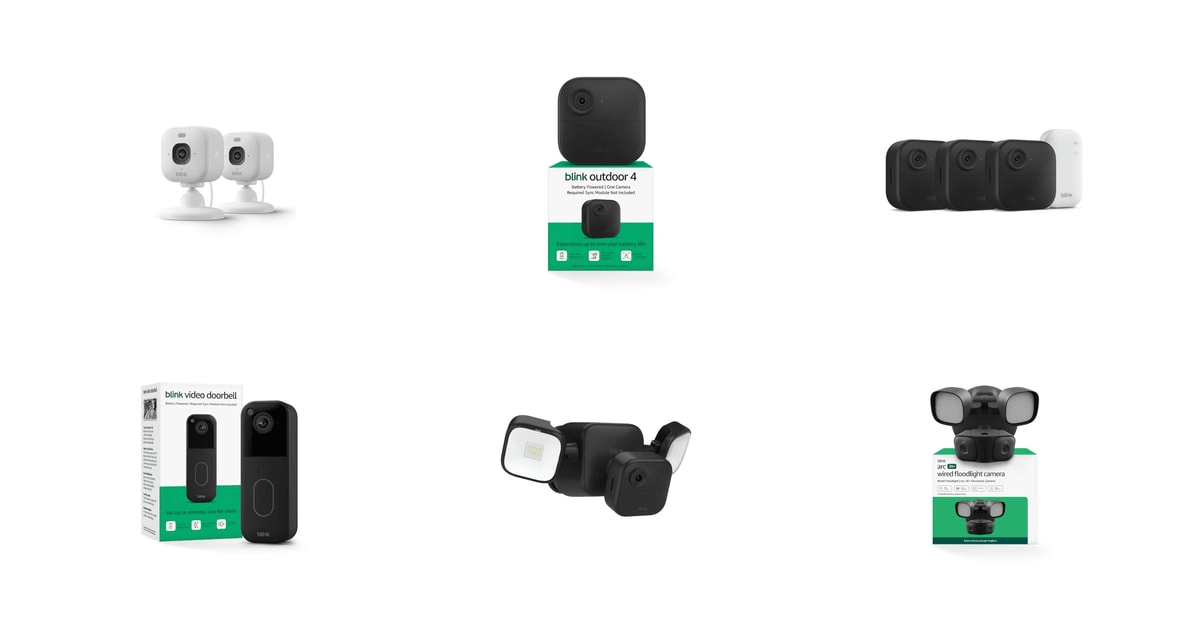
Most home security cameras want a monthly fee before they'll do much of anything. Blink's pitch is different: buy the camera, skip the contract, and get motion alerts on your phone for free. That's why these turn up on so many rental porches and first-time smart home shopping lists. You mount them yourself in a few minutes. There's no electrician, no drilling a power line through siding, and no monitoring company to call. Because Blink is Amazon's, the cameras talk to an Echo without any fuss.
Here's what none of them do especially well. Without a Blink Subscription Plan, you get live view and stills, not saved clips. You can dodge the fee with a Sync Module 2 and a USB drive, but that's another purchase, and the Sync Module Core bundled into some kits can't store anything locally. Smart alerts lag too. PCMag and Tom's Guide both put Blink's person and vehicle detection behind Nest and Ring, and you won't get facial recognition or package detection. Expect the occasional alert for a swaying branch.
So think of Blink as cheap, decent coverage rather than a smart security system. It watches a driveway, a back door, a nursery, or a dog who's been eating the couch. It won't tell you a package arrived. If that trade sounds fair, start with a multi-camera kit, since CNET's coverage notes the bundles work out to far less per camera than single units. We think that the Blink Outdoor 4 three-camera system is the best Blink security camera for most people, and that the Blink Mini 2K+ two-pack is the one to buy if your cameras are staying indoors.
Everything we recommend

Three weatherproof cameras and the hub, no wiring to run
Sharper video indoors, as long as an outlet is nearby

Much more light and a wider view, if you can wire it in

A motion-triggered light without touching any wiring
At a glance
| Product | Resolution | Power Source | Price | |
|---|---|---|---|---|
| Blink Mini 2K+Budget pick | 2K | Plug-In | $69.99 |
 | Blink Outdoor 4Also in lineup | 1080p HD | 2-Yr Battery | $69.99 |
| Blink Outdoor 4Top pick | 1080p HD | 2-Yr Battery | $189.99 |
 | Blink Video DoorbellAlso consider | HD | 2-Yr Battery | $49.99 |
| Blink Outdoor 4 Floodlight CameraAlso great | 1080p HD | 2-Yr Battery | $99.99 |
| Blink Arc 2K+ Wired Floodlight CameraUpgrade pick | 2K | Wired | $159.99 |
How we picked
Ongoing cost. We looked at what each camera does without a subscription, since that's Blink's main draw. Cameras that need a plan for basic recording had to earn it elsewhere.
Power and placement. We compared Blink's battery claims and power requirements against where people actually want cameras. A camera that can't reach an outlet or a junction box is no camera at all.
Video and night view. We read the published specs for resolution, night vision type, and field of view, and weighed 2K models against 1080p ones. Anything meant for a driveway needed either a floodlight or a sharp sensor.
Alert accuracy. Published reviews from PCMag and Tom's Guide flag Blink's smart detection as its weak spot, so we favored the models with dual-zone detection and finer activity zones.
Setup difficulty. We checked what each listing requires before it works, including sync modules and electrical boxes. Kits that arrive complete beat add-ons that don't.
Top pick
Three weatherproof cameras and the hub, no wiring to run
Blink Outdoor 4
This kit covers a front door, a back door, and a driveway with three battery cameras plus the Sync Module Core they need to run. You get 1080p video, two-way talk, and up to two years on the included AA lithium batteries, with no monthly fee required for live view.
$189.99fromAmazonBuying three at once is the point. One camera watches one thing, and you'll want a second within a week. This kit ships with the hub already in the box, so there's nothing else to order before you can mount anything. CNET's Blink coverage makes the same case: the multi-camera bundles are where the math works. If you only ever wanted one camera, you're probably shopping in the wrong aisle.
Setup is genuinely a coffee-break job. You plug the Sync Module into an outlet inside, join it to your Wi-Fi, then add each camera in the app. Blink says the batteries run up to two years under typical use, and owners with quiet side yards report going a very long time between swaps. A busy front walk drains them faster, since every trigger costs power. Two AAs is a cheap fix either way.
Motion detection is better here than on older Blink cameras. Outdoor 4 uses dual-zone detection with a finer activity-zone grid, so you can carve out the sidewalk and keep the porch. PCMag's review credits those zones as a real improvement. Add a subscription and you get person alerts from onboard computer vision. Without one, everything is just motion, and you'll be trimming zones until the phone stops buzzing.
The cameras are rated IP65, so rain, dust, and a cold snap are all fine. They mount with a small ball-swivel bracket that lets you aim at a driveway from under an eave. And if you already own an Echo Show, you can pull up any of the three by voice, which is the kind of small convenience that makes a system get used instead of ignored.
Flaws but not dealbreakers
The Sync Module Core in this kit doesn't support local storage. That's the catch, and it's a real one. If you want free recorded clips on a USB drive, you need a Sync Module 2 instead, which means another purchase. Otherwise you're on a subscription for anything beyond live view and stills.
Video is 1080p with infrared night vision, so nighttime footage is black and white and softer than what the 2K models capture. Owners also report occasional offline drops that need a camera reset, usually in spots with weak Wi-Fi. And the swivel mount is easy to pop loose, which some owners point out is not ideal on a camera meant to deter thieves.
Budget pick
Sharper video indoors, as long as an outlet is nearby
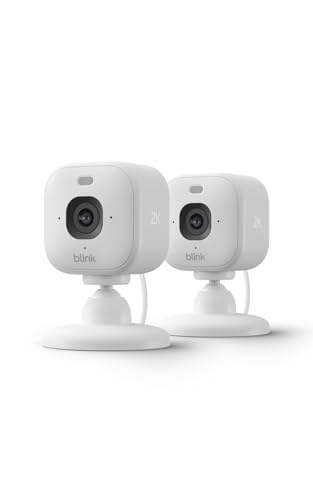
Blink Mini 2K+
The Mini 2K+ is a palm-sized plug-in camera that shoots 2K video with up to 4x zoom and noise-cancelling two-way talk. Buying the two-pack covers a living room and a nursery, or a kitchen and a back hallway, for less than a single outdoor camera costs.
$69.99fromAmazonPoint it at a crate and you'll see why people buy these in pairs. The 2K sensor picks up enough detail to tell whether the dog is asleep or working on the baseboards, and the zoom holds together well enough to read a face across a room. Owners watching pets and elderly parents overnight are the ones who sound happiest with it. For indoor checking-in, this is the most camera Blink sells for the money.
It runs on wall power, which changes the calculus. No batteries means no swaps and no dead camera in month nineteen. It also means the camera lives within a cord's reach of an outlet, so the corner you actually wanted may not be an option. Extension cords work, but you'll be looking at one. Plan the placement before you buy the two-pack.
With a subscription, the Mini 2K+ adds person and vehicle detection, and it doubles as a plug-in chime for the Blink Video Doorbell. That last bit matters if you install the doorbell wire-free, because a wire-free doorbell has no chime of its own. One Mini in the hallway solves it. Small feature, but it's the difference between hearing the door and checking your phone.
Audio is the quiet upgrade. Blink added noise cancellation, and two-way talk through the app sounds closer to a phone call than the tinny squawk you get from cheap cameras. If you use the camera to tell a delivery driver where to leave a box, or to talk a nervous dog off the couch, that's the feature you'll use most.
Flaws but not dealbreakers
It's an indoor camera by default. Taking it outside requires Blink's weather-resistant power adapter, sold separately, and even then you're running a cord to a covered spot. If the plan is a driveway or an exposed wall, buy an Outdoor 4 instead.
The app is the weak link. Owners regularly gripe about clunky navigation and cameras going offline until they're reset, and a few mention that the clip-in mount pops loose while you're aiming it. Blink support seems to sort out the offline problems, but it's a phone call you'd rather not make.
Upgrade pick
Much more light and a wider view, if you can wire it in
Blink Arc 2K+ Wired Floodlight Camera
The Arc 2K+ pairs two hardwired 2K cameras on one mount, throwing 3000 lumens and stitching both feeds into a single 180-degree view. It's the Blink to buy when a driveway or a whole backyard needs real light and there's no interest in batteries.
$159.99fromAmazonThis is the only Blink that lights up a yard properly. At 3000 lumens it's more than four times brighter than Blink's wire-free floodlight, and that's what turns a dark driveway into usable color video instead of a gray infrared smear. You can hold the light on for anywhere from 30 seconds to 15 minutes after motion. There's a built-in siren too, for the nights when you want to make a point.
Two cameras on one mount is the other reason to pick it. The app stitches the feeds into a single 180-degree panorama, so a corner of the house that used to need two separate cameras and two separate alerts becomes one wide view. Aim one lens at the driveway and the other down the side yard. You'll stop wondering what happened just outside the frame.
Because it's wired to your junction box, there are no batteries to think about and no low-power warnings in the app. That's the whole appeal of going wired. The camera sits there drawing house current, ready for live view whenever you open the app, and the floodlight never dims because someone walked past it fifty times that afternoon.
The 2K sensor also puts this well ahead of the 1080p Outdoor 4 cameras on detail. If the point is identifying a car in the driveway rather than knowing something moved, resolution is the spec that matters. Combined with the floodlight, it's the closest Blink gets to what Ring and Nest charge much more for.
Flaws but not dealbreakers
Installation is a different sport. You need a four-inch round, UL-listed weatherproof electrical box and existing wiring at the spot you want to mount it. If that box doesn't already exist, you're hiring an electrician, and the savings that drew you to Blink start to evaporate.
Panoramic Vision, the feature that stitches the two cameras together, requires a compatible Blink plan. So does smart detection. Buy this expecting the full 180-degree view for free and you'll be disappointed. It's also the most expensive setup in this guide by a wide margin, and it's fixed in place once it's mounted.
Also great
A motion-triggered light without touching any wiring
Blink Outdoor 4 Floodlight Camera
This one bolts a 700-lumen LED floodlight onto an Outdoor 4 camera and runs the whole thing on two AA lithium batteries. The Sync Module Core comes in the box, so it's a complete system for a dark side yard or a shed with no power nearby.
$99.99fromAmazonLight where there's no wiring is a genuinely rare thing. Most floodlight cameras assume a junction box. This one doesn't, so you can put light on a gate, a shed door, or the dark stretch of fence behind the garage where nobody ever ran power. That freedom is the entire reason to choose it over the wired Arc.
The camera half is a standard Outdoor 4: 1080p live view, infrared night vision, two-way talk, and dual-zone motion detection. When motion trips it, the floodlight comes on and the footage gets a lot more useful than infrared alone. Owners consistently describe the motion triggering as reliable and the light as bright enough for a driveway-sized area.
Because the Sync Module Core is included, this works as a standalone system rather than an add-on. If you're starting from zero and only need one camera in one dark spot, you can buy this by itself and be running the same evening. Adding more Blink cameras later still works fine.
Flaws but not dealbreakers
At 700 lumens, it's a helpful light, not a floodlight in the hardware-store sense. Compared with the 3000-lumen wired Arc, it lights a patch rather than a whole yard. If your driveway is long, size up.
The light and the camera both run off the same two AAs, so heavy traffic will chew through battery life much faster than Blink's up-to-two-years figure suggests. The unit is also heavy, and owners note it takes a solid mounting surface. As with the Outdoor 4 kit, the included Sync Module Core can't do local storage, and a few owners needed support sessions before the lights behaved.
Who this is for
Buy a Blink system if you rent, if you're outfitting a first house, or if the idea of a monitoring contract makes you close the tab. These are self-monitored cameras: alerts come to your phone and nobody else. Security.org's comparison of DIY systems groups Blink with Ring as an entry-level camera ecosystem with a major company behind it. If your household already runs on Alexa, the integration is about as painless as it gets.
Skip Blink if you want the camera to think for you. There's no facial recognition, no package detection, and smart alerts only arrive with a paid plan. Anyone who needs continuous 24/7 recording, professional monitoring, or a system tied to door and window sensors should look at Ring Alarm or a wired setup instead. This guide covers Blink's own cameras, doorbell, and floodlight units. It doesn't cover sync modules, mounts, or other accessories sold on their own.
How we picked
Ongoing cost: we favored cameras that stay useful without a subscription, and we noted every kit whose sync module blocks free local storage. Power and placement: we weighed battery claims, plug-in cords, and hardwiring against the spots people really want covered. Video and night view: we compared published resolution and night-vision specs, and asked whether nighttime footage would actually identify anyone. Alert accuracy: we leaned on published reviews that flag Blink's detection as its weakest area, and preferred models with dual-zone detection and fine activity zones. Setup difficulty: we checked what each listing needs before it works at all, and gave credit to kits that arrive complete.
Other blink security cameras worth considering
If you want to see who's at the door: The Blink Video Doorbell ($49.99) — Blink's second-generation Video Doorbell shoots a head-to-toe HD view, so you see the package on the mat and not just the delivery driver's chin. It runs up to two years on three AA lithium batteries, or you can connect it to existing doorbell wiring and let your indoor chime work normally. Owners switching from Ring often mention the wider view as the upgrade they noticed. Two catches: this listing is the add-on version, so it needs a Sync Module you already own, and wire-free installs have no chime unless you add a Mini as a plug-in one. Video and audio quality also sit a step below the 2K cameras here.
More from Blink
This is what our research surfaced within Blink's current lineup, not everything the brand sells or has sold. Older models turn up at retailers constantly, and Blink revises the lineup often enough that a camera on a shelf may be two generations behind the one in the app.
The Blink Outdoor 4 ($69.99) — The Blink Outdoor 4 add-on camera is the same camera as the one in our top pick, sold on its own without a Sync Module. That's the whole story: if you already run a Blink system, this is how you add a fourth or fifth angle, and it's the sensible way to buy. If you're starting fresh, it won't work out of the box, and the three-camera kit gets you more cameras and the hub together. Worth knowing that it pairs with a Sync Module 2 and a USB drive for free local storage, which the Core in the kits can't do.
Installation and setup notes
Put the Sync Module somewhere central and indoors, not in a basement corner, because most offline complaints trace back to weak Wi-Fi at the camera rather than the module itself. Mount outdoor cameras high enough that someone can't reach up and twist them off the swivel, and aim them across a walkway instead of straight down it, since motion detection reads side-to-side movement better. Then spend ten minutes in the activity zones. Trimming out the street, a busy tree, or a neighbor's driveway cuts false alerts sharply and saves real battery life, because every trigger wakes the camera. Use lithium AAs when you replace them, not alkalines, especially anywhere that gets cold. And if you're going the free-storage route, buy a Sync Module 2 and confirm it before you rely on it.
Questions we get
Do Blink cameras require a monthly subscription?
No, but you give up a lot without one. Free use gets you live view, motion alerts, and photo stills. Saved video clips in the cloud require a Blink Subscription Plan, as do person and vehicle alerts. The alternative is free local storage with a Sync Module 2 and a USB drive.
Can Blink cameras record without cloud storage?
Yes, with the right hub. A Sync Module 2 paired with a USB flash drive saves clips locally at no monthly cost, and a Sync Module XR does the same with a microSD card. The Sync Module Core included in several kits, including our top pick, does not support local storage. Check which module is in the box before you count on it.
How long do Blink batteries actually last?
Blink rates its wire-free cameras at up to two years on two AA lithium batteries, and the doorbell at up to two years on three. That figure assumes typical use, which means a modest number of motion events per day. A camera facing a busy sidewalk, or one running a floodlight every time someone passes, will need batteries far sooner. Tight activity zones help more than anything else.
Do Blink cameras work with Alexa and Echo Show?
They do, and it's one of Blink's better arguments. Blink is owned by Amazon, so you can pull a live feed onto an Echo Show or a Fire TV by voice without any extra bridge or app. Arming and disarming by voice works too. If your home already runs on Alexa, this is the smoothest camera ecosystem to add.
How does Blink compare with Ring?
Tom's Guide's comparison found Blink hardware and plans run roughly 30 to 50 percent below equivalent Ring gear. What you give up is the smarter half of the software. Ring's detection is more accurate and more granular, and Blink has no facial recognition or package detection at all. If alerts matter more than upfront cost, Ring is the better buy.
Which Blink is best for a driveway or a large yard?
A floodlight model, because infrared alone won't identify anyone at that distance. The wired Arc 2K+ is the stronger choice at 3000 lumens with 2K video and a 180-degree stitched view, if you have a weatherproof junction box to wire it to. If you don't, the wire-free Outdoor 4 Floodlight Camera lights a smaller area on batteries with no wiring at all.
Why you should trust us
For this guide:
- We read Blink's published specifications for every camera in this guide and checked them against the feature claims on each Amazon listing.
- We reviewed published coverage from PCMag, Wirecutter, CNET, Tom's Guide, and Security.org on how Blink's cameras, plans, and detection compare with Ring, Nest, and Arlo.
- We read through owner feedback for recurring themes, including offline drops, mounting complaints, app frustration, and how battery life holds up in busy locations.
- We read owner reviews on every listing, weighted toward the critical ones, because that is where the recurring failures show up.
- We have a systematic way of automatically fetching the latest prices, so the numbers on this page stay current.
- This is a research-focused guide, so the team may not own every product listed — though we often do own the top winners, which gives us extra context for the recommendations.
- We don't accept free products, and the retailer commission never changes which product we recommend.
Sources
Blink Outdoor 4 Camera - Official Product Specifications, Blink (Amazon)
Blink Mini 2 - Official Product Specifications, Blink (Amazon)
Blink Subscription Plans - Pricing and Storage Details, Blink (Amazon)
Best Blink Camera Deals and Buying Guide, CNET
Blink Outdoor 4 Review, PCMag
Blink Mini 2 Review, PCMag
The Best Home Security Cameras, Wirecutter
Best DIY Home Security Systems and Cameras, Security.org
Blink vs. Ring: Which Amazon Camera Brand Is Right for You?, Tom's Guide
Best Outdoor Security Cameras, The Verge
Blink Video Doorbell Review, TechRadar
Home Security Camera Buying Guide, Consumer Reports
Amazon product listings and owner reviews for all 6 products
Manufacturer specification pages for each product
Some passages in this guide may be paraphrased with AI help. Prices are refreshed automatically.
More like this.
Continue exploring electronics reviews and recommendations.

The Best Indoor Security Cameras
An indoor camera earns its keep in small moments. You're at work and the dog has gone quiet. A package gets dropped inside the door and you want to know…

The Best Outdoor Security Cameras Without a Subscription
An outdoor camera earns its keep on ordinary days, not dramatic ones. You check who rang the bell. You find out whether the package actually landed on the…

The Best Smart Home Security Cameras
A security camera earns its keep on ordinary days, not dramatic ones. You want to know the dog walker showed up, the package landed, the kid got home. So…

The Best Outdoor Smart Home Security Cameras
An outdoor camera earns its keep in small moments. A package shows up while you're at work. Something knocks over the recycling bin at 2 a.m. A contractor…

The Best Car Alarm and Security Systems
Your car spends most of its life parked and unattended. On a street, in a work lot, in a driveway you can't see from the kitchen sink. A security system's…

The Best Inspection Cameras and Borescopes
A camera on a flexible probe turns guesswork into a look. You can see why the kitchen sink drains slowly, whether there's a nest behind the drywall, what…