The Best Inspection Cameras and Borescopes
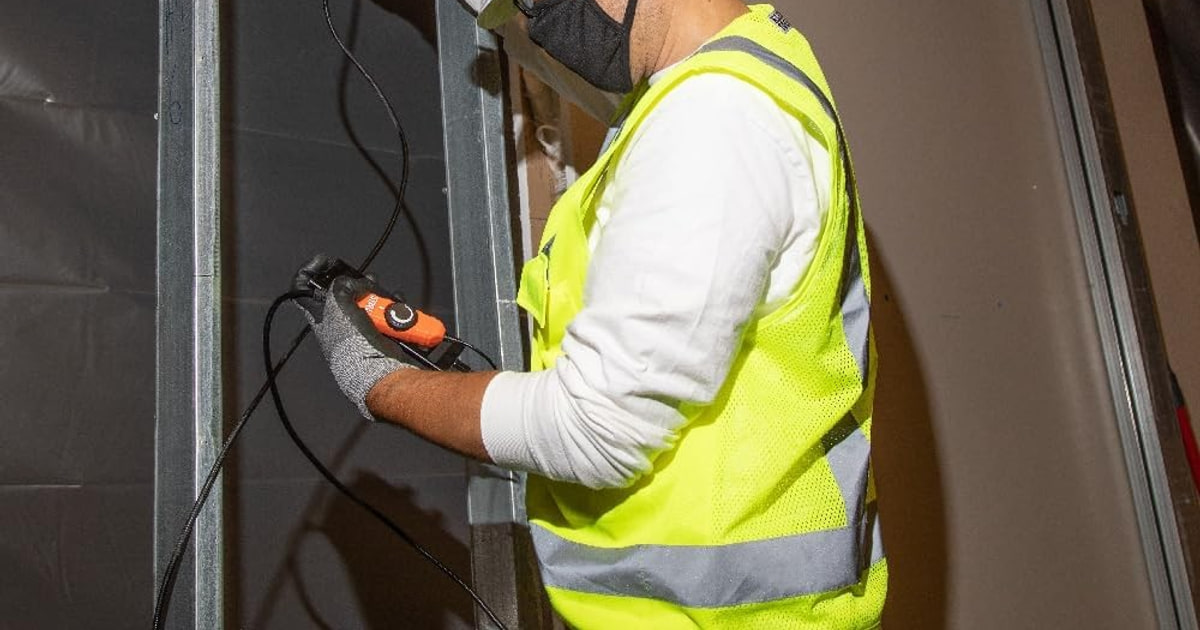
A camera on a flexible probe turns guesswork into a look. You can see why the kitchen sink drains slowly, whether there's a nest behind the drywall, what the inside of a cylinder looks like without pulling a head, or where the condensate line is plugged. The whole job takes minutes and doesn't cost you a hole in the wall. What separates one of these tools from another is simple: how thin the probe is, how far the cable reaches, how well you can see the picture, and whether the screen works when your phone can't.
None of them see as well as you'd hope. The sensors are tiny, the LEDs sit right next to the lens, and shiny copper or steel throws the light straight back at you, so half the frustration is glare rather than resolution. Long cables curl and pool once you're past ten feet or so, which quietly eats your reach. And no handheld unit here covers a full sewer lateral without accessories, since the run from a house to the main is usually far longer than any stock cable.
So we sorted these seven by the job rather than the spec sheet: engine access, drain spot-checks, wall cavities, and professional drain work with documentation. We think that the Teslong NTS500 is the best inspection camera for most people, and that the DEPSTECH 1080P HD Borescope is the one to buy if you want a big, sharp screen and more cable without stepping up to a professional tool.
Everything we recommend

A screen you never have to pair, and two lenses in one probe

A bigger, sharper picture and more cable, in a plainer body
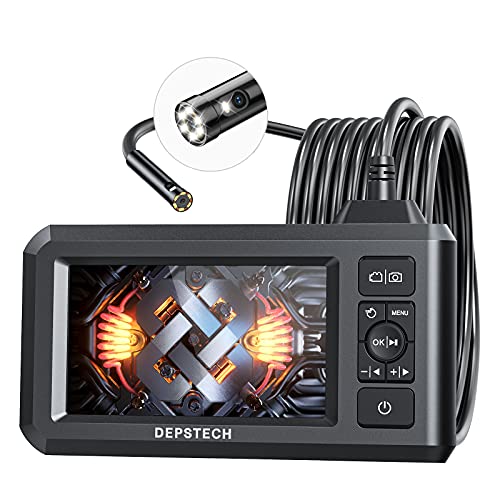
Split-screen views and long reach in a simple package

Serious reach and recorded footage, if you bill for the job

Steer the tip around a bend and look back at yourself
At a glance
| Product | Cam Diameter | Resolution | Price | |
|---|---|---|---|---|
 | Milwaukee New 2313-21 12 Volt M12 CordlessAlso in lineup | 9mm | — | $427 |
| Ridgid 55898 micro CA-350 Handheld Inspection CameraUpgrade pick | 17mm | — | $745.27 |
 | Klein Tools ET16 BorescopeAlso consider | 8mm | 640x480 | $39.97 |
| Dual Lens Endoscope with 5" MonitorTop pick | 0.21in | 720P | $269.99 |
| DXZtoz Two-Way Articulating Borescope with LightAlso great | 8.5mm | 1080P | $109.39 |
| Dual-Lens Endoscope Camera with LightRunner-up | — | 1080P | $34.99 |
| DEPSTECH Endoscope Camera with LightBudget pick | — | 1080P | $59.99On sale |
How we picked
Probe size and reach. We compared manufacturer specs for head diameter and cable length against the jobs people actually do. Around 5.5 mm is the practical threshold for residential supply pipe, 10 to 16 feet covers most drain spot-checks, and engine work needs only five or six feet.
Image and lighting. We treated 1080p capture as the baseline for identifying hairline cracks and early corrosion, with 640×480 reserved for pass/fail checks. Adjustable LED brightness mattered as much as resolution, since glare inside metal pipe ruins more images than pixel count does.
Screen versus phone. Published comparisons consistently favor built-in screens in basements, crawlspaces, and metal-walled spaces where 2.4 GHz signal drops or stutters. We gave weight to units that show live video without pairing anything.
Water and abuse resistance. We required a stated IP67 rating for anything we'd recommend near standing water or an active drain, since water ingress kills these sensors permanently. We also read listings and reviews for cable armoring and housing quality.
Recording and documentation. For anyone reporting to a client or an insurer, on-device microSD or handset recording beats phone capture because it doesn't depend on connectivity. We noted where a memory card isn't included.
Top pick
A screen you never have to pair, and two lenses in one probe
Dual Lens Endoscope with 5" Monitor
The Teslong NTS500 puts a 5-inch IPS screen right in your hand and a front-and-side dual lens on a 0.21-inch probe. That combination covers spark plug holes, supply lines, and duct runs without an app, a mirror attachment, or a WiFi signal you may not get.
$269.99fromAmazonThe built-in screen is the whole point. WiFi borescopes drop out in exactly the places you use them: basements, crawlspaces, metal-walled mechanical rooms, and anywhere a neighbor's 2.4 GHz network is crowding yours. The NTS500 skips that entirely. You press the power button and you're looking at live video on a 5-inch color IPS panel, with no pairing, no app updates, and no lag between what the probe sees and what you see.
Two cameras in one tip save you a pocketful of adapters. One button toggles between the front lens and the side lens, so you can look down a pipe and then look at its wall without pulling the probe and clipping on a mirror. That matters most in narrow spaces where there's no room to rotate the cable. If you've ever fished a mirror attachment out of a drain, you'll appreciate it.
The probe is thin enough for the jobs people actually buy these for. At 0.21 inch, it passes through a spark plug hole to look at a combustion chamber, and it clears a standard 3/4-inch supply pipe with room to steer. Six adjustable LEDs light the front view and the side camera carries its own illumination, so you can dial brightness down when a copper interior starts washing out the frame.
It's built to get thrown in a bag. The housing is industrial-grade plastic with toughened glass over the screen, and the whole probe is rated IP67, with a water-safe aerospace connector where the cable meets the handset. The 3500 mAh battery covers a full working day rather than an afternoon. This is the unit here that reads as a tool rather than a gadget.
Flaws but not dealbreakers
The cable is short for plumbing work. At 9.8 feet you can check a P-trap, a branch drain, or a wall cavity, but you can't inspect a sewer lateral — that run is typically several times longer, and there's no extension option. If drain lines are your main use, buy more cable elsewhere.
The screen is 720p, not 1080p. The panel is big and easy to read, but fine surface detail looks slightly soft up close. For spotting a blockage or obvious corrosion it's fine. For documenting a hairline crack, a 1080p display shows more.
It's heavier and bulkier than a phone-based probe. The handset, battery, and case add up, and one-handed use in an awkward crouch gets old. That's the trade you make for not depending on a signal.
Runner-up
A bigger, sharper picture and more cable, in a plainer body
Dual-Lens Endoscope Camera with Light
This DEPSTECH pairs a 5-inch IPS screen with true 1080p capture and a 16.5-foot semi-rigid cable. It's the one to get if you'd rather have reach and resolution than a rugged shell, and it starts up the moment you press the button.
$34.99fromAmazonYou get the two things buyers usually want most: a big screen and a long cable. The 5-inch IPS display is the largest here, and 16.5 feet of semi-rigid cable covers most household drain runs, vent ducts, and wall cavities. Semi-rigid matters more than it sounds — the cable holds a shape you give it instead of flopping over the moment it hits a vertical drop.
The image is a real step up from a 720p panel. DEPSTECH pairs 1080p capture with its Bluart 3.0 lighting and a higher frame rate, so movement down a pipe looks smooth rather than smeary. That's the difference between seeing that something's wrong and seeing what's wrong — pitting in a copper fitting, a crack line, roots pushing through a joint.
Dual lenses with one-button switching keep you from fishing the probe back out. Front view for where you're going, side view for the pipe wall beside you. In a duct or a wall bay, that's the difference between one insertion and three. No mirror attachment to lose, no rotating the cable blindly and hoping.
Nothing has to connect to anything. No app, no account, no WiFi handshake. You power it on and the screen fires up with live video, which is the behavior you want when you're lying under a sink with one hand free. The rechargeable battery and simple button layout hold up during long sessions.
Flaws but not dealbreakers
There's no memory card in the box. If you want to save stills or clips for a landlord, an insurer, or your own before-and-after, buy a microSD card separately or you'll discover the gap mid-job.
The tip doesn't articulate. The probe goes where the pipe pushes it. At a hard 90-degree elbow you're stuck, and forcing a fixed tip through a bend risks cracking a PVC fitting.
The housing is consumer-grade plastic. It's fine in a homeowner's toolbox and fine in a truck if you're careful. It isn't built for the daily drops and crush loads of a working job site.
Budget pickOn sale
Split-screen views and long reach in a simple package
DEPSTECH Endoscope Camera with Light
The DEPSTECH DS300 shows the front and side cameras at once on a 4.3-inch screen and gives you 16.5 feet of IP67 cable. It's the low-fuss option for occasional jobs — a slow drain, a suspected leak, a noise in the wall.
$59.99fromAmazonList priceSplit screen is genuinely useful for a first pass. Instead of toggling, the DS300 can show both lenses at once, so you're watching where the probe is headed and what's beside it in the same glance. A 70-degree field-of-view button widens the picture when you're in a cramped space and can't tell where you are.
You get 16.5 feet of cable without paying for a pro tool. That's enough for most residential drain spot-checks, a run of vent duct, or the length of a wall bay. Combined with a 180-degree rotating camera orientation, you can right the image when the probe twists on its way down instead of reading everything sideways.
The picture is better than the screen size suggests. The 4.3-inch IPS panel has a roughly 170-degree horizontal viewing angle, so it stays readable when you can't get your head directly in front of it. Capture is 1080p from a 2.0 MP sensor, and seven LEDs with adjustable brightness let you cut glare inside metal pipe.
Switching lenses doesn't stall the picture. DEPSTECH's second-generation CMOS chip addresses the frame delay that made earlier dual-lens units feel laggy at the moment you swapped views. The hook and magnet accessories in the box also turn it into a retrieval tool, which is how a lot of people end up using it — dropped screws, a ring behind the drywall.
Flaws but not dealbreakers
The screen is small. At 4.3 inches, fine detail is harder to judge than on a 5-inch panel, and outdoors in daylight it's harder still. If you're squinting at a crack to decide whether it's a crack, size helps.
No card is included and the tip is fixed. Recording needs a card you supply, and without articulation you can't steer past a bend or look back toward the entry point.
This is a homeowner's tool. The build is light plastic, and the front camera's focal range is short, so you'll be working close to whatever you're inspecting. Daily trade use will wear it out.
Upgrade pick
Serious reach and recorded footage, if you bill for the job
Ridgid 55898 micro CA-350 Handheld Inspection Camera
The RIDGID micro CA-350 uses a 17 mm imager on a 3.5-inch color display and extends to 100 feet with See Snake reels. It records stills and video on the handset, which is what makes it a documentation tool rather than just a camera.
$745.27fromAmazonIt's the only unit here that can reach a full sewer lateral. With RIDGID's micro Reel, Nano Reel, and micro Drain accessories, the CA-350 extends to 100 feet from one handset. A house-to-main run is usually well beyond what a stock consumer cable covers, so if lateral inspection is part of your work, this is the practical entry point.
The big imager is the right tool for big pipe. A 17 mm head lights and fills a 4-inch or 6-inch line properly. Drop a 5.5 mm probe into the same pipe and you get a bright center with dark, underexposed walls — which is exactly where root intrusion and cracks tend to be.
On-board recording turns an inspection into a deliverable. Stills and video save directly to the handset, so you can hand a customer evidence, attach clips to a report, or back up an insurance claim without pairing a phone or uploading anything. That's the feature people are really paying for.
It's set up for a working week, not an afternoon. The 12V rechargeable lithium-ion battery covers extended sessions, camera heads swap out for smaller spaces and longer reaches, and the blow-molded case takes the abuse of being loaded and unloaded from a van every day.
Flaws but not dealbreakers
Full reach costs extra. The 100-foot figure depends on RIDGID's proprietary reels, which you buy separately. Out of the box, you have a capable handheld camera, not a sewer system.
It's the heaviest and least casual option here. Around two pounds in the hand plus a case, it's not something you grab to check under a sink. Homeowners doing one drain check are paying for capability they'll never use.
The tip doesn't steer. In this configuration there's no articulation, so navigating a complex run means accessories and patience rather than a control wheel.
Also great
Steer the tip around a bend and look back at yourself
DXZtoz Two-Way Articulating Borescope with Light
The DXZtoz bends its 8.5 mm head through 220 degrees with a control wheel, so you can get past obstructions and aim back toward where you came in. For engine bays and tight mechanical spaces, that beats more cable every time.
$109.39fromAmazonArticulation solves the problem no amount of resolution fixes. A fixed probe goes where the gap lets it. The DXZtoz's two-way wheel bends the tip up to 220 degrees, letting you work around crankcase obstructions, past valve train parts, and back toward the spark plug hole you entered through. A quarter turn of the wheel gives a proportional bend, so aiming is intuitive.
Lighting control is what makes engine work readable. Eight high-intensity LEDs with four brightness levels let you back the light off inside a cylinder bore or a steel conduit, where full brightness just bounces back and blows out the frame. Add 8x zoom and you can look closely at valve seats, carbon buildup, and scoring on a cylinder wall.
The picture holds up on its own screen. A second-generation CMOS sensor feeds true 1080p to a 4.3-inch IPS display, with no app and no phone involved. For short insertions — which is most mechanical work — that covers the great majority of what you'd want to see.
The gooseneck is built for messy environments. The probe is IP67 rated and oil resistant, and the metal gooseneck is malleable enough to shape but stiff enough to hold that shape as you push. A hook, magnet tip, and side mirror come in the case, and the 3000 mAh battery runs about four hours.
Flaws but not dealbreakers
The cable is very short. At 5.5 feet, this is an engine and mechanical-access tool. It won't reach down a drain line or along a wall cavity, and there's no extending it.
The 8.5 mm head is too wide for small supply pipe. Standard 3/4-inch water lines want something closer to 5.5 mm. You'll get into drains and larger fittings, but not everywhere the thinner probes go.
It's heavy and the brand is less established. Over three pounds in hand tires you out during a long inspection, and DXZtoz doesn't have the long service history that RIDGID or Klein brings if something fails.
Who this is for
Buy one of these if you own a home and have ever wondered what's behind a wall or under a slow drain, if you work on your own car, or if you're a tradesperson who needs eyes in a place your hand won't fit. The payback is fast: one avoided exploratory hole or one correctly diagnosed cylinder usually justifies the tool. If you only need to confirm that a drain is blocked, you don't need much camera at all — a modest probe with a screen will tell you that.
Skip this category if you're inspecting a full sewer lateral on a regular basis. That's push-camera territory, and only the RIDGID here gets close, and only with accessory reels. This guide covers handheld borescopes and inspection cameras with flexible probes, which are also sold as endoscopes; it doesn't cover thermal cameras, wall scanners, drain-cleaning machines, or truck-mounted sewer systems.
How we picked
We ranked these on the things that change the outcome of a job. Probe diameter: around 5.5 mm gets you into 3/4-inch supply pipe, while a 17 mm imager is what properly lights a 4-inch drain. Cable length: five or six feet is plenty for an engine, 10 to 16 feet handles household drains and wall cavities, and full laterals need far more. Image and light: 1080p is the sensible baseline for fine defects, and adjustable brightness prevents the washout that ruins shots inside copper and steel. Display: a built-in screen keeps working where WiFi doesn't, which is most basements. Water resistance: IP67 or don't put it in the drain. Recording: on-device storage produces files you can actually hand to someone.
Other inspection cameras and borescopes worth considering
If you want a tough, waterproof probe that plugs straight into an Android phone: The Klein Tools ET16 Borescope ($39.97) — The Klein Tools ET16 skips the screen and the battery entirely. It connects over USB-C, draws power from your phone, and uses your phone's display — which means nothing to charge and nothing to pair. The 10-foot cable is an armored gooseneck that resists kinking and crushing better than the plastic-jacketed cables on consumer units, and the 8 mm camera carries an explicit IP67 rating, so it's safe in standing water and an active line. Six LEDs with adjustable brightness handle dark pipe. What you give up is resolution: at 640×480 it's a pass/fail tool, good for confirming a blockage or finding a pull point, not for judging the severity of a crack. It's also Android-only, so iPhone users should look at the picks.
The competition
This is what our research surfaced across this category, not a census of everything for sale. Borescope listings turn over constantly and plenty of near-identical units ship under different names, so we focused on models with enough published coverage and manufacturer detail to say something useful about.
The Milwaukee New 2313-21 12 Volt M12 Cordless ($427) — The Milwaukee 2313-21 runs off the same M12 batteries as the rest of Milwaukee's 12V line, which is a real advantage on a job site: a dead pack swaps in seconds and charges in well under an hour, while USB-rechargeable units are out of service for hours. The 9 mm aluminum head is sized for commercial conduit and larger pipe, and the 2.7-inch LCD means no phone involved. It lost to our picks on two counts. The screen is the smallest here, which makes detail hard to read outdoors, and it's a single forward-facing lens, so seeing a pipe wall means physically repositioning the probe — something the dual-lens picks do with a button. If you already carry M12 batteries every day, it's a reasonable add to the kit; if you don't, you're paying for an ecosystem you won't use.
Care and cable handling
After a drain or sewer job, rinse the probe with warm water and mild dish soap, then dry it with a lint-free cloth; a brief dunk in clean rinse water is fine on IP67-rated heads. Keep bleach, acetone, and solvent cleaners away from the lens and cable jacket — they cloud the optics and degrade the sheathing. Store the cable in a loose coil rather than a tight wrap, since repeated tight bends fatigue the wires inside and eventually show up as a flickering image. Don't force a fixed tip through a hard elbow; a rigid probe can crack a PVC fitting under side load. And never submerge a camera that doesn't state an IP rating. Water gets into the sensor once and the tool is done.
Questions we get
What's the difference between a borescope and an endoscope?
Functionally, nothing — both are a camera on a flexible probe. The word borescope comes from industrial inspection of gun barrels, cylinders, and turbines, while endoscope comes from medicine. In tool retail the two get used interchangeably, along with the plainer term inspection camera. Don't read a technical distinction into which word a listing uses.
What probe diameter do I need for household plumbing?
For standard 3/4-inch supply lines, you want a head of about 5.5 mm or smaller, which is the widely cited minimum that will actually enter the pipe. Drain lines and P-traps are more forgiving and will take heads up to around 9 mm. For a 4-inch sewer line, a large imager like the RIDGID's 17 mm head is the better match, because a thin probe lights the center of a big pipe and leaves the walls dark.
How much cable do I need for a sewer inspection?
More than most of these have. The run from a house to the sewer main is commonly 50 to 75 feet, and the usual guidance is a 33-foot minimum before you can call it a lateral inspection. The consumer units here top out around 16.5 feet, which covers drain spot-checks and P-traps. Only the RIDGID micro CA-350, with its accessory reels, reaches full lateral depth.
What does an IP67 rating actually mean?
The 6 means fully dust-tight and the 7 means it survives submersion in up to a meter of water for half an hour. For plumbing work, standing water, or a wet crawlspace, treat IP67 as the minimum. A camera with no stated rating shouldn't touch water at all — the sensor doesn't recover from ingress.
Do I need an articulating tip?
It depends on whether you need to steer or just to look. A two-way tip bends up and down, which is enough to get around an obstruction and aim back toward where you entered — essential inside an engine or a duct full of fittings. A fixed tip follows whatever path the pipe gives it, which is fine for straight drain runs and wall cavities. If you mostly inspect straight runs, save the money and put it toward cable and resolution.
Can I record what the camera sees?
Usually, but check how. The RIDGID records stills and video to the handset for job reports, and the DEPSTECH models record to a microSD card — which they don't include, so buy one. The Klein saves to your Android phone's gallery over its USB-C connection. If documentation matters for your work, confirm the storage method before you buy rather than after.
Why you should trust us
For this guide:
- We compared manufacturer spec sheets across all seven listings for probe diameter, cable length, capture resolution, screen size, IP rating, and battery type.
- We read published reviews and category guidance on what these thresholds mean in practice — the minimum head size for residential supply pipe, and how built-in screens compare with WiFi apps in low-signal spaces.
- We weighed the failure modes owners of this category report most often, including glare inside metal pipe, cables that curl and lose usable reach, and memory cards sold separately, against what each listing claims.
- We read owner reviews on every listing, weighted toward the critical ones, because that is where the recurring failures show up.
- We have a systematic way of automatically fetching the latest prices, so the numbers on this page stay current.
- This is a research-focused guide, so the team may not own every product listed — though we often do own the top winners, which gives us extra context for the recommendations.
- We don't accept free products, and the retailer commission never changes which product we recommend.
Sources
Best Borescopes and Inspection Cameras — Bob Vila, Bob Vila
Best Inspection Cameras — Family Handyman, Family Handyman
Best Inspection Cameras — Popular Mechanics, Popular Mechanics
Best Inspection Camera Reviews — This Old House, This Old House
Best Borescopes Tested — Tom's Guide, Tom's Guide
Amazon product listings and owner reviews for all 7 products
Manufacturer specification pages for each product
Some passages in this guide may be paraphrased with AI help. Prices are refreshed automatically.
More like this.
Continue exploring electronics reviews and recommendations.

The Best Wireless Backup Camera Kits
Backing up is where most parking-lot damage happens, and mirrors alone won't show you the toddler's scooter lying behind your bumper. A wireless backup…

The Best Blink Security Cameras
Most home security cameras want a monthly fee before they'll do much of anything. Blink's pitch is different: buy the camera, skip the contract, and get…

The Best Smart Home Security Cameras
A security camera earns its keep on ordinary days, not dramatic ones. You want to know the dog walker showed up, the package landed, the kid got home. So…

The Best Camera Drones
A camera drone earns its keep in the ten minutes after you park the car. You unfold it, it finds satellites, and you get a shot of the coastline that no…

The Best Camera Lens Attachments for iPhone
Your iPhone already has three cameras, so the question isn't whether you need more glass - it's whether an add-on lens gets you something the phone…

The Best Dash Cams
Most days your dash cam does nothing at all. It sits on the glass, loops over yesterday's commute, and asks nothing of you. Then someone drifts into your…