The Best Car Alarm and Security Systems
Your car spends most of its life parked and unattended. On a street, in a work lot, in a driveway you can't see from the kitchen sink. A security system's job is to make your car a worse target than the one beside it, and to tell you fast when something's wrong. The good ones do three things: they make noise, they stop the engine from cranking, and they buzz your pocket. Most of what you pay for is how well those three parts work together.
Here's the honest part. Nothing here stops a thief who really wants your car and has ten quiet minutes. Consumer Reports makes the point that no single device blocks every method, which is why it pushes layers: a visible deterrent out front, a hidden kill switch or tracker behind it. NHTSA says roughly the same thing. A siren by itself mostly annoys your neighbors, and plenty of people now ignore one entirely. Treat an alarm as one layer, not the whole plan.
So think about what you actually want to happen at two in the morning. Some people want a loud, obvious deterrent and a remote that confirms the doors locked. Others want a quiet app alert and a map. Those are different products, and buying the wrong one is the most common mistake we saw in this category. We think that the Viper 5305V is the best car alarm and security system for most people, and that the Compustar CS7900-AS is the one to buy if you need a louder siren or cover two cars.
Everything we recommend
The longest remote range here, with confirmation you can read

A louder siren and two-car coverage, at a real premium

The core alarm features, minus the long-range polish
Prices as of Oct 25, 6:48 AM PT · Details
At a glance
| Product | Remote range | Remote type | Price | |
|---|---|---|---|---|
| Compustar CS7900-AS 2-Way Car Remote Start &Upgrade pick | 3000 feet | 2-Way LCD | $329.99 |
| Viper 5305V 2 Way LCD Vehicle CarTop pick | — | 2 Way LCD | $218.87 |
 | CARLOCK OBD2 Anti Theft Car Device +Also consider | — | Phone app (OBD2) | Check price |
| Avital 5305L 2-Way Security System Responder KeylessBudget pick | — | 2-Way LCD 4-button | $149.95 |
Prices as of Oct 25, 6:48 AM PT · Details
How we picked
Remote confirmation. We favored two-way remotes that send a readable confirmation back rather than a one-way fob that just hopes. Zone identification, so you know what set the alarm off, was the threshold we cared about.
Recovery, not just noise. Consumer Reports and NHTSA both argue for layering a deterrent with something that immobilizes or tracks. We looked for a starter interrupt at minimum, and treated GPS or cellular tracking as a separate layer worth adding.
Vehicle compatibility. Manufacturer documentation and Crutchfield's installation guidance shaped this one. Systems that ship with a documented immobilizer bypass and broad model coverage ranked above kits that assume a simple wiring job.
Installer support. Owner feedback across this category keeps circling back to who can service the thing later. We leaned toward brands with a wide installer network over cheaper systems that leave you stranded when something misbehaves.
Ongoing cost. Cellular trackers carry a monthly fee that alarm-only systems don't. CNET Roadshow makes the point that a subscription should be weighed against a one-time hardware purchase, and we did the same.
Top pick
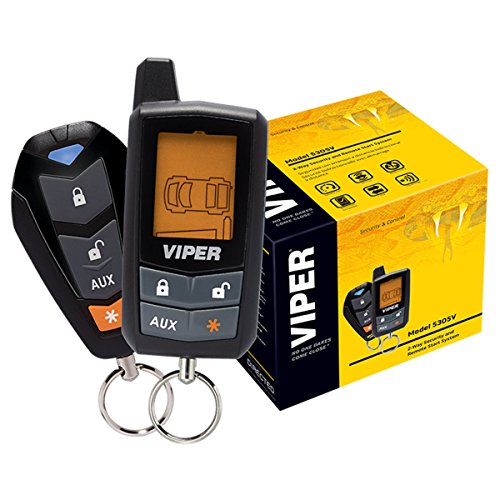
The longest remote range here, with confirmation you can read
Viper 5305V 2 Way LCD Vehicle Car
The Viper 5305V pairs a two-way LCD remote with keyless entry and remote start, so you get a written confirmation back instead of a hopeful beep. It's the system installers know best, which matters more than any single spec once something needs fixing.
$218.87fromAmazonPrices as of Oct 25, 6:48 AM PT · Details
The two-way LCD remote is the whole point. With a one-way fob you press lock and hope. This one buzzes your pocket and shows you which zone tripped, so you can tell a neighbor's car door from someone leaning on your window. Directed rates the SmartStart-paired setup at roughly a mile in open air. Inside a concrete garage you'll get a fraction of that, but still far more than a bare keychain fob gives you.
Installers know this system cold. Directed Electronics gear has been on shop shelves for a very long time, and that's worth more than a spec line. If the alarm gets cranky two winters from now, the shop across town has probably wired a dozen of them. That's not exciting. But it's the difference between a fixable annoyance and a car you stop trusting.
Remote start is where most owners get their money's worth. The security half sits idle, and you hope it stays that way. The remote start half you'll use on every freezing morning and every blistering afternoon. Pairing it with SmartStart moves those controls to your phone, so range stops mattering when you're upstairs in an apartment. That's the single upgrade most people notice day to day.
The security side runs impact sensing and a starter interrupt, so someone who gets inside still can't just drive off. That's the layer NHTSA and Consumer Reports both push for. It's also why we'd send you to a shop. Crutchfield's guidance is blunt that starter-kill and CAN-bus wiring is where do-it-yourself jobs go sideways, because a wrong wire can knock out factory immobilizer or safety electronics.
Flaws but not dealbreakers
It doesn't track anything. If your car leaves the block, the 5305V has no idea where it went and neither do you. That's a real gap in a high-theft city, and it's why we'd pair this with a tracker rather than treat it as complete coverage.
Installation is a separate expense and a separate hassle, and it's not optional for most people. Add shop labor to whatever the hardware costs before you decide this fits your budget. Replacement two-way remotes aren't cheap either, so the day you leave one in a jacket pocket at the beach stings a bit.
Upgrade pick
A louder siren and two-car coverage, at a real premium
Compustar CS7900-AS 2-Way Car Remote Start &
Compustar's CS7900-AS bundle adds a 105-decibel siren, support for two vehicles, and an integration cartridge that plays nicely with a huge range of factory computers. It costs meaningfully more than our top pick, and installation still isn't included.
$329.99fromAmazonPrices as of Oct 25, 6:48 AM PT · Details
This arrives as a bundle, not a single box. You get the CS7900-AS control module with its two-way LCD remote and a one-way backup transmitter, plus an ADS-Blade AL integration cartridge and the USB interface a shop uses to program it. That cartridge is the quietly important piece. It handles immobilizer bypass and door-lock integration across more than 4,000 vehicle models, which is why this kit works on cars that choke a generic alarm.
The 105-decibel siren and two-vehicle support are what the extra money buys. If you've got a truck and a commuter car in the same driveway, running one remote for both is genuinely nice. And a louder siren does more work in a busy neighborhood where a polite chirp gets tuned out. Neither feature helps you if you own one car parked in a quiet cul-de-sac.
Range is the trade you make. Compustar specs the sidekick remote at 3,000 feet in open air, which is shorter than the roughly one mile Viper claims for its SmartStart-paired setup. In practice both numbers collapse indoors, and neither reaches across a big-box parking lot from inside the store. If you want range that survives walls, the answer is an app, not a fob.
That's where DroneMobile comes in. Compustar's app-compatible systems, this one included, put status and remote control on your phone, so you can check the car from a desk two floors up. It's the same logic as SmartStart on the Viper. Consider it the feature that makes either of these worth buying over a plain one-way remote start kit.
Flaws but not dealbreakers
The listing says it plainly: installation is not included. This is a multi-part kit with a bypass cartridge and a programming interface, which should tell you it's meant for a shop bench, not a Saturday in the driveway. Budget accordingly.
You're paying for capability you may never touch. If you don't need two-vehicle support and your street isn't loud, our top pick covers the same ground for less and reaches farther on the fob.
Budget pick
The core alarm features, minus the long-range polish
Avital 5305L 2-Way Security System Responder Keyless
The Avital 5305L is Directed's value tier, and it keeps the parts that matter: a two-way LCD remote, a dual-zone impact sensor, and a fault-proof starter interrupt. You give up range and refinement, not the security fundamentals.
$149.95fromAmazonPrices as of Oct 25, 6:48 AM PT · Details
You're giving up reach, not protection. The 5305L runs the same core ideas as our top pick. A backlit two-way LCD remote with tone and vibrate modes, Zone ID so you know what tripped, a dual-zone impact sensor, and a starter interrupt that keeps the engine from cranking. A one-way companion remote comes in the box for a second driver. For a lot of people that's the whole shopping list.
The nuisance features matter more than they sound. Warn Away chirps at someone leaning on the car instead of going straight to full siren, and the nuisance prevention circuitry cuts down on the three-in-the-morning false alarms that make neighbors hate you and make you stop caring. An alarm you've learned to ignore protects nothing.
It's SmartStart compatible too, so the phone-control path stays open if you decide later that a fob isn't enough. That keeps this from being a dead end. Start here, add the app subscription if apartment walls turn out to be a problem, and you haven't wasted the hardware.
Flaws but not dealbreakers
The remote's range is the obvious compromise. Directed doesn't market this tier on distance, and you'll notice it across a large lot or through a building. If you park where you can't see the car, that gap is exactly the one you'll feel.
This particular listing bundles the alarm with a magnetic phone holder, which is filler. Ignore it. And like every system here, it still needs professional wiring for the starter-kill to be done safely.
Who this is for
Buy one of these if your car parks where you can't watch it, or if you drive something thieves specifically look for. That second group is bigger than it used to be. The NICB's Hot Wheels reports have repeatedly named Hyundai and Kia models among the most-stolen in the country after a viral social media trend exposed the missing engine immobilizers in certain model years, and FBI crime data showed national vehicle theft climbing past a million cars a year at the peak before starting to level off. If you own one of those cars, an aftermarket starter interrupt closes exactly the hole thieves were exploiting.
Skip this if your car already has a factory immobilizer, you park in a secured garage, and you mostly want the convenience of remote start. Buy a remote start kit instead and save the difference. This guide covers aftermarket alarm and security systems for a single owner's vehicle: two-way remotes, starter interrupts, and plug-in trackers. It doesn't cover steering wheel locks, dash cameras, factory subscription services, or fleet telematics platforms, though Consumer Reports would tell you a wheel lock alongside one of these is a perfectly sensible pairing.
How we picked
We built the shortlist around five things. Remote confirmation: a two-way remote that tells you which zone tripped, not a one-way fob you press and hope on. Recovery, not just noise: a starter interrupt at minimum, since both Consumer Reports and NHTSA argue that layering an immobilizer or tracker behind a visible deterrent is what actually works. Vehicle compatibility: documented immobilizer bypass and broad model coverage, per manufacturer specs and Crutchfield's installation guidance. Installer support: brands with shops that can service them later, a theme that runs through owner feedback in this category. Ongoing cost: cellular trackers bill monthly, and that belongs in the math before you buy.
Other car alarm and security systems worth considering
If you want to find the car after it's gone: The CARLOCK OBD2 Anti Theft Car Device + — CarLock's 4G bundle plugs into the OBD-II port and skips the shop entirely, which is its whole appeal. It watches for movement, engine starts, unusual vibration, and even someone yanking the device out, then pushes an alert to your phone. PCMag's reviewers report that plug-in trackers like this one send tow and movement alerts within seconds, no wiring required. The included Bluetooth tag arms and disarms alerts based on how far you've walked from the car, and the app tracks trips and flags a battery that's draining. What you give up is the deterrent: there's no siren, no starter kill, and nothing a thief sees before breaking in. It also bills monthly, forever. Owner feedback on this bundle is thin and mixed, so treat it as a layer on top of an alarm rather than a replacement for one.
The competition
This is what our research surfaced, not a map of the whole market. Two big names came up constantly that we couldn't evaluate here because they weren't in the lineup. LoJack's recovery network works with law enforcement and operates independently of GPS and cellular, which the company says helps when a car is stashed inside a building or when a tracker gets jammed. Clifford's Matrix systems sit above Viper in the same corporate family for people with a high-value car. And Python's alarm line is essentially the Viper hardware under a different badge, so if you find one on a shop's shelf, you're not settling. Any of them is worth a look alongside our picks.
Installation notes
Every alarm here except the plug-in tracker needs a shop, and you should treat that as part of the purchase rather than an upsell. Crutchfield's guidance is direct about why: starter-kill and CAN-bus wiring sits close to your car's immobilizer and safety electronics, and a wrong connection can disable something you very much want working. A good installer also hides the siren and control module where a thief can't reach them in ten seconds, which is half the value of the job. Ask where the valet switch ends up, and write down the bypass procedure before you drive away. If you're adding an OBD-II tracker instead, tuck the cable so it isn't the first thing someone sees under the dash. Then test the alarm once, at a reasonable hour, so you know what it sounds like.
Questions we get
Are aftermarket car alarms still worth it if my car has factory security?
It depends on what your car came with. Most modern cars have an engine immobilizer, which is the part that actually stops a theft, and if yours does, an aftermarket alarm adds noise and convenience more than protection. The exception is cars that shipped without one, where an aftermarket starter interrupt closes a real hole. Check your model before you spend.
What's the best car alarm for a Kia or Hyundai to prevent theft?
Look for a system with a starter interrupt, which is standard on all three of our picks. The NICB has repeatedly listed certain Hyundai and Kia models among the most-stolen in the country, and the underlying issue was the missing engine immobilizer in specific model years. A starter kill replaces that missing layer. Adding a plug-in tracker on top gives you a way to find the car if someone still gets it moving.
Do car alarms lower my insurance premium?
Often, but not by a life-changing amount. The Insurance Information Institute notes that many insurers offer discounts in the range of five to twenty percent for vehicles with verified anti-theft or recovery devices. You'll usually need documentation from the installer, so keep the paperwork. Call your carrier before you buy and ask what specifically qualifies.
What's the difference between an alarm, a remote starter, and a GPS tracker?
An alarm makes noise and, on better systems, blocks the starter. A remote starter warms or cools the car before you get in and does nothing for security on its own. A GPS tracker tells you where the car is and where it's been. Our picks combine the first two, and CarLock covers the third.
Can I install one of these myself?
An OBD-II tracker, yes, in about a minute. A full alarm with a starter interrupt, probably not. Crutchfield's guidance flags that starter-kill and CAN-bus integrated systems normally need professional installation because miswiring can disable factory immobilizer or safety electronics. Budget shop labor on top of the hardware.
Do GPS trackers require a monthly subscription?
Cellular trackers like CarLock do, because they're paying for data service every month the device is connected. CNET Roadshow's point is worth repeating: weigh that recurring cost against a one-time alarm purchase before you commit. LoJack's recovery service is subscription-based as well. A plain two-way alarm has no ongoing fee at all.
Why you should trust us
For this guide:
- We read manufacturer specifications from Compustar, Viper, Avital and CarLock alongside published coverage from Consumer Reports, PCMag, CNET Roadshow and Crutchfield.
- We compared theft-risk and recovery guidance from the NICB, the FBI, NHTSA, the Highway Loss Data Institute and the Insurance Information Institute to decide which features actually change outcomes.
- We looked for recurring themes in owner feedback about false alarms, remote range and installer support rather than counting individual opinions.
- We read owner reviews on every listing, weighted toward the critical ones, because that is where the recurring failures show up.
- We have a systematic way of automatically fetching the latest prices, so the numbers on this page stay current.
- This is a research-focused guide, so the team may not own every product listed — though we often do own the top winners, which gives us extra context for the recommendations.
- We don't accept free products, and the retailer commission never changes which product we recommend.
Sources
National Insurance Crime Bureau — Hot Wheels: America's 10 Most Stolen Vehicles Report, National Insurance Crime Bureau (NICB)
FBI Uniform Crime Reporting — Motor Vehicle Theft Statistics, FBI
Insurance Information Institute — Facts + Statistics: Auto Theft, Insurance Information Institute (III)
Consumer Reports — How to Protect Your Car From Theft, Consumer Reports
NHTSA — Vehicle Theft Prevention, NHTSA
PCMag — The Best Car Alarms and GPS Trackers, PCMag
CNET — Best Car Security Systems and Trackers, CNET Roadshow
Crutchfield — Car Alarm and Remote Start Buying Guide, Crutchfield
Highway Loss Data Institute — Theft Losses by Make and Model, Highway Loss Data Institute (HLDI)
LoJack — How Stolen Vehicle Recovery Technology Works, LoJack
Amazon product listings and owner reviews for all 4 products
Manufacturer specification pages for each product
Some passages in this guide may be paraphrased with AI help.
Product prices and availability are accurate as of the date/time indicated and are subject to change. Any price and availability information displayed on Amazon.com at the time of purchase will apply to the purchase of this product.
More like this.
Continue exploring electronics reviews and recommendations.

The Best DIY Smart Home Security Systems
A home security system earns its keep on the days nothing happens. You leave for a long weekend, glance at your phone in an airport line, and see every…

The Best Home Security Systems of 2026
A home security system spends almost all of its life doing nothing at all. That's the point. What you actually notice day to day is smaller stuff: whether…

The Best Car Speakers and Stereo Systems
A car stereo is the one piece of gear in your car you touch every single day. You reach for it before you've backed out of the driveway, and you're still…

The Best GPS Navigation Systems for Cars
A dedicated car GPS does one job, and it does it without asking anything of your phone. It already has the map onboard, so it keeps calling out turns…

The Best WiFi Freeze Alarms and Temperature Sensors
A frozen pipe doesn't announce itself. It splits quietly, thaws a day later, and then, according to the American Red Cross, a single 1/8-inch crack can…

The Best Sunrise Alarm Clocks
The alarm on your phone works by startling you. A sunrise alarm clock tries something gentler: it brightens your room over 20 or 30 minutes so you're…