The Best Car Speakers and Stereo Systems
A car stereo is the one piece of gear in your car you touch every single day. You reach for it before you've backed out of the driveway, and you're still using it an hour into a traffic jam. Factory systems are built to a price, which usually means a small screen, laggy phone pairing, and paper-cone speakers that turn muddy the moment you pass half volume. Swapping the head unit, the speakers, or both is one of the simplest ways to make an old car feel newer.
Here's the honest part: nothing in this category is plug-and-play. Every head unit needs a dash kit and a wiring harness matched to your exact year and trim, and some cars need an adapter just to keep the steering-wheel buttons working. Speakers need the right mounting depth or they'll hit a window regulator. And no aftermarket speaker fixes a rattling door panel or road noise on the highway. Sound deadening and a proper install matter as much as the parts you buy.
We looked at the head units and speakers that keep coming up in published reviews and owner discussions, then compared them against manufacturer specifications for screen size, chassis depth, sensitivity and power handling. We weighted wireless phone mirroring heavily, because it's what most people actually want. We think that the Sony XAV-AX8100 is the best car stereo for most people, and that the Pioneer DMH-WT8600NEX is the one to buy if your dash has an awkward vent or a curved console in the way.
Everything we recommend

A big floating screen and simple software, in a shallow chassis

A screen you can angle and tap, if your dash fights you

A real jump from factory speakers, no amplifier required

Reference-grade detail, if you'll add an amp and aim tweeters

A shallow chassis for tight dashes, with wired phone mirroring
At a glance
| Product | Size (In) | Power (Watts) | Price | |
|---|---|---|---|---|
| Sony XAV-AX8100 9-inch Floating Multi Media ReceiverTop pick | 9-inch | — | $498 |
| Pioneer DMH-WT8600NEX 10.1" HD Touchscreen Floating DisplayRunner-up | 10.1" | — | $1,499.99 |
| Alpine iLX-W650BT Multimedia Car RadioAlso great | — | — | $349.95 |
 | JL Audio C1-690 225W 6"x 9" 2-WayAlso consider | 6x9" | 225W | $189.99 |
| Focal PS 165 FXE 6.5" Flax EvoUpgrade pick | 6.5 Inch | — | $499.03On sale |
| Rockford Fosgate Prime R165X3 6.5" 3-Way FullBudget pick | 6.5-Inch | 45W RMS | $77.75 |
 | JBL GTO629 6.5" Grand Touring Series CarAlso consider | 6.5" | 360W Max | $119.95 |
 | KICKER 51KSC6504 KS-Series 6.5" Coaxial Speakers withAlso in lineup | 6.5" | — | $129.99 |
How we picked
Phone integration. We treated Apple CarPlay and Android Auto as mandatory on any head unit here, and gave real weight to wireless versions. Consumer Reports survey data shows it's the main reason most people replace a factory radio at all.
Screen and controls. We compared published screen sizes, panel types and adjustability across manufacturer spec sheets. Capacitive panels and adjustable floating mounts earned an edge, because glare and awkward dash angles are what owners complain about most.
Sensitivity over wattage. For speakers, we prioritized sensitivity ratings in dB/W/m rather than peak wattage. Anything near 90 dB plays convincingly loud on a factory radio putting out 10 to 18 watts RMS per channel.
Fit and install depth. We favored products that publish mounting diameter, mounting depth and chassis depth, since that's what decides whether a part goes in at all. Crutchfield's fitment database covers more than 32,000 vehicle configurations and is the check we'd want anyone to run first.
Room to grow. We looked for preout voltage, subwoofer outputs and bi-amp capability, so a head unit or speaker set doesn't become the bottleneck when you add an amplifier later.
Top pick
A big floating screen and simple software, in a shallow chassis
Sony XAV-AX8100 9-inch Floating Multi Media Receiver
The XAV-AX8100 puts a roughly nine-inch floating display in front of your dash while the body itself slides into a single-DIN opening. You get wireless CarPlay and Android Auto, a rear camera input, and 5-volt preouts if you ever add an amplifier.
$498fromAmazonThe screen is the main reason to buy this one. It's a floating panel that sits in front of your dash instead of inside it, so you get a big map without anyone cutting up your trim. The anti-glare coating helps on a bright afternoon with the sun behind you. Text stays readable at a glance, which matters more than pixel count when you're changing lanes.
Sony builds this on a single-DIN chassis with three-way adjustment, so the body tucks into a narrow factory opening while the screen floats over whatever's in the way. That's a real advantage in older trucks and small cars that never had a double-DIN cutout. You'll still need a dash kit and a harness matched to your vehicle, but the hard part — finding room — is mostly solved.
The back panel is generous for a mainstream receiver. You get gold-plated front, rear and subwoofer preouts rated at 5 volts, which hands an external amplifier a strong, clean signal. There's a rear camera input as well, and the unit is SiriusXM ready. If amps and a subwoofer are somewhere in your future, this is a sensible place to start.
Wireless phone mirroring is what you'll notice every day. Your phone connects while you're still buckling up, and the maps and messages you already use come up without digging for a cable. Consumer Reports survey data puts wireless smartphone integration as the main reason drivers buy an aftermarket head unit at all. Once you've had it, going back to a USB cord feels ridiculous.
Flaws but not dealbreakers
The touchscreen is resistive rather than capacitive. It wants a deliberate press instead of a light tap, and swiping never feels as fluid as your phone. Most people stop noticing within a week. But if you're coming from a newer car with a glass panel, the difference is obvious the first time you use it.
There's no disc slot, so a CD collection means burning a USB stick instead. The floating panel can also sit in front of a climate vent or a small factory display in some dashes. Check the sightline for your specific car before you order, because that's the one thing a dash kit can't fix.
Sony lists a three-year warranty on this receiver.
Runner-up
A screen you can angle and tap, if your dash fights you
Pioneer DMH-WT8600NEX 10.1" HD Touchscreen Floating Display
The DMH-WT8600NEX mounts a 10.1-inch capacitive display on an adjustable arm, so you can pull it forward and tilt it away from glare or an awkward console. It runs CarPlay and Android Auto, adds split-screen viewing, and has Alexa built in.
$1,499.99fromAmazonSome dashes just don't have room for a big flush-mounted screen. The console curves, or a vent sits exactly where the display would go. Pioneer's answer is a 10.1-inch panel on an adjustable arm — per Pioneer's specifications it extends up to about 20 millimeters from the dash face and tilts roughly six degrees up or down. That's usually enough to clear the obstacle and kill the reflection at the same time.
The capacitive touchscreen is a clear step up from our top pick. It answers a light tap and handles swipes the way a tablet does, so scrolling a long playlist doesn't feel like a chore. The 16:9 shape suits map view nicely. If screen feel is the thing that bugs you about cheaper receivers, this is where your extra money goes.
Split-screen mode shows CarPlay or Android Auto alongside the receiver's own source at the same time. In practice that means turn-by-turn directions on one half and your radio station or Bluetooth track on the other, with no toggling back and forth. It's a small convenience that quietly removes a lot of small annoyances on a long drive.
Alexa is built in, so you can ask for music, weather or directions without routing everything through your phone's assistant. Bluetooth covers hands-free calls and streaming, and there's a rear camera input if your car doesn't already have one. None of that is exotic in this class anymore, but Pioneer's version of it is one of the more polished you'll find.
Flaws but not dealbreakers
It's a bigger, heavier unit than our top pick, and it's the more expensive of the two. The arm needs clearance behind the dash as well as in front of it, so a tight install can get fiddly fast. If you're not confident with panel removal, budget for a shop.
A large floating panel can also cover hazard buttons or climate controls in some vehicles. Pull up a photo of your dash and hold your hand where the screen would sit before you buy.
Budget pick
A real jump from factory speakers, no amplifier required
Rockford Fosgate Prime R165X3 6.5" 3-Way Full
The R165X3 is a 6.5-inch three-way coaxial rated at 45 watts RMS with roughly 90 dB sensitivity, so it gets loud on a stock radio. Grilles and mounting hardware are in the box, and Rockford publishes the fitment dimensions you need.
$77.75fromAmazonIf your factory speakers sound muddy, start here. Most stock head units put out only about 10 to 18 watts RMS per channel, and factory paper cones give up early. These are rated at 45 watts RMS with roughly 90 dB sensitivity, which means they play cleanly on the power you already have. The improvement in vocals and cymbals is the kind you hear in the first song.
The three-way layout stacks a polypropylene woofer, a midrange and a silk-dome piezo tweeter in one basket. That gets you more treble detail than the typical two-way coaxial at the same money. Polypropylene also shrugs off the humidity and heat inside a door, which is where most factory paper cones eventually fail.
Fitment is refreshingly well documented. Rockford lists a 5.51-inch mounting diameter and a 2.15-inch mounting depth, so you can measure your door before you order rather than after. Grilles and hardware come in the box, which matters if your factory grilles are molded into the panel and can't be reused.
For a lot of people, this is the whole upgrade. Swap all four doors, leave the factory radio alone, and you've fixed the problem for a fraction of what a head unit and amplifier would cost. It's the least glamorous recommendation here and probably the one that helps the most cars.
Flaws but not dealbreakers
A piezo tweeter is a blunt instrument. On bright recordings these can get a little sharp, especially with the treble cranked on a factory radio that already boosts the top end. Backing the treble off a notch usually settles it down.
Don't expect deep bass. A 6.5-inch cone in a leaky door panel only does so much, and 45 watts RMS is a modest ceiling. If you want low end, you're looking at a subwoofer, not a bigger coaxial.
Rockford Fosgate covers the R165X3 with a one-year warranty.
Upgrade pickOn sale
Reference-grade detail, if you'll add an amp and aim tweeters
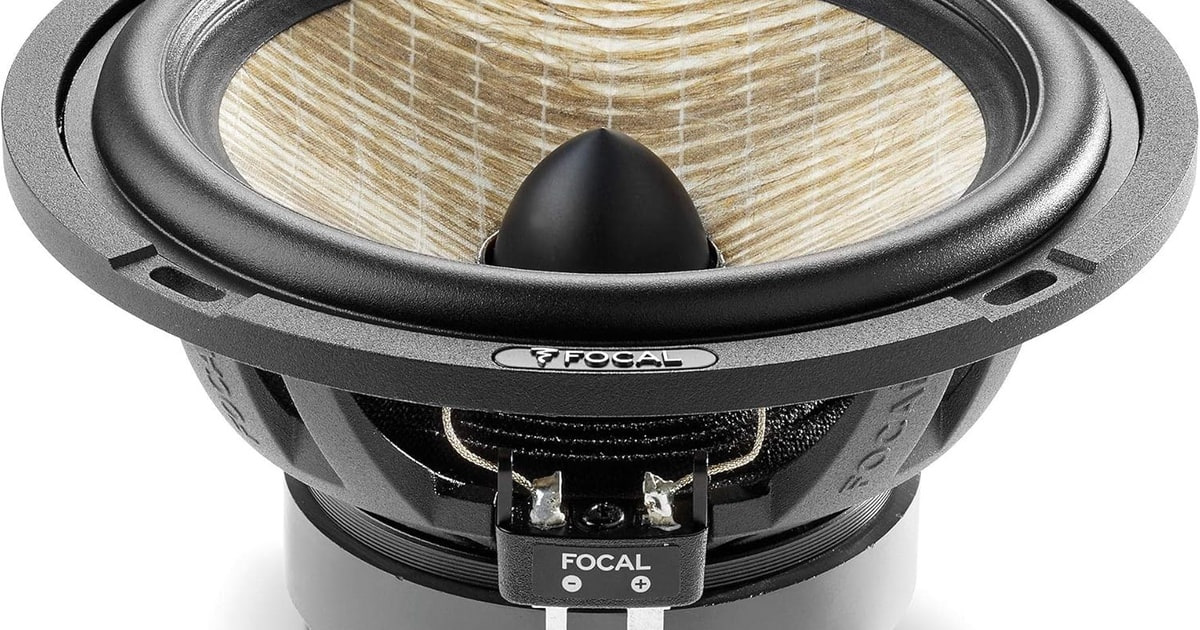
Focal PS 165 FXE 6.5" Flax Evo
Focal's PS 165 FXE pairs a flax-fiber woofer with a separate aluminum-magnesium inverted-dome tweeter and an external crossover. It's a bi-amplifiable component set aimed at people who want a real soundstage in a daily driver, not just more volume.
$499.03fromAmazonList priceFlax is the unusual part. Focal has been building these cones in France for years, and its engineering data puts the flax sandwich construction at roughly 30 percent less internal resonance than a polypropylene cone of the same weight. What that buys you is a midrange that stays clean when the music gets busy. Voices sit in front of the mix instead of smearing into it.
A component set is worth the hassle because of where the tweeter goes. In a coaxial, the tweeter fires up at your knees from inside the door. Here it mounts separately, near ear level in the A-pillar or sail panel, and the stage lifts up onto the dash. Sound & Vision's listening comparisons consistently find component sets beat coaxials on soundstage width and imaging for exactly this reason.
The TAM tweeter uses an aluminum-magnesium inverted dome, and Focal designed it for wide dispersion. That matters more in a car than almost anywhere else, because you're never sitting on axis with both speakers. Off to the side, the treble doesn't collapse the way it does with a cheap dome. The TMD surround on the drivers is part of the same story.
You can run this set bi-amplified, driving the woofers and tweeters from separate amplifier channels. That gives you finer control over power distribution and lets you tune the tweeter level to your car's glass and seats. It's more wiring, and it's the reason this set rewards a careful install rather than a fast one.
Flaws but not dealbreakers
These need an amplifier. Running them off a factory head unit wastes most of what you paid for, so factor an amp and its wiring into the plan from the start.
The install is the real cost. Tweeter pods or A-pillar work often means drilling, and the external crossovers need somewhere dry to live inside the door or behind a kick panel. If you're not doing this yourself, shop labor can rival the price of the speakers.
Also great
A shallow chassis for tight dashes, with wired phone mirroring
Alpine iLX-W650BT Multimedia Car Radio
The Alpine iLX-W650BT is a mech-less receiver with a 7-inch screen and an install depth of about 6 centimeters. It runs wired Apple CarPlay and Android Auto, and it fits behind dashes where a full double-DIN unit simply won't go.
$349.95fromAmazonThe reason to buy this one is behind the dash, not in front of it. Alpine lists an install depth of about 6 centimeters, because there's no CD mechanism taking up space. In cars with ductwork, a body brace or a shallow radio pocket, that's the difference between a clean install and giving up. It also removes the one moving part most likely to fail eventually.
Wired CarPlay and Android Auto cover the essentials: maps, messages, music and voice commands, all on a 7-inch screen. A cable is less elegant than wireless, though it does keep your phone charged on a long drive. If you already leave a cable plugged in out of habit, you won't miss much here.
Alpine sells this as part of a Power-Stack setup with the KTA-450 four-channel power pack, which bolts on behind the receiver instead of taking up trunk space. That's a tidy way to add real power to factory-location speakers in a small car. It's optional, but it's a genuinely clever path if you're short on room.
Flaws but not dealbreakers
There's no wireless phone mirroring, which is the one feature that separates this from our top two picks. For some people that alone rules it out.
The screen is smaller and lower-resolution than the floating displays above, and the bezel around it is chunky. It looks like what it is — a practical receiver rather than a showpiece.
Who this is for
This guide is for anyone whose factory audio has worn out its welcome — the muddy doors, the radio that takes ten seconds to find your phone, the screen you can't read at noon. If you drive an older car with a basic radio, a head unit swap changes your commute more than almost any other upgrade at this money. If you mostly want louder, clearer music and don't care about screens, four coaxial speakers will get you most of the way there for a lot less.
You should probably skip all of this if your car has a factory system tied into climate controls, driver displays or an amplified premium package, since those installs get complicated and expensive fast. We're covering head units and full-range door speakers here. Subwoofers, amplifiers, sound-deadening material, dash kits and vehicle-specific wiring harnesses are all outside the scope, even though you'll likely need at least one of them.
How we picked
Phone integration: CarPlay and Android Auto were non-negotiable on every head unit, and wireless versions scored higher because that's what drivers say motivates the purchase. Screen and controls: we compared panel size, panel type and mounting adjustability across manufacturer specifications, favoring capacitive glass and floating arms that dodge glare and dash obstructions. Sensitivity over wattage: for speakers we weighted dB/W/m ratings ahead of peak-power marketing numbers, since a 90 dB speaker gets loud on a stock radio and an 87 dB one doesn't. Fit and install depth: we preferred products that publish mounting diameter, mounting depth and chassis depth, because fitment kills more upgrades than sound quality ever does. Room to grow: preout voltage, subwoofer outputs and bi-amp wiring decided ties, so nothing here holds you back when you add an amplifier.
Other car speakers and stereo systems worth considering
If you want a component set that drops into 6x9 factory openings: The JL Audio C1-690 225W 6"x 9" 2-Way ($189.99) — The JL Audio C1-690 is a two-way component system built for the oval openings you find in rear decks and older truck doors. That bigger cone area moves more air than a 6.5-inch driver, so you get fuller low end without a subwoofer, and the separate tweeter still buys you the ear-level imaging a coaxial can't manage. JL designs the crossovers in house, and the set is shaped to sit behind factory grilles. It gives up some of the Focal's midrange refinement, and like any component set it really wants an amplifier.
If you want the most bass from a coaxial on factory power: The JBL GTO629 6.5" Grand Touring Series Car ($119.95) — JBL's GTO629 uses the company's Plus One cone geometry, which JBL says increases the 6.5-inch driver's effective radiating area by about 25 percent and lifts bass sensitivity roughly 1.5 dB. That's audible without touching your amplifier, and it's why these keep showing up in owner recommendations for cars that need more weight down low. The edge-driven tweeter spreads treble widely, which helps when you're sitting off to one side. It's a two-way, so you don't get the extra super-tweeter detail of our budget pick, and the listing is thin on published mounting dimensions — measure your door first.
The competition
This is what our research surfaced, not a survey of everything sold. Car audio has hundreds of speaker models, and fitment means the right answer for your specific car may be something none of us listed. Treat the rest of this section as context for why the picks above won.
The KICKER 51KSC6504 KS-Series 6.5" Coaxial Speakers with ($129.99) — Kicker's KSC6504 is a 6.5-inch, 4-ohm coaxial with a 0.75-inch tweeter, and its sensitivity rating of about 92 dB is the highest here. Kicker's specifications put it 2 dB above the JBL, meaning it hits the same volume on roughly half the power — a genuine edge if you're keeping a weak factory radio. The dampened polypropylene cones and near-zero tweeter protrusion also make for a clean fit in most vehicles without modification. It lost to the Rockford Fosgate on breadth: the R165X3 adds a third driver for more treble detail and publishes exact mounting diameter and depth figures, which makes ordering less of a gamble. If sheer loudness on stock power is your only goal, buy these instead.
Fit and installation
Before you buy anything, confirm three numbers for your car: speaker diameter, mounting depth, and whether your dash takes a single-DIN or double-DIN chassis. Crutchfield's fitment database covers over 32,000 vehicle configurations and will tell you all three, plus which harness and dash kit you need. Buy the vehicle-specific harness — never cut factory wiring, because it destroys resale value and makes troubleshooting miserable. Disconnect the battery before you pull a panel. Use foam gaskets or a strip of sound deadening behind each speaker; a door that rattles will undo most of what you just paid for. Match impedance too. Most aftermarket speakers are 4 ohms, and running a mismatched load stresses an amplifier over time. If any of that sounds like a bad Saturday, a shop install is money well spent.
Questions we get
How do I know what size speakers fit my car?
Look up your year, make, model and trim in a fitment database rather than measuring by eye. You need three things: the speaker diameter, the mounting depth available behind the panel, and the bolt pattern. Depth is the one that trips people up, because a window regulator or door glass can sit closer than you'd expect.
Are component speakers worth the extra cost over coaxials?
For soundstage, yes. Listening comparisons from Sound & Vision consistently favor component sets over coaxials at similar money, because the tweeter can be mounted near ear level instead of firing at your shins. The trade-off is install work — you'll be mounting tweeters, hiding crossovers, and usually adding an amplifier.
Do I need an external amplifier for aftermarket speakers?
Not always. A high-sensitivity coaxial around 90 dB/W/m sounds noticeably better than factory speakers on a stock radio's 10 to 18 watts per channel. Component sets and anything with a low sensitivity rating do want an amp, and even a modest four-channel amp cleans up the top end at highway volume.
What's the difference between single-DIN and double-DIN stereos?
It's the height of the opening in your dash. Single-DIN is about two inches tall, double-DIN is about four. Some single-DIN receivers, like our top pick, mount a large floating screen on a single-DIN body, which is how you get a big display in a car that never had room for one.
Is a mech-less stereo better than one with a CD player?
For most people now, yes. Dropping the optical drive lets the chassis get much shallower, which is what makes a receiver like the Alpine fit behind a cramped dash. It also removes the part most likely to fail eventually. If you still play discs, keep the CD unit.
Can I install a car stereo myself?
Plenty of people do. With the correct dash kit, a vehicle-specific wiring harness and a panel removal tool, a head unit swap is a couple of hours of careful work. Steering-wheel control adapters and factory amplifier integration are where it gets harder, so read your car's requirements before you order parts.
Why you should trust us
For this guide:
- We read manufacturer specification sheets for every head unit and speaker here, comparing screen size, chassis depth, sensitivity, RMS power handling and preout voltage rather than peak-wattage marketing figures.
- We reviewed published editorial coverage and standardized bench measurements from outlets including Crutchfield, RTINGS.com and Sound & Vision, plus Consumer Reports survey data on what motivates head unit purchases.
- We tracked recurring themes in owner feedback — glare, install depth surprises, harness headaches and tweeter brightness — and used them to shape the flaws and caveats above.
- We read owner reviews on every listing, weighted toward the critical ones, because that is where the recurring failures show up.
- We have a systematic way of automatically fetching the latest prices, so the numbers on this page stay current.
- This is a research-focused guide, so the team may not own every product listed — though we often do own the top winners, which gives us extra context for the recommendations.
- We don't accept free products, and the retailer commission never changes which product we recommend.
Sources
Car Stereo Receivers Buying Guide — Crutchfield, Crutchfield
Car Speakers Buying Guide — Crutchfield, Crutchfield
Best Car Receivers — RTINGS.com, RTINGS.com
Best Car Stereo Systems — The Drive, The Drive
Car Audio Reviews — Sound & Vision, Sound & Vision
Sony XAV-AX8100 Product Page — Sony, Sony (Manufacturer)
Pioneer DMH-WT8600NEX Product Page — Pioneer Electronics, Pioneer Electronics (Manufacturer)
Focal Performance PS 165 F — Focal Official, Focal (Manufacturer)
JL Audio C-Series Component Speakers — JL Audio, JL Audio (Manufacturer)
Rockford Fosgate R-Series Speakers — Rockford Fosgate, Rockford Fosgate (Manufacturer)
JBL GTO Series Speakers — JBL Car Audio, JBL (Manufacturer)
Car Electronics Ratings — Consumer Reports, Consumer Reports
Amazon product listings and owner reviews for all 8 products
Manufacturer specification pages for each product
Some passages in this guide may be paraphrased with AI help. Prices are refreshed automatically.
More like this.
Continue exploring electronics reviews and recommendations.

The Best Car Stereo Head Units
Your factory stereo is probably the oldest piece of technology you touch every day. Replace it and you get wireless Apple CarPlay or Android Auto, a…

The Best Car Alarm and Security Systems
Your car spends most of its life parked and unattended. On a street, in a work lot, in a driveway you can't see from the kitchen sink. A security system's…

The Best GPS Navigation Systems for Cars
A dedicated car GPS does one job, and it does it without asking anything of your phone. It already has the map onboard, so it keeps calling out turns…

The Best Bookshelf Speakers
A good pair of bookshelf speakers changes how music sounds in your home more than almost any other upgrade. Two boxes, spaced a few feet apart, can put a…

The Best Waterproof Outdoor Bluetooth Speakers
A speaker that lives outdoors leads a rough life. It gets set down in wet sand, splashed by a cannonball, knocked off a picnic table, and left in a hot…

The Best Tire Pressure Monitoring Systems
Your tires are losing air right now. Nothing dramatic - just the ordinary seep of one to two pounds a month, according to the Tire Industry Association,…