The Best Car Vacuum Cleaners
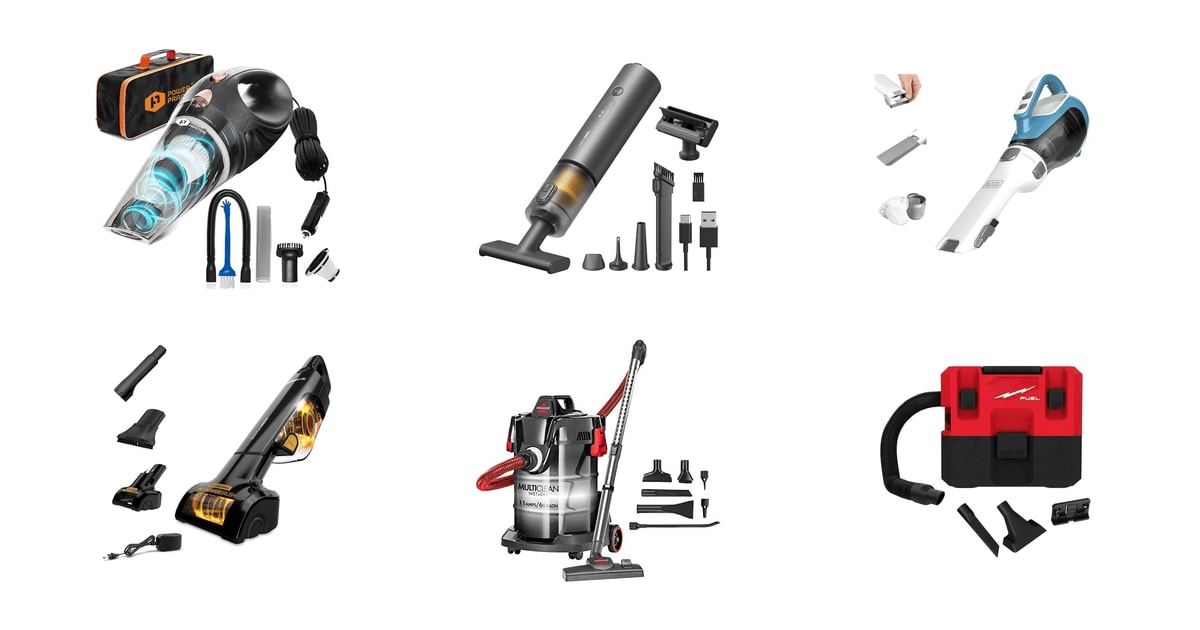
A car vacuum spends most of its life doing small, unglamorous jobs. Crushed crackers under the booster seat. Sand in the seat rails after a beach trip. The layer of dog hair that shows up on the back bench no matter what you put down there. A full-size upright can't reach any of it, and the gas-station vacuum takes your quarters and quits early. What you want is something that lives in the car, fits the gaps beside the seats, and gets used often enough to stay ahead of the mess.
Here's the honest part: nothing in this class is a match for a household machine. Dust bins are measured in ounces, so you'll be emptying mid-job. Filters clog, and suction fades with them, which is the single biggest reason a car vacuum feels dead after a few months. Cordless models average about 18 minutes at full power, per Road & Track, while a thorough interior takes 25 to 35 minutes. Corded units don't run down, but they tether you to the 12V outlet and can't clean anything else you own.
So the choice comes down to how you actually clean. If you do one long, careful session every few weeks, a corded 12V unit gives you reach and steady power for the whole job. If you do quick passes after errands, cordless wins on sheer likelihood of getting used. We think that the ThisWorx Handheld Car Vacuum is the best car vacuum for most people, and that the Shark UltraCyclone Pet Pro+ is the one to buy if you'd rather not deal with a cord.
Everything we recommend
Plugs into the 12V outlet and reaches all the way back

Cordless, and the suction holds up as the cup fills

Far more power and filtration, if you'll pay for it

A simple grab-and-go handheld for everyday crumbs
At a glance
| Product | Suction (Pa/AW) | Runtime | Price | |
|---|---|---|---|---|
| ThisWorx Handheld Car VacuumTop pick | 106W motor | — | $20.99 |
 | HOTO Car Vacuum Portable CordlessAlso consider | 20,000Pa | 10-35 min | $79.99 |
| Black+DeckerAlso great | — | — | $59.99 |
| Shark UltraCyclone Pet Pro Plus Cordless HandRunner-up | — | — | $68.79 |
 | BISSELL MultiClean Wet/Dry Garage and Auto VacuumAlso consider | 11 Amp motor | — | $174.99 |
 | 0960-20 Compact Brushless Wet/Dry Vacuum for MilwaukeeAlso in lineup | 42in Water Lift | — | $268.33 |
| Dyson V8 Car+Boat HH15 Handheld VacuumUpgrade pick | 115 AW | 50 min | $340 |
How we picked
Reach and power source. We compared cord and hose lengths against Car and Driver's finding that about 16 feet of combined reach is needed to clean a full-size SUV's third row from the front 12V outlet. For cordless models, we looked at manufacturer runtime claims next to Road & Track's measured average of roughly 18 minutes at full suction.
Suction that lasts. Peak suction numbers are easy to advertise and hard to sustain. We leaned on Popular Mechanics' airflow comparisons and RTINGS' measurements of suction loss as a dust cup fills, which separate the vacuums that stay strong from the ones that quit at the halfway mark.
Filtration. We treated true HEPA-class filtration as a premium feature, not a baseline, based on Forbes Vetted's finding that HEPA-filtered vacuums cut in-cabin airborne allergens by about 54% versus 31% for foam filters. We also noted which filters are washable and how often they need attention.
Tools for crevices. Good Housekeeping found flexible crevice tools of 12 inches or longer pulled about 35% more debris out of seat gaps than short rigid ones. We checked what ships in the box and whether the tools stay with the vacuum or scatter.
Weight and noise. We compared listed weights and, where available, sound levels, since you'll be holding these overhead and often using them in a garage or driveway near neighbors. Anything over about four pounds gets tiring fast on headliners.
Top pick
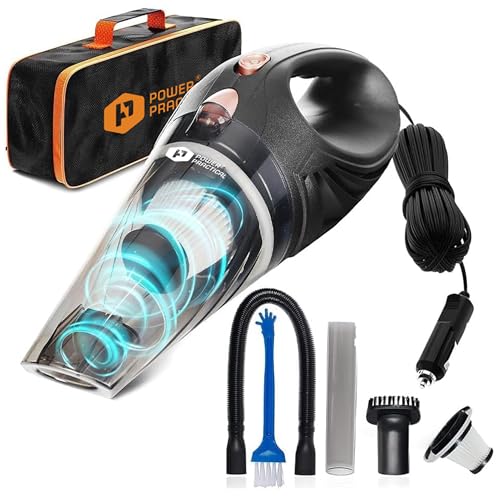
Plugs into the 12V outlet and reaches all the way back
ThisWorx Handheld Car Vacuum
This is a small 12V vacuum that runs off your car's accessory outlet, so it never runs out of battery mid-clean. The 16-foot cord reaches the third row and the trunk, and three nozzles get into seat seams, vents and cup holders.
$20.99fromAmazonThe cord is the whole point. Sixteen feet of it, plus the nozzle, gets you from the front 12V outlet to the third row without moving the car. Car and Driver's testers put roughly 16 feet of combined reach at the minimum for cleaning a full-size SUV that way. You never stop to recharge, and the power doesn't sag halfway through the footwells.
On paper the 106-watt motor is unremarkable, and plenty of cordless units advertise bigger numbers. But Popular Mechanics found that corded 12V vacuums sustained up to 40% more airflow at the nozzle than cordless rivals in the same price class after two straight minutes of use. That's the part you feel on floor mats and in seat tracks, where the grit actually lives.
It's smaller than you're picturing — roughly the size of a large travel mug, under two and a half pounds. That's the reason it works. It fits in the gap beside the seat rails and under the front seats, where a full-size handheld just wedges. Owners who stash it in a door pocket or a minivan's storage well tend to actually use it, which is most of the battle.
Plan on rinsing the filter, and rinsing it often. The washable filter is the difference between real suction and a vacuum that seems broken, and Wirecutter's long-term notes say foam-style filters in budget 12V vacuums want cleaning every two or three uses. A spare filter, a small brush and a carry bag come in the box, so the routine is easy enough to keep up with.
Flaws but not dealbreakers
Suction drops as the bin fills and the filter loads. Owner feedback describes the same arc over and over — strong for the first few passes, then noticeably weaker until you empty it and rinse the filter. If your idea of a car vacuum is one long unbroken session, this isn't it. It's a stop-and-shake-out tool.
The build is plainly inexpensive. Thin plastic, a loud whine, and a real minority of buyers get units that arrive weak or quit within a few months. And because it draws from the 12V outlet, it cleans your car and nothing else — no doorways, no dog beds, no garage floor.
Runner-up
Cordless, and the suction holds up as the cup fills
Shark UltraCyclone Pet Pro Plus Cordless Hand
A cordless handheld with two cyclone stages that keep airflow steady as the dust cup loads up. It's light enough for headliners and door tops, the XL cup means fewer trips to the trash, and the included tools pull pet hair off fabric seats.
$68.79fromAmazonCordless handhelds usually die a slow death mid-clean, and it's rarely the battery's fault. Debris packs against the filter and airflow collapses. Shark's two cyclonic streams are built to keep that from happening, and RTINGS measured this one losing under 8% of its suction with the dust cup 75% full — the steadiest result among the cordless car vacuums in its tier.
Pet hair is where it earns the name. The tools grab fur off fabric seats and floor mats instead of skating across them, and the XL cup swallows a shedding dog's worth before you have to stop. Emptying is a one-handed job over a trash can, which sounds trivial until you've tried it in a parking lot with a full bin and a windy day.
At under three pounds it's easy to hold overhead for headliners and door tops, and there's no cord to drag across your paint. It charges on a base at home, so it's ready when you want it. For a fast pass after a grocery run or a muddy soccer practice, you'll reach for this over anything that needs plugging in.
Flaws but not dealbreakers
Runtime is the ceiling here. Road & Track's testers found cordless car vacuums average about 18 minutes at full suction, while a thorough interior runs 25 to 35 minutes. A deep clean means working fast, dropping to lower power, or finishing another day.
It's loud, and it costs meaningfully more than the corded picks here. The filter is washable rather than replaceable, so you're on the hook for rinsing it and letting it dry completely before it goes back in. Skip that step and suction fades quickly.
Upgrade pick
Far more power and filtration, if you'll pay for it
Dyson V8 Car+Boat HH15 Handheld Vacuum
The most powerful vacuum in this guide by a wide margin, at 115 air watts in Max mode, with sealed filtration rated to 99.99% of particles down to 0.3 microns. It runs up to 50 minutes on low, enough to cover a full interior in one sitting.
$340fromAmazonNothing else here is close on raw power. Dyson rates the V8 at 115 air watts in Max mode. A typical budget 12V car vacuum measures somewhere around 25 to 30 air watts at the nozzle. That gap shows up in the stuff that ruins your afternoon: sand ground into carpet, dried road salt, mud in the driver's footwell, dog hair woven into a fabric bench seat.
Runtime is the other surprise. Dyson quotes up to 50 minutes on the low setting, more than the 25 to 35 minutes a full interior usually takes. Max mode drains far faster, so the sane approach is low power for broad passes and short bursts of Max for the spots that fight back. Charging takes about five hours, so plan ahead.
Filtration is sealed and rated to capture 99.99% of particles down to 0.3 microns, which matters if anyone who rides with you has allergies. Forbes Vetted's testers measured HEPA-filtered vacuums cutting airborne allergen levels inside vehicles by roughly 54% in one session, against 31% for foam-filtered models. You're also not spraying fine dust back across the dash as you work.
The last thing you're buying is versatility. This is a proper handheld, not a car-only gadget, so it handles couch cushions, stair treads and the workbench just as well. If you were going to buy a handheld for the house anyway, the math shifts — one good machine covering both jobs instead of two mediocre ones sitting in different closets.
Flaws but not dealbreakers
The bin holds 0.54 liters, which isn't much next to the motor in front of it. On a genuinely filthy car you'll empty it two or three times, and each stop costs you runtime you were counting on.
This listing is the international version, built for 100–240V operation. It'll run here with the right plug, but service and coverage on an imported unit can be a hassle, and some owners report battery trouble early on. That's a real risk on the most expensive vacuum in this guide.
Also great
A simple grab-and-go handheld for everyday crumbs
Black+Decker
A light cordless hand vac that lives on a wall charger and gets grabbed for two-minute jobs. The nose rotates for tight angles and the crevice tool pulls straight out of the body, so there's no bag of attachments to hunt through.
$59.99fromAmazonMost car messes aren't projects. They're a handful of crumbs on the passenger seat, or the sand that rode home in a beach bag. This is the vacuum for that. Pull it off the charger, spend two minutes, put it back. No cord to route through a window, no case to open, no decision about which nozzle to bring.
The tools are built into the vacuum, and that's the whole trick. The nose rotates to angle into tight spots, the crevice tool slides out of the body, and the brush flips up for vents and the dash. Nothing to lose in a glovebox. For the deepest seat seams you'll still want the longer flexible nozzle a corded unit gives you.
It's a known quantity. Black+Decker has built this shape of hand vac a long time, and owner feedback stretching back years describes the same experience: steady suction, easy emptying, a filter that survives plenty of rinsing. That kind of boring durability is genuinely uncommon at this end of the market.
Flaws but not dealbreakers
It's loud — a high whine that owners bring up constantly. Fine in a driveway. Less fine in an apartment garage late at night.
Battery life is short and the bin is small, so treat it as a spot cleaner rather than a detailing tool. It also won't touch a spilled drink. Keep it dry.
Who this is for
This guide is for anyone who cleans their own car — commuters who eat behind the wheel, parents dealing with crumbs and sand, pet owners fighting fur on the back bench, and weekend detailers chasing a clean seam. A survey by the American Cleaning Institute found that 61% of car owners vacuum their interior fewer than four times a year, which is well under what a household with kids or a dog needs. If that's you, the fix is usually a vacuum that's easy to reach for, not a more powerful one.
If your car is already spotless and you just want to touch up the mats, the gas-station vacuum is fine and you can skip this. And if what you really need is a shop vacuum for drywall dust or standing water in a basement, look at full-size wet/dry machines instead — we cover only vacuums small and reachable enough to work inside a car cabin. We also don't cover pressure washers, upholstery extractors or steam cleaners, all of which do a different job.
How we picked
We started from the buying criteria that actually change the experience in a driveway. Reach: cord and hose together should clear about 16 feet so you can do a third row from the front outlet. Sustained suction: we weighted published airflow comparisons and suction-loss measurements over advertised peak numbers, because a full bin is the normal state of a car vacuum. Filtration: HEPA-class sealing is worth paying for if allergies or pets are in the picture, and washable filters need to survive frequent rinsing. Tools: a long flexible crevice nozzle is non-negotiable for seat gaps, and tools that live on the vacuum get used. Weight and noise: under about three pounds for overhead work, and quiet enough that you're not annoying a whole parking garage.
Other car vacuum cleaners worth considering
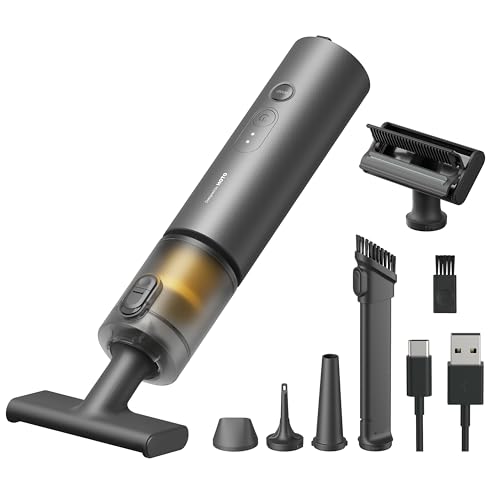
If you want something tiny enough to live in the glovebox: The HOTO Car Vacuum Portable Cordless ($79.99) — The HOTO weighs about twelve ounces and is roughly the size of a flashlight, with a 96,000 RPM brushless motor rated at 20,000 Pa in its top mode. It also blows, inflates and vacuum-seals, which makes it a decent thing to keep in a trunk kit. What you give up is endurance and capacity: Boost mode lasts about 10 minutes, the dust cup is small, and owners report suction dropping off once the filter picks up any dust. A few also mention bumping the power button by accident. It's a touch-up tool, not an interior clean.
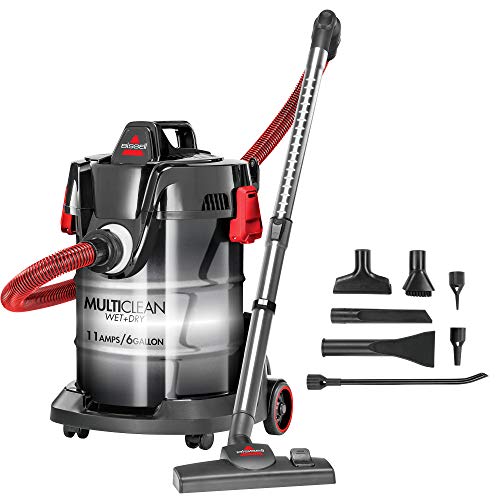
If you want one vacuum for the car, the garage and the occasional flood: The BISSELL MultiClean Wet/Dry Garage and Auto Vacuum ($174.99) — The Bissell MultiClean is a 6-gallon wet/dry vac with an 11-amp motor and a specialized auto tool kit — crevice tool, upholstery brush, precision wet and dry nozzles. It handles a spilled soda, a muddy floor mat and a driveway full of leaves, and it blows as well as sucks. Owners like the light metal body and the suction. But at about 16 pounds it doesn't ride in the car, it needs a wall outlet, and the hose is short enough that several owners wish it were longer. The carpet attachment is also the part people report breaking.
The competition
This is what our research surfaced in this category, not a survey of everything for sale. A model missing here usually just means we didn't find enough published measurement or consistent owner feedback to say anything useful about it.
The 0960-20 Compact Brushless Wet/Dry Vacuum for Milwaukee ($268.33) — The Milwaukee M12 FUEL compact wet/dry vacuum is a genuinely good tool for tradespeople: 1.6 gallons, 42 inches of water lift, wet and dry pickup, a wall mount, and a HEPA filter that Milwaukee rates at 99.97% of particles down to 0.3 microns. It's also sold here as a bare tool, so you need an M12 battery and charger already, and at 87 dB it's the loudest thing in this guide. If your van is a work vehicle and you're on M12 anyway, it makes sense. For a family car it's more machine, and more setup, than the job asks for.
Care and maintenance
Almost every dead car vacuum is really a clogged one. Empty the bin before it's full rather than after, and check the filter every few uses — Wirecutter's long-term notes put foam filters in budget 12V units at a rinse every two or three sessions, while HEPA cartridges in pricier models typically go 6 to 12 months before replacement. Wash filters in plain water, and let them dry all the way through before reinstalling; a damp filter kills suction and can grow a smell. Clear hair off the nozzle and out of the hose after pet cleanups. Don't leave a lithium-battery vacuum baking on a dashboard in summer, and coil a 12V cord loosely instead of yanking it from the plug.
Questions we get
Are cordless car vacuums as powerful as 12V corded ones?
Usually not, once you're a couple of minutes in. Popular Mechanics found corded 12V vacuums sustained up to 40% more airflow at the nozzle than cordless rivals in the same price class after two straight minutes. The exception is a high-end cordless like the Dyson V8, which is far stronger than any budget 12V unit — but only while the battery holds.
How long should a full car interior take?
Plan on 25 to 35 minutes for a thorough job, according to Road & Track's testers. That's a problem for cordless models, which averaged about 18 minutes at maximum suction in the same comparison. Either drop to a lower power setting for the broad passes, or keep a corded vacuum as your backup for deep cleans.
What actually works on ground-in pet hair?
A brush that agitates the fabric. Consumer Reports found motorized brush-roll attachments pulled up to 72% more embedded pet hair from upholstery in a single pass than suction-only nozzles. If your vacuum doesn't include a powered tool, expect several slow passes with a rubber or stiff-bristle attachment, working in one direction rather than back and forth.
Do I need a HEPA filter?
It matters if you have allergies or a shedding pet, and it's optional otherwise. Forbes Vetted's testers measured HEPA-filtered vacuums cutting airborne allergen levels inside vehicles by about 54% in a single session, against 31% for standard foam-filtered models. The other benefit is that a sealed filter isn't blowing fine dust back into the cabin while you work.
What's the difference between kPa and air watts?
kPa measures sealed suction pressure — how hard the vacuum pulls with the nozzle blocked. Air watts measure the combination of suction and airflow, which is closer to how a vacuum behaves on a real carpet. Air watts are the more useful number, but budget brands almost always publish kPa because the figure looks bigger. Don't compare the two directly.
Can a car vacuum handle a spilled drink?
Only if it's specifically rated wet/dry. Pulling liquid into a dry-only handheld will soak the filter and can wreck the motor. Among our recommendations, the Bissell MultiClean and the Milwaukee M12 are the ones built for it. For everything else, blot the spill dry first, let the fabric air out, and vacuum after.
Why you should trust us
For this guide:
- We read published lab and comparison testing from Popular Mechanics, Consumer Reports, RTINGS, Car and Driver, Good Housekeeping, Road & Track, Forbes Vetted and Wirecutter to understand how suction, reach and filtration hold up under load.
- We compared manufacturer spec sheets across every model here for suction ratings, filtration standards, bin capacity, runtime and cord length.
- We read through owner feedback looking for repeated themes rather than one-off complaints, particularly around filter clogging, battery decline, noise and build quality over time.
- We read owner reviews on every listing, weighted toward the critical ones, because that is where the recurring failures show up.
- We have a systematic way of automatically fetching the latest prices, so the numbers on this page stay current.
- This is a research-focused guide, so the team may not own every product listed — though we often do own the top winners, which gives us extra context for the recommendations.
- We don't accept free products, and the retailer commission never changes which product we recommend.
Sources
Best Car Vacuums 2026 — Wirecutter (NYT), Wirecutter
Best Car Vacuums Tested by Popular Mechanics, Popular Mechanics
Best Car Vacuums — Car and Driver, Car and Driver
Handheld and Car Vacuum Ratings — Consumer Reports, Consumer Reports
Best Car Vacuums for Pet Hair — Road & Track, Road & Track
Handheld Vacuum Cleaner Reviews & Rankings — RTINGS.com, RTINGS.com
Best Car Vacuums 2026 — Forbes Vetted, Forbes Vetted
Best Car Vacuums Tested — Good Housekeeping Institute, Good Housekeeping
Milwaukee M12 FUEL Compact Vacuum (0850-20) Official Specs, Milwaukee Tool
Dyson V8 Car+Boat Technical Specifications, Dyson
Amazon product listings and owner reviews for all 7 products
Manufacturer specification pages for each product
Some passages in this guide may be paraphrased with AI help. Prices are refreshed automatically.
More like this.
Continue exploring electronics reviews and recommendations.

The Best Portable Car Vacuums
Cleaning a car is mostly a reaching problem. The crumbs live in the seat track, the sand settles into the carpet pile, and the dog hair works its way into…

The Best Handheld Vacuums for Car and Pet Hair
Pet hair in a car doesn't behave like pet hair on a floor. It works down into the seams of a bench seat, wraps around the fibers of a rubber-backed mat,…

The Best Handheld Vacuums for Car and Pet Hair
Pet hair doesn't sit on car upholstery. It works its way into the weave, and a plain suction nozzle glides right over the top of it. That's the whole…

The Best Pool Cleaning Robots
A pool robot buys back your Saturday morning. Instead of dragging a pole around the deck and pushing dirt into corners, you drop a machine in the water,…

The Best Pressure Washer Surface Cleaners
A surface cleaner is the attachment that makes a pressure washer worth owning. Instead of one jet carving stripes into your driveway, two nozzles spin…

The Best Eco-Friendly Cleaning Products
Cleaning products are one of the few things you buy that you also breathe. You spray them on the counter where your kid eats breakfast, and you wipe them…