The Best Pool Cleaning Robots
A pool robot buys back your Saturday morning. Instead of dragging a pole around the deck and pushing dirt into corners, you drop a machine in the water, walk away, and come back to a clean floor. The good ones climb the walls and scrub the waterline ring too, which is the part manual vacuuming almost never handles well. They also run independently of your pump, so you're not backwashing the filter every time you clean. If you have leaves, pollen, or a dog that swims, the difference shows up within a week.
Here's the honest part: none of these machines are set-and-forget appliances. Every brand in this category, including the expensive ones, generates a steady stream of owner complaints about power supplies dying, tracks stretching, and units getting stuck on step ledges or beach entries. Filters need rinsing after most cycles, and corded models are heavy to lift out dripping wet. Cordless robots dodge the tangle problem but trade it for a battery clock. Plan on maintenance, and plan on eventually needing service.
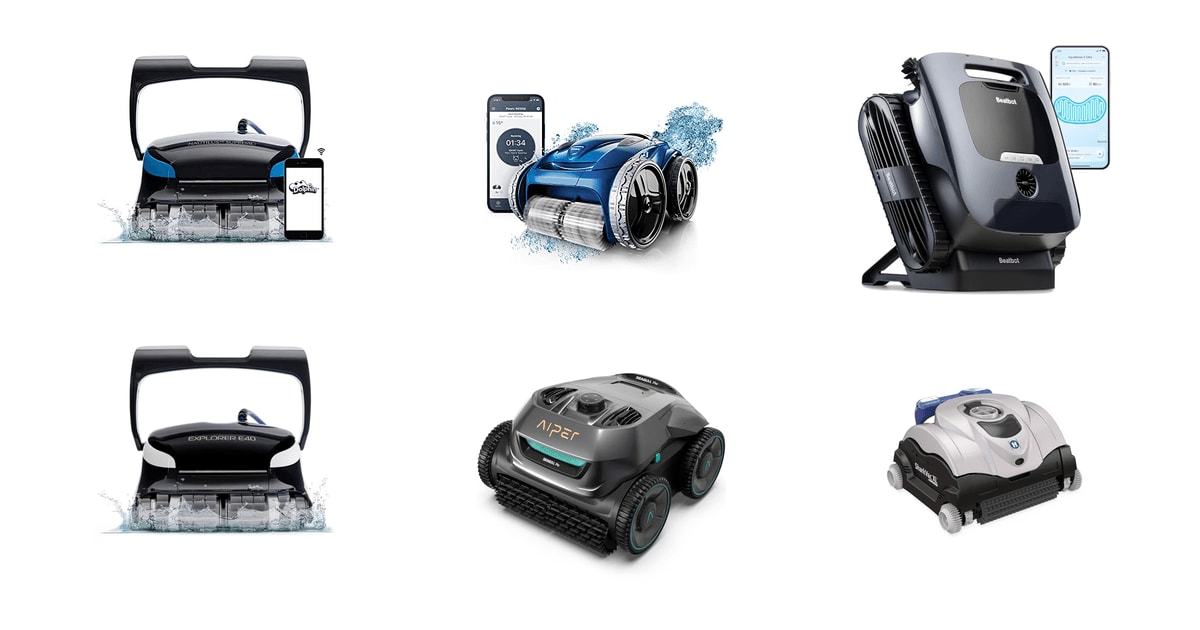
Most of what separates a good robot from a frustrating one is navigation, brush design, and how easy the filter is to empty. We think that the Dolphin Nautilus CC Supreme is the best pool cleaning robot for most people, and that the Polaris 9650iQ Sport is the one to buy if your pool runs longer than 50 feet or has walls the other machines can't hold onto.
Everything we recommend
Systematic scanning and real waterline scrubbing, for most pools

Four-wheel drive and 60-foot reach for big, awkward pools

Nearly the same clean, a step down in filter capacity

Real mapping and cordless freedom, for oddly shaped pools

Cordless waterline scrubbing at the low end of the range
At a glance
| Product | Power Source | Pool Coverage | Price | |
|---|---|---|---|---|
| Dolphin Nautilus CC Supreme Wi-Fi Automatic RoboticTop pick | — | Up to 50 ft | $1,449 |
| Polaris 9650iQ Sport Robotic CleanerUpgrade pick | Corded 70-ft | — | $999 |
| Beatbot AquaSense 2 Ultra Cordless Robotic PoolAlso great | Cordless | — | $2,499 |
| Dolphin Explorer E40 Automatic Robotic Pool VacuumRunner-up | — | Up to 50 ft | $1,449 |
 | Hayward W3RC9740WCCUB SharkVac XL Robotic Pool CleanerAlso in lineup | — | — | $1,599 |
| Budget pick | Cordless | Up to 1,220 sq ft | $334.97 |
How we picked
Navigation quality. We prioritized robots that scan systematically over ones that bounce around at random, based on Consumer Reports lab findings of 95% versus 68% coverage per two-hour cycle. Anything relying purely on random-path movement had to be exceptional elsewhere to stay in the running.
Walls and waterline. We only considered machines whose specifications include wall climbing and active waterline scrubbing, since This Old House research found that brushes spinning above 3,000 RPM strip far more algae than suction-only designs. Floor-only cleaners were cut.
Filtration. We compared cartridge and basket specs, favoring fine filtration rated to around 2 microns that captures pollen, fine sand, and algae spores. We also weighed how easily you can pull and rinse the filter, because a filter that's annoying to clean gets cleaned less.
Pool size fit. We matched each robot's rated pool length or square footage against real backyard pools from 30 to 60 feet, and treated cordless runtime as a hard ceiling rather than a soft one. A robot that quits at 40 feet can't serve a 55-foot pool.
Service and durability. We read owner feedback for repeated failure patterns — power supplies, tracks, stuck-on-ledge behavior — and weighed warranty length and the existence of a repair network. Bob Vila puts a quality robot's life at five to seven years with routine filter maintenance.
Top pick
Systematic scanning and real waterline scrubbing, for most pools
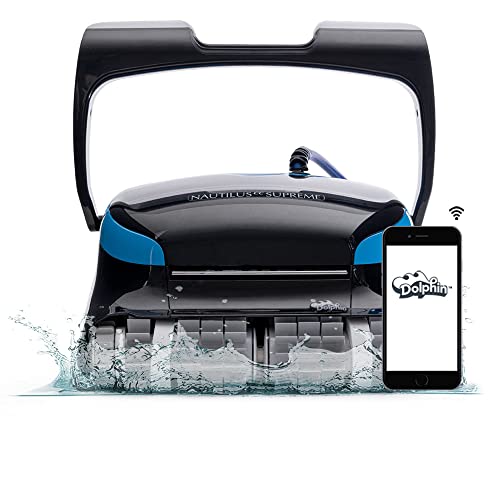
Dolphin Nautilus CC Supreme Wi-Fi Automatic Robotic
The Nautilus CC Supreme uses Maytronics' CleverClean scanning to work a pool in a pattern instead of bouncing around at random, and its active brush scrubs the waterline as it climbs. It's rated for in-ground pools up to 50 feet, which covers the large majority of backyard pools.
$1,449fromAmazonSystematic navigation is the single biggest upgrade you can buy here. Consumer Reports lab testing found that robots using systematic scanning covered about 95% of pool surface area in a two-hour cycle, while random-path models managed 68% under the same conditions. That gap is the difference between a clean pool and one with a dirty stripe along the deep end. Wirecutter also named this model its top overall pick, citing better coverage than similarly positioned random-path competitors.
The waterline is where a pool looks dirty even when the floor is spotless. That greasy gray ring is sunscreen, body oil, and pollen, and passive suction won't touch it. The CC Supreme climbs the wall, grips, and drags an active scrubbing brush across the tile line. This Old House research found that robots with brushes spinning at 3,000-plus RPM pulled up to 80% more algae off walls in one cycle than suction-only designs.
The filter loads from the top, which sounds trivial until you've done it fifty times. You lift the lid, pull the cartridge straight up, and hose it off — no flipping a soaked 25-pound machine upside down on your deck. The fine cartridge is rated to 2 microns, so it holds onto pollen, fine sand, and algae spores that a standard 50-micron mesh bag passes straight back into the water.
The app is genuinely useful, not decoration. You set a schedule and the robot runs three times a week without you thinking about it, which is the cadence that actually keeps water circulated. Pool & Spa News reports that running a robot on that schedule can cut annual chlorine and algaecide use by 15 to 25%. Wi-Fi also means you can start a cycle from the couch after a windy afternoon.
Flaws but not dealbreakers
Reliability is the real asterisk. Owner feedback on this model splits hard — plenty of people report years of trouble-free cleaning, but a meaningful share describe power supplies failing, units dying within weeks, or wheels jamming. The pattern in the complaints is usually the power supply rather than the robot itself. Maytronics support generally comes through on replacements, though owners describe the process as slow.
At about 25 pounds dry, it's heavier coming out of the water. If lifting an awkward, dripping object over a pool coping is hard for you, budget for a caddy or plan to have someone else pull it out.
It's corded. The swivel helps, but on a freeform pool with lots of direction changes, you'll still occasionally untwist the cable.
Maytronics backs Dolphin models with a two-year warranty, the longest standard coverage in this category.
Upgrade pick
Four-wheel drive and 60-foot reach for big, awkward pools
Polaris 9650iQ Sport Robotic Cleaner
The Polaris 9650iQ Sport is rated for pools up to 60 feet — the longest coverage in the consumer robot segment — and its 4WD system is specified to climb walls at up to 90 degrees. A 5-liter canister and a 70-foot swivel cord round it out.
$999fromAmazonIf your pool is genuinely large, this is the one that reaches the far end. Polaris rates the 9650iQ Sport for pools up to 60 feet, and the 70-foot swivel cord is what makes that possible. Most robots here top out around 50. If you have a long lap pool or a sprawling freeform shape, a machine that runs out of cord halfway isn't a bargain at any price.
The 4WD drive system is the other reason to pick it. Polaris rates it to climb walls up to 90 degrees, which matters on gunite pools with steep, near-vertical sides where two-wheel robots slip back down. Owners with beach entries report that it climbs the shallow ramp, senses the edge, and backs itself out instead of beaching. That's a specific failure mode plenty of other robots handle badly.
The 5-liter canister is oversized for this category, and it empties without you touching the debris — you shake it out and spray it down. If you're cleaning up after a storm or a heavy fall of leaves, a bigger bin means fewer mid-cycle interruptions. The Easy Lift button also surfaces the robot at the spot you choose so you're not fishing for it with a pole.
iAquaLink Wi-Fi handles scheduling and status, and the motion-sensing remote lets you steer the robot to a specific spot. Owners who want to hit one dirty corner after a pool party consistently call out that manual control as the feature they use most.
Flaws but not dealbreakers
Multiple owners describe the navigation as feeling more random than programmed, and corners are a recurring complaint — dirt gets left in the tight angles where floor meets wall. Most say the overall clean is still good, but don't expect corner-perfect results.
Reliability and service are the bigger concern. Owners report parts failures after several months and slow replacement-part fulfillment. Separately, buyers have flagged that Polaris parent company Fluidra does not treat some Amazon third-party sellers as authorized, which can complicate a warranty claim. Confirm the seller before you buy.
It's the most expensive machine in this guide, and the extra capability only pays off if your pool is large or steep-walled. On a standard 30-foot rectangle, you're paying for reach you'll never use.
Runner-up
Nearly the same clean, a step down in filter capacity
Dolphin Explorer E40 Automatic Robotic Pool Vacuum
The Dolphin Explorer E40 brings the same Wi-Fi scheduling, wall climbing, and waterline scrubbing as our top pick to a lower-priced package, and it's also rated for in-ground pools up to 50 feet. The main compromise is a smaller filter that you'll empty more often.
$1,449fromAmazonThis is the Nautilus CC Supreme's core recipe with the edges sanded off. You get dual-drive steering, an active scrubbing brush, wall climbing, waterline scrubbing, and always-connected Wi-Fi scheduling — the four things that actually determine whether a robot keeps your pool clean. If your budget stops short of the CC Supreme, you're not giving up the navigation or the brushing, which are the parts that matter most.
The filter is where the savings come from, and you'll notice it. Owners describe the included cartridges as moderate in size and report seeing fine sediment blow back out the top vent once they load up. On a pool with fine sand or heavy pollen, that means emptying more often, or buying the finer cartridges separately. On a clean suburban pool with mostly leaves, it's a non-issue.
The Wi-Fi has been a bright spot in owner feedback. People who bought it reluctantly, expecting app hassle, report that the connection just works and scheduling stays set. That's not a given in this category — plenty of pool robots have apps that drop the unit constantly.
One useful note from owners: it doesn't vacuum in water shallower than about 30 inches. If you have a big shallow tanning ledge or a wading section, you'll still be doing that part by hand.
Flaws but not dealbreakers
It gets stuck on ledges. Several owners with step or bench ledges report the E40 hanging up there repeatedly, to the point where they gave up on unattended cycles. If your pool has a prominent tanning shelf, this is a real risk.
It's the heaviest Dolphin here at roughly 40 pounds shipping weight, and the corded power supply adds to the hassle of setup and teardown.
Maytronics classifies tracks, brushes, and similar parts as wearable and excludes them from warranty coverage. Owners who've had plastic components shed after a season describe that exclusion as an unpleasant surprise.
Maytronics backs Dolphin models with a two-year warranty, though wearable parts like tracks and brushes are excluded.
Also great
Real mapping and cordless freedom, for oddly shaped pools
Beatbot AquaSense 2 Ultra Cordless Robotic Pool
The Beatbot AquaSense 2 Ultra uses an AI camera, 27 sensors, and a four-core processor to map a pool and plan a route, then cleans the floor, walls, waterline, and surface without a cord. It also surfaces itself and parks when the cycle ends.
$2,499fromAmazonMapping is the reason to consider this over a Dolphin. TechRadar identifies the AquaSense 2 platform as the first consumer-tier pool robot using ultrasonic sensor arrays and onboard AI path planning to build a real-time, persistent pool map, which is what enables zone-targeted repeat passes. In practice, you can see the route the robot took in the app and send it back to a specific area.
If your pool is a strange shape, this is where it earns its keep. Owners with lazy-river layouts, non-90-degree walls, and mixed surface textures — the pools that defeat pattern-based robots — consistently report full coverage. A rectangular vinyl pool doesn't need this much computer. A freeform gunite pool with three depth changes might.
The cordless design solves a problem that gets worse the weirder your pool is. No cable means no tangles around ladders, no untwisting, and no 70-foot cord to coil onto a caddy. When the battery drops below 12% or the cycle ends, the robot floats itself to the surface, and one tap in the app brings it to the edge. SmartDrain dumps nearly five pounds of water before you lift it.
It also skims the surface and runs a clarifier system that binds fine particles. That's genuinely five jobs in one machine. Whether you need all five depends on whether you already own a skimmer setup that works.
Flaws but not dealbreakers
Not everyone finds the cleaning as impressive as the technology. At least one detailed owner account describes floor cleaning as mediocre despite the long battery life and the elaborate feature set. The consensus leans positive, but this isn't a machine that satisfies everyone who pays for it.
The app allows one primary account, and additional household members have to be invited in. Minor, but it surprises people.
It's expensive — the priciest robot here alongside the Polaris — and it's a newer product with a shorter track record than the Dolphin and Hayward machines. If you want a long service history and a dense repair network behind your purchase, that argues for Maytronics.
Budget pick
Cordless waterline scrubbing at the low end of the range
The Wybot B1 is a cordless robot with a six-roller brush setup, floor, wall, waterline, and combo modes, and app scheduling with over-the-air updates. It's rated for up to 125 minutes of runtime on pools up to 1,220 square feet.
$334.97fromAmazonFor anyone still vacuuming by hand, this is a big jump for the least money in this guide. You get wall climbing, waterline scrubbing, app scheduling, and no cord — the combination that used to require a much more expensive machine. Above-ground pool owners in particular report it handling a 24-foot round pool cleanly on one charge.
The six-roller design is the interesting part. Dual main rollers plus side and bottom brushes give it more contact with the surface than a typical two-brush layout, and the extra rollers improve traction over drains and seams. Edge-to-edge coverage is the point — the corners and wall-floor joints are where cheap robots leave a visible line of grit.
The mesh filter is easy to pull and rinse, and owners describe it catching nearly everything in a normal pool. On a pool with fine sand, a mesh basket won't match a 2-micron cartridge, but for leaves, pine needles, and general dirt it's fine.
Runtime is the honest constraint. CNET's lab work on cordless robots generally puts a 90-minute battery at roughly 40 feet of pool, and this one's 125-minute rating tracks with its 1,220-square-foot spec. On a larger pool you'll be running two cycles with a charge in between.
Flaws but not dealbreakers
It's new, and the feedback reflects that. Most owners are happy, but a visible minority report the battery only managing a couple of short cycles and the pool ending up dirtier than when they started. Whether that's a bad unit or a bad match for a debris-heavy pool isn't clear from the pattern.
One experienced owner who has run nine different robots names Wybot units as the worst of the group. That's a single voice against many positive ones, but it's worth weighing against Maytronics' four-decade track record if long-term durability is your priority.
There's no repair network to speak of. When a Dolphin power supply fails, there's a service path. With a newer cordless brand, a dead battery usually means a dead robot.
Who this is for
This guide is for anyone who owns a pool and is tired of the pole. If you have an in-ground pool between roughly 30 and 60 feet, a corded robot with systematic navigation will save you the most time per dollar. If your pool is above-ground, oddly shaped, or full of ladders and obstacles that snag a cable, look at the cordless options instead. And if you're currently running a booster-pump pressure-side cleaner, the energy math alone is worth a look: robots run on self-contained 100 to 180 W motors, while a booster pump adds 600 to 900 W of load every session.
It's not for everyone. If your pool stays clean with a weekly skim and you don't mind ten minutes with a brush, a machine that costs as much as a good appliance and needs its own maintenance may not be a trade you want. Owners of pools with big tanning ledges or beach entries should read the flaws sections carefully — several of these robots get stuck there. We've limited this guide to robotic cleaners that run independently of your pump; suction-side and pressure-side cleaners are a different category with different tradeoffs, and we don't cover them here.
How we picked
We built this guide around five things. Navigation: systematic scanning beats random-path movement by a wide margin in published lab testing, so pattern-based robots got priority. Walls and waterline: we required specs for wall climbing and active scrubbing, because passive suction leaves the tile ring behind. Filtration: fine cartridges rated near 2 microns catch pollen and algae spores that mesh bags pass through, and top-loading filters get rinsed more often than ones that make you flip the machine. Pool fit: we matched rated length and square footage to real pools from 30 to 60 feet and treated cordless runtime as a hard limit. Service: we looked for repeated failure patterns in owner feedback, warranty length, and whether a repair path exists when something breaks.
The competition
These are the other machines our research surfaced, not a survey of everything sold. Pool robots turn over quickly and plenty of capable models exist outside this set. What follows is why each of these lost to a pick, and who might still reasonably choose one.
The Hayward W3RC9740WCCUB SharkVac XL Robotic Pool Cleaner ($1,599) — The Hayward SharkVac XL is the plug-and-play option: no app, no pairing, no account. You plug it in and it runs a three-hour smart-steering cycle across the floor, coves, walls, and waterline, with two fine-porosity filter elements that lift out from the top. Out-of-water and beach-entry sensors keep it from cooking its motor or crawling onto your deck. It lost to the Dolphins on two counts. At 48 pounds it's the heaviest machine here by a wide margin, and multiple owners — including one who described being unable to lift it at all — end up buying a caddy. Owner feedback also flags drive-track belts breaking early and filter doors jamming. Still, if you want a machine with zero software involved and you have a strong back or a cart, it's a legitimate choice from a brand your pool store already stocks.
Care and maintenance
Rinse the filter after every cycle, not every third one. A loaded cartridge chokes suction, and on several of these machines it also starts blowing fine sediment back out the top vent — you'll watch your robot redistribute the dirt it just collected. Hose the cartridge from the outside in, and soak it in a filter cleaner a couple of times a season to clear the oils that a hose won't touch. Check the tracks and brushes for stretching or cracking; on most brands these count as wearable parts and aren't covered by warranty, so catching wear early is cheaper. Don't store the robot in the pool between runs, and keep the power supply out of direct sun and off the ground. Bob Vila puts a well-maintained robot's life at five to seven years, and filter discipline is most of what gets you there.
Questions we get
Are robotic pool cleaners worth it compared to vacuuming by hand?
For most pool owners, yes — but the savings are as much in chemicals and energy as in time. Pool & Spa News reports that running a robot three times a week can cut annual chlorine and algaecide use by 15 to 25% because the water stays circulated. Robots also run on their own 100 to 180 W motors instead of loading your pump with an extra 600 to 900 W like a pressure-side cleaner does. Owners still describe spending some time on manual touch-ups, so think of it as most of the job, not all of it.
Can a pool robot really clean the walls and waterline, or just the floor?
The better ones handle all three, but only if they have active brushes rather than passive suction. Every pick in this guide is specified for wall climbing and waterline scrubbing. This Old House research found that robots with brushes spinning above 3,000 RPM removed up to 80% more wall algae in one cycle than suction-only models. Cheaper floor-only robots exist, and they'll leave the tile ring for you.
Which is better for me, corded or cordless?
It depends on your pool's shape and length. Cordless robots eliminate cable tangles entirely, which is a real win on freeform pools with ladders and obstacles, but batteries generally cap out around 90 to 150 minutes — enough for pools to roughly 40 feet on one charge. Corded models have no runtime limit and usually push more water, but you'll deal with the cable and a power supply on the deck. If your pool is over 45 feet, go corded.
How long does a robotic pool cleaner last?
Bob Vila puts the average life of a quality robot at five to seven years with routine filter maintenance. Owner feedback across brands suggests the first thing to fail is usually the power supply on corded units, and tracks and brushes on all of them. Maytronics offers a two-year warranty on Dolphin models, the longest standard coverage in this category, though wearable parts are excluded. Buy from an authorized seller, because warranty claims on third-party listings get complicated.
How often should I run it?
Three times a week is the sweet spot for most pools. That's frequent enough to keep debris from settling and to help circulate the water, which is where the chemical savings come from. If you have heavy leaf fall or a lot of swimmers, run it more; a lightly used pool under no trees can get by with less. This is exactly what app scheduling is for — set it once and stop thinking about it.
Do these work in saltwater pools?
Yes. Robotic cleaners run independently of your pool's sanitation system, and the models here are built for use in chlorinated and saltwater pools alike. The Aiper Seagull Pro's specifications call it suitable for all pool types. Rinse the robot with fresh water occasionally to keep salt from crusting on the tracks and seals.
Why you should trust us
For this guide:
- We read manufacturer specifications for every robot here, including rated pool length, motor wattage, filtration ratings, and battery runtime.
- We reviewed published findings from Consumer Reports, This Old House, CNET, TechRadar, Wirecutter, and Bob Vila on navigation coverage, brush effectiveness, cordless runtime, and expected service life.
- We read through owner feedback for each listing and looked for repeated failure patterns — power supply failures, stretched tracks, and getting stuck on ledges — rather than isolated complaints.
- We read owner reviews on every listing, weighted toward the critical ones, because that is where the recurring failures show up.
- We have a systematic way of automatically fetching the latest prices, so the numbers on this page stay current.
- This is a research-focused guide, so the team may not own every product listed — though we often do own the top winners, which gives us extra context for the recommendations.
- We don't accept free products, and the retailer commission never changes which product we recommend.
Sources
Best Robotic Pool Cleaners of 2026 — Wirecutter (NYT), Wirecutter
Best Robot Pool Cleaners — Consumer Reports, Consumer Reports
Best Robot Pool Cleaner 2026 — CNET, CNET
Best Robotic Pool Cleaners — Popular Mechanics, Popular Mechanics
Best Robotic Pool Cleaners — This Old House, This Old House
Best Robotic Pool Cleaners — Good Housekeeping, Good Housekeeping
Best Robot Pool Cleaners 2026 — Bob Vila, Bob Vila
Best Robotic Pool Cleaners — Forbes Home, Forbes Home
Dolphin Nautilus CC Supreme Specifications — Maytronics, Maytronics (Dolphin Official)
Polaris 9650iQ Sport Product Specifications, Polaris (Official)
Best Robotic Pool Cleaners — TechRadar, TechRadar
Pool Maintenance Cost Savings — Pool & Spa News, Pool & Spa News (Trade Publication)
Amazon product listings and owner reviews for all 6 products
Manufacturer specification pages for each product
Some passages in this guide may be paraphrased with AI help. Prices are refreshed automatically.
More like this.
Continue exploring lifestyle reviews and recommendations.

The Best Robot Window Cleaners
We evaluated ten suction-mounted window robots on grip, finish and reach, for anyone tired of ladders and…

The Best Pool Floats and Accessories
A pool float has one job: keep you comfortable long enough that you stop checking your phone. The ones that do it well are boring in the right ways. They…

The Best Swimming Gear and Pool Accessories
Most swim gear does exactly one job. Goggles keep water out of your eyes and let you find the wall. A kickboard floats. Fins make your legs work harder…

The Best Robot Lawn Mowers
A robot mower changes the chore, not just the tool. Instead of one sweaty hour every Saturday, a small machine shaves a couple of millimeters off your…

The Best Robot Litter Boxes
Scooping is the chore nobody in the house volunteers for. A robot litter box takes it off your plate: it senses when your cat steps out, waits a few…

The Best Robot Vacuums for Pet Hair
If you live with a shedding dog or a long-haired cat, you already know the problem isn't dirt. It's hair. It drifts into corners, mats into the edge of…