The Best Robot Window Cleaners
We evaluated nine suction-mounted window robots on grip, finish and reach, for anyone tired of ladders and squeegees.
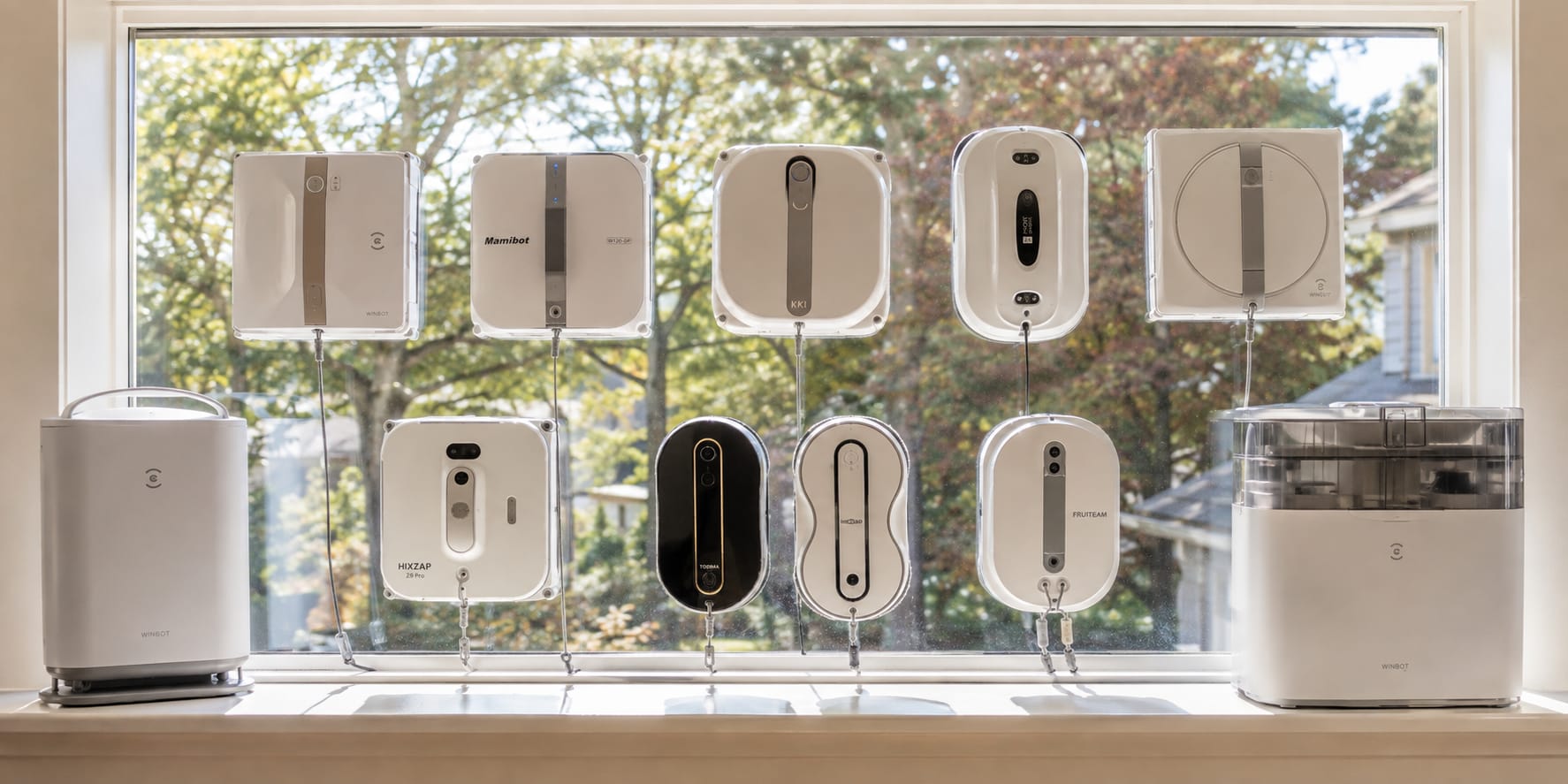
Our own shot. Credit: The Consumer's Guide
What separates a good robot window cleaner from a bad one is not raw suction but whether the machine stays predictable on your particular glass. The good ones hold through a corner turn, keep the pad evenly damp from the first pass to the last, and read an edge fast enough to stop before the frame. The bad ones lose their footing on tapered or lipped frames, dry out halfway across a big pane, and leave the swirl marks that send you up the ladder anyway.
No robot here finishes a window. All of them leave the corners and the outermost edge band for a human hand, and none lifts baked-on sap, sea salt or bug residue in a single pass — that work still starts with a manual scrub. Nozzles clog, cloths load with grit faster than owners expect, and tilted or skylight glass defeats most of the lineup. We weighted grip and safety above everything, then finish, because a robot that drops is worse than no robot at all.
Our protocol runs each robot over the same set of panes — a clean interior slider, a grimy exterior picture window, a divided casement — and scores what a buyer actually feels: whether it holds, how it finishes, how much of the pane it reaches, how fiddly it is to run, and how often it demands fresh cloths and refills. We think that the ECOVACS Winbot W2 Pro Omni is the best robot window cleaner for most people, and that the ECOVACS Winbot W3 Omni is the one to buy if you have a whole house of glass and never want to touch a dirty pad.
Everything we recommend

A portable station, charge-while-cleaning power, and the most complete safety net in the lineup

The station washes its own pads, so back-to-back sessions never stop for a cloth change
Compact enough for casement and divided glass, with grip that ramps up as the dirt gets worse
Flagship-level holding force and a large visible tank, run from a simple remote

Arrives with a year of cloths, a tether and an adapter, and starts with one button
Prices as of Oct 22, 7:36 AM PT · Details
The Best Robot Window Cleaners
Best overall
ECOVACS WINBOT W2 PRO Omni Portable Window
score
PROS
- Portable station works as carrier, charger, control panel and stand
- Battery mode reaches balconies and bathrooms with no outlet nearby
- Wide-angle nozzle array wets glass evenly ahead of the pad
- Path planning lays down consistent overlap instead of random passes
- Layered hardware and software failsafes on framed and frameless glass
CONS
- Spray nozzles clog over months of hard-water use
- Station kit takes real shelf space between sessions
- Tilted and skylight glass remains outside its comfort zone
- Pads still need hand washing and eventual replacement
Prices as of Oct 22, 7:36 AM PT · Details
The Ecovacs Winbot W2 Pro Omni solves the two problems that stop most window cleaners from finishing a house. The first is power: battery mode lets it work a balcony or a bathroom pane with no outlet in reach, and it can take a charge while it cleans. The second is handling — the station carries it to the window, holds it steady while you seat it, and doubles as the control panel, so you are never balancing a wet machine one-handed.
The finish is the best in the lineup without being flawless. The wide-angle spray on the Ecovacs Winbot W2 Pro keeps the cloth damp across the full width of a large pane, which is what actually prevents streaking, and its path planning covers the glass with real overlap rather than a hopeful zigzag. Owners still see faint streaking in raking sunlight and still wipe the corners by hand, so treat this as a machine that takes the chore down to a touch-up, not to zero.
Its real limits are chemical and geometric, not mechanical. The nozzles gum up over a long ownership period unless you flush them, and pads clog quickly on exterior glass that has not been rinsed first. Tilted panes and anything approaching horizontal fall outside what it handles confidently. On vertical glass, framed or frameless, the Ecovacs Winbot W2 Pro Omni is the most trustworthy machine here — and the safety layering is why we would put it on an upper-floor exterior.
Best for a whole house of glass
ECOVACS WINBOT W3 Omni Robot Window Cleaner
score
PROS
- Station washes the wiping pads itself with a bank of pressure jets
- Edge scrubber drops along borders and works into corners
- Newest navigation adds dynamic obstacle avoidance
- Higher-pressure spray loosens grime the lesser models smear
- Anti-fall system and tether rated for exterior high-rise glass
CONS
- Depends on the maker's own cleaning solution, which can be hard to source
- Large station is the bulkiest storage burden here
- Overkill for a single-story home with ordinary framed windows
- Heavy soiling still needs two passes
Prices as of Oct 22, 7:36 AM PT · Details
The self-washing station on the Ecovacs Winbot W3 Omni is the only feature in this category that genuinely removes a chore rather than automating one. On a house with a dozen panes, the pad is the bottleneck: it loads with grit, starts pushing dirt instead of lifting it, and you stop to rinse it. This station scrubs the pad between rooms, so a long session keeps the same finish on the last window as the first. Nothing else here comes close.
The edge scrubber is the second reason to step up. It lowers along the border and works the corner instead of skimming past it, which narrows the band of glass you still have to reach yourself. Combined with the sharper obstacle avoidance, the Ecovacs Winbot W3 wanders less on odd window layouts — sunrooms, mullioned walls, glass doors set into frames — where earlier generations hunted and re-covered the same strip.
Buy the Ecovacs Winbot W3 Omni for volume, not for difficulty. Owners on the coast find sea salt beyond it, and anyone expecting one pass on a season's worth of grime will be disappointed; this is still a damp cloth on a smart chassis. It also ties you to a proprietary cleaning solution, which has been intermittently unavailable. If your glass is ordinary and your house is small, the Ecovacs Winbot W2 Pro Omni does nearly as well with far less to store.
Best for small and divided panes
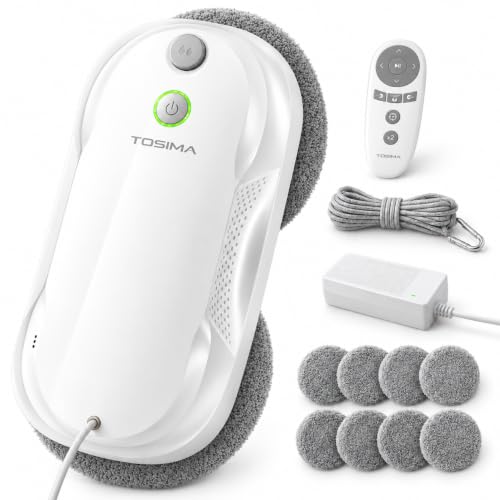
Tosima W5 Window Cleaning Robot
score
PROS
- Small footprint fits divided, casement and smaller panes that defeat big robots
- Variable-frequency suction climbs as the surface demands it
- Externally visible tank shows the water level at a glance
- Air-pressure sensor backs up the edge detection against drops
- Bidirectional spray keeps the cloth wet on both travel directions
CONS
- Remote only, with no app or scheduling
- Tank size forces refills across big picture windows
- Loses grip on tapered window edges
- Round pads leave square corners untouched
Prices as of Oct 22, 7:36 AM PT · Details
Most window robots are sized for picture windows, and the Tosima W5 is not, which is exactly the point. On a divided casement or a run of smaller panes, the large flagships have nowhere to turn and spend their time re-covering the same strip. This body fits, maps the pane quickly and gets on with it. Owners with tall contemporary glass like it too, but its real advantage shows up where the panes are chopped into sections.
Grip is the strongest thing about the Tosima W5 after size. Suction rises with the demands of the surface rather than sitting at one setting, and an air-pressure sensor watches for the loss of seal that precedes a fall. That combination is why we trust it above eye level. The exception is tapered or beveled window edges, where owners report it walking off the glass — check your frame profile before committing to an upper floor.
The finish is good, not great, and the controls are basic. With plain water the Tosima lifts everyday film cleanly; on heavily soiled exterior glass it needs a manual pre-wipe or it just spreads the dirt. There is no app, so scheduling and progress tracking are out, and the round pad leaves the square corners for you. For the money it asks, those are fair trades.
Best grip for the money
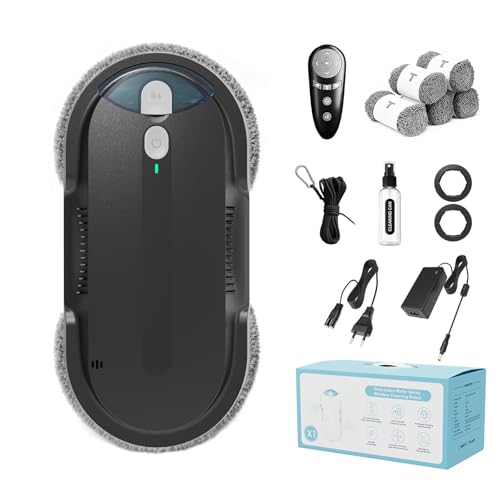
HIXZAP X1 Window Cleaning Robot - Double
score
PROS
- Variable double-helix suction reaches into flagship territory
- Largest external tank among the budget machines here
- Air-pressure anti-drop sensor plus edge detection
- Light body is easy to lift and seat overhead
- Sprays automatically on each movement cycle
CONS
- Remote only, with no app or scheduling
- Navigation is simpler than the flagships on irregular panes
- Corners and the outer edge band still need hand work
- Newer brand with a short reliability record
Prices as of Oct 22, 7:36 AM PT · Details
If your first question is whether it will stay on the glass, the Hixzap is the budget answer. Its suction range tops out level with machines that cost far more, and it climbs when the surface calls for it rather than running flat. Paired with an air-pressure sensor and edge detection, it inspires more confidence above head height than anything else at its tier — and confidence is most of what a budget buyer is actually shopping for.
The large visible tank is the Hixzap's underrated feature. It sprays on each movement cycle and you can see the level without stopping the machine, which matters on a run of big panes where the other budget robots run dry mid-pass and start dragging a half-damp cloth. That single design choice is why its finish holds up better than its price tier suggests.
What you give up with the Hixzap is intelligence and track record. There is no app, no scheduling and no clever mapping; it runs a straightforward pattern and re-covers ground on irregular windows. The brand is young, so long-term reliability is unproven. Choose it over the KKI if grip matters more to you than what comes in the box.
Best kit for first-time buyers
KKI Window Cleaning Robot
score
PROS
- Ships with spare cloths, safety rope and adapter — nothing else to buy
- One-touch start is genuinely usable one-handed
- Dual-direction atomized spray wets on both travel passes
- Variable suction adjusts itself as an anti-drop measure
- Works on tile, mirrors and marble as well as glass
CONS
- Corded only, so exterior use depends on outlet reach
- No app control or scheduling
- Nozzles clog and support is hard to reach when they do
- Round pad can leave swirl marks if the cloth is not changed often
Prices as of Oct 22, 7:36 AM PT · Details
Everything you need to run the KKI for a year is in the box, which is not true of anything else here. The other budget robots arrive with a pair of cloths and a hint that you should order more; this one comes with a stack of spares, the safety tether and the adapter, packed in a case. For a first robot — or a gift to a parent — that removes the two friction points that usually kill the habit.
One-touch operation is the other reason we picked the KKI. It finds its position, scans the frame and goes, with no app to pair and no mode to choose. Owners who cannot manage a ladder anymore, or who only have one free hand, get real use out of that simplicity. The atomized spray wets in both travel directions, so the cloth stays damp across the pass rather than only on the way out.
The KKI's ceiling is low and its failure mode is predictable. Suction is mid-pack, so we would not put it on a high exterior pane without the tether firmly anchored, and the cord ties you to outlet range. The nozzle is the part that fails, usually to mineral deposits, and getting warranty help has frustrated owners. Change the cloth often and the swirl marks people complain about mostly disappear.
Product comparison table
Displaying 1 – 9 (scroll right to see all products)
| #1ECOVACS WINBOT W2 PRO Omni Portable Window | #2ECOVACS WINBOT W3 Omni Robot Window Cleaner | #3Tosima W5 Window Cleaning Robot | #4HIXZAP X1 Window Cleaning Robot - Double | #5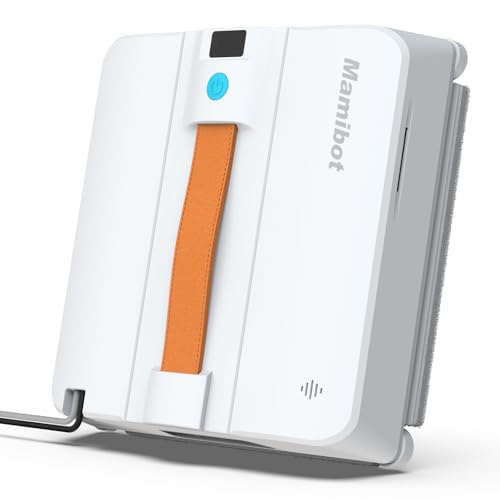 Mamibot W120-DP Window Cleaning Robot Mamibot W120-DP Window Cleaning Robot | #6KKI Window Cleaning Robot | #7 HOBOT-2S Window Cleaning Automatic Robot with Ultrasonic HOBOT-2S Window Cleaning Automatic Robot with Ultrasonic | #8 FRUITEAM Automatic Window Cleaner Robot with Dual FRUITEAM Automatic Window Cleaner Robot with Dual | #9 ECOVACS Winbot W1 Pro Window Cleaning Robot ECOVACS Winbot W1 Pro Window Cleaning Robot | |
|---|---|---|---|---|---|---|---|---|---|
| Awards | Editors' Choice · Best overall | Top Pick · Best for a whole house of glass | Top Pick · Best for small and divided panes | Best Buy · Best grip for the money | Best Buy · Best kit for first-time buyers | ||||
| Price | — | $699.99 | $179.99 | $169.99 | $174.99 | $151.99 | $299 | $94.99 $99.99 −5% | $223.93 |
| Overall Score | 89 | 88 | 78 | 77 | 76 | 75 | 73 | 69 | 64 |
| Bottom Line | A portable station, charge-while-cleaning power, and the most complete safety net in the lineup | The station washes its own pads, so back-to-back sessions never stop for a cloth change | Compact enough for casement and divided glass, with grip that ramps up as the dirt gets worse | Flagship-level holding force and a large visible tank, run from a simple remote | This is the hardest-gripping machine in the lineup and the obvious candidate for exterior high-rise work, with a slim body that r… | Arrives with a year of cloths, a tether and an adapter, and starts with one button | The ultrasonic mist system produces the finest, most even wetting of anything here, and on large picture windows that translates… | This is the rare budget robot with both a remote and a full app, plus a power-loss grip reserve and a quiet brushless motor, and… | The cordless design still solves a real problem — exterior glass with no outlet in reach — and the dual cross spray finishes bett… |
| Pros |
|
|
|
|
|
|
|
|
|
| Cons |
|
|
|
|
|
|
|
|
|
| Ease of use (15%) | 9.0 | 7.8 | 8.0 | 7.6 | 7.8 | 8.8 | 7.8 | 8.2 | 6.0 |
| Grip & safety (30%) | 9.2 | 9.0 | 8.3 | 8.6 | 8.8 | 7.2 | 7.0 | 6.6 | 6.5 |
| Streak-free finish (25%) | 8.8 | 8.8 | 8.0 | 7.4 | 7.0 | 7.2 | 8.2 | 7.2 | 7.4 |
| Upkeep & consumables (10%) | 7.5 | 9.5 | 7.0 | 7.8 | 7.4 | 9.0 | 6.8 | 6.6 | 5.5 |
| Coverage & navigation (20%) | 9.0 | 9.0 | 7.0 | 6.6 | 6.6 | 6.4 | 6.5 | 6.0 | 5.8 |
| Key facts | Battery run: up to 110 min · Spray: 3-nozzle wide-angle · Navigation: WIN-SLAM 4.0 · Station: 6-in-1 portable · Protection: 12-stage | Station: 16 jets, 1-min pad wash · Edge: TruEdge scrubber, 200 RPM · Navigation: WIN-SLAM 5.0, 1 mm · Spray: 3-nozzle wide-angle | Suction: up to 6,400 Pa variable · Spray: bidirectional ultrasonic, 2 per cycle · Tank: 65 ml external · Control: remote | Suction: 4,800–6,400 Pa double helix · Spray: bidirectional ultrasonic, 2 per cycle · Tank: 85 ml external · Control: remote | Suction: 7,000 Pa variable · Spray: 4 nozzles, bidirectional · Modes: 10 · Body: 2.7 in thick · Weight: 3.2 lb · Min glass: 3 mm | Suction: 2,200–3,200 Pa variable · Spray: dual-direction, 0.05 ml per spray · Modes: 3 · Surfaces: 35–145° · In box: 10 cloths, rope, adapter | Hold: 7 kg ascending power · Spray: ultrasonic mist · Pad: 9.5 × 9.5 in · Programs: 3 · Control: app or remote · Tanks: dual replaceable | Suction: 3,000 Pa · Noise: 58–65 dB · Tank: 50 ml · Coverage: 323 sq ft per cycle · Power-loss grip: 20 min · Control: app and remote | Suction: 2,800 Pa · Spray: dual cross · Navigation: WIN-SLAM 3.0 · Modes: 3 · Tank: 60 ml · Weight: 3.3 lb · Control: app |
Prices as of Oct 22, 7:36 AM PT · Details
How we tested — and why trust us
We evaluated every robot in this lineup on the same glass: a clean interior slider, a grimy south-facing exterior picture window, a divided casement with a tapered frame, and a shower door. Each machine ran the same sequence — a dry pass, a cloth change, then a wet pass — so differences in finish came from the machine rather than from how we prepared it. We used plain tap water in every unit that permits it, and the maker's own solution only where the manual requires it.
We weighted grip and safety heaviest because the consequence of failure is not a dirty window, it is a broken machine and possibly a broken window below it. Finish comes second, since a robot that holds but smears has not saved anyone any work. Coverage and navigation, ease of use, and upkeep follow in that order — they shape whether the thing gets used more than twice, but none of them outranks the question of whether it stays on the glass.
For grip we ran each robot on vertical exterior glass with the tether anchored, then deliberately introduced the conditions that cause drops: a beveled frame edge, a wet lower border, and a mid-session power interruption. For finish we photographed each pane in raking morning light, which exposes streaking that looks invisible head-on. For coverage we traced the untouched band around each pane's border and corners after a full automatic cycle.
We buy every unit at retail through ordinary consumer channels. We do not accept review samples from manufacturers, and we do not contact brands before publication. Anything that arrives dead or fails within the first session gets replaced once at our own expense and re-run from the start, because a single bad unit is not evidence about a model.
There are things we cannot verify. Long-term nozzle clogging and battery degradation take years to surface, so on those points we lean on the pattern of owner reports rather than on our own bench time. We also cannot test every frame profile in existence — our casement is one shape among many, and a robot that handles it may still walk off yours. Where a model's compatibility depends on your specific glass, we say so rather than guessing.
- We ran every robot in this guide over the same set of panes — a clean interior slider, a grimy exterior picture window, a divided casement and a shower door — so the differences reported here come from the machines and not from the glass.
- We buy each unit at retail through ordinary consumer channels, accept no manufacturer samples, and contact no brand before publication.
- We compared grip under the conditions that actually cause drops, including beveled frame edges and mid-session power interruption, and we photographed every finished pane in raking light because that is where streaking shows.
- We buy the products we test at retail — no free units from manufacturers.
- The commission we may earn from links never changes which product wins.
What to look for
- Suction and anti-drop. Raw holding force matters less than whether the robot notices a failing seal and reacts. Look for variable-frequency suction paired with an air-pressure sensor, not just a headline figure. Anything going on an upper-floor exterior needs both, plus a tether.
- Frame profile fit. Tapered, beveled and lipped frames defeat more robots than any other factor, and sliders with a raised divider in the middle stop several models cold. Check your window profile against the model's edge-detection claims before you buy.
- Spray coverage. Streaking is a wetting problem, not a suction problem. Multi-nozzle, bidirectional and ultrasonic spray systems keep the full width of the cloth damp across a long pass; single center jets dry out on big panes and start smearing.
- Corded or cordless. Corded machines run indefinitely but limit you to outlet range, which rules out most balconies and bathrooms. Battery models free you from that at the cost of session length, and sealed batteries have failed for owners after long storage.
- Pad handling. The pad is the consumable that decides your finish. A station that washes the pad for you is the premium answer; a box that includes a year of spares is the cheap one. Either beats rinsing a filthy cloth in the sink mid-session.
- Nozzle serviceability. Clogged spray nozzles are the most common long-term failure across every brand here, usually from hard water. Models with user-replaceable tanks and nozzles stay useful for years; sealed designs become paperweights when the jet blocks.
Test results
Which robots hold the glass most securely?
Holding force separates this lineup more than anything else, and the split does not follow price. The Ecovacs Winbot W2 Pro Omni and the Ecovacs Winbot W3 Omni lead, but the Tosima W5 and the Hixzap — remote-only budget machines with variable-frequency suction — sit right behind them, and the Mamibot W120-DP, built specifically for high-rise work, grips as hard as anything here. The laggards are the older Ecovacs Winbot W1 Pro and the Fruiteam, whose owners report outright drops. What matters more than the peak figure is whether suction rises when the seal starts to fail: the machines with an air-pressure sensor recover, the ones without simply let go. Tapered and lipped frames remain the common failure point across the whole field.
Which leave the cleanest glass when the pass is done?
Finish tracks spray design far more closely than suction. The models that wet the full width of the cloth — the wide-angle arrays on the Ecovacs Winbot W2 Pro Omni and the Ecovacs Winbot W3 Omni, the ultrasonic mist of the HOBOT-2S window robot, multi-sprayer heads in general — finish visibly better than single-jet designs, because a cloth that dries mid-pass starts polishing dirt instead of lifting it. The HOBOT-2S produces the finest mist in the lineup and shows it on large picture windows. Every robot here leaves faint streaking in raking sunlight, and none of them removes sap, sea salt or bug residue without a manual pre-wipe. Round pads also mean square corners go untouched on all of them, which is the single most common owner complaint in the category.
How much of the pane does the robot actually reach?
This is where the flagships earn their place. The path planning on the Ecovacs Winbot W2 Pro Omni and the Ecovacs Winbot W3 Omni lays down overlapping passes and turns cleanly at a border, while the simpler machines run a fixed pattern, re-cover ground they have already done and stall at frames they cannot interpret. Irregular windows expose the gap fastest: mullions, sliders with a raised lip in the middle, and non-rectangular panes stop several models outright. The W3 Omni adds an edge scrubber that drops along the border, which narrows the untouched band more than any navigation upgrade does. The compact Tosima W5 trades coverage speed on big glass for the ability to fit divided panes at all — a worthwhile trade if your windows are sectioned.
How much fuss is there before and after a session?
The single-button, corded KKI is the easiest to start and the easiest to hand to someone who will not read a manual. App-controlled models such as the HOBOT-2S window robot and the Fruiteam offer scheduling and fault alerts, but pairing and mode selection add a learning curve that several owners never climb. The portable station on the Ecovacs Winbot W2 Pro Omni changes the calculation entirely: carrying a wet robot to a second-floor window by hand is the part people dread, and a station that doubles as a handle and control panel removes it. At the bottom of this metric sits the Ecovacs Winbot W1 Pro, whose battery design has stranded owners with a unit that refuses to run at all — a reliability problem that shows up as an ease-of-use problem.
What will you be buying and washing after the novelty wears off?
Cloths load with grit far faster than buyers expect, especially on exterior glass, and most of the field expects you to rinse or replace them mid-session. The Ecovacs Winbot W3 Omni washes its own pads at the station, which is the only real answer to this problem in the category — though it ties you to a proprietary cleaning solution that has been hard to source. At the other end, the KKI simply includes enough spare cloths to last a year, which solves the same problem far more cheaply. Nozzle clogging is the universal long-term failure across brands; the HOBOT-2S window robot, with its user-replaceable tanks and nozzles, ages much better than the sealed designs.
Does spending more get you a better one?
Prices as of Oct 22, 7:36 AM PT · Details
The competition
The Mamibot W120-DP Window Cleaning Robot — This is the hardest-gripping machine in the lineup and the obvious candidate for exterior high-rise work, with a slim body that reaches into narrow frames and a four-nozzle bidirectional spray. What keeps it out of the awards is the finish: owners consistently report leftover droplets and visible streaking that require a dry follow-up pass, which undoes much of the point. It also skips corners more than its navigation claims suggest. Choose it anyway if holding force on an upper floor is the only thing you care about and you accept a manual touch-up.
The HOBOT-2S Window Cleaning Automatic Robot with Ultrasonic — The ultrasonic mist system produces the finest, most even wetting of anything here, and on large picture windows that translates into genuinely excellent results. It is also the most serviceable design in the lineup, with replaceable tanks and nozzles and both app and remote control. The problem is consistency: it loads its cloth quickly and needs several passes on anything beyond light soiling, and owners report it stalling at edges and occasionally coming off the glass. Worth it if your windows are big, flat and only moderately dirty.
The FRUITEAM Automatic Window Cleaner Robot with Dual — This is the rare budget robot with both a remote and a full app, plus a power-loss grip reserve and a quiet brushless motor, and owners who get it working are delighted. But grip is the weakest of the budget group and drop reports are the most frequent here, which is exactly the wrong place to economize. Setup instructions are poorly translated and the small tank forces refills across a house. Consider it if app scheduling matters to you and your windows are all ground-floor and framed.
The ECOVACS Winbot W1 Pro Window Cleaning Robot — The cordless design still solves a real problem — exterior glass with no outlet in reach — and the dual cross spray finishes better than its age suggests. What sinks it is reliability: the sealed battery has left owners with units that refuse to run after a period of storage, with no user-serviceable fix, and the edge detection misreads the low rounded frames common on sliders. If you specifically need untethered operation and can accept the risk, it remains the only battery-only option here, but the newer station-based model does the same job better.
Questions we get
Do robot window cleaners actually get windows clean, or is it a gimmick?
They work, with a caveat: on ordinary household film and dust they produce a genuinely clean pane, and on tall or unreachable glass they are transformative. But none of them removes baked-on sap, sea salt or bug residue in a single pass, and every one leaves the corners and the outermost edge band for a human hand. Treat them as a way to turn a two-hour chore into a fifteen-minute touch-up, not as a replacement for cleaning.
Can one of these fall off my window?
Yes, and it is the failure mode you should plan around. Every reputable model ships with a safety tether, and you should anchor it to something structural before the robot ever touches exterior glass. The models with an air-pressure sensor — the Tosima W5 and the Hixzap both carry one — detect a failing seal and increase suction to recover; the ones without simply let go. Tapered and beveled window frames are the most common trigger.
Which windows can these robots not clean?
Curved, heavily textured and deeply frosted glass are out, as are windows behind security bars or in deeply recessed frames. Very small panes leave the robot no room to seat itself or turn. Tilted glass and skylights defeat almost the whole category — most of these machines are built for vertical surfaces and lose grip as the angle drops.
Corded or cordless — which should I get?
Corded if you can reach an outlet, because the session never ends and there is no battery to degrade. Cordless if you are cleaning a balcony, a bathroom or exterior glass with no power nearby. Be aware that sealed batteries in this category have failed for owners after months of storage, so a machine that can run plugged in as well as on battery, as the Ecovacs Winbot W2 Pro Omni does, is the safer buy.
How often do I need to change the cleaning pad?
Far more often than the box implies — typically once per large window on exterior glass, and once per room indoors. A loaded pad stops lifting dirt and starts redistributing it, which is the cause of most streaking complaints. Either buy a machine that washes its pad at the station, as the Ecovacs Winbot W3 Omni does, or one that includes a generous stack of spares, as the KKI does.
What is the difference between suction and magnetic window cleaners?
Every robot in this guide is suction-based: it holds itself to one side of the glass with a vacuum seal and cleans that face. Magnetic cleaners use a paired unit on each side of the pane to clean both faces at once, which suits sealed double-glazing but restricts you to a narrow combined glass thickness. Suction models are more flexible and far more common.
Some passages in this guide may be paraphrased with AI help.
Product prices and availability are accurate as of the date/time indicated and are subject to change. Any price and availability information displayed on Amazon.com at the time of purchase will apply to the purchase of this product.
More like this.
Continue exploring home reviews and recommendations.

The Best Pool Cleaning Robots
A pool robot buys back your Saturday morning. Instead of dragging a pole around the deck and pushing dirt into corners, you drop a machine in the water,…

The Best Robot Mops And Floor Scrubbers
A robot mop earns its keep on the floors you walk on barefoot. Kitchen tile picks up grease and crumbs. Entryway plank floors collect grit that gets…

The Best Window Well Covers of 2026
A window well is a small pit that fills with whatever falls into it. Leaves, rain, a stray tennis ball, the occasional frog. Left open, it collects water…

The Best Cordless Window Vacuums
Cleaning glass by hand is a losing battle. You spray, you wipe, and the water runs down the frame and dries into gray streaks you only see at sunset. A…

The Best Window Insulation Kits and Draft Stoppers
A drafty house doesn't announce itself. You just notice that the room with the big window stays cold no matter how high you set the thermostat, or that…

The Best Robot Vacuum Mop Combos
A robot vacuum mop combo earns its keep in the boring middle of the week. You're not deep-cleaning. You're dealing with cereal under the high chair, dog…