The Best Cordless Electric Snow Blowers
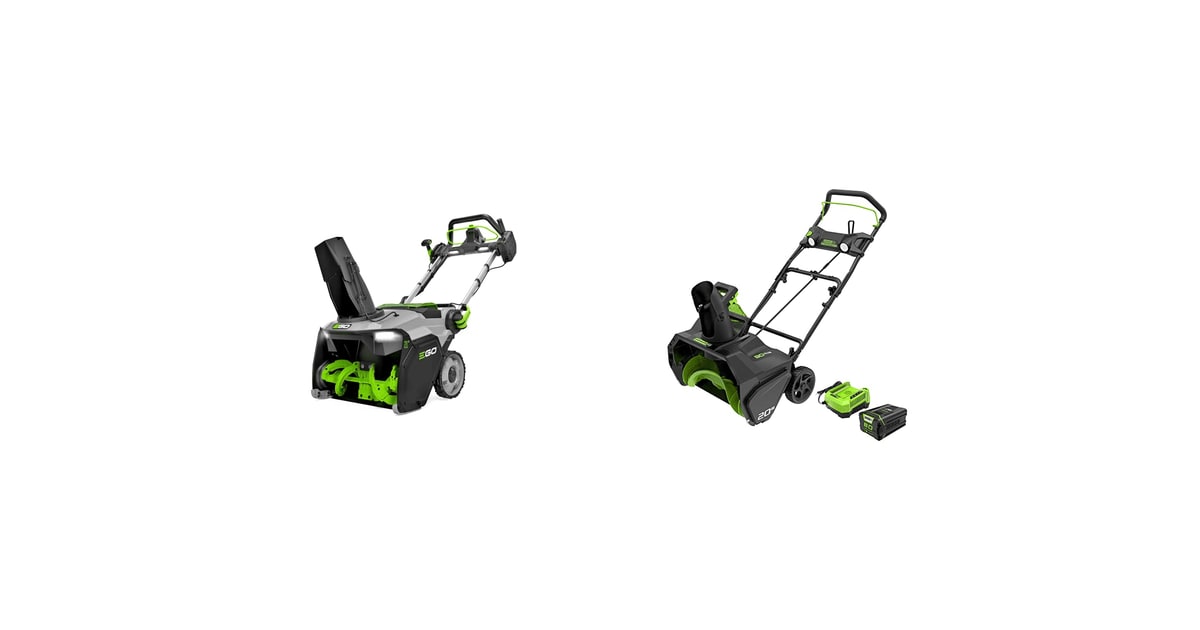
Snow clearing is a chore with a narrow window. You want the driveway open before work, in the dark, in the cold, without a trip to the gas station the night before. That's the case for a cordless machine. There's no priming, no pull cord, no stale fuel and no carburetor to clean out in the fall. You press a button and start walking. For a one- or two-car driveway in a place that measures storms in inches rather than feet, that's usually all you need.
Here's the honest limit. No cordless single-stage blower is a match for a foot of wet, heavy snow. Popular Mechanics found these machines clear six to nine inches of light powder in one pass but need repeated passes once wet snow gets past about four inches. Runtime is finite too, usually somewhere in the thirty-to-fifty-minute range, and it drops fast when the auger is working hard. If you live where storms routinely bury the car, a two-stage machine is still the right tool.
So the real question isn't whether cordless matches gas. It's whether your driveway needs that much machine. Most don't. What matters more is the battery platform behind the tool, because that decides how cold it can get before the pack quits and what else you can run off the same charger. We think that the EGO Power+ 21-inch Snow Blower is the best cordless electric snow blower for most driveways, and that the Greenworks 80V 20-inch Cordless Snow Blower is the one to buy if you'd rather have a battery and charger in the box.
Everything we recommend

The most muscle you can get without gas, batteries aside

Less reach than the top pick, but nothing else to buy
Light and simple, as long as the snow stays shallow
At a glance
| Product | Clearing Width | Battery Included | Price | |
|---|---|---|---|---|
| EGO Power+ 21" Electric Snow BlowerTop pick | 21 in | Not Included | $590.92On sale |
| Greenworks 80VRunner-up | 20 in | 2.0Ah Included | $428.65 |
| RYOBI 40V HP Brushless 18in Single-Stage CordlessBudget pick | 18 in | 6.0Ah Included | $902.44 |
How we picked
Clearing width and depth. We compared manufacturer clearing widths and rated snow depths against what published reviews found in practice. Anything that couldn't handle a normal six-inch fall in one or two passes wasn't worth recommending for a driveway.
Throw distance. Spec sheets and Bob Vila's comparative work both show throw distance tracking closely with battery voltage. We treated a machine that dumps snow at your feet on a two-car driveway as a failure, not a quirk.
Cold-weather battery behavior. We looked at each brand's stated operating temperature range and at owner feedback about packs refusing to start in the cold. A blower that needs its battery warmed indoors first loses much of the point.
Weight and handling. We compared listed weights alongside owner comments about push effort and turning. Under about 40 pounds is where these machines stop feeling like equipment and start feeling like a tool you'll actually go get.
Battery ecosystem. We favored platforms with deep tool lineups, since sharing packs with a mower or trimmer changes the real cost of ownership. Packs that only ever run one seasonal tool are expensive dead weight.
Top pickOn sale
The most muscle you can get without gas, batteries aside
EGO Power+ 21" Electric Snow Blower
This EGO runs two 56V ARC Lithium packs at once to spin a steel auger and throw snow up to 45 feet. It gets through the wet, heavy stuff that stops most cordless single-stage machines, and the heated grips make a cold morning a lot more bearable.
$590.92fromAmazonList priceRunning two batteries at once is what separates this from every other cordless blower here. EGO's Peak Power setup pulls from both packs, and the steel auger chews through the packed ridge the plow leaves across the end of your driveway. Rubber-paddle machines tend to skate over that stuff. If your street gets cleared before you get outside, this is the one that won't send you back for a shovel.
Picture the storm that drops eight inches overnight. EGO says two 6.0Ah packs will clear a driveway roughly fourteen car lengths long at that depth on one charge, which covers a normal two-car driveway several times over. Owners in heavy-snow states report getting through more than a foot of accumulation, though nobody does that in a single pass. You take it in bites and it keeps going.
The platform matters as much as the machine. EGO's ARC Lithium cells are rated to run down to 0°F, while ordinary lithium-ion packs can shed 20 to 30 percent of their rated capacity below about 14°F. That's the gap between a blower that works on the worst morning of the winter and one that dies partway down the drive. Consumer Reports has ranked EGO's 56V single-stage blowers among the top-rated battery-powered models it evaluates.
The batteries are the real investment, and they last. Wirecutter's long-term work with EGO packs found they held more than 80 percent of original capacity after 500 charge cycles, which works out to roughly five to eight years of normal seasonal use. Those same packs run EGO's mowers, trimmers and chainsaws. If you're already on the platform, you're essentially buying a bare tool, and the chute levers and push-button start are right where you'd expect them.
Flaws but not dealbreakers
The batteries and charger aren't included. That's the catch across the EGO line, and it means the real cost of getting started is a lot higher than the tool alone. Two packs are the recommended setup, not one. If you're coming in cold with no EGO gear at home, the Greenworks below is a cheaper door to walk through.
It isn't flawless in shallow snow. Some owners report the auger bunching up a wet three-inch dusting instead of clearing it cleanly, and a few find the folding handle fussy to set and unset. This is also a full-size single-stage machine, so it takes some effort to steer around a curved walkway or a tight garden bed.
Runner-up
Less reach than the top pick, but nothing else to buy
Greenworks 80V
The Greenworks pairs an 80V brushless motor with a 20-inch clearing path and comes with a battery and charger already in the box. At 33 pounds it's the easiest machine here to turn around, and the pack works across more than 75 other Greenworks tools.
$428.65fromAmazonThe voltage is the reason to look here. Bob Vila's comparisons found 80V cordless blowers threw snow within 10 to 15 percent of equivalent gas single-stage machines, while 40V models trailed by 20 to 25 percent. You notice that at the far edge of a driveway, where snow either lands on the lawn or drifts back onto the pavement you just cleared. For a two-car driveway with grass on both sides, 80V is the comfortable choice.
Everything you need is in the box. You get a 2.0Ah battery and a charger, so nothing else has to arrive before the first storm. Greenworks rates the machine for snow up to 10 inches deep, and the 20-inch path is narrow enough to run down a front walk without scalping the edges. The chute swings through 180 degrees, which is enough range for a driveway with a lawn on one side.
It's light in a way that changes how the job feels. At 33 pounds it's the machine you can lift over a curb, pull out of a crowded garage one-handed, or hand to someone who doesn't want to wrestle sixty pounds of steel. The brushless motor is quiet enough that clearing at six in the morning won't wake the block, and there's nothing to service between seasons.
Flaws but not dealbreakers
The included 2.0Ah battery is the weak link. Owners consistently report roughly twenty minutes of work from it, which is enough for a walkway and one pass down a short drive and not much more. Plan on a second, larger pack if your driveway holds two cars, and treat the included battery as a spare rather than your main one.
Greenworks itself warns that a cold pack may not start the machine and suggests warming it indoors for ten minutes before trying again. That's a real annoyance when the whole appeal is walking outside and going. Owner feedback also turns up scattered reports of dead batteries and mixed luck getting them replaced, so keep your receipt.
Budget pick
Light and simple, as long as the snow stays shallow
RYOBI 40V HP Brushless 18in Single-Stage Cordless
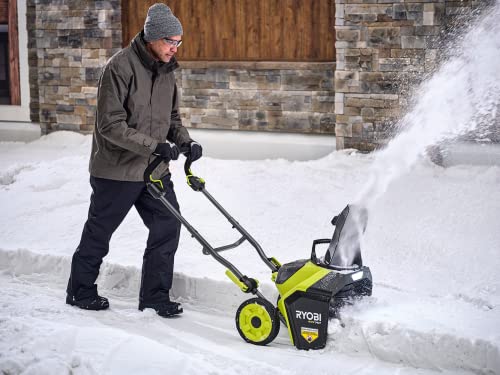
Ryobi's 18-inch single-stage blower comes with a 6.0Ah 40V battery and charger, and it's the lightest machine in this guide. It's the right pick for a short driveway, a long walkway or a deck, in a place where storms usually land in the three-to-five-inch range.
$902.44fromAmazonThis is a machine for the storms that don't make the news. An 18-inch path is narrow, and that's the point. It fits between parked cars, runs down a sidewalk without hanging off the edges, and clears a set of front steps and a landing without a fight. If most of what you're clearing is a few inches of powder, the extra width and weight of a bigger blower is capacity you'll pay for and rarely use.
Weight is the honest selling point. Ryobi lists the RY40890VNM at about 31 pounds without a battery, roughly 35 to 40 percent lighter than an entry-level gas single-stage machine at 50 to 55 pounds. That difference shows up every time you turn around at the top of a driveway or lift the thing over a snowbank. Anyone with a bad back or a stiff shoulder will feel it immediately.
The 40V ONE+ HP platform is the other draw. It's one of the broadest battery lineups in the hardware aisle, so the pack that clears the drive also runs a mower, a blower, a hedge trimmer and a pressure washer. The brushless motor helps stretch each charge, and a 6.0Ah battery and charger are both included, which keeps the entry cost down if you're starting from nothing.
Flaws but not dealbreakers
Wet snow is its limit, and owners say so plainly. The auger clogs and the machine bogs down in heavy, slushy accumulation, which burns through a charge faster than dry powder does. A few owners report the motor heating up and needing a rest after about ten minutes of hard work, and at least one found it couldn't handle an eight-inch fall at all. If you get lake-effect or coastal storms, buy more machine.
The narrow path and the lower voltage add up. An 18-inch swath means more passes on a two-car driveway, and Bob Vila's comparisons put 40V throw distance 20 to 25 percent behind gas equivalents, so snow lands closer to where you're walking. Owner feedback on this model is thin, too, which makes it harder to know how it holds up over several winters.
Who this is for
Buy one of these if you have a one- or two-car driveway and your storms usually come in under about eight inches. That's the sweet spot for cordless single-stage machines, and the trade for giving up gas is a good one: no fuel to store, no cold-start ritual, no annual carburetor service, and no fuel bill each winter. If you already own EGO, Greenworks or Ryobi batteries, the math gets better still, because you're mostly buying a motor and an auger.
Skip cordless if you regularly dig out of a foot or more, if your driveway is long or steeply pitched, or if you get the wet, dense snow that comes off a lake or a coastline. A two-stage machine, gas or battery, is the honest answer there. This guide also sticks to walk-behind single-stage cordless blowers for residential driveways. It doesn't cover corded electric models, snow shovels, tractor-mounted blowers or gas machines, and the picks assume paved or paver surfaces rather than loose gravel.
How we picked
We started from manufacturer specifications and published evaluations, then weighed each machine against the same five things. Clearing width and depth: it has to open a normal driveway after a normal storm without endless passes. Throw distance: snow needs to land off the pavement, not back on it, which in practice means paying attention to voltage. Cold-weather battery behavior: a pack rated for genuinely cold operation beats one you have to warm up indoors first. Weight and handling: under roughly 40 pounds is where these stop feeling like equipment. Battery ecosystem: packs that also run a mower or trimmer change the long-term cost more than any single feature on the tool.
The competition
This is what the research turned up, not a census of the market. Cordless snow blowers are one of the fastest-growing corners of outdoor power equipment, according to Outdoor Power Equipment Institute data, and brands are adding models faster than reviewers can work through them. Two-stage cordless machines in particular are worth watching if you're in a heavy-snow region, since they're the only battery design that reliably handles wet snow past about eight inches. The rest of the listings we looked at for this guide were accessories, replacement parts or gas machines, and they're noted below.
Battery care and storage
Batteries decide how long these machines last, so treat them like the expensive part they are. Store packs indoors at room temperature rather than in an unheated garage, and bring them out just before you clear rather than leaving them clipped to the blower overnight. Cold cells lose capacity and can refuse to start the motor at all. For the off-season, park packs at a partial charge in a cool, dry spot and top them up once or twice over the summer instead of leaving them empty for months. On the machine itself, clear packed snow out of the chute and auger housing before you put it away, and let it dry rather than sealing wet metal under a cover.
Questions we get
Are cordless electric snow blowers powerful enough for heavy, wet snow?
Up to a point. Popular Mechanics found cordless single-stage machines clear six to nine inches of light, dry snow in one pass but need multiple passes once wet snow goes past about four inches. A steel auger and a higher-voltage platform help a lot, which is why the EGO handles wet snow better than the Ryobi does. If wet, dense storms are your normal, a two-stage machine is the safer buy.
How long does a cordless snow blower battery last on one charge?
Most single-charge runtimes land in the thirty-to-fifty-minute range, which covers the majority of residential driveways. Battery size matters more than the machine: the 2.0Ah pack included with the Greenworks gives owners roughly twenty minutes, while a pair of 6.0Ah EGO packs clears far more. Working through deep or wet snow shortens all of these numbers, so a second pack is worth having.
Do I need 40V, 56V or 80V?
Voltage mostly buys you throw distance and staying power in dense snow. Bob Vila's comparisons put 80V cordless blowers within 10 to 15 percent of equivalent gas single-stage machines, while 40V systems averaged 20 to 25 percent shorter throws under the same conditions. For a short driveway and shallow snow, 40V is fine. For a two-car driveway, step up to 56V or 80V.
Do these lose power in very cold weather?
Standard lithium-ion cells can lose 20 to 30 percent of rated capacity below about 14°F, which is exactly when you need them. EGO rates its ARC Lithium packs for operation down to 0°F, and that difference is worth paying for in a cold climate. Greenworks explicitly advises storing packs at room temperature and warming a cold one indoors if the machine won't start.
Can I use a cordless snow blower on a gravel driveway?
Not really, and not safely with a steel auger. Single-stage machines pull the auger down to the surface, so on gravel they'll pick up stones and fire them through the chute. Rubber-paddle augers are gentler on pavers and brick but still aren't meant for loose surfaces. For gravel, you want a two-stage machine with adjustable skid shoes that keeps the auger off the ground.
How much does switching from gas actually save?
The recurring costs go away entirely. There's no fuel to buy each winter, no stabilizer, no oil changes and no annual carburetor service, and U.S. Energy Information Administration data on household gasoline spending shows fuel alone adds up over a season. Sharing battery packs with tools you already own cuts the entry cost further. The offset is battery replacement, which Wirecutter's long-term work suggests comes around every five to eight years.
Why you should trust us
For this guide:
- We read manufacturer specifications for every machine in this guide alongside published evaluations from Consumer Reports, Popular Mechanics, Bob Vila and Wirecutter.
- We compared owner feedback across all three picks for recurring themes, particularly wet-snow clogging, real-world runtime from the included batteries, and cold-weather starting behavior.
- We cross-checked battery platform claims, including rated operating temperatures and long-term capacity retention, against each brand's own technical documentation.
- We read owner reviews on every listing, weighted toward the critical ones, because that is where the recurring failures show up.
- We have a systematic way of automatically fetching the latest prices, so the numbers on this page stay current.
- This is a research-focused guide, so the team may not own every product listed — though we often do own the top winners, which gives us extra context for the recommendations.
- We don't accept free products, and the retailer commission never changes which product we recommend.
Sources
Best Cordless Snow Blowers — Wirecutter, Wirecutter (NYT)
Best Electric Snow Blowers — Consumer Reports, Consumer Reports
Best Cordless Snow Blowers Tested — Popular Mechanics, Popular Mechanics
Best Battery-Powered Snow Blowers — Good Housekeeping, Good Housekeeping
Best Cordless Snow Blowers — Bob Vila, Bob Vila
Best Snow Blowers — This Old House, This Old House
Best Cordless Snow Blowers — The Spruce, The Spruce
Best Cordless Snow Blowers 2026 — Tom's Guide, Tom's Guide
EGO Power+ SNT2118 Official Specifications, EGO Power+ (Manufacturer)
Ryobi RY40890VNM Product Specifications, Ryobi (Manufacturer)
Amazon product listings and owner reviews for all 3 products
Manufacturer specification pages for each product
Some passages in this guide may be paraphrased with AI help. Prices are refreshed automatically.
More like this.
Continue exploring home reviews and recommendations.

The Best Electric Snow Shovels
An electric snow shovel isn't a snow blower, and that's the whole point. You carry it out one-handed, walk it down the sidewalk, and a spinning paddle…

The Best Robotic and Cordless Electric Lawn Mowers
Mowing is the one chore you can't skip, and for most of us it eats a Saturday morning every week from April through October. Electric mowers change that…

The Best Leaf Blowers
Leaf blowers get judged on two numbers, and only one of them matters most days. CFM is air volume - how much leaf litter you can push across a lawn in one…

The Best Leaf Blower Vacuum Mulchers
Raking leaves is slow, and hauling them is worse. A 3-in-1 blower vacuum does three jobs with one motor: it pushes leaves into a pile, sucks them up, and…

The Best Roof Rakes for Snow Removal
A foot of wet snow on your roof isn't a cosmetic problem. Fresh powder weighs about 3 pounds per cubic foot, but dense, water-logged snow can hit 20…

The Best Driveway Markers for Snow Plowing
A driveway marker is a boring purchase right up until the moment it isn't. The first big storm covers your lawn edge, your sprinkler heads and that…