The Best Digital Calipers
A caliper is the tool you reach for when "close enough" stops being good enough. You're checking whether a 3D-printed bracket will actually seat, whether a drill bit is the size stamped on the shank, whether a tenon fits its mortise. A good one gives you the same number every time, from the same measurement, months apart. A bad one drifts, wobbles at full extension, and quietly makes you doubt your own work. The difference between those two experiences is what you're really shopping for here.
Here's the honest part: almost every caliper reads accurately when it's new. The hard problem is what happens after a year of getting knocked around a bench, and no spec sheet tells you that. Ingress ratings are inconsistently reported, too — plenty of listings say "splash resistant" without a number behind it, which means nothing was standardized or verified. And no caliper on this list, including the expensive ones, ships with a calibration certificate by default.
So we read the specs closely, compared what owners report after months and years of use, and weighted encoder behavior and build reports heavily. We think that the Mitutoyo 500-196-32 is the best digital caliper for most people who measure seriously, and that the Clockwise Tools DCLR-0605 is the one to buy if you want a genuinely good caliper for a home shop without spending much.
Everything we recommend

The reference-grade choice, if you measure for a living

Confirmed IP54 and a huge screen for very little money

Absolute encoder and data output, for far less

IP67 sealing and 8 inches of range, for wet shops
At a glance
| Product | Range | Resolution | Price | |
|---|---|---|---|---|
| Mitutoyo 500-196-32 Absolute Digimatic CaliperTop pick | 6"/150mm | — | $156.98On sale |
| Starrett Stainless Steel IP67 Electronic Slide CaliperUpgrade pick | 0-8" | .0005" | $299.29 |
| iGAGING Absolute Origin 0-6" Digital CaliperAlso great | 0-6" | — | $47.77 |
| Clockwise Tools IP54 Grade Digital CaliperBudget pick | 0-6"/150mm | 0.0005"/0.01mm | $23.45 |
 | Fowler 54-101-150-2Also consider | 0-6"/150MM | 0.0005"/.01mm | $78.05 |
 | NEIKO 01407A Electronic Digital Caliper Measuring ToolAlso in lineup | 0-6"/150mm | 0.0005"/0.01mm | $27.99 |
 | VINCA IP54 Grade Digital CaliperAlso consider | 0-6"/150mm | 0.0005"/0.01mm | $21.45 |
How we picked
Encoder behavior. We separated absolute encoders, which keep their zero through power-off, from incremental ones that need re-zeroing every time. For anyone measuring frequently, that distinction affects error rates more than any accuracy figure on the box.
Stated accuracy. We treated ±0.001" accuracy with 0.0005" resolution as the floor, since every caliper here meets it on paper. What separated them was owner reports of whether that accuracy held up after a year or five.
Ingress protection. We only credited a caliper with dust and moisture resistance when the listing states an IP number. Vague phrasing like "splash resistant" tells you nothing about what was actually verified.
Display and controls. We compared screen dimensions, unit-switching behavior, and whether fractional readout is available, because a caliper you can't read quickly in a dim shop is a caliper you stop using.
Long-term owner reports. We looked for feedback stretching past the first few months — accuracy drift, jaw slop developing, units dying outright — since that's the failure pattern spec sheets never cover.
Top pickOn sale
The reference-grade choice, if you measure for a living
Mitutoyo 500-196-32 Absolute Digimatic Caliper
The Mitutoyo 500-196-32 is the caliper professional shops buy by default, built around an Absolute encoder that keeps its zero through power cycles. It holds ±0.001" accuracy across the full 6" range, and it stays that way for years rather than months.
$156.98fromAmazonList priceThe Absolute encoder is the whole argument. Most calipers use an incremental encoder, which means the tool forgets where zero is every time it powers down. You re-zero, or you get a reading that's off by an unknown amount. The Mitutoyo retains its origin point through power-off. If you take dozens of measurements a shift, that's one entire category of human error removed from your day.
Mitutoyo also claims no overspeed errors, which sounds like marketing until you've slammed a slide shut in a hurry. Cheap encoders can miss counts when you move fast, and you won't know it happened. The reading just comes out wrong. This one is specified to stay stable at any slide velocity, and that's a meaningful difference when you're working quickly.
The build is hardened stainless steel with precision-ground guide surfaces, and the reason that matters is wear. Jaws that ride against steel workpieces all day slowly lose their edge on softer instruments. Owner feedback on this one leans toward accuracy and repeatability being exactly what's advertised. It's the benchmark other calipers on this list get compared against, and none of them fully catch it.
It's overkill for a lot of people, and that's fine. If you pick up a caliper twice a week to check board thickness, you're paying for stability you'll never stress. The value here is in high-volume, high-consequence measurement — aerospace, medical device, production QC — where a wrong number costs you a scrapped part.
Flaws but not dealbreakers
There's no IP rating, and that's a real limitation. Keep this away from cutting coolant, chip wash, and any workspace where liquid gets flung around. In a wet CNC environment, the Starrett is the correct tool and this one isn't.
Owner reports are more mixed than the brand's reputation suggests, and it's worth knowing why. Some buyers describe the slide action as stiffer or rougher than expected, and a few report receiving a different model number than the one listed, sometimes without a battery. If the caliper powers off after a few seconds and forces you back through the origin-set procedure every time, that's a defective unit, not normal behavior — check it against a known reference the day it arrives.
The listing quotes a shipping window of over a week. If your only caliper just died mid-job, this isn't the replacement that gets you back to work tomorrow.
Budget pick
Confirmed IP54 and a huge screen for very little money
Clockwise Tools IP54 Grade Digital Caliper
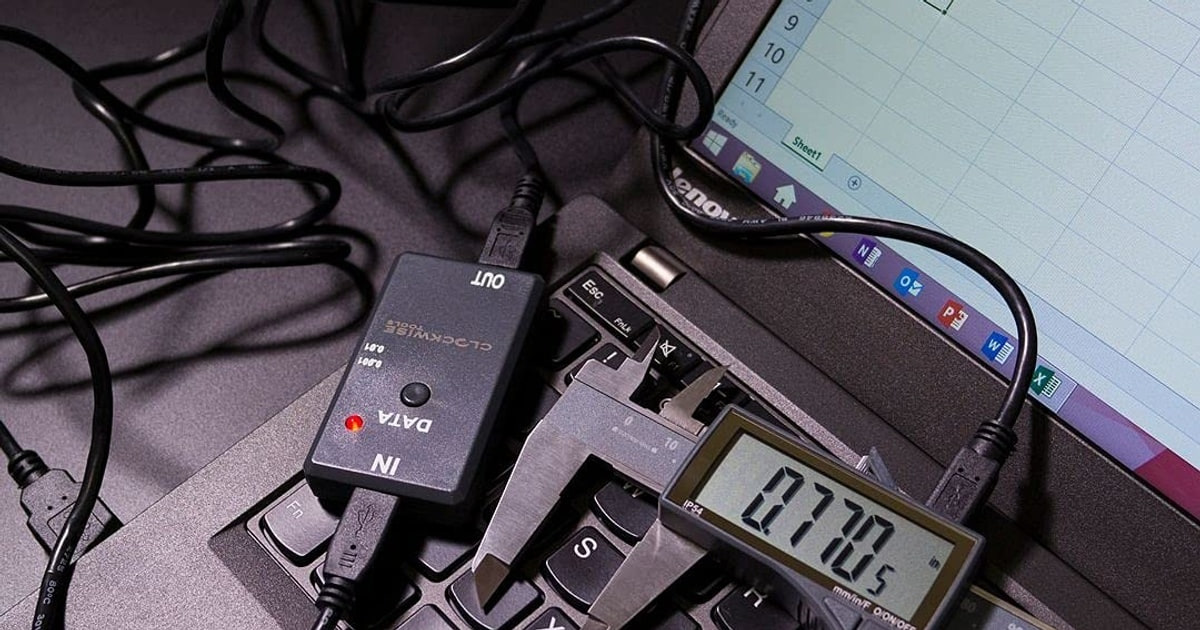
The Clockwise Tools DCLR-0605 gives you a stated IP54 rating, a 3/4" × 2" LCD, and one-button switching between inch, metric, and fractions. It's the caliper we'd put on a home bench, and owners report units still reading true after five and seven years of use.
$23.45fromAmazonThe display is the reason to pick this one. At 3/4" by 2", it's the largest screen here, and that stops being a novelty the moment you're squinting at a number in a dim garage with safety glasses on. Owners consistently call out readability as the thing they noticed first. It's a small design choice that you appreciate every single day.
IP54 is a specified rating, not a vibe. The 5 means dust-protected and the 4 means protected against water spray from any direction. For sawdust-heavy woodworking, a 3D printer corner, or a garage that gets humid in summer, that's the threshold that matters. Plenty of calipers at this price say "splash resistant" instead, which is an unverified claim.
The fraction mode earns its keep if you work in imperial. Press one button and 0.234" becomes a fraction you can find on a rule. Owners who measure drill bits and stock thickness bring this up repeatedly as the feature that made the caliper stick around on their bench instead of in a drawer.
Long-term owner reports are unusually good for something this affordable. Multiple people describe five and seven years of steady use with accuracy still holding against calibration blocks. That's the part you can't get from a spec sheet, and it's what moved this above the other inexpensive options.
Flaws but not dealbreakers
It uses an incremental encoder, so you'll re-zero on every power-up. That's a two-second habit for a hobbyist and a genuine annoyance if you're measuring all day.
The body feels lighter in the hand than the Fowler or the Mitutoyo. Some owners like that; others read it as less substantial. And a few report units simply quitting after several years — accurate right up until they weren't. Treat this as a very good tool with a finite life, not an heirloom.
IP54 handles spray, not coolant. If you're working next to an active flood-cooled mill, this isn't enough protection and you should look at the Starrett.
Also great
Absolute encoder and data output, for far less
iGAGING Absolute Origin 0-6" Digital Caliper
The iGAGING Absolute Origin retains its zero through power-off like the Mitutoyo does, adds IP54 protection and an SPC/USB port, and includes a case. For a woodworker or 3D printer builder who wants the encoder benefit without the professional price, this is the sweet spot.
$47.77fromAmazonYou get the single most useful Mitutoyo feature for a fraction of the outlay. The origin point survives power-off. Set the caliper down, come back after lunch, pick it up — the number is still referenced to the same zero. If you work in bursts rather than continuous sessions, this changes how much you trust the tool.
The SPC/USB port is genuinely unusual at this level. If you're reverse-engineering a part and want dimensions going straight into CAD or a spreadsheet, you skip the transcription step where digits get transposed. Most calipers anywhere near this price have no data output at all.
Owner feedback skews strongly positive and specific: people describe it as the most-used tool on the bench, reaching for it to measure, fit, and copy everything from toys to replacement parts. That kind of comment — it lives next to the notebook — tells you more about a tool than any accuracy figure does.
IP54 covers sawdust, forge scale, and workshop humidity, which is the environment most of the people buying this actually work in. It ships with a protective case and a manual, so you're not immediately hunting for somewhere to store it.
Flaws but not dealbreakers
There's no fractional readout. If you think in 1/64" increments, you'll be converting in your head or reaching for a chart, and that gets old fast. The Clockwise Tools and the VINCA both do fractions and cost far less.
Jaw feel at full 6" extension isn't as tight as the Mitutoyo's. It's within reason for non-production work, but you can tell the difference if you've handled both.
A few owners note the caliper arrives in minimal packaging for a precision instrument. Check it against a known reference before you rely on it.
Upgrade pick
IP67 sealing and 8 inches of range, for wet shops
Starrett Stainless Steel IP67 Electronic Slide Caliper
The Starrett 798B-8/200 is rated IP67 — fully dust-tight and able to survive directed water jets — with an 8" range and RS232 output for SPC logging. If coolant is flying and you measure larger parts, nothing else here is appropriate.
$299.29fromAmazonIP67 is the reason this exists. Coolant spray, chip wash, wet grinding — these kill calipers that only claim splash resistance. The Starrett is specified to keep working through directed water jets from any direction. If your caliper lives on a machine that floods, this is the protection level you need and the Mitutoyo can't offer it.
The 8" range opens up work the 6" tools can't reach: medium-bore components, pipe fittings, larger castings. If you're regularly measuring past five inches, you already know the frustration of a caliper that runs out of jaw. Most people don't need this. The ones who do need it constantly.
RS232 output feeds measurements straight into SPC software. In a QC department logging hundreds of readings, hand-typing numbers is where the errors creep in, and eliminating that step is worth real money. The auto-off after thirty minutes of no slide movement preserves battery and wakes up without losing position.
Owners who've used both this and a Mitutoyo tend to land on the Starrett when the environment is harsh — the sealing holds up where an unsealed instrument gradually degrades. One consistent theme is that it returns to zero reliably and holds its accuracy, which is the practical test that matters.
Flaws but not dealbreakers
It's the most expensive caliper here, and the price only makes sense if you actually need IP67 or the longer range. For dry-bench work on small parts, the Mitutoyo gives you better encoder technology for less.
The 8-inch body is bulky. Measuring a 2-inch part with it feels like using a spanner to turn a watch screw, and one-handed work is more awkward than with a 6-inch.
It uses an incremental encoder. The auto-off position retention mitigates that, but it isn't the same as true absolute referencing. And a few owners report the battery arriving dead, so have a CR2032 on hand.
Who this is for
This guide is for anyone who needs a repeatable number off a physical object: machinists, woodworkers, 3D printer owners, home mechanics, students in a machining program. If you measure into production parts or finished assemblies where a wrong reading scraps material, buy toward the top of this list and don't overthink it. If you're checking filament diameter and board thickness on weekends, the inexpensive options here are genuinely good and you'd be spending money on stability you'll never tax.
We stuck to handheld electronic calipers in the 6" and 8" range, since that covers the overwhelming majority of shop and bench measurement. We didn't look at dial or vernier calipers, micrometers, height gauges, or bore gauges — all useful, all different tools. We also didn't evaluate calibration services or gauge block sets, though if you're working to a documented quality standard you'll need both eventually.
How we picked
Encoder type: absolute encoders keep their zero through power-off, and that removes a whole class of forgotten-re-zero errors, so we weighted it heavily. Accuracy and resolution: 0.001 inch accuracy with 0.0005 inch resolution is the floor here, and every caliper clears it, so we looked instead at owner reports of drift over years. Ingress protection: we counted a stated IP54 or IP67 number and ignored unverified language like "splash resistant," because only one of those reflects a standardized test. Display and controls: big high-contrast screens and one-button unit switching matter more in a dim garage than any spec on the box, and fractional readout decides the tool for imperial woodworkers. Long-term reports: we favored calipers where owners describe them still reading true after several years, since that's the thing you can't learn from a listing.
Other digital calipers worth considering
If you want a stated IP rating for as little as possible: The VINCA IP54 Grade Digital Caliper ($21.45) — The VINCA DCLA-0605 is close kin to the Clockwise Tools pick — same manufacturer, similar body — and it undercuts it while keeping IP54, fraction mode, and a protective case. Its distinguishing feature is a glass scale, which expands less with temperature than steel does, so a garage that swings from freezing to sweltering causes less drift. Owners like the padded case and the bundled spare batteries. The trade-off is a smaller display than the Clockwise Tools, and a few owners find the digit sizing on it genuinely awkward — the tenths render large while the finer digits shrink, which is backwards from what you want. It's an incremental encoder too, so re-zeroing is part of the routine.
If you want a recognized precision-tool brand at a middle price: The Fowler 54-101-150-2 ($78.05) — The Fowler 54-101-150-2 is the caliper to buy when procurement wants a named brand and you don't want to commit to Mitutoyo money. It covers outside, inside, depth, and step measurement, comes with a case, two batteries, and a stated one-year warranty. Owners who use it daily in shop settings describe it holding zero well and surviving drops, with several noting years of service. What it gives up is the encoder: it's incremental, while the iGAGING gets you absolute referencing for less. There's no stated IP rating either, so keep it away from moisture. It's the sensible middle choice rather than the exciting one.
The competition
This is what our research turned up across the range, not a survey of every caliper sold. We focused on models with enough published specification detail and enough accumulated owner feedback to say something useful about how they hold up. Plenty of decent calipers exist outside this group, and new ones appear constantly.
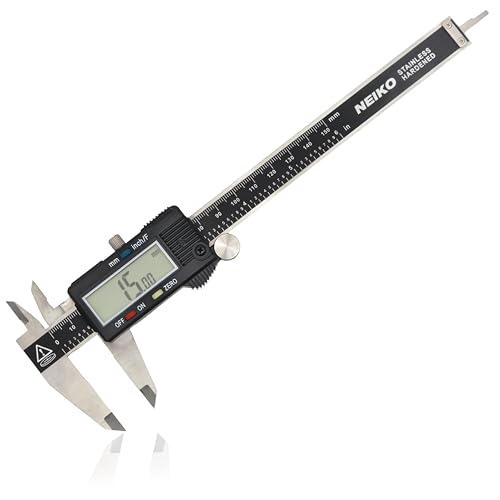
The NEIKO 01407A Electronic Digital Caliper Measuring Tool ($27.99) — The NEIKO 01407A is the caliper a lot of people already own, and it's a reasonable first instrument for a student or an occasional user. It switches between decimal inch, millimeter, and fractions down to 1/128 of an inch, which is finer fractional resolution than anything else here, and it ships with a hard case. Owners generally find it accurate for the money and easy to read. It lost to the Clockwise Tools on one specific point: the listing says "splash and dust resistant" without an IP number, which is an unverified claim, while the Clockwise Tools states IP54 for a similar outlay. It's also incremental, so re-zero on every startup, and jaw play at full extension is more noticeable than on the picks. Buy it if you measure rarely and want something expendable on the bench.
Care and calibration
Check your caliper the day it arrives and then every few weeks. Close the jaws fully and confirm the display reads exactly zero — any deviation means drift or debris on the measuring faces. Then measure something with a known dimension, like the shank of a numbered drill bit, three times in three different jaw positions. Readings that wander tell you there's slop in the slide. Wipe the beam and jaws with a dry cloth after use, since chips and sawdust wedged in the track are the most common cause of erratic numbers. Pull the CR2032 if the caliper is going into storage for months. And if you're working to a documented standard, send it out for annual calibration against traceable gauge blocks — hobby-grade checks aren't a substitute for that.
Questions we get
Are inexpensive digital calipers accurate enough for real work?
For woodworking, 3D printing, and home repair, yes — the budget options here are all specified to ±0.001" and owners generally confirm they read true when new. The limitation is what happens after a year or two: calibration drift and jaw play at full extension creep in faster than on professional instruments. If a wrong reading only costs you a re-cut, that's an acceptable risk. If it scraps an expensive workpiece, buy up.
What's the difference between an absolute and an incremental encoder?
An absolute encoder keeps its zero reference through power-off, so you can put the caliper down and pick it up without re-zeroing. An incremental encoder loses that reference and needs re-zeroing on every power-up. Only the Mitutoyo and the iGAGING here use absolute encoders. For occasional use it barely matters; for dozens of measurements a shift, the forgotten re-zero is a real source of bad numbers.
What does IP54 mean, and do I need it?
IP54 is a standardized ingress rating: the 5 means dust-protected and the 4 means protected against water spray from any direction. For sawdust, humidity, or a garage bench, it's worth having. If you work around cutting coolant or chip wash, you need IP67, which is fully dust-tight and rated against directed water jets — the Starrett is the only caliper here that meets it. Treat "splash resistant" with no number as meaning nothing.
Should I buy a 6-inch or an 8-inch caliper?
Buy the 6-inch unless you have a specific recurring reason not to. It covers the overwhelming majority of bench and shop measurement, and it's easier to handle one-handed on small parts. The 8-inch makes sense for medium-bore components, pipe fittings, and larger castings. If you're not regularly measuring past five inches, the extra range just adds bulk.
Are digital calipers better than vernier calipers for beginners?
Yes, clearly. Reading a vernier scale means finding which graduation lines up with the main scale, and new users misread it constantly. A digital caliper shows the number directly and switches between inches, millimeters, and fractions with a button. The one advantage vernier calipers keep is that they never have a dead battery.
How long does the battery last, and what type is it?
Every caliper here runs on a CR2032 lithium coin cell, which costs little and is stocked at any hardware store. Runtime typically spans one to three years depending on how the caliper handles idle time. Models that shut off after thirty minutes of no movement — the Starrett among them — stretch that considerably compared with designs that stay powered. Keep a spare in the case.
Why you should trust us
For this guide:
- We read the full published specifications for all seven calipers, comparing stated accuracy, resolution, encoder type, ingress ratings and data-output options side by side.
- We worked through owner feedback for each model, weighting reports from people who'd used the tool for a year or more over first-impression comments.
- We treated unverified marketing language like "splash resistant" as no claim at all, and only credited moisture protection where a listing states a specific IP number.
- We read owner reviews on every listing, weighted toward the critical ones, because that is where the recurring failures show up.
- We have a systematic way of automatically fetching the latest prices, so the numbers on this page stay current.
- This is a research-focused guide, so the team may not own every product listed — though we often do own the top winners, which gives us extra context for the recommendations.
- We don't accept free products, and the retailer commission never changes which product we recommend.
Sources
Best Digital Calipers — Wirecutter / The New York Times, Wirecutter
Best Digital Calipers Tested in 2026 — Popular Mechanics, Popular Mechanics
Digital Caliper Reviews and Buying Guide — ToolGuyd, ToolGuyd
Best Digital Calipers for Woodworking — Fine Woodworking, Fine Woodworking
Digital Calipers Compared: Mitutoyo vs. Starrett vs. Budget — Pro Tool Reviews, Pro Tool Reviews
Amazon product listings and owner reviews for all 7 products
Manufacturer specification pages for each product
Some passages in this guide may be paraphrased with AI help. Prices are refreshed automatically.
More like this.
Continue exploring electronics reviews and recommendations.

The Best Digital Picture Frames
A digital picture frame earns its place by disappearing into a room and then surprising you. The work is less in the hardware than in the pipeline behind…

The Best Digital Kitchen Scales for Precision Baking
Baking by volume is the reason your cookies come out different every time. King Arthur Baking found that a cup of all-purpose flour can weigh anywhere…

The Best Motorcycle Phone Mounts
Your phone is your GPS, your music player, and the thing that tells you where the next gas station is. On a motorcycle, it also sits a few inches from an…

The Best Truck Bed Cargo Nets
A cargo net is the difference between a load that arrives and a load that scatters across two lanes of highway. Most of what you haul in a pickup bed - …

The Best Backup Camera Rearview Mirrors
Most of your driving happens facing forward. But the two minutes a day you spend in reverse are where the dents and the tragedies happen. Federal safety…

The Best Headlight Restoration Kits
Cloudy headlights sneak up on you. One night you're driving a back road and realize the pool of light in front of the car has shrunk to a smudge. That's…