The Best Backup Camera Rearview Mirrors
Most of your driving happens facing forward. But the two minutes a day you spend in reverse are where the dents and the tragedies happen. Federal safety data puts backing crashes at roughly 267 deaths and 15,000 injuries a year, and children under five account for 44 percent of those deaths. A mirror-style backup camera clamps over the rearview mirror you already have and turns it into a screen. You get a wide, live view of the bumper you can't see. If your car predates the federal backup-camera rule, it's one of the easiest safety upgrades you can add yourself.
Here's the part nobody advertises. The screen is the easy half; the rear camera is the work. Even a wireless camera needs power, which usually means splicing into your reverse lights or running a lead to the back of the vehicle. Mirror screens wash out in direct sun, and at night a bright display in your line of sight takes getting used to. Cheap rear sensors turn to mush under a single parking-lot lamp. And none of these talk to your car, so you get no beeps and no cross-traffic alerts. Just a picture.
So the question isn't which unit has the longest spec list. It's which one gives you a rear image you can actually read, from a camera that survives a car wash, with an install you'll finish. We leaned on published testing, manufacturer specs and the recurring themes in owner feedback to sort that out. We think that the WOLFBOX G850 PRO is the best backup camera rearview mirror for most people, and that the CAMECHO 9.66-inch Mirror Dash Cam is the one to buy if you mostly want a big, simple screen and don't need the driver-assist extras.
Everything we recommend

The clearest rear view here, if you'll run one cable

A big screen and simple recording, with a narrow rear view

No wiring and no drilling, on a screen you'll squint at
At a glance
| Product | Resolution | Night Vision | Price | |
|---|---|---|---|---|
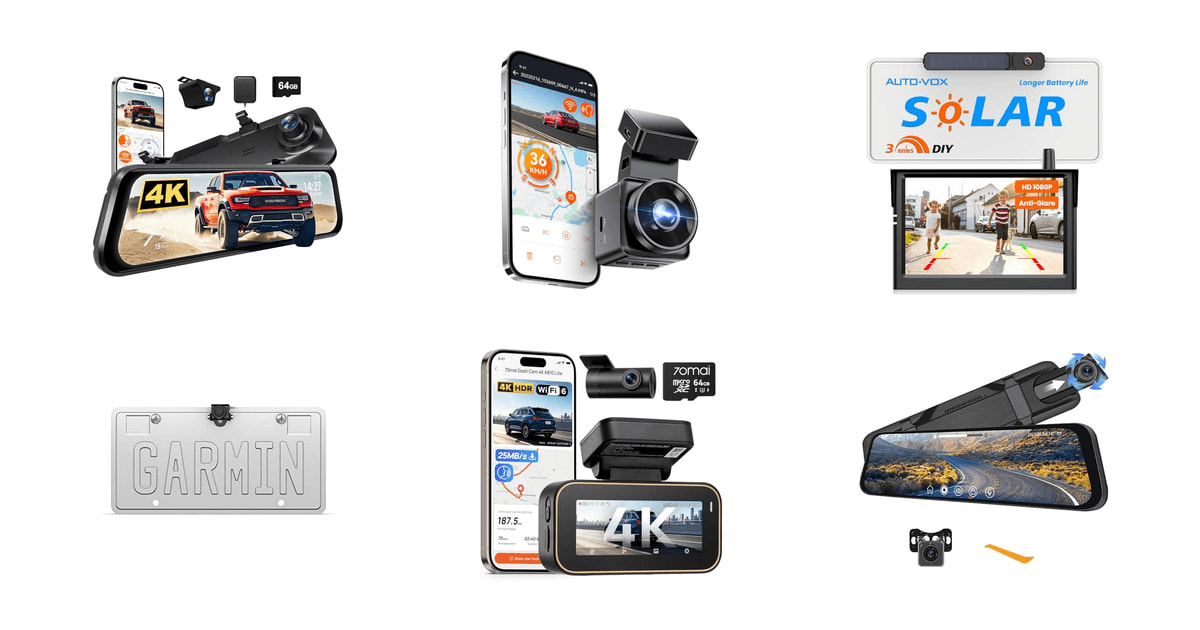
| WOLFBOX G850 PRO 4K Mirror Dash CamTop pick | 4K Front, 1080P Rear | — | $179.98On sale |
 | Vantrue E1 Lite 1080P Mini Dash CamAlso in lineup | 1920*1080p@30fps | HDR Night Vision | $96.99 |
| AUTO-VOX W5 Wireless Backup Camera: 4.5" 1080PAlso great | 1080P | — | $79.99 |
 | Garmin BC™ 50Also consider | 720p HD | — | $199.99 |
 | 70mai A810 Lite 4K Dash Cam FrontAlso consider | 4K Front, 1080P Rear | HDR Night Vision | $149.99 |
| CAMECHO 9.66" Mirror Dash Cam Rear ViewBudget pick | 1080P HD | Super Night Vision | $49.99 |
How we picked
Night rear image. Backing up happens in dim garages and after dark, so we weighted low-light rear performance heavily. Manufacturer sensor specs and the recurring owner complaints about grainy or washed-out reverse views did the sorting.
Rear field of view. Published testing has found that cameras around 160 degrees catch objects about a foot behind the bumper, while 120-degree cameras can miss things two feet out. We treated anything under about 150 degrees as a genuine limitation.
Screen you can read. Anything under about 9 inches makes you squint in daylight. We favored large, bright IPS panels and split-screen layouts you can interpret in a glance rather than a stare.
Weather sealing. The rear camera lives in road spray, slush and car washes. IP67 was the floor, since that rating covers a meter of water for half an hour, and IP69K earned extra credit.
Install you'll finish. We read published reviews and owner accounts of real installs, looking for clean cable runs, license-plate mounting options and honest wireless range figures instead of best-case claims.
Top pickOn sale
The clearest rear view here, if you'll run one cable
WOLFBOX G850 PRO 4K Mirror Dash Cam
The G850 PRO is a full-width mirror that records 4K in front and 1080p behind, with lane-departure and blind-spot alerts most rivals skip. Its rear camera is the one owners praise most after dark, which is exactly when a backup camera needs to work.
$179.98fromAmazonList priceThe rear image is the whole point, and this one holds up when the light goes. Owners with pickups and Jeeps keep saying the same thing: they can read what's behind them in a dim garage or under a single parking-lot lamp. That's not a given in this category. A rear camera that looks fine at noon and turns to grain at dusk isn't much help, because dusk is when you back into things.
It records in both directions, too. The front camera captures 4K and the rear 1080p, both with HDR, so a plate at a normal following distance stays legible instead of blowing out under headlights. Add the included 64GB card and 5.8GHz Wi-Fi for pulling clips to your phone, and you've got an incident recorder that happens to also be your mirror.
The driver-assist features are the reason to pick this over a simpler mirror. You get forward-collision and pedestrian warnings, lane-departure alerts, a nudge when the car ahead of you finally moves, and blind-spot detection for lane changes. None of it replaces looking. But on a long highway stretch the lane-departure chirp earns its keep, and the blind-spot alert covers a corner your factory mirrors don't.
Installing it isn't hard, but plan on an afternoon. The mirror straps over your existing one and powers off a 12-volt lead. The fiddly part is walking the rear camera cable back to the tailgate or license plate. Owners who mounted the rear camera on the plate frame report the least trouble and the most useful angle. Voice commands handle most of the rest once you're moving.
Flaws but not dealbreakers
It's a screen strapped in front of your mirror, and it behaves like one. At night the display is bright enough to be distracting until you dial it down, and some owners never fully get past the reflections. If you want a mirror that still mostly looks like a mirror, this isn't it.
The rear camera is also the part most likely to disappoint. A minority of owners describe a soft or washed-out reverse image, especially on longer vehicles where the cable run is stretched. And while the driver-assist alerts work, they're chatty out of the box. Expect to spend time in the menus switching things off.
Budget pick
A big screen and simple recording, with a narrow rear view
CAMECHO 9.66" Mirror Dash Cam Rear View
The CAMECHO gives you a 9.66-inch mirror screen with 1080p front and rear recording, split-screen view, loop recording and a 24-hour parking monitor. It skips GPS and driver-assist alerts, but for a first backup camera it covers the basics without asking much of you.
$49.99fromAmazonScreen size does more for you than most specs on the box. At 9.66 inches you can glance at the rear feed while reversing and actually read it: the curb, the bollard, the kid's scooter. Smaller mirror screens make you lean in and squint, which rather defeats the purpose. This one splits the screen too, so you can watch front and rear at the same time.
Everything here is the standard-issue version, and that's fine. You get 1080p both ways, night-vision processing, a G-sensor that locks clips on impact, loop recording, and a parking monitor that runs off the included external power lead. Nothing on that list leads the class. But it's the feature set most people actually use, and leaving out GPS and ADAS keeps the menus short and the setup quick.
For a first-time buyer, the low stakes matter. If a mirror camera turns out not to be your thing, you haven't sunk much into finding out. Owners with awkward rear sightlines tend to be happiest with it: split rear hatches, cargo-loaded SUVs, older trucks. It solves a specific annoyance they've lived with for years, and it does that job on day one.
Flaws but not dealbreakers
The rear camera sees 120 degrees, and that's the real limitation. Published testing has found that cameras around 160 degrees pick up objects about a foot behind the bumper, while 120-degree cameras can miss objects two feet out. That's exactly the zone where a bumper meets a bollard. Sweep your eyes; don't trust the edges of the frame.
Rear camera quality and the install are the other recurring complaints. Owners describe a mushy night-time reverse image and a painful cable run on full-size trucks, and a few report the rear playback showing up mirrored. Card compatibility is hit or miss as well. Format the microSD card in the unit itself before you decide something is broken.
Also great
No wiring and no drilling, on a screen you'll squint at
AUTO-VOX W5 Wireless Backup Camera: 4.5" 1080P
This AUTO-VOX system keeps its rear camera alive with a built-in battery and a solar panel, so it mounts to your license plate with one screwdriver and never needs a cable. The trade-off is a small 5-inch monitor instead of a full mirror screen.
$79.99fromAmazonIf running a cable through your trunk liner is the reason you still don't have a backup camera, this is your answer. The camera bolts to the license plate with an anti-theft screw and charges itself from a solar panel, topped up over USB when the weather doesn't cooperate. Owners who describe themselves as not handy have it working in minutes. There's nothing to splice and nothing to route.
The camera itself is built for abuse. It's rated IP69K, a step above the IP67 most rear cameras claim, and it's specified to keep working from below freezing to well past what a summer parking lot can do. That matters more than it sounds. The rear camera is the part that lives in road spray, slush and the car wash.
The wireless link runs on 2.4GHz and holds to about 40 feet, which covers a pickup or a van but not a fifth-wheel. Six adjustable guidelines let you line the overlay up with your actual bumper rather than a generic box. And because the monitor is separate, you keep your normal mirror, which is a real advantage if the mirror-screen look bothers you.
Flaws but not dealbreakers
The 5-inch monitor is the compromise. It's clear enough, but it's small, and it takes up space on your dash or windshield instead of living in a mirror you already look at. If screen size is what you're after, the mirror units win outright.
Battery life depends on sun. AUTO-VOX rates the pack around 15 hours between charges and expects the panel to keep up in most U.S. climates, but a garage-parked car through a northern winter will want the USB cable now and then. Charging uses the older micro-USB connector, which irritates anyone who's standardized on USB-C.
There's also far less owner feedback behind this listing than behind the mirror units here, and at least one buyer had a monitor fail early. The seller replaced it quickly, but treat the long-term reliability picture as thin rather than proven.
Who this is for
Buy one of these if your vehicle came without a backup camera and you'd rather not pay a shop to retrofit one. That's most cars, trucks and vans built before the federal rule took effect, and it's still the majority of vehicles on the road. Owners of pickups, minivans and packed SUVs get the most out of a mirror unit, because it fixes two problems at once: the rear window you can't see through and the bumper you can't see over.
Skip it if your car already puts a factory backup camera on a center screen. A mirror unit mostly duplicates that, unless you also want dash-cam recording. This guide covers mirror-mounted camera systems and the close alternatives our research turned up. It doesn't cover OEM camera replacements, professional 360-degree multi-camera systems or motorcycle rigs, and it doesn't cover rear parking sensors, which do a different job. Worth knowing: insurance-industry research found cameras cut backing crashes by about 17 percent, and cameras paired with rear sensors cut them by 40 percent.
How we picked
We started with the rear camera, because that's the part that decides whether any of this works. Night vision: low-light rear performance counted for more than headline resolution, since reversing happens in dim garages and after dark. Field of view: we treated 160 degrees as the target and anything near 120 as a compromise, based on published testing of how close an object gets before a narrow lens loses it. Screen size: nine inches and up, bright enough to read in daylight. Weather sealing: IP67 as the floor, with credit for IP69K. Install: clean cable runs, license-plate mounting and honest wireless range rather than best-case numbers. Recording: dual-channel footage with legible plates, loop recording and a parking mode that keeps watching once the car is off.
Other backup camera rearview mirrors worth considering
If you already drive with a Garmin navigator: The Garmin BC™ 50 ($199.99) — The BC 50 isn't a mirror at all. It's a rear camera that beams 720p to a compatible Garmin nav unit you already own, which makes it a narrow pick but a tidy one. You get a 160-degree view, IPX7 sealing and a rated 50-foot range that suits a long truck or a trailer, extendable with an optional cable. Owners routinely report shorter real-world range than the rating, especially with metal in the path, and pairing takes patience. The picture is also softer than what the mirror units show, and Garmin recommends professional installation since it needs a switched 12-volt source.
If you care more about recording quality than about the mirror: The 70mai A810 Lite 4K Dash Cam Front ($149.99) — The 70mai A810 Lite tucks behind your mirror instead of clamping over it, and records 4K in front with a 1080p rear camera. If your goal is evidence — legible plates, night footage that isn't a smear — this is the stronger camera, with an F1.55 lens, HDR, Wi-Fi 6 transfers, three-constellation GPS and an 18-month warranty. What you give up is the reason you're reading this guide: there's no big rear-view screen in your mirror, so it's a dash cam with a reversing aid rather than the other way around. It also runs on a supercapacitor instead of a battery, so it stops recording the moment power cuts.
The competition
This is what our research surfaced, not a census of the category. Mirror cameras turn over quickly, and dozens of near-identical units ship under different brand names with the same internals. Here's the one we looked at that didn't earn a spot.
The Vantrue E1 Lite 1080P Mini Dash Cam ($96.99) — The Vantrue E1 Lite is a genuinely well-liked mini dash cam, and Vantrue has a good reputation for its app, its GPS logging and its support. But it's a single windshield camera with a 160-degree front lens. There's no rear camera and no mirror screen, so it can't do the job this guide is about. Owners also flag the adhesive mount letting go in heat. Buy it as a discreet forward-facing recorder to sit alongside a backup camera, not instead of one.
Installation notes
Plan the rear camera first, because it's the whole job. Most people mount it on the license plate frame, which gives a clean angle and a short run to the reverse-light wiring. From there the cable follows the headliner or the door sill up to the mirror, and you'll want plastic trim tools rather than fingernails. Power for the mirror usually taps a 12-volt lead or the fuse box, and a hardwire kit is what lets parking mode keep watching after you shut the car off. Format the microSD card in the unit itself, not on your laptop, and use a card rated for continuous recording. A 128GB card holds roughly 16 hours of 1080p footage before it starts overwriting the oldest files. Check the clamp against your factory mirror before you commit.
Questions we get
Are wireless backup cameras as reliable as wired ones?
For parking, yes. Independent testing puts wireless systems at roughly 100 to 200 milliseconds of delay versus under 50 for wired, which you won't notice at walking speed. The bigger issue is range and interference, since metal between the camera and the receiver cuts real-world distance well below the rated figure. If you're towing or watching a trailer at low highway speed, a wired run is still the safer bet.
Do I need a professional to install one?
Usually not. The mirror straps over your existing one and powers from a 12-volt lead, which is a 15-minute job. The rear camera is what takes time, since you're routing a cable to the license plate and tapping the reverse lights. If you're not comfortable pulling trim panels or touching wiring, a shop will do it in an hour, and a solar wireless camera avoids the wiring altogether.
What screen size should I look for?
Nine inches or larger if you can. Bigger screens are much easier to read at a glance while you're reversing, especially in bright daylight when smaller panels wash out. A 7-inch screen works, but you'll find yourself leaning toward it. Screen brightness and an IPS panel matter nearly as much as raw size.
Will a mirror unit fit my car's existing mirror?
Almost always. These clamp over the factory mirror with adjustable silicone straps or brackets, so they fit most cars, trucks, SUVs and vans. Measure your mirror's width and depth first, since very large factory mirrors with built-in displays or auto-dimming housings can be a tight squeeze. Also check that the added depth doesn't block your view of the windshield edge.
Do these record while the car is parked?
The mirror dash cams here do, but only if you power them properly. Parking mode needs constant power from a hardwire kit or an external supply rather than the cigarette-lighter socket, which cuts out with the ignition. Most units then use a G-sensor to record and lock a clip when something bumps the car, or run a low-power time-lapse. Standalone backup cameras like the Garmin and the AUTO-VOX don't record at all.
Can I use one on an RV or a trailer?
Only within the range limits. The wireless systems here reach roughly 40 to 50 feet under good conditions, which covers a pickup, a van or a small trailer but falls short on a full-size fifth-wheel. Owners consistently report less range than the rating once metal sits in the signal path. For a long rig, look for an extension cable option or a purpose-built long-range system.
Why you should trust us
For this guide:
- We read manufacturer spec sheets, published reviews and safety research from federal and insurance-industry sources for this category, then compared listed sensor resolution, field-of-view ratings and waterproofing claims across every unit here.
- We also worked through owner feedback for each product, looking for repeated themes — night-time rear image quality, cable runs, card compatibility and wireless range — rather than one-off complaints.
- We read owner reviews on every listing, weighted toward the critical ones, because that is where the recurring failures show up.
- We have a systematic way of automatically fetching the latest prices, so the numbers on this page stay current.
- This is a research-focused guide, so the team may not own every product listed — though we often do own the top winners, which gives us extra context for the recommendations.
- We don't accept free products, and the retailer commission never changes which product we recommend.
Sources
Best Backup Cameras — Wirecutter / NYT, Wirecutter
Best Dash Cams and Mirror Cams 2026 — CNET, CNET
Best Backup Cameras Tested and Reviewed — Car and Driver, Car and Driver
Backup Camera Ratings and Reviews — Consumer Reports, Consumer Reports
Best Mirror Dash Cams — Forbes Wheels, Forbes Wheels
Best Backup Cameras — Tom's Guide, Tom's Guide
NHTSA Backup Camera Safety Data and Regulation Overview, NHTSA
IIHS: Rearview Camera Effectiveness Study, Insurance Institute for Highway Safety
Best Backup Cameras and Mirror Cams — TechRadar, TechRadar
Garmin BC 50 Wireless Backup Camera — Official Specs, Garmin
Amazon product listings and owner reviews for all 6 products
Manufacturer specification pages for each product
Some passages in this guide may be paraphrased with AI help. Prices are refreshed automatically.
More like this.
Continue exploring electronics reviews and recommendations.

The Best Wireless Backup Camera Kits
Backing up is where most parking-lot damage happens, and mirrors alone won't show you the toddler's scooter lying behind your bumper. A wireless backup…

The Best Backup Cameras for Car Safety
Backing out of a driveway is one of the few things you do in a car with almost no information. Mirrors miss the ground directly behind your bumper, and…

The Best Truck Towing Mirrors
The first time you pull a trailer that's wider than your truck, you notice the problem immediately. Your factory mirrors show you the side of the trailer…

The Best Blind Spot Mirrors for Cars
A blind spot mirror is a small piece of convex glass you stick to the corner of your side mirror, and it costs less than a tank of gas. What you get back…

The Best Lighted Makeup Mirrors
Bad bathroom lighting has ruined more eyeliner than shaky hands ever did. You lean toward the sink, the overhead bulb drops a shadow straight down your…

The Best Indoor Security Cameras
An indoor camera earns its keep in small moments. You're at work and the dog has gone quiet. A package gets dropped inside the door and you want to know…