The Best E-Bike Accessories and Upgrades
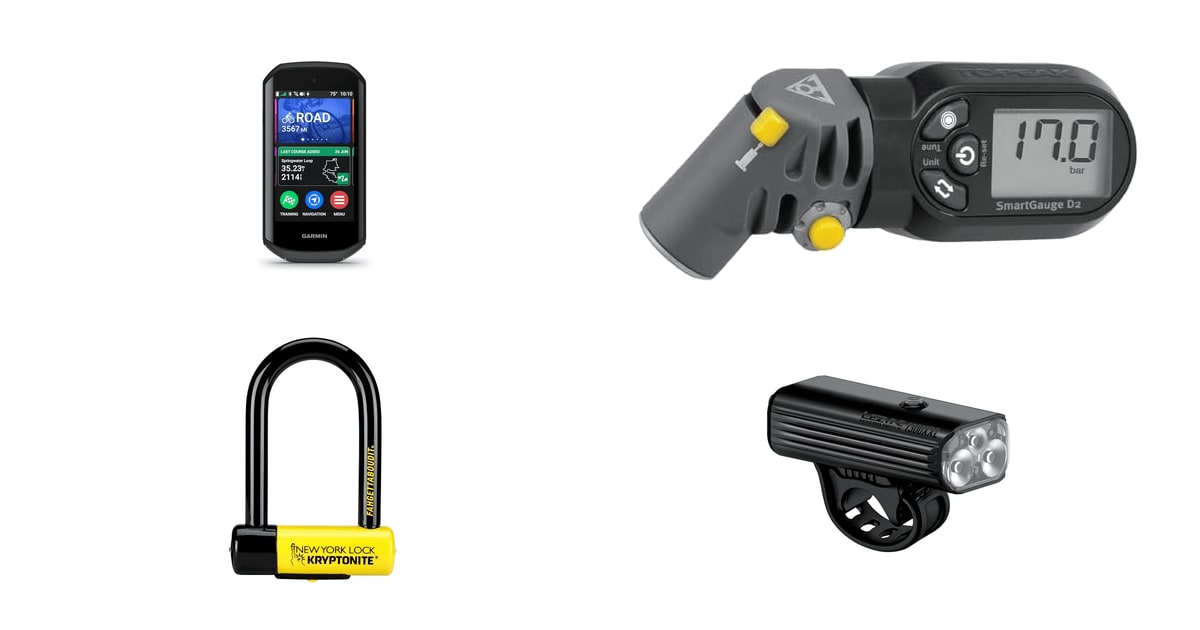
An e-bike changes what you ask of your gear. The bike is heavier, faster, and worth more than the commuter you probably owned before, and that shifts what counts as good. A lock that was fine for a beach cruiser isn't fine for a bike a thief can resell in an afternoon. A light rated for 15 mph isn't enough when you're holding 25. And a mid-drive motor buzzes at a frequency that shakes cheap mounts and phone cameras apart over months of riding.
Here's the honest part: no accessory fixes the thing you actually want fixed, which is range. Nothing here adds miles to your battery. The gauge helps at the margins, good panniers keep you from strapping a backpack to your spine, and a head unit tells you how much charge you have left — but the pack is the pack. Some of these upgrades are also plainly heavy, and on an e-bike that already weighs 50-plus pounds, every pound you add is a pound you'll feel carrying it up basement stairs.
We looked at published reviews, manufacturer specs, and what owners say after a season or two of daily use. The gear that keeps earning its place is boring in the best way: it works wet, it survives vibration, and it doesn't need babying. We think that the Kryptonite New York Fahgettaboudit Mini is the best e-bike accessory for most people, and that the Garmin Edge 1050 is the one to buy if you ride long routes and want real motor and battery data on screen.
Everything we recommend
The lock that makes a thief go find an easier bike

Real motor and battery data on a screen you can read in sun

Enough light to ride confidently at e-bike speeds after dark

Cargo that stays dry, on a rack, instead of on your back

The cheap tool that quietly protects your range and your tires
At a glance
| Product | Accessory Type | Key Spec / Bike Fit | Price | |
|---|---|---|---|---|
| Garmin Edge® 1050Upgrade pick | Cycling Computer | Up To 20 Hours | $686.90 |
| Topeak SmartGauge D2 Digital Tire Pressure GaugeBudget pick | Tire Pressure Gauge | 250 Psi/17 Bar | $37.06 |
| Kryptonite New York FAHGETTABOUDIT Mini Bike U-LockTop pick | U-Lock | 18mm Shackle | $179.95 |
| LEZYNE Macro Drive 1300XXL Bicycle USB RechargeableAlso great | Front Light | 1300 Lumens | $89.90 |
| Ortlieb Back-Roller Classic QL2.1 PanniersAlso great | Panniers | 40L | $199 |
How we picked
Survives vibration. Mid-drive motors buzz constantly, and gear that isn't built for it loosens, cracks, or shakes apart. We favored purpose-built cycling hardware with metal bodies and proper mounts over consumer electronics pressed into bike duty.
Weatherproofing that's rated. We looked for published IP ratings rather than vague claims of water resistance, and preferred immersion-rated gear for anything electronic. Owner feedback about multi-season wet-weather use had to back the spec up.
Real security certification. For locks we cared about shackle diameter, crossbar locking design, and independent security ratings — not marketing language. A lock that only locks one leg of the shackle didn't qualify.
Weight you can live with. An e-bike is already heavy, so we weighed every addition against what it does for you. We accepted extra bulk only where it buys something concrete, like a thicker shackle or a brighter beam.
Long-run owner reports. We leaned hardest on feedback from people who'd owned the gear for multiple seasons, because failure modes like rust, cracked hooks, and dying batteries only show up with time.
Top pick
The lock that makes a thief go find an easier bike
Kryptonite New York FAHGETTABOUDIT Mini Bike U-Lock
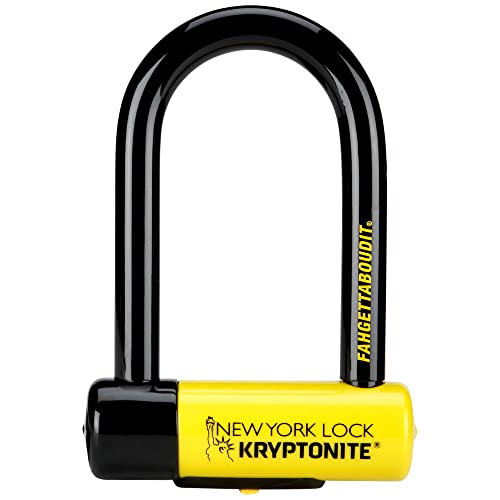
A stubby, extremely heavy U-lock with an 18mm hardened steel shackle and a double-deadbolt crossbar. It's the first thing you should buy for an e-bike, because everything else you spend money on is worthless if the bike is gone.
$179.95fromAmazonIf you buy one thing for a new e-bike, buy this. An e-bike is one of the most stealable objects you can leave on a sidewalk. It's valuable, it's easy to ride away on, and there's a ready resale market for it. The Fahgettaboudit Mini's 18mm shackle is roughly the thickness where hand tools stop being an option. Bolt cutters won't touch it. A thief needs a power tool and the nerve to use it in public.
The double-deadbolt crossbar matters more than people realize. Cheaper U-locks lock on one side only, which means a thief cuts once and the lock falls open. This one locks both legs of the shackle, so a single cut leaves the bike still attached. Owners who've compared it against the U-locks they used to carry point to exactly this detail as the reason they switched.
The short shackle is a feature, not an oversight. Less open space inside the U means less room to wedge in a jack or a length of pipe for a leverage attack. It also means you have to think about where you park. You'll want a proper rack or a fat, immovable post, not a skinny signpost a thief can lift the bike over.
The weight is the price of admission. This thing runs about four and a half pounds, and that's not a rounding error in a backpack. On an e-bike, though, the math is friendlier than on a road bike. You already have a motor. Four pounds on a 55-pound bike disappears. The included frame bracket helps, though owners report mixed luck with it depending on frame shape — several ended up buying a third-party bracket instead.
Flaws but not dealbreakers
It rusts. Owners in wet and salted-road climates report corrosion on the shackle and, worse, a cylinder that starts to bind. A stuck lock with your bike inside it is its own kind of bad day. A drop of lubricant in the keyway every month or two is not optional maintenance here.
The keyhole dust cover is the flimsiest part of an otherwise overbuilt product, and owners report it breaking off. The lock still works without it, but grit gets into the cylinder faster once it's gone.
You can't secure both wheels with it. The shackle simply isn't long enough. If you're leaving the bike somewhere overnight, plan on a second cable or chain for the front wheel — which is two locks to carry, and there's no way around that.
Upgrade pick
Real motor and battery data on a screen you can read in sun
Garmin Edge® 1050
Garmin's flagship cycling computer, with a bright 3.5-inch touchscreen, deep route planning, and support for the ANT+ LEV protocol that connected e-bike motors use. It's expensive and it's more computer than a casual rider needs.
$686.90fromAmazonYour bike's stock display probably shows you four LED bars and an assist level. That's fine for a trip to the store and useless for planning a 40-mile day. The Edge 1050 speaks ANT+ LEV, the protocol connected motor systems use, which means assist level, battery percentage, and range estimate can all live on one screen alongside your route. You stop guessing and start managing.
The screen is the reason to pick this over an older Edge. Owners upgrading from a 1030 or 1040 consistently single out the display: it's brighter, sharper, and readable in direct sun without squinting. That matters more on an e-bike than on a road bike, because you're often navigating city streets at speed, and a glance has to be a glance.
Garmin quotes up to 20 hours in demanding use and up to 60 in battery-saver mode. Either number outlasts your bike's battery by a wide margin, so this isn't a device you'll be nursing along. It also handles the vibration question. A mid-drive motor buzzes constantly, and Apple has warned that motorcycle-class vibration can permanently damage an iPhone's camera stabilization. A purpose-built bike computer sidesteps that whole problem.
The extras are genuinely useful rather than spec-sheet filler. ClimbPro flags upcoming ascents with gradient detail, which on an e-bike is really a battery-planning tool — you can see the climb coming and decide whether to spend charge now. There's a built-in speaker for navigation prompts and a surprisingly loud bell. Road hazard alerts from other riders show up on the map.
Flaws but not dealbreakers
It's the most expensive thing in this guide by a wide margin, and it's overkill for a lot of riders. If you commute the same four miles every day and your bike's display tells you enough, you don't need this.
The LEV integration depends on your motor and its firmware. Bosch, Shimano, and Brose systems generally play along, but depth varies and older firmware may show you very little. Check your motor system against Garmin's compatibility list before you buy, not after.
Early owners ran into software rough edges after launch — the kind that get patched but are irritating in the meantime. Some also feel the 1050 traded away small conveniences their older Edge had. Neither is a dealbreaker, but don't expect a flawless first week.
Also great
Enough light to ride confidently at e-bike speeds after dark
LEZYNE Macro Drive 1300XXL Bicycle USB Rechargeable
A CNC-machined aluminum front light with 1300 lumens at peak, seven modes, and an IPX7 waterproof rating. It's heavy and it's bright, and on a Class 3 e-bike at night, both of those turn out to be the point.
$89.90fromAmazonSpeed changes how much light you need. A 200-lumen blinker announces you exist. It does not show you the pothole. On an e-bike holding 20-plus mph, you need to see far enough ahead to actually stop, and that's where 1300 lumens earns its keep. The Tri-Focus optics put a bright center spot inside a wide flood, so you get distance down the road and enough spill to catch a curb.
Most owners don't run it at full blast, and that's the smart way to use it. The middle settings light a suburban street just fine and stretch runtime dramatically. Save Over Drive for unlit roads and fast descents. Lezyne quotes up to 148 hours in the lowest Femto mode, which is a daytime-flash-and-forget number more than a real riding mode.
IPX7 means immersion to a meter for half an hour, not just splash resistance. In practice that covers riding through a downpour, blasting through a flooded gutter, and hosing the bike down afterward. Cheaper lights carry IPX4 or IPX5 ratings and fail in exactly those situations. The aluminum body with cooling fins also keeps output steadier as the light heats up.
Flaws but not dealbreakers
It's a brick. Around 200 grams, and owners mention the weight constantly — usually approvingly, but it's real. On a helmet mount you'll notice it after an hour.
Runtime at peak is short. Plan on recharging after any long night ride, and note that it charges over Micro USB, not USB-C, which is an annoyance if you've standardized everything else in your life.
There's no light sensor, so it won't switch modes on its own when you ride into a tunnel or out of a lit street. And the body gets warm during sustained high output, which is normal for a light this bright but surprises people the first time.
Also great
Cargo that stays dry, on a rack, instead of on your back
Ortlieb Back-Roller Classic QL2.1 Panniers
A pair of 20-liter roll-top panniers with welded seams and a quick-release mounting system that clips on in seconds. If you commute with a laptop and a change of clothes, these move that weight off your shoulders and keep it dry.
$199fromAmazonThe roll-top closure and welded seams are why these have been the default recommendation for decades. There's no zipper to fail and no seam to wick water. Owners who ride through genuinely wet winters report laptops and clothes coming out dry after years of daily use, which is the only durability claim that really matters for a bag like this.
Getting weight off your back is the underrated upgrade here. A loaded backpack on a commute means a sweaty shirt and a sore neck, every day. Panniers put that load low and over the rear axle. On an e-bike the motor doesn't care about the extra weight at all — you'll barely notice the groceries are there until you go to lift the bike.
The QL2.1 hooks clip on and off in a couple of seconds without tools, and they fit essentially every standard rear rack. That includes the integrated racks common on e-bikes. The anti-sway lock matters more here than on a regular bike, because mid-drive motors deliver a lot of torque from a standstill, and a bag that shifts on hard acceleration eventually works its hooks loose.
Longevity is the real argument. Owners routinely describe sets lasting five, ten, even twenty years of commuting. Cheaper panniers get replaced every couple of seasons as coatings peel and hooks crack. Spread across that many years, the expensive pair stops looking expensive.
Flaws but not dealbreakers
It's one big bucket inside. There are no pockets, dividers, or laptop sleeve in the base set. Small things migrate to the bottom, and you'll want packing cubes or a separate sleeve to impose any order. Ortlieb sells accessories for this, but they're extra.
A roll-top is slower than a zipper. Every stop means unrolling and re-rolling, and if you're the sort who grabs your phone from your bag at every red light, it'll wear on you.
The high-visibility yellow-black is genuinely safer at night and genuinely loud in an office lobby. Some people love it, some don't.
Ortlieb backs the Back-Roller Classic with a five-year warranty.
Budget pick
The cheap tool that quietly protects your range and your tires
Topeak SmartGauge D2 Digital Tire Pressure Gauge
A pocket-sized digital gauge that reads both Presta and Schrader valves with a twist of the head, up to 250 psi. It has a bleed button so you can dial pressure down precisely instead of guessing.
$37.06fromAmazonTire pressure is the most neglected thing on most e-bikes and one of the few free levers you have on range. Underinflated tires roll worse, which means the motor works harder, which means you get fewer miles per charge. They also pinch-flat more easily, and an e-bike puts far more weight on its tires than the bike you rode in college.
Floor pump gauges lie, and this one doesn't. Built-in pump dials are usually approximate at best and drift as they age. A dedicated digital gauge reads to a tenth of a psi and holds the reading on screen, so you're not crouched on the garage floor squinting at a needle. Owners who've replaced decade-old analog gauges with this one consistently call out the accuracy and the ease of reading it.
The rotating SmartHead is the practical detail that makes you actually use it. No adapters, no swapping parts — twist it and it fits whichever valve you have. The bleed button lets you overshoot with the pump and then let air out a psi at a time until you hit your number. Small thing, but it turns a two-minute fiddle into a ten-second check.
Flaws but not dealbreakers
It's a gauge and nothing else. No pump, no inflation. It lives in your saddle bag to tell you what's wrong, not to fix it.
The CR2032 battery isn't rechargeable, and a few owners have had trouble getting the battery door open the first time — usually because of a protective film left on the cell at the factory. Worth knowing before you decide the unit is dead.
Every external gauge bleeds a tiny amount of air just to take a reading, which matters most on high-pressure road tires. And like most LCDs, the display can wash out in hard direct sunlight.
Who this is for
This guide is for people who already own an e-bike, or are about to, and want to know what to spend money on first. It's aimed at commuters and everyday riders more than racers. If you ride to work, haul groceries, park in public, or ride after dark, everything here is relevant to you. If your e-bike lives in a garage and comes out for weekend paths in daylight, you can skip most of it and just get the gauge.
We're covering bolt-on accessories only: locks, lights, cargo, tools, and electronics. We're not covering batteries, range extenders, motor swaps, or anything that changes how the bike is powered, because those depend entirely on your specific model and can void a warranty or create a real fire risk if you get them wrong. Talk to your manufacturer before touching the electrical system. Tires and brakes are also out of scope here — they deserve their own guide.
How we picked
We built this list around what an e-bike does differently than a regular bike: it's heavier, faster, more valuable, and it vibrates. Vibration: we favored purpose-built cycling gear with metal housings and mounts designed for sustained motor buzz, since consumer electronics tend to fail here slowly and expensively. Weatherproofing: we wanted published IP ratings, ideally immersion-rated for anything with a battery in it, and owner reports from wet climates to confirm the rating holds up. Security: for locks we looked at shackle thickness, double-deadbolt crossbar design, and independent certification rather than claims. Weight: every accessory adds pounds to a bike that's already hard to carry upstairs, so extra bulk had to buy something real. Longevity: we weighted feedback from owners several seasons in, because rust, cracked hooks, and dying cells only show up with time.
The competition
This is what our research surfaced, not a census of everything sold. The e-bike accessory market is enormous and turns over fast, and there are certainly good products we didn't look at. What follows is how the rest of this lineup stacked up against the picks.
Care and maintenance
Most of this gear fails in predictable ways, and a few minutes a month prevents nearly all of it. Put a drop of lubricant in your lock's keyway regularly, especially if you ride through salt or rain — a seized cylinder with your bike attached is the single most common complaint owners have about heavy U-locks. Check tire pressure weekly rather than monthly, since e-bike tires carry more load and lose air faster than you'd expect, and a few psi genuinely affects how far you go. Wipe road grime off your light's lens after wet rides, because a filmed-over lens throws a surprisingly dim beam. Rinse salt and mud off pannier hooks so the release mechanism keeps working smoothly. And charge lights and computers before they run flat rather than after.
Questions we get
What should I buy first for a new e-bike?
A serious lock, before anything else. Your bike is a high-value target and the lock is the only accessory that protects the whole investment. After that, front and rear lights if you'll ride after dark, then a tire pressure gauge, then panniers if you carry anything. A cycling computer is the last thing to buy, once you're riding far enough that route planning and battery data actually matter.
Why do e-bikes need a stronger lock than regular bikes?
Because they're worth more and easier to sell. Thieves working city centers routinely carry portable power tools, and a thin-shackle lock gives way in well under two minutes. The thicker the shackle and the better the crossbar design, the longer and louder the attack has to be — and time and noise are what actually deter theft. Lock through the frame and rear wheel to something fixed and immovable, never to a signpost a bike can be lifted over.
Can I just use my phone for navigation instead of a bike computer?
You can, but there's a real risk. Apple's own documentation warns that motorcycle-class vibration can permanently damage an iPhone's camera stabilization system, and mid-drive e-bike motors produce exactly that kind of sustained buzz. If you're going to mount a phone, use a vibration-damping mount made for powered two-wheelers. A dedicated cycling computer avoids the problem entirely and reads better in sunlight.
How bright does my front light need to be?
It depends on your speed and where you ride. On lit city streets at moderate speed, a few hundred lumens is plenty and mostly about being seen. On unlit roads at Class 3 speeds, you want considerably more, because you need to spot a pothole with enough distance to stop. Most people who own a very bright light run it on a middle setting nearly all the time and save full output for dark descents.
Do panniers fit any rack?
Most standard rear racks, yes, including the integrated racks common on e-bikes. The main things to check are the rack tube diameter and whether your bike's rack uses a proprietary mounting system. Incompatible hook systems are one of the most common reasons cargo accessories get returned, so measure before you order. If your e-bike came with a manufacturer-specific rack, check its documentation first.
Can I add a second battery to extend my range?
Only if your bike is explicitly designed for it. Some Bosch and Shimano platforms support factory-approved range extenders on compatible frames, but most e-bikes aren't built for a second pack. Adding one improperly can void your warranty, confuse the motor controller's safety systems, or create a genuine charging hazard. Check your manufacturer's documentation before you spend anything.
Why you should trust us
For this guide:
- We read manufacturer specifications, published cycling reviews, and independent lock security ratings for every product in this lineup.
- We compared owner feedback across multiple seasons of ownership to identify the failure modes that only show up over time, like corrosion, hook wear, and battery degradation.
- We prioritized the concerns specific to electric bikes — motor vibration, higher speeds, heavier loads, and theft risk — over general cycling criteria.
- We read owner reviews on every listing, weighted toward the critical ones, because that is where the recurring failures show up.
- We have a systematic way of automatically fetching the latest prices, so the numbers on this page stay current.
- This is a research-focused guide, so the team may not own every product listed — though we often do own the top winners, which gives us extra context for the recommendations.
- We don't accept free products, and the retailer commission never changes which product we recommend.
Sources
Best E-Bike Accessories 2026, Cycling Weekly
E-Bike Lock Test & Security Ratings, Sold Secure
Best Bike Lights 2026, BikeRadar
Avoiding Bike Mount Vibration Damage to iPhone Camera, Apple Support
E-Bike Market Statistics & Consumer Trends 2025–2026, Light Electric Vehicle Association
Best E-Bike GPS Computers 2026, DC Rainmaker
Bosch eBike Systems — PowerTube 625 Specifications, Bosch eBike Systems
Schwalbe E-Bike Tire Technology — SmartGuard Puncture Protection, Schwalbe
Amazon product listings and owner reviews for all 5 products
Manufacturer specification pages for each product
Some passages in this guide may be paraphrased with AI help. Prices are refreshed automatically.
More like this.
Continue exploring electronics reviews and recommendations.

The Best RV Accessories and Camper Upgrades
An RV is a house that shakes at 65 miles an hour, and most of the parts that make it livable didn't come from the factory. You add them. Power that lasts…

The Best Commuter E-Bike Accessories
A commuter e-bike gets you to work. The gear bolted to it decides whether the ride is pleasant or grim. You're out in traffic at speeds a regular bike…

The Best Trail Mountain Bike Accessories
The bike you already own is probably fine. What's holding you back on a wet descent or a ride that runs long is usually smaller and cheaper than a new…

The Best Work-From-Home Upgrades
Most home offices got built in a hurry. A dining chair, a laptop propped on a stack of cookbooks, and whatever light happened to come through the window.…

The Best Electric Bike Conversion Kits
Most bikes sitting in American garages are perfectly good bikes. They just don't get ridden, because the hill between you and the office feels steeper on…

The Best Bike Computers
A bike computer earns its spot on your stem by answering the questions your phone handles badly. How far to the next turn? How hard are you actually…