The Best Fish Tank Starter Kits for Beginners
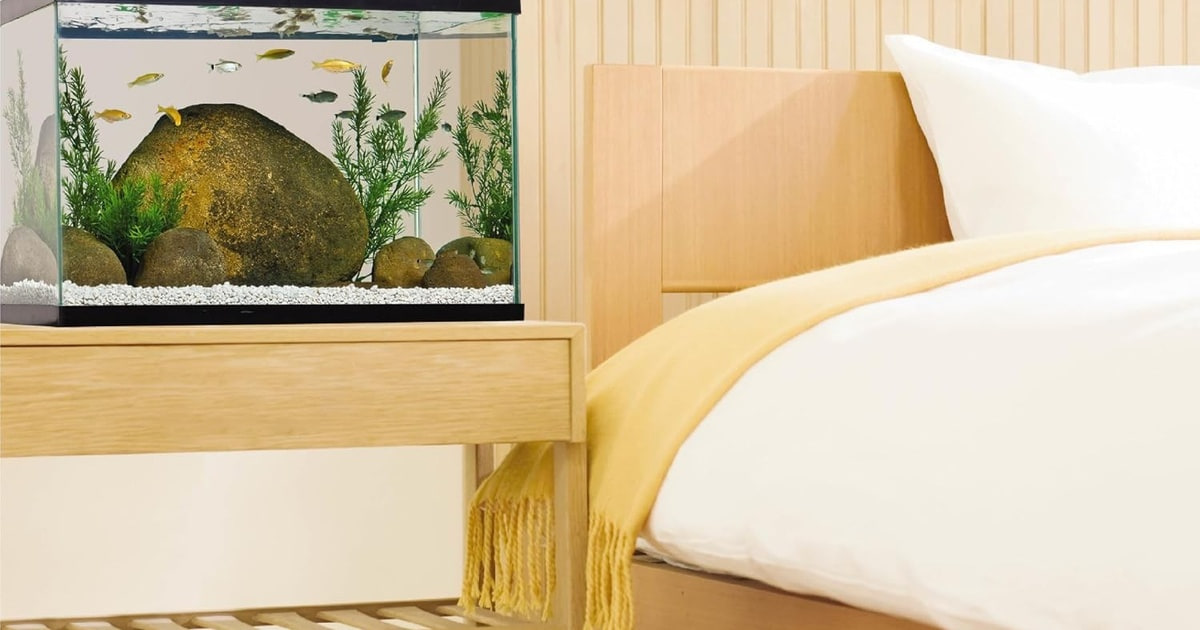
A fish tank is the rare pet that asks for a little work every week instead of a lot every day. But the equipment you start with decides how pleasant that work is. A quiet filter that moves enough water, a heater you can't accidentally set to 90 degrees, and a light you don't hate looking at will carry you through your first year. Roughly 11.1 million U.S. households keep freshwater fish, according to the American Pet Products Association, and most of them started with a boxed kit like these.
Here's the part the box won't tell you. No starter kit can skip the nitrogen cycle, the four-plus weeks it takes for bacteria to colonize your filter and start converting toxic ammonia into something your fish can live with. Fishkeeping World points to skipping that wait as the main cause of early fish death in new tanks. Kits also tend to bundle a bare-minimum filter that technically fits, and Aquarium Co-Op has flagged that many of these filters turn over the water only two or three times an hour — about half what you want.
The other thing to know is that small isn't easy. A 3-gallon tank swings in temperature and ammonia within hours, while a 20-gallon gives you days of margin. That's why we lean toward 10 gallons and up for a first tank, and why the compact picks here earn their place on filtration rather than cuteness. We think that the Fluval Flex 15 is the best fish tank starter kit for most beginners, and that the Aqueon Aquarium Starter Kit 10 Gallon is the one to buy if you want everything in one box without spending much.
Everything we recommend
Serious filtration in a tank you'll actually want to look at

Everything in one box, and the size beginners should start at
The compact tank to get if you're keeping one betta

More swimming room for a modest step up in price

The best filtration you can get in a five-gallon footprint
At a glance
| Product | Capacity | Filtration | Price | |
|---|---|---|---|---|
| Aqueon Aquarium Starter Kit with Smart CleanBudget pick | 10 Gallon | Smart Clean Filtration | $121.52On sale |
 | Marina 5 GallonAlso consider | 5 Gallon | Slim S20 Filter | $67.99 |
| Tetra Complete 20 Gallon Fish Tank KitRunner-up | 20 Gallon | Internal Filtration | $113.18 |
| Marineland Portrait Glass LED Aquarium KitAlso great | 5 Gallon | 3-Stage Filtration | $109.99On sale |
 | hygger Horizon 8 Gallon LED Glass AquariumAlso in lineup | 8 Gallon | 7W Power Filter | $139.99On sale |
| Fluval SPEC Aquarium KitUpgrade pick | 5 Gallon | 3-Stage System | $153.99 |
| Fluval Flex 57 - 15 Gallon NanoTop pick | 15 Gallon | 3-Stage Filtration | $189.99 |
 | Coralife LED Biocube Aquarium Starter KitAlso consider | 16 Gallon | Filtration Chamber | $292.05On sale |
How we picked
Filtration first. We compared manufacturer flow ratings against tank volume, looking for at least four to five turnovers per hour and preferring kits with genuine three-stage media over a single cartridge. Aquarium Co-Op's point that many bundled filters fall short of that minimum shaped how skeptical we were of spec-sheet claims.
Forgiving size. We favored 10 gallons and up, because The Spruce Pets and other beginner guidance agree that smaller volumes let ammonia and temperature spike within hours. We included 5-gallon kits only where the filtration and design made them clearly suited to a single betta or shrimp.
Heater safety. We checked whether a heater was included, its wattage against tank volume, and whether it was preset or dial-adjustable. Preset heaters got credit for beginners, since PetMD notes tropical fish need a tight temperature band and a misread dial is an easy mistake.
Noise and placement. We read owner feedback for recurring reports of humming pumps, rattling filter compartments and vibration, since a starter tank usually ends up in a bedroom, dorm or office. Repeated noise complaints counted against a kit even when its other specs were strong.
Parts you can find. We looked at how easily replacement cartridges and media are stocked at major retailers, because a filter you can't service is a filter you'll stop maintaining. Fluval and Marineland media are widely available, and Aqueon's is close to universal.
Top pick
Serious filtration in a tank you'll actually want to look at
Fluval Flex 57 - 15 Gallon Nano
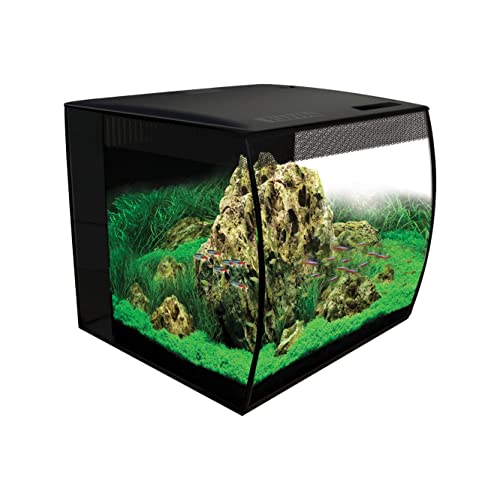
The Fluval Flex 15 hides a real three-stage filter behind its curved front glass, so your water stays clear without a plastic box hanging off the back. It's big enough to forgive a missed water change and small enough for a console table.
$189.99fromAmazonThe filter is the reason to buy this tank. Fluval rates the Flex 15's internal pump at 260 GPH, which works out to roughly 17 times the tank's volume every hour. Most guidance puts the freshwater minimum at four or five times. You won't need all of that turnover, and you can dial the dual outputs down. But it means the mechanical, chemical and biological media all get fed properly, which is what actually keeps water clear.
Fifteen gallons is a genuinely useful size for a beginner. You get enough water volume that a skipped Saturday won't crash your parameters, but the footprint is barely larger than a 10-gallon because the Flex is built deep rather than wide. Owners moving up from 5-gallon tanks consistently mention this — nearly double the water, not much more furniture. It'll hold a small school of tetras or rasboras with room to spare.
The LED is the other thing you're paying for. It's a 7500K white plus RGB array with a remote, so you can set a color you like and grow real plants under it instead of plastic ones. Live plants aren't decoration for a beginner — they consume nitrate and buy you slack between water changes. The remote's lightning and cloud effects are a gimmick, and you'll use them once.
The honeycomb wrap around the back hides the waterline and the filter compartment, and there's a surprising amount of usable space back there. Owners routinely tuck a heater and a seeded sponge filter into it, which is the fastest legitimate way to shorten your cycling wait. Nothing is visible from the front. For a tank that lives in a living room, that matters more than you'd expect.
Flaws but not dealbreakers
No heater is included, which is a real gap in a beginner kit. You'll need to buy one separately, and for a 15-gallon tropical setup that's another decision to research. Budget for it up front.
It's the most expensive freshwater option here by a comfortable margin, and pump reliability isn't perfect — a minority of owners report a rattling or humming pump out of the box. Fluval's customer service draws mixed reports when that happens, so buy from a retailer with an easy return window.
Budget pickOn sale
Everything in one box, and the size beginners should start at
Aqueon Aquarium Starter Kit with Smart Clean
Aqueon's 10-gallon kit includes a preset 50W heater, filter, thermometer, net, food and water conditioner, so you can go from unboxing to a filled tank in an afternoon. It's the most widely stocked beginner kit in the country, which makes replacement parts easy.
$121.52fromAmazonList priceThis is the kit that answers "what do I need?" with a single box. You get the glass tank, a hood with LED lighting and a feeding door, the SmartClean internal filter with a cartridge, a preset heater, a thermometer, a net, a food sample and water conditioner. Nothing else to buy before you start cycling. For a parent setting this up with a seven-year-old on a Saturday, that completeness is worth more than any single spec.
The preset heater is the quietly smart choice here. It holds 78 degrees and has no dial, which sounds like a limitation until you consider what goes wrong with adjustable heaters. PetMD notes that tropical fish want their temperature held within a couple of degrees, and a dial that a beginner misreads — or a kid nudges — can cook a tank overnight. Fifty watts is right for 10 gallons. You lose flexibility and gain a much smaller chance of disaster.
Ten gallons is the smallest size we'd point a first-timer toward, and The Spruce Pets draws the same line. Below that, a single missed water change can spike ammonia within hours because there's so little water to dilute it. At 10 gallons you have room for a betta and some snails, or a small group of guppies, platies or tetras — and enough margin to make a mistake and fix it.
Aqueon is stocked at essentially every pet retailer in the U.S., so cartridges and parts are a five-minute errand rather than a shipping wait. That sounds boring. It stops mattering right up until the week your filter needs a new cartridge and you're staring at an empty shelf.
Flaws but not dealbreakers
The build quality is merely fine. Owners regularly mention messy silicone work along the seams — ugly rather than leaky, but noticeable if you look. A few also report the filter failing within the first couple of weeks, which is a bad time for it to happen.
The included filter is adequate, not good. Its flow can feel strong in a partly filled tank and it's the first component most owners eventually replace. If you want to spend a little extra anywhere, spend it here rather than on decorations.
Also greatOn sale
The compact tank to get if you're keeping one betta
Marineland Portrait Glass LED Aquarium Kit
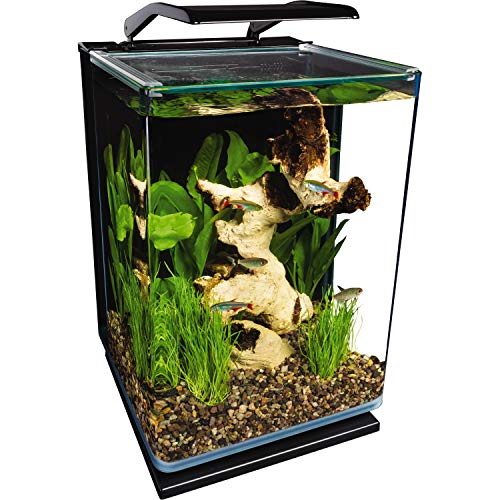
The Marineland Portrait's tall, narrow glass footprint fits a dorm desk or a nightstand, and its three-stage filtration is tucked out of sight behind the tank. The rear-compartment design keeps surface movement gentle, which is exactly what a betta wants.
$109.99fromAmazonList priceBettas don't want a current. They come from still, warm water, and a front-mounted hang-on-back filter pushes them around all day. Wirecutter's reporting on rear-compartment tanks like this one notes they produce noticeably less surface agitation than HOB filters. The Portrait's filtration lives behind the back wall, so the water turns over without turning your fish into a kite.
Five gallons is the compromise, and you should go in knowing it. This tank suits one betta and a snail, or a small shrimp colony, and that's the honest ceiling. Long-time owners say the same thing. Under five gallons the water chemistry gets twitchy fast; at five you're fine as long as you keep the stocking light and stay on a weekly water-change rhythm.
The design does a lot of work in a small room. Rounded corners, a clear glass canopy and a hinged LED hood mean you can look at it from any angle without seeing hardware. There are bright white LEDs for daytime and blue moonlight LEDs for evening. It's the tank we'd pick for a bedroom or an office desk where the equipment shouldn't be part of the decor.
It also fits Marineland's Rite-Size Z cartridges, which are common at chain retailers. Some owners find one specific filter piece annoying to source, but the cartridges themselves aren't hard to keep on hand.
Flaws but not dealbreakers
The rear filter compartment can rattle. Enough owners report a loose back panel or a buzzing pump in the first weeks that it's a known pattern rather than a fluke, and the fix is usually an exchange.
There's no heater in the box, which is a problem for the betta keepers this tank is aimed at — bettas need water in the upper 70s year-round. Plan on buying a small adjustable heater, and check that it fits the compartment before you fill the tank.
Runner-up
More swimming room for a modest step up in price
Tetra Complete 20 Gallon Fish Tank Kit
Tetra's 20-gallon kit gives you double the water of a standard starter tank plus a heater, thermometer, internal filter and hinged hood. If you want a community of small fish rather than one betta, this is the practical starting point.
$113.18fromAmazonTwenty gallons changes what you can keep. Following the rough one-inch-per-gallon guideline adjusted for adult size, Aquarium Source puts a 20-gallon at roughly 10 to 15 small community fish — about three times what a 5-gallon supports. That means a school of neon tetras and a few corydoras instead of a single betta staring at you. For kids who want to watch something happen, a school is a much better show.
The extra volume also does quiet work on your behalf. More water means slower swings in ammonia and temperature, so a forgotten water change is a nuisance rather than an emergency. Beginners who start at 20 gallons tend to have an easier first six months than beginners who start at five, even though the bigger tank sounds more intimidating.
The kit is genuinely complete for the money. You get the glass tank, a low-profile hinged hood, LED lighting, an internal filter with a cartridge, a heater, a thermometer, water conditioner and food samples, and a setup guide. The hinged hood is a small thing that you'll appreciate every single feeding — no lifting a whole lid off with wet hands.
One design note worth knowing: this 20-gallon is built tall rather than long, at 24 by 12 by 16 inches. Tall tanks give fish less horizontal swimming lane per gallon. It's not disqualifying, but if you're deciding between this and a longer 20-gallon elsewhere, the longer one is generally the better home.
Flaws but not dealbreakers
The pump is the weak link. Owners describe it as noticeably noisy compared with other brands, and swapping it for a quieter one is a common early upgrade. If the tank is going in a bedroom, budget for that.
The instructions are thin, and the light strip's mounting clips draw complaints — some owners report the clips breaking or the strip not sitting properly under the hood. Neither ruins the tank, but neither belongs in a kit sold on ease of setup.
Upgrade pick
The best filtration you can get in a five-gallon footprint
Fluval SPEC Aquarium Kit
The Fluval Spec V pairs a three-stage filter with a 37-LED, 821-lumen light in an etched-glass tank with aluminum trim. It's the small tank for someone who cares more about water quality and plant growth than about getting everything in one box.
$153.99fromAmazonSmall tanks live or die on filtration, and this is where the Spec V separates itself. It runs oversized mechanical, chemical and biological media — foam block, activated carbon and BioMax bio rings — with a pump rated at 55 to 80 gallons per hour. In five gallons that's more than 10 turnovers hourly. Compared with the single cartridge that ships in most 5-gallon kits, it's a different class of equipment.
The light is bright enough to actually grow things. Fluval rates it at 821 lumens across 37 LEDs at 7000K, which puts easy plants like anubias, java fern and cryptocoryne well within reach. Plants aren't just decoration in a nano tank — they pull nitrate out of the water and give a betta places to rest near the surface.
You'll need to modify it for a betta, and that's a known trade-off. The stock outflow is strong for a fish that likes still water. The standard fix is a sponge or baffle on the output, which owners have been doing for years and which takes about ten minutes. Do it, and this becomes an excellent betta home. Skip it, and your fish will spend its day fighting the current.
The 17-inch swim lane is unusual for five gallons — the tank is long rather than tall, which suits shrimp colonies and nano fish that cruise horizontally. Etched glass and aluminum trim make it look like furniture rather than equipment.
Flaws but not dealbreakers
There's no heater, and the tank is small enough that room-temperature swings show up quickly in the water. A nano heater is a required purchase, not an optional one.
It costs more than any other 5-gallon here, and a vocal minority of owners feel it doesn't earn that. The common complaints are the strong stock flow and a fussy pump. It's a premium tank that expects a little tinkering from you, which isn't what every beginner wants.
Who this is for
This guide is for anyone setting up their first freshwater tank — a first-time owner, a parent buying a starter pet for a kid between about 7 and 14, an apartment or dorm dweller who wants something calm on a desk, or someone graduating a betta out of a bowl. If you want the aquarium mostly for the quiet of it, that's a legitimate reason: a study at the National Marine Aquarium in Plymouth found that watching fish lowered participants' heart rate by about 7% on average, along with measurable drops in blood pressure. Every kit here is glass rather than acrylic, which matters because Fish Laboratory reports acrylic scratches up to 10 times more easily during routine algae scraping.
This isn't the guide for you if you're already running tanks and shopping for a specific piece of gear, or if you're set on a large custom build with a sump. We're also not covering goldfish setups well — goldfish want cool, high-flow, high-volume water, and almost every kit here is built around a heater and gentle flow for tropical fish. If saltwater is where you're headed, read the BioCube entry below, but know that a freshwater year first will teach you the habits that make a reef tank survivable.
How we picked
We weighed each kit on five things. Filtration: we compared rated flow against tank volume, looking for at least four to five turnovers an hour and favoring real three-stage media over a lone cartridge. Size: we leaned toward 10 gallons and up, since smaller volumes let ammonia and heat spike within hours, and allowed 5-gallon kits only where the design clearly suits one betta or a shrimp colony. Heater: we checked wattage against volume and gave preset models credit, because a dial a beginner misreads is a common and expensive mistake. Noise: we read owner feedback for recurring humming, rattling and vibration reports, because these tanks live in bedrooms and dorms. Parts: we favored brands whose cartridges and media sit on shelves at ordinary pet stores.
Other fish tank starter kits for beginners worth considering
If you want a simple 5-gallon with a clip-on filter you can service in seconds: The Marina 5 Gallon ($67.99) — The Marina 5 Gallon LED kit is the most straightforward small tank here. Its Slim S20 clip-on filter uses quick-change cartridges, and owners consistently call it quiet and easy to swap — no reaching into a rear compartment. The kit includes Nutrafin Aqua Plus conditioner, a net, food and a temperature strip, plus a beginner guide that walks through the nitrogen cycle. What you give up is filtration muscle and looks: the clip-on hangs visibly off the back, and its media capacity doesn't approach the Fluval Spec V's. There's also no heater. For a first tank on a budget where you'd rather not fuss with anything, it's a sensible landing spot.
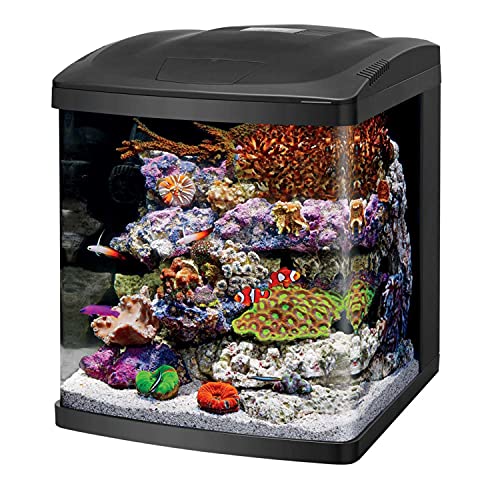
If you're set on starting with saltwater or a reef: The Coralife LED Biocube Aquarium Starter Kit ($292.05) — The Coralife LED BioCube 16 is the standard entry point, cited across the Reef2Reef community in more than 80% of first-saltwater-tank threads. The three-stage filtration is built into the back of the tank with a submersible return pump, dual intakes and an adjustable nozzle, so you get a reef-capable setup without plumbing anything. The hood's LEDs run three independent channels on a 24-hour timer with sunrise and sunset fades, and they're strong enough to keep corals. Be realistic about what you're taking on: saltwater means salinity testing, mixing water and more equipment. Owners also report the stock pump can hum and that leaks around the top seam show up in a minority of tanks.
The competition
This is what our research surfaced among widely sold beginner kits, not a survey of everything available. Plenty of good tanks — especially bare tanks you equip yourself — sit outside the all-in-one kit format we looked at here.
The hygger Horizon 8 Gallon LED Glass Aquarium ($139.99) — The hygger Horizon 8 Gallon is the most eye-catching tank in this group, with curved panoramic front glass, an 18W LED on a digital controller with timer and brightness settings, and a molded 3D rockery background. The problem is that background. It's not removable, it eats a meaningful share of the 8-gallon volume — the tank only holds about 6 gallons of water to begin with — and its porous surface traps waste and grows algae quickly. Several owners also warn that small fish can get into gaps behind the rockwork. The 7W, 110 GPH filter is quiet and adjustable, and if you plan to keep shrimp rather than fish, the trade-offs mostly disappear. As a first fish tank, though, we'd rather have the plain glass box and more usable water.
Setting up and keeping it running
Fill the tank, run the filter, and wait before you buy fish. The nitrogen cycle takes at least four weeks, and rushing it is the single most common beginner mistake — the bacteria in your filter media are what convert toxic ammonia into safer nitrate, and they need time to establish. A bottled bacteria starter or a seeded sponge from an established tank speeds this up; a liquid test kit tells you when ammonia and nitrite have both hit zero. After that, plan on a 25% water change weekly with dechlorinated water, and rinse filter media in the water you removed rather than under the tap, which kills the bacteria you spent a month growing. Feed once a day, only what your fish clear in a couple of minutes. Overfeeding causes more cloudy-water panic than anything else.
Questions we get
What size aquarium is easiest to maintain for a beginner?
Ten to 20 gallons. It sounds backwards, but bigger tanks are more forgiving — more water dilutes waste and holds temperature steady, so small mistakes stay small. In a 1- to 3-gallon tank, ammonia and heat can spike within hours of a missed change. Start at 10 gallons if you have the space.
What is the nitrogen cycle, and do I really have to wait?
Yes, you do. The nitrogen cycle is the process of growing bacteria in your filter that turn toxic ammonia from fish waste into far less harmful nitrate. It takes a minimum of four weeks, and skipping it is the main cause of what hobbyists call new tank syndrome — fish that die in the first month. Run the tank empty, test the water, and add fish only after ammonia and nitrite both read zero.
Do starter kits include everything I need?
Not quite, and the gaps vary. The Aqueon and Tetra kits are the most complete here, both including a heater, thermometer, filter, conditioner and food. The Fluval and Marineland tanks don't include heaters at all, which you'll need for tropical fish. Nothing in any kit includes gravel, decorations, a water test kit or the fish.
What's the best beginner tank for a betta?
The Marineland Portrait, mostly because of its rear-compartment filtration. Bettas come from still water and hate current, and hidden rear filters stir the surface far less than a hang-on-back filter. The Fluval Spec V is the other good answer if you're willing to baffle the outflow with a bit of sponge. Either way, add a small heater — bettas need water in the upper 70s.
Are glass or acrylic tanks better for beginners?
Glass, for one practical reason: scratching. Fish Laboratory reports that acrylic scratches up to 10 times more easily than glass during ordinary algae scraping, and those scratches are permanent. A beginner is going to scrape a lot of algae in year one. Glass is heavier, but it stays clear.
Can I start with saltwater, or should I do freshwater first?
You can start with saltwater, and the Coralife BioCube 16 is the usual on-ramp. But freshwater teaches you the same habits — cycling, testing, water changes — with cheaper livestock and fewer variables. If you're patient and willing to test salinity weekly, go ahead. If you're not sure yet, a year of freshwater will make your first reef tank far more likely to survive.
Why you should trust us
For this guide:
- We read manufacturer spec sheets for every kit here, comparing rated filter flow against tank volume and heater wattage against water capacity.
- We reviewed published beginner guidance from The Spruce Pets, PetMD, Fishkeeping World, Aquarium Co-Op and Wirecutter, along with community consensus on Reef2Reef for the saltwater option.
- We read owner feedback across all eight kits for recurring themes — pump noise, rattling filter compartments, seam quality and missing components — rather than isolated complaints.
- We read owner reviews on every listing, weighted toward the critical ones, because that is where the recurring failures show up.
- We have a systematic way of automatically fetching the latest prices, so the numbers on this page stay current.
- This is a research-focused guide, so the team may not own every product listed — though we often do own the top winners, which gives us extra context for the recommendations.
- We don't accept free products, and the retailer commission never changes which product we recommend.
Sources
Best Fish Tanks — The Spruce Pets, The Spruce Pets
Best Aquarium Starter Kits — Aquarium Source, Aquarium Source
Fishkeeping World — Beginner's Guide to Starting an Aquarium, Fishkeeping World
Best Aquarium Kits — PetMD Editorial, PetMD
Aquarium Co-Op — Best Beginner Fish Tanks (YouTube + Blog), Aquarium Co-Op
Wirecutter — The Best Small Fish Tanks, Wirecutter / NYT
Chewy — Best Aquarium Starter Kits Buying Guide, Chewy
American Pet Products Association (APPA) 2025–2026 National Pet Owners Survey, APPA
Coralife Biocube Product Page & Reef2Reef Community Reviews, Reef2Reef Community
Fluval Flex Spec Sheet — Hagen Group, Fluval (Hagen Group)
Healthline — Stress Relief Benefits of Aquariums, Healthline
Fish Laboratory — Aquarium Kit Reviews & Comparisons, Fish Laboratory
Amazon product listings and owner reviews for all 8 products
Manufacturer specification pages for each product
Some passages in this guide may be paraphrased with AI help. Prices are refreshed automatically.
More like this.
Continue exploring pet reviews and recommendations.

The Best Betta Fish Tanks
A betta is sold as the easy pet, the one that lives in a vase on a windowsill. It isn't. A betta is a tropical fish that wants warm, stable water, a place…

The Best Beekeeping Starter Kits
Beekeeping gear is simpler than it looks. Nearly everything you'll see for sale is a Langstroth hive: a stack of boxes holding removable frames, with a…

The Best Fishing Rod and Reel Combos for Beginners
Your first fishing combo has one job: get you to the water without a fight. That means a reel that doesn't tangle when your cast goes sideways, a rod that…

The Best Fishing Gear for Beginners
Fishing asks less of you than almost any other outdoor hobby. You need something to cast with, something to tie on the end, and a place to stand. But the…

The Best Aquarium Filters for Freshwater Tanks
A freshwater filter is the one piece of equipment in your tank that never gets a break. It runs every hour of every day, pushing water through foam and…

The Best Nano Reef Tanks
A nano reef sits on a countertop and asks for attention every few days. The water volume is small, so everything you do to it lands hard. Add a fish, and…