The Best Gas Cans and Fuel Spouts
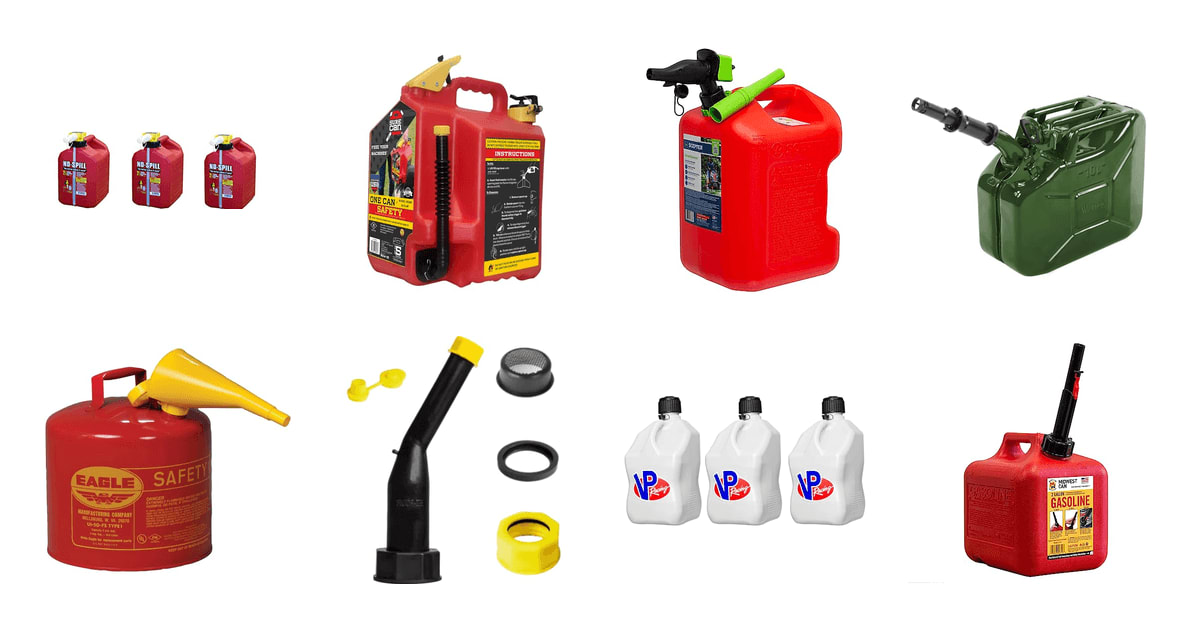
A gas can is one of those things you never think about until it fights you. You're standing over a mower deck with a hot muffler, the spout won't seat, and fuel is running down the side of the tank instead of into it. The right can changes that. It seats cleanly in the fill neck, it stops when you stop, and it doesn't glug and surge halfway through the pour. That's the whole job, and it's surprising how many cans still get it wrong.
Here's the honest part: no can in this category is a joy to use. Federal rules require automatic shut-off spouts and tight permeation limits, and every compliant design pays for that with stiffness, extra steps, or both. Some need sustained grip. Some need a specific angle. Owners across nearly every brand report the same complaints — a vent that clogs, a valve that gets harder over a season, a spout that dribbles. You're choosing the least annoying compromise, not a perfect product.
We also can't ignore that a plastic can is a consumable. Sun, heat cycles and ethanol all work on it, and owners who leave cans outside report seam splits and leaks within a couple of years. Steel costs more up front and weighs more in your hand, but it doesn't chalk out in the driveway. We think that the No-Spill 1405 is the best gas can for most people, and that the Scepter SmartControl is the one to buy if you want a single 5-gallon can that fills fast.
Everything we recommend

The easiest spout to work, in a size you can actually lift
Fills fastest, if your hand can hold the squeeze

Enough can for a mower and a snow blower, and not a bit more

Steel, a flame arrestor, and a cap that closes itself
At a glance
| Product | Capacity | Spout Type | Price | |
|---|---|---|---|---|
| No-Spill 1405 2-1/2-Gallon Poly Gas CanTop pick | 2-1/2-Gallon | 7/8-Inch Funnel Spout | $89.99 |
 | SureCan 5 Gallon Type II Storage ContainerAlso consider | 5 Gallon | Rotating Spout | $72.50On sale |
| Scepter 5 Gal Gas CanRunner-up | 5 Gallon | SmartControl Spout | $41.11 |
 | Wavian USA Authentic NATO Jerry Can andAlso in lineup | 10 Liters | Quick-Release Nozzle | $129.99On sale |
| Eagle 5 Gallon Type I Red SafetyUpgrade pick | 5 Gallon | Single Opening | $64.98On sale |
 | EZ-POUR® RIGID Replacement Spout & Vent KitAlso consider | — | 7" Rigid Spout | $11.95On sale |
 | VP Racing Motorsport 5.5 Gallon Square Even-DensityAlso in lineup | 5.5 Gallon | Wide Mouth Opening | $92.66 |
| Midwest Can 2310 Safe-Flo Auto Shut OffBudget pick | 2 Gallon | Quick-Flow Spout | $24.89 |
How we picked
Spout that works. We weighted spout mechanism heavily, because published reviews and owner feedback both point to the same thing: a stiff or clogged spout is why people abandon or break a can. Thumb buttons and triggers came out ahead of sustained-squeeze valves for anyone with limited grip.
Compliance, verified. Every can here meets EPA Phase II requirements under 40 CFR Part 59, meaning a permeation rate below 0.3 g/m²/day and an automatic shut-off spout. We checked manufacturer specification sheets for CARB EO numbers or an explicit compliance statement rather than taking a product page at its word.
Venting and flow. We looked for an integrated air vent, since a can without one builds a vacuum and surges. Manufacturer flow ratings gave us a ceiling and owner reports on smoothness gave us the reality check.
How it fails. Owner feedback told us the real failure modes: split seams on plastic cans left in the heat, vent plugs snapping after a couple of years, leaking spout gaskets. We favored designs where the recurring complaints were annoyances rather than leaks.
Capacity and weight. We matched size to workload — 2 to 2.5 gallons for small engines, 5 gallons for generators and larger equipment. A can you can't hold steady at the fill neck is a spill waiting to happen, so weight when full counted as much as volume.
Top pick
The easiest spout to work, in a size you can actually lift
No-Spill 1405 2-1/2-Gallon Poly Gas Can
A three-pack of 2.5-gallon cans with a thumb-button valve that shuts off the instant you let go. The narrow funnel spout seats in chainsaw and trimmer necks that fatter nozzles skate right off, and a full can stays light enough to hold steady with one hand.
$89.99fromAmazonThe thumb button is the least fussy control in the category. You press it to pour and release it to stop, and the stopping is immediate — no dribble, no trailing stream after you pull away. Compare that to a squeeze valve, where you're holding grip pressure with the same hand that's supporting the can. Owners who describe themselves as older or arthritic single this design out specifically. That's the tell.
Size is doing quiet work here too. A full 2.5-gallon can weighs roughly half what a loaded 5-gallon can does, and you can hold it at an awkward angle over a mower deck without your wrist giving out. If you've ever tried to steady a full 5-gallon can above a riding mower's fill neck, you know why this matters.
The 7/8-inch funnel spout is narrower than the standard nozzle on most 5-gallon cans, and that's the point. Chainsaw, leaf blower and string trimmer fill necks are small. A fat spout perches on the rim and leaks around the edges; this one drops in and sits. The attached dust cover keeps dried fuel residue out of the tip, which is the most common way a spout clogs.
Three cans is the real argument for this pack. Dedicate one to straight gas for the mower, one to the two-stroke mix for the trimmer, one to a spare. Mixing those up is a repair bill, and separate cans make it nearly impossible. You'd pay more buying three comparable cans one at a time.
Flaws but not dealbreakers
Two and a half gallons is not much. Filling a 5-gallon generator tank takes two cans and a swap in the middle, which is genuinely irritating during an outage. If a generator is your main use, buy a 5-gallon can instead.
At least one owner reports seams splitting when the cans got hot — the classic plastic-can failure. Store them out of direct sun and don't fill to the absolute brim in summer, and leave room for the fuel to expand. This is a plastic can problem generally, not a No-Spill defect, but it's worth knowing before you leave a full can baking in a truck bed.
These are sold for gasoline. There's no diesel or kerosene marketing here, so don't buy them expecting a multi-fluid setup.
Runner-up
Fills fastest, if your hand can hold the squeeze
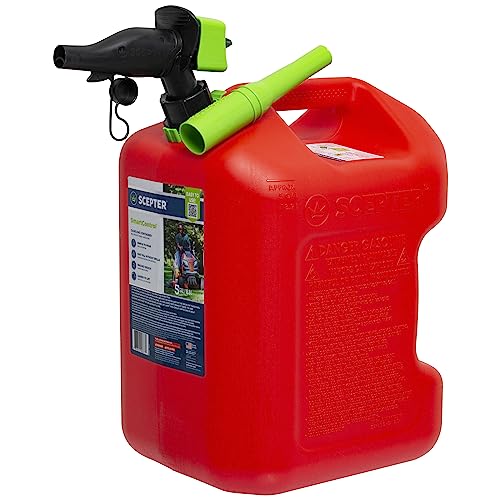
Scepter 5 Gal Gas Can
A 5-gallon can with a variable squeeze spout and a vent built into the nozzle, so it pours smoothly instead of glugging. Squeeze lightly for a trickle or hard for a fast stream, and it ships with a spout extender and a funnel that clips to a storage ring.
$41.11fromAmazonThe vent is what separates this from a cheap 5-gallon can. Air enters through the spout while fuel leaves, so you don't get the vacuum that makes an unvented can gulp, pause, then surge over the rim. Scepter rates it at up to 3 gallons per minute wide open. Owners filling small generators consistently describe the flow as controllable rather than violent, which is the practical version of that number.
Variable flow is more useful than it sounds. Topping off a trimmer needs a trickle; filling a generator tank needs everything the spout has. One valve does both, based on how hard you pull. Cans with an on-off valve force you to feather the whole pour by tilting, which is exactly when things go wrong.
The included extras aren't padding. The spout extender reaches into deep or recessed fill necks that the stock nozzle can't angle into, and the bonus funnel rides on a storage ring so it isn't lost in a drawer by spring. Small things, but they're the difference between using the can and fighting it.
This is also the easy one to live with long-term. Scepter cans are stocked widely, replacement spouts are common, and the design is well enough known that you can find a fix for most problems.
Flaws but not dealbreakers
The squeeze is real work. A full 5-gallon fill takes a minute or two of sustained hand pressure, and owners with weaker grip say the button is stiff — several wish they could lock it open like a gas pump. In cold weather, holding it while steadying a heavy can gets uncomfortable fast.
This can draws more complaints than the others we recommend, and the pattern is consistent: leaks around the spout and a button that's hard to hold while lifting. Some of that is technique, but not all of it. If a leak-free seal matters more to you than fill speed, the Eagle or the Wavian are the steadier choices.
The spout extender is a mixed blessing. It's essential for recessed necks and awkward in tight ones, so expect to swap it on and off depending on what you're fueling.
Budget pick
Enough can for a mower and a snow blower, and not a bit more
Midwest Can 2310 Safe-Flo Auto Shut Off
A 2-gallon HDPE can with a quick-flow spout that Midwest rates at 2.5 times the speed of a standard compliant nozzle, plus an auto-shutoff valve. It's light enough empty to carry with a finger and cheap enough to buy without thinking hard about it.
$24.89fromAmazonIf you fuel one mower and maybe a snow blower, this is all the can you need. Two gallons and change fills a residential push mower several times over, and the whole thing weighs almost nothing empty. You can carry it in one hand and a bag of grass seed in the other.
The auto-shutoff is the feature to care about. The valve closes when the receiving tank fills, so you're not watching the neck and guessing. That's the exact moment fuel ends up on a hot muffler, and it's the leading way a routine refuel becomes an incident. Getting that on an entry-level can is unusual.
Midwest also builds in what it calls FlameShield — an internal flame mitigation device plus a vapor-locking spout. It's not the same as a certified steel safety can with a flame arrestor, and we won't pretend otherwise. But it's meaningful passive protection on a can that costs a fraction of the Eagle.
Speed matters more than most buyers expect. The whole complaint about modern compliant spouts is that they pour too slowly to be practical, and people work around that by defeating the mechanism. A spout that actually flows is a spout people leave intact.
Flaws but not dealbreakers
The auto-shutoff mechanism is also this can's weak point. A meaningful share of owners find the resealing action fiddly or fail to get it working at all, and the one-star reviews cluster there. Read the instructions before the first fill — several owners who initially struggled say the sequence is non-obvious rather than broken.
Two gallons is limiting past a single mower. For a generator, a multi-acre property, or a fleet of equipment, you'll be making trips. Buy a 5-gallon can instead of buying two of these.
It's not an emergency-preparedness container. There's not enough capacity here to run a generator through an overnight outage without a resupply.
Upgrade pickOn sale
Steel, a flame arrestor, and a cap that closes itself
Eagle 5 Gallon Type I Red Safety
A galvanized steel Type I safety can with a non-sparking flame arrestor and a gasketed cap that self-closes when you let go. It meets OSHA 1910.106 and NFPA 30 and carries FM, UL and ULC approval — the kind of protection commercial shops are required to have.
$64.98fromAmazonList priceIf gasoline lives in your attached garage, this is the can to buy. The flame arrestor is a metal mesh that stops a flame from traveling back through the spout into the fuel, which is a live scenario around welding sparks or an engine backfire. No plastic can here replicates it. Neither does a vapor-locking spout, which is a different and lesser thing.
The self-closing cap is the feature owners underrate. A plastic can left uncapped, or capped carelessly, off-gasses flammable vapor into an enclosed space for as long as it sits there. The Eagle's cap seats itself the moment you release it — no deliberate action required, which means it happens even when you're distracted. The cap assembly also vents on its own as temperatures swing, so pressure doesn't build.
Steel is why owners keep this can. The recurring theme in their feedback is that they stopped replacing plastic cans every few years. Galvanized steel with a baked powder coat doesn't chalk in the sun or split at a seam, and the double interlock no-weld bottom seam is a genuine structural detail rather than marketing. Made in the USA, for what that's worth to you.
The included funnel attaches to the can and makes the pour into a mower tank straightforward. Combined with the fixed handle, you can carry and pour a full 5 gallons with reasonable control.
Flaws but not dealbreakers
Filling it at a pump is the common frustration. Stations with vapor-recovery nozzles don't play well with the Eagle's single opening, and owners report real difficulty getting the nozzle to seat and flow. If your local station has the accordion boot on the nozzle, expect a slow, awkward fill.
Type I means one opening for both filling and dispensing, which is less flexible than a Type II with a separate spout. Pour angles are more limited and the workflow is clumsier.
Steel is heavy. Empty, it already outweighs comparable plastic cans, and full it's a real load. And the spring-loaded closure takes hand strength — a few owners note the pour is slower than a plastic can's. You're buying this for the fire protection, not the ergonomics.
Who this is for
This guide is for anyone who keeps gasoline at home — for a mower, a snow blower, a chainsaw, a generator, an ATV. If that's you, you want a can that seats in your equipment's fill neck, pours without surging, and stops when you stop. We've weighted the picks toward that everyday workflow, and we've noted where a can is better suited to a garage full of tools or a truck bed headed to a trailhead.
We're covering portable fuel containers and the spout kits that keep them working. We aren't covering fuel transfer pumps, tank-mounted auxiliary fuel systems, siphons, or anything you'd bolt to a vehicle. We also haven't tried to rank cans by long-term durability from direct experience — for that we're leaning on what owners report after a season or two of storage, and on material behavior that's well established, like HDPE degrading under UV faster than coated steel does.
How we picked
Spout mechanism: how much hand strength and how many steps it takes to get fuel out, since that's what makes people give up on a can or break it. Compliance: EPA Phase II certification under 40 CFR Part 59, confirmed on spec sheets by CARB EO number or an explicit statement. Venting and flow: whether an integrated air vent keeps the pour smooth instead of letting the can glug and surge. Failure modes: what owners actually report going wrong — split seams, snapped vent plugs, leaking spout gaskets — and whether those complaints are annoyances or leaks. Capacity and weight: matching size to the job, and keeping a full can light enough that you can steady it over a fill neck.
Other gas cans and fuel spouts worth considering
If you want the least spill-prone way to pour 5 gallons: The SureCan 5 Gallon Type II Storage Container ($72.50) — The SureCan puts the spout at the base and rotates it downward, so the can sits flat while you dispense. Nothing tilts. That's a genuine advantage on a sloped driveway, where hoisting a full 5-gallon can at an angle is the moment things go sideways. A thumb trigger gives you flow from a trickle to a steady stream, and the self-venting design keeps it smooth throughout. Owners are enthusiastic to a degree that's rare in this category, though many of them say the same thing: it's expensive. It's also mechanically more complex than a simple valve, and the rotating spout is awkward when you're fueling something tall. SureCan backs it with a three-year limited warranty.
If your can is fine but the spout has failed: The EZ-POUR® RIGID Replacement Spout & Vent Kit ($11.95) — The EZ-POUR RIGID kit replaces a broken or clogged OEM spout on a container that's otherwise sound, and it costs a small fraction of what a replacement can does. You get a 7-inch rigid spout with a 45-degree bend, a flame arrestor, a spout cap, and — critically — a replacement push-in vent, since a dead vent is usually why an old spout became impossible to press. It fits 1-3/4-inch openings via two base caps: yellow coarse thread for Midwest, Scepter, Igloo and Eagle containers, black fine thread for Rubbermaid, Essence and Gott. Owners report the vent plug can snap after a few years, so keep the packaging. And don't use this to postpone retiring a can whose body is cracked or chalky.
The competition
This is what our research surfaced among widely available, widely reviewed cans — not a census of the market. Plenty of regional brands and hardware-store house cans never came up, and a few of the products below are perfectly good buys for a narrower job than most readers have.
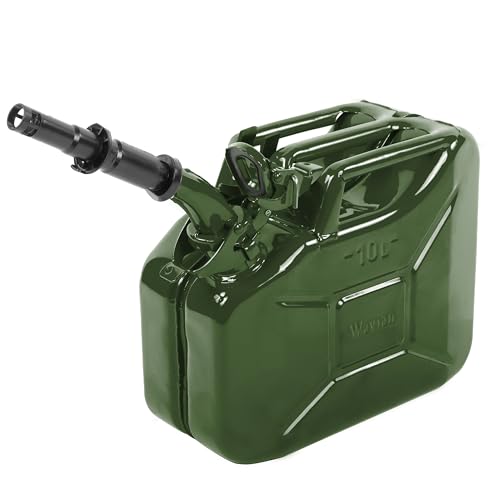
The Wavian USA Authentic NATO Jerry Can and ($129.99) — The Wavian NATO jerry can is the one to buy if fuel has to survive months on a roof rack. It's 0.9mm cold-rolled steel with an anti-corrosive coating, built to the NATO STANAG 9825 pattern, EPA and CARB compliant under EO number G-14-079B-1, and UN-certified for transporting flammable liquids. The bayonet nozzle locks with a click and won't shake loose on a washboard road. It lost to our picks on everyday practicality: this listing is the 10-liter size, so you're getting about 2.65 gallons for the price and weight of a much larger plastic can, and owners repeatedly report that the spout itself — not the can — leaks. Overlanders and preparedness buyers should still look here first.
The VP Racing Motorsport 5.5 Gallon Square Even-Density ($92.66) — The VP Racing utility jugs are three 5.5-gallon HDPE containers built for a race paddock: square, stackable two-high in a truck bed, with a close-trimmed cap and neck that seals tighter than a wide-mouth jug. That's 16.5 gallons in one purchase, more total capacity than anything else here. But they ship without a spout, so you're buying dispensing separately, and there's no flame arrestor, no safety certification and no integrated vent. Several owners report seams splitting and leaking within months. The white color also makes it hard to tell at a glance what's inside. Buy these for staging water or race fuel with a quick-disconnect system you already own — not as a household gas can.
Storage and maintenance
Treat any fuel you won't burn within two months. Untreated gasoline starts forming gum and varnish in three to six months, and those deposits clog carburetor jets and injectors — a stabilizer at the manufacturer's dosage stretches usable life to around two years. That's fuel chemistry, so it applies to steel and plastic alike. Keep plastic cans out of direct sun and don't fill them to the brim in hot weather, since heat expansion is what splits seams. Check the spout gasket once a season for swelling, softening or discoloration; E15 will attack older nitrile seals, while modern Viton-type ones handle it. And if the plastic looks chalky or bleached, retire the can — a new spout won't fix a compromised body.
Questions we get
What's the best gas can for a lawn mower?
We'd take the No-Spill 1405 for mower duty. The thumb valve cuts flow the instant you release it, which keeps fuel off a hot muffler, and the 7/8-inch spout seats in most residential fill necks without an adapter. If you'd rather have one 5-gallon can that covers the mower and everything else, get the Scepter SmartControl.
Are old-style gas cans illegal to buy now?
Retailers can't legally sell portable fuel containers made after the Phase II rules took full effect under 40 CFR Part 59 unless they comply. New cans need automatic shut-off spouts and a permeation rate below 0.3 g/m²/day. Old non-compliant stock still turns up at smaller shops and resellers as inventory clears. Look for a CARB EO number on the label if you're unsure.
What's the difference between a Type I and Type II safety can?
A Type I can, like the Eagle, has one opening for both filling and pouring — simpler, but clumsier to aim. A Type II has a separate fill opening and a flexible dispensing spout, so you get better angle control and less vapor exposure. Both need a flame arrestor to count as certified safety cans. OSHA specifies Type II in many commercial settings, but either gives a home garage real fire protection.
Why is my gas can spout so hard to push?
Some of it is by design — the pressure-relief valves, child-resistant closures and auto shut-offs required since 2009 all add stiffness. But if it used to work and has gotten progressively worse, suspect the vent. A blocked vent creates a vacuum inside the can that makes even a healthy spout nearly impossible to actuate. The EZ-POUR RIGID kit replaces both the spout and the vent, which is usually the real fix.
How long can you store gasoline in a can?
Untreated gas in a sealed container is good for roughly three to six months before oxidation byproducts start forming. A stabilizer at the recommended dose pushes that to about two years. This happens in the fuel itself, so the container material doesn't change the timeline much — though steel does lose less to evaporation over very long storage because it permeates less than HDPE.
Are metal jerry cans better than plastic for storage?
For long-term outdoor storage, yes. Coated steel shrugs off UV that embrittles and chalks HDPE, and it permeates less, so you lose less fuel to evaporation over months. The tradeoffs are weight and cost — a steel can is noticeably heavier full and costs several times what a plastic one does. For indoor storage with regular fuel rotation, a good HDPE can is completely adequate.
Can I use my gas can with E15 fuel?
Only if the gaskets are Viton or an equivalent ethanol-resistant fluoroelastomer. Cans built after roughly 2015 generally use those and handle E10 and E15 fine. Older nitrile gaskets swell and crack with E15, which creates a continuous vapor leak into whatever space the can sits in. If your can is over a decade old with no documented E15 rating, assume nitrile and replace it or the spout kit.
Why you should trust us
For this guide:
- We read manufacturer specification sheets and CARB EO listings for every can here to confirm EPA Phase II compliance rather than relying on product page claims.
- We compared spout mechanisms, venting designs and stated flow rates across the lineup, and weighed manufacturer claims against what published reviews describe.
- We read owner feedback across all eight listings looking for repeated failure modes — split seams, snapped vent plugs, leaking spout gaskets — and let those patterns shape the flaws sections.
- We read owner reviews on every listing, weighted toward the critical ones, because that is where the recurring failures show up.
- We have a systematic way of automatically fetching the latest prices, so the numbers on this page stay current.
- This is a research-focused guide, so the team may not own every product listed — though we often do own the top winners, which gives us extra context for the recommendations.
- We don't accept free products, and the retailer commission never changes which product we recommend.
Sources
Best Gas Cans of 2026 — Popular Mechanics, Popular Mechanics
Best Gas Cans Tested and Reviewed — Bob Vila, Bob Vila
Best Gas Cans for Your Garage — The Drive, The Drive
Best Gas Cans 2026 — This Old House, This Old House
EPA Portable Fuel Container Evaporative Emissions Regulations — 40 CFR Part 59, U.S. Environmental Protection Agency
Amazon product listings and owner reviews for all 8 products
Manufacturer specification pages for each product
Some passages in this guide may be paraphrased with AI help. Prices are refreshed automatically.
More like this.
Continue exploring electronics reviews and recommendations.

The Best Car Trash Cans
Trash in a car doesn't announce itself. It accumulates - a receipt in the door pocket, a coffee lid in the cup holder, three straw wrappers under the…

The Best Gas Grills for Outdoor Entertaining
A grill that's fine for two pork chops on a Tuesday falls apart when twelve people show up. You need enough grate space to get everything off at once,…

The Best Backyard Gas Grills
A gas grill earns its keep on a Tuesday, not just on the Fourth of July. You want it to light on the first try, get hot enough to sear a steak, and hold a…

The Best Gas and Charcoal Grills
Most of what a grill does is unglamorous. Burgers on a Tuesday. Chicken thighs for four people who are already hungry. Roughly two-thirds of American…

The Best Foldable Walking Canes
A cane only helps if you actually have it with you. That's the whole case for a folding one: it collapses into three or four sections, drops into a tote…

The Best Can Openers
A can opener is one of those tools you don't think about until it fails you. Then you're standing over a half-open can of tomatoes, working the wheel back…