The Best Garage Tire Inflators
Tire pressure is the one bit of car maintenance you can actually do yourself in two minutes. Tires lose roughly a pound of pressure a month, and more when the weather turns cold. Drive on soft tires and you burn extra gas, wear out the edges of the tread early, and build up heat on the highway. A gas station pump works, but it's usually broken, usually inaccurate, and it means driving on the underinflated tire to get there. A tool in your garage removes every excuse.
Here's the honest part: no single machine does all of this well. Cordless inflators are light and go anywhere, but they get hot and slow down when you ask them to fill a big truck tire from flat. Tank compressors fill fast and run air tools, but they're heavy, they need a wall outlet, and most of them are loud enough to wake the house. Anything that clamps to your battery needs the engine running. You're picking which compromise you can live with, not finding a tool without one.
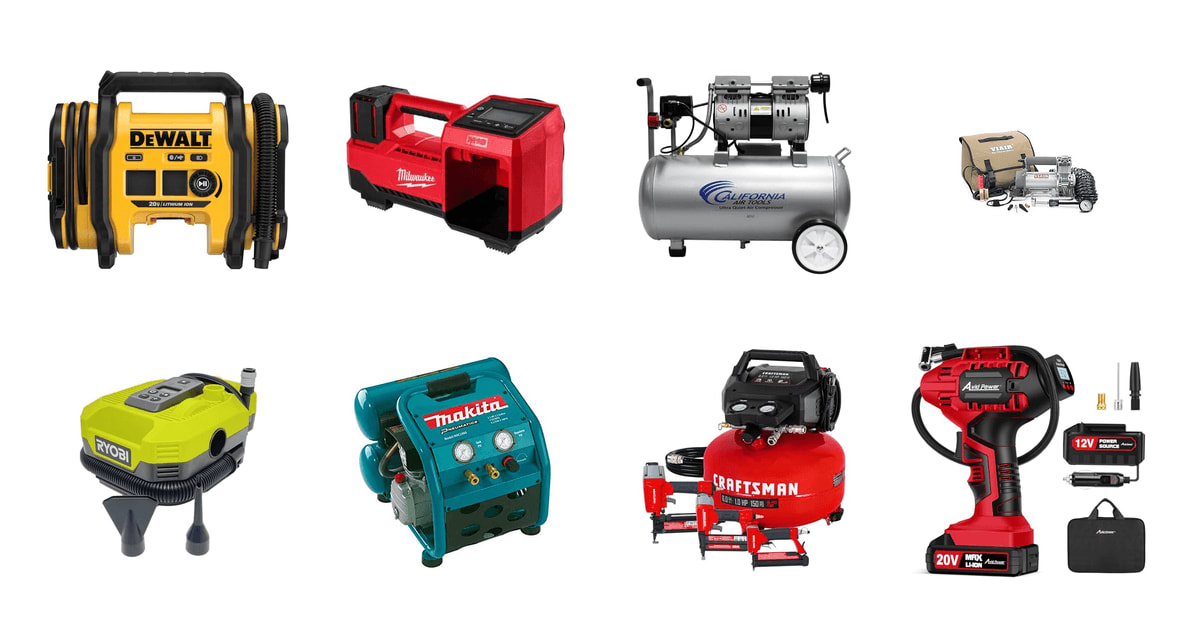
We looked at cordless inflators, a battery-clamp compressor for oversized tires, and tank compressors that double as shop air. We think that the DEWALT DCC020IB is the best garage tire inflator for most people, and that the AVID POWER 20V Cordless Tire Inflator is the one to buy if you don't already own power tool batteries and want everything in the box.
Everything we recommend

Three ways to power it, and it stops when it should

Everything in the box, and no ecosystem to buy into
The fastest cordless here, if you already own M18 batteries

Quiet enough to run next to a nursery

Built for 35-inch tires and long, hot duty cycles
At a glance
| Product | Max PSI | Power Source | Price | |
|---|---|---|---|---|
| DEWALT Tire Inflator Portable Air Compressor 20VTop pick | — | 20V/12V/110V AC | $139.99On sale |
| Milwaukee M18 Inflator 2848-20Also great | — | 18V Cordless | $184.99 |
| California Air Tools 8010 1.0 HP UltraUpgrade pick | 120 PSI | — | $197.99 |
| VIAIR 400P - 40043 Portable Compressor Kit.Also great | 150 PSI | 12V | $226.46 |
 | Ryobi 18V ONE+ DUAL FUNCTION DIGITAL Inflator/DeflatorAlso consider | — | 18V | $65.66On sale |
 | Makita MAC2400 2.5 HP* Big Bore™ AirAlso in lineup | — | — | $389 |
 | Craftsman 6-Gallon Pancake Air Compressor 4-Tool ComboAlso in lineup | 150 PSI | — | $260.80 |
| AVID POWER Tire Inflator Portable Air CompressorBudget pick | — | 20V/12V | $54.99On sale |
How we picked
Auto-shutoff accuracy. We compared published shutoff tolerances, which run from ±1 PSI on the DEWALT and Milwaukee to ±2 PSI on the AVID POWER. Anything without a preset shutoff was out, because manual monitoring is how tires end up 5 PSI over.
Power flexibility. We favored inflators that keep working when a battery dies. Spec sheets told us which models offer 12V DC or AC fallback, and owner feedback told us how often that fallback actually gets used.
Pressure and tire size. Every product here reaches at least 120 PSI, and most hit 150. We checked manufacturer duty-cycle ratings to see which ones can sustain that pressure long enough for a light truck or RV tire rather than just reaching it on paper.
Noise. Published decibel figures separate these sharply — 60 dB for the California Air Tools versus 85 to 90 for a typical pancake unit. Owner reports of attached-garage and indoor use confirmed the gap is as dramatic as the numbers suggest.
What's in the box. We read listings closely for what ships and what doesn't, since tool-only pricing hides a real cost. We also looked for Presta adapters, needles, and hose length, because missing adapters are a common source of owner frustration.
Top pickOn sale
Three ways to power it, and it stops when it should
DEWALT Tire Inflator Portable Air Compressor 20V
A cordless inflator that also runs off your car's 12V outlet or a wall socket, so a dead battery never strands you. Set your target pressure, hit go, and it shuts off on its own while you do something else.
$139.99fromAmazonList priceThe three power modes are the whole argument. Most cordless inflators give you one option, and when the battery's flat you're out of luck. This one takes a 20V MAX battery, a 12V DC cord from your car outlet, or 110V AC from the wall. That means it lives in the garage on wall power, rides in the trunk on battery, and still works in a parking lot at midnight when the battery died two weeks ago and you forgot.
Set the pressure you want, squeeze the trigger, and walk away. The digital readout works in single-PSI steps and the high-pressure mode cuts off at your number instead of blowing past it. Owners who came from cheap glovebox pumps consistently say the same thing — the set-and-forget part is what they actually notice, more than the speed. You're not standing there squinting at a needle gauge.
Small details add up here. Heavy rubber feet keep it from crawling across a smooth garage floor while it runs, which sounds trivial until you've chased one under a car. There's an LED light on the front, genuinely useful at 6 a.m. before work. And the onboard storage means the needle and nozzle adapters are still attached the next time you need them, instead of lost in a drawer.
It's not just for tires. There's a separate high-volume mode for low-pressure stuff — air mattresses, pool rafts, a paddleboard. Owners bring this up a lot, and it's the thing that gets the inflator out of the garage and into the back of the car for a weekend. A small pancake compressor can't do this without the right adapter, and most pocket inflators can't do it at all.
Flaws but not dealbreakers
It's sold tool-only, so the price on the listing isn't what you'll actually spend unless you already own DEWALT 20V MAX batteries. Adding a battery and charger roughly changes the math, and at that point a complete kit from another brand starts looking reasonable. If you own the batteries already, ignore this entirely — it's the best deal on the page.
It's slower than you'd hope on a genuinely flat tire. Topping off from 28 to 35 PSI takes a couple of minutes and feels quick. Filling a tire that's on the rim takes noticeably longer, and several owners flag that specifically. Running it off the 12V car outlet instead of the battery makes it slower still. It's also on the heavier side for something you carry, at a little over six pounds.
DEWALT lists a three-year limited warranty on the DCC020IB.
Budget pickOn sale
Everything in the box, and no ecosystem to buy into
AVID POWER Tire Inflator Portable Air Compressor
This one arrives with its own 20V battery and a 12V car adapter, so there's nothing else to order. It's accurate enough for car and motorcycle tires, and it costs a fraction of what the name-brand tool-only inflators do once you add a battery.
$54.99fromAmazonList priceIf you don't own power tools, this is the one that makes sense. The DEWALT and the Milwaukee both assume you already have their batteries. This one doesn't assume anything — battery, charger, and a 12V car adapter are all included. For a two-car household that just wants to stop visiting gas station pumps, that's the entire decision right there.
It's quick enough for the job it's meant for. The specs put a standard 195/60 R14 tire from flat to 36 PSI in under three minutes, and a larger 215/60 R16 in under five. One full charge covers roughly four small tires or three midsize ones from flat, which is more than you'll ever need for a monthly top-off. Owners who switched from tiny glovebox pumps describe the difference as dramatic.
The display reads in PSI, BAR, KPA, and KG/CM, which matters more than it sounds if you own a European motorcycle or a bike with pressures printed in bar. There's an anti-glare screen and an LED light, and the rubberized handle means you can hold it against a valve stem without your hand cramping. Auto-shutoff works the same way as on the pricier units — set it, start it, stop watching.
The 12V adapter deserves its own mention. It's a nearly ten-foot cord that plugs into your car's outlet, so a dead battery isn't the end of the session. Autocross drivers and road-trippers in the owner feedback lean on this constantly — adjusting pressures between runs, or topping off at a rest stop with no wall outlet in sight.
Flaws but not dealbreakers
Accuracy is specified at ±2 PSI rather than the ±1 PSI the DEWALT and Milwaukee claim. For a car tire at 35 PSI that's noise. For a motorcycle or a low-pressure application where two pounds is a real percentage of the target, verify with a separate gauge afterward.
The battery is proprietary. It doesn't fit anything else you own and nothing else you own fits it, so when it eventually stops holding a charge you're buying an AVID POWER pack rather than pulling one off the shelf. This is the trade for getting a battery included.
It's the least consistently praised of our picks. Owner feedback includes a real thread of units where the trigger or the pressure regulator started acting up after months of sitting unused. It's also explicitly not rated for high-volume items like air mattresses or rafts, and it wants a three-minute cooldown after ten to fifteen minutes of continuous running. Treat it as a tire tool and it holds up fine.
Also great
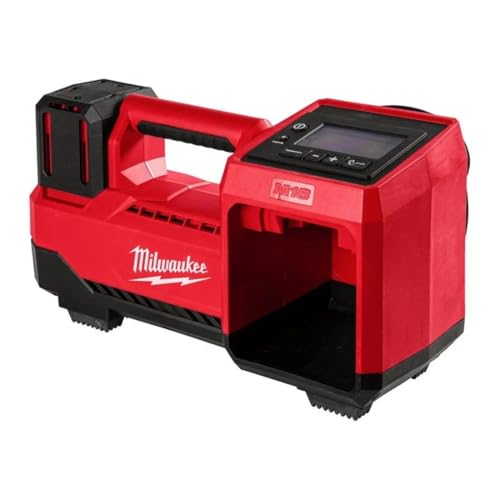
The fastest cordless here, if you already own M18 batteries
Milwaukee M18 Inflator 2848-20
Milwaukee builds this for people who fill a lot of tires and don't want to wait. It tops off a 33-inch light truck tire in under a minute, and the all-brass chuck seals better than the plastic ones on cheaper inflators.
$184.99fromAmazonSpeed is the reason to buy this one. Milwaukee rates it to top off a 33-inch light truck tire in under a minute, and it's tuned for passenger and light truck sizes in that range. If you maintain four or five vehicles, or you air down at the beach and air back up before the drive home, the minutes add up in a way they don't for someone topping off a commuter car once a month.
The all-brass Schrader chuck is a small part that changes the experience. Plastic and rubber chucks bleed air when you attach and detach, which is annoying on a tire and infuriating on a motorcycle where you're chasing a couple of pounds. This one threads on and holds. Owners who fill tires constantly — the car-guy-with-six-cars type — call the connection out specifically.
The kit includes more than most. An inflation needle, an inflator nozzle, and a Presta chuck come in the box alongside the brass Schrader, so bicycles and sports balls are covered without a separate adapter order. The digital gauge and auto-shutoff work like the DEWALT's. If you're already in the M18 system, this slots in without a second thought.
Flaws but not dealbreakers
There's no AC or 12V fallback. It runs on an M18 battery and only on an M18 battery, which is exactly why it isn't our top pick. A dead battery in a parking lot means you're calling someone. The DEWALT's car-outlet cord is the difference between an inconvenience and a problem.
It's tool-only, and it doesn't come with a bag or a charger either. Several owners mention buying the inflator and then discovering the real total once batteries and a case were added. It's also aimed at medium-duty tires — fine for light trucks, not the right tool for RV or oversized off-road work.
Upgrade pick
Quiet enough to run next to a nursery
California Air Tools 8010 1.0 HP Ultra
This eight-gallon compressor runs at 60 decibels, roughly the volume of a conversation, instead of the 85 to 90 a typical pancake unit produces. If your garage shares a wall with a bedroom, that difference is the whole product.
$197.99fromAmazonNoise is the only reason to pay this much, and it's a very good reason. A standard pancake compressor kicking on is startling — owners here describe replacing units that made them flinch every time the motor cycled. This one runs at 60 dB. That's normal conversation. If your garage is attached and someone's sleeping, working, or on a call on the other side of that wall, nothing else on this list is usable and this one is.
The eight-gallon steel tank changes how the tool feels day to day. It stores enough air to top off all four tires without the motor restarting mid-job, so most of your time with it is silent anyway. Fill time from empty is about 165 seconds, and it recovers from 90 to 120 PSI in around a minute. You're not standing around waiting between tires.
The oil-free dual-piston pump is rated past 3,000 hours before wear becomes a concern, and there's no oil to check or change. The 1.0 HP motor turns at only 1,680 RPM, which is where most of the quiet comes from — less speed, less noise, less wear. At 48 pounds with a wheel kit, one person can move it across a garage, which is not true of most tanks this size.
It also does more than tires. At 3.10 CFM at 40 PSI and 2.20 at 90, it'll run a brad nailer or a blowgun for indoor work. Owners doing remodels inside occupied houses are a recurring theme in the feedback, and that's the use case where a quiet compressor stops being a nice-to-have.
Flaws but not dealbreakers
It plugs into a wall and that's it. No battery, no car outlet, no roadside anything. If your tire goes soft in a parking lot this tool is at home and useless to you.
It's big and it's expensive for something you might only use on tires. It costs more than a good cordless inflator while doing less of what an inflator does. And a few owners note it's top-heavy — worth a thought if you're rolling it over a threshold or loading it into a truck. The cooling fins also get hot enough to matter, so keep hands off after a long run.
Also great
Built for 35-inch tires and long, hot duty cycles
VIAIR 400P - 40043 Portable Compressor Kit.
This clamps to your battery and fills oversized truck, Jeep, and RV tires at 150 PSI without quitting. The 25-foot hose reaches all four corners of a big vehicle, which cordless inflators can't do.
$226.46fromAmazonIf you air down for trails or beach driving, this is the category the cordless units simply don't cover. Filling four 35-inch tires back to street pressure is a sustained job, and it's exactly what overheats a battery inflator. The 400P is a direct-drive compressor with a thermal overload protector and a 40-amp inline fuse, built to run hot and keep going. Owners airing up from 30 back to 65 PSI report roughly four minutes a tire, all four in a row, no cooldown.
The 25-foot hose is the underrated part. It reaches every wheel on a full-size truck or an RV from one parking spot, with an inline 100 PSI gauge and a 5-in-1 fitting that deflates as well as it inflates. An eight-foot power cord gives you room from the battery. Three inflation tips and a Presta adapter come in the dual-compartment bag, so bikes and sports gear are covered too.
Duty cycle is the spec that actually matters for this kind of work: 33 percent at 100 PSI, 2.3 CFM free flow, 150 PSI maximum working pressure. In practice that's about a 20-minute run per hour. RV owners in the feedback fill to 80 PSI without drama. It's a specialist tool and it's honest about being one.
Flaws but not dealbreakers
It needs your engine running and battery clamps attached, which is a real setup ritual compared to grabbing a cordless unit. And the clamp leads are on the short side — an RV owner with a 32-footer noted struggling to reach the rear tires.
There's no digital auto-shutoff. You watch the analog inline gauge and turn it off yourself. For airing up after a trail run that's fine, but it's a step backward from every cordless pick here for routine monthly top-offs. It also runs genuinely hot to the touch after a long fill — normal for this design, but worth knowing before you grab it.
Who this is for
Buy one of these if you check your tire pressure more than a couple of times a year, or if you'd like to and don't because the gas station pump is a hassle. That covers most drivers. It especially covers anyone with a second car that sits, a camper or trailer that loses pressure between trips, a motorcycle, or kids' bikes that always need air. If you own power tools already, buy the inflator that takes the batteries you have — the ecosystem match matters more than any spec difference between these models.
You can skip this if you drive a lease you'll hand back in a year and a shop handles your service, or if you already own a shop compressor with a hose that reaches the driveway. This guide covers garage-and-driveway inflators and small compressors that handle tires well. It doesn't cover permanently mounted onboard air systems, big stationary two-stage compressors, or the tiny phone-sized pumps that live in a glovebox — those are a different purchase with different tradeoffs.
How we picked
We built the shortlist around five things. Auto-shutoff: the inflator has to stop at your target on its own, within a pound or two, because over-inflation is the failure mode that quietly costs you a set of tires. Power flexibility: a battery-only tool is one dead pack away from useless, so we gave real weight to 12V and AC fallback. Pressure and duty cycle: reaching 150 PSI on a spec sheet is easy, sustaining it long enough to fill a 35-inch tire is not, and we separated the two. Noise: for an attached garage, the gap between 60 dB and 90 dB decides whether you can use the tool at all. What ships in the box: tool-only pricing and missing valve adapters are the two things owners complain about most after delivery.
Other garage tire inflators worth considering
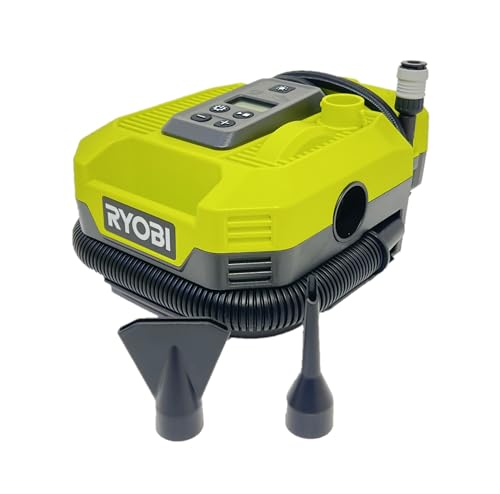
If you already own Ryobi ONE+ batteries: The Ryobi 18V ONE+ DUAL FUNCTION DIGITAL Inflator/Deflator ($65.66) — This is the obvious add-on rather than a reason to switch platforms. It does the important things — digital gauge, hands-free auto-shutoff, and a deflate function the DEWALT and Milwaukee don't match in the same package — and it weighs under three pounds, so it disappears into a trunk. It's slower than the Milwaukee and there's no AC or 12V backup. Owner feedback is mostly warm but not spotless: a few report the valve connector being fussy to lock on, and one earlier unit burning out after a couple of years. For monthly top-offs from a battery you already own, that's an easy trade.
The competition
These are the products our research surfaced across cordless inflators and small compressors, not a survey of everything sold. A few here are good tools that lose to a pick on fit rather than quality — a compressor that's excellent at running nailers is still the wrong answer if all you want is 35 PSI in four tires.
The Makita MAC2400 2.5 HP* Big Bore™ Air ($389) — The Makita MAC2400 is the most capable machine on this list and the least sensible one to buy for tires. Its cast-iron Big Bore pump puts out 4.2 CFM at 90 PSI, well ahead of everything else here, and the four-pole motor runs slower and quieter than the pancake units it competes with. Owners running impact guns, air hammers, and roofing staplers daily describe it lasting years. But it's corded, heavy, and priced as a shop investment. If you run air tools regularly it's a genuinely great buy; if you want to fill tires, you're paying for capability you'll never touch.
The Craftsman 6-Gallon Pancake Air Compressor 4-Tool Combo ($260.80) — The CRAFTSMAN 6-gallon pancake kit is really a nailer purchase with a compressor attached. You get a 16-gauge finish nailer, an 18-gauge brad nailer, a 23-gauge pin nailer, and a 25-foot hose, which is a sensible starter set for trim and cabinetry. The compressor itself reaches 150 PSI with 2.6 SCFM at 90 and has dual couplers for running two tools at once. It'll fill tires fine. But at 30.8 pounds it's corded and stationary, it's loud in the usual pancake way, and owner feedback includes reports of one of the bundled nailers arriving faulty. Buy it if you actually want the nailers.
Getting the pressure right
Check the sticker in your driver's door jamb, not the number molded into the tire sidewall. The sidewall figure is the tire's maximum limit, not what your car wants — most passenger cars run 32 to 35 PSI, light trucks 60 to 80, and trailers or RVs can ask for 90 or more. Check when the tires are cold, before you've driven on them, since a few miles of highway will add several pounds and give you a false reading. Expect to lose about a pound a month, plus another pound for every 10-degree drop in temperature, which is why everything looks low the first cold morning of fall. And let cordless inflators rest between tires on a hot day — most want a few minutes off after ten or fifteen minutes of continuous running.
Questions we get
What's the difference between a tire inflator and an air compressor?
An inflator is a tankless pump built to push air directly into a tire at a set pressure. A compressor stores air in a tank and can run nailers, spray guns, and impact wrenches as well as fill tires. The DEWALT, Milwaukee, Ryobi, and AVID POWER units here are inflators; the California Air Tools, Makita, and CRAFTSMAN are compressors that happen to fill tires.
How long does it take to fill a completely flat car tire?
Longer than you'd think. Cordless inflators are specified around three minutes for a small passenger tire from flat and closer to five for a midsize one, and the Milwaukee tops off a 33-inch light truck tire in under a minute. Topping off from 28 to 35 PSI is much quicker than starting from empty. For oversized truck or RV tires from a low start, the VIAIR is the tool designed for it.
Are cordless inflators accurate enough, or do I need a corded model?
Cordless is fine. The DEWALT and Milwaukee both specify ±1 PSI at shutoff, which matches or beats most consumer digital gauges. The AVID POWER specifies ±2 PSI, which is irrelevant for a car tire and worth double-checking on a motorcycle. If you're setting pressures for track use, verify with a separate gauge after.
What's the quietest option for an attached garage?
The California Air Tools 8010, by a wide margin. It's rated at 60 dB, about the level of a normal conversation, where a typical pancake compressor runs 85 to 90 — which sounds roughly four times louder to your ear. If your garage shares a wall with a bedroom or a home office, that's the deciding spec.
Can one inflator handle tires, bikes, and sports balls?
Mostly yes. Most of these ship with a Presta adapter for bicycles and a needle for balls, and the VIAIR and AVID POWER include the widest accessory sets. The catch is low-pressure control — sports balls want 6 to 10 PSI and pool toys even less, so an inflator with ±2 PSI accuracy is imprecise at that end. Check whether high-volume items like air mattresses are supported, because some inflators explicitly aren't rated for them.
DEWALT or Milwaukee?
Buy whichever matches the batteries you already own. If you own neither, the DEWALT is the better tool because its 12V and AC power options work when the battery doesn't. If you own M18 packs and regularly fill 33-inch truck tires, the Milwaukee's speed advantage is real and worth having.
Why you should trust us
For this guide:
- We read manufacturer spec sheets for every model here, comparing shutoff tolerance, maximum pressure, airflow, duty cycle, and published noise ratings.
- We compared published reviews and owner feedback across all eight products, looking for failure modes that come up repeatedly rather than one-off complaints.
- We weighed what actually ships in each box against tool-only pricing, since battery and adapter costs change which product makes sense for a given buyer.
- We read owner reviews on every listing, weighted toward the critical ones, because that is where the recurring failures show up.
- We have a systematic way of automatically fetching the latest prices, so the numbers on this page stay current.
- This is a research-focused guide, so the team may not own every product listed — though we often do own the top winners, which gives us extra context for the recommendations.
- We don't accept free products, and the retailer commission never changes which product we recommend.
Sources
Best Tire Inflators 2026 — Popular Mechanics (hands-on tested), Popular Mechanics
Best Tire Inflators — Car and Driver, Car and Driver
Best Air Compressors Rated & Reviewed — Consumer Reports, Consumer Reports
Best Portable Air Compressors — The Drive, The Drive
Best Tire Inflators for 2026 — Bob Vila, Bob Vila
Amazon product listings and owner reviews for all 8 products
Manufacturer specification pages for each product
Some passages in this guide may be paraphrased with AI help. Prices are refreshed automatically.
More like this.
Continue exploring lifestyle reviews and recommendations.

The Best Portable Tire Inflators
Tire pressure is one of those things you ignore until it costs you. A tire that's five pounds low wears out faster, hurts your mileage, and handles worse…

The Best Tire Chains and Snow Traction Cables
Chains live in your trunk for years and matter for about twenty minutes. But those twenty minutes tend to happen on a dark shoulder, in falling snow, with…

The Best Tire Pressure Monitoring Systems
Your tires are losing air right now. Nothing dramatic - just the ordinary seep of one to two pounds a month, according to the Tire Industry Association,…

The Best Tire Tread Depth Gauges
Tread depth is the one safety check on your car that costs almost nothing to make and almost nothing to fix - if you catch it early. Worn tread doesn't…

The Best Tire Pressure Gauges
Air leaks out of tires slowly, and you can't see it happening. A tire can look completely normal and still be several pounds low. That's a mileage…

The Best Garage Ceiling Storage Racks
Garage floors fill up in a way that sneaks up on you. A cooler here, a bin of holiday lights there, and one day the second car doesn't fit. Ceiling…